Home Blog Page 154

How AurumXchange’s Unlicensed Operations Funneled Millions from Silk Road: A Case of Crypto, Crime, and Evasion

AurumXchange Silk Road case: DOJ accuses Maximiliano Pilipis of laundering millions via unlicensed crypto operations, raising regulatory concerns.

Maximiliano Pilipis, the operator of the crypto exchange AurumXchange, is now at the center of a federal indictment for allegedly laundering millions linked to the Silk Road, the infamous darknet marketplace. The U.S. Department of Justice (DOJ) alleges that AurumXchange facilitated unregulated transactions worth over $30 million, including significant sums associated with Silk Road accounts. By bypassing critical regulatory steps such as registration, Know Your Customer (KYC) protocols and Anti-Money Laundering (AML) requirements, Pilipis is said to have leveraged AurumXchange’s operations to move funds through one of the most controversial platforms in crypto history. This case highlights cryptocurrency’s darker uses, particularly in anonymous markets. It raises critical questions about crypto’s potential as both a means for financial freedom and a target for illicit exploitation.

Silk Road’s Shadow in Crypto’s History

The Silk Road, launched in 2011 by Ross Ulbricht (alias “Dread Pirate Roberts”), operated on the Tor network to enable anonymous transactions outside the traditional financial system. It became a notorious hub for drug trafficking, among other illicit trades. The FBI shut it down in 2013. Silk Road became emblematic of the regulatory challenges surrounding cryptocurrency. It sparked concern over crypto’s pseudo-anonymous capabilities for masking illegal activities.

According to the DOJ, AurumXchange handled approximately 100,000 unregistered transactions, amassing 10,000 Bitcoin from accounts linked to Silk Road. At the time they were worth about $1.2 million. The DOJ alleges that Pilipis collected millions in fees without registering with the U.S. Treasury or complying with federal requirements, particularly those related to AML and KYC. These protocols are crucial for regulated crypto exchanges to curb illegal transactions. They ensure that user identities are verified and funds can be tracked.

The Role of Regulatory Gaps in Facilitating Illicit Finance

AurumXchange’s operations, as outlined in DOJ reports, underscore how the crypto sector’s regulatory gaps can enable bad actors to exploit digital assets for criminal purposes. Unregistered exchanges like AurumXchange, which allegedly operated from 2009 to 2013 without any federal oversight, present a significant regulatory challenge. By sidestepping KYC and AML, AurumXchange purportedly allowed users to transact anonymously, enabling money laundering and other financial crimes without the barriers typically in place for regulated financial institutions.

This indictment points to a broader concern among regulators about the misuse of cryptocurrency exchanges. Zachary A. Myers, U.S. Attorney for the Southern District of Indiana, stated that combatting the criminal misuse of cryptocurrencies is a “critical priority” for the DOJ. That reflects the department’s commitment to pursuing cases against those exploiting crypto assets to fuel illegal activity.

A Test of Cryptocurrency’s Dual Nature: Privacy vs. Regulation

The AurumXchange case highlights the fine line crypto exchanges walk between facilitating privacy for legitimate users and preventing misuse for criminal gain. The promise of crypto as a decentralized financial tool remains appealing to users valuing privacy and autonomy. However, unregulated platforms have, in some cases, turned into havens for criminal activities. While certain levels of anonymity are key to crypto’s appeal, they also pose challenges for law enforcement trying to prevent money laundering, terrorist financing, and other illicit activities.

For crypto enthusiasts and policymakers alike, this case rekindles debates over the ideal balance between regulatory oversight and financial freedom. Cryptocurrency’s decentralized structure offers many advantages. Yet, as the AurumXchange case illustrates, there is potential for misuse when exchanges operate outside regulatory boundaries.

The Road Ahead: Tightening the Regulatory Net

Pilipis’ charges underscore the DOJ’s commitment to tightening oversight on cryptocurrency exchanges that facilitate illegal transactions. By setting a precedent with AurumXchange, regulators may push for stricter KYC and AML requirements across all exchanges, licensed or otherwise, to close the gaps that currently allow certain platforms to operate without oversight. If convicted, Pilipis could face up to 10 years in prison and significant fines, further emphasizing the DOJ’s intent to address financial misconduct in the crypto space and dissuade others from bypassing federal regulations.

In summary, AurumXchange’s operations and subsequent legal consequences reinforce the urgent need for balanced crypto regulations. While crypto’s anonymity and accessibility remain its defining strengths, this case reflects an industry still in the process of defining its boundaries and responsibilities. As digital assets continue to mature, finding that middle ground will be key in ensuring cryptocurrency’s growth as a trusted, secure financial tool – one that prevents crime without compromising on innovation and freedom.

Readers’ frequently asked questions

How do regulators ensure crypto exchanges comply with AML and KYC protocols, and why were these requirements allegedly bypassed by AurumXchange?

Regulators, particularly in the U.S., enforce Anti-Money Laundering (AML) and Know Your Customer (KYC) protocols by requiring crypto exchanges to verify user identities and report suspicious transactions, following a structure similar to traditional financial institutions. Exchanges must register with the U.S. Treasury and submit activity reports, which aid authorities in tracking and flagging potentially illicit funds. AurumXchange allegedly bypassed these requirements by failing to register with federal authorities, allowing it to operate in an unregulated manner. Without registration, AurumXchange didn’t need to implement KYC checks, thus enabling transactions that could move funds from illicit sources without scrutiny. This lack of oversight is what the DOJ claims allowed AurumXchange to launder millions linked to Silk Road.

Why is cryptocurrency perceived as a tool for illicit finance, and how has this perception affected regulatory measures?

Cryptocurrency’s pseudo-anonymity and decentralized structure make it appealing for private transactions. However, these same traits have attracted bad actors who exploit its potential for obfuscating financial trails, as seen with cases like Silk Road and, more recently, AurumXchange. Because transactions can be made without clear identities, it’s difficult for regulators to monitor funds connected to illegal activities. As a result, this perception has intensified calls for tighter regulations on crypto exchanges, especially concerning AML and KYC compliance. The DOJ’s focus on cases like AurumXchange underscores a growing regulatory trend to prevent crypto misuse while ensuring it remains accessible for lawful users. The challenge is striking a balance between preserving cryptocurrency’s privacy advantages and reducing its appeal for illicit finance.

How could stricter regulations impact cryptocurrency’s role in financial freedom and privacy for legitimate users?

While stricter regulations aim to prevent illegal activities, they also risk encroaching on the financial privacy that draws many users to crypto. Regulations like mandatory KYC processes on all exchanges could potentially reduce anonymity, making it harder for crypto users to protect their identities. However, some in the crypto community see this as a necessary compromise to ensure the industry’s legitimacy and broader acceptance in the global financial system. As governments push for more oversight, the industry faces a pivotal moment. It may need to adapt by creating privacy-preserving technologies that meet compliance standards while also safeguarding user autonomy.

What Is In It For You? Action Items You Might Want to Consider

Review Exchange Compliance Standards Carefully

As crypto regulations tighten, especially around Anti-Money Laundering (AML) and Know Your Customer (KYC) policies, make it a priority to review the compliance standards of any exchange you use. This not only helps protect your assets but also ensures your trading aligns with regulatory shifts. Even if certain platforms allow for high privacy levels, it’s essential to confirm they adhere to mandatory federal and international guidelines to prevent potential disruptions to your funds.

Prepare for Enhanced KYC Measures

Expect stricter KYC verification processes on many platforms in the near future as regulatory bodies push for comprehensive compliance. Take proactive steps by preparing any documentation required to meet these enhanced standards, as more exchanges may soon require thorough identity verification. Ensuring your documents are updated can streamline the onboarding process for new exchanges or the re-verification processes on existing ones.

Stay Informed on Regulatory Updates

With cases like AurumXchange highlighting the regulatory focus on unlicensed operations, staying informed on evolving crypto regulations is more important than ever. Subscribe to reliable sources on crypto law updates and monitor any major changes in your jurisdiction that may affect exchange compliance requirements. This awareness can help you anticipate shifts in trading conditions. It will allow you to react quickly, whether by adjusting trading strategies or switching to compliant exchanges.


Celestia Unlocks $1.1B in TIA Tokens: Paving the Way for a New Wave in Modular Blockchain Development?

Celestia Unlock releases 176M TIA tokens

Today, October 30, 2024, marks a transformative day for Celestia. The modular blockchain network unlocks 176 million TIA tokens, valued at $1.1 billion. The release is expected to expand TIA’s circulating supply by 80%, potentially impacting its market price while spotlighting Celestia’s pioneering role in modular blockchain architecture. As modular blockchain networks like Celestia gain attention for their unique approach to scalability and decentralization, this token unlock offers a deeper look into how TIA’s increased availability may shape the project’s future and support ecosystem development.

Celestia stands apart from traditional blockchains by offering a data availability (DA) layer rather than a full-service blockchain. This design allows other blockchains or rollups – secondary layers handling transactions off the main chain – to leverage Celestia’s network for secure data publication and retrieval. This separation of data and transaction processing enables applications and Layer-2 (L2) rollups to function independently while still securing their data on Celestia’s DA layer. As more projects turn to modular frameworks for scalability, today’s TIA unlock could help fuel the growth of projects utilizing Celestia’s infrastructure.

Early Adopters and Ecosystem Expansion

Several prominent projects, such as Dymension and Hyperlane, are already building on Celestia’s modular blockchain architecture. Dymension leverages Celestia’s DA layer to enhance its RollApps. These modular blockchain solutions allow users to deploy applications with efficient resource usage and optimized security. Hyperlane, meanwhile, focuses on decentralized content delivery by integrating Celestia to ensure secure and censorship-resistant data dissemination. By enabling projects to build custom Layer-2 and Layer-3 chains, Celestia provides developers with a more flexible approach to blockchain design. It attracts applications in decentralized finance (DeFi), gaming, and cross-chain communication.

With today’s influx of tokens, the project aims to increase its appeal to developers and attract new projects looking to benefit from its unique DA-focused infrastructure. The TIA token, which plays a role in network security and transaction validation, is anticipated to gain further utility as more applications integrate with Celestia.

Price Impact and Market Sentiment

While today’s unlock opens up new possibilities for ecosystem expansion, it may also create short-term selling pressure for Celestia. Many of these tokens were allocated to early investors and team members. Market analysts suggest that some holders could choose to liquidate their assets, potentially influencing TIA’s price. Historically, large token unlocks can lead to price volatility, as seen with similar events in other blockchain projects.

However, proponents argue that the Celestia unlock could also broaden liquidity, attracting a wider base of investors. A positive long-term outlook may hinge on whether the token release strengthens Celestia’s ecosystem by providing developers with a well-funded environment to build modular applications. If these tokens are used to support the project’s growth rather than flood the market, the unlock could ultimately bolster TIA’s standing in the market.

Looking Ahead: Modular Blockchain’s Role in Web3

Today’s unlock highlights Celestia’s potential as a game-changer in modular blockchain architecture. This is especially relevant as Web3 and decentralized applications (dApps) seek scalable solutions to meet increasing demand. By offering a secure and reliable data layer, Celestia empowers developers to focus on specific functionalities, such as transaction processing or custom application logic, while leaving data availability to Celestia. The approach appeals to projects like Axelar. It uses Celestia to enable cross-chain interoperability, allowing digital assets to move seamlessly across blockchains.

As modular blockchain technology continues to mature, Celestia’s ability to drive innovation within its ecosystem is likely to set a precedent for future blockchain design. The TIA token’s broader distribution is expected to further stimulate Celestia’s role in the evolving blockchain landscape. It could support projects that prioritize scalability and decentralization without sacrificing data integrity.

Today’s historic TIA unlock serves as both a test and an opportunity. For Celestia, this unlock is a step toward establishing itself as a leading data availability layer for the blockchain industry. It provides developers with essential tools to build the next generation of modular applications aimed at defining the future of Web3.

Readers’ frequently asked questions

How does Celestia’s modular approach differ from traditional blockchains, and why does this matter?

Celestia’s modular design separates data availability from transaction execution, addressing some core limitations of traditional monolithic blockchains like Ethereum. In traditional blockchains, data and transaction processing are closely linked. This can lead to bottlenecks as every node must store the entire history of transactions to validate new data. Celestia, on the other hand, provides a data availability (DA) layer that allows other blockchain applications and rollups to use Celestia solely for publishing and verifying data. They handle transactions independently. This setup enables developers to build more scalable solutions. They can focus on specific functionalities like security or application logic without being constrained by the storage needs of an entire blockchain. This division also supports interoperability, making it easier for applications on different blockchains to work together effectively.

What potential impact could the TIA token unlock have on the development of the Celestia ecosystem?

The release of 176 million TIA tokens increases Celestia’s circulating supply by 80%. This may provide greater liquidity and attract more developers and projects to build within the ecosystem. The influx of tokens is likely to make TIA more accessible for staking, which secures the network and can support decentralized governance initiatives within the ecosystem. With the increase in TIA token availability, developers using Celestia’s DA layer for applications may find it easier to integrate and experiment with TIA-powered solutions, from governance mechanisms to transaction validations. Furthermore, the unlock could incentivize ecosystem growth. If the tokens are retained and reinvested by holders into Celestia aligned projects, they can create an ecosystem-wide support structure for projects like Dymension, Hyperlane, and Axelar. These projects benefit from modular DA infrastructure and are crucial in demonstrating Celestia’s potential within DeFi, gaming, and cross-chain interoperability

Why are other blockchain projects integrating Celestia, and how does this impact the broader blockchain ecosystem?

Projects like Dymension, Manta Network, and Hyperlane are turning to Celestia’s DA layer because it simplifies the task of deploying scalable applications. By relying on Celestia for data availability, these projects can focus on unique functionalities such as privacy-preserving transactions, cross-chain interoperability, and efficient gaming experiences. Celestia’s DA layer allows these projects to scale efficiently without needing to invest in heavy infrastructure. They offload data availability onto Celestia. This modular approach facilitates interoperability across blockchains, making it easier for applications to communicate and share data across different platforms. For example, Axelar uses Celestia’s DA to connect disparate networks, effectively fostering a more interconnected ecosystem. This modular design encourages innovation as it reduces entry barriers for developers. This could accelerate the growth of decentralized finance (DeFi), gaming, and data-sharing applications across the blockchain ecosystem

What Is In It For You? Action Items You Might Want to Consider

Monitor TIA’s Price for Short-Term Volatility and Liquidity Opportunities

With the recent token unlock increasing TIA’s circulating supply by 80%, there’s a strong chance of initial selling pressure. Early Celestia investors and team members might cash out. Watching price action over the next few days could reveal entry points, as volatility might create short-term dips. Consider setting alerts for TIA price movements and volume changes across major exchanges to capitalize on sudden fluctuations.

Evaluate Staking TIA as a Strategic Move for Long-Term Gains

The increase in TIA tokens may lead to greater staking opportunities, particularly if ecosystem growth attracts more users and developers to Celestia. For traders with a long-term outlook, staking could be a strategic move to benefit from network growth while also participating in Celestia’s governance. Look for official staking programs through trusted platforms to ensure secure participation in the network’s development.

Track Ecosystem Partnerships to Assess Project Adoption and Demand

Celestia’s integration with projects like Dymension, Hyperlane, and Axelar suggests growing adoption in decentralized finance and gaming sectors. As these projects expand, they may drive demand for TIA, especially if developers choose Celestia for data availability needs. Keep an eye on announcements from Celestia’s ecosystem partners. New integrations could positively impact TIA’s value and the broader market demand for Celestia’s services.

Global Views, Local Impacts: How Blockchain Prediction Markets Reflect the 2024 U.S. Presidential Race

Blockchain-based prediction markets go beyond mere gambling.

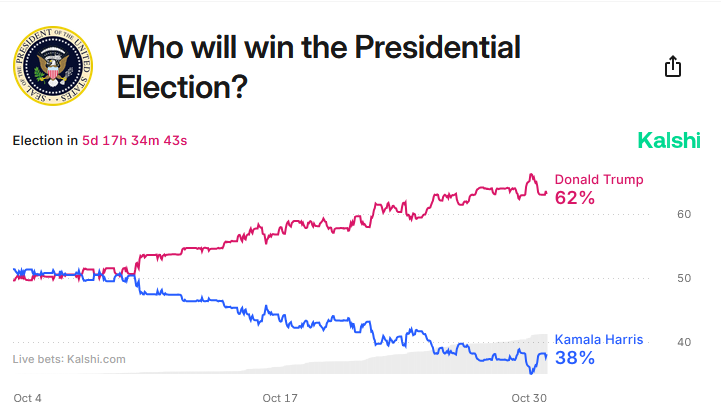
As the United States heads toward the 2024 presidential election, blockchain-powered prediction markets are capturing headlines and drawing unprecedented volumes of bets. Platforms like Polymarket, Kalshi, and now Robinhood are emerging as significant players in this space. Each is offering unique insights into election sentiment through distinct lenses. While Polymarket’s global user base fuels its predictions, Kalshi and Robinhood provide regulated platforms tailored to U.S. citizens. Together, they reveal divergent perspectives on the U.S. election outcome, shaped by the regulatory, demographic, and technological frameworks of each platform.

Polymarket: A Global Perspective on U.S. Politics

Polymarket, built on the Polygon blockchain, has become a leading prediction platform for high-stakes events, including the 2024 U.S. presidential race. The platform’s open, decentralized model allows international participants to bet on election outcomes using stablecoins like USDC. It attracts a global pool of users with varied perspectives. However, Polymarket has geo-fenced U.S.-based users to avoid regulatory conflict with the Commodity Futures Trading Commission (CFTC). That means its election predictions largely reflect the sentiment of non-U.S. participants.

This global focus has raised intriguing questions about how accurately Polymarket’s predictions capture U.S. sentiment. As reported in late October, Donald Trump recently held a 64% probability of victory on Polymarket. Some analysts suggest that international users may have different assumptions or biases about American politics. The involvement of major international “whale” bettors, such as a prominent French trader placing substantial bets on Trump, adds to speculation that non-U.S. bettors could shape these odds.

https://polymarket.com/elections

Kalshi and Robinhood: Regulated U.S.-Based Options

In contrast, Kalshi offers a legally sanctioned platform for U.S. election betting within the United States. It is one of the first prediction markets approved by the CFTC. Kalshi allows U.S.-based users to bet on the election outcome under strict regulatory compliance. Kalshi’s approval came after a prolonged legal process, culminating in an October 2024 decision by the U.S. Court of Appeals. By adhering to federal guidelines, Kalshi offers a more structured option for Americans interested in election betting without regulatory repercussions.

Robinhood recently joined Kalshi in offering election betting for U.S. citizens through Robinhood Derivatives, a CFTC-regulated entity allowing users to bet on specific event contracts. Users can bet on the Trump-Harris race by applying for an account and meeting specific criteria. This development introduces Robinhood as a mainstream alternative for American users. It enables legal betting on the 2024 election under federal oversight while competing with platforms like Kalshi to capture domestic sentiment.

https://kalshi.com/elections

The Role of Blockchain Prediction Markets in Election Forecasting

Despite their differences, all three platforms contribute to a growing trend where prediction markets are valued as tools for aggregating and analyzing public sentiment. Blockchain-based markets, in particular, bring transparency and decentralization, with each transaction recorded on a public ledger, offering a secure environment for forecasting political outcomes. These economic incentives create dynamic, market-driven probabilities that could provide a more accurate snapshot of sentiment than traditional polling alone.

However, Polymarket’s restriction on U.S. users limits its ability to reflect domestic perspectives. At the same time, Kalshi and Robinhood offer these insights tailored to U.S. audiences. This contrast underscores the influence of regulatory environments on prediction platforms’ user bases and how they shape election sentiment. As the 2024 election nears, odds on Polymarket, Kalshi, and Robinhood may continue to diverge, influenced by their respective regulatory, demographic, and technological landscapes.

Blockchain Prediction Markets: Shaping Political Expectations Beyond 2024

Looking beyond this election cycle, blockchain prediction markets are proving their potential to shift traditional approaches to political forecasting. Platforms like Polymarket, Kalshi, and Robinhood underscore the evolving relationship between finance, technology, and politics. They offer unique perspectives that challenge traditional methods. As they aggregate insights from diverse audiences, these platforms may continue to redefine how elections are interpreted, setting a new standard for political forecasting.

Readers’ frequently asked questions

How does Kalshi ensure compliance with U.S. regulations for election betting?

Kalshi operates under the regulatory oversight of the Commodity Futures Trading Commission (CFTC), which has authorized it to offer event-based contracts, including election predictions. The platform uses a fiat-based system, ensuring compliance with U.S. financial laws. These laws prohibit most election betting but allow certain structured event contracts. Kalshi’s approval was achieved through a lengthy legal process, distinguishing it from decentralized platforms that can’t meet U.S. regulatory standards.

What makes blockchain-based prediction markets more transparent than traditional betting platforms?

Blockchain prediction markets like Polymarket and Augur rely on decentralized ledgers to record every transaction transparently and immutably. This public ledger feature prevents tampering and adds a layer of security that centralized systems cannot easily match. Blockchain technology also allows anyone to observe real-time changes in market odds, fostering a sense of transparency and accountability in how predictions are formed. Additionally, using smart contracts ensures that payouts are automatically executed based on the outcome, further reducing human interference.

How does Robinhood’s prediction market differ from typical blockchain prediction markets?

Robinhood launched its prediction market under Robinhood Derivatives. It complies with CFTC regulations, offering event-based election contracts to U.S. users but it does not use blockchain technology. Instead, it operates within a centralized, regulated framework, providing a straightforward user experience, more familiar to traditional investors. Unlike Polymarket or Augur, which use cryptocurrency transactions and decentralized frameworks, Robinhood offers a more conventional model. It appeals to users seeking regulated, fiat-based access to prediction markets without the need for crypto or blockchain knowledge.

What Is In It For You? Action Items You Might Want to Consider

Explore Cross-Platform Insights

Consider following both Polymarket and Kalshi for comprehensive perspectives on the 2024 election sentiment. Polymarket’s global user base can reveal international trends, while Kalshi’s regulated, U.S.-focused environment offers insight into domestic sentiment.

Leverage Blockchain Transparency

With platforms like Polymarket, monitor real-time transaction data on the blockchain to gauge market confidence and potential trend shifts. Blockchain transparency could reveal sudden whale activity or significant odds changes.

Assess Regulatory Implications

Robinhood and Kalshi’s regulated offerings may present lower-risk alternatives for U.S. traders. For those concerned about regulatory stability, these compliant platforms could offer safer opportunities compared to decentralized prediction markets.

Stripe’s $1.1 Billion Bridge Acquisition: Paving the Way for Stablecoins in Global Payments

Stripe Acquires Bridge Stablecoin for $1.1B

In a landmark move for fintech and cryptocurrency, Stripe has acquired the stablecoin platform Bridge for $1.1 billion. This signals a strong vote of confidence in stablecoins‘ potential to revolutionize international payments. With this acquisition, Stripe not only deepens its commitment to blockchain technology. It also positions itself as a major player in the growing stablecoin market, a field traditionally dominated by crypto-native firms. For fintech industry leaders, this is a significant shift, showing how quickly stablecoins are emerging from niche applications to the mainstream financial ecosystem.

Expanding Stripe’s Vision with Stablecoins

Stripe’s purchase of Bridge follows its gradual foray into cryptocurrency. In recent years, Stripe has introduced limited stablecoin payments on its platform, incorporating Circle’s USDC for specific cross-border transactions. Now, with the acquisition of Bridge – a startup specializing in B2B stablecoin solutions – Stripe can expand these capabilities and streamline international transactions at scale. Stablecoins, digital assets pegged to fiat currencies like the U.S. dollar, allow for more stable value transfer compared to other cryptocurrencies. It makes them attractive for Stripe’s payment networks and global user base.

Founded by former Coinbase and Square executives, Bridge’s platform has gained traction by allowing businesses to create, store, send, and accept stablecoins. It became an attractive infrastructure provider for cross-border payments. Its client list includes tech and aerospace companies like SpaceX. It showcases the growing interest in stablecoin solutions for corporate treasury functions and global payment needs. With a record year of tenfold growth in stablecoin volume, Bridge presents Stripe with an established infrastructure to support a full suite of stablecoin services.

Stablecoins in Cross-Border Payments

Cross-border transactions are typically burdened by high costs and lengthy settlement times. The current international payments infrastructure – comprising SWIFT, credit networks, and various local intermediaries – remains slow and costly, especially for smaller transactions. Stablecoins provide an alternative: they facilitate near-instant settlement with low fees, making them ideal for Stripe’s global network of businesses. Stripe’s acquisition of Bridge may also help address financial inclusivity. It could make affordable cross-border payments accessible to small businesses and consumers globally.

Bridge’s stablecoin platform offers API-based solutions that allow developers to integrate stablecoins into their services. Since its API launch in early 2023, Bridge has seen interest from fintech and government sectors alike. Entities use stablecoins for transactions, remittances, and even government aid disbursements in emerging markets. Such use cases align with Stripe’s global growth goals, potentially positioning stablecoins as viable alternatives for underserved markets with high remittance needs.

Competitive Landscape and Institutional Adoption

Stripe is not alone in its pursuit of stablecoin integration. Other fintech giants have already moved into this space, signaling a broader industry shift. PayPal, for example, launched its own stablecoin in 2023, allowing users to make payments in a USD-pegged digital currency. Similarly, Robinhood’s acquisition of Bitstamp earlier in 2024 marked another traditional fintech player making strides into the digital asset market. Stripe’s acquisition, however, is one of the largest in the cryptocurrency sector. It highlights its unique commitment to scaling stablecoin solutions within traditional finance.

While many institutions are exploring stablecoins, Stripe’s acquisition of Bridge could give it a competitive edge by offering businesses direct access to stablecoin payments through an established platform. According to Stripe CEO Patrick Collison, stablecoins offer “room-temperature superconductor” efficiency in financial services, reflecting Stripe’s intent to adopt blockchain-based systems to cut costs and improve speed.

Potential Challenges: Regulation and Market Conditions

Despite its promise, the acquisition comes with challenges. Regulatory scrutiny around stablecoins remains high, especially in markets like the U.S., where stablecoin legislation is still in development. Stripe’s decision to pursue a stablecoin acquisition amid this uncertain regulatory environment is ambitious, though it may accelerate government interest in defining stablecoin guidelines.

Market timing has also influenced Stripe’s acquisition strategy. With cryptocurrency valuations and fundraising down since 2021, the deal was likely more affordable than it might have been during the industry’s peak. This environment has allowed established fintech companies to make strategic acquisitions, securing promising digital assets firms for long-term growth at more favorable valuations.

Conclusion: Stripe’s Strategic Bet on Stablecoin Integration

The acquisition of Bridge marks a bold move for Stripe. It sets itself apart from other payment processors by establishing a deeper role in the future of stablecoins. As other traditional fintech firms cautiously test the waters of digital assets, Stripe’s full acquisition reflects its belief in the transformative potential of stablecoins to simplify global payments. For both the fintech and cryptocurrency communities, Stripe’s move is a signal that stablecoins are poised for broader adoption. Traditional payment networks may soon need to integrate this new technology to keep pace.

In the long term, Stripe’s foray into stablecoins could drive the evolution of cross-border transactions, with other companies and possibly regulators following suit. As stablecoin infrastructure becomes increasingly embedded in the financial system, the Stripe-Bridge acquisition could well be remembered as a defining moment for stablecoins in the mainstream financial landscape.

Readers’ frequently asked questions

What specific benefits does Stripe expect from incorporating Bridge’s stablecoin infrastructure?

Stripe sees Bridge’s stablecoin technology as a way to improve cross-border payments by eliminating costly intermediaries. Traditional systems, like SWIFT, involve fees and delays that impact smaller transactions the most. Bridge’s stablecoin infrastructure allows Stripe to provide businesses with faster, low-cost transfers globally, which is especially beneficial in markets where traditional services are less accessible. Stablecoins’ value stability adds security to this process, making them reliable for businesses to integrate into their own operations

How does Stripe’s acquisition compare to other fintech companies’ moves into stablecoins?

Stripe’s acquisition is notable for its size and scope compared to similar fintech moves, such as PayPal’s launch of its own stablecoin and Robinhood’s acquisition of Bitstamp, which focus on integrating stablecoins or crypto trading separately. By acquiring Bridge, Stripe gains direct control over a full suite of stablecoin services that are already live, which allows it to build out new applications on a platform it owns entirely. This could position Stripe to expand stablecoin use across treasury management, cross-border finance, and even new fintech services globally​.

How might regulatory challenges impact Stripe’s ability to fully utilize Bridge’s technology?

Stripe’s ambitions for Bridge may face regulatory challenges, as global stablecoin regulation is still evolving. Stablecoins often raise concerns around financial stability and consumer protection, and some countries may impose strict controls. Stripe might need to adjust Bridge’s offerings by region, prioritizing regulatory compliance to maintain its operations worldwide. With stablecoins becoming more popular, Stripe’s close monitoring of regulatory frameworks will be crucial to achieving secure and compliant expansion into different markets

What Is In It For You? Action Items You Might Want to Consider

Keep an Eye on Stablecoin-Related Assets

With Stripe’s acquisition of Bridge, stablecoins are gaining traction as essential tools in global finance. Traders could consider monitoring stablecoin-backed assets, as Stripe’s involvement may increase adoption and stability in this sector. Watching for price changes in USDC, or projects tied to stablecoins, could provide early insights into shifts in demand or regulatory impacts

Monitor Fintech Stocks with Crypto Expansions

Stripe’s move shows that traditional fintech companies are embracing crypto infrastructure. Traders might look at stocks in companies with similar expansions, such as PayPal or Robinhood, since these firms are incorporating stablecoins or crypto trading solutions, often with positive impacts on stock performance. Keeping tabs on any updates in the stablecoin space could reveal new opportunities​.

Stay Updated on Regulatory Developments for Stablecoins

Regulatory changes could strongly influence stablecoin markets, given Stripe’s goal to use stablecoins globally. Traders should pay close attention to legislation in major markets, particularly in the U.S., EU, and Asia, which are actively shaping stablecoin rules. New regulations may affect volatility, usage, and demand for these digital assets, potentially influencing market behavior.

Bybit Settles with FTX for $228 Million in Landmark Crypto Bankruptcy Case

Bybit FTX settlement of $228M addresses VIP withdrawal claims

In a significant development within the crypto sector, Bybit has agreed to a $228 million settlement with the FTX bankruptcy estate. The settlement resolves claims that the crypto exchange and its affiliate, Mirana, engaged in preferential withdrawals shortly before FTX’s collapse. This agreement, submitted for approval to the U.S. Bankruptcy Court in Delaware, includes $175 million in digital assets and $53 million in BIT tokens. This arrangement is a critical win for FTX’s creditors. It may also become a potential model for similar disputes within the digital assets space, demonstrating how crypto companies might navigate financial and legal obligations amid heightened scrutiny.

Bybit and Mirana’s Alleged Preferential Withdrawals

The lawsuit was initially filed in late 2023, targeting Bybit and Mirana’s alleged “VIP” withdrawal privileges. FTX claimed that these firms withdrew hundreds of millions in assets in early November 2022. At this time, FTX was already grappling with liquidity issues that would soon lead to its bankruptcy filing. FTX contended that Mirana’s access to expedited withdrawals contributed to FTX’s liquidity shortfall. It disadvantaged other creditors who were left without access to their funds during the platform’s freeze on withdrawals.

FTX Bankruptcy Strategy and the Impact of Bybit Settlement

This resolution comes amid FTX’s larger effort to maximize asset recovery for its creditors, which includes complex bankruptcy proceedings overseen by John J. Ray III, the veteran restructuring expert now at the helm of FTX. Ray has prioritized securing assets and navigating legal avenues to retrieve funds. He sought settlements and recoveries across multiple entities and individuals connected to FTX’s collapse. Bybit’s agreement provides a “net savings” for the estate. It reflects FTX’s strategy of minimizing prolonged litigation in favor of direct financial recovery.

Regulatory Implications of Bybit’s Settlement

The settlement holds broader implications for crypto regulation and legal standards in financial insolvency cases. Bybit’s willingness to settle highlights a shift in how crypto firms are approaching legal accountability, with many facing increased regulatory pressure and operational scrutiny. This case could serve as a precedent, especially as regulators and courts become more involved in crypto insolvency and bankruptcy proceedings. It compels crypto exchanges to prioritize compliance and transparency as part of their business models.

Moreover, FTX’s overall bankruptcy restructuring, already one of the largest in U.S. history, could influence how creditors are prioritized in similar high-profile cases. As FTX continues to make strides toward recouping and redistributing assets to stakeholders, the crypto industry is left with a vital lesson on the importance of regulated withdrawal practices and financial controls. For FTX, the additional $228 million from Bybit moves the estate closer to its goal of returning funds to creditors. That is a positive step in a winding journey of financial and legal recovery.

The case underscores the crypto industry’s complex regulatory landscape and growing need for protocols that protect creditor rights in bankruptcy situations. Bybit’s settlement with FTX may well set a new standard. It’s a cautionary example for crypto firms navigating similar legal and financial challenges.

Readers’ frequently asked questions

Why did Bybit choose to settle rather than continue legal proceedings?

Bybit’s decision to settle with FTX likely reflects a strategic choice to avoid prolonged litigation. That would have been costly and time-consuming. Legal battles in bankruptcy cases, especially those involving multiple jurisdictions and high-profile accusations, can lead to extended court appearances and increased legal expenses. The negative publicity may harm both operational stability and reputation. The $228 million settlement allowed Bybit to resolve the dispute on terms acceptable to both parties. The FTX estate can now focus on efficient creditor reimbursement without further complications. Additionally, in the rapidly evolving crypto industry, compliance and transparency are increasingly valued. Bybit’s settlement could reflect a proactive approach to meet these standards within the regulatory landscape.

How will the Bybit settlement impact FTX’s creditors?

The $228 million settlement represents a meaningful gain for FTX’s creditors. It provides an immediate increase to the estate’s assets, which are being systematically allocated to satisfy outstanding claims. Under FTX’s restructuring plan, led by John J. Ray III, FTX has prioritized swift asset recovery to maximize payouts for creditors, who faced substantial losses when the exchange collapsed. This settlement contributes to FTX’s broader strategy of securing funds through settlements and legal actions. It has so far led to the recovery of billions in assets. The increase in the estate’s assets through the Bybit settlement accelerates potential payouts to creditors. It may also set an example for efficient fund recovery in crypto bankruptcies, especially for creditors who may have felt disadvantaged by preferential withdrawals made by select FTX users.

What does this settlement mean for the future of crypto regulation in cases of insolvency?

The Bybit FTX settlement highlights a growing recognition of the need for stricter regulatory oversight in the cryptocurrency industry, especially in how exchanges manage assets during insolvency. With cases like this one setting precedents, regulatory bodies will likely introduce more detailed requirements for managing customer funds, withdrawal protocols, and transparency standards to protect stakeholders in future bankruptcies. This settlement also demonstrates that crypto companies are increasingly expected to comply with industry standards to avoid legal repercussions. In future crypto insolvencies, settlements like this one may encourage firms to prioritize quick resolutions and creditor reimbursement, reinforcing the importance of robust legal frameworks and transparency to protect customers and investors​.

What Is In It For You? Action Items You Might Want to Consider

Stay Informed About Exchange Policies on Withdrawal Prioritization

The Bybit-FTX case underscores the importance of understanding how exchanges prioritize withdrawals, especially when they are financially strained. This is crucial for protecting assets. High-tier “VIP” withdrawal privileges can sometimes lead to unequal access, as alleged in FTX’s claims against Bybit. Before engaging heavily on any platform, familiarize yourself with its terms of service, withdrawal policies, and VIP programs to ensure your funds are secure if the exchange faces liquidity issues.

Diversify Holdings Across Multiple Platforms

Given the volatile nature of the crypto market, it’s wise to avoid concentrating assets on a single exchange. With major exchanges like FTX collapsing despite their size, diversifying funds across several trusted platforms reduces risk exposure. Select exchanges with strong compliance standards and transparent customer protections, as seen in regulated markets. That improves the security of your holdings in uncertain times.

Monitor Legal and Regulatory Developments in Crypto Insolvency Cases

The Bybit-FTX settlement is a bellwether for how crypto insolvency disputes might be resolved in the future. Stay updated on similar cases and evolving regulations, as they may affect your trading activities and the level of protection exchanges must offer. Proactive traders who monitor these trends can make informed decisions about where to allocate capital, knowing which exchanges adopt stronger protective measures based on legal and regulatory pressures​.

- Advertisement -

FEATURED