Home Blog Page 196

ESMA Raises Red Flag – Majority of Global Crypto Trading Consolidated in 10 Exchanges

90% of Crypto traded via only 10 exchanges, ESMA finds

The European Securities and Markets Authority (ESMA) has issued a stark warning regarding the concentration of cryptocurrency trading activity. According to a recent analysis, a mere 10 cryptocurrency exchanges oversee a staggering 90% of global crypto trading volume. This revelation underscores the significant level of centralization within the crypto market. It raises concerns about potential risks to the broader financial ecosystem.

The Dominance of Few

ESMA’s analysis reveals a striking level of dominance among a handful of cryptocurrency exchanges. Binance, the largest among them, commands approximately half the market share. Other major exchanges such as Coinbase and Upbit follow closely behind. Despite the proliferation of new exchanges in recent years, the market remains heavily concentrated. The top 10 exchanges process the vast majority of trades.

Concerns Raised

The concentration of trading activity in a small number of exchanges poses several risks to the crypto ecosystem. Firstly, it increases the potential impact of a failure or malfunction at any of these exchanges. This could have far-reaching consequences for traders and investors. Moreover, the lack of diversity in trading platforms could stifle competition and innovation within the industry, leading to decreased market efficiency and liquidity.

https://twitter.com/ESMAComms/status/1778393891001004068

ESMA’s Call to Action

ESMA’s findings underscore the need for enhanced oversight and regulation of the cryptocurrency market. As the European Union prepares to implement the Markets in Crypto Assets (MiCA) regulations, which aim to provide a comprehensive framework for crypto asset trading, regulators must prioritize measures to address the concentration of trading activity. This may include stricter licensing requirements for exchanges and increased transparency measures to ensure fair and orderly markets.

The Role of MiCA

The MiCA regulations are poised to play a crucial role in shaping the future of crypto trading in the EU and beyond. By establishing clear rules and standards for exchanges and market participants, MiCA aims to promote investor protection and market integrity while fostering innovation in the burgeoning crypto industry. However, the effectiveness of these regulations will depend on their enforcement and implementation by regulatory authorities.

In conclusion, ESMA’s warning regarding the concentration of crypto trading activity serves as a wake-up call for regulators and market participants alike. With just a handful of exchanges controlling the majority of global trading volume, steps must be taken to mitigate the associated risks and ensure a more decentralized and resilient crypto ecosystem. As the crypto market continues to evolve, regulatory efforts such as MiCA will play a crucial role in shaping its future trajectory.


Read more: Full Throttle On The Path To Crypto Regulation

SEC Targets Uniswap in Lawsuit Over Regulatory Compliance

SEC targets Uniswap with lawsuit

In a landscape that is ever-vibrant and ever-evolving, the cryptocurrency world finds itself at a crossroads yet again. This time, the spotlight shines on Uniswap, a trailblazer in the decentralized exchange arena, as it navigates through turbulent waters. The U.S. Securities and Exchange Commission (SEC) has unfurled a Wells notice, marking a significant moment for Uniswap and the decentralized finance (DeFi) community. It’s a move that whispers of change and challenges, and here’s what it means.

Understanding the Situation

Imagine receiving a letter that could alter the course of your journey. That’s the essence of a Wells notice — a heads-up from the SEC that it’s considering enforcement action. Uniswap, a platform celebrated for connecting cryptocurrency traders directly, is now under the microscope for how it fits within the regulatory tapestry.

What This Means for Uniswap and DeFi’s Future

The ripples of this scrutiny extend far beyond Uniswap. It raises pivotal questions about how decentralized platforms operate within the regulatory framework. Uniswap stands at the frontier of DeFi, and its encounter with the SEC could set precedents affecting countless other projects in the crypto cosmos.

Uniswap Labs Strikes a Chord

The team behind the Uniswap protocol, Uniswap Labs, has vowed to defend vigorously its operations against the SEC’s allegations. The company maintains that its platform and associated products comply with existing regulations and asserts that the UNI token, which powers the Uniswap ecosystem, does not qualify as a security under U.S. securities laws.

https://twitter.com/haydenzadams/status/1778126466984575166

How the Market Took the News

The news of SEC’s gaze turning towards Uniswap sent waves through the market. The UNI token, a barometer of sorts for the platform, saw its value plummet by about 9% in just an hour after the news broke. It lost more than 18% over the past 24 hours. This momentary downturn is a testament to the uncertainty that regulatory news can bring to the dynamic world of cryptocurrency trading.

Looking Ahead

This scenario with Uniswap underscores a larger narrative — the dance between innovation and regulation. While the path may be fraught with challenges, it’s also littered with opportunities. Opportunities for clarity, growth, and for setting a course that safeguards the interests of innovators and investors alike.

At the heart of this saga is a broader conversation about the future of finance itself. As the tale of Uniswap and the SEC unfolds, it will undoubtedly shed light on how decentralized platforms can coexist with regulatory frameworks. For enthusiasts, innovators, and observers, these are indeed interesting times to watch, learn, and perhaps, pave new paths.

Countdown to the Bitcoin Halving – Will Bitcoin deliver on analysts’ predictions?

Countdown to Bitcoin Halving - will Bitcoin deliver on analysts' predictions?

The cryptocurrency community is on the edge of its seat as we approach the Bitcoin Halving event set for April 2024, a pivotal moment that reduces the block reward for miners by half and has historically influenced Bitcoin’s price and market dynamics significantly. This event, embedded in Bitcoin’s protocol, occurs roughly every four years and has been a cornerstone in maintaining Bitcoin’s scarcity and value. The anticipation around this event is palpable, given its potential to reshape the market landscape.

Predictions and Historical Context

Past Bitcoin halvings have shown a notable pattern of price increases following these events. For instance, after the first halving in 2012, Bitcoin’s price saw a dramatic increase, a trend that continued with the subsequent halving in 2016 and 2020. These precedents fueled a wide array of predictions for the 2024 halving, with analysts and models forecasting significant price movements post-halving. CoinCodex suggests a possibility of a minor retracement a month after the 2024 halving, followed by a 14-month rally leading to a new all-time high of approximately $179,000 by August 2025.

https://twitter.com/Croesus_BTC/status/1655566101437186050

Short-term vs. Long-term Impact

While the short-term effects of the halving on Bitcoin’s price can be volatile and uncertain, the long-term outlook remains bullish according to several predictions. For instance, ARK Invest predicts that Bitcoin’s price could reach $1.5 million by 2030 under certain global asset allocation scenarios. Similarly, Standard Chartered and Bernstein Research have also projected significant price milestones for Bitcoin by the end of 2024 and 2025, respectively, with predictions reaching up to $120,000 and $150,000.

Market Sentiment and Speculation

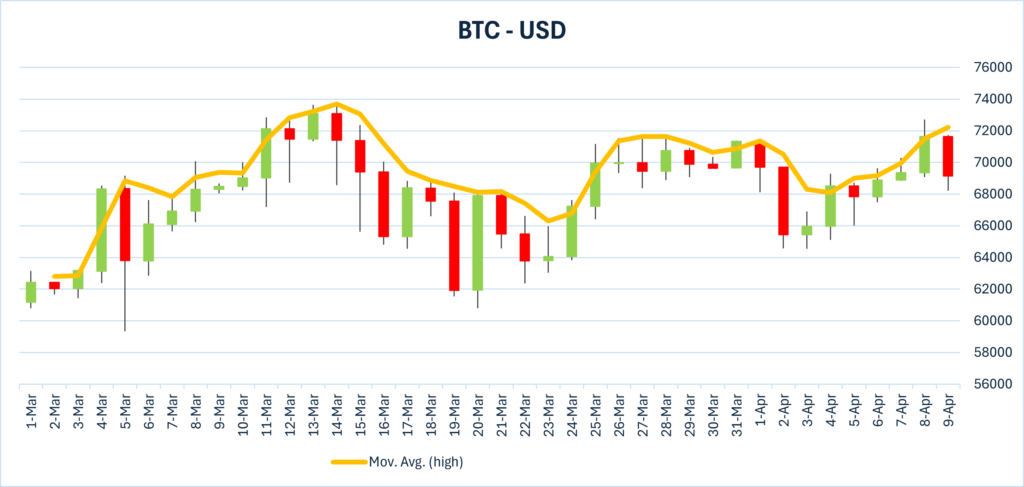
From the 1st of March to the 9th of April 2024, Bitcoin’s market behavior illustrated its volatility, albeit within a relatively contained range compared to its historical fluctuations. The month of March began with Bitcoin at $61,168.06, showing an early peak at $63,155.10, and importantly, the currency managed to maintain its value at around the $60,000 mark throughout the period. The subsequent weeks saw Bitcoin’s price oscillating, but by early April, there was a noticeable consolidation, with values consistently tracking in the high $60,000s to low $70,000s.

As the halving draws closer, the market’s sentiment tends to lean bullish, buoyed by historical performance and the reduction in new Bitcoin supply that the event guarantees. This optimism is tempered by caution, however, with reminders that past performance is not always indicative of future results and that the cryptocurrency market remains inherently volatile.

The Road Ahead

As we inch closer to halving, the debate intensifies: will Bitcoin follow the historical precedent and soar to new heights, or will market dynamics shift, leading to a different outcome? While the predictions provide a broad spectrum of possibilities, the actual impact remains to be seen, contingent on a myriad of factors including technological advancements, regulatory developments, and macroeconomic conditions.

As investors and enthusiasts watch the countdown to the halving, one thing is clear: Bitcoin remains at the heart of the cryptocurrency conversation, with its halving events serving as significant milestones that not only reflect on its scarcity and value proposition but also on the broader crypto ecosystem’s evolution and maturity. Whether these predictions will come to fruition or not, the halving is a reminder of the innovative design of Bitcoin and its profound impact on the financial landscape.

SEC Victorious Against Do Kwon of Terraform Labs in Landmark Crypto Fraud Case

Learn about the SEC's victory against Do Kwon and Terraform Labs in the landmark case. Dive into the SEC vs Do Kwon Terraform saga now!

In a significant legal triumph for the US Securities and Exchange Commission (SEC), a jury in Manhattan ruled against Do Kwon, the co-founder of Terraform Labs, in a civil fraud case. The verdict marks a pivotal moment in cryptocurrency investments’ ongoing regulatory scrutiny. It highlights the SEC’s commitment to protecting investors in the burgeoning digital asset landscape. The case underscores the crypto industry’s regulatory challenges and the implications for market participants.

The Legal Battle Unveiled

The legal proceedings unfolded over a two-week trial. It centered on allegations of fraud and deceptive practices by Terraform Labs and its founder, Do Kwon. The SEC accused the defendants of misleading investors regarding the stability of Terra USD (UST), an algorithmic stablecoin developed by the company. Additionally, the SEC alleged that Kwon and Terraform Labs made false claims about their blockchain technology. These claims purportedly involved facilitating transactions for a prominent Korean payment application.

A Verdict with Far-Reaching Consequences

The jury’s decision favoring the SEC signifies a significant victory in the regulator’s efforts to assert greater control over the crypto industry. By holding Kwon and Terraform Labs accountable for their actions, the SEC aims to deter fraudulent activities and enhance investor confidence in digital asset markets. The ruling sets a precedent for future enforcement actions against entities engaged in deceptive practices within the crypto space.

Implications for the Crypto Market

The fallout from the Terraform Labs case extends beyond the courtroom, reverberating throughout the cryptocurrency market. The collapse of Terra USD in 2022 contributed to heightened volatility and uncertainty among investors. Allegations of fraud against Kwon and his company further exacerbated market concerns. The SEC’s decisive action underscores the importance of regulatory oversight. It aims to safeguard the integrity of digital asset markets and mitigate systemic risks.

Navigating Regulatory Challenges

As the crypto industry continues to evolve, regulatory scrutiny remains a central concern for market participants. The SEC’s success in the case against Do Kwon highlights the importance of regulatory compliance for crypto companies. It emphasizes the necessity to uphold transparency and accountability in the industry. By promoting compliance with securities laws, regulators aim to foster a more secure and resilient ecosystem for digital asset investments.

The outcome of the SEC’s legal battle against Do Kwon and Terraform Labs serves as a stark reminder of the regulatory risks inherent in the crypto industry. As authorities ramp up enforcement efforts to combat fraud and misconduct, market participants must navigate evolving regulatory landscapes with caution. Moving forward, adherence to compliance standards and ethical business practices will be essential for fostering trust and stability in the dynamic world of cryptocurrencies.

Read more: Landmark SEC Victory: Cryptocurrency Regulators Win

Google Clamps Down on Crypto Scam Apps

Google clamps down on crypto scam apps in its Play Store

The digital era has ushered in unparalleled opportunities, with blockchain and cryptocurrencies at the forefront of this technological revolution. However, where innovation thrives, so too do opportunities for deceit. A recent legal battle initiated by Google spotlights a concerning trend: the proliferation of crypto scam apps on the Google Play Store, defrauding thousands.

Unveiling the Threat: Google Crypto Scam Apps

Google’s bold move to sue the architects behind these deceptive applications marks a critical juncture in digital security. The company’s stance against the creators of Google crypto scam apps is a testament to its commitment to user safety and platform integrity. By identifying and taking legal action against these malicious entities, Google sets a new standard in the fight against online fraud.

The Mechanism of Deceit

The modus operandi of the scammers was ingeniously malevolent. Developing apps that mirrored legitimate cryptocurrency investment platforms lured users with the allure of significant returns. These scam apps, however, were nothing more than digital traps, ensnaring users and siphoning off their investments without a trace of returns.

The Legal Frontline

Through its lawsuit, Google is not just seeking justice for wronged users; it’s also pioneering a path for digital justice. Leveraging the Racketeer Influenced and Corrupt Organizations (RICO) Act, Google aims to dismantle the networks that propagate these scams. It signals a zero-tolerance policy against digital fraudsters undermining the ecosystem’s trust.

Wider Implications for the Tech Community

The impact of Google’s legal action reverberates far beyond the immediate victims. It serves as a crucial wake-up call to the tech industry at large. It highlights the necessity of robust security measures and vigilant oversight of app marketplaces. The incident underscores the ongoing battle between technological advancement and the persistent threat of digital scams.

Elevating User Awareness and Protection

Google’s initiative is a beacon of proactive defense in cyberspace, emphasizing the importance of user education and awareness. It sheds light on the tactics employed by scammers, empowering users to navigate the digital landscape with caution and skepticism. They must remain vigilant against too-good-to-be-true investment opportunities.

Strategies for Safe Digital Exploration

In the wake of the Google crypto scam apps scandal, users must adopt a cautious approach to digital investments. Verifying the authenticity of apps, researching developers, and being wary of unsolicited investment advice are essential steps in safeguarding one’s digital assets. Google’s efforts to cleanse its platform of these predatory apps also highlight the need for continuous innovation in cybersecurity measures.

Google’s legal battle against the purveyors of crypto scam apps is a significant milestone in the digital age. It underscores the tech giant’s dedication to creating a safe and trustworthy online environment. This initiative not only seeks to penalize those behind the scams but also to deter future attempts at digital deception. As we venture further into the digital frontier, the collective efforts of companies like Google, alongside informed and cautious users, will be paramount in securing a future where technology is a tool for empowerment, not exploitation.

Read more: How Easy Is It to Trade Crypto with a Fake ID?

- Advertisement -

FEATURED