Home Blog Page 234

Canadian Crypto Exchange Claims to be Hacked, Traders Doubt it is a Scam

MapleChange is a relatively small crypto exchange with around 1,000 users, based in Edmonton, Alberta. Yesterday, the startup announced on Twitter that:
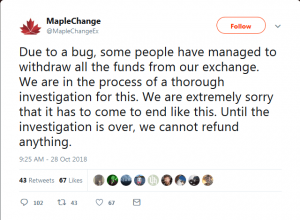
The Canadian company has allegedly lost all their funds, about 913 Bitcoins worth approximately $6 million USD.

Soon after that, the account was deleted by Twitter, which led many crypto fans to the suspicions it was just another scam.

Just two days ago, on October 27th, the company announced that their upgrade is ready and from now on, users can rejoice on their software Version 2.0.0. Just a day after, MapleChange declared a hack and shut all its accounts down. Now, there is another account on Twitter, called @MapleChange’d, which posts news and updates about the exchange.

A real hack or an exit scam?

Social media is now a complete mess. Tweets are posted every couple of minutes with statements from “It was an obvious scam, people!” to “They were hacked for real”.

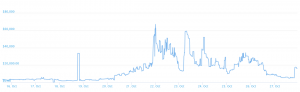
MapleChange had an exceeding trading volume for the last two weeks. According to CoinGecko’s chart, on some days the volume went up to $30,000 and on some, like 22nd October even over $60,000 USD. Exactly because of the raised profits, many traders assume it was a take-it-and-go kind of scam.
At the same time, MapleChange’s second Twitter account keeps posting ways to connect them and to refund at least a part of users’ funds. However, this does not seem a legitimate way of refunding and it is not yet clear if any users managed to withdraw their assets back.

However, CrispyBull stays up-to-date with the case’s outcome and will immediately report for any news.


 

UK: New Report Warns about the Crypto Regulations’ Dangers

The British news journal Telegraph reports today about a new joint research, conducted by the cryptocurrency exchange TodaQ, the market research group Novum Insights, the British Business Federation Authority (BBFA) and the law firm Baker Botts. The report claims that too harsh regulations will ruin the entire crypto market in the UK. Since legal attention seems to be quite focused on the Bitcoin’s status, other financial assets could be harmed, too.

Bad regulation is worse than no regulation at all,

Says the report, quoted by Telegraph.

The statement comes as an answer to the Members of the Parliament’s plan to regulate crypto and ICO’s market through the Financial Conduct Authority. The latter aims to fight illegal financial activities in the country and to prevent money laundering. However, the BBFA alerts that if not made adequately, the legislation process would only force investors and crypto businesses to leave the Kingdom.

As CrispyBull reported, some companies like Coinbase has already decided to move abroad due to the forthcoming Brexit.

Banks on the Island are worried that people use their credit cards to invest in cryptos, which would lead to huge losses of non-paid back loans. At the same time, the government plans to fight the dark web criminal abuse of cryptos by imposing new rules on trading: investors to reveal their names and personal information.

Patrick Curry, the CEO of BBFA, commented on this plan that:

It is a very blunt instrument approach and I haven’t seen this in other countries. The use of this technology is still a voyage of discovery and these technologies are being refined for different types of use. My concern is the law of unintended consequences.

The research group calls for new, more ‘sophisticated’ ways of regulating the crypto market regarding its technological specifics. Now, the HMRC collaborates with Bank of England on a new regulation project. A timetable of the draft though is not yet announced.


COSS Exchange Hacked, Trader Loses About $880,000

Crypto One-Stop Solution or COSS is a relatively small exchange, registered in Singapore which offers fiat-to-crypto and crypto-to-crypto trading pairs. Yesterday, a user alarmed on Reddit that his account was hacked, and his funds were stolen. The person with the nickname blockchainified reported the balance in his account was 11 700 000 COSS coins, the exchange’s native tokens, 14 Bitcoins and 22 Ethers. He stated to have lost coins worth roughly $880,000 USD. His assets surprisingly came out on the market without his knowledge.

I had 2FA< I haven’t checked my account for a couple of months. Yesterday, while I was sleeping somebody, hacked my account and sold all my assets. I had 11 000 000 COSS tokens! Somebody just dumped it on the market,

The distressed trader writes.

As he later explained in additional posts, he also had 19 000 EOS tokens, which stayed untouched, thanks to the shut of the node. COSS tokens, however, could not resist the breach and went missing.

The main assumption was that a brute force attack occurred. A brute force hack is a hack through multiple attempts until the password is revealed. But blockchainified does not know how this would be possible since his password was 16 digits long with letters, numbers and special characters.

The story has a happy end, though. The trader contacted the compliance center immediately and the CEO of the exchange, Rune Evensen, contacted him personally. Blockchainified asked for at least 50% recover of his assets but received 11 million COSS coins back.

COSS took urgent measures and shut the platform down for 24 hours. It seems it was a combination of DDoS and brute force attacks, which affected other users, too. For the moment, it is not clear how many victims there are. COSS posted an announcement that:

[…] user’s password was compromised outside of COSS; at no time was any user password breached on our systems.

They look for the hacker and warn that if he returns 9.8 million COSS tokens, the case will not be pursued.

Breaking: Tether Just Destroyed 500 million Tokens

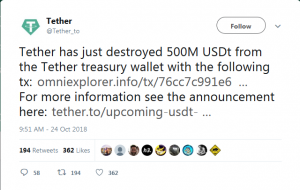
Tether LLC., the company behind the USDT token, announced on Wednesday 24th of October that it will burn more than 50% of its total market capitalization.

Tether is a stablecoin pegged to the U.S. dollar and is supposed to be on a ratio of 1:1 to it. However, as CrispyBull reported two weeks ago, on Monday, October 15th the USDT experienced a substantial drop down to $0.93 USD which led to a surprising spike of the Bitcoin for the day to over $7.000 on some exchanges. The decline was related to the turmoil the exchange Bitfinex caused, suspending the USDT purchase on their platform. At the time, it became clear Bitfinex returned a huge amount of Tether tokens back to the company, due to a low buying interest. Investors then went eager to redeem their tokens, and the redemption reached the cosmic sum of almost 800 million USDT. Speculations about Tether’s fiat coverage came out despite the firm’s constant statements of immutable transparency.

The official statement published on Tether’s homepage reads:

Over the course of the past week, Tether has redeemed a significant amount of USDT from the circulating supply of tokens. In line with this, Tether will destroy 500m USDT from the Tether treasury wallet and will leave the remaining USDT (approx 466m) in the wallet as a preparatory measure for future USDT issuances.

Tether made two moves: firstly, it moved 500 million USDT from its treasury to the official issuing address and after the transaction was completed, it destroyed them for good.

Doubts about the company’s fair policy are still in the air. The public reactions go from “The scam has been uncovered” to the logical explanations like “They [Tether] print AND destroy tokens based on demand and supply to make it stable. They burned tokens to raise the price back to one dollar. All of you need to start learning basic economic concepts.”, expressed by someone with the alias Bitwhale. However, USDT’s legitimacy is seriously shaken. Since the company failed to provide legal auditing services in June, traders do hesitate on the tokens’ backup. Speculative opinions say Tether perhaps did not have a fiat reserve to support its digital assets, which provoked the radical decision of burning them.


- Advertisement -

FEATURED