
Home Blog Page 3

Bitcoin Holds Near $86,000 After Short Squeeze and Near-$1 Billion ETF Inflow

TL;DR

  • Bitcoin climbed above $86,000 on September 21 as forced short liquidations added buying pressure to the rally.
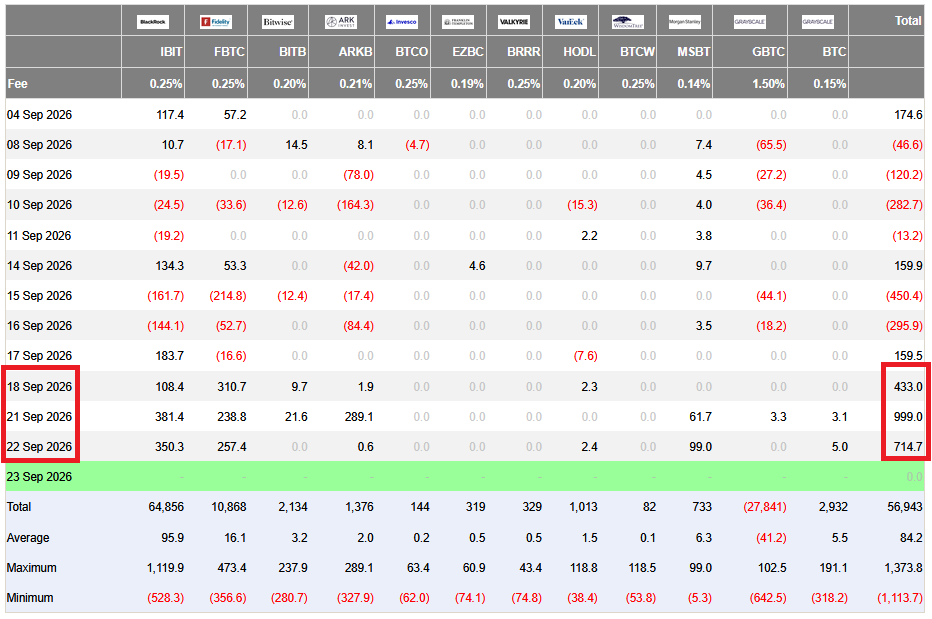
  • US spot bitcoin ETFs recorded $999 million of net inflows on Monday and another $714.7 million on Tuesday.
  • After the short squeeze, Bitcoin will need steady spot buying to stay near its new range.

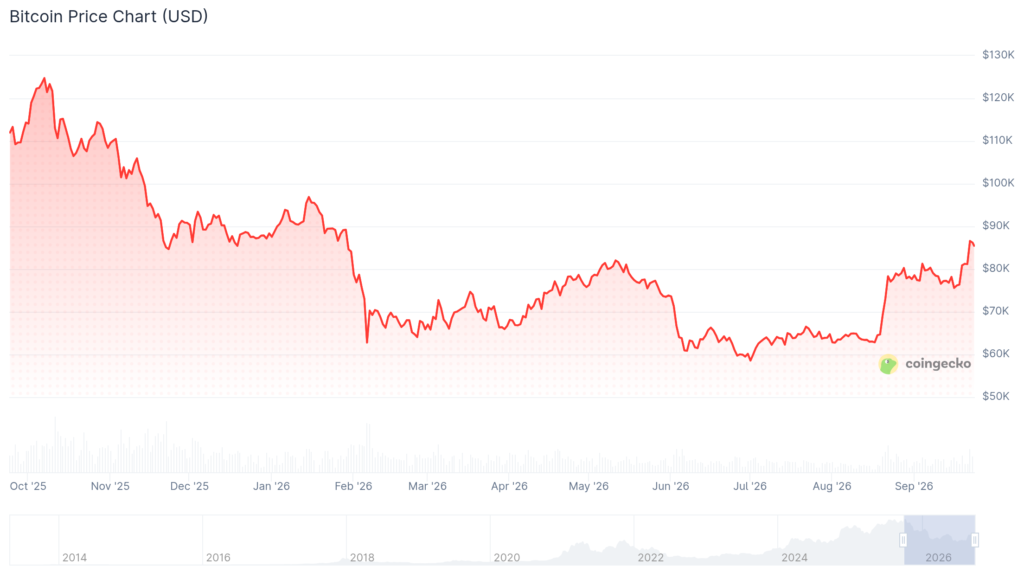
Bitcoin climbed above $86,000 on September 21, reaching its highest level since January. The rally forced out traders betting on a decline, and their exits added buying pressure. The intra-day peak reached about $87,360 on Monday before Bitcoin pulled back.

Bitcoin traded near $85,800 as of 10:08 am UTC on Wednesday, September 23, according to Coinbase. The price remains below Bitcoin’s all-time high of October 2025.

Forced buying in derivatives markets

A short position gains when an asset falls in price. Traders often place that bet with borrowed funds or derivatives, which magnify both profits and losses. If the price rises far enough, an exchange can close a leveraged short automatically to stop further losses.

Closing the position means buying back the asset or settling the contract. When exchanges close many bearish trades at once, the forced buying can lift prices further. Higher prices then trigger more closures, a feedback loop that traders call a short squeeze.

Bitcoin’s breakout set off that loop across crypto derivatives markets. CoinGlass recorded $647.9 million of short liquidations out of $746.6 million over 24 hours on Monday. Later tallies covering wider windows and more tokens topped $1 billion. Providers differ because exchanges report unevenly and rolling 24-hour windows keep shifting.

A liquidation figure measures the value of positions that exchanges closed, which can exceed the money traders actually lost.
Source: coingecko.com

Spot demand before and during the breakout

Spot Bitcoin exchange-traded funds (ETFs) hold Bitcoin directly and trade on US stock exchanges. Farside Investors data shows $746 million of outflows on September 15 and 16. Flows reversed on Thursday, and Friday, September 18, brought $433 million, led by Fidelity’s FBTC.

Monday’s session dwarfed both figures. Net inflows reached $999 million on September 21, the largest daily total since October 2025. BlackRock’s iShares Bitcoin Trust led with $381 million. The funds added another $714.7 million on Tuesday, their fourth straight day of inflows.

As a group, US ETF holders moved into profit when Bitcoin cleared $82,225, their average entry price, per CoinDesk. ETF buying supplies spot demand, while liquidations create forced buying in derivatives. Public data cannot show how much of the rally came from each source.

Strategy, the largest publicly traded corporate Bitcoin holder, disclosed a purchase of 950 Bitcoin for $75.7 million. The buy, made between September 14 and 20, followed two weeks without purchases. Strategy reported four Bitcoin sales totaling 6,916 coins between June 30 and August 10. It resumed buying with 4,603 coins, reported on August 31. The two purchases returned holdings to 846,000 Bitcoin, the level Strategy held at the end of June. Strategy shares rose 7.4% in Monday premarket trading.
Source: farside.co.uk

A rate hike and a stalled Senate bill

The week before the rally brought two policy setbacks, and traders had positioned for both.

On September 15, the US Senate failed to advance the CLARITY Act, a bill setting rules for crypto markets. The procedural vote ended 49–50, short of the 60 votes required. Polymarket odds of the bill becoming law in 2026 had fallen to 19.5% by the morning of the vote.

Bitcoin slid with the odds, falling from about $78,000 to below $77,000 before the vote. The result pushed it below $75,000 intraday, and Coinbase and Circle shares fell more than 10%. Rising yields and oil weighed on Bitcoin the same day, so the vote’s share of the drop is unclear. Bitcoin’s recovery began on September 18, when it rose 5.8% to about $80,900.

On September 16, Securities and Exchange Commission (SEC) Chairman Paul Atkins pledged action under existing law, with or without legislation. Commodity Futures Trading Commission (CFTC) Chairman Mike Selig said his agency was ready to issue its own crypto rules. The SEC’s proposed Regulation Crypto Assets, covering crypto offerings, is open for public comment until October 20. The CFTC has sent a separate crypto market proposal to the White House budget office, Investing.com reported.

Agency rules offer a path forward, but they are less permanent than a statute. In August, Atkins called legislation indispensable for rules that a future regulator cannot easily reverse.

The Federal Reserve raised its benchmark rate by a quarter point to 3.75%–4.00% on September 16. HashKey researcher Tim Sun called the hike fully anticipated and said it removed a degree of uncertainty. He told Decrypt that traders cut most of their risk before the Fed decision and Senate vote.

Bond yields and oil

The vote and the hike arrived on set dates, but yields and oil move with incoming data and events.

The 10-year Treasury yield touched 5.014% on September 14, its highest since 2023. The increase followed a hot August inflation report on September 11, which lifted bets on a Fed hike. The same day, Brent crude topped $109 a barrel as Houthi rebels threatened a second Middle East shipping route.

The 10-year yield returned to 5% on the day of the hike and fell from September 17. Decrypt attributed the decline to investors finding Fed Chair Kevin Warsh credible on inflation.

Brent crude touched a half-month low on September 21 and slipped below $100 on September 22. BTSE executive Jeff Mei told The Block that cheaper oil and easing yields drew institutions back to Bitcoin.

Derivatives positioning after the squeeze

Open interest, the value of outstanding derivatives contracts, rose 7.6% to about $156 billion market-wide, according to Santiment. Exchanges closed hundreds of millions in shorts during the squeeze, so traders opened new positions even faster.

Fresh leverage leaves the market exposed to another wave of forced closures. A sharp drop could now force out traders betting on further gains, as Monday’s rally forced out shorts.

Wintermute trader Jasper De Maere flagged Friday’s options expiry, on September 25, as the next test. Options give holders the right to buy or sell at a set price until a set date. Traders often reshuffle positions around expiry, which can move prices.

Pontes Goes Live as ECB Builds a Bridge to Tokenized Markets

TL;DR

  • The ECB launched Pontes for tokenized settlement, giving eligible institutions a live route to settle tokenized trades using central bank money.
  • Pontes links asset transfers on distributed ledgers with payment through either temporary cash tokens or the Eurosystem’s T2 system.
  • The service has limited hours and features at launch, with broader functionality and 24/7 operation planned by 2028.

On September 21, the European Central Bank’s Eurosystem launched Pontes, a service that lets eligible financial institutions settle tokenized-asset transactions in central bank money. Pontes connects newer digital-ledger systems to the payment infrastructure banks already use across the euro area.

The ECB launched Pontes for tokenized settlement after testing several approaches in 2024. Thirteen market participants, four distributed-ledger operators and Germany’s Bundesbank had completed on-boarding at launch. The service is live, although the ECB has not yet disclosed transaction volumes.

Why tokenized markets need a settlement bridge

Institutions already hold reserves at the central bank, the safest form of money in the financial system. Banks keep two kinds: a mandatory minimum, and additional reserves they hold voluntarily beyond that floor. The problem was using that money on newer, distributed-ledger platforms.

A tokenized asset is a digital representation of something such as a bond that can be recorded and transferred on a distributed ledger, the technology also used by many blockchain systems. Moving the digital asset covers only half of a financial transaction. The buyer must also send payment to the seller, and traditional markets handle both legs through established financial infrastructure.

The challenge appears when the asset sits on a newer ledger system while payment moves through the conventional banking system. Institutions completing that payment leg had choices, but not a good one. They could settle through balances held at a commercial bank, or increasingly through privately issued stablecoins. Both carry a risk their own reserves at the central bank do not: the issuer could fail or default, leaving the payment side of the transaction exposed.

Pontes closes that gap. Banks fund it from reserves they already hold at the central bank. That is typically the voluntary balance, not the mandatory minimum. It lets approved financial institutions use that money directly when settling tokenised-asset transactions, instead of falling back on commercial money or stablecoins. It does not require a new cryptocurrency or digital coin.

How a Pontes transaction works

Pontes provides two ways to complete the payment side of a transaction.

The first route uses cash tokens. A bank moves money from its regular T2 account into a dedicated cash account, and the Eurosystem mints tokens against that balance. Those tokens can then move freely between banks on the distributed-ledger platform throughout the day, without each transfer touching T2 directly. The tokens exist only for the trading day. Balances convert back to a standard T2 balance before the day closes, so no new money enters circulation.

The second route skips tokens entirely. It sends a trigger instruction straight into T2, the Eurosystem’s real-time payment system, each time a payment needs to settle.

Both routes link the payment leg to the asset transfer through a mechanism called delivery versus payment. The distributed-ledger platform holding the tokenized asset reserves it for transfer. The payment settles through a cash token or a T2 trigger at the same moment. Both legs complete together, or neither does.

Legal settlement finality for the cash leg rests with T2 in both cases. A cash token changing hands on the ledger represents a claim on a bank’s T2 balance, not a final transfer of central bank money on its own.

Conventional financial markets already require this kind of coordination for ordinary securities trades. Pontes extends the same guarantee to transactions where the asset itself sits on distributed-ledger technology.

Who’s already connected

The onboarded banks include Deutsche Bank, Santander, Société Générale, DZ Bank, Deka Bank, BayernLB, ABANCA and Cecabank. Development finance institutions on the list include the European Investment Bank, KfW, NRW.BANK and France’s Caisse des Dépôts et Consignations. Germany’s Bundesbank onboarded separately, as a market participant rather than an overseer.

The four distributed-ledger operators are Axiology, Cashlink, Clearstream and SWIAT. The Eurosystem has said more participants are committed to connecting in the coming months.

The four platforms differ in their underlying technology. Axiology builds on code from the XRP Ledger. Cashlink supports multiple chains, including Ethereum and Avalanche. Clearstream and SWIAT run their own purpose-built systems.

What Pontes can and can’t do yet

Pontes operates between 8 a.m. and 4 p.m. CET on business days at launch. The Eurosystem plans to extend that window step by step, reaching 22.5 hours a day before full 24/7 operation by 2028.

The limit traces back to T2. Pontes settles the cash leg’s legal finality through T2, the Eurosystem’s existing real-time payment system. T2 runs on a business-day schedule; it does not operate continuously. Extending Pontes to 24/7 will likely depend on T2’s own operating hours expanding first.

The feature set narrows for the same reason. Today’s version handles delivery-versus-payment settlement and little else. Later versions plan to bring settlement finality onto a Eurosystem-operated ledger directly. Smart contract functionality and support for multiple currencies are also on the roadmap.

Access stays limited too. Approved financial institutions and qualifying ledger operators can use Pontes. Ordinary consumers and public blockchain users cannot.

Pontes invites comparison to two other things, and it is neither. A wholesale central bank digital currency would let central bank money exist natively as a token, with settlement final the moment the token moves. Pontes doesn’t do that: one of its two settlement routes uses tokens, but they represent a temporary claim on a T2 balance. They are not central bank money in tokenised form. Final settlement still runs through T2 itself. A stablecoin carries a different risk entirely. It’s issued by a private company, backed by reserves that company holds and manages, and its holders depend on that company staying solvent. Pontes tokens carry no such dependency, since they trace back to the Eurosystem at every step. Its purpose stays narrow: giving financial institutions access to central bank money when they settle tokenised transactions.

The ECB could eventually use Pontes itself

The ECB announced preparatory work for investing a small part of its own funds in tokenised securities, alongside the launch. The investments would initially focus on euro-denominated public-sector and supranational debt, with settlement taking place through Pontes. No purchases have started, and the ECB’s Executive Board still has to decide the timing and operating details.

Pontes gives European banks a real alternative to stablecoins for settling tokenised trades in an asset with no issuer risk. Whether they use it instead of the private alternatives is the question the ECB is now trying to answer.

Readers’ frequently asked questions

Is Pontes a cryptocurrency?

No. Pontes settles transactions using central bank money, not a new digital currency. One of its two payment routes uses tokens. Those tokens represent a temporary claim on a bank’s T2 balance. They are not an independent form of money.

Can individual consumers use Pontes?

No. Pontes is open only to approved financial institutions and qualifying distributed-ledger operators. Ordinary consumers and public blockchain users cannot access the platform directly.

What’s the difference between Pontes and the digital euro?

The digital euro is a retail project, meant for households and businesses to pay each other directly in central bank money. Pontes serves a different purpose entirely. It gives banks a way to settle tokenized-asset trades using reserves they already hold at the central bank. The two projects run on separate tracks, with separate timelines.

US Targets BitBank in Wider Push Against Iran’s Shadow Banking and Crypto Networks

TL;DR

  • The U.S. Treasury sanctioned BitBank after alleging the Iranian exchange moved hundreds of millions of dollars in Bitcoin to the IRGC.
  • The sanctions against BitBank are part of a broader campaign targeting Iran’s shadow banking networks, crypto exchanges, brokers and foreign financial intermediaries.
  • OFAC expanded its reach in August by authorizing sanctions against anyone operating in Iran’s digital asset sector.

The U.S. Treasury sanctioned Iranian cryptocurrency exchange BitBank on September 17. Treasury alleges the exchange moved hundreds of millions of dollars in Bitcoin to Iran’s Revolutionary Guard, the IRGC.

The Treasury Department’s Office of Foreign Assets Control, or OFAC, made the designation under Operation Economic Outcast. Treasury launched that campaign against Iran’s finances on August 24. The action covered BitBank’s software developer and three associates of Iranian financier Babak Zanjani, who controls the exchange.

Treasury places the designated parties inside the network Iran uses to evade sanctions with digital assets. Beside it runs an older set of banking workarounds that Iran has built over years.

The Allegations Against BitBank

OFAC places the alleged transfers to the IRGC in June and July. The allegation remains untested in court, and OFAC’s listing for BitBank omits wallet addresses.

A second allegation ties BitBank to Hormuz Safe Marine Services Authority, or Hormuz Safe. OFAC says the insurer has used the exchange since June to pass collected payments to Tehran. OFAC gives no amount and leaves open whether these payments belong to the June and July transfers.

Hormuz Safe advertises marine insurance for ships crossing the Strait of Hormuz. The strait is one of the world’s most important shipping routes. In March, Lloyd’s List cited at least one reported $2 million payment to Iran for safe passage. Iran’s IRGC-linked Fars News Agency reported the launch in May, saying Hormuz Safe could generate more than $10 billion. OFAC designated Hormuz Safe on July 29, describing a platform that accepts Bitcoin and other digital assets.

OFAC says Zanjani promoted Hormuz Safe to his social media followers. He has promoted BitBank there since at least 2024. Several companies in his network list it as a partner.

OFAC designated Pishtaz Simorgh Electronic Trade Company, which developed BitBank’s software. Pishtaz Simorgh is a subsidiary of Dot One, the Zanjani conglomerate OFAC sanctioned on July 24. The three associates hold senior roles in the Dot One network. They are Hossein Ali Zaker Hossein, Mohammad Mahdi Zaker Hossein and Seyed Adel Heidari.

Note: The Iranian BitBank exchange has no connection to bitbank, inc., a licensed Japanese exchange.

How Iran Moves Money Around Sanctions

Iran’s banks have faced U.S. sanctions for years. OFAC designated Parsian Bank, Bank Sina and Bank Mellat in October 2018, and Bank Sepah followed in November.

Sanctioned Iranian banks rely on rahbar companies, private firms that run overseas shell companies to pay for trade. Exchange houses hold and convert foreign currency for the banks. Treasury calls the whole arrangement Iran’s shadow banking network.

Treasury Secretary Scott Bessent described the target on August 7. “Whether in dollars, rials, or crypto,” he said, Treasury would dismantle the networks that keep the regime afloat.

Layer by Layer: OFAC’s 2026 Designations

OFAC targeted the rahbar networks of Bank Melli and Shahr Bank on January 15. On April 28, it designated 35 targets, including rahbar companies for six banks. Four actions between May 1 and July 10 named at least eight exchange houses. Treasury counted its August 7 action as the eighth of 2026 against the shadow banking network.

The crypto layer drew its first designations on January 30: Zedcex and Zedxion, two UK-registered exchanges linked to Zanjani. Zedcex had processed more than $94 billion since its August 2022 registration, according to OFAC. On June 2, OFAC designated Nobitex, Wallex, Bitpin and Ramzinex. OFAC credits Nobitex with more than half of Iran’s digital asset inflows in 2025. On August 7, OFAC designated Shelbit Exchange and Aban Tether. Tens of millions of dollars from an Iranian gambling network moved through Shelbit, OFAC says. BitBank brings the total to at least nine exchanges this year.

Stablecoins ran through the same exchanges. These are crypto tokens pegged to a currency such as the U.S. dollar. Nobitex helped the Central Bank of Iran obtain hundreds of millions of dollars in stablecoins, according to OFAC. On July 14, OFAC added four Tron blockchain addresses to the Central Bank’s sanctions listing. Chainalysis, a blockchain analytics firm, reports that the wallets received $165 million in stablecoins. Tether, which issues the USDT stablecoin, froze $131 million. Chainalysis puts total freezes on Central Bank addresses near $475 million. The regime prefers stablecoins for their liquidity, the firm says, though issuers can freeze them at law enforcement’s request.

The August 24 Determination and Foreign Targets

On August 24, OFAC issued five sector determinations under Executive Order 13902, and one covers digital assets. OFAC can now sanction any person, anywhere, that operates in Iran’s digital asset sector. Entities that launder money or evade sanctions for Iran risk losing access to the U.S. financial system. Treasury’s announcement expands secondary sanctions exposure for anyone who keeps doing business with the regime. OFAC designated BitBank under that order for operating in the sector.

OFAC designated Ivan Obukhov the same day, a broker for Iran’s shadow fleet of oil tankers. According to the release, he processed more than $100 million in cryptocurrency payments for IRGC Qods Force oil sales.

Foreign banks followed. OFAC designated Istanbul-based Golden Global Bank and two subsidiaries on September 4 for providing correspondent banking to Iran. Correspondent accounts let foreign banks clear dollar payments through U.S. institutions. On September 14, OFAC designated Russia’s VTB Bank for building correspondent relationships with sanctioned Iranian banks. The release called the action a warning that there is “no safe way to do business with Iran.”

Iran has spent years building workarounds to sanctions that date to at least 2018. Crypto channels followed the same path, operating for years before OFAC reached them. UAE regulators took action against Shelbit’s operator twice before OFAC designated it. BitBank kept moving funds after OFAC designated Zanjani in January.

The tools for reaching those channels have widened since. Issuer freezes work on stablecoins, and the August 24 determination covers any business in Iran’s digital asset sector. Two foreign banks drew designations within three weeks of the campaign’s launch.

FinCEN Proposal on Banque Misr UAE

On August 28, FinCEN, Treasury’s financial crimes bureau, proposed cutting Banque Misr UAE off from U.S. correspondent banking. FinCEN estimates the bank processed about $1.8 billion between January 2024 and June 2026 for 103 companies. The companies may belong to Iranian shadow banking networks. The comment period closes 30 days after Federal Register publication.

CFTC Extends Phantom-Style Broker Relief to More Crypto Wallets

TL;DR

  • The CFTC expanded conditional no-action relief from Phantom to other qualifying providers of passive software, including crypto wallets.
  • Eligible wallets and apps can connect users with regulated derivatives markets without introducing-broker registration.
  • Providers must meet ten conditions, while the staff position does not extend to unregistered derivatives platforms or create a permanent CFTC rule.

The US Commodity Futures Trading Commission has expanded a regulatory pathway that could make it easier for crypto wallets and other software applications to connect users with regulated derivatives markets.

The agency’s Market Participants Division issued Staff Letter 26-25 on September 17, making conditional no-action relief available to qualifying providers of what it calls “passive software.” The CFTC’s crypto wallet relief builds on a similar position granted specifically to Phantom Technologies in March. It now extends the framework to other providers that meet the regulator’s conditions.

Under the new position, CFTC staff will not recommend enforcement against qualifying providers solely for failing to register as introducing brokers, or against relevant personnel for failing to register as associated persons, when their software connects users to regulated derivatives markets.

From Phantom-specific relief to a broader framework

The September decision expands a regulatory approach first applied to Phantom Technologies earlier this year. Phantom received its own no-action relief in March, allowing the self-custodial wallet provider to connect users with regulated derivatives services without registering as an introducing broker under the circumstances covered by that letter.

Staff Letter 26-25 makes substantially similar treatment available more broadly. That means other qualifying wallet developers and software providers no longer need to rely on relief written specifically for Phantom.

The CFTC’s crypto wallet relief could therefore make regulated derivatives functionality easier to integrate into consumer-facing applications. Users could interact with products through a familiar wallet or software interface while the underlying trading remains connected to registered market participants.

What the relief permits and requires

The CFTC’s position depends on what the software provider actually does.

Eligible software can provide an interface through which users view markets and submit orders to registered firms or trading venues. Qualifying providers may also market the service and collect transaction-based fees.

The provider must remain passive in specific ways. It cannot take custody of assets backing a derivatives position. It may not generate explicit buy or sell signals, and it cannot exercise discretion over how orders get routed or executed. The relief does not extend to unregistered venues. In crypto, perpetual contracts and other leveraged products often trade on offshore platforms outside CFTC registration.

Staff Letter 26-25 attaches ten conditions on top of these behavioral limits. Providers must maintain compliance policies, make required disclosures, file notice with the CFTC and accept the agency’s enforcement jurisdiction. The position is a staff no-action letter, not a formal exemption from US derivatives regulation.

A user experiences the wallet as a single hub for accessing different products. The wallet provides the entry point. But the trade itself still happens with the registered exchange or broker on the other side of that interface.

A temporary path for wallet developers

Crypto wallet developers get relief from the CFTC, a clearer route to regulated derivatives access. But the route runs through a no-action letter; and a no-action letter is not a rule.

The initiative arrived two days after the Senate rejected a cloture vote on the CLARITY Act. CFTC Chairman Michael Selig has said the agency intends to regulate crypto derivatives under its existing authority, independent of that legislation’s fate. Staff Letter 26-25 fits the pattern: the CFTC building market structure through staff-level tools while Congress works out a broader framework.

Circle’s Arc Mainnet Goes Live With Major Financial Firms Onboard

Futuristic digital finance hub with glowing USDC symbol and connected blockchain nodes, representing Circle’s upcoming Arc Layer-1 blockchain for stablecoin payments and FX.

TL;DR

  • Circle launched Arc mainnet on September 16 with more than 100 applications and over 100 institutional and ecosystem builders.
  • Arc uses USDC for transaction fees and targets payments, tokenized assets, financial markets and AI-agent applications.
  • BlackRock, DTCC, Visa and other major institutions are joining the permissioned validator cohort through a phased rollout.

Circle has launched the public mainnet of Arc, bringing its own Layer 1 blockchain into operation as the company expands beyond its core USDC stablecoin business. Arc went live on September 16 with more than 100 applications and over 100 institutional and ecosystem builders participating from day one.

Arc is designed for financial markets, payments, tokenized assets and applications involving AI agents. Unlike many blockchains that require users to hold a separate native token for transaction fees, Arc uses USDC for gas, putting Circle’s dollar-backed stablecoin directly into the network’s operating model.

Arc puts USDC at the center of network activity

Arc is EVM-compatible, meaning developers accustomed to Ethereum tools and Solidity smart contracts can use much of the same infrastructure on the new network. Circle also says Arc offers deterministic sub-second finality, allowing transactions to reach a final state quickly.

The use of USDC for transaction fees is one of Arc’s more distinctive features. Users do not need to obtain a separate, potentially volatile cryptocurrency simply to pay network costs. That design could make fees easier for businesses to account for when using blockchain-based payment or settlement applications.

Arc’s mainnet also connects with other parts of Circle’s infrastructure. Circle Payments Network is natively integrated with Arc, while StableFX supports round-the-clock foreign exchange settlement using stablecoins. The network also supports tokenized financial assets and applications for trading and lending.

Major financial companies join the validator cohort

Arc arrives with significant participation from established financial and payments companies. Its planned founding validator cohort includes BlackRock, DTCC, Galaxy, ICE, Mastercard, MoneyGram, SBI Group, Standard Chartered, Sumitomo Corporation, Visa and Worldpay, which is now part of Global Payments.

Arc is permissionless for users and developers. Its validator set is initially permissioned, meaning Circle controls which institutions can join, with the named cohort added in phases.

Circle says it is exploring a move from the current Proof of Authority model toward Proof of Stake in 2027. The company has already completed the genesis mint of 10 billion ARC tokens, which could eventually play a role in network security, utility and governance. Circle stresses that the mint does not constitute a commitment to launch ARC publicly.

Circle builds more infrastructure around USDC

The launch also changes Circle’s position within the blockchain ecosystem. USDC became a major stablecoin partly through availability across external blockchain networks. With Arc, Circle now operates a Layer 1 designed specifically around stablecoin settlement and financial applications while continuing to support USDC across other networks.

Arc gives Circle a settlement layer it did not previously own. The company already operates stablecoins, cross-chain infrastructure and tokenized financial products. Arc adds a network where those services can interact more directly.

Day-one infrastructure includes trading applications such as Uniswap, alongside lending protocols including Aave and Morpho. Circle’s USYC and BlackRock’s BUIDL are live and trading on Arc at mainnet launch. Users can trade these assets, lend against them and post them as collateral alongside private credit products and cirBTC.

Arc begins its mainnet phase

The Arc mainnet launch gives Circle greater control over the infrastructure surrounding USDC while creating another venue for institutions and developers building blockchain-based financial services. Full validator participation, not just the current phased rollout, will show whether the founding cohort follows through.

Circle plans three Network Sectors for later stages of Arc’s development. A Privacy Sector will support opt-in confidential transactions, and a Payment Sector targets more than 100,000 transactions per second, while the Agent Sector is designed for verifiable agent identity and auditable records. The roadmap also explores a move from Proof of Authority toward Proof of Stake in 2027.

- Advertisement -

FEATURED