Home Blog Page 74

$300 Million Frozen — T3 Targets Stablecoin Crime but the Hard Part’s Just Beginning

Editorial illustration showing a Tether coin frozen in ice and connected by digital cables to TRON and TRM Labs logos, symbolizing the T3 Financial Crime Unit’s $300 million freeze of illicit crypto assets across the USDT-TRON network.

A year after its launch, the Tether – TRON – TRM Labs Financial Crime Unit (T3) says it has now frozen more than $300 million in illicit crypto assets. It’s one of the industry’s largest coordinated anti-crime efforts to date. The milestone, announced in Tether’s latest update, reflects both the scale of fraud moving across stablecoin networks and a growing willingness among crypto companies to police their own infrastructure before regulators do it for them.

Inside T3 — How T3 Freezes Illicit Crypto Funds

The T3 Financial Crime Unit was founded by Tether, TRON, and blockchain-intelligence firm TRM Labs to trace and immobilize stolen or criminally obtained digital assets. Its method is simple in theory but complex in execution. It requires continuous on-chain surveillance, data sharing between private actors, and real-time coordination with law-enforcement agencies.

In August 2025, T3 expanded its reach through T3+, a collaborator program that allows exchanges and analytics companies to join its network. Binance became the first participant, working with investigators to identify and freeze roughly $6 million in pig-butchering scam proceeds. That case showed the system’s effectiveness. Suspicious wallets were flagged in hours rather than weeks. T3 neutralized criminal liquidity before it could vanish into mixers or offshore OTC desks.

The crime unit functions almost like a financial intelligence agency built directly on-chain. Instead of subpoenas and bank statements, T3’s analysts rely on address clustering, token flow heuristics, and wallet-behavior patterns provided by TRM Labs’ risk engine.

Following the Rails — Why TRON and USDT Matter

If most crypto crime follows the money, then much of that money runs on the USDT TRON network. With its near-zero transaction fees and massive daily volume, TRON has become the preferred rail for low-cost stablecoin transfers. Hence, it inevitably became a haven for laundering operations.

TRM Labs’ prior intelligence reports show that scammers and ransomware groups increasingly route funds through TRON-based USDT because it offers speed and anonymity at scale. A typical flow starts with scam victims sending funds to fraudulent investment platforms. Operators convert them to USDT, move them across hundreds of TRON wallets to obfuscate origin, and finally off-ramp through loosely regulated brokers.

For investigators, this stablecoin crime crackdown is less about any single blockchain and more about closing the gaps between them. T3’s progress indicates that cooperation between issuers and network operators can actually freeze funds in real time. That’s something governments have long struggled to do.

The Milestone in Context — From $250 Million to $300 Million

When T3 launched T3+ in August, it had already locked down $250 million in frozen crypto assets. Just two months later, the figure rose to $300 million. The speed of new seizures suggests both improved tracking capabilities and an alarming persistence of fraud.

The blocked assets span romance scams, investment fraud, phishing campaigns, and laundering pipelines stretching across Asia, Europe, and North America. Each freeze requires verification that the tokens were criminally linked. This labor-intensive process involves blockchain analytics, cooperation from exchanges, and in some cases direct law-enforcement warrants.

These operations prove that industry-led crypto enforcement can work faster than formal regulation. It appears to be a necessary argument as stablecoin issuers fight for credibility under emerging global rules.

The Hard Part — From Freeze to Recovery

Still, freezing is the easy part. Can victims recover frozen USDT? The short answer: rarely, at least not yet. Once assets are immobilized, they remain in limbo until courts issue seizure or restitution orders. Unfortunately, such a process can take months or years.

Legal complexity multiplies when funds cross jurisdictions. A wallet flagged in Singapore may hold tokens frozen by a U.S. issuer and transferred via a European exchange. Many countries lack clear legal definitions for “confiscated digital assets.” Hence, victims often depend on ad-hoc cooperation between prosecutors and private firms.

Compliance experts describe it as a two-step race. First stop the flow, then fight for the return. The crypto asset recovery process often collapses in step two due to fragmented rules of evidence. T3’s architects say the next stage is to standardize data packages and notification procedures. This should allow law-enforcement partners to move from freeze to forfeiture more efficiently.

Implications — Industry Self-Policing and Regulatory Signals

For regulators watching from the sidelines, T3’s progress offers both optimism and leverage. On one hand, it shows that major stablecoin issuers are capable of self-policing at a level comparable to traditional banks’ compliance desks. On the other hand, it reinforces that the TRON-based USDT ecosystem remains the primary battlefield for illicit activity.

Tether’s leadership hopes the initiative strengthens its case as a responsible actor amid scrutiny from central banks and the Financial Action Task Force. Critics counter that industry-driven crypto crime task forces like T3 still depend on voluntary cooperation and lack judicial enforcement power. In that sense, the project’s success highlights both the promise and the limits of private-sector enforcement.

What’s Next — From Collaboration to Consolidation

The Tether – TRON – TRM Labs Financial Crime Unit plans to expand the T3+ Collaborator Program to additional exchanges, analytics firms, and payment processors through 2026. Future phases include integrating AI-driven wallet clustering, automated alerts for suspicious flows, and standardized recovery frameworks across jurisdictions.

For all its momentum, T3’s evolution underscores a paradox: the same tools that make stablecoins efficient for legitimate users — speed, liquidity, interoperability — make them equally efficient for criminals.

Whether this industry-driven crypto crime task force becomes a permanent pillar of digital-asset compliance or remains a crisis-response experiment will depend on what comes after the freeze: the return of funds to real victims.

Readers’ frequently asked questions

What happens to frozen crypto assets once they are locked by issuers like Tether?

When a token such as USDT is frozen, it remains visible on the blockchain but cannot be transferred, traded, or redeemed. The issuer blacklists the wallet address, rendering the tokens inert. They stay in limbo until a competent authority (court or law enforcement) orders release or seizure as part of a criminal case.

How can exchanges and wallet providers join the T3+ Collaborator Program?

Prospective collaborators undergo due diligence (compliance capacity and technical integration) coordinated with TRM Labs. Approved partners receive real-time alerts on high-risk wallets and standardized reporting channels to coordinate with Tether, TRON, and law enforcement, enabling faster action on illicit flows.

Does freezing funds on the blockchain affect legitimate users or network performance?

No. Freezes are address-specific and target wallets confirmed to be linked to illicit activity. They do not slow the USDT–TRON network or block legitimate transfers and redemptions. Freezes can be reversed if subsequent evidence shows they were unjustified.

What Is In It For You? Action items you might want to consider

Monitor upcoming T3+ expansions

Follow new members joining the T3+ Collaborator Program (exchanges, analytics firms, payment processors). Early membership signals where freezes and intelligence sharing may scale next.

Track court-ordered seizures and restitutions

Watch official updates on cases tied to T3 freezes. The key metric is not just frozen totals but how many cases convert into court-approved seizures and victim payouts.

Evaluate stablecoin compliance implications on TRON

Assess how issuer-initiated freezes and T3 workflows affect USDT transfer policies, OTC desk procedures, and exchange onboarding, especially for high-risk wallets on the TRON network.


ConsenSys IPO: What a 2026 Listing Could Mean for Wallets, Infra and L2s

ConsenSys IPO, a golden bridge linking Ethereum’s digital network with Wall Street skyscrapers.

MetaMask parent ConsenSys has hired JPMorgan and Goldman Sachs to guide a planned U.S. IPO, setting the stage for one of the most anticipated public listings in the Web3 space. Sources say the target window is 2026, though the company stresses it has “nothing to announce.” Even so, bringing Wall Street’s biggest underwriters into Ethereum’s orbit signals a new level of mainstream confidence in blockchain infrastructure.

Regulatory clarity opens the door

A year ago, the odds of a ConsenSys listing looked remote. That changed after the Ethereum 2.0 probe closed in June 2024 and the SEC MetaMask case was dismissed in February 2025. With those two enforcement threats gone, the firm can pitch investors without the cloud of regulatory uncertainty. The new environment strengthens prospects for the ConsenSys IPO and for other Ethereum-native projects considering equity routes instead of token issuance.

Inside the stack: what investors would be buying

ConsenSys is not a token play; it is an Ethereum infrastructure company built on three engines. MetaMask connects millions of users to decentralized apps and on-chain finance. Infura supplies API access to developers and institutions, powering much of the Ethereum network’s daily traffic. Linea, its emerging Layer-2, offers a scaling path that reduces transaction costs and expands throughput. Together they form a vertically integrated stack that touches retail, developer, and enterprise audiences.

MetaMask — from wallet to platform

While a standalone MetaMask IPO is unlikely, the wallet remains ConsenSys’s crown jewel. Its revenues come from embedded swaps, bridges, and institutional tools. Investors will scrutinize metrics such as monthly active users, swap volumes, and average take-rates. New compliance features and professional tiers aim to attract enterprises that need custodial control without sacrificing decentralization. For public investors, MetaMask data will anchor how the ConsenSys IPO is valued.

Infura — monetizing reliability

Infura is the silent workhorse behind countless Web3 applications. As ConsenSys preps for a stock listing, Infura’s appeal lies in its predictability. The platform sells usage-based access with uptime and latency guarantees that resemble cloud-service SLAs. If retention among enterprise clients proves strong, investors may treat it like a Platform-as-a-Service company rather than a speculative crypto venture. That distinction could lift multiples closer to developer-infrastructure peers.

Linea — an L2 without a token

Linea gives equity holders exposure to the Layer-2 economy without a native token. Its revenue will derive from sequencing fees, data-availability costs, and B2B partnerships. That transparency could attract investors seeking measurable cash flow over volatile token value. How ConsenSys structures these disclosures in its eventual S-1 will reveal how much maturity regulators now expect from Web3 companies.

Why it matters

The ConsenSys 2026 IPO timeline is more than a liquidity event. It would mark the first large-scale U.S. listing of an Ethereum-focused infrastructure builder, validating the “plumbing” layer of Web3. Wallets, APIs, and scaling solutions would become investable businesses. It also deepens Wall Street’s integration with decentralized networks: JPMorgan and Goldman underwriting Ethereum’s backbone would have been unthinkable a few years ago. For developers, a successful offering could bring greater stability and funding to the ecosystem they rely on.

What to watch next

Investors tracking the ConsenSys IPO should watch for three milestones:

  • A public S-1 filing revealing MetaMask, Infura, and Linea KPIs.
  • Expansion of the underwriting syndicate as 2026 approaches.
  • Market conditions across tech and crypto indices that dictate the final launch window.

Whether or not the listing lands on schedule, ConsenSys has already blurred the line between Web3 innovation and Wall Street finance. It’s a preview of how Ethereum’s infrastructure may be valued in the public markets.

The Stablecoin Arms Race: Mastercard Nears $2 B zerohash Deal as Stripe and Coinbase Tighten the Competition

Mastercard is reportedly in late-stage talks to acquire crypto-infrastructure firm zerohash for up to $2 billion. The deal could redefine how traditional payment giants plug into the stablecoin economy.

If confirmed, the zerohash acquisition would mark Mastercard’s boldest step yet toward integrating on-chain settlement and programmable payments into its existing network.

The move comes as stablecoin infrastructure acquisitions heat up across the fintech landscape. Stripe just snapped up Bridge for roughly $450 million, and Coinbase is said to be in exclusive talks for BVNK. For Mastercard, the bet isn’t about speculation. It wants to own the rails that digital money will run on.

An M&A Sprint for Stablecoin Infrastructure

A wave of consolidation is reshaping digital-asset infrastructure. Over the past six months, Stripe’s Bridge acquisition, Coinbase’s rumored BVNK deal, and Mastercard’s courtship of zerohash signaled an industry-wide shift. Whoever controls the stablecoin pipes controls the next generation of payments.

Interestingly, each deal targets a different layer. Bridge gives Stripe direct merchant-level access to crypto settlement. BVNK expands Coinbase’s cross-border corridors. Mastercard’s zerohash acquisition secures back-end control, ie. custody, issuance, and payouts, at enterprise scale.

Behind this arms race lies the same logic that fueled fintech’s early processor wars. Interchange is shrinking and cross-border friction persists. Corporate treasuries are moving toward tokenized cash for speed and transparency. Consequently, stablecoin infrastructure becomes the new competitive moat.

Why Zerohash Fits Mastercard

Founded in 2017, zerohash built an API-first infrastructure that lets banks, brokers, and fintechs offer digital-asset features without handling coins directly. Its platform covers issuance, trading, custody, and payouts. Effectively, it is a turnkey engine for stablecoin payments rails. Because the company is licensed to operate in 51 U.S. jurisdictions (all 50 states and Washington D.C.), it boasts one of the broadest regulatory footprints among crypto-native providers.

Zerohash already powers brokerage-level crypto products for Interactive Brokers, and a Morgan Stanley E*Trade integration is reportedly in the pipeline for 2026. That track record explains how Mastercard plans to use zerohash. It’s not just to add features to the Multi-Token Network (MTN) but to bring proven, compliant infrastructure into its enterprise ecosystem.

Where Mastercard’s MTN experiments with programmable payments, zerohash offers the operational layer to settle them; APIs, custody, and compliance. Together, they form the connective tissue between traditional card networks and the emerging world of tokenized money.

Competitors Raise the Stakes

Mastercard’s rivals are hardly standing still. Stripe’s Bridge acquisition focuses on merchant-side integration, allowing businesses to accept and pay out in stablecoins directly. Coinbase’s prospective BVNK buy targets the cross-border B2B segment, giving the exchange a foothold in fiat-on/off-ramp infrastructure for institutions.

In this context, Mastercard’s zerohash acquisition represents the missing puzzle piece. It grabs the large-scale, licensed infrastructure that connects regulated banks and brokerages to blockchain rails. The goal is to secure the back-end of stablecoin transactions, not just the front-end user flows.

These moves highlight a new layer of competition among giants. Stripe controls the merchant on-ramp; Coinbase is building treasury corridors; Mastercard aims to dominate the settlement stack. Visa’s absence from this round only fuels speculation about its next move.

Enterprise Adoption Moves Center Stage

While headlines focus on billion-dollar valuations, the real story is enterprise stablecoin adoption. Corporates increasingly want stablecoin-based settlement for payroll, cross-border payments, and instant merchant payouts. But they need it through regulated partners.

By merging its network with zerohash’s infrastructure, Mastercard could deliver precisely that. The impact of the Mastercard-zerohash deal on stablecoin markets would likely ripple through brokerage and banking clients already using the platform. Consequently, faster clearing, programmable settlement, and embedded compliance could make stablecoin payments as routine as card authorizations.

For fintechs, the deal signals that stablecoins are entering the “production” phase of finance. For Mastercard, it transforms an experiment into an enterprise service line.

Risks and Regulatory Hurdles

Most importantly, the deal isn’t finalized. Neither company has confirmed the negotiations, and sources emphasize talks could still collapse. Also, integration won’t be easy: combining crypto custody with Mastercard’s legacy settlement systems raises technical and compliance challenges.

Regulators are watching closely, too. Stablecoin infrastructure straddles money transmission, banking, and securities oversight. Mastercard will need to balance innovation against heightened scrutiny, especially after its 2023 CipherTrace compliance upgrades.

Yet even with these uncertainties, the rationale remains clear. Regulated crypto infrastructure is becoming a core payment-system component, not an experiment on the periphery.

Owning the Rails of Programmable Money

If completed, Mastercard‘s zerohash acquisition would redefine what it means to be a payment network. It would do so in the age of blockchain. Mastercard isn’t chasing the next speculative boom; it’s buying programmable money infrastructure that will let fiat, stablecoins, and tokenized deposits move interchangeably.

In this new landscape, card processors evolve into settlement platforms, and APIs replace clearinghouses. The companies that once competed on interchange fees now compete on latency and liquidity, the raw materials of digital finance.

Stripe, Coinbase, and Mastercard are no longer fighting for merchants or users; they’re racing to own the invisible rails beneath them. And in the stablecoin arms race, that’s where the real power lies.

Readers’ frequently asked questions

What does Zerohash actually do for Mastercard?

Zerohash supplies licensed, API-based infrastructure so banks, brokers, and fintechs can offer stablecoin and digital-asset features without holding crypto directly. For Mastercard, this means ready-made rails for issuance, custody, and settlement that can plug into its Multi-Token Network (MTN) to support on-chain payments.

Why are stablecoin infrastructure acquisitions becoming so common?

Payment leaders are acquiring stablecoin infrastructure to modernize cross-border settlement and treasury operations. Owning regulated rails cuts costs, reduces latency, and improves global transfer reliability, helping firms like Mastercard, Stripe, and Coinbase expand beyond traditional card flows.

Will the Mastercard–Zerohash deal affect ordinary cardholders or businesses right away?

Not immediately. Integration will happen behind the scenes across Mastercard’s network. Over time, businesses may gain faster settlement and programmable payout options powered by stablecoins, while most consumer experiences remain unchanged in the near term.

What Is In It For You? Action items you might want to consider

Monitor official confirmation of the Mastercard–Zerohash deal

The acquisition remains unconfirmed by both companies. Watch for formal filings or statements that clarify the transaction value, structure, and regulatory conditions.

Track how Mastercard integrates Zerohash into the Multi-Token Network (MTN)

Observe whether the infrastructure is used for stablecoin issuance, enterprise settlement, or cross-border remittances. Integration details will reveal Mastercard’s broader stablecoin strategy.

Follow competing moves by Stripe, Coinbase, and Visa

Stripe and Coinbase already made stablecoin infrastructure acquisitions, while Visa may soon respond. Competitive positioning over programmable payment rails could determine market leadership in 2026.

Fintoch Crypto Scam: Bangkok Arrest Unmasks Fake Morgan Stanley DeFi Scheme

Thai police have arrested Liang Ai-Bing, the alleged mastermind behind the Fintoch crypto scam, bringing a dramatic close to one of 2023’s most notorious DeFi frauds. Liang was detained in Bangkok on October 30 after a months-long joint operation between Thai and Chinese authorities. Officers also discovered an unlicensed firearm at his residence, and extradition to China is now being arranged.

The arrest revives memories of a project that promised investors the impossible, 1 percent daily returns, while hiding behind the credibility of global banking giant Morgan Stanley.

Inside the Fintoch Crypto Scam and Its 1%-a-Day Promise

Operating under the name Morgan DF Fintoch, the platform presented itself as a legitimate decentralized lending protocol. Its slick website and promotional videos showcased a supposed CEO, “Bob Lambert,” who later turned out to be an actor hired for marketing footage.

Fintoch positioned itself as a bridge between traditional finance and DeFi. It claimed deposits were “secured” by major banks and promised effortless passive income. However, in May 2023 withdrawals suddenly froze, and all communication channels went silent.

Soon after, wallets linked to Fintoch began emptying out. Singapore’s Monetary Authority (MAS) had already warned that the project was not authorized to operate, but by then many investors had already lost access to their funds.

How the Fintoch Crypto Scam Worked: From ROI Promises to Exit

Behind the glossy marketing front, Fintoch followed a familiar Ponzi playbook. New deposits funded older investors’ “profits,” while token liquidity and wallet transparency were intentionally obfuscated.

Blockchain investigator ZachXBT documented how more than $31.6 million USDT moved from Binance Smart Chain through Tron and Ethereum networks in a single day, immediately after withdrawals were halted. ZachXBT’s Fintoch report became the first public forensic trace of the operation’s collapse.

These transactions were quickly split into smaller wallets, swapped into stablecoins, and passed through mixers. Meanwhile, victims speculated that the founder had fled abroad. Unfortunately, law enforcement had little to act on until Liang resurfaced in Thailand this month.

The Difference Between $14 Million and $31.6 Million Fintoch Losses

When Liang’s arrest made global headlines, a new confusion emerged: how much money was actually lost?

Some reports described $14 million (≈ ¥100 million) in victim complaints filed on the Chinese mainland. Others cited the $31.6 million USDT tracked on-chain during the exit. Both figures are accurate in context. They simply measure different aspects of the same scam.

The $31.6 million number reflects the total cryptocurrency outflows visible on public ledgers. In contrast, the $14 million figure stems from verified complaints by Chinese citizens who could document their losses to police. Because many victims outside China never filed claims, and because token prices fluctuate, totals diverge.

This mismatch highlights a persistent problem in crypto-crime reporting: regulatory filings record fiat losses, while on-chain data captures actual token movement. Understanding both sides gives a fuller picture of the damage.

The Fake Morgan Stanley Crypto Illusion

Fintoch’s success relied on more than greed: it depended on borrowed trust. The project’s branding mirrored Morgan Stanley’s logo, and its marketing claimed the bank had invested in the platform’s “smart-contract lending” product. None of it was true.

By the time fact-checkers exposed the ruse, thousands of users had already deposited their funds. The fake Morgan Stanley Fintoch crypto association remains one of the boldest identity-theft tactics seen in DeFi marketing.

Since then, similar ploys have surfaced, from “Citibank DeFi Yield” to “BlackRock AI Funds.” As a result, regulators are calling for stronger intellectual-property cooperation to deter such impersonations.

Warning Signs of Fake DeFi Projects Like Fintoch

The Fintoch Ponzi scheme shows how easily investors can mistake presentation for legitimacy. Recognizing the red flags early can prevent losses:

  • Guaranteed ROI: Any platform promising fixed daily profits is mathematically unsustainable.
  • Borrowed Branding: Always verify corporate partnerships through official press releases or regulator databases.
  • Anonymous Leadership: Legitimate companies list real, verifiable executives.
  • Opaque Token Flows: A lack of audits or whitepapers should immediately raise suspicion.

These warning signs of fake DeFi projects like Fintoch form a baseline checklist for anyone tempted by high-yield platforms.

Enforcement and Outlook

Liang Ai-Bing’s capture marks a notable shift in cross-border crypto enforcement across Southeast Asia. Thailand and China have collaborated on several financial-crime cases before, yet this is among the first where on-chain evidence directly supported an international arrest warrant.

Authorities believe Liang will face trial in China, where most victim complaints originated. Asset recovery remains uncertain, since much of the $31 million was likely laundered through unregistered exchanges. Even so, the cooperation between chain analysts, regulators, and law enforcement shows how digital forensics are now translating into real-world accountability.

Lessons from the Fintoch Crypto Scam

A scam that began with a fake Morgan Stanley banner has ended with a Bangkok arrest, but the broader lesson is sobering. In today’s tokenized markets, credibility can still be fabricated as easily as a logo.

For ordinary investors, the Fintoch crypto scam is a warning: even professional-looking DeFi projects can vanish overnight. Brand names, website polish, and daily-yield promises are no substitute for verifiable truth.

Bitcoin Sinks After Fed Rate Cut and Trump–Xi Deal: What Spooked the Market?

Despite a highly anticipated trade truce between the U.S. and China and a fresh Federal Reserve rate cut, Bitcoin and the broader crypto market are still struggling to regain their footing. The reaction to the Fed rate cut turned unexpectedly negative, with traders selling into strength instead of extending the rally many had priced in. After a brutal start to October that saw a historic $19 billion liquidation event, the largest in crypto history, markets have yet to recover. The decline exposes deep fragility in sentiment and positioning.

The result is one of the most confusing and challenging months of 2025 for investors. It reflects a mix of macro optimism, structural weakness, and fading confidence that good news can reverse crypto’s volatility spiral.

Why the Trump–Xi Deal and Fed Rate Cut Matter

The Trump–Xi trade deal is being hailed as a diplomatic breakthrough. Both leaders agreed to de-escalate tariff tensions and cooperate on supply-chain resilience. Beijing pledged modest agricultural imports, while Washington signaled an easing of certain tech restrictions.

At the same time, the Federal Reserve cut its benchmark rate by 25 basis points, the first reduction since the summer, to support slowing growth. However, Federal Reserve Chair Jerome Powell tempered market optimism by warning that a December rate cut is “not a foregone conclusion.” He stressed that policy is not on a preset course, given divided FOMC views and data gaps caused by the government shutdown.

A further reduction in the policy rate at the December meeting is not a foregone conclusion, far from it. There were strongly different views today. And the takeaway from that is that we haven’t made a decision about December.

Jerome Powell, Federal Reserve Chair

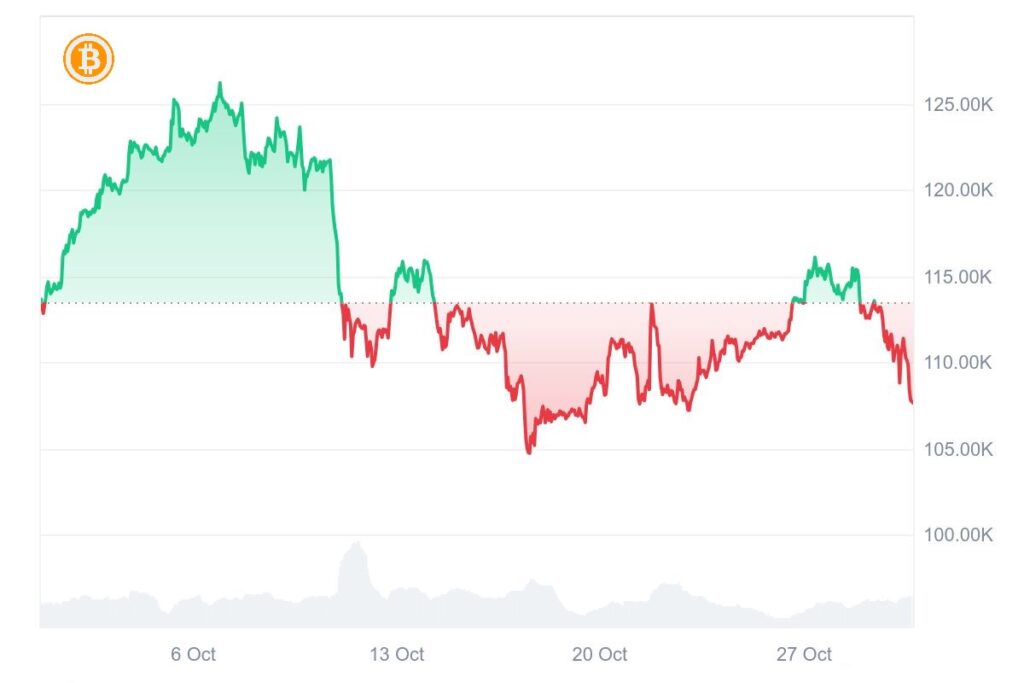
Essentially, analysts expected Bitcoin’s price reaction to follow earlier easing cycles: higher risk appetite, renewed institutional inflows, and relief across risk assets. Yet Bitcoin fell nearly 4 percent, while Ethereum, Solana, and other majors extend losses. The market is still nursing its losses from the earlier crash.

Source: CoinMarketCap

October’s Whiplash: From Tariff Shock to Historic Liquidations

The real damage came earlier in the month. On October 10–11, President Trump stunned markets by announcing a 100 percent tariff on all Chinese tech imports and tighter export controls on semiconductors. The move reignited trade-war fears and triggered panic across global markets.

Crypto, already heavily leveraged, suffered the worst. Within 24 hours, over $19 billion in positions were wiped out, the largest single-day liquidation in crypto history. The event impacted 1.6 million traders and dwarfed past crises such as FTX and Terra Luna.

Bitcoin plunged 18 percent, dropping from an October 6 high of $126,000 to below $105,000. Leading altcoins like Solana, XRP, and Dogecoin also suffered steep double-digit losses as liquidity vanished and traders rushed to unwind positions. Meanwhile, ETF inflows reversed as institutions cashed out, erasing about $370 billion from total market value.

Consequently, this forced liquidation wave created a structural dent in market liquidity. By the time the Fed cut rates and the Trump–Xi trade deal was signed later in the month, traders had already de-risked. ETFs are still selling, and the crypto market sell-off continues as investors use every bounce to exit positions.

Trader Reaction: Crypto Futures in Flux

Following the macro announcements, Bitcoin’s price reaction becomes a textbook “sell-the-news” event. Futures funding rates turned negative across major exchanges, showing that bearish sentiment is taking hold.

Profit-taking and margin calls drove open interest down to its lowest point in six weeks. As one derivatives analyst notes, “Everyone was expecting a recovery rally, but the market is still shell-shocked from the earlier liquidation wave.” Consequently, hesitation to rebuild exposure carries through this so-called good-news week.

Macro Factors Still Weigh on Crypto

Beyond the technical resets, deeper macro issues persist. While the Trump–Xi trade deal softens rhetoric, it fails to resolve disputes over technology and intellectual property.

Meanwhile, Powell’s cautious stance, emphasizing uncertainty about future cuts, undermines hopes of a prolonged easing cycle. Analysts highlight that how Fed policy affects crypto prices depends on clarity. Bitcoin tends to thrive on clear liquidity expansion, not ambiguity.

In parallel, rising bond yields and sticky inflation expectations cap enthusiasm. The Crypto Fear & Greed Index dipped into “fear” territory several times in October, and volatility continues to climb.

Investors asking why Bitcoin is down after the Fed rate cut are discovering that mixed central-bank signals, combined with a fragile derivatives landscape, keep confidence muted.

Market Outlook: Recovery Scenarios and Risks

Analysts remain divided on whether the worst is over. On-chain data shows accumulation zones near $105,000, suggesting some long-term holders are stepping in. Yet institutional ETF flows stay negative.

The Bitcoin price forecast Q4 2025 varies widely. JPMorgan expects consolidation below $115,000, while others see upside potential if liquidity improves. For now, futures open interest remains subdued, indicating that leverage has been flushed out but conviction has yet to return.

Ultimately, stabilization will require steady inflows and a clearer macro narrative, especially a Fed stance that supports sustained risk-taking.

Lessons from October’s “Cursed” Crypto Month

October 2025 is shaping up as the month when both bad and good news fail to help. The early tariff shock exposed how fragile leverage structures have become. Later, the Federal Reserve rate cut and the Trump–Xi deal show that positive headlines alone cannot repair sentiment.

For traders, the key takeaway is caution. When optimism meets structural stress, even favorable news can trigger a crypto market sell-off. The recent weeks prove that the crypto market’s biggest threat is not necessarily policy, but overconfidence amid volatility.

As Q4 unfolds, investors are watching ETF inflows, liquidity recovery, and the Fed’s next signals closely. In such a reactive market, survival depends less on timing headlines and more on navigating the turbulent space between them.

Readers’ frequently asked questions

Why is Bitcoin down after the Fed rate cut?

Markets had already priced in the 25-basis-point rate reduction, so when the decision arrived without a surprise, traders sold the news. Fed Chair Jerome Powell’s cautious tone about future cuts added uncertainty, leading to a muted Bitcoin reaction to the Fed’s rate cut.

How does Fed policy affect crypto prices?

Lower interest rates generally increase liquidity and risk appetite, which can boost crypto valuations. However, when policy guidance is mixed or inflation remains high, traders tend to reduce exposure to volatile assets. The latest meeting shows that how Fed policy affects crypto prices depends on clarity and market confidence, not just rate direction.

What could trigger a Bitcoin recovery in Q4 2025?

Analysts point to three key catalysts: a decisive shift toward dovish Fed communication, renewed institutional inflows into ETFs, and stabilization of derivatives funding rates. If those align, Bitcoin’s momentum could return. Until then, markets remain sensitive to macro headlines and volatility spikes.

What Is In It For You? Action items you might want to consider

Tighten risk guardrails for heightened volatility

Right now, treat every bounce as suspect until trend confirmation. Reduce leverage, cap position sizes, and predefine stop-loss/invalidations instead of reacting intraday. Separate trading from investing: keep long-term allocations ring-fenced so tactical trades don’t force sales at lows.

Track stability signals: ETF flows, funding rates, open interest

Watch for a shift from persistent ETF outflows to net inflows, funding rates moving sustainably back to neutral/positive, and open interest rebuilding without spikes in liquidations. A cluster of these signals often precedes a steadier base.

Calendar key macro catalysts and prepare scenarios

Log upcoming Fed communications, CPI and jobs prints, and major China–U.S. trade headlines. For each event, set “if-then” playbooks (entries, trims, hedges) beforehand to avoid chasing volatility. Reassess plans if liquidity thins or spreads widen ahead of data drops.

- Advertisement -

FEATURED