Home Blog Page 102

U.S. House Approves Blockchain Bill to Bolster National Edge and Formalize Federal Strategy

Photo-realistic image of the U.S. Capitol building with an American flag, overlaid with glowing blockchain nodes and circuit patterns, representing the national blockchain strategy under the Deploying American Blockchains Act of 2025.

In a landmark move signaling the maturation of blockchain policy in the United States, the U.S. House of Representatives has passed H.R. 1664, officially titled the Deploying American Blockchains Act of 2025. This U.S. blockchain bill 2025, introduced with strong bipartisan backing, directs the Secretary of Commerce to create a national blockchain strategy that will coordinate federal efforts, support private sector innovation, and help strengthen America’s global digital position.

The legislation is more than symbolic. It represents Washington’s clearest step yet toward institutionalizing blockchain as a strategic technology. Lawmakers now rank it alongside AI and quantum computing in terms of national importance.

What the Bill Actually Does

At its core, H.R. 1664 requires the Commerce Department to develop a comprehensive blockchain roadmap. This includes:

  • Identifying federal use cases for blockchain applications.
  • Collaborating across federal agencies to ensure technological coherence.
  • Consulting with private sector stakeholders to align innovation with policy.
  • Establishing guiding principles to encourage responsible blockchain development.

The roadmap aims to accelerate blockchain integration across government systems. It also seeks to reduce fragmentation in the domestic regulatory environment, long a challenge for crypto and Web3 projects.

The Global Tech Race: Why Now?

The Deploying American Blockchains Act comes amid growing concern that the United States is falling behind in the global blockchain innovation race. China’s state-backed Blockchain-based Service Network (BSN) and the EU’s regulatory progress with the Markets in Crypto-Assets (MiCA) framework have raised alarm bells in Washington.

Lawmakers from both parties emphasized that a lack of cohesive policy has discouraged Web3 entrepreneurs and investors from operating within the U.S. jurisdiction. Supporters of the bill argue that a national blockchain strategy is essential for setting global standards, fostering innovation, and ensuring the U.S. leads rather than lags in next-generation digital infrastructure.

Institutionalizing Blockchain Strategy

What makes this bill different from prior legislative attempts is its institutional clarity. Rather than issuing piecemeal guidance or punitive enforcement, the U.S. government is now committing to a federal blockchain framework that spans across sectors and stakeholders.

For enterprises, it means potential integration with government systems, procurement clarity, and long-term policy stability. For regulators, it provides a unified structure to guide oversight. And for developers and founders, it creates a more predictable environment to build and scale.

Market Implications and Web3 Outlook

While the bill does not directly regulate cryptocurrencies, many in the industry interpreted its passage as a positive signal for Web3 adoption. Analysts predict that clearer national policy could lead to:

  • Increased capital inflow into U.S.-based blockchain startups.
  • Strengthened public-private partnerships for decentralized infrastructure.
  • A friendlier legal environment for token issuance and on-chain innovation.

Crypto markets responded with cautious optimism, with several leading platforms calling the bill “a pivotal moment” for the U.S. digital asset ecosystem.

What Happens Next?

The legislation now heads to the Senate, where it is expected to face further discussion but has already garnered bipartisan interest. If signed into law, the Deploying American Blockchains Act will require the Secretary of Commerce to deliver a finalized national blockchain strategy within one year.

In parallel, industry stakeholders are already preparing to engage with the Commerce Department to ensure their needs and innovations are reflected in the federal blockchain roadmap.

With the passage of H.R. 1664, the United States is making a formal play to reclaim its leadership in emerging technologies. The Deploying American Blockchains Act of 2025 is more than a legislative accomplishment; it’s a strategic inflection point.

By mandating a coordinated, forward-looking blockchain policy, Washington’s message is clear: the future of digital infrastructure will not be left to chance, and the U.S. intends to lead, not follow.

Readers’ frequently asked questions

How will the national blockchain strategy affect private companies?

Expect the strategy to provide clearer policy direction, encourage public-private collaboration, and support blockchain adoption in areas like supply chains, identity, and digital infrastructure. It may also reduce uncertainty for developers and investors.

Does the bill mean the U.S. is finally recognizing blockchain as critical infrastructure?

Yes. By mandating a federal strategy and placing blockchain alongside AI and quantum computing, the bill signals that blockchain is now part of the national innovation agenda.

What should Web3 startups or crypto businesses do in response?

Companies should begin monitoring Commerce Department initiatives and prepare to engage during public consultations. Aligning with national priorities could improve funding access, compliance readiness, and long-term viability.

What Is In It For You? Action items you might want to consider

Monitor upcoming Commerce Department announcements

Once the bill is signed into law, the Commerce Department will begin drafting the national blockchain strategy. Track consultations, public feedback opportunities, and roadmap milestones.

Align your project roadmap with national blockchain priorities

Start identifying how your technology or service fits within federal priorities such as supply chain resilience, identity solutions, or data integrity. Early alignment could offer a competitive edge in future grants or partnerships.

Prepare for increased government and enterprise demand

Federal recognition of blockchain may lead to broader adoption in public-sector infrastructure and regulated industries. Businesses should assess their readiness to meet compliance, scalability, and security expectations.

Bitcoin Mining Reels from Historic Hashrate Swings — But Miners Refuse to Sell

Generate the SEO optimized alt text for the image.

Bitcoin’s hashrate drop in late June sent shock waves through the crypto industry. It marked the most severe network contraction since China’s 2021 mining ban. Yet despite falling revenues and a turbulent geopolitical backdrop, Bitcoin miners are HODLing, not capitulating. This signals a structural shift in the mining economy, raising new questions about Bitcoin’s network health.

The Numbers: Historic Hashrate Drop Followed by Rapid Rebound

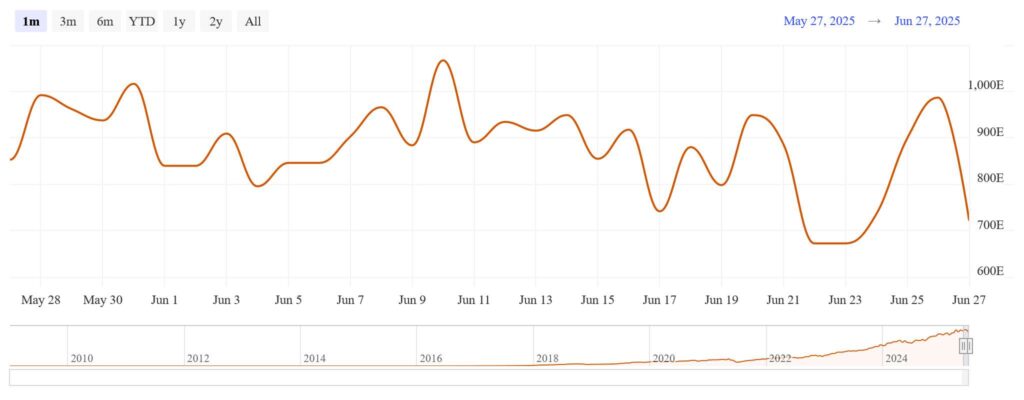
Between June 15 and June 24, the Bitcoin hashrate dropped by roughly 15%. It fell from around 944 EH/s to just under 800 EH/s. This marked its lowest levels in eight months. The plunge triggered expectations of a 9% downward adjustment in Bitcoin mining difficulty, the largest since mid-2021.

Source: BitcoinVisuals.com

Then, on June 26, the network rebounded sharply, pushing the hashrate metric up by nearly 30% in a single day. It was one of the fastest recoveries in recent memory.

Root Causes: More Than Just a Power Bill Problem

What caused the sharp network contraction? Several overlapping factors likely contributed:

  • Energy cost pressures: Skyrocketing electricity prices have squeezed Bitcoin mining profitability. This hit miners in regions reliant on fossil fuel infrastructure.
  • Geopolitical instability: Some analysts have linked the mid-June network disruption to reported U.S. cyber or military actions targeting Iranian infrastructure. While Iran accounts for an estimated 6–7% of global Bitcoin hashrate, there is no hard evidence confirming a direct outage. However, the timing of the decline overlapped with the regional escalation, making it a credible if unverified factor behind the Bitcoin hashrate drop. This has fueled speculation that Iran’s Bitcoin mining may have been temporarily disrupted during the crisis.
  • Operational bottlenecks: Grid constraints in Central Asia and delays in China may have caused temporary reductions in hashpower.

Revenues Sink, But Miner Selling Stalls

Miner revenue is falling. On June 22, daily Bitcoin miner revenue dropped to $34 million, a two-month low. Transaction fees have also declined. This has further reduced profitability.

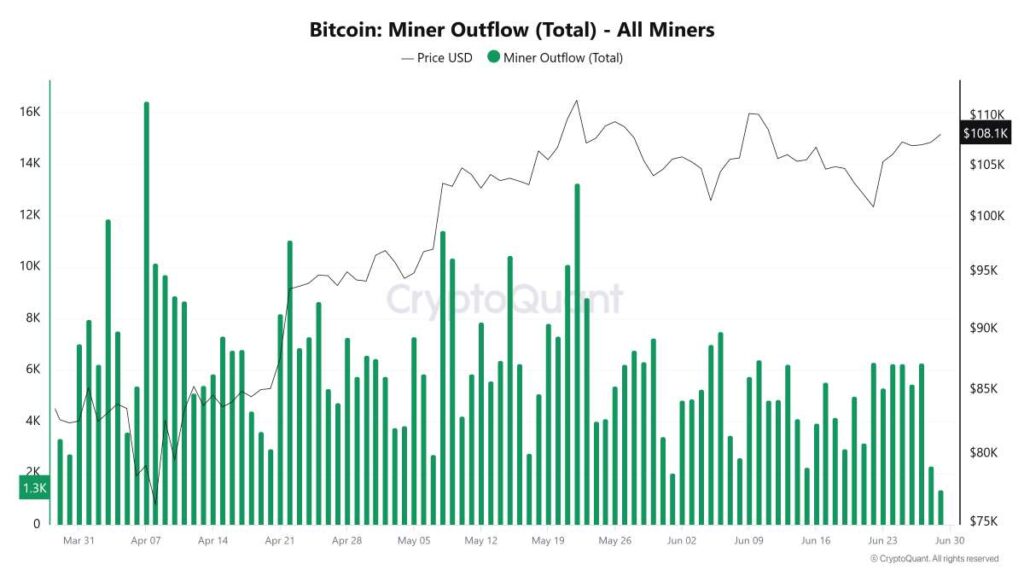
Yet miners are not rushing to sell. Bitcoin miners’ selling remains minimal. Outflows from miner wallets dropped from 23,000 BTC per day in February to only 6,000 BTC by late June. Even early Satoshi-era wallets stayed quiet, with less than 150 BTC sold so far in 2025.

The decline in Bitcoin miner revenue has not triggered widespread selloffs. This stands in contrast to earlier periods of Bitcoin miners selling, especially in early 2024.

Source: CryptoQuant

Why Are Miners HODLing?

This is not April 2024 all over again. After the halving, weaker miners sold heavily. But now, the landscape has changed. Miners with efficient operations and large treasuries are staying patient.

  • Low-cost miners dominate: Companies like CleanSpark and Marathon maintain profitability. They operate with breakevens far below market price, even during the Bitcoin hashrate drop.
  • Difficulty relief is imminent: A 5–6% Bitcoin mining difficulty adjustment is expected. This could improve Bitcoin mining profitability by reducing energy demands.
  • Accumulation strategy: Wallets holding 100 to 1,000 BTC have added over 4,000 BTC since April. This suggests a broader mid-tier accumulation trend.

Consolidation, Not Capitulation

This shake-up looks more like a reset than a collapse. Unprofitable operators are exiting quietly. Stronger miners are consolidating their network share. This ongoing consolidation shows crypto mining is a maturing industry. Operational resilience now matters more than sheer scale.

Risks still remain. Energy prices could rise further. Political tensions could escalate in mining regions like Iran or Kazakhstan. If that happens, a delayed miner capitulation is still possible.

Conclusion: Miner Patience May Signal Bullish Intent

While the Bitcoin hashrate drop drew headlines, the real story lies in what didn’t happen. There was no panic selloff. Bitcoin miners are HODLing, even with falling revenue. That shows confidence — or at least a calculated bet on future gains.

The unexpected Bitcoin hashrate rebound provided temporary relief. But Bitcoin’s long-term network health will depend on how the network responds to economic and regional pressure.

Readers’ frequently asked questions

Did the Iran attack cause the Bitcoin hashrate drop?

Possibly, but not conclusively. Some analysts linked the timing of the drop to reported U.S. actions targeting Iranian infrastructure. Iran is estimated to contribute 6–7% of the global Bitcoin hashrate. However, no direct outage has been confirmed, and other global factors were also at play.

Where are most Bitcoin miners located today?

The majority of Bitcoin miners operate in the United States, particularly in Texas and other energy-abundant states. Other notable mining hubs include Kazakhstan, Russia, and parts of Canada. These regions offer favorable electricity costs, regulatory frameworks, or access to stranded energy, all critical for maintaining competitive margins in mining.

How will the difficulty adjustment affect miners?

The expected 5–6% drop in mining difficulty will reduce the average energy cost per block. This should increase profitability for the remaining miners and could encourage some to bring machines back online, stabilizing the network.

What is in it for you? Action items you might want to consider

Understand why hashrate matters for Bitcoin’s stability

A sharp drop in Bitcoin’s hashrate can slow down transactions and signal miner stress. Awareness of these shifts helps you read the market beyond price charts.

Watch how miner behavior influences supply pressure

When miners hold onto their Bitcoin instead of selling, it can reduce selling pressure in the market. That’s often seen as a bullish signal, but only if it lasts.

Stay informed about global events that affect mining regions

Geopolitical events, energy crises, or regulations in countries like the U.S., Iran, or Kazakhstan can all impact mining operations. These changes may influence Bitcoin’s security, decentralization, or price trends over time.

Can KRAK Beat PayPal? Kraken Enters Fintech Arena With 10% Yields and P2P Transfers

Digital illustration of the KRAK mobile app interface surrounded by cryptocurrency symbols (Bitcoin, Ethereum, USDC) and fiat currencies (€, $, £), with a glowing world map in the background and faded logos of PayPal and Cash App, representing global peer-to-peer payments and fintech disruption.

Kraken has entered the global fintech race with a bold new offering: the KRAK app, an all-in-one platform for peer-to-peer crypto transfers, fiat payments, and high-yield digital wallets. With support in over 110 countries, the Kraken KRAK app positions itself as a formidable PayPal crypto alternative, aiming to merge the best of decentralized finance with the ease of modern digital banking.

This marks a major step in Kraken’s bid to compete directly with fintech heavyweights like PayPal, Venmo, and Cash App; only this time, crypto takes center stage.

What Is the KRAK App?

KRAK is not just another payment app. Described as a Kraken global money app, it’s designed to simplify the way people send crypto globally and move fiat across borders. All of this happens within a single, intuitive interface.

The Kraken payments app enables:

  • Free peer-to-peer transfers of crypto and fiat
  • Yield-bearing accounts with potential earnings up to 10%
  • Instant global payments with minimal fees

While it leverages Kraken’s infrastructure, the KRAK brand is independent. This signals Kraken’s intent to go mainstream beyond its exchange roots.

Kraken’s Competitive Pitch: Disrupting Fintech from Within

Kraken isn’t hiding its ambition. The KRAK app vs PayPal comparison is built into the product’s DNA. Legacy platforms rely on centralized systems and region-bound frameworks. In contrast, KRAK champions borderless crypto payments, crypto self-custody, and financial sovereignty.

From a functionality standpoint, it’s shaping up to be KRAK vs Cash App. One critical difference: KRAK integrates decentralized infrastructure and yield mechanics.

Key differentiators include:

  • Access to both traditional and digital currencies
  • Control over private keys (for supported assets)
  • A non-custodial roadmap in future updates

In a world where apps like Venmo and PayPal charge fees and impose regional limits, Kraken wants KRAK to serve as a crypto payment platform that works anywhere, anytime.

The 10% Yield Pitch: Real Incentive or Risky Play?

Among KRAK’s most attention-grabbing features is its high-yield crypto app functionality. It promises users up to 10% returns by opting into staking or savings services within the app.

However, Kraken has yet to fully disclose the underlying mechanisms. Yields might be sourced from DeFi protocols, on-chain staking, or other financial products. This lack of clarity raises questions about risk exposure and sustainability. That’s especially important in a post-Celsius, post-Terra market.

Still, the pitch is strong: earn yield on crypto and earn interest with crypto while enjoying seamless payments.

Global Reach: 110+ Countries and Counting

Unlike region-locked fintech apps, Kraken’s KRAK global money app model is already live in over 110 countries. From North America to Southeast Asia, Kraken targets underserved markets. In these regions, crypto fiat payments can help fill the gaps left by legacy banks.

Australia is seeing a phased rollout, and more regional integrations are planned. The goal: a truly borderless app that supports local currencies alongside crypto. There are no artificial limitations or region-based restrictions.

In Europe, Kraken’s expansion gets a boost from a major regulatory win. The company was recently approved under the Markets in Crypto-Assets (MiCA) framework. The MiCA license allows Kraken to operate legally across all EU member states under one rulebook. It eliminates fragmented country-by-country compliance.

This makes KRAK one of the first fully compliant crypto payment apps in the European Union. It also gives Kraken a first-mover advantage in one of the world’s most regulated financial regions.

Regulatory Readiness in a Fragmented World

Operating across so many jurisdictions means Kraken must meet a patchwork of global compliance regimes, but the KRAK app is designed to handle this. It accommodates both KYC/AML requirements and Kraken’s long-standing compliance-first reputation.

In the EU, Kraken’s new MiCA license provides broad legal permission to offer crypto custody and payments. It lets KRAK serve millions of users in the EU with full regulatory clarity. That’s an advantage many crypto fiat payments apps still lack.

As Kraken expands compliance coverage, future updates are expected to enhance crypto self-custody payments. This aligns the app more closely with decentralized finance principles.

While the app’s crypto-native design may invite scrutiny in some regions, Kraken seems ready. It’s confident it can scale KRAK globally without compromising its mission of financial freedom and innovation.

Reactions and Market Outlook

Initial industry reactions range from cautious optimism to full-blown enthusiasm. Some critics are asking for more transparency around the app’s yield mechanisms. Others praise its clean design, crypto-native structure, and payments-first approach.

If KRAK succeeds, it could redefine what a PayPal crypto alternative looks like. It may also force fintech incumbents to adopt Web3 functionality or risk losing relevance.

Conclusion: A Bold Move Into Everyday Finance

With KRAK, Kraken isn’t just a crypto exchange anymore. It’s staking a claim in everyday finance. Kraken’s KRAK app blends convenience, control, and opportunity in a way that legacy players haven’t yet delivered.

Can Kraken turn this into a dominant position in the market? That remains to be seen. But one thing is certain: fintech disruption is no longer hypothetical. It’s here and it runs on crypto.

Readers’ frequently asked questions

Is the KRAK app available to users in Europe?

Yes. Kraken’s MiCA license allows it to offer the KRAK app in all 27 EU member states. This ensures full legal compliance across the European Union.

Do users need to complete KYC to use the KRAK app?

Yes. Like Kraken’s main platform, the KRAK app requires identity verification in accordance with global KYC and AML regulations. The process may vary slightly depending on your country of residence.

Can I transfer money between Kraken and KRAK?

Yes. Although KRAK is branded separately, it is built on Kraken’s infrastructure. Users can move funds between the two platforms, but specific transfer options may depend on regional availability and regulatory status.

What Is In It For You? Action items you might want to consider

Sign up for the KRAK app in your region

The app is available in over 110 countries. EU residents benefit from MiCA-backed legal clarity, making it easier to onboard and use Kraken’s KRAK app for crypto-fiat payments with regulatory confidence.

Assess yield options carefully

KRAK advertises yields of up to 10%, but the mechanisms remain partially undisclosed. Users should review all terms and disclosures thoroughly and evaluate the associated risks before opting into earning features.

Compare KRAK to fintech alternatives

Fintech users currently on platforms like Revolut, PayPal, or Cash App should compare transaction fees, custody models, and international support to decide whether KRAK better fits their financial needs.

Sanctions, Sovereignty, and Satoshi: Is Russia Building a Parallel Crypto Economy?

A photo-realistic image showing a glowing digital map with Moscow illuminated and data streams linking it to BRICS nations. In the foreground, a gold Bitcoin coin and Russian flag sit beside a closed SWIFT terminal, symbolizing Russia’s emerging crypto economy and financial decoupling.

Russia’s pivot toward blockchain has sparked a provocative question: Is the country building a parallel crypto economy, one designed to operate outside the influence of Western institutions? As sanctions tightened and SWIFT access narrowed, Moscow shifted from crypto hostility to crypto utility. But this evolution was never about decentralization. It was about sovereignty.

Over the past six articles, we’ve mapped how the country moved from a proposed crypto ban to a multi-pronged digital finance strategy. With legal Bitcoin mining, state-licensed platforms like Sberbank DFA, and the foundation of a crypto economy designed to bypass Western systems, Russia’s crypto architecture now functions like a state-walled garden: accessible only to the powerful and built for strategic goals.

This final installment connects those threads into a bigger picture: a sovereign digital ecosystem using blockchain, but rejecting its liberating ethos.

From Isolation to Innovation

In 2021, the Central Bank of Russia (CBR) pushed to ban all crypto activities. The rationale? Criminal risk, capital flight, and financial instability. But the geopolitical calculus changed dramatically in 2022. Sanctions targeting Russia’s central bank, trade finance, and dollar reserves prompted a digital rethink.

In August 2024, they passed a law to legalize Bitcoin mining. It took effect on November 1, 2024, and mining was now legal for registered entities under state energy constraints. By June 2025, Sberbank launched structured notes tied to Bitcoin, offering institutional investors exposure through regulated financial products. The Ministry of Finance and CBR began allowing crypto to settle cross-border trade deals, especially with BRICS-aligned partners.

The shift was not ideological. It was adaptive. Crypto became a tool to move value, preserve access to global trade, and absorb energy surpluses without touching Western rails.

Infrastructure of a Parallel Economy

Russia has not simply adopted crypto; it has redesigned it to fit within a command economy.

  • Mining: Legalized in energy-rich regions for export only, with state oversight on electricity usage and tax remittance.
  • Platforms: DFA-licensed platforms like Atomyze and Lighthouse tokenize government bonds, commodities, and digital rubles.
  • Cross-border pilots: BRICS corridors and bilateral crypto-settlement experiments are emerging as SWIFT alternatives.
  • Regulatory asymmetry: Domestic retail use remains banned, while institutional use for cross-border activity is encouraged.
  • Sberbank’s dual role: As both issuer and market maker, it embodies the merger of public goals and private infrastructure.

The result is a controlled but functional framework: a Russian crypto economy tailored for strategic resilience.

Centralized Sovereignty, Not Decentralized Freedom

What Russia is building is not DeFi. There are no open wallets, public blockchains, or user-owned smart contracts. Every component is permissioned. Each platform is licensed. All transactions are traceable.

This model abandons the ideals that animated Bitcoin’s creation: openness, anonymity, and disintermediation. Instead, Russia is embracing crypto as a tool of sovereign digital mercantilism. It doesn’t use Blockchain to free markets. It uses it to route around them, under state control.

This approach echoes China’s model of digital centralization. But while Beijing focuses on the digital yuan, Moscow is experimenting with tokenized commodities and Bitcoin-linked derivatives that serve institutional needs.

Parallel but Not Independent

Russia’s crypto infrastructure is parallel, but not yet fully sovereign. The country still relies on Bitcoin, Ethereum, and other global assets for liquidity, mining, and valuation benchmarks.

Its licensed platforms are domestic in architecture but cut off from global interoperability. There is no native Russian stablecoin accepted abroad. No homegrown blockchain standard rivaling Ethereum. Yet what Russia has built is enough to reduce dependence on SWIFT and FX settlement networks.

This semi-sovereign stance may be a deliberate compromise: build enough to transact, evade, and innovate, without challenging international financial norms too directly.

Risk and Friction

This strategy is not without complications.

  • Over-centralization risks stifling innovation. Private developers can’t join in. Retail participation is minimal.
  • Institutional silos create regulatory friction between the Ministry of Finance, CBR, and energy regulators.
  • International integration is unstable. Some BRICS members are reluctant to fully adopt crypto-linked trade rails.
  • Legal inconsistency persists. Crypto is both banned and encouraged, depending on jurisdiction and use case.

The result is a fragmented but functional system: enough to operate, but far from frictionless.

Conclusion: Satoshi’s Shadow

Russia is not building a decentralized future. It is building a parallel one.

Russia’s crypto economy is engineered for control, not autonomy. It uses blockchain not to democratize finance but to fortify sovereignty. This is a state-centric digital strategy, not a libertarian experiment.

Whether this crypto economy will scale or stagnate depends on its ability to balance innovation with control.

Yet in the shadow of Satoshi’s vision, it remains a powerful case study: crypto, once imagined as a tool of liberation, is now also a tool of geopolitical adaptation. Russia’s version of crypto is many things: functional, strategic, and nationalist, but it is not free.

From Blueprint to Reality: Tracing Russia’s Crypto Shift

U.S. Recovers $225M in Tether with Coinbase Help in Largest Pig Butchering Crypto Bust

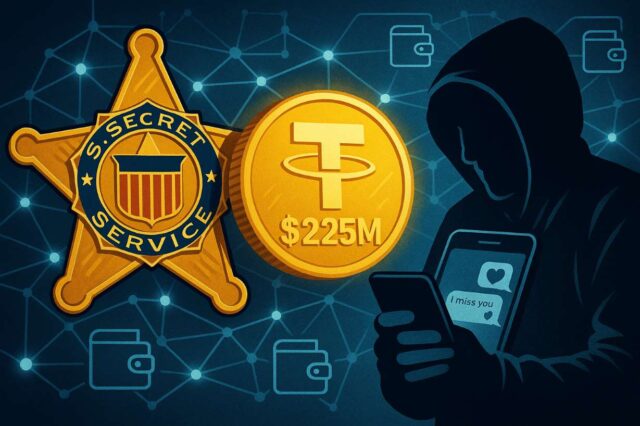
Illustration of a U.S. Secret Service badge, a $225M Tether (USDT) coin, and a hooded scammer texting “I miss you,” representing a pig butchering scam and crypto fraud crackdown.

In a historic enforcement action, the U.S. Secret Service has seized $225 million worth of Tether (USDT) linked to a global pig butchering scam, marking the largest crypto recovery of its kind. Investigators tracked illicit transactions across hundreds of wallets, not least with critical forensic support from Coinbase. What they unraveled was a complex network of transnational crypto fraud. This USDT seizure reflects growing cooperation between centralized exchanges like Coinbase and federal agencies in targeting crypto-enabled financial crimes.

What Is a Pig Butchering Scam?

The pig butchering scam, a term derived from Chinese slang, blends romance, investment, and psychological manipulation. Victims are “fattened up” over weeks or months through fabricated relationships, often via dating apps or social media. Once they secured the trust, scammers encourage victims to invest in fraudulent crypto platforms or send assets directly. When the victims try to withdraw funds, they’re locked out, their investments gone.

Sadly, such romance scam schemes have surged globally, targeting elderly individuals, young professionals, and even experienced investors.

https://twitter.com/CrispyBull/status/1922280123480351119

The $225 Million Crypto Seizure

Federal investigators traced the $225 million in crypto to a fraud ring spanning multiple jurisdictions. The U.S. Department of Justice (DOJ), in partnership with the U.S. Secret Service, filed a formal crypto forfeiture complaint to seize the funds held in Tether wallets. According to the filing, they consolidated the funds from thousands of victims defrauded through fake investment platforms.

Law enforcement froze the wallets after flagging them using blockchain analytics and live tracking tools. The Secret Service executed its crypto crackdown across multiple states and coordinated with foreign counterparts, signaling the scam’s international scale.

How the Scam Was Orchestrated

The fraud ring is believed to be operated by organized crime syndicates based in Southeast Asia and China. Scammers exploited anonymity tools like mixers, decentralized platforms, and proxy wallets to obfuscate the origin of funds. However, investigators observed these rapid fund movements, layering transactions to avoid detection.

Despite employing such a sophisticated laundering network, they couldn’t escape modern crypto asset tracing tools. Smart contract anomalies and wallet clustering flagged the activity as part of a high-risk fraud pattern.

Coinbase’s Role in the Crackdown

Coinbase directly supported law enforcement through its compliance and investigations unit. The exchange used proprietary tools to flag and map suspicious activity across its platform and external blockchains, contributing significantly to the Coinbase USDT seizure.

The level of forensic support showcased by Coinbase is becoming standard practice among top crypto exchanges. The case sets a new precedent for industry–government collaboration in disrupting fraud, enhancing transparency, and reinforcing compliance obligations.

With the DOJ filing the crypto forfeiture complaint, the seized funds are now under federal custody. If the court grants full forfeiture, the U.S. government intends to begin a restitution process to return funds to verified victims of the pig butchering scams. While this could take months, legal experts believe this may become a benchmark model for handling large-scale crypto asset recovery.

Implications for Crypto Regulation and Enforcement

The $225 million crypto seizure underscores the increasing risks scammers face. Enforcement agencies finally improve detection tools and deepen public-private partnerships. The operation also reinforces the narrative that crypto is no longer a lawless frontier. On the contrary, the sector is maturing with traceability, oversight, and accountability.

For crypto firms, this case illustrates the need for advanced KYC/AML procedures and rapid incident response capabilities. For users, it’s a reminder to stay vigilant and verify all platforms and contacts before transacting.

The takedown of this expansive pig butchering scam, culminating in the largest-ever USDT fraud recovery, demonstrates how cooperation between centralized exchanges like Coinbase and law enforcement agencies can yield tangible results. As the crypto scam enforcement ecosystem evolves, bad actors will face an increasingly narrow path to operate, and victims may finally see justice.

Readers’ frequently asked questions

Will victims of the pig butchering scam get their money back?

If the court approves the DOJ’s forfeiture filing, the U.S. government may begin a restitution process. Verified victims could receive partial or full reimbursement, depending on the outcome of the legal proceedings.

What role did Coinbase play in the asset recovery?

Coinbase assisted law enforcement with forensic analysis and blockchain tracing. The exchange flagged suspicious wallet activity and supported investigators with its internal compliance tools.

How can I avoid falling for a pig butchering scam?

Be cautious of unsolicited investment offers, especially those tied to romantic or social contacts. Always verify platforms before sending funds, and avoid apps or websites not registered with regulatory bodies.

What Is In It For You? Action items you might want to consider

Audit your crypto investment platforms

Ensure that any app or website you use for crypto investing is licensed, transparent, and listed with your jurisdiction’s financial authorities.

Strengthen personal security practices

Avoid engaging with unsolicited DMs, especially those involving romance or financial discussions. Enable 2FA and monitor wallet activity regularly.

Watch for regulatory guidance on restitution

If you believe you’ve been a victim of a similar scam, follow updates from the DOJ’s Asset Forfeiture Program for potential claims and recovery steps.

- Advertisement -

FEATURED