Home Blog Page 124

GPS Token Plunge Sparks Crisis: Binance’s Market Maker Ban Triggers Community Backlash and Compensation Concerns

Binance bans GPS token market maker

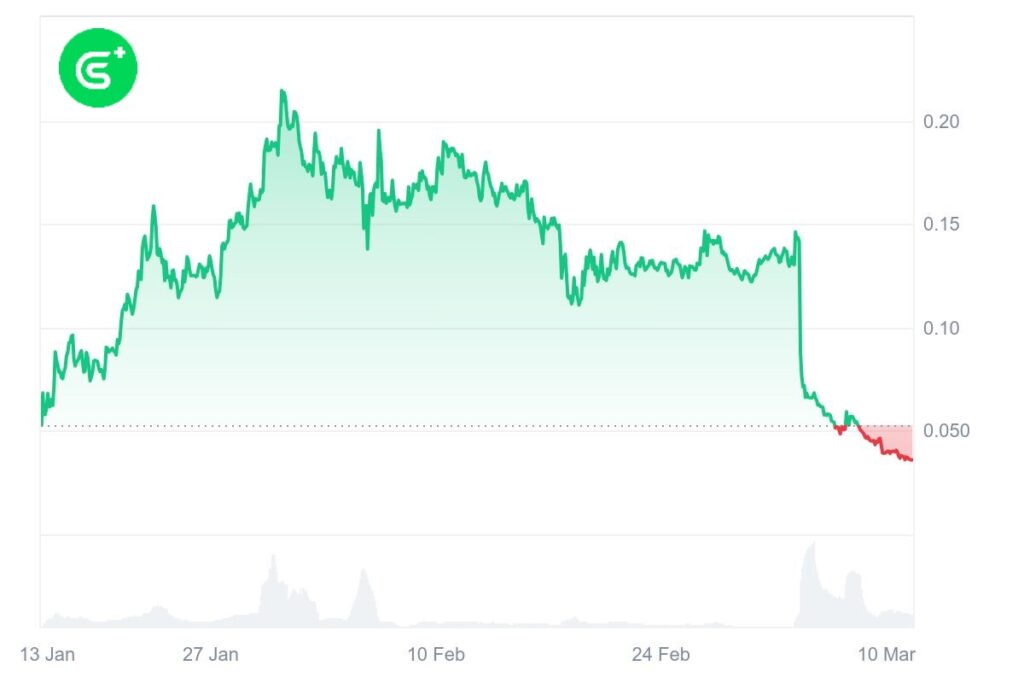
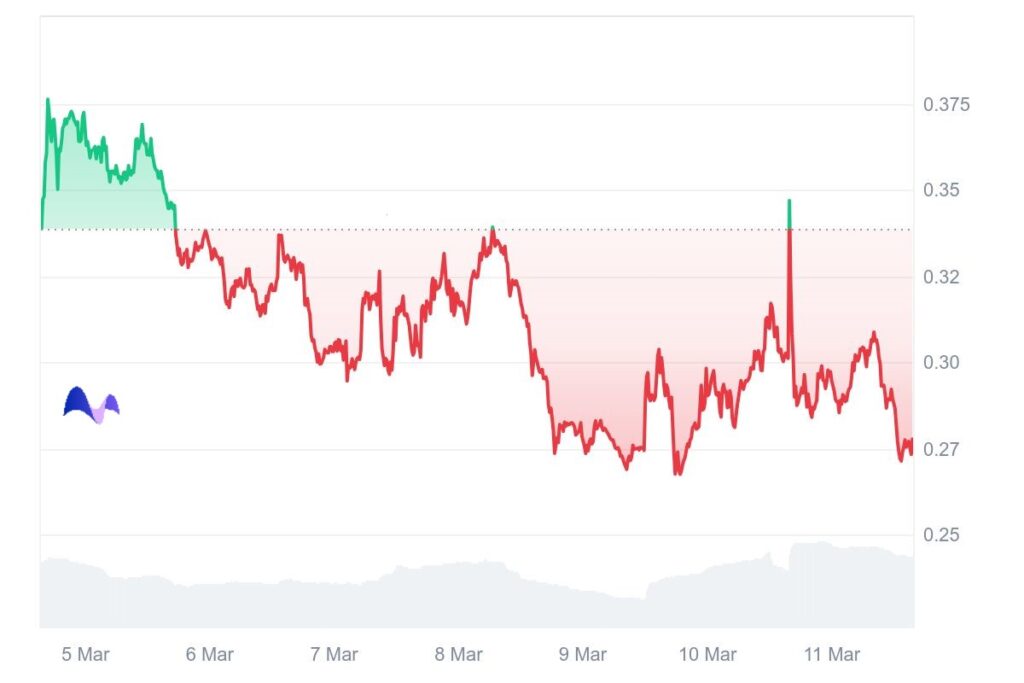
Binance shook the cryptocurrency market announcing the termination of a market maker responsible for severe trading irregularities involving the GoPlus Security (GPS) and MyShell (SHELL) tokens. The decision came after an internal investigation revealed that the market maker had aggressively offloaded 70 million GPS tokens between March 4 and March 5, 2025, without placing corresponding buy orders, leading to an abrupt 60% price drop.

Binance has since confiscated the market maker’s funds and pledged to compensate affected investors, yet uncertainty surrounding the process has fueled community backlash and concerns over investor protection. In response, GoPlus Security has launched its own internal probe into the incident, denying allegations of insider trading.

Investor Outrage and Demands for Compensation

The fallout from the market maker’s removal has sparked widespread criticism from GPS token holders. The sudden price collapse caught many caught off guard. Traders have voiced frustration over the lack of immediate compensation details. They questioned whether Binance’s decision would be sufficient to cover their losses.

Binance confirmed they would use funds confiscated from the market maker to reimburse affected users. However, the exchange failed to disclose the specific amount recovered and did not define the exact criteria for compensation eligibility. Many investors fear they could be left with significant losses. Those who entered leveraged positions or bought GPS tokens at higher prices before the crash are particularly concerned.
GoPlus Security Responds Amid Transparency Concerns

GoPlus Security, the issuer of the GPS token, has sought to distance itself from the controversy. The issuer stated the market maker did not inform them in advance about the activities or Binance’s decision to list GPS on March 4. The company has launched an internal investigation into the abnormal trading activity, but skepticism remains high among investors.

Adding to the controversy, some reports suggest that the banned market maker might have ties to prominent figures in the industry. While Binance has not disclosed its identity, speculation within the community has linked the entity to major crypto trading firms. However, companies such as Animoca Brands and GSR have publicly denied involvement, fueling further uncertainty.

Binance’s Market Integrity Efforts – But Are They Enough?

Binance’s decision to remove the market maker aligns with its broader efforts to ensure market integrity and prevent manipulative trading practices. The exchange reaffirmed its strict market-making principles, which require participants to:

  • Maintain both bid and ask orders
  • Ensure adequate order sizes at different price levels
  • Prevent market disruption through excessive order cancellations or aggressive sell-offs

However, critics argue that Binance’s reactive approach does little to prevent future incidents of this nature. The controversy surrounding GPS and SHELL raises deeper concerns about investor protection and the lack of safeguards against price manipulation in token listings.

A Broader Crypto Market Challenge

The GPS token crash is not an isolated event. Cases of market makers engaging in questionable trading practices have surfaced before, raising questions about exchange oversight and accountability. With investor sentiment already fragile due to recent market downturns, the incident has exacerbated distrust in centralized exchanges and reignited calls for greater transparency in market-making agreements.

Binance’s handling of the situation will serve as a test case for investor protection policies in crypto markets. For now, affected GPS holders are left waiting for clearer compensation guidelines. Whether this marks a turning point in exchange accountability or just another temporary controversy remains to be seen.

Readers’ frequently asked questions

What is a market maker, and how can it manipulate a token’s price?

A market maker is a trading entity, usually an individual or a firm, responsible for providing liquidity to a market by placing both buy and sell orders for a token. This ensures that traders can easily buy and sell assets without significant price fluctuations due to low liquidity. However, suppose a market maker does not follow fair trading practices. In that case, it can manipulate the price by aggressively selling a large quantity of tokens while placing few or no buy orders. This can create an artificial sense of market pressure, causing a token’s price to drop sharply, as seen in the GPS token incident. Market makers are supposed to stabilize prices. But when they act irresponsibly, they can instead destabilize the market and cause significant losses for retail traders.

How does Binance’s compensation plan work, and will affected users get their money back?

Binance has stated that it confiscated the funds from the banned market maker and will use them to compensate affected users. However, Binance has not yet provided specifics. How much was recovered, who qualifies for compensation, or what percentage of losses will be reimbursed? This lack of clarity is one of the main reasons why the crypto community is concerned. Typically, in cases like this, Binance or the affected projects (such as GoPlus Security) might distribute compensation based on users’ trading records, prioritizing those who suffered losses directly linked to the market maker’s actions. Until Binance provides more details, users remain uncertain about whether they will receive full, partial, or no compensation at all.

What does this incident mean for investors holding GPS or other newly listed tokens?

Removing the market maker and Binance investigating highlight the risks of newly listed tokens, especially those with low liquidity and high volatility. GPS investors now face increased uncertainty because Binance has placed the token under a Monitoring Tag. Users must pass a risk quiz every 90 days to continue trading it. This suggests that Binance considers GPS to be a high-risk asset. For traders and investors, this incident serves as a reminder to exercise caution when trading newly listed tokens, as they can be vulnerable to manipulative practices and sudden price fluctuations. It also reinforces the need to research token projects and market conditions before making investment decisions.

What Is In It For You? Action Items You Might Want to Consider

Be Wary of Newly Listed Tokens with Low Liquidity

If you’re trading a recently listed token like GPS, always assess its liquidity, market depth, and trading volume before making a move. Low-liquidity tokens are more vulnerable to price manipulation by market makers, leading to sharp crashes like the one seen with GPS. Use tools like order book analysis and on-chain data to spot unusual trading patterns before entering a position.

Monitor Exchange Announcements for Red Flags

Binance’s Monitoring Tag on GPS should be a clear warning – such flagged tokens often carry higher risks due to volatility or security concerns. If a token you’re holding gets tagged or if an exchange issues a sudden rule change, reassess your position immediately. Staying ahead of these updates can help you adjust your risk exposure before it’s too late.

Secure Profits and Set Stop-Losses to Protect Against Market Manipulation

Given the increasing number of cases involving market makers acting against retail traders, it’s essential to implement strict stop-loss strategies to safeguard your capital. If you’re holding a highly speculative or newly listed token, consider taking profits at key levels rather than waiting for long-term gains. This way, you lock in returns while minimizing potential losses from unpredictable sell-offs like the one that hit GPS holders.
Bitcoin Reserve Announcement Falls Flat: Market Expectations Misaligned with Reality

Strategic Bitcoin Reserve disappoints

The crypto market waited with bated breath as President Trump signed an executive order officially creating the first-ever Strategic Bitcoin Reserve and Digital Asset Stockpile. Yet, rather than sparking the awaited bull run, Bitcoin tumbled nearly 6%! What a stark gap between sky-high investor expectations and the government’s cautious stance. With no immediate government purchases and only a commitment to hold seized assets, the administration’s symbolic move left traders deflated. Did investors bet too heavily on rumors, or did the White House miss an opportunity for decisive action?

Market Expectations vs. Reality

Investor anticipation soared in the weeks leading up to President Trump’s signing of the executive order officially establishing the first-ever Strategic Bitcoin Reserve and Digital Asset Stockpile. Traders and market participants widely expected the U.S. government to actively purchase significant quantities of Bitcoin, potentially initiating a major bullish catalyst. Speculation was rampant, driving Bitcoin prices to recent highs amid expectations of substantial institutional endorsement. However, the executive order clarified that the reserve would only utilize previously seized Bitcoin holdings. It did not outline any immediate plans for further market acquisitions, significantly underwhelming investor hopes.

Investor Disappointment Fuels Market Decline

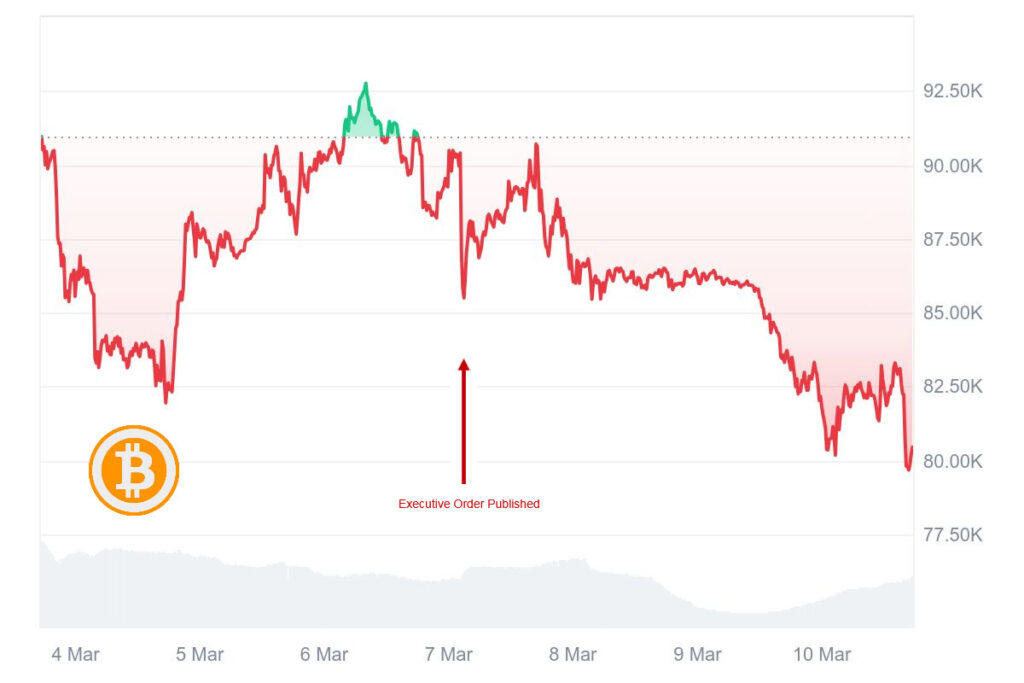
The immediate response was stark. Bitcoin plunged roughly 6%, declining from around $90,400 to about $85,000 in the wake of the announcement. This rapid downturn underscored the significant disparity between optimistic market speculation and the conservative governmental stance. The sharp reversal illustrated a classic “buy the rumor, sell the news” scenario. Retail investors initially surged into Bitcoin expecting the strategic reserve to become a bullish catalyst; only to quickly unwind their positions upon realizing the absence of anticipated government purchases.

Source: Coinmarketcap.com

Broader Economic Challenges Compound Sentiment

Prevailing macroeconomic headwinds further dampened investor sentiment. Persistent inflation rates above central bank targets have compelled the Federal Reserve and other central banks worldwide to sustain higher interest rates. Higher rates generally make riskier assets like cryptocurrencies less attractive due to increased opportunity costs and a stronger U.S. dollar, drawing investors toward more stable assets such as bonds or cash holdings. Additionally, geopolitical tensions, including new tariffs imposed by the U.S. on major trade partners such as Canada, Mexico, and China, as well as uncertainties related to post-conflict economic strategies in Europe and Ukraine, have intensified global market anxiety. This risk-averse environment markedly diminished the market’s enthusiasm for speculative investments like cryptocurrencies.

Institutional vs. Retail Investor Dynamics Reveal Divergent Reactions

Institutional investors viewed the reserve’s establishment as largely symbolic, underscoring disappointment with the lack of immediate governmental purchases. Significant outflows from cryptocurrency ETFs evidenced this sentiment. Institutional products experienced withdrawals exceeding $1 billion shortly after the announcement. The scale of these outflows highlighted a cautious institutional stance and profit-taking behavior. Conversely, retail traders, who had heavily speculated based on rumors, swiftly exited positions when it became clear that the anticipated buying wave would not materialize. This divergence reinforced the sharp market correction, illustrating a clear split between speculative retail optimism and prudent institutional caution.

Impact on Altcoins and Long-Term Outlook

The announcement also had notable implications for altcoins, including Ethereum, XRP, Solana, and Cardano, which were initially buoyed by inclusion in the Digital Asset Stockpile. However, this initial enthusiasm faded rapidly as it became clear that these assets were merely held due to seizure rather than any strategic governmental endorsement. Unlike Bitcoin, which at least received a commitment of long-term holding, altcoins were positioned ambiguously. This triggered even steeper price corrections and greater market uncertainty around their future government treatment.

The introduction of a Strategic Bitcoin Reserve is symbolically significant. However, the event demonstrated the considerable divergence between investor optimism and governmental caution. Combined with challenging economic conditions and divergent institutional-retail dynamics, the crypto market experienced a notable short-term dip. Investors are now recalibrating their strategies and expectations. They must carefully navigate an environment marked by mixed signals from policymakers and persistent macroeconomic instability.

Readers’ frequently asked questions

What exactly is a Strategic Bitcoin Reserve?

A Strategic Bitcoin Reserve is a government-controlled reserve, similar to reserves of gold or foreign currency. In this case, it’s specifically holding Bitcoin. The U.S. government’s reserve mentioned in the article is made up primarily of Bitcoin seized from criminal activities. It didn’t involve buying new Bitcoin on the open market. Governments typically use strategic reserves as a financial safety net or to influence market stability during economic volatility.

What are cryptocurrency ETFs, and why are outflows significant?

Cryptocurrency ETFs (Exchange-Traded Funds) are investment funds traded on stock exchanges. Through these products, investors can buy and sell shares that track cryptocurrency prices without directly owning the digital currencies themselves. Outflows occur when investors withdraw their investments from these ETFs. This typically happens due to waning confidence or concerns about the short-term value of cryptocurrencies. Large outflows, like those mentioned in the article (over $1 billion), signal that institutional investors are reducing their crypto exposure, often causing downward pressure on prices.

Why did Bitcoin’s price fall when the government announced something positive?

Bitcoin’s price fell because investors had expected the U.S. government to actively purchase Bitcoin to bolster its strategic reserve, which would have increased demand and driven the price higher. Instead, the announcement revealed that the government would only hold existing Bitcoin already seized from criminal activities. It did not reveal any immediate plans for new purchases. This mismatch between expectations and actual government action caused disappointed investors to sell off their Bitcoin, driving the price down.

What Is In It For You? Action Items You Might Want to Consider

Stay Cautious with Rumor-driven Trades

Given the recent “buy the rumor, sell the news” scenario around the Bitcoin Reserve announcement, consider setting clear exit strategies when entering trades based on anticipated news events. It’s wise to lock in profits early rather than wait for official confirmations that might disappoint the market.

Monitor Institutional Activity Closely

Institutional money flows, especially large ETF withdrawals, can significantly impact market sentiment. Pay attention to weekly ETF flow reports or institutional trading patterns. These reports can offer valuable insights into where large investors see the market heading next.

Keep an Eye on Broader Economic Indicators

Don’t overlook macroeconomic signals like inflation data, interest rate decisions, or geopolitical news. They’re strongly influencing crypto markets right now. Incorporating these factors into your analysis can help you make better-informed trading decisions and avoid being caught off guard by broader market moves.

Part 3: Regulatory Landscape, Economic Impact, and Key Challenges

What are the challenges along the way to establish the Strategic Digital Asset Reserve?

The U.S. government’s establishment of a Strategic Digital Asset Reserve has sparked significant discussion regarding regulatory implications, economic impacts, and challenges. This final part of the series examines the complexities and critical considerations that could define the success or failure of this ambitious venture.

Navigating the Regulatory Landscape

Implementing a crypto reserve involves navigating complex regulatory frameworks. Recent legislative initiatives, such as Senator Cynthia Lummis’s BITCOIN Act, highlight bipartisan efforts to establish clear guidelines for managing crypto assets in federal reserves. The Act proposes transparent governance, regular audits, and tight custody standards to mitigate risk and ensure public trust.

The regulatory environment remains complex. Various federal agencies, including the SEC, CFTC, and U.S. Treasury, will need to define clear classifications and oversight roles for these digital assets. Resolving longstanding regulatory uncertainty will be crucial, influencing not only the viability of the reserve but also broader institutional willingness to engage with crypto.

Economic Considerations

Economically, integrating digital assets into national reserves has notable implications for the U.S. dollar’s global dominance. Advocates argue this diversification can strengthen America’s economic resilience and hedge against inflation. However, critics warn that significant crypto volatility could introduce new risks to national finances. Consideration must be given to potential impacts on the nation’s credit rating and borrowing costs.

The broader economic effects could extend globally, potentially reshaping reserve currency dynamics. Other countries might follow the U.S. lead. If they diversify their own reserves with digital assets, it will influence global financial stability and the international monetary system.

Critical Challenges and Risks

Despite its potential benefits, several critical challenges must be addressed when laying the foundations for the Strategic Digital Asset Reserve:

  • Volatility and Stability: The inherent price volatility of cryptocurrencies poses a substantial risk. Sharp price swings could undermine the reserve’s stability and effectiveness.
  • Security and Custody Risks: Safeguarding an extensive digital asset reserve demands state-of-the-art cybersecurity measures. Risks of hacking, theft, and loss of access due to technical or human errors remain considerable challenges.
  • Legal and Regulatory Uncertainty: The initiative risks legal challenges if not backed by comprehensive legislation. Ensuring robust, bipartisan support will be crucial for its longevity.
  • Political and Public Perception Risks: Public acceptance is critical. Political opposition, coupled with public skepticism or backlash over perceived speculative risks, could threaten the continuity and scale of the reserve.
  • Market Manipulation and Ethical Concerns: The scale of government involvement might inadvertently influence market dynamics. It may create perceptions of market manipulation or favoritism towards specific digital assets.

Looking Ahead: What to Watch

Future legislative actions, like the progress of Senator Cynthia Lummis’s BITCOIN Act and outcomes from ongoing congressional debates, will significantly shape the reserve’s structure and scope. Market reactions, international responses, and institutional adoption trends will also serve as crucial indicators of the strategic reserve’s success.

The U.S. Strategic Digital Asset Reserve represents a pivotal moment in economic history, bridging traditional finance and digital innovation. Its success depends on cautious yet proactive policymaking, robust security and regulatory frameworks, and measured risk management. As this ambitious initiative unfolds, stakeholders worldwide will closely watch America’s pioneering effort to redefine financial security and innovation in the digital age.

Part 2: U.S. Strategic Digital Asset Reserve – Broader Implications for Bitcoin and Cryptocurrencies

Impact of Strategic Digital Asset Reserve on the markets.

The U.S. government’s announcement of establishing a Strategic Digital Asset Reserve has significant impacts on Bitcoin and the broader cryptocurrency ecosystem and global financial systems. Let us delve into these impacts, exploring how this strategic initiative could reshape market dynamics, institutional adoption, and interactions in global finance.

Impact on Crypto Markets

The announcement immediately triggered significant market movements. Bitcoin and several other named cryptocurrencies, such as Solana and Cardano, experienced notable price surges, driven by expectations of increased institutional buying from the U.S. Treasury. However, markets quickly corrected as investors reassessed the timelines and feasibility of the initiative. This further illustrates the volatile and speculative nature of cryptocurrency markets.

Institutional and Retail Adoption

Government endorsement of cryptocurrencies through a strategic reserve sends a powerful signal to institutional investors worldwide. Financial institutions previously hesitant to enter the crypto market may now see clearer regulatory paths and reduced uncertainty, potentially leading to increased institutional investment and broader mainstream adoption.

This initiative also significantly enhances the credibility of digital assets. It may boost their image from speculative investments to legitimate, strategic financial instruments. Including assets like Ethereum highlights blockchain’s practical utility in decentralized finance and applications, further encouraging corporate and institutional adoption.

Global Implications and the Potential “Crypto Arms Race”

The U.S. government’s decision to establish a strategic digital asset reserve could spark international competitive dynamics, prompting other nations to consider similar strategies. Countries previously hesitant to adopt cryptocurrencies might now reconsider. We could potentially see a global “crypto arms race” where nations rush to accumulate digital assets to safeguard financial stability or geopolitical influence.

Countries already exploring or holding crypto, such as El Salvador, could see their initiatives validated, potentially prompting larger economies to adopt similar policies. Conversely, nations wary of crypto, like China which emphasizes central bank digital currencies (CBDCs), might double down on restrictive policies, further polarizing the global approach to crypto.

Institutional Confidence and Wider Adoption

We can expect that the U.S. government’s active involvement in crypto reserves will drive significant institutional confidence around the globe. Traditional financial institutions, previously hesitant due to regulatory uncertainty, might feel more secure expanding into crypto investments, further boosting liquidity and market stability.

For everyday users and retail investors, increased legitimacy and transparent regulatory frameworks could facilitate greater public adoption, making cryptocurrencies more accessible and attractive. The administration’s parallel support for privately-issued stablecoins further bolsters mainstream confidence in digital currencies, helping bridge the gap between traditional and decentralized financial systems.

What’s Next?

The success and broader implications of the U.S. Strategic Digital Asset Reserve largely depend on regulatory clarity, the government’s execution strategy, and market dynamics. Upcoming legislative developments, ongoing regulatory clarity, and international responses will shape the next phase of crypto’s evolution within global finance.

Stay tuned for Part 3, which will analyze the regulatory landscape, economic impacts, and the critical challenges this ambitious strategic asset reserve faces.

The Voice of Crypto Policy in Europe – Who is Patrick Hansen?

Patrick Hansen, Senior Director of EU Strategy and Policy at Circle

The European Union has set the global standard for crypto regulation, creating a framework that balances innovation and financial stability. Patrick Hansen, a leading voice in the region’s crypto policy and regulatory affairs, is at the center of these developments.


As the Senior Director of EU Strategy and Policy at Circle, Patrick Hansen has played a crucial role in shaping Europe’s approach to blockchain innovation. He has helped Circle become the first major global stablecoin issuer to achieve MiCA compliance in the EU, a critical step toward bringing stability, legitimacy, and trust to the crypto industry.

Who is Patrick Hansen beyond his role at Circle? This profile delves into his journey; from his early life to his rise as a key figure in cryptocurrency, highlighting his contributions and vision for the future.

Early Life and Education

Patrick Hansen has a Binational Bachelor of Arts in Political Science, Public Policy, and Economics and a Master’s in International Business from The University of Freiburg.

Hansen also spent a semester (Erasmus program) at Charles University in Prague, focusing on Economics and Finance.

Career Beginnings

First Steps

Hansen’s professional journey began in 2014 with an internship at TheFamily, a venture capital firm. After completing his master’s in 2017, he then transitioned to the public sector, serving as an MEP staff member in the European Parliament.

In July of the same year, Hansen left his job at the European Parliament for Bitkom, Europe’s largest tech trade, officially marking his entry into Blockchain and financial services.

Rise to Prominence

Hansen joined Bitkom as a Project Manager for Startups and quickly advanced to Head of Blockchain. As the Head of Blockchain, he spearheaded initiatives to promote blockchain adoption and engaged with policymakers deepening his knowledge on cryptocurrency.

Patrick Hansen has also worked with Unstoppable Finance and Presight Capital before joining Circle in 2022 as the Director of EU Strategy and Policy.

He was promoted to Senior Director of EU Strategy and Policy in January 2024. In this position, he has been pivotal in navigating the EU’s complex regulatory landscape, ensuring that Circle’s stablecoins, USDC and EURC, comply with the forthcoming Markets in Crypto-Assets (MiCA) Regulation. Thanks to Patrick Hansen, Circle became the first and only major global stablecoin issuer to achieve MiCA compliance.

Key Projects and Initiatives

Throughout his career, Hansen has been instrumental in shaping blockchain and cryptocurrency policies within the EU. At Bitkom, he led initiatives to integrate blockchain technology into various sectors.

Hansen also played a huge role in getting Circle (USDC & EURC) to achieve MiCA compliance.

Leadership and Vision

Leadership Style

His success in the EU and global crypto space can be attributed to his leadership style and values.

Friends in the industry and colleagues describe Hansen as a visionary. He does not settle until he is sure something is optimal. Hansen continues to push the boundaries and explore new possibilities.

Vision for the Future

Patrick Hansen has been a staunch advocate for integrating digital currencies and public blockchains into mainstream financial systems.

In his writings on Substack, LinkedIn, and even Twitter, he delves deeper into topics such as stablecoins and the necessity for accessible central bank accounts for payment companies, including stablecoin issuers, to enhance financial stability. He views the proactive regulatory environment in Europe, particularly implementing the Markets in Crypto Assets Regulation (MiCA), as a positive development for the industry; and one that will provide the clarity needed for businesses to innovate confidently while ensuring consumer interests are safeguarded. Currently, Europe leads the world in the number of crypto-friendly banks.

Personal Insights

Personal Life

Beyond cryptocurrency, Hansen loves the outdoors. He occasionally shares beautiful nature photos on his Instagram. Hansen also loves travel and adventure.

Challenges and Controversies

Obstacles Overcome

Cryptocurrency regulations remain a headache globally, and as such, there are many misconceptions. As a leading voice in crypto policy and regulations in Europe, Hansen has so much on his plate. Day in and day out, he has to explain certain laws and how they affect investors and buyers in more detail. But he doesn’t have a problem with it.

In an interview, Hansen explained that it gives him joy to find that he is tagged on a particular video and that people are waiting to hear his opinion. “It shows the world is ready for cryptocurrency and ready for change. The people are so eager to learn, which is great to see”- Patrick Hansen.

Future Plans

Upcoming Projects

Looking ahead, Patrick Hansen envisions the EU as a leader in the global crypto space, leveraging comprehensive regulations like MiCA to attract talent and capital. He wants to be part of this change, whether through his role as Senior Director of EU Strategy and Policy at Circle or his solo advocacy.


Are you a founder, executive, or operator building in crypto or blockchain?
We regularly profile leaders shaping the industry. Contact us to be featured!


- Advertisement -

FEATURED