Home Blog Page 172

Court Ruling Puts Kraken on the Defensive: Is SEC Overstepping in the Crypto Market?

Kraken faces SEC scrutiny over unregistered securities claims, raising concerns about regulatory overreach in the crypto market.

The ongoing legal battle between Kraken and the U.S. Securities and Exchange Commission (SEC) intensified this week after a federal judge ruled that the crypto exchange must face charges of operating as an unregistered securities platform. The ruling marks a significant development in the SEC’s broader effort to bring crypto platforms like Kraken under regulatory control. While this decision allows the case to move forward, Kraken’s legal team argues that the ruling lacks clarity. Do digital assets, such as those traded on Kraken, actually qualify as securities?

The Central Issue: Are Kraken’s Crypto Transactions Securities?

The SEC’s case against Kraken hinges on whether certain cryptocurrencies, including well-known assets like Cardano (ADA) and Solana (SOL), should be classified as securities under U.S. law. According to the SEC, Kraken’s failure to register as a securities exchange exposes investors to unnecessary risks. Allegedly, they are bypassing essential regulatory safeguards, including protections against fraud and mismanagement of assets. The agency is applying the Howey Test, a legal standard used for decades to determine whether a transaction involves an investment contract. The SEC’s position is that the activities conducted on Kraken’s platform meet this threshold, making them subject to securities laws.

Despite the ruling, Kraken’s legal team remains defiant. They argue that the court’s decision does not definitively categorize the tokens as securities. Instead, it focuses on the broader context of how the exchange markets and sells these assets. This distinction is crucial as it could determine to which extent the SEC can regulate digital assets going forward.

Innovation vs. Regulation: The Crypto Industry’s Growing Concerns

The Kraken crypto SEC dispute has broader implications beyond this single case. Many in the cryptocurrency industry believe the SEC’s aggressive regulatory stance threatens to stifle innovation and drive technological advancements offshore. The ruling highlights the tension between using established legal frameworks like the Howey Test and adapting to the rapidly evolving nature of blockchain technology and decentralized finance (DeFi).

Marco Santori, Kraken’s Chief Legal Officer, noted that the court’s decision mirrors aspects of the recent Ripple case. It drew similar lines between the classification of tokens and the agreements surrounding them. Santori emphasized that the real challenge for the SEC will be proving that each transaction involving Kraken’s crypto offerings meets the criteria of the Howey Test. This technical debate could shape how digital assets are regulated in the future​.

The Regulatory Landscape: What’s Next for Kraken and the Crypto Market?

Kraken is not the only exchange facing pressure from regulators. The SEC has initiated lawsuits against other major platforms like Binance and Coinbase, signaling a comprehensive effort to assert control over the crypto market. SEC Chair Gary Gensler repeatedly stated that most digital assets should be classified as securities. Exchanges like Kraken would therefore be required to register under existing securities laws. This broader crackdown suggests that more crypto platforms may soon find themselves in similar legal battles​.

Critics of the SEC’s approach argue that applying the Howey Test – a framework designed for traditional financial instruments – fails to account for the unique characteristics of digital assets. It is a framework designed for traditional financial instruments. Imposing outdated rules might cost the U.S. its competitive edge in the global cryptocurrency market. These regulatory decisions could push innovation out of the country, favoring jurisdictions with more flexible approaches to crypto​.

Conclusion: A Defining Moment for Kraken and U.S. Crypto Regulation

The crypto industry watches closely as Kraken prepares for a potentially precedent-setting trial. The outcome could either reinforce the SEC’s authority or prompt a reevaluation of how digital assets should be regulated. The stakes are high, not only for Kraken but for the broader ecosystem of blockchain technology and decentralized finance. Whether the U.S. will continue to be a hub for crypto innovation or face an exodus of blockchain projects largely depends on how the courts resolve cases like this.

As the battle between Kraken crypto exchange vs. SEC unfolds, the fundamental question remains: Can regulatory frameworks developed decades ago adapt to the complexities of digital assets, or is it time for a new legal paradigm in the crypto market?

Readers’ frequently asked questions

What is the Howey Test, and how does it relate to the Kraken case?

The Howey Test is a legal framework used in the U.S. to determine whether certain transactions qualify as investment contracts and, therefore, securities under the law. Established by a 1946 Supreme Court case (SEC v. W.J. Howey Co.), the test applies if an investment is made with an expectation of profits derived from the efforts of others. In the context of the Kraken case, the SEC argues that the crypto assets traded on Kraken’s platform meet these criteria. The court’s reliance on the Howey Test is central to determining whether Kraken’s crypto transactions fall under the SEC’s jurisdiction. Kraken disputes this stance as outdated for modern digital assets. The broader crypto industry is watching closely because the application of this test could set new precedents for how digital assets are regulated​.

Why does the SEC believe Kraken should be considered an unregistered securities exchange?

The SEC’s case against Kraken is based on the assertion that certain cryptocurrencies traded on its platform, such as Cardano (ADA) and Solana (SOL), qualify as securities under the Howey Test. The SEC claims that by offering these digital assets without proper registration, Kraken operates as an unregistered securities exchange, broker-dealer, and clearing agency. The SEC argues that this lack of registration deprives investors of critical protections typically required in traditional securities markets, such as preventing fraud, managing conflicts of interest, and ensuring accurate recordkeeping. Kraken, however, disputes this characterization, arguing that the tokens themselves are not securities. Applying securities regulations to decentralized digital assets is a legal overreach​ in their legal opinion.

What are the potential consequences if Kraken loses the case?

If Kraken loses the case, it could face severe penalties, including fines and potential operational restrictions. It could force the platform to alter its business model significantly. The case’s outcome could also have broader implications for the cryptocurrency industry. A ruling in favor of the SEC would likely embolden the agency to pursue similar actions against other exchanges, increasing the regulatory burden on crypto platforms operating in the U.S. Such a precedent could drive innovation out of the U.S., pushing blockchain startups and exchanges to relocate to more crypto-friendly jurisdictions. On the other hand, a win for Kraken could limit the SEC’s ability to regulate digital assets. That would bring more regulatory clarity and a less restrictive environment for crypto companies​.

What Is In It For You? Action Items You Might Want to Consider

Explore Arbitrage Opportunities

With the ongoing legal pressure on Kraken and other exchanges, market reactions can create price discrepancies between platforms. This could be a prime moment to leverage arbitrage strategies, where you buy an asset on one exchange and sell it on another where the price is higher. Keep a close eye on how different markets react to the news. Be ready to execute swiftly for potential profits.

Test the Waters with Low-Risk Crypto Derivatives

As regulatory clarity evolves, so will market sentiment. Consider exploring low-risk derivatives, like options or futures, tied to assets potentially affected by the case. This lets you speculate on price movements without fully exposing your capital. Given the uncertainty, this approach offers more flexibility in rapidly changing conditions while providing a hedge against unfavorable outcomes.

Short the Market (But Be Cautious)

If you believe the SEC case against Kraken will lead to a broader downturn in the crypto market, you might explore shorting opportunities on certain tokens or assets that are likely to be affected. However, this strategy comes with high risk, so ensure you have a solid risk management plan in place. This tactic can be particularly potent in a volatile market environment like the one currently influenced by regulatory uncertainty.


Germany’s Nationwide Crackdown on Illegal Crypto ATMs Seizes €28 Million in Cash and Assets

German authorities seize €28 million in illegal crypto ATMs in a major crackdown.

In a decisive enforcement action, German authorities have launched a sweeping crackdown on illegal crypto ATMs. They seized approximately €28 million in cash and digital assets. This major operation, which targeted 35 locations across the country, underscores Germany’s commitment to enforcing financial regulations and combating the misuse of cryptocurrencies.

Operation Details and Financial Impact

The enforcement operation spanned multiple cities, including major financial hubs like Stuttgart and Munich. The crackdown focused on unlicensed crypto ATMs operating without the necessary regulatory approvals. These unauthorized ATMs are suspected of being used for illicit activities, such as money laundering, which has prompted authorities to take rigorous action.

During the operation, they confiscated both physical cash and digital assets from these illegal crypto ATMs. The total value of the assets seized is reported to be around €28 million. It highlights the scale of the illicit operations and the significant financial impact of the crackdown.

Regulatory Context and Implications

BaFin, Germany’s financial regulatory authority, played a pivotal role in this operation. It is a significant enforcement measure against illegal cryptocurrency ATMs. The crackdown is part of a broader effort to ensure that all financial operations involving cryptocurrencies comply with legal and regulatory standards. By targeting these unauthorized ATMs, BaFin aims to curb the misuse of cryptocurrencies and reinforce the finance system’s integrity.

This action highlights the growing regulatory focus on crypto ATMs and their potential for exploitation. As authorities continue to address the challenges posed by the rapid growth of digital assets, regulating crypto ATMs is becoming increasingly important to prevent their use in illegal activities.

Industry Reactions and Future Implications

The seizure of €28 million from illegal crypto ATMs has sparked significant discussions within the cryptocurrency industry. Stakeholders are debating the balance between necessary regulatory measures and the potential impact on legitimate cryptocurrency operations. While some view the crackdown as a crucial step in ensuring compliance and protecting the financial system, others are concerned about its effects on the broader market.

As Germany navigates the complex landscape of cryptocurrency regulation, the outcome of this operation will likely influence future strategies and enforcement actions both domestically and internationally. The focus on crypto ATMs and their regulation will remain a key topic as the industry evolves.

Germany’s recent crackdown on illegal crypto ATMs represents a significant step in enforcing financial regulations and addressing the misuse of digital assets. This operation underscores the importance of regulatory oversight in maintaining the economic system’s integrity amid the growing prevalence of cryptocurrencies. The attention given to crypto ATMs reflects the broader efforts to ensure that all financial operations involving digital assets adhere to legal standards and contribute to a secure economic environment.

Readers’ frequently asked questions

Why did German authorities target crypto ATMs in this crackdown?

German authorities targeted crypto ATMs because many of these machines were operating without proper regulatory licenses. The primary concern was that these unlicensed ATMs could facilitate illegal activities, such as money laundering. By seizing these machines, the authorities aim to enforce financial regulations and prevent the misuse of cryptocurrencies. This action reflects a broader effort to ensure that all financial operations, including those involving digital assets, comply with legal standards.

What are the potential implications of this crackdown for the cryptocurrency industry?

The crackdown on illegal crypto ATMs may have several implications for the cryptocurrency industry. On one hand, it demonstrates the commitment of regulators to enforce compliance and address illegal activities within the crypto space, potentially leading to a more secure and regulated environment. On the other hand, it may raise concerns among industry stakeholders about the balance between necessary regulation and the impact on legitimate cryptocurrency operations. The industry might see increased scrutiny and potentially stricter regulations as authorities continue to address the challenges posed by digital assets.

How does this enforcement action fit into Germany’s broader approach to cryptocurrency regulation?

This enforcement action is part of Germany’s broader strategy to regulate the cryptocurrency sector. They want to address financial crimes associated with digital assets. By focusing on illegal crypto ATMs, Germany is working to close regulatory gaps and ensure that all cryptocurrency-related activities adhere to legal standards. The operation highlights the country’s proactive stance in regulating the rapidly evolving crypto market. It also reinforces its commitment to maintaining the finance system’s integrity amidst growing concerns about digital asset misuse.

What Is In It For You? Action Items You Might Want to Consider

Stay Informed About Regulatory Changes

Given the recent crackdown on illegal crypto ATMs in Germany, traders must stay updated on regulatory developments in their region. Ensure that your trading activities and crypto transactions comply with local regulations to avoid potential legal issues. Regularly review updates from financial authorities and adjust your strategies accordingly to align with any new guidelines or compliance requirements.

Verify the Legitimacy of Crypto ATMs

If you’re using or considering using a crypto ATM, always verify its legitimacy and regulatory compliance. Choose machines that are operated by reputable providers with the necessary licenses and certifications. This will help you avoid any complications related to unlicensed ATMs and ensure your transactions are secure and legal.

Enhance Security Measures

With increased scrutiny of crypto-related activities, it’s more important than ever to enhance the security of your digital assets. Use reputable wallets and exchanges with robust security protocols. Consider employing additional security measures such as two-factor authentication and regular security audits to protect your assets from potential risks and align with best practices in the industry.

Mango Markets Faces SEC Penalty: Is the DeFi Dream Collapsing Under Regulatory Pressure?

MNGO Token shutdown is looming

Mango Markets, a decentralized exchange (DEX) built on the Solana blockchain, has reached a critical turning point in its regulatory battle. The protocol’s decentralized autonomous organization (DAO) has voted to settle with the U.S. Securities and Exchange Commission (SEC), agreeing to pay a $223,228 fine and cease operations involving its governance token, MNGO. This decision comes in the aftermath of the 2022 exploit that drained $110 million from Mango Markets. It placed the platform under intense scrutiny by U.S. regulators. As this settlement unfolds, questions arise about the broader future of decentralized finance (DeFi): Can DeFi platforms maintain their ethos of decentralization while complying with evolving legal frameworks?

The SEC Settlement and Its Terms

Mango Markets’ settlement with the SEC highlights a series of stringent requirements that mark a significant shift in the DeFi landscape. Under the proposal, Mango DAO will not only pay the fine but also destroy its MNGO tokens. Further, it will request their delisting from all exchanges. The decision to settle was backed unanimously by DAO members, reflecting a pragmatic approach to avoid prolonged legal battles. If the settlement is accepted by the SEC, Mango Markets will effectively halt its operations within the U.S. That is a move that could render its governance structure obsolete.

The SEC’s interest in Mango Markets centers on alleged violations of U.S. securities laws, particularly concerning the offering and trading of unregistered securities. The regulator claims that MNGO tokens qualify as securities under existing laws, thus subjecting them to stricter compliance requirements. The proposed settlement reflects the growing scrutiny of DeFi projects, even those that attempt to limit their engagement with U.S. investors, as was the case during Mango’s 2021 token sale.

The 2022 Exploit: A Turning Point

The troubles for Mango Markets trace back to October 2022, when trader Avraham Eisenberg executed an exploit that siphoned $110 million from the platform. Eisenberg’s actions, which he described as a “profitable trading strategy,” involved manipulating the value of the platform’s native token, MNGO, to inflate his holdings and withdraw large sums of cryptocurrency. Although Eisenberg later returned a portion of the stolen funds, the damage was done—both financially and reputationally. The exploit brought Mango Markets under the radar of multiple regulatory agencies, including the SEC, DOJ, and CFTC.

The Broader Implications for DeFi

The Mango Markets settlement raises a fundamental question: Is DeFi’s vision of decentralization compatible with traditional regulatory frameworks? DeFi platforms, by design, are intended to operate without centralized control, using smart contracts and community governance to manage operations. However, regulators increasingly view these platforms as subject to existing laws, particularly when they involve financial instruments that could be classified as securities.

For the DeFi community, this settlement may signal a trend toward increased regulation that challenges the core principles of decentralization. As more DeFi projects come under scrutiny, the tension between innovation and compliance is becoming more apparent. Critics argue that regulatory pressure could stifle innovation, forcing platforms to either centralize or shut down entirely. On the other hand, proponents of regulation assert that it’s essential for protecting investors and ensuring market stability.

The Future of Mango Markets and DeFi

For Mango Markets, this settlement may be the beginning of the end. The destruction of its governance token undermines the DAO’s decision-making framework, essentially crippling the protocol’s ability to function as intended. The broader DeFi space will likely watch closely as this settlement unfolds, considering the potential precedent it sets for future interactions with regulatory bodies. As more DAOs and DeFi protocols face similar pressures, the industry may be forced to reconsider its approach to compliance, governance, and the sustainability of decentralization itself.

In conclusion, the Mango Markets settlement highlights the growing regulatory challenges that DeFi projects face. Whether this marks the beginning of a broader crackdown on decentralized platforms or a necessary evolution toward sustainable growth remains to be seen. For now, the balance between decentralization and regulation continues to be the central debate in the world of blockchain and cryptocurrencies.

Readers’ frequently asked questions

How does this settlement affect the future of governance tokens and DAOs in the DeFi space?

The Mango Markets settlement raises concerns about the sustainability of governance tokens and DAOs, particularly in jurisdictions with stringent securities regulations like the U.S. Governance tokens are often used to decentralize decision-making. The SEC’s stance is that many of these tokens could be classified as unregistered securities. This classification challenges the legality of issuing and trading such tokens without regulatory approval. For DAOs, this poses a significant risk, as their core functionality relies on these tokens to coordinate governance. If more governance tokens are subjected to similar scrutiny, DAOs may need to explore alternative models of decision-making. They could shift away from U.S. markets, or seek proactive regulatory approvals to continue operations without legal setbacks.

Could this settlement set a precedent that impacts other DeFi platforms?

Yes, the Mango Markets case could set an important regulatory precedent. The SEC’s involvement in this case suggests that regulators are not limiting their focus to traditional centralized exchanges but are also targeting decentralized platforms. If the settlement is accepted, it could embolden regulators to pursue other DeFi projects with similar token structures or governance models. This could push platforms to either comply by registering their tokens as securities, adjust their operations to avoid triggering securities laws or restrict access to U.S. investors entirely. The precedent could also encourage DeFi platforms to preemptively adopt more transparent practices and legal safeguards to mitigate the risk of similar enforcement actions.

What alternatives could DeFi platforms explore to avoid regulatory conflicts while maintaining decentralization?

Navigating regulatory frameworks while preserving decentralization is a complex challenge. Some DeFi platforms may consider implementing more robust legal compliance strategies. They may geofence their products to exclude U.S. users, acquire legal opinions on their token structures, or engage with regulators early in their development phases. Others might explore new governance models that do not rely on tradable tokens. They could experiment with non-transferable governance tokens (soulbond tokens) to sidestep securities classifications. Additionally, relocating core operations to jurisdictions with more favorable regulatory environments or adopting decentralized legal entities like Wyoming’s DAO LLC structure are other potential approaches. However, these solutions come with trade-offs, often sacrificing some degree of decentralization to ensure long-term viability within a regulated environment.

What Is In It For You? Action Items You Might Want to Consider

Evaluate Your Exposure to Governance Tokens

With the increasing regulatory scrutiny, assessing your current holdings in governance tokens is essential, particularly those tied to DeFi protocols. The SEC’s action against Mango Markets underscores the risk of such tokens being classified as securities. This could lead to delistings, liquidity issues, or even a collapse in value. Consider diversifying your portfolio by reducing your exposure to tokens that could face similar legal challenges.

Monitor Regulatory Developments Closely

Stay updated on regulatory trends, especially those involving the SEC and other major financial authorities. The outcome of Mango Markets’ settlement could set a precedent that affects other DeFi projects and governance tokens. Traders who stay informed are better positioned to make timely adjustments, whether it’s reallocating assets or identifying opportunities in projects that proactively address regulatory concerns.

Consider Alternative DeFi Protocols with Lower Regulatory Risk

As regulatory pressure mounts, look into DeFi platforms operating under more compliant frameworks or in jurisdictions with clearer crypto regulations. Projects that are taking proactive steps – such as acquiring securities licenses or exploring non-U.S. markets – might offer a safer environment for traders. Additionally, protocols experimenting with innovative governance models (like non-transferable or jurisdiction-specific tokens) could present new opportunities while mitigating the risk of regulatory crackdowns.

The Dark Side of Crypto’s Growth: 2024 Sees Record Ransomware Payments and Centralized Exchange Hacks

Crypto cybercriminals shifting to target centralized exchanges with ransomware attacks.

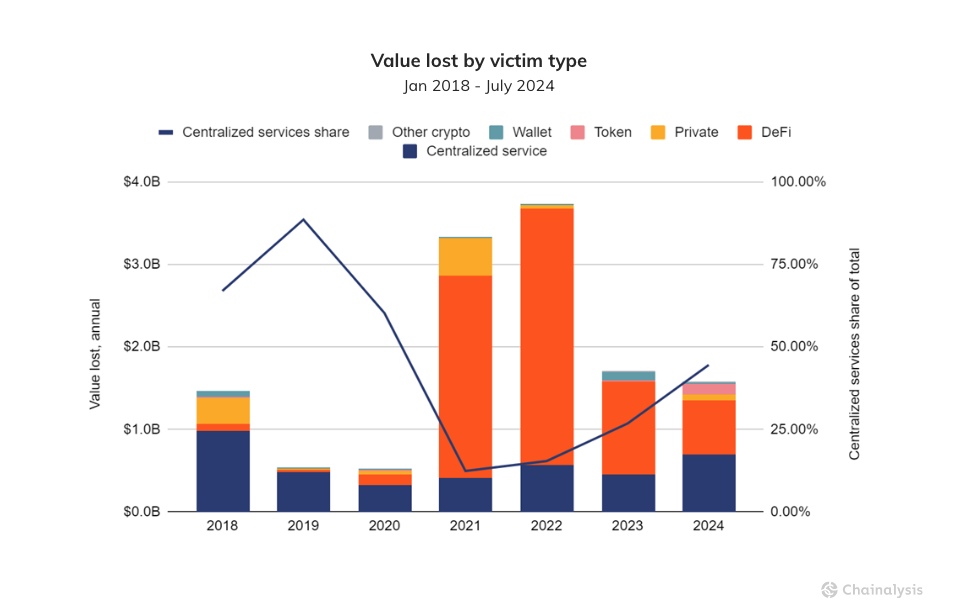
As the crypto landscape continues to evolve, so do the tactics of cybercriminals. In 2024, a stark increase in the scale of crypto-related crimes has emerged. Stolen funds reached an alarming $1.58 billion by mid-year, a significant 84% rise compared to the same period in 2023. This surge has largely been driven by a resurgence in attacks targeting centralized exchanges (CEXs) and record-breaking ransomware payouts, painting a worrying picture for the industry.

Centralized Exchanges in the Crosshairs Again

After several years of heightened focus on decentralized platforms, cybercriminals have returned to centralized exchanges. These platforms offer large liquidity pools and hold substantial reserves. They have become prime targets once more despite enhanced security measures. The 2024 Chainalysis mid-year report notes that hackers are employing increasingly sophisticated methods, such as advanced social engineering and even insider infiltration, to compromise these exchanges. The May 2024 breach of Japanese exchange DMM, resulting in the theft of $305 million in Bitcoin, exemplifies this trend.

One of the key reasons for this shift is that while decentralized finance (DeFi) platforms have been under heavy scrutiny and security tightening, centralized exchanges remain attractive for their concentrated assets. Even as security protocols improve, the potential payoff for cybercriminals remains too tempting to resist. High-profile breaches, often involving North Korea-linked hacking groups like Lazarus, underscore the evolving threat landscape.

Ransomware on the Rise: Record-Breaking Payouts

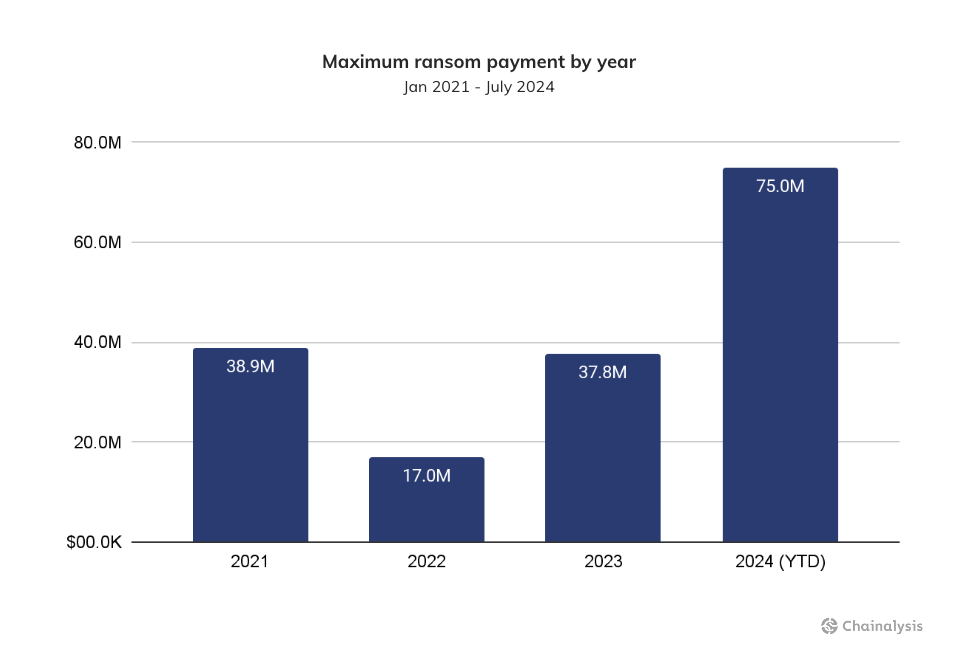
2024 has also seen ransomware attacks escalate to unprecedented levels. Not only has the frequency of attacks grown, but the payouts have also skyrocketed. The largest recorded ransomware payment in history – $75 million to the Dark Angels group – was made this year. It highlights the trend of “big game hunting” where attackers specifically target high-value organizations with the capacity to pay large ransoms.

The rise in ransomware activity reflects a broader shift in strategy among cybercriminals. Instead of numerous small-scale attacks, attackers increasingly focus on smaller but larger targets. This shift has led to a significant increase in the average ransom payment. It spiked from under $200,000 in 2023 to over $1.5 million in mid-2024. These figures point to a new era in ransomware attacks. Criminal groups are more organized and selective in their approach.

The Broader Implications: A Threat to Industry Credibility

While overall illicit cryptocurrency activity has dropped by nearly 20% – thanks to the growing dominance of legitimate transactions driven by positive developments like spot Bitcoin and Ethereum ETFs – the rise in high-value crimes is casting a shadow over the industry’s progress. The fact that stolen funds have surged despite this broader decline suggests that the security landscape is lagging behind the innovation and growth within the sector.

These developments raise critical questions about the crypto industry’s ability to protect its users and maintain trust as it moves toward mainstream adoption. The continuous evolution of criminal tactics, coupled with the immense financial rewards for successful attacks, signals that the threat will only grow more complex. For an industry aiming for global legitimacy, tackling these challenges is essential to ensuring that crypto’s bright future isn’t overshadowed by its dark underbelly.

The dual narrative of 2024—on one hand, significant growth in legitimate crypto adoption, and on the other, a resurgence of large-scale crimes—underscores the fragile balance the industry must strike. While advancements in adoption are promising, the escalating scale of theft and extortion reveals vulnerabilities that must be addressed. For the crypto ecosystem to sustain its momentum, ensuring robust defenses against sophisticated cybercrime will be as crucial as the innovations driving the next wave of adoption.

Readers’ frequently asked questions

Why are centralized exchanges (CEXs) suddenly more vulnerable again, despite their improved security measures?

The resurgence in targeting centralized exchanges can be attributed to several factors. While these platforms have indeed implemented more robust security features over the years, the scale and liquidity they hold still make them prime targets. Cybercriminals have adapted by shifting from technical exploits to more sophisticated social engineering techniques. For example, some attackers, particularly those linked to North Korea, are reportedly securing insider positions within crypto firms. This allows them to bypass advanced security layers. Additionally, CEXs hold large amounts of assets in fewer locations compared to decentralized platforms. It makes them harder to crack but all the more attractive. This combination of significant rewards and evolving infiltration strategies is driving the renewed focus on these exchanges.

What measures are being taken to combat the growing ransomware threat in the cryptocurrency industry?

While ransomware attacks are on the rise, governments and industry players are not sitting idle. Law enforcement agencies are increasingly coordinating internationally to target ransomware groups. Consequently, they took down several high-profile ransomware operators like ALPHV/BlackCat and LockBit. Additionally, cybersecurity firms are refining tools to detect and mitigate ransomware attacks. In addition, many companies are investing in more advanced backup systems to minimize the need to pay ransoms. The industry is also pushing for regulatory changes to improve the reporting of ransomware incidents and discourage ransom payments. However, the growing sophistication of these groups, combined with the deep financial resources of their targets, continues to challenge even the best defensive strategies.

How does the rise in crypto-related crime affect mainstream adoption of cryptocurrencies?

The increase in large-scale hacks and ransomware attacks does pose a threat to broader adoption. It can undermine public trust in the security and reliability of crypto platforms. For institutional investors and businesses considering entering the crypto space, the risk of large financial losses due to security breaches is a significant concern. On the other hand, the growth in legitimate transactions, fueled by developments like spot Bitcoin ETFs, suggests that many users and institutions remain optimistic about crypto’s long-term prospects. To maintain this positive trajectory, the industry will need to demonstrate that it can stay ahead of evolving threats, potentially through better regulatory frameworks, stronger security protocols, and greater transparency in how incidents are handled.

What Is In It For You? Action Items You Might Want to Consider

Diversify Your Trading Across Platforms

With centralized exchanges becoming prime targets for sophisticated attacks, consider spreading your assets across multiple platforms, including decentralized exchanges (DEXs) and secure wallets. By diversifying where you hold your assets, you reduce the risk of losing everything in a single breach. Consider using hardware wallets or multi-signature solutions for added security.

Stay Updated on Security Best Practices and Industry News

Given the evolving nature of cyber threats, it’s essential to keep yourself informed. Regularly monitor updates from trusted blockchain analytics firms, like Chainalysis, and stay aware of recent attacks and the methods used. This knowledge can help you better anticipate risks and adopt preventive measures, such as enabling two-factor authentication (2FA) and avoiding platforms with a history of breaches.

Assess Risk Before Participating in High-Yield Opportunities

While high-yield opportunities on centralized platforms can be tempting, these may come with elevated risks, especially in a climate of increased cybercrime. Before committing significant assets to a platform offering attractive returns, evaluate the platform’s security protocols, history, and whether it has implemented recent safeguards. Prioritizing platforms with transparent security practices can be the difference between gaining returns and suffering unexpected losses.

Kyrgyzstan to Launch Digital Som by 2027: Paving the Way for a Central Asian CBDC Revolution

Kyrgyzstan CBDC set to launch by 2027

The National Bank of the Kyrgyz Republic (NBKR) is pushing forward with its plans to introduce the Digital Som by 2027. It is an ambitious move that could set a new standard for central bank digital currencies (CBDCs) in Central Asia. As the world shifts towards digital finance, Kyrgyzstan aims to position itself as a regional leader through this transformative initiative. With sandbox testing already in progress and legislative frameworks being refined, the Digital Som is more than just a currency; it represents a strategic step toward financial modernization in the region.

Strategic Context and Regional Significance

Kyrgyzstan’s Digital Som is poised to be more than a mere digital payment tool. It is designed to address several economic and infrastructural challenges unique to the region. Financial inclusion is a major concern, with large segments of Kyrgyzstan’s population still lacking access to traditional banking services. The Digital Som could bridge this gap by making financial services more accessible, particularly in remote areas. Moreover, the move reflects Kyrgyzstan’s desire to stay competitive. After all, its Central Asian neighbors, including Kazakhstan, are advancing their own CBDC initiatives already.

The project also has significant geopolitical implications. Central Asia is emerging as a crucial zone for digital finance due to its growing crypto-mining sector, underpinned by abundant hydropower resources. By being one of the first in the region to launch a fully operational CBDC, Kyrgyzstan could leverage this project to attract investments and enhance its digital economy’s stature on the global stage.

Legislative and Technical Progress

The road to launching the Digital Som has been marked by meticulous planning. The NBKR has already conducted sandbox testing, inviting various companies to propose and test Digital Som prototypes. A demo version was even developed earlier this year. They must still select the final technology provider. The NBKR will operate the platform managing the Digital Som. It will enable both online and offline transactions. That is a crucial feature for a country with limited internet connectivity in its remote areas.

Legislation plays a critical role in the project’s success. Lawmakers drafted amendments to the laws governing the NBKR’s powers and payment systems. These are currently open for public consultation. The proposed legal framework focuses on issues like privacy, cybersecurity, and user verification. These are vital for the safe and efficient operation of the digital currency. If these laws are approved, they are expected to come into effect by January 1, 2027.

Broader Implications for Central Asia

Kyrgyzstan’s Digital Som project is more than a national financial reform; it is a potential game-changer for Central Asia’s digital economy. As countries in the region look to modernize their financial systems, the success of the Digital Som could serve as a blueprint for others. Kyrgyzstan is sending a clear signal, embracing blockchain technology and implementing a robust CBDC. It intends to be at the forefront of the digital financial revolution in Central Asia.

Moreover, this initiative aligns with global trends toward digital currencies and decentralized finance. As other nations in Central Asia closely watch Kyrgyzstan’s progress, the Digital Som could catalyze a regional shift towards more transparent, efficient, and inclusive financial systems.

The planned launch of Kyrgyzstan’s Digital Som by 2027 is not just a technological upgrade – it is a strategic move with wide-ranging implications for the region. Kyrgyzstan is positioning itself as a leader in Central Asia’s evolving financial landscape by addressing financial inclusion, enhancing digital infrastructure, and setting a regulatory standard. As the world increasingly turns towards digital finance, the Digital Som could be a key milestone in Kyrgyzstan’s journey towards economic modernization and regional influence.

Readers’ frequently asked questions

How does the Digital Som differ from traditional cryptocurrencies like Bitcoin or Ethereum?

While both the Digital Som and cryptocurrencies like Bitcoin and Ethereum are digital assets, they differ fundamentally in structure and purpose. The Digital Som is a central bank digital currency (CBDC). That means it is the National Bank of the Kyrgyz Republic (NBKR) issuing and regulating the currency. Unlike decentralized cryptocurrencies, the Digital Som will be backed by the state, ensuring it functions as legal tender within Kyrgyzstan. This contrasts with Bitcoin and Ethereum, which operate on decentralized networks with no central authority. They rely on blockchain consensus mechanisms to maintain security and integrity. Additionally, the Digital Som is designed primarily to enhance financial inclusion and streamline the national payment system. Traditional cryptocurrencies often focus on decentralization, anonymity, and cross-border transactions.

How will the Digital Som be used, and will it replace cash?

The Digital Som as CBDC will complement, not replace, cash and other non-digital payment options in Kyrgyzstan. It will be available for use in everyday transactions, similar to cash or traditional bank transfers. Enhanced security, faster transactions, and offline capabilities for areas with limited internet access are added benefits. The NBKR will issue and regulate the Digital Som. Users will access it through digital wallets managed by authorized intermediaries, such as banks and payment system operators. The Digital Som will coexist with existing payment methods, providing more options for citizens and businesses. This model reflects how other countries are designing their CBDCs—to offer convenience without immediately eliminating physical currency.

What challenges could Kyrgyzstan face in successfully launching the Digital Som by 2027?

The path to launching the Digital Som involves several hurdles, primarily in the realms of technology, regulation, and public adoption. On the technological front, selecting and integrating the right platform is crucial, especially as initial testing has yet to finalize a provider. Ensuring the platform is secure, scalable, and capable of handling offline transactions adds another layer of complexity. From a regulatory perspective, the NBKR must balance privacy with the need for robust anti-money laundering (AML) and know-your-customer (KYC) measures, all while updating laws that govern digital currencies. Public adoption is also key; the government needs to build trust in the Digital Som, particularly among those unfamiliar with digital payments or skeptical of government oversight. Lessons learned from other countries, alongside successful pilot programs, will be critical in overcoming these challenges and meeting the 2027 launch deadline.

What Is In It For You? Action Items You Might Want to Consider

Monitor Regional CBDC Developments

As Kyrgyzstan progresses toward the 2027 launch of its Digital Som, keep an eye on similar CBDC initiatives in Central Asia, such as Kazakhstan’s digital tenge. These developments could influence market dynamics in the region and present early opportunities for traders interested in digital assets tied to emerging economies. Understanding how these currencies are adopted can provide insights into regional market trends and potential trading opportunities.

Explore Investment in Fintech and Blockchain Projects in Central Asia

With Kyrgyzstan’s commitment to a digital currency, there’s likely to be increased investment in the region’s fintech and blockchain sectors. Consider diversifying your portfolio by investing in companies or startups poised to benefit from the infrastructure supporting the Digital Som. This could include payment processors, cybersecurity firms, or blockchain technology providers involved in CBDC development.

Stay Updated on Regulatory Frameworks

The legislative progress and regulatory landscape in Kyrgyzstan will play a significant role in the success of the Digital Som. As a trader, you should pay close attention to the evolving laws around CBDCs in Kyrgyzstan and other emerging markets. Regulations that favor blockchain innovation and digital finance could signal future growth in these sectors, making it advantageous to identify early investment opportunities in compliant projects. Understanding the regulatory trajectory can help you make informed decisions when trading digital assets in emerging markets.

- Advertisement -

FEATURED