Home Blog Page 184

Tether Introduces aUSD₮, a Gold-backed Stablecoin

Tether launches stablecoin backed by Gold

Tether introduced a new stablecoin, aUSD₮, pegged to the US Dollar and backed by physical gold. Stored in Swiss vaults, aUSD₮ aims to offer investors a secure and transparent digital asset. This launch marks a significant step in Tether’s strategy to expand its stablecoin offerings and meet the growing demand for asset-backed digital currencies.

What is aUSD₮?

aUSD₮ is a new stablecoin from Tether, combining the stability of the US dollar with the value of gold. Each aUSD₮ token represents ownership of a specific amount of physical gold, ensuring it is a reliable and secure investment. The gold is stored in high-security vaults in Switzerland, known for their robust protection standards.

Benefits of the Tether Gold-Backed Stablecoin

The primary advantage of aUS₮ is its backing by physical gold, which offers a tangible value that can appeal to risk-averse investors. This gold-backed token is designed to provide stability, making it an attractive alternative to more volatile digital currencies. Additionally, aUSD₮ is issued on Ethereum and TRON blockchains as ERC-20 and TRC20 tokens, respectively, ensuring wide accessibility and integration with existing financial systems.

Source: Twitter @Alloy_Tether

No Custody Fees

Unlike other gold-backed tokens, Tether’s aUSD₮ does not charge custody fees. This makes aUSD₮ a more cost-effective option for investors looking to hold digital assets backed by physical commodities. Investors can also redeem their aUSD₮ tokens for physical gold, provided they meet certain requirements and complete identity verification.

Enhancing Transparency and Security

Tether’s introduction of aUSD₮ reflects its commitment to transparency and security in the cryptocurrency market. By backing its stablecoin with gold stored in Swiss vaults, Tether aims to provide a more reliable and transparent alternative to other digital assets. This move is expected to attract investors looking for lower-risk options within the cryptocurrency market.

Integration with Blockchain

aUSD₮ is available on Ethereum and TRON blockchains, enhancing its accessibility and usability. This multi-blockchain approach ensures that aUSD₮ integrates easily into various decentralized financial systems, facilitating seamless trading and utilization across different platforms.

Regulatory Context

The launch of aUSD₮ comes at a time of increasing regulatory scrutiny over stablecoins and their reserves. By backing the token with physical gold, Tether aims to bolster its reputation and appeal to a broader range of investors, particularly those wary of the risks associated with other digital assets. This strategic move aligns with Tether’s efforts to enhance the transparency and security of its stablecoins.

Competitive Landscape

Tether’s aUSD₮ will compete with other gold-backed tokens like Paxos’ PAXG and Digix’s DGX. However, Tether’s offering stands out due to its no-custody-fee model and the backing of Swiss-stored gold. Tether designed this differentiation to provide a secure and cost-effective investment option for those looking to diversify their digital asset portfolio.

Tether launching its gold-backed aUSD₮ is a significant development for the stablecoin market. The combination of the US Dollar’s stability and the enduring value of gold aims to offer a secure and transparent digital asset. aUSD₮ wants to appeal to both traditional investors and cryptocurrency enthusiasts. It presents a reliable alternative in the volatile world of digital currencies. Its innovative features and strong security measures position aUSD₮ to become a leading choice for those seeking a stable and secure investment in the cryptocurrency market.

Key Takeaways

  • aUSD₮ is Tether’s new stablecoin backed by physical gold.
  • Stored in Swiss vaults, it ensures high security and reliability.
  • aUSD₮ is available on Ethereum and TRON blockchains, ensuring wide accessibility.
  • Tether’s no-custody-fee model makes aUSD₮ a cost-effective option.
  • This launch enhances Tether’s transparency and security in the crypto market.

BlackRock Bold Bet – How Ethereum is Revolutionizing Asset Tokenization

BlackRock bets on Ethereum for Asset tokenization

Underscoring the growing integration of traditional finance and blockchain technology, BlackRock recently committed €100 million to Ethereum. This marks a significant step for the tokenization of real-world assets. The strategic alliance with Securitize is poised to reshape the financial landscape. It offers unprecedented opportunities for liquidity and transparency in asset management. As Ethereum’s robust infrastructure gains favor over permissioned blockchains, the implications for investors and the broader market are profound.

BlackRock, the world’s largest asset manager, has been a pivotal force in traditional finance for decades. Their recent venture into the blockchain space signifies a major shift in how institutional investors view and utilize decentralized technologies. The decision to leverage Ethereum’s blockchain for asset tokenization over more controlled, permissioned blockchains highlights a growing confidence in Ethereum’s security, scalability, and widespread developer support.

Strategic Alliance and Objectives

BlackRock has entered into a strategic alliance with Securitize. They are a leading digital asset securities firm specializing in the tokenization of real-world assets. This partnership aims to create a tokenized money market fund on the Ethereum blockchain. It will be one of the first of its kind in the financial industry. The fund will utilize Securitize’s technology to digitize shares, making them more accessible and easier to trade.

By partnering with Securitize, BlackRock leverages its expertise in digital securities and Ethereum’s decentralized infrastructure. It enhances the liquidity and transparency of traditional financial assets. The tokenized fund will allow investors to purchase and trade shares more easily. This can reduce the friction and costs associated with traditional asset management processes.

The Case for Ethereum

Ethereum, the second-largest cryptocurrency by market capitalization, has long been recognized for its smart contract capabilities and decentralized applications (dApps). Unlike permissioned blockchains, which are controlled by a single entity or a consortium, Ethereum operates on a decentralized network. That ensures greater transparency and security. This decentralized nature is a key factor in BlackRock’s choice. It aligns with the principles of trust and openness that customers and investors increasingly value in modern financial systems.

https://twitter.com/matthew_sigel/status/1801342560977190937

By tokenizing assets on Ethereum, BlackRock aims to enhance liquidity and accessibility. Tokenization refers to the process of converting physical or financial assets into digital tokens on a blockchain. These tokens can represent ownership in assets such as real estate, commodities, or even shares in a fund. The benefits are manifold. It increases liquidity, as tokens can be traded 24/7 on global markets. It improves transparency, as blockchain records are immutable and accessible to all participants. Minimizing intermediaries reduces costs.

Financial Innovation and Market Impact

The endorsement of Ethereum by such a heavyweight in the financial industry is expected to have significant ripple effects. For one, it could lead to a broader acceptance and adoption of blockchain technology in traditional finance. As other institutional investors observe BlackRock’s success, they may be encouraged to explore similar ventures, further driving the integration of blockchain and finance.

Moreover, this move is likely to influence Ethereum’s market dynamics. Historically, major endorsements from influential players have positively impacted the value and perception of cryptocurrencies. Ethereum’s price has already shown signs of bullish behavior following the announcement. Many analysts predict a sustained upward trajectory as the full potential of this partnership unfolds.

A New Era in Asset Management

The tokenization of assets represents a fundamental shift in asset management. Traditional systems often suffer from inefficiencies, lack of transparency, and high intermediary costs. Blockchain technology provides a secure, transparent, and efficient platform to manage assets, addressing those concerns. BlackRock’s commitment to Ethereum is a testament to the technology’s maturity and readiness for mainstream adoption.

Larry Fink, BlackRock’s CEO, has previously expressed interest in the transformative potential of cryptocurrencies and blockchain technology. This latest move aligns with his vision and sets a precedent, too. It demonstrates how traditional financial institutions can innovate by integrating cutting-edge technologies.

BlackRock’s €100 million commitment to Ethereum is more than just a significant investment; it is a strong endorsement of blockchain technology’s future role in finance. By choosing Ethereum and partnering with Securitize, BlackRock is embracing a decentralized, transparent, and efficient model for asset management. This strategic move is set to revolutionize how assets are managed and traded, paving the way for a more integrated and innovative financial ecosystem.

As the financial world watches closely, BlackRock’s bold bet on Ethereum could very well be the catalyst that drives the next wave of blockchain adoption in traditional finance, unlocking new possibilities for investors and institutions alike.

Evolve Bank Under Fire: Synapse Bankruptcy Exposed Compliance Failures

Evolve Bank Synapse Crisis

The bankruptcy of Synapse Financial Technologies disrupted the fintech sector but also exposed significant compliance failures at Evolve Bank & Trust. This led to a Federal Reserve cease-and-desist order. Synapse, a key intermediary for fintech firms, collapsed under the weight of financial discrepancies and operational disputes, particularly with Evolve Bank. This prompted a regulatory crackdown on Evolve, mandating stringent oversight improvements. The dual crises underscore the urgent need for robust compliance frameworks in fintech partnerships to safeguard consumer interests and financial stability.

Synapse’s Downfall and the Ripple Effect

Synapse Financial Technologies, once a prominent player in the banking-as-a-service (BaaS) sector, filed for bankruptcy earlier this year, revealing severe financial mismanagement. The company’s role as a middleman for fintech firms and banks, including Evolve Bank & Trust, became its Achilles’ heel. Disputes over customer balances and a shortfall of $85 million in customer funds were central to Synapse’s collapse.

The operational failures at Synapse led to immediate consequences for its partners. Accounts linked to fintech firms using Synapse were frozen, affecting thousands of customers and businesses. Yotta, a savings app, was notably impacted, with 85,000 accounts locked, leaving customers without access to their savings.

Evolve Bank’s Compliance Lapses

The fallout from Synapse’s bankruptcy revealed deeper issues within Evolve Bank. As a primary banking partner of Synapse, Evolve Bank struggled with reconciling account balances. That raised red flags about its compliance and risk management practices. The Federal Reserve’s cease-and-desist order highlighted Evolve Bank’s failure to adequately manage its fintech partnerships. It failed to enforce anti-money laundering (AML) and sanctions compliance measures.

The order mandates Evolve Bank to implement rigorous oversight and enhance its compliance framework. This includes improving its systems for monitoring transactions and ensuring that fintech partners adhere to regulatory standards. The action taken by the Federal Reserve underscores the critical need for traditional banks to maintain robust compliance mechanisms. That is especially true when engaging in partnerships with fintech companies.

The Broader Implications for Fintech-Bank Partnerships

The Synapse-Evolve Bank crisis is a cautionary tale for the fintech and banking sectors. It highlights the vulnerabilities and risks associated with banking-as-a-service models. Fintech companies rely heavily on traditional banks to provide financial services to their customers. The dual crises highlight the importance of stringent regulatory oversight. Banks must enforce robust compliance frameworks when dealing with fintech partners.

As the fintech industry continues to grow, the regulatory landscape is likely to become more stringent. Banks partnering with fintech companies must prioritize compliance and risk management to protect consumer interests and ensure financial stability. The Synapse collapse and the subsequent regulatory actions against Evolve Bank serve as a wake-up call for the industry. They must reassess and strengthen its operational and compliance practices.

The Synapse Financial Technologies bankruptcy and the resulting regulatory crackdown on Evolve Bank & Trust have exposed significant compliance failures and underscored the need for robust oversight in fintech-bank partnerships. This incident highlights the critical importance of maintaining stringent compliance frameworks to safeguard consumer interests and ensure financial stability in the rapidly evolving fintech sector. As the industry continues to mature, both fintech companies and traditional banks must work together to enhance their compliance and risk management practices, thereby fostering a more secure and reliable financial ecosystem.

Market Reacts to Trump’s Bitcoin Mining Pledge: Stocks Surge Amid Controversy

Trump Bitcoin Mining Pledge: Stocks Surge Amid Controversy

Bitcoin mining stocks surged after former President Donald Trump pledged to centralize all Bitcoin mining operations within the United States. Companies like CleanSpark and Riot Blockchain experienced notable increases in their stock prices, reflecting investor optimism. However, this move has not been without controversy. Environmentalists and political opponents raise concerns about the sustainability and the logistical challenges of such a comprehensive plan.

Market Reactions

Following the Trump announcement, Bitcoin mining stocks saw immediate positive impacts. CleanSpark, a leading mining and energy technology company, saw its stock price increase by over 15%. Riot Blockchain, another major player in the industry, experienced a similar surge. Investors are bullish on the potential for increased profitability and stability in the U.S. mining sector, spurred by anticipated regulatory support and investment in infrastructure.

The enthusiasm in the market reflects a broader optimism about the U.S.’s ability to leverage its technological and economic advantages to dominate the Bitcoin mining industry. Analysts suggest that Trump’s proposal could lead to significant investment in renewable energy sources and advanced mining technologies. That would position the U.S. as a global leader in this rapidly evolving sector.

Environmental Concerns

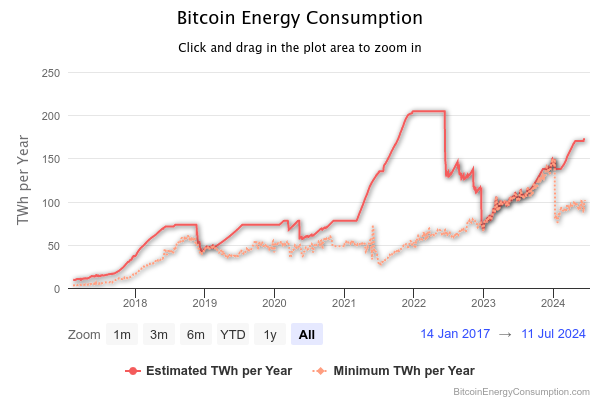
Despite the market optimism, Trump’s pledge has sparked significant controversy, particularly from environmental groups. Bitcoin mining is notorious for its high energy consumption. Critics argue that scaling up operations in the U.S. could exacerbate environmental issues. The Bitcoin network’s energy consumption already rivals that of some small countries, leading to concerns about the sustainability of such an expansion.

The Bitcoin Energy Consumption Index provides the latest estimate of the total energy consumption of the Bitcoin network. Source: digiconomist.net

Trump and his supporters counter these concerns by emphasizing the potential to use renewable energy sources. They argue that the U.S. could set a global standard for sustainable mining practices, potentially repurposing fossil fuel plants and investing in solar, wind, and hydroelectric power to mitigate the environmental impact.

Political and Logistical Challenges

The political landscape surrounding Trump’s proposal is equally complex. While the plan has garnered support from segments of the tech industry and pro-crypto lawmakers, it faces opposition from those worried about regulatory overreach and the feasibility of rapidly scaling up mining operations. Critics point out the significant logistical challenges of transitioning a substantial portion of global Bitcoin mining to the U.S. That includes the need for vast amounts of energy and the infrastructure to support it.

https://twitter.com/TBG9270584/status/1758956499400032687

Moreover, the political ramifications extend beyond environmental concerns. Some see Trump’s proposal as a strategic move to regain influence in the tech sector and appeal to younger, tech-savvy voters. However, it also risks alienating environmentalists and those skeptical of large-scale government interventions in the private sector.

The ambitious Trump plan to centralize Bitcoin mining operations in the United States has sparked mixed reactions of market enthusiasm and significant controversy. While the potential economic benefits and market reactions are promising, the environmental and logistical challenges cannot be overlooked. As the debate continues, the future of Bitcoin mining in the U.S. will likely hinge on finding a balance between economic ambitions and sustainable practices.

Gemini’s $50 Million Settlement and New York Crypto Lending Ban: A Regulatory Turning Point

Gemini Exchange agreed to $50M settlement with NYAG

Gemini Exchange, a prominent name amongst cryptocurrency exchanges, is navigating turbulent regulatory waters following a landmark $50 million settlement with the New York Attorney General’s Office (NYAG). This agreement resolves significant allegations but also imposes a ban on Gemini’s crypto lending services in New York. This highlights critical issues of compliance and consumer protection in the digital asset market.

Settlement Dynamics and Ramifications

The $50 million settlement with the NYAG marks a pivotal moment for Gemini Exchange. It addresses allegations that have drawn scrutiny over its operational transparency and customer engagement practices. This resolution incorporates stringent measures aimed at bolstering future compliance efforts and reinstating confidence in the exchange’s operational integrity.

Under the terms of the settlement, Gemini Exchange is prohibited from offering crypto lending services within New York State. This directive directly responds to regulatory apprehensions regarding the legality and transparency of Gemini’s lending activities. The NYAG’s stance underscores the evolving regulatory climate surrounding digital assets. It emphasizes the need for stringent consumer safeguards and market transparency.

Regulatory Framework and Market Response

The regulatory scrutiny faced by Gemini Exchange mirrors broader efforts to establish comprehensive standards for cryptocurrency exchanges. This is particularly true for jurisdictions like New York known for rigorous financial oversight. This enforcement action serves as a potent reminder to industry participants how critical it is to adhere to regulatory protocols and foster transparent business conduct.

Gemini Exchange, co-founded by Cameron and Tyler Winklevoss, has long positioned itself as a bastion of regulatory compliance and security within the crypto sphere. The settlement with the NYAG highlights the significant challenges experienced by established players in navigating complex regulatory landscapes for digital currencies.

Future Prospects and Industry Impact

Looking forward, the cryptocurrency community will closely observe how Gemini Exchange navigates the regulatory obligations outlined in the settlement. The exchange’s adherence to these mandates will be pivotal in restoring trust among its user base and regulatory stakeholders, potentially influencing its competitive standing and operational strategies.

Moreover, this landmark case sets a precedent for other exchanges. It signals the consequential ramifications of regulatory non-compliance in an industry aspiring for broader institutional acceptance. As regulatory frameworks evolve globally, exchanges must proactively engage with regulatory bodies to forge sustainable growth paths and mitigate legal risks effectively.

Gemini Exchange’s settlement with the NYAG, coupled with the prohibition on crypto lending activities in New York, marks a significant milestone in the regulatory trajectory of the cryptocurrency industry. It underscores the increasing emphasis on regulatory adherence and consumer protection. This shaping of the operational landscape applies particularly to exchanges operating within tightly regulated markets. As the sector matures, the ability of exchanges to navigate these regulatory complexities will be pivotal. If successful, it will foster trust and ensure long-term viability in the digital asset ecosystem.

- Advertisement -

FEATURED