Home Blog Page 21

What Is Bittensor? A Beginner’s Guide to the Network Trying to Decentralize AI

Bittensor is a decentralized network that pays thousands of independent computers around the world to compete in producing AI outputs.

Start with a problem you already know.

ChatGPT. Gemini. Claude. These are products built by large corporations that spent hundreds of millions of dollars training the AI models inside OpenAI, Google, Anthropic. But that price tag also means that only a handful of companies in the world can afford to build cutting-edge AI. Those companies decide what the AI can and can’t do. They control access to it, set the prices. They own it entirely. And they capture almost all the value it creates.

Bittensor’s founding question was simple: what if you didn’t have to do it that way?

What if, instead, you could build AI the way Bitcoin built money? Distribute it across thousands of independent participants. None of them owns the whole thing. All of them are rewarded for contributing to it.

That is, in one paragraph, what Bittensor is.

The Bitcoin Comparison

Most people know that Bitcoin is a decentralized currency. It’s not printed by any government and no bank controls it. Instead, thousands of computers around the world run software that collectively agrees on who owns what. The people running those computers, the miners, are rewarded in Bitcoin for doing the work of keeping the network honest.

Bittensor borrows that structure but points it at something different. Instead of reaching agreement on financial transactions, the network reaches agreement on the quality of intelligence. Instead of rewarding miners for processing transactions, it rewards them for producing useful AI outputs.

The native currency, the token that flows through the whole system, is called TAO. Like Bitcoin, TAO has a fixed maximum supply: 21 million coins, ever. No central bank, no government, no company can print more.

The Basic Unit: A Subnet

The core building block of Bittensor is the subnet. Think of a subnet as a specialized marketplace for a specific kind of digital work.

Take a simple example. Imagine a subnet whose job is: answer medical questions accurately. Inside that subnet, there are two kinds of participants:

The miners who do the work. Each miner runs an AI model. When a question comes in, every miner produces an answer.

Then, the validators judge the work. They look at all the answers from all the miners and score them: which was most accurate, most useful, most complete?

Those scores go back to the blockchain, which uses them to decide how much each miner earns. Better answers, more income. If a miner contributes consistently poor answers, he eventually gets pushed out as new competitors register.

Marcus Graichen, founder of Taostats, the network’s leading analytics platform, describes it this way: “When you ask ChatGPT a question, it’s like having one university professor in front of you. What Bittensor does is fill a room with a hundred professors, ask the question to all of them, grade those answers, and give you back the best.”

Why Have Subnets? 128 of them?

Because different problems need different kinds of work.

One subnet produces AI text responses. Another handles image generation. Another provides blockchain infrastructure services to developers. Another analyses financial markets. Another researches pharmaceutical molecules.

Right now there are 128 active subnets on Bittensor, but the network’s roadmap targets to increase it to 256 by end of 2026. Each subnet has its own economy, its own rules for what counts as good work, and its own community of miners and validators.

TAO and Alpha: The Two-Token Economy

This is where the economics get more layered, but it is worth following.

Originally, the network had one token: TAO. All rewards across all subnets were paid in TAO. In April 2025, Bittensor introduced a system called dTAO (dynamic TAO) which changed the system fundamentally.

Under dTAO, every subnet gets its own token, called an alpha token. Each alpha token has again a fixed maximum supply of 21 million, exactly like Bitcoin, and its own emission and halving schedule, independent of TAO’s.

Here is how the two relate:

Alpha tokens are what miners and validators within a subnet earn for their work. The price of a subnet’s alpha token reflects demand for that subnet’s services. If lots of people are using it and investing in it, the alpha token rises in value.

TAO is the reserve currency of the whole economy. It flows into each subnet’s liquidity pool based on how much demand the subnet attracts. More demand, more TAO flowing in, higher value for the alpha token.

Think of it this way: TAO is the dollar. Alpha tokens are the local currencies of individual businesses operating within the same economy. Connected, but able to move independently.

Staking: How You Participate Without Mining

You do not have to run a miner or a validator to participate in Bittensor. You can also be a delegator who holds TAO and assigns it to a validator you trust.

When you delegate your TAO to a validator, that validator uses your stake as part of their weight in the network. In return you earn a share of what that validator earns. Validators typically charge a small percentage of earnings, their “take”, to cover their costs and team.

This delegation model is what funds Taostats. People who use the platform every day choose to delegate their TAO to the Taostats validator. That delegation generates the revenue Mog uses to pay his team and run the infrastructure — no venture capital, no advertising.

The Halving

Both TAO and each subnet’s alpha token follow a halving schedule. At regular intervals, the number of new tokens produced per day is cut in half, the same mechanism Bitcoin uses to manage supply over time.

Bittensor’s first TAO halving happened in December 2025. Daily emissions dropped from 7,200 TAO to 3,600. Because miners are now paid in alpha tokens instead of TAO directly, the TAO halving had less immediate impact on day-to-day miner economics than many expected.

The more consequential event for each subnet will be its own alpha halving, when that subnet’s token emissions get cut in half. The subnets that are already generating real revenue from real customers by that point will be fine. Those still depending entirely on token emissions will face a harder test.

Why Institutions Are Paying Attention

The network generated over $43 million in revenue across its subnets in the first quarter of 2026 alone. Grayscale filed with the SEC to launch a spot ETF around TAO. Asset managers who were ignoring this space two years ago now have analysts covering it.

The reason is not hype. It is that Bittensor represents a testable thesis: that distributing the ownership and economics of AI infrastructure across thousands of independent participants produces better, cheaper outputs than a single centralized provider. And the people doing the work capture the value, rather than having it flow upward to a small number of shareholders.

Whether that thesis holds at scale is still being established. But the early numbers suggest it is worth taking seriously.


USB-Spreading Malware Poses New Threat to Crypto Wallet Users

TL;DR

  • Microsoft disclosed an ongoing crypto clipper malware campaign that spreads through USB drives by disguising itself as legitimate files.
  • The malware can replace copied wallet addresses, steal seed phrases, capture screenshots, and maintain remote access to infected systems.
  • The campaign highlights growing security risks for cryptocurrency users and the importance of verifying wallet addresses before transactions.

Microsoft has disclosed a new crypto clipper malware campaign that can spread through USB drives. It steals cryptocurrency-related data, and redirects transactions by replacing wallet addresses copied to a user’s clipboard. The company said the threat, tracked as Trojan:Win32/CryptoBandits.A, has been active since at least February 2026. Besides traditional clipping techniques it uses also broader backdoor capabilities.

Malware targeting cryptocurrency users is becoming more sophisticated and can maintain long-term access to infected systems.

Microsoft Details the CryptoBandits Campaign

According to Microsoft’s threat intelligence team, the malware is designed to monitor infected Windows devices for cryptocurrency-related activity. Once installed, it can search for wallet information, collect system data, and monitor clipboard contents for cryptocurrency addresses. The malware polls the clipboard approximately every 500 milliseconds, allowing it to quickly identify and replace copied wallet addresses.

The malware also targets sensitive information such as seed phrases and private keys. In addition, researchers observed functionality that allows attackers to capture screenshots and gather information from infected systems.

Microsoft said the campaign’s infrastructure uses the Tor anonymity network, making it more difficult to identify or disrupt the operators behind the activity.

How the Malware Spreads Through USB Drives

One of the more unusual aspects of the campaign is its ability to spread through removable media. The malware searches connected USB drives for common file types, including Word documents, PDFs, and Excel files. It then hides the original files and replaces them with malicious Windows shortcut files that mimic the legitimate documents. When a user opens one of these shortcuts, the malware executes while simultaneously opening the original file, making the compromise less noticeable. This allows the malware to disguise itself as legitimate content and move between systems when infected drives are used elsewhere.

Researchers described the behavior as worm-like because the malware can propagate without direct interaction from the attacker once an infected system is established.

However, Microsoft did not disclose how victims are initially infected. While USB drives are a key propagation mechanism, the company did not identify the original infection vector or attribute the campaign to a specific threat actor.

More Than a Traditional Clipper

A typical crypto clipper malware operation focuses on replacing cryptocurrency wallet addresses stored in a victim’s clipboard. If a user copies a legitimate wallet address while preparing a transaction, the malware can substitute it with an attacker-controlled address before the funds are sent.

Microsoft’s analysis suggests CryptoBandits goes beyond that traditional model.

The malware includes remote command execution capabilities that allow operators to run additional actions on compromised devices. Combined with data collection and persistence features, these functions effectively give attackers ongoing access to infected systems.

That broader functionality has led some security researchers to describe the threat as a lightweight backdoor in addition to a clipper.

Why the Threat Matters for Crypto Users

The campaign highlights a persistent security risk for cryptocurrency users: endpoint compromises can undermine otherwise secure storage practices. Even users who safeguard their assets carefully may still be exposed if malware modifies transaction details before funds are transferred.

Clipboard replacement attacks are particularly difficult to detect because transactions may appear legitimate until users carefully compare wallet addresses. A single altered character can redirect funds to an attacker-controlled destination.

Security experts generally recommend verifying wallet addresses before confirming transactions. Users should avoid unknown USB devices, keeping security software updated, and treating unexpected shortcut files with caution.

The Broader Security Implications

The crypto clipper malware campaign identified by Microsoft reflects the continued evolution of threats targeting digital asset holders. CryptoBandits combines wallet theft techniques, USB-based propagation, Tor-enabled communications, and remote access capabilities. These features make it a more versatile threat than traditional clipping tools.

Microsoft’s report explained well how the malware spreads between devices. Nevertheless, it was not able to identify the campaign’s original infection method and the individuals responsible. The investigations into this threat continue. But what we know so far underscores once more how important strong security practices are when managing cryptocurrency assets.

Exclusive | Gregg Bell, Hashgraph – Your Bank Account Is Becoming a Wallet

Hashgraph's Chief Investment Officer Gregg Bell sat down with CrispyBull at Proof of Talk Paris 2026 to talk about the quiet migration from bank accounts to wallets, why the wholesale layer always comes first, and what it will actually take for blockchain infrastructure to disappear under the hood

Gregg Bell has spent two decades at the intersection of traditional finance and digital markets. He thinks the migration from bank account to wallet has already begun — quietly, invisibly, and faster than anyone expected.

There is a migration underway in global finance that most people have not noticed. It is happening beneath the surface, inside the systems that banks, asset managers, and central banks use to move money between each other. By the time it reaches ordinary people, the infrastructure will already be in place. The transition will feel seamless. That, at least, is the plan.

Gregg Bell, Chief Investment Officer at Hashgraph, the enterprise software company that builds on top of Hedera’s network, has had a front-row seat to every stage of this shift. He has watched it from credit hedge funds, from Wall Street trading desks, from the earliest days of crypto lending, and from inside one of the world’s largest cryptocurrency exchanges during its most turbulent years. Now he is at Proof of Talk in Paris, a summit gathering the architects of the financial infrastructure most people will one day use without knowing it exists.

“The migration from a bank account or a securities account to a wallet,” he says, “is what we are living through in real life right now.”

The road and the vehicle

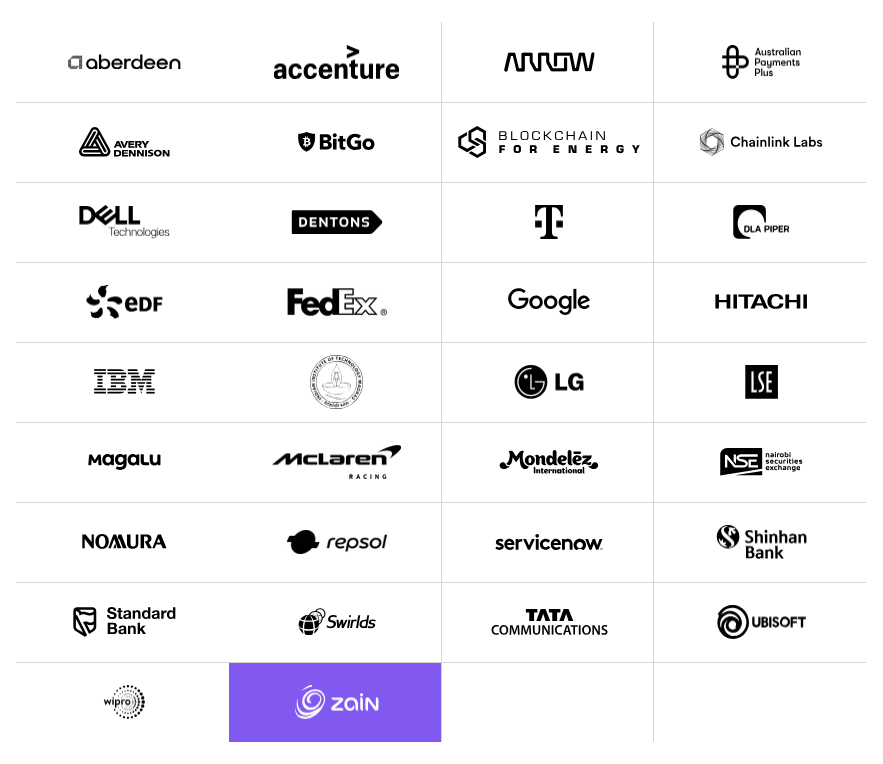
To understand what that means, it helps to understand what Hedera is, and what Hashgraph does. Hedera is a public network, similar in purpose to a blockchain but built on a different underlying technology called a hashgraph. It allows transactions to settle in seconds at a fraction of a cent. While most blockchains are governed by anonymous participants Hedera is overseen by a council of some of the world’s largest corporations; Google, IBM, FedEx, Deutsche Telekom, and McLaren among them. Each council member has an equal vote. Hashgraph is a separate but related company that builds enterprise software and deploys capital to accelerate adoption on top of that network. If Hedera is the road, Hashgraph builds the vehicles institutions use to drive on it. It also funds projects that put those vehicles into production.

Two decades at the border

Bell’s career did not follow a straight line to this point. He started at Silver Point Capital, a multi-billion dollar credit hedge fund, before moving to the Royal Bank of Scotland as a trader and investment banker in structured products. He then joined ArrowMark Partners, another multi-billion dollar hedge fund, where he focused on investment analysis and trading. From there, he co-founded A3 Financial Investments, building out its asset management business, and Salt Blockchain, where he served as both Chief Investment Officer and Chief Operating Officer. He helped pioneer the crypto-backed lending market at a time when the concept was genuinely novel. A stint leading growth at Binance during its most turbulent years followed. And now this.

The through-line, he says, has always been the same: finding where the inefficiencies are and building the infrastructure to remove them.

The foundations are being laid now

What is easy to miss from the outside is that this migration is not theoretical. It is not a roadmap or a whitepaper. It is happening in production, at some of the largest financial institutions in the world. It’s just not happening yet in a way that touches ordinary customers.

In the UK, Lloyds Banking Group and Aberdeen, one of the country’s largest asset managers, completed a trade last year that their compliance teams would have refused just two years earlier. Rather than selling investments and wiring cash to meet a routine margin requirement, the slow, expensive, traditional method, they transferred digital versions of fund units and government bonds directly, in near real-time, on Hedera. They moved collateral and settled the trade with neither side touching cash.

“The problem being solved was counterparty risk,” Bell explains. “In the past, and I’ve done this myself, back in my early investment banking days, in order to meet margin requirements, you often had to revert to cash. You’d sell out of a position, wire fiat from one bank to another. That’s a reduction in your return, and it’s a slow, cumbersome process. When you can transfer a tokenized security intraday, you’re maintaining assets in an investable, yield-bearing format while reducing counterparty risk. That’s a real value add.”

“Hedera is like the S&P 500. It provides a diversified exposure to Fortune 500 companies across a variety of industries — from tech giants like Google and IBM to investment banks like Nomura, asset managers like Aberdeen, corporates like FedEx, and entertainment firms like Ubisoft.” — Gregg Bell, CIO, Hashgraph

Down under, ahead of the curve

In Australia, the Reserve Bank used HashSphere, Hashgraph’s private, invitation-only version of the Hedera network, to mint a central bank digital currency made available exclusively to its member banks. Those banks created their own tokenized deposits, backed by that central bank currency and carrying the full faith and credit of the Australian government. The banks could then service their own clients with these instruments while the details of transactions remained private. The whole system remained connected to Hedera’s public network, allowing access to broader liquidity when needed. This was Project Acacia, which ran across 2025. Its use case: settling wholesale fixed income products using tokenized deposits. Quiet, technical, and almost entirely unreported outside specialist publications.

Neither of these is a retail story. The ordinary bank customer was nowhere near either transaction. But the point Bell makes, and it is worth sitting with, is that the infrastructure being built now is the same infrastructure that retail will eventually run on. The wholesale layer always comes first.

The plumbing nobody sees

Bell is direct about what needs to happen before trades like these become routine. The technology already exists, but it requires the alignment of cost structures, service providers, and regulatory understanding within each firm’s business logic. “Once that calculus is embedded,” he says, “then we’ll see more and more collateral mobility experiments and deployments.”

The friction is not resistance

Traditional finance does not resist technology. It has adopted technology consistently and aggressively wherever it demonstrably reduces cost and risk, from electronic trading to real-time payments to algorithmic risk management. What slows adoption of blockchain infrastructure is something different and more specific: the practical complexity of aligning every part of a large institution simultaneously.

“Adoption is not just a decision from a technology department or innovation department,” Bell says. “It’s a decision throughout a variety of different executive offices, whether that’s compliance, regulatory, the finance department. All of these concerns need to be addressed.”

That process has become significantly more informed, he says, as regulation has clarified — particularly in the United States, where legal ambiguity around holding digital assets on institutional balance sheets had artificially elevated the perceived risk of adoption. As that ambiguity has reduced, institutions have been able to move from pilot projects into production deployments.

There is, however, a different kind of friction that Bell is more candid about. It comes from within the industry itself. He uses the word “tribalism” carefully but deliberately.

“Despite the industry being called Web3, it is anything but a web. It is very siloed.” — Gregg Bell, CIO, Hashgraph

The blockchain world is fragmented. Dozens of networks, each with its own architecture, its own rules, its own community, and largely, its own walls. Assets held on one network cannot easily move to another. The workarounds that exist, known as bridges, have proven dangerously vulnerable. Such concentrated pools of assets sitting in third-party systems have been drained for billions of dollars in repeated exploits. “They are contrary to the decentralisation structure of the networks themselves,” Bell says.

Building the translator

Hashgraph’s proposed answer is called CLPR, pronounced Clipper, a cross-ledger protocol currently in development that takes a different architectural approach. Instead of pooling assets in a vulnerable intermediary, it aims to enable the consensus algorithms of two different blockchain networks to communicate directly with each other. No pool. No trusted third party.

“It’s as if you rolled back the clock to the early days of the internet,” Bell says. “If Yahoo could never speak to AOL, if your emails could only send to one network — it’s less beneficial to everyone.”

Bell is clear that CLPR is still in development, not yet live. And he is careful to frame it not as a prerequisite for the migration already underway, but as something that would meaningfully accelerate it. “Assets will move from one network to another in a safe and sound manner. And that is going to lead to adoption.” He frames it explicitly as a rising tide; infrastructure that benefits every network, not just Hedera. The tribalism problem he identifies is not one that any single network can solve by competing harder. It requires the kind of shared infrastructure that nobody owns.

The corporate payment comes first

The stablecoin conversation has matured considerably in the past two years. Regulators in the US, Europe, and Australia are now treating digital versions of currencies, stablecoins, as serious payments infrastructure and no longer as mere crypto trading instruments. Shinhan Bank in South Korea has run cross-border stablecoin pilots on Hedera. Bank consortiums in the Philippines have used the network for cross-border asset movement.

Bell is specific about where he sees the clearest near-term traction: bank-to-bank cross-border payments, where fees, costs, and friction are greatest, and corporate invoice settlement, where stablecoins offer a programmable, low-cost alternative to traditional wire transfers. “What’s very clear from the institutional adoption is that stablecoins are the means by which payments for goods and services will be facilitated on a corporate level,” he says. “That to me is quite exciting — because that’s paying invoices in stablecoins.”

But he flags a problem on the horizon that receives almost no attention in mainstream coverage. If every regional bank or national bank becomes an issuer of its own tokenized deposit, the result could be a fragmentation problem at the issuer level that mirrors the fragmentation problem at the network level. A corporate holding their local bank’s tokenized dollar may find it simply not accepted elsewhere. The acceptance problem would require the equivalent of a clearing house function the industry has not yet built.

“We’re going to move from funding crypto exchanges to actually paying for goods and services with stablecoins,” he says. “But in order to do that, those assets need to be interchangeable.” The migration’s next chapter, in other words, depends on solving a problem that predates blockchain. Competing financial institutions must agree on common standards.

What the destination looks like

Proof of Talk, as an event, is a room full of people who think about this constantly. The institutions, the networks, the protocols, the compliance frameworks. Bell is asked to step back from all of it and describe what success actually looks like; not in technical terms, but in human ones.

“It’s getting in the car — or McLaren, in Hedera’s case — and driving from A to B very fast, and you’re not thinking about how, but you’re thinking about the destination and that it works.” — Gregg Bell, CIO, Hashgraph

Hedera under the hood. Invisible. Functioning. That is his definition of success.

The wallet replacing the bank account will not feel like a revolution when it happens. It will feel like the ATM replacing the bank teller, or online banking replacing the branch visit. A gradual shift in where and how people interact with their money. It will not be driven by consumer demand for new technology. The infrastructure improvements will simply make the new way easier, cheaper, and more reliable than the old one.

For those who simply want to keep using cash? “They will continue to use it, and that’s quite all right,” Bell says. “Sometimes handing someone a dollar bill might be the right tool. It’s very difficult to do across an international border that’s a different time zone away.”

The migration does not require everyone to come along at once. It just requires that when they are ready, or when the system around them has quietly shifted, the infrastructure is already there.

Aztec’s $4.1M Loss Shows the Hidden Risk of Abandoned DeFi Code

Two separate exploits drained approximately $4.1 million from legacy Aztec contracts, highlighting the risks posed by forgotten blockchain infrastructure.

TL;DR

  • Aztec smart contract exploits drained roughly $4.1 million from two retired products in separate attacks within four days.
  • The exploits targeted dormant contracts that remained active on Ethereum years after the products were shut down.
  • The incidents highlight a growing DeFi security challenge as abandoned smart contracts continue holding user funds long after development teams move on.

Two separate attacks targeting retired Aztec products have resulted in losses of roughly $4.1 million this week, drawing attention to a little-discussed risk in decentralized finance: dormant smart contracts that continue holding user funds long after a product has shut down.

The incidents involved two different legacy systems developed by Aztec Labs, a London-based privacy-focused blockchain company. Neither product was active at the time of the attacks, and both had been officially discontinued years earlier. However, funds left behind by users remained locked in the contracts, creating an opportunity for attackers.

The Aztec smart contract exploits occurred within four days of each other and targeted separate products with different vulnerabilities.

Two Retired Products Targeted

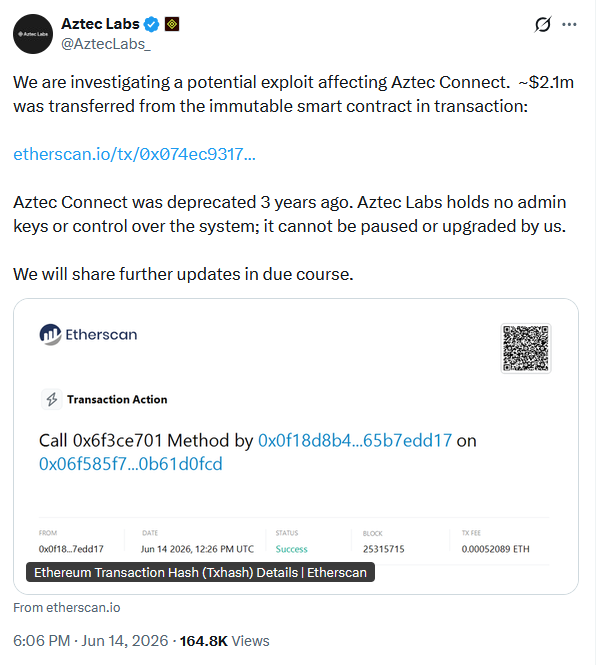
The first incident involved Aztec Connect, a privacy bridge that was discontinued in 2023.

Security researchers said an attacker exploited a flaw in the contract’s transaction verification process, allowing them to create balances that appeared valid within part of the system without being backed by actual deposits. Those balances were then withdrawn, resulting in losses estimated at approximately $2.1 million.

The stolen assets reportedly included ETH, DAI, and wstETH, along with several smaller token holdings.

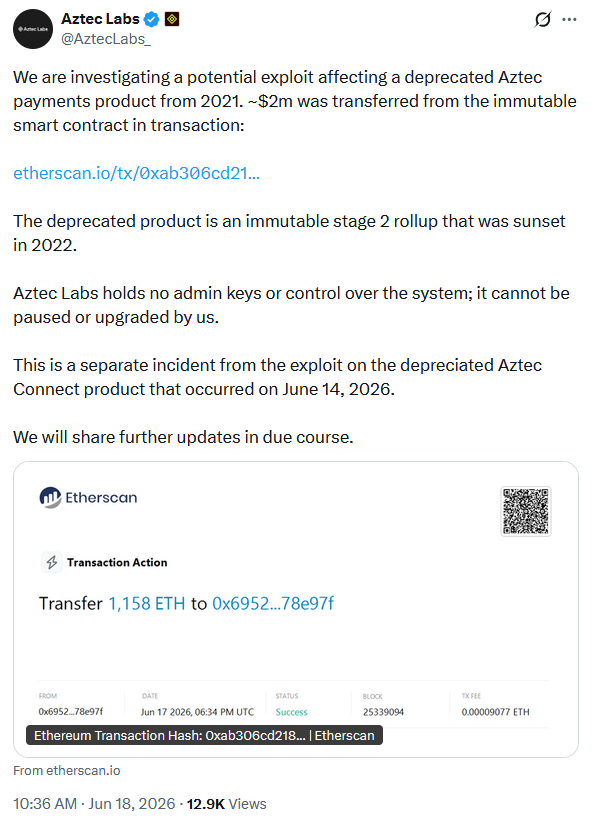
A second exploit followed days later, targeting an older Aztec payments product launched in 2021 and sunset in 2022.

According to reports, the attacker abused an emergency withdrawal mechanism known as an escape hatch. The function was designed to help users recover funds if the primary system became unavailable, but investigators say it lacked sufficient ownership verification checks. The exploit resulted in losses of roughly $2 million.

Why Aztec Could Not Intervene

Although Aztec labs created both products, the company said it had no ability to stop either attack.

When the services were retired, users were given extended periods to withdraw their funds. The contracts themselves remained on Ethereum, but Aztec Labs renounced administrative control over them.

That meant the company could not pause the contracts, modify their code, freeze assets, or deploy emergency fixes once vulnerabilities were discovered.

The situation reflects one of the core principles behind decentralized systems. There is no central operator. Code controls the funds held in smart contracts. While that limits administrative control over user assets, it also means vulnerabilities can remain exploitable even after a product has been abandoned.

Dormant Contracts Remain a DeFi Risk

The Aztec smart contract exploits highlight a broader challenge facing the DeFi sector.

Many blockchain applications leave contracts deployed indefinitely after services shut down. In some cases, users forget about small balances, lose wallet access, or simply fail to withdraw funds before a protocol is retired.

Those contracts continue operating exactly as programmed, often without active maintenance or security monitoring.

Industry observers sometimes refer to these systems as “zombie contracts” because they remain active on-chain despite no longer being part of a functioning product. While many hold little value, others continue to contain significant amounts of user funds.

The risk is not unique to Aztec. Several blockchain projects have warned users in recent years about withdrawing assets before network migrations, protocol sunsets, or infrastructure shutdowns.

What Happens Next

At the time of writing, none of the stolen assets from either attack appear to have been recovered.

Blockchain investigators continue to monitor wallets linked to the exploits, while security researchers analyze the vulnerabilities involved. Aztec Labs has emphasized that neither incident affected its current network infrastructure or ongoing development efforts.

The Aztec smart contract exploits serve as a reminder that shutting down a crypto product does not necessarily eliminate risk. As long as contracts remain active on public blockchains and continue holding user funds, they may remain attractive targets for attackers searching for overlooked vulnerabilities.

CME and CFTC Clash Over the Future of Crypto Derivatives

TL;DR

  • CME Group is moving ahead with a lawsuit against the CFTC over its approval of Bitcoin perpetual futures in the United States.
  • The dispute centers on whether perpetual futures should be regulated as futures contracts or as swaps under existing U.S. law.
  • The outcome could influence how future crypto derivatives are approved, regulated, and traded in U.S. markets.

CME Group moves to file a lawsuit against the U.S. Commodity Futures Trading Commission (CFTC) after the regulator approved Bitcoin perpetual futures, a popular trading product that has long dominated offshore crypto markets.

Speaking on CNBC’s Fast Money on Wednesday, outgoing CME CEO Terry Duffy said the exchange operator believes the approval raises serious legal and risk-management concerns. The move sets up a potentially significant battle over how crypto derivatives should be regulated in the United States.

The dispute follows a decision by the CFTC in late May to allow prediction market platform Kalshi to offer bitcoin perpetual futures, the first approval of such a product in the U.S. On the same day, the regulator also cleared a path for Coinbase to offer similar products through a registered affiliate.

What are Bitcoin perpetual futures?

For many readers, the dispute starts with a simple question: what exactly is a perpetual future?

A traditional futures contract allows traders to bet on the future price of an asset, such as oil, gold, or Bitcoin. Those contracts have expiration dates and eventually settle.

Bitcoin perpetual futures work differently. They allow traders to speculate on Bitcoin’s price without owning the cryptocurrency and without a contract expiration date. Positions can remain open indefinitely as long as traders maintain sufficient collateral.

The product has become one of the most widely traded instruments in crypto markets. It offers continuous exposure and often allows traders to use leverage.

Why is CME objecting?

Duffy argues that perpetual futures differ fundamentally from traditional futures contracts.

One concern is that the contracts never expire. CME believes this characteristic makes them more similar to swaps than conventional futures. That distinction matters because U.S. law treats swaps and futures differently. Under the Dodd-Frank Act, the two products are subject to different rules governing who can trade them, how transactions are cleared, and what disclosures are required.

At the center of CME’s lawsuit is the argument that the regulator should treat bitcoin perpetual futures as swaps, not as futures contracts.

CME has also raised concerns about leverage and the potential for rapid liquidations during periods of market volatility. Speaking about the approval, Duffy described crypto perpetuals as a product that could create significant risks for retail traders and broader markets.

The company has also argued that it holds exclusive licensing arrangements with major benchmark providers, an issue it believes should be considered when similar perpetual products reference those benchmarks.

A debate over regulation and competition

Supporters of perpetual futures argue that the products already dominate global crypto trading. Bringing them into regulated U.S. markets could improve oversight.

The CFTC has strongly defended its decision. A spokesperson described CME’s planned lawsuit as “frivolous,” while CFTC Chair Michael Selig said the agency believes regulated perpetual futures should be available in the United States.

“It’s time to approve regulated futures contracts that have no expiration date,” Selig said. “We’re going to make sure the product’s available, but it’s well regulated here in the U.S.”

Critics, however, argue that the contracts encourage excessive speculation and introduce risks that traditional futures markets were designed to limit.

The disagreement also highlights growing tensions between established financial exchanges and newer crypto-focused trading platforms. While CME has expanded its own crypto offerings in recent years, it remains skeptical of perpetual contracts.

What happens next?

The lawsuit could become a landmark case for the U.S. crypto industry.

At the center of the dispute is a relatively simple question with potentially large consequences. Should Bitcoin perpetual futures be treated as a standard futures product, or do they belong in a different regulatory category?

The answer may influence how future crypto derivatives are approved and traded in the United States, shaping a market that continues to move closer to mainstream finance.

- Advertisement -

FEATURED