Home Blog Page 227

Developer Warns of Possible Ethereum Attack

Burning guitar on a black font

The Dapp developer called Level K posted a public disclosure yesterday warning of a possible malicious activity on the Ethereum platform. It concerns all tokens supported by the Ethereum but especially vulnerable is the GasToken.

The risk comes when an Ether is sent to an address and the system performs arbitrary computations. In that case, the exchange pays an arbitrary sum for computations if it does not have gas risk prevention. When a user sends Ether to an address, he pays for arbitrary computations performed by the address. That is well known, Level K explains, and is called a vector of ‘griefing’. However, the cryptocurrency exchanges do not have proper protection. Here is how he presents the issue regarding the GasToken:

GasToken, which takes advantage of the refund mechanism on storage in Ethereum, allows users to store gas when the gas price is low and receive a gas refund when the gas price is high. By minting large amounts of GasToken when receiving ETH, the griefing vector mentioned above can now be a profitable attack.

Level K also posted a list of recommendations to crypto exchanges. He urges them to share contact details for developers to explain the possible risk even in a greater detail. Exposed tokens are the ones built on the ERC20 system but also on ERC721, ERC777, and ERC677. Coins that implement these tokens should implement gas restrictions, according to the Ethereum developer Level K.

Attackers may have co-discovered this vulnerability. Review your logs to determine if you have been subject to this attack.

Consider whether similar issues are present on other blockchains, such as Ethereum Classic or EOS, and set appropriate limits.

Consider implementing rate limiting and gas monitoring on withdrawal. Rate limiting is not sufficient to prevent attacks. However, it can help mitigate the issue,

He warns. For a full description of the possible risks, read Level K’s paper. CrispyBull will watch out for attack alarms and will keep following the cryptocurrency market.


Binance Just Invested $3 Million in a US OTC Exchange

Two hands

Binance team announced in a press release on Tuesday, 20th of November that the company collaborated with Koi trading platform. Binance is the biggest cryptocurrency exchange based in China. According to the crypto watcher CoinMarketCap, currently, Binance has the incredible trading volume of over $715 million USD.

The investment was made through Binance labs, a wing of the corporation defined as “social impact fund”. It aims to sponsor blockchain and cryptocurrency entrepreneurs, projects, and communities.

Koi trading is an over-the-counter cryptocurrency exchange. It is based in San Francisco, California. It deals with institutions and focuses on OTC compliance management. That is a small for the largest crypto exchange investment but certainly a substantial one.

Regarding the initiative, the head of Binance Labs Ella Zhang stated that:

Koi Trading’s mission is to bridge fiat and cryptocurrencies in a compliant manner. This aligns with our broader vision at Binance to build the infrastructure which provides the freedom of value exchange globally.

Binance wants to reach the North American market through financial organizations such as Koi trading. It deals with the U.S. regulations about cryptocurrencies and trading conditions.

The founder of Koi, and currently its CEO Hao Chen said about the exchange that:

Our team of experienced traders and sales personnel will join forces to tap into vast networks of counterparties in North America, Asia, and the EU, bridging the gap that divides the current OTC landscape.

He also stated that the partnership will be a great success for the exchange because both companies will join forces to spread across continents.

With Koi’s robust AML program, extensive banking relations in the US, investment from Binance Labs, and strong trust amongst counterparties in the Greater China, we aim to be the market nexus that reduces trust and information asymmetry and improves cryptocurrency OTC deal close rate.

10 Unconventional Blockchain Uses You’d Be Surprised About

10 Unconventional blockchain uses

In today’s rapidly evolving digital landscape, blockchain technology continuously redefines traditional paradigms, extending its reach far beyond the realms of cryptocurrency. Even though Bitcoin and Ethereum were the ones to propel blockchain into the limelight, the real power of this groundbreaking technology lies in its adaptability and broad applicability across sectors. Whether managing supply chains or revolutionizing healthcare, blockchain is ushering in a new era of innovation and disruption. It offers unconventional solutions to age-old challenges. Come along with us as we explore ten captivating uses of blockchain technology, transforming industries in ways you never thought possible.

1/ Art

Blockchain is now used by Christie’s to record information on artworks. Its Artory registry lists data on when and where a piece of art was bought, what its status is, the name of the artist, how it was made, etc. It registers everything but the owner’s true identity as many art lovers want to keep their anonymity. Christie’s recorded billions from its last auctions on it. If you wonder how it works, check it out here.

    2/ Elections

    The popularity of E-voting systems is on the rise globally. Although not completely adopted, many governments are contemplating switching to a digital structure. With blockchain, people can vote from anywhere and the system immediately registers and processes the vote. A few months ago, Brazil announced it was considering blockchain voting. It would be a convenient solution to apply to its vast territory: citizens cannot make their choices due to the sheer inaccessibility of polling stations. However, for the moment the project seems to be frozen. Similarly, Russia also wants to implement the blockchain. Recently, the autonomous community of Catalonia announced that e-voting would be more secure (corruption-wise) and motivating for Catalan citizens. None of these countries introduced blockchain voting, though.

    3/ Electricity

    That is an interesting one. South Korea announced recently it will implement the blockchain in an innovative microgrid system. Microgrids are localized sources of energy that can operate separately on their own. Presently, they are connected to the main grid controlled by a central bottleneck. The electricity company plans to substitute the central system with a decentralized one, meaning each microgrid works independently within a power ecosystem. That would remove limitations for different energy structures and would consolidate interoperations. The best of all is that it is super eco-friendly, too.

    4/ Supply chains

      Big chains like Walmart have started implementing blockchain technology to track its food suppliers. Recently, the Center for Disease Control and Prevention (CDC) advised the giant to carefully track its products due to E.coli outbreaks. The blockchain emerges as a highly efficient and rapid solution for such purposes. Suppliers can instantaneously upload information on food sources, transportation, and everything from the farm to the store. Other examples are Nestle and Tyson Foods. They all partner IBM on an Ethereum-based system.

      5/ Healthcare

      Currently, all health-related details of a patient are kept in a central system. In some countries, it is not even a digital one but still on paper documentation. Blockchain can help a lot here, literary. Making data accessible to different health services would ease the process. In today’s world, patients can travel the globe and heal in various locations. A blockchain health system would provide important information about past treatments, examinations, etc. Simultaneously, it could be updated equally from different places. This application of blockchain technology is really a crucial one.

      6/ Beekeeping

      A curious one. Blockchain technology can enhance hive management, supply chain transparency, and product traceability. Beekeepers who leverage blockchain can accurately record hive data, monitor environmental conditions, and track honey from hive to consumer, ensuring authenticity and quality. This innovation boosts trust and efficiency within the sector, benefiting both producers and consumers.

      7/ Poverty projects

      There are numerous projects already on how to use the blockchain to fight poverty. For instance, The Central Bank of China announced some time ago it will use blockchain to face the huge poverty in Tibet by upgrading its cloud services. Other examples include corruption limitations projects, ICO fundraising, cryptocurrency charity organizations, and natural disasters crowdfunds. They all stand on the principle of being part of a non-hierarchic network that triggers an alarm when there is an issue.

      8/ Real estate

      Blockchain would be very helpful in registering real estate. Its decentralized software can record information about land, houses, apartments, etc. And it does not end there. In fact, the accounting giant Deloitte recently released a report on prospering blockchain uses. They include faster search engines, safer real estate purchases, better leasing conditions, and cheaper commissions. That one is connected to #7. A huge part of the land in Africa is not yet registered. The blockchain would allow multiple registration processes from different places. That is another way to fight poverty.

      9/ ID management

      With the recent scandals of Cambridge Analytica and Facebook, the question of personal information becomes even more vital. We are all exposed to a personal attack being part of the Internet family. So, keeping our personal details secure is getting harder and extremely important. Blockchain technology could aid identity management by eliminating central data storage. If everyone could register their own information from different nodes, no one would keep our info on a server somewhere.

      10/ Music

      Blockchain and music make a perfect combination. Through the independence from third parties, the blockchain can improve the music-making process substantially. The decentralization can connect artists to producers, musicians, etc. Without the need for record companies, unfair contracts, and all these steps that now exist. Moreover, the blockchain can solve piracy issues, royalty management, and authorship problems. Simply put, it would let the music reach straight to the audience and both sides would benefit from it. There are many blockchain music projects already. Ujo, Viberate, Myceli, and Blokur, to name a few.

      Wrapping up our exploration of these ten uses of blockchain technology, it’s clear that blockchain has a lot more to offer beyond just being used for cryptocurrencies. From improving transparency in supply chains to transforming how healthcare data is managed blockchain is bringing about changes across various industries. These creative applications demonstrate how versatile and flexible blockchain can be, providing answers to challenging issues and paving the path for a more transparent, secure, and efficient future. As blockchain continues to progress we can anticipate the emergence of more innovative applications that will solidify its position as a key technology in the digital era.

      Follow our Blockchain News section for more live updates on the innovation.

      The Biggest Korean Power Provider to Implement Blockchain

      Lightning ads in South korea

      Korea Electric Power Corporation (KEPCO) announced in a press release on Monday that it will develop a refined microgrid system with blockchain technology. The company holds a total monopoly on the South Korean market providing 93% of the country’s electricity.

      KEPCO’s president stated on November 18th the company works on a “future microgrid project”. The plan is to utilize digital technology and blockchain on the new system. Microgrids are localized energy sources, connected to the main grid, that can work separately on their own. However, the current microgrid network fails to provide stable electricity for the whole country. The new implementations will use power-to-gas (P2G) technology to convert electricity into gas fuel.

      P2G is an innovative technology that uses renewable sources of power like wind or water. It splits the molecules via electrolysis to extract hydrogen from them. Then the microgrid stores the gas fuel and transforms it back into electricity when is needed. The technology is super eco-friendly because it does not emit greenhouse gases. It will support the hydrogen industry, the statement reads, which will be the electricity’s future.

      The blockchain technology will be favorable for the new microgrid system since it will allow each energy source to operate independently. The release explains how this will happen:

      If electricity can be traded between microgrids, it will be helpful to stabilize the power system of new and renewable energy by eliminating the system connection bottleneck.

      Previously, the technical standards were different for each microgrid provider. However, when interoperability became possible, the network operators, consumers, and related companies could implement various business models and share the benefits derived from them.

      The blockchain will solve inter-operational problems and will ease the connections in the microgrid ecosystem. According to the KEPCO’s announcement, it will significantly raise the electricity efficiency. Current microgrid systems limit power levels through their centralized bottleneck.

      The three major trends in the future of the energy industry are: decarbonization, decentralization, and digitalization.

      Said the CEO of KEPCO Kim Jong-gap, cited by the release. Furthermore, the company plans to construct the first mega-wattage (MW) energy-independent microgrid. It remains unclear when it will be launched.


      Ripple (XRP) and Stellar (XLM) Hold the Uptrend This Week

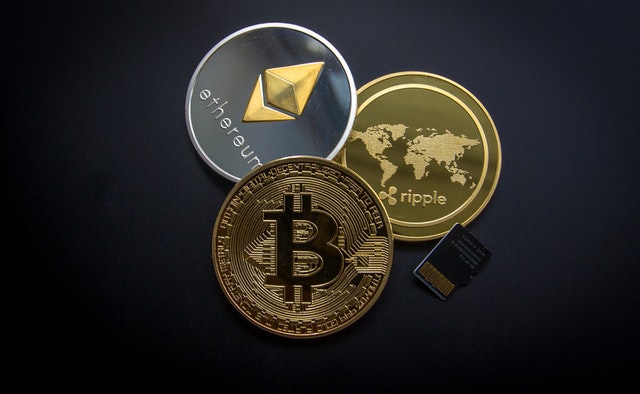
      Bitcoin, Ethereum, Ripple as golden coins.

      In the midst of a totally negative crypto market lately, Ripple’s XRP and Stellar occur to be the only ones to keep the uptrend. Their price levels showed distinctive stability opposing all other major cryptocurrencies except for the stablecoins, of course. Perhaps, the steady decline we see with Bitcoin and Ethereum lately led many traders to the altcoin solution. However, if both digital assets keep moving up, they will certainly breakout on the market.

      Ripple’s fast dash

      Ripple has managed to quickly evolve and popularize. The fintech company that stands behind it, RippleNet develops fast-payment systems using peer-to-peer software. Ripple is not Bitcoin’s rival but on the contrary, it aims to ease crypto transactions. However, the platform works with fiat money, too. The startup signed up contracts with numerous banks and cross-border payment systems (like MoneyGram) and has already spread across 40 countries. The network is widely used in Asia which probably explains the high sentiment in the digital coin, too.

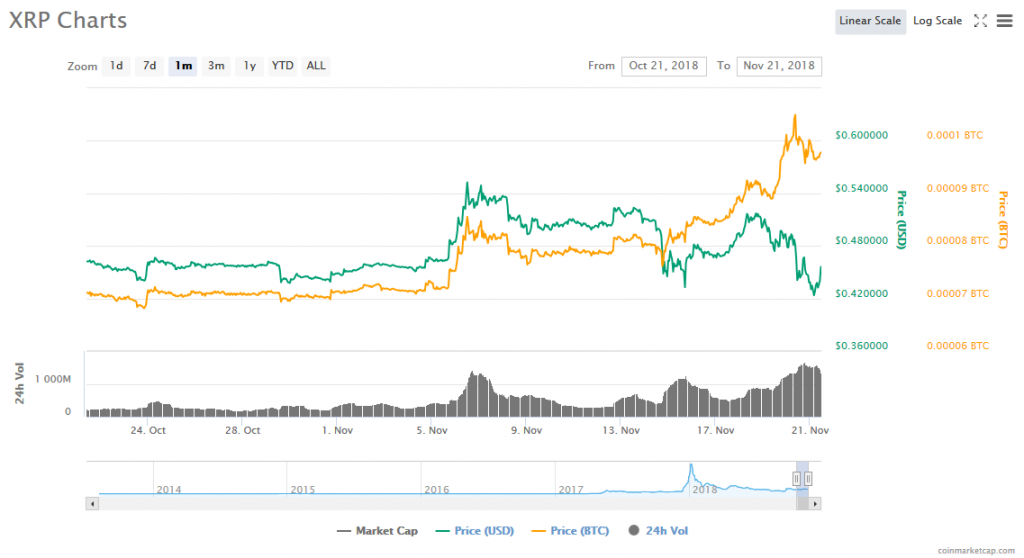
      XRP’s price holds the rate of around $0.4 – $0.5 USD in the last week. It fell down 5% yesterday but quickly recovers today. It performs quite well, compared to the other coins which recorded a plunge with a two-digit percent. For the last three months, XRP has gained almost 50%.

      Ripple price chart
      Chart from coinmarketcap.com

      At the time of writing, Ripple’s XRP is listed as worth $0.452 on CoinMarketCap. It marks a level of resistance of $0.54 USD. If XRP breaks it, it could surge to $6.00 and even up to $7.00 very soon. It is also worth mentioning that XRP has over a billion dollars trading volume for 24 hours, which is a great movement.

      Stellar’s breakthrough

      Stellar Lumens works in the field of fast transactions and micropayments. It is free-to-use software, licensed under Apache. The startup, presented as a non-stock non-profit organization, fights for “payments that move like emails”. Lumens also works with banks and cross-border payment providers, like Tempo in Europe. It is basically a decentralized network for fast and mobile money transfers on a distributed ledger.

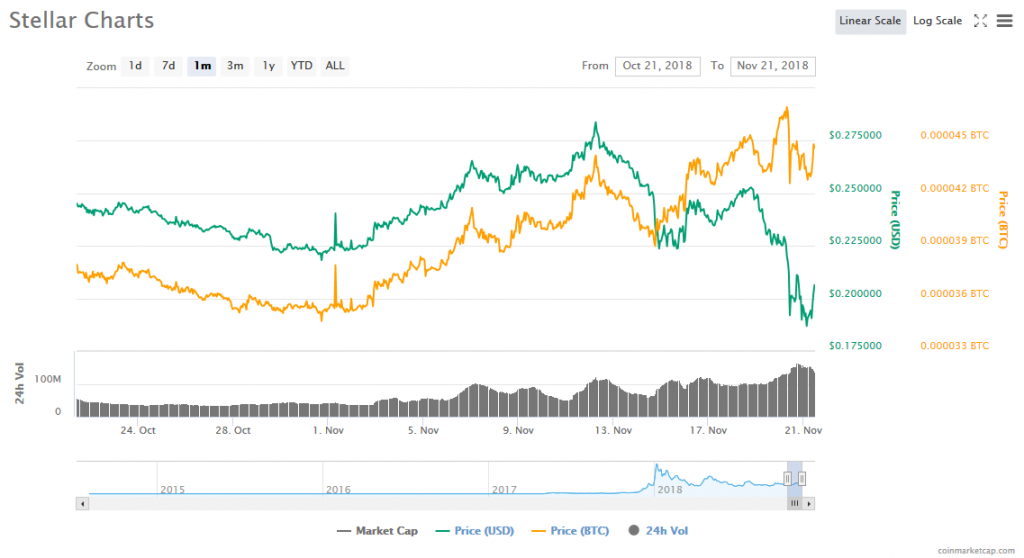
      Stellar’s XLM survived the crypto storm with dignity. From the middle of September by now, it has raised to 14%. It did drop with 16% yesterday, but the charts show a bullish trend is coming. However, despite many others, this altcoin moves upwards for the last three months.

      Stellar price chart
      Chart from coinmarketcap.com.

      Now, XLM costs around $0.20 on CoinMarketCap. It managed to survive the Bitcoin Cash hard fork and hash war mess and jumped immediately after. It holds the fifth place on the cryptocurrencies’ ranking steadily. Moreover, Stellar has a market capitalization of over $3 billion dollar which almost doubles Litecoin’s one. Lumens has certainly a lot more to show.

      It is interesting to note, that in the colorful range of crypto coins, exactly these two occurred stable lately. Both companies develop digital payment systems with public ledgers. They strive for instant transactions and have already partnered with official financial institutions.

      It seems the world genuinely needs a refined money structure.


      - Advertisement -

      FEATURED