
Home Blog Page 228

Catalonia Considers Blockchain E-Voting System

Catalan Flag

The Spanish news platform La Vanguardia just reported yesterday that the Catalan government considers switching to e-voting public system on the blockchain network. According to the data, last elections on 2017 reached a record high activity outside of Catalonia. However, all in all, the electoral dynamics did not exceed 12%. That strongly contrasted the polling results which were about 89%.

That is why in October the Generalitat of Catalonia accepted a draft bill on e-votes for citizens living abroad. It also discussed other changes in the voting system regarding the easiness of votes for the autonomous province. All changes are supposed to be launched effectively from 2020.

Yet, for now, electronic votes can be used only by Spanish emigrants.

For reasons of security and cost-benefit, in case it works badly. There is a consensus among the experts that when introducing this type of tools, it is necessary to ensure that the risk in case of failure is smaller.

Explained Ismael Peña-López, director of the Generalitat, according to La Vanguardia. The plan is to introduce e-voting step-by-step, so people can get used to it.

The implementation of the digital system will be made on three phases: first for the citizens abroad, then for early votes and finally for all voters.

My intention is that the groups amend the law so that it is universal already in the beginning. The current project does not prevent it from the need to start from scratch again with the paperwork and the reports and take half a year or a year to pass the law.

Continues Peña-López, stressing on the flexibility of the bill. The Catalan government wants to accept the changes gradually but at the same time, to be adjustable enough for all consequent transformations.

There are lots of discussions about the blockchain technology and e-voting in Spain. However, the country seems to far away from it for now. As for Catalonia, Generalitat announced that if they would like to implement blockchain, testing could not start earlier than the end of next year. On that question, Peña-López stated the government is not completely sure it will use it yet.

An interesting option is to use blockchain, it’s on our digital agenda. There are several options offered beyond the vote. But we have not yet entered the electronic vote. The Generalitat has not made a clear commitment to the blockchain and is still exploring what options there are before deciding.

An important issue of the e-voting is the general electoral activity expected to plunge with the technology. It is so because the population grows older (as everywhere in Europe) and will not be able to use modern systems. Nonetheless, digital voting was defined as much more secure than traditional one by the Catalan legislators.

Ethereum’s Incredible Year: Price Reaches Unseen 2018 Levels

Blue lights in front of skyscrapers

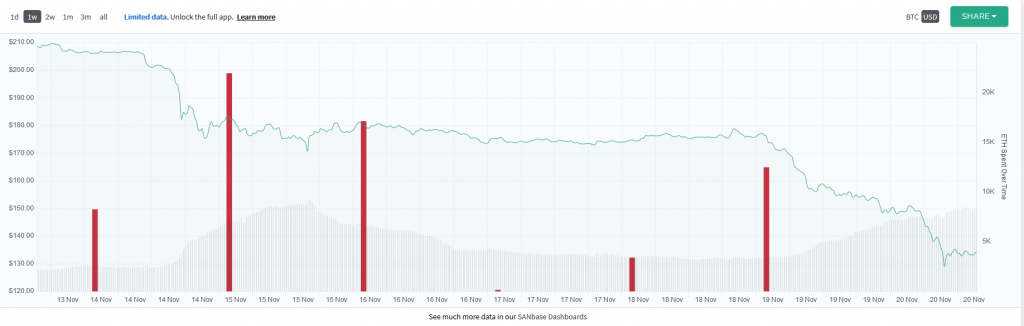
Cryptocurrency market decline started last week with the Bitcoin Cash hard fork. Around 14th and 15th of November, the two major cryptos the Bitcoin and the Ethereum started to decrease in price substantially. Since then the market refuses to recover. Instead, it shows a trend of steady decline leading experts to even darker predictions.

At the time of writing, Ethereum is worth only $134.13 USD, according to CoinMarketCap. It marked a decline with almost 15% for just one day. The coin saw its peak in January when it reached around $1,420 USD on some exchanges. That calculates to the incredible difference of nearly 9,000%.

According to the sentiment data by SANbase, 55,000 ETH were moved out of teams’ wallets only for the past week. As seen on the graph, that activity was reported specifically on the 14th and 15th of November, and again on 18th and 19th.

Ethereum Price Decline Chart

Logically, Ethereum’s market capitalization has shrunk, too. From over $21 billion at the beginning of last week, to just $14 billion today.

The hype around Bitcoin Cash hard fork and the hash war is probably the reason. Miners probably sell their BTC and ETH to sponsor Bitcoin Cash mining. Doing so, they richly supply the market and the price automatically goes down.

Another reason for ETH’s plunge is perhaps the ICO sale on the Ethereum platform. As known, the Ethereum functions a lot like a developing platform, except as only a cryptocurrency. ICO projects, supported by the blockchain, sell Ethereum ERC20 tokens. The ICO market was so vibrant lately, as CrispyBull informed, but the last couple of weeks there is certainly an ICO activation going on.

Ethereum’s price decline seems to be part of the negative financial market in general with stocks’ prices going down and huge corporations registering loses.

Greece Suppresses Accused Bitcoin Scammer’s Rights, According to His Lawyer

Financial chart on a black screen

The case dates back to 2011. BTC-e was launched as a cryptocurrency exchange offering popular at the time coins against the US dollar, Russian rubble, and European currencies. It was based in the United States and operated by ALWAYS EFFICIENT LLP, registered in London. It gained a significant trading volume holding 3% of the Bitcoins worldwide.

However, in 2017 the US authorities shut the platform and seized their funds. It did not become clear what were the reasons exactly: BTC-e was accused in money-laundering, illegally keeping users’ assets and false claims of hackers’ attacks.

Alexander Vinnik was arrested as a leading operating of the BTC-e exchange on 25th of July 2017 while on a holiday with his family in Greece. He was wanted from France and the U.S. for money laundering for $4 million USD in Bitcoins and a fraud. Next year, in 2018 it was widely discussed if he would be moved to Russia where he would face only fraud charges. But the Greek Supreme Court decided to extradite him to France which changed the case.

Currently, Vinnik is still held in Greece. His representative claims tough, that his extradition to Russia is already dealt with and will soon happen. By then, his lawyer Zoya Constantopoulous accused the Greek court of failing to provide adequate court documents to the alleged Bitcoin criminal. With that, Constantopoulous means that the court did not provide translations of the paper. The news, reported by the Russian outlet TASS, continues with the claim for a different attitude towards his client Alexander Vinnik, in comparison to any other European or Greek defendant. Cited by TASS, Constantopoulous stated on the court protocol that:

You are violating the rights of Alexander Vinnik, who until November 17 did not receive an official translation of the documents of the French request. These documents were not translated into Russian, they have no seals or signatures. You apply this procedure to Vinnick just because he is Russian. You don’t apply it to any Greek or EU citizen.

Meanwhile, Vinnik keeps his innocent plead and claims he had nothing to do with the management of the exchange. Since the US authorities shut BTC-e, they developed tokens called WEX to refund users (they were worth $1). At the moment, a crypto exchange operates with the same, World Exchange Services, opposing any connections with BTC-e. However, the website’s design resembles BTC-e’s one and it was pitched to attract disappointed BTC-e’s users.

At the time of writing, 20th November, WEX platform sells Bitcoin for $7864 USD which seems totally impossible. Today, the Bitcoin’s price hit another record low of around $4.400 on literally all exchanges.

BTC-e and Alexander Vinnik are said to be connected to the Mt.Gox scandal. Allegedly, the BTC-e team was laundering stolen money in the attacks against Mt.Gox’s hot wallet. In both cases, many Bitcoins were lost, and thousands of traders could not withdraw their funds. Now, online talks say WEX will be soon sold and has strong connections to Ukraine and Crimea annexation military operators.


Bitcoin Black Friday? The Coin Hit A Record 2018 Bottom

Autumn wood, red-leaves trees and a road

It seems like a Black Friday big sale of the most popular cryptocurrency ever. But, unfortunately, it is not staged by anyone.

In the financial lexicon we say, ‘to buy the dip and to sell the rally’, meaning to buy when the price declines significantly and to sell when it surges. Bitcoin’s price has not been so low for a very long time and now, even hodlers find it hard to keep their assets.

Why did the Bitcoin fall?

Crypto market is led by a complex mix of factors. However, what we are witnessing for the last couple of weeks is a total lack of momentum. The price fell, and we somehow expected it to recover fast. But it did not happen this way. On the contrary, it kept plunging to unseen this year level. And it looks like it will continue its steady decline.

The broad 2-month consolidation led to a breakout, but unfortunately for bulls, it was to the downside.

An apt comment by a TradingView user called goldbug1. It really summarizes the situation quite well: there was a continuous stability in Bitcoin’s price and everyone was expecting a move. But the breakout did not occur in the direction we thought would but on the opposite one.

Usually, in economic history, a big plunge is followed by a skyrocketing. It certainly makes traders believe another moon is coming, and quite soon. However, financial predictions on TradingView forecast Bitcoin’s price to reach the overwhelming $2000 in order to recover strongly. In fact, some still consider going back to $20,000 plausible.

The Bitcoin Cash fuss

At the time of the Bitcoin Cash hard fork, Bitcoin Core (BTC) fell down substantially. The split pertained a huge public attention to the two new blockchains and included free coins for the miners. So, of course, it did lead to a distraction as the whole cryptocurrency market is closely interconnected. Currently, the hash war between the two Bitcoin Cash teams is quenched. It will probably resonate to a new Bitcoin buying interest.

The financial market in crisis?

Meanwhile, while the Bitcoin’s price suffers record lows for the year, the financial market does not bloom, too. The so-called FAANG, which consists of Facebook, Apple, Amazon, Netflix and Alphabet’s Google, experienced a significant decline of shares lately – with about 20%. Facebook’s Mark Zuckerberg lost the third place of the world’s richest people and became sixth for just a day. As Bloomberg reported yesterday, Morgan Stanley’s analysis says that:

For the first time in more than a decade, buying the dip isn’t working in the stock market.

And it was working even during the financial crisis in 2008-2009.

There is not a proven correlation between the stock market and the cryptocurrency one. But this sudden decline shared by both fields does not seem random. We are yet to see how 2018 will end. CrispyBull stays live for all moves of the crypto market.

Bitcoin Cash Remains Split In The Near Future

Chess play with a king winning

The latest boom in the crypto world was the hard fork of the Bitcoin Cash on 15th of November. However, the two developing teams could not reach a consensus and for almost a week now, both blockchains are active. Everyone was wondering what is going to happen and if they would shake hands any time soon. Rumor has it, the team led by Satoshi-want-to-be Craig Wright prepares a 51% attack or mining empty blocks. However, Coin Dance, the website which monitors and posts everything related to the Bitcoin-derivative cryptocurrencies announced that the chains will not merge again. At least for now.

Coin Dance is now able to declare that both active chains will continue to be permanently split into the foreseeable future. The majority of businesses in the cryptocurrency ecosystem are now using Bitcoin Cash (BCH) to refer to the chain maintained by miners operating in consensus with the latest implementations from Bitcoin ABC, Bitcoin Unlimited, Bitprim, Bitcoin XT, bcash, and bchd. A number of exchanges have added support for the Bitcoin SV chain under the Bitcoin SV (BSV / BCHSV) name but general app support is currently very limited. Expect to see announcements made from each of the major companies in the Bitcoin Cash ecosystem that clarify which chain(s) they will support going forward.

Apparently, Bitcoin Cash ABC won the game, in a way. The ABC team was really struggling with mining, since Satoshi’s Vision kept most of the hash power, as CrispyBull reported last week. Also, speculations went on to wonder where SV’s hash rate was going if the team did not mine any blocks in the days after the fork. Anyhow, Roger Ver’s team seems to handle the problem because currently, according to the Coin Dance’s charts ABC holds 58% of the total hash rate. Moreover, the latter officially received the BCH ticker symbol, too.

Since most of the crypto exchanges decided to support the ABC system, Bitcoin Cash ABC started to be referred straightly as BCH (and not as BCHABC, as it were for a few days). The mining pool of bitcoin.com announced their full support of the ABC ecosystem which makes it even more credible. In fact, BCHABC is mined predominantly by the bitcoin.com pool, with 36% of the blocks, followed by BTC.com and AntPool. BCH SV, on its side, is developed mainly by Coingeek with 56%, the SV team, BMG, and Mempool.

As of the time of writing, BCH ABC substantially wins over SV pricewise. According to the crypto watchdog CoinMarketCap, ABC sells for $233 USD whereas SV fell with more than 30% for the last 24 hours and now costs only about $79 USD.


- Advertisement -

FEATURED