Home Blog Page 229

ICO Funding Fell With 48% in Q3, New Research Reveals

Blue paper on a picture of bulb

A new study, published on 15th of November, by the independent research group ICO Rating gives insights on the latest coin projects. In toto, the research reveals that the months between July and September were not so successful for the ICO (Initial Coin Offering) initiatives than the two previous quarters of 2018. The summary says that:

Q3 2018 was not as successful as Q2 and Q1 of 2018 for ICOs. Regardless of the high risks inherent in ICO investing, many fraudulent projects and an overall bearish trend in the market, investments continued.

The total amount raised by ICOs was $1,819,585,090 USD. This is significantly less compared to the previous quarter when funded ICOs reached 8,359,976,282 – almost 7 times more. However, despite the bearish predictions lately, there were nearly 600 projects launched in Q3. But, sadly, 57% could not collect more than $100,000 USD. And only the modest number of 4% of all ICOs managed to get listed on cryptocurrency exchanges.

Why was there a fall in investments?

Perhaps the reason for the smaller funding is the business proposal that backs up these projects. According to ICO Rating’s report, 76,15% of the offerings had nothing behind them but an idea. This is not such a shock, compared to Q2, because the difference is with only 18% more idealistic kind of offerings. However, this summer we saw a huge lack of transparency, too. 82.17% of the ICOs used closed-source code instead of an open-source one. And their statistics say open-source projects are more successful in general, 69.42% of the ICOs which did not expose their developing process on GitHub could not attract investors.

Where the ICOs were launched?

Geographically speaking, it is interesting to note that almost half of the recent ICOs were launched in Europe – 43%. The funds stayed in Europe though, because 48% were raised there, too. The second place goes to Asia, with almost 20% of ICO gained funds, the third one is for various countries worldwide, and North America comes fourth with about 12% of ICO crowdfunds.

What were the ICOs for?

The offerings in Q3 stood primarily for financial services which gained more than $120 million followed by blockchain infrastructure and wallets, also quite successful. Per ICO Rating, the surprise for this quarter is the listing of Drugs and Healthcare industries in the ICO ranking which has not been so popular by now. Moreover, service tokens certainly ruled the market whereas the utility ones have backed up substantially.

The Ethereum platform kept the monopole again in Q3. 83.75% of all token sales were made on the Ethereum platform and the other percentage is divided between smaller systems such as NEO, Stellar and Waves.

86.13% of the projects aimed to create a Dapp or a decentralized application. Unfortunately, even with the strong hype around all kinds of applications in recent years, 67% of all Dapps ICOs were not successful.

Which are the successful ICOs?

So, after the long negative list with ICO which did not manage to break through, let us see the good examples. Unsurprisingly, EOS holds the number one in raised funds. EOS is a platform, operation-system like and a cryptocurrency with more than $3 billion market capitalization already. Among others are TaTaTu, the decentralized entertainment platform, Bankera, Telegram, the crypto exchange Huobi, and Environ. The latter is a Swiss-based energy startup we recommended as a promising green ICO project some time ago.

CrispyBull will continue to monitor the ICO market and to deliver live information. After all fraudulent activities, let’s hope that the market will finally re-organize and consolidate.

 

Giant Crypto Exchange eToro Announces a New Native Stablecoin

A row of golden coin in an ascending line

EToro is a huge marketplace, originally based in Israel. It offers social trading on numerous assets: cryptocurrencies, as well as fiat ones, commodities, stocks, indices, ETFs, and others. The exchange has just announced it will launch its own, native coin, Finance Magnates reports. Yoni Assia, CEO of eToro, said on the latest London Summit that the company definitely will start a new project.

Will eToro issue its own stablecoin in 2019? – absolutely yes!

Stated Assia on the event, according to the Finance Magnates. The stablecoin will strive to include those who ‘have less’. However, it is not yet clear how would be backed up and/ or to what currency would be pegged to.

Yoni Assia does not also reveal if and how the new project is connected in any way to the GoodDollar one. The latter is an experiment, announced on November 7th, to create a not-for-profit cryptocurrency which would fight global inequality. It will do a series of test and consequently, distribute money through the principles of the universal basic income.

That is a second big news for eToro recently. At the beginning of November, the company also presented their new crypto wallet services. Allegedly, eToro will offer crypto-to-crypto pairs very soon.

EToro is established in Tel Aviv, Israel but has offices in the UK and Cyprus, and works with all EU members, as well as Gibraltar and Switzerland. It remains unknown to which currency the eToro coin, whatever its name would be, would be pegged to.

However, stablecoins are certainly on the rise, especially among the crypto exchanges. As CrispyBull recently reported, Coinbase partnered Circle for a Dollar-collateralized token USDC. Winklevoss’s Gemini also launches the Gemini dollar soon. Usually, as it this the case with these stablecoins, and with the Tether, they are pegged in 1:1 ratio to the US dollar. It is certainly interesting for us to see what would be eToro’s chosen money and how it would reflect the market. EToro’s CEO Assia claims, though, that the stablecoin would be released by the end of the year.

ICO Issuers Will Pay Taxes, French Regulator Says

Eiffel Tower on a Pink Sky

France struggles to regulate its ICO market for quite a while. However, the process still goes in a slow way. At the beginning of October, the country announced a draft of proposed regulations. They included steps of application and approval for new projects, as well as dispute resolving prescriptions.

Now, the third economic power in Europe, adds up that whoever wants to apply and launch a digital asset project, would have to pay taxes by the profits. As Reuters reports, that is not a surprise for the blockchain industries there – if they expect better safety, they would have to contribute, too.

Fabrice Heuvrard, who works with the French government on the new regulations, claimed, cited by Reuters, that that would not be an issue for the local businesses.

The (cryptocurrency) community is ready to pay taxes as long as they are not confiscatory.

However, the French crypto market is relatively vibrant at the moment. Compared to the US one, or even the British one, there are fewer blockchain projects on the Mediterranean. But according to the ICOWatchList, France holds 2% of the total ICO market. By now it has raised more than $78 million USD in total. That is the reason for the French government’s attempts to stimulate the crypto business. The new regulations would apply only to ICO projects submitted by French-based companies.

The exact sum of the taxes is not yet decided, though. The usual amount is 20% but according to the ministry official, it is discussed to be calculated proportionally to the revenue, Reuters continues.

Perhaps not so attractive part of the legislative plan is the slight shake of anonymity. French authorities would carefully check who support the ICO launch, do they have a backup plan if the crowdfunding fails and will have to mandatorily do a KYC procedure. For many, that would not be such a business magnet since cryptos rely on secrecy by default. But perhaps that is not so bad because it will not attract wild business adventurers. As Paul Allard, an ICO initiator in France puts it:

Cowboy capitalists will not come to Paris and, you know what, it’s better that way.

The regulations are expected to go effective next year.


Bitcoin Hits October 2017 Low on Wednesday, Now Slowly Recovers

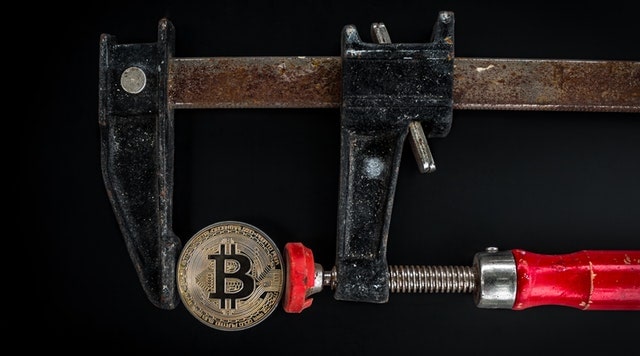
Bitcoin as a physical coin

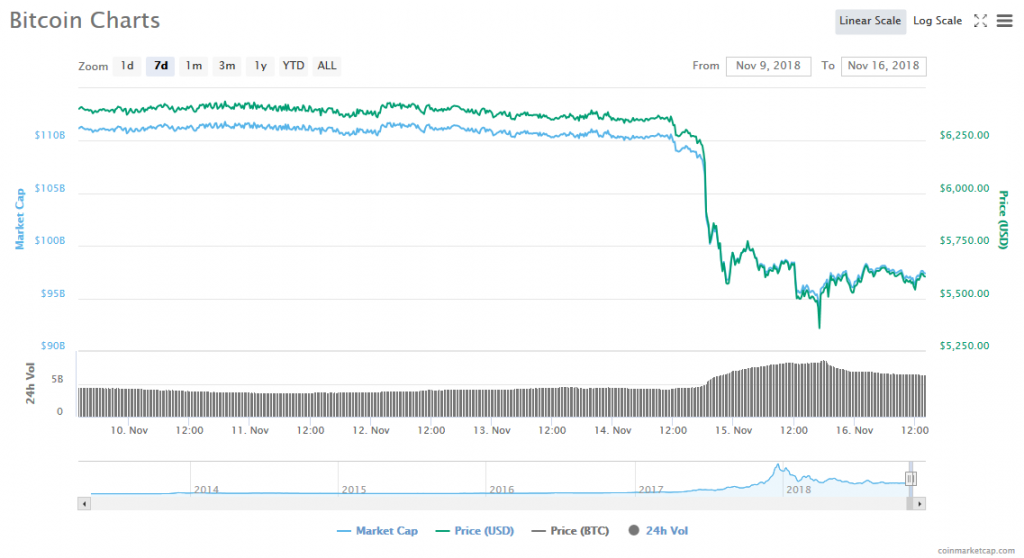
Bitcoin’s price showed incredible stability for the last couple of months. It was circulating around $6.500 with a single breakout over $7.000 USD on 15th of October 2018. The low volatility rate was praised by many as an important step towards its mass adoption. However, this Wednesday the market nearly crushed.

On November 15th Bitcoin hit a record of roughly $5.300 on some exchanges. The most popular cryptocurrency in the world has not seen so low levels since October last year, i.e. before its overwhelming jump to almost $20.000. Bullish predictions felt disappointed. All the hype around Bitcoin’s white paper birthday just fade away and reportedly, traders started selling. As seen by the graph, the panic raised Bitcoin’s trading volume because users got probably quite worried.

What actually happened?

With financial markets, we cannot be sure what exactly led to the current situation since it is usually a complex mix of internal and external factors. And yet, the date matches the event of the Bitcoin Cash’s hard fork. On Wednesday, as CrispyBull reported, the BCH upgrade was scheduled. That led to huge public attention to the altcoin and, of course, investments in the latter. Usually, when hard forks are conducted that is related to some sum of free coins given to the owners of the pre-forked token and those who support.

Joshua Frank, cryptocurrency analysist from the platform TheTIE.io, told before Forbes that the Bitcoin Cash fork certainly reflected the whole digital assets market. Here is how he explains it:

We have seen this FUD and confusion in Twitter conversations. This is reflected by the fact that Bitcoin Cash has had sentiment volatility three times higher than any other major cryptocurrency over the last 24 hours and BCH’s tweet volume is 217% higher than its 20-day moving average.

With the uncertainty expressed by crypto traders on Twitter, both the short and long-term sentiment of Bitcoin Cash remain negative. It will be interesting to see how the sentiment of BCHABC vs. BCHSV, as well as miner adoption, play out over the next 48 hours. We anticipate this having a strong impact on future price movement.

According to other financial experts, the market was very sensitive anyway and the hard fork just triggered what was about to happen anyway. Tim Enneking, for example, from the Digital Capital Management, expressed quite a similar opinion:

The markets have been incredibly soft, and the BCH fork simply provided the catalyst for a drop that’s been waiting to happen for a while now.

However, the deep drop could turn out to be a good bounce for the Bitcoin. Currently, it slowly recovers at $5.600. For quite a while, the Bitcoin kept the level of resistance to $6.000 and that would be its next goal again. If it supports this level for a month, the Bitcoin still has the chance to end the year positively.

Bitcoin Cash Divided Into 2 New Coins: Which Blockchain Will Prevail?

Two men fight over money

Bitcoin Cash, the last-year born division of the Bitcoin, goes through numerous forks for its short life. The last one, as CrispyBull informed, was set to be yesterday, Thursday 15th of November. The hard fork of BCH was necessary due to disagreements between the supporting teams.

Today, we woke up with two new cryptocurrencies at hand: Bitcoin Cash ABC and Bitcoin Cash SV. The result of the hard fork shows that the original BCH is no longer active on the market, as seen in major crypto watchdogs such as CoinMarketCap. The latter utterly warns that:

Please be aware that BCH withdrawals, deposits, and transactions are being frozen across a multitude of exchanges until a consensus is reached regarding the hard fork.

Currently, users’ funds are directly divided between the BCH ABC and SV networks if no other choice is stated. Major crypto exchanges like Binance and Coinbase announced they would support the split thriving for profits from the new coins.

Hard forks occur because of the demand of consensus. Currently, the two developing teams cannot reach one and until then, the two blockchains will keep existing. However, it is not so often to end up with two different cryptocurrencies though. Usually, the teams handle the upgrade one way or another or just decide to work on separate projects.

A hash war between the teams?

It is not just that no consensus is reached but even worse, the teams are in a vigorous dispute. It goes for quite a while already, since the Satoshi-wanna-be Craig Wright’s team keeps bashing others’ proposals. Now, his group nChain called the new project Satoshi’s Vision referring to what the Bitcoin’s creator truly wanted to happen.

Meanwhile, BCH ABC team views SV’s mining passivity as a potential attack. The question is who has more hash rate. Reportedly, Satoshi’s Vision has around 70% hash rate. Surprisingly, their developers do not mine at the moment, as seen on CoinDance. This leads the Bitcoin Cash ABC’s supporters to ask where their hash power is, if not used for mining. Moreover, rumor has it that Craig Wright’s group plans to mine empty or false blocks (which do not have recorded transactions). This would certainly shake the Bitcoin Cash’s ecosystem.

If both sides are going to shake hands or not, we are about to see. By then, BCH ABC keeps selling around $287 USD, according to CoinMarkerCap, whereas BCH SV stays at $114 with a 30% dropdown for the last several hours.


- Advertisement -

FEATURED