Home Blog Page 232

Blockchain Meets Cosmology: Ethereum’s ConsenSys Just Bought Planetary Resources

A picture of space

The blockchain is going into space. Literally.

The Ethereum-developing company Consensys acquired Planetary Resources Inc., a press release announced yesterday.

Consensys was founded in 2015 by the Ethereum’s co-creator Joseph Lubin. The company has a wide range of activities: from developing the Ethereum’s platform, through creating new software tools to supporting startups. It focuses on the decentralized technology which can “power the emerging economic, social, and political operating systems of the planet”, as their website reads. Basically, ConsenSys envisions various uses of the Ethereum’s ecosystem in business, social life, natural causes, and others. This summer ConsenSys even signed a contract with the Chinese government for advising their Smart city project. Well, the latest one goes out of space.

Planetary Resources is a prospective company, working mainly with asteroids. What they do is to seek new resources of natural materials and water into space. That happens through mining asteroids in the near to the Earth sphere, extracting elements and bringing them back to the globe or building tools right there. Apparently, the blockchain technology can be helpful with these initiatives.

Planetary Resources’ CEO Chris Lewicki and General Counsel Brian Israel have also joined ConsenSys with the new deal. Lewicki, who is a former NASA flight director, said about the acquisition that:

Over the course of nearly a decade, Planetary Resources has simultaneously pioneered technology, business, law, and policy, and brought the promise of space resources irreversibly closer to humankind’s grasp. I am proud of our team’s extraordinary accomplishments, grateful to our visionary supporters, and delighted to join ConsenSys in building atop our work to expand humanity’s economic sphere of influence into the Solar System.

Israel, on his side, deals with the legal perspective of the cosmic enterprise since he used to advise the U.S. government. About the merge, he commented that blockchain and astronaut business would be a good match because both of them are non-territorial and free of country’s ownership.

Ethereum smart contract functionality is a natural solution for private-ordering and commerce in space—the only domain of human activity not ordered around territorial sovereignty—in which a diverse range of actors from a growing number of countries must coordinate and transact.

Next thing we can expect is perhaps an ICO project with tokens representing space operations.

Happy Bitcoin Birthday!

Yes, fellas, Bitcoin was created exactly today, ten years ago. Spooky, ha?!

Here is how the popular crypto blogger (CEO of ShapeShift) defined the event:

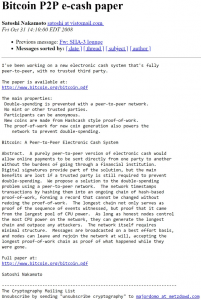
In fact, on 31th of October, the crypto community celebrates the publishing of Bitcoin’s white paper. A few months later, in 2009 the first Bitcoin transaction was made, probably between Satoshi Nakamoto and Hal Finney. However, the question why the mysterious founder chose exactly Halloween to post its white paper keeps puzzling all crypto fans. As well as his identity, which will perhaps never be revealed.

For the small (from a historical point of view) period of only a decade, Bitcoin grew from a totally dismissed geek’s vagary to an enormous industry. At the moment, Bitcoin’s total market capitalization exceeds $100 billion USD, according to CoinMarketCap. It is not completely clear how much was its price back then, but it is known it was some cents, under $0.01 USD. And just nine years after, it skyrocketed to the staggering near $20.000 USD. Here is a comprehensible list of Bitcoin’s price development, thanks to the blockchain evangelist Philip Nunn:

What happened during these ten years?

Bitcoin’s white paper was not the only remarkable event in 2008. In the same year, the infamous Financial Crisis occurred, defined by economists as the biggest after the Great Depression. Just six weeks before Bitcoin’s birth Lehman Brothers outrightly bankrupted. But what collapsed was not only the investment bank or any institution, rather the whole financial system did, as well as the public trust in the economic establishment. At the time, the movement Occupy Wall Street began, too. And the inequality issue became so transparent, it hurt.

Bitcoin came as a reaction to the conventional monetary structure. Its appearance on the financial scene in 2008 was in any way a coincidence. But it was provoked by long years of economic injustice and harsh hierarchy. Bitcoin’s philosophy, known as crypto-anarchy strives for the values of the French Revolution: liberty, equality, fraternity. The cryptocurrency managed to form a community and tried to bring the money opportunity to everyone. And if that sounds impossible, the least of Bitcoin’s priorities is the decentralization we saw in practice.

Bitcoin changed the game

Bitcoin has completely changed the fiscal order. Even if not adopted by the central institution, the coin becomes more and more popular. The blockchain technology shows the great potential for usage in a huge range of life’s areas. The lack of central control, perhaps not so pleasant for the small circle of 1%, brought new opportunities to the payment services: unbelievable speed, less-bureaucratic processes, easier administration, security, and personal information safety. But most importantly, Bitcoin solved the notorious ‘double payment’ problem which was torturing its digital predecessors. Now, thanks to the advanced technology behind it, the public ledger can track and record transactions much more efficiently than any other database.

Bitcoin’s future

This October seems to be crucial for the ‘digital gold’, as some call it. Bitcoin’s price saw a long-time-no-see dropdown to $6.200. This calculates to the stunning 70% decline comparing to its all-time high of $20.000 in December last year. Bearish predictions claim it will never meet its blooming moments of late 2017, and that is probably true. On the other side, its trading volume does not shrink but rather expands, despite the reduction in price. In the last couple of months, Bitcoin demonstrated an incredible stability. The latter is usually pointed as the main reason preventing its adoption by the common payment methods.

Financial forecasts say Bitcoin’s price will rise again. Especially if a significant event occurs, like its introduction to the Wall Street market or its listing as a financial asset by an established bank.

However, the price is not the greatest imperative here. It is to see its genuine meaning for the society, why was created and what it fights for. Thinking about Bitcoin’s ideology, seems like Satoshi did want to send a message with this date, don’t you think?


The Chief of Russian Election Commission Says ‘Blockchain’ Needs Rebranding

On the 29th of October, Ella Pamfilova talked on a conference dedicated on the 25th anniversary of Russia’s electoral system. The head of the Central Election Commission (CEC) expressed the opinion that the word ‘blockchain’ should be necessarily changed.

The word ‘block’ is immediately associated with something closed. In Russia, where a third of the population has been in a prison…Next, you have ‘chain’. ‘Block’ and ‘chain’ — it works even on a subconscious level.

Pamfilova said, cited by the local journal Tass.

According to the CEC boss, in order for the blockchain technology to be adopted, its name should be translated in Russian.

To develop this technology in Russia we need some rebranding. We need… kind of Russian equivalent that takes into account our mentality…

The statement was part of the hot topic for Russia lately, discussed at the conference, the electronic voting system. In that matter, the blockchain-based system was also mentioned as a good alternative to the traditional paper votes.

Russia plans to introduce the blockchain election system since 2016. But despite all efforts, last year CEC did not launch official blockchain voting and decided it is early, due to insufficient technical equipment. However, a few months ago after the Presidential elections, Pamfilova stated on the “Moscow Calling” radio station, quoted by RT that:

I will discuss this issue with the president … there is a public demand for it. We have refurbished everything we could before the latest election, but now as the election is over we have to act preemptively. I want to make a system that has no analogue, a system based on the blockchain. This is my ambition.

In the last elections, the blockchain was actually used but only in the polls. It is considered by many a refined and more transparent way to vote. It is also very convenient for big countries like Russia or Brazil (which also considers blockchain elections) since citizens from distant areas cannot reach the voting places. The device issue stays though because a big part of the population in these countries does not use computers or smartphones.

Some critics speculate that Pamfilova’s struggle to promote blockchain elections in the country is just another way for Kremlin to keep the control of the votes.

Facebook Unexpectedly Bans Startup’s Ads, Accuses It of Being Crypto

In the last two weeks, Facebook leads a major cleanup of unwanted ad banners. As CNBC recently reported, the social media removed 13 pages and 10 accounts used for military propaganda in Myanmar, as well as hundreds of fake accounts who spammed users to attract traffic on their websites.

But the latest case with the startup Bloom is quite different. Bloom offers personal identity management and credit score/ loan applying services. As could be clearly seen from their homepage, the company does not sell any financial instruments, not it deals cryptocurrencies.

However, Bloom’s ads were shut down from Facebook yesterday, Yahoo News posted. The issue is perhaps their decentralized nature: the startup’s system is based on the blockchain (namely, on the Ethereum’s platform) and provides distributed credit protocol. Therefore, on their website and banners, crypto’s vocabulary is widely used: words like ‘Ethereum‘, ‘blockchain‘, etc.

As CrispyBull informed a while ago, in June this year Facebook unleashed its crypto ads restrictions introduced in January. But even during the period of crypto bans, Bloom’s ads were still online.

While we loosened the policy this summer, it remains restrictive. We will continue to listen to feedback, look at how well this policy works and continue to study this technology so that, if necessary, we can revise it over time.

A Facebook spokeswoman stated, according to Yahoo News.

But Jesse Leimgruber, a co-founder of Bloom, thinks the real problem with their ads is not the crypto-related vocabulary. Rather, he assumes the personal information/ identity management services compete with Facebook’s one. Known as Facebook Login (ex-Facebook Connect), the tool collects individuals’ details and keeps them online.

There’s no rule in their ad guidelines that says you can’t compete with them. Since BMW and other financial institutions are using Bloom as a replacement for Facebook Connect, it’s a threat to them.

Said Leimgruber on the ban. And thousands of U.S. dollars were spent for their advertisement campaign.

Perhaps, Facebook is worried that Bloom exposes their data-collecting methods. As one of their bans reads:

You’re being targeted with this ad because the entire history of you is being mined and sold. But now you can take back control of your data with BloomID.

In the last years, Facebook constantly faces personal information issues. Remember the alleged hack attack on September 28th and the Cambridge Analytica Scandal.


Crypto Charity WeTrust Spring Will Match All Ether Donations

WeTrust is a platform for developing of financial application, which recently launched the charity organization Spring. As reported by the Crowdfund Insider, Spring announced today it will match all donations, made in Ethereum, up to $100,000 USD. The crowdfund is through their Giving Tuesday event on November 27th.

WeTrust aims to provide decentralized financial services and create a more inclusive financial system which allows capital to reach those in need without bias, discrimination, or unnecessary hurdles,

Their website reads. The idea is to connect non-profit organizations to crypto investors, who can donate straightly, thanks to the blockchain platform.

WeTrust also announced new partnerships with 14 charity organizations. They could be funded up until 27th of November. The list goes:

  •     African Advocacy Network
  •     Bridge Global Foundation
  •     Cavalier Rescue
  •     Code for America
  •     Cultural Heritage Imaging
  •     Equity in Access
  •     Fight for the Future
  •     Lava Mae
  •     Learning Equality
  •     Open Library
  •     Rainforest Trust
  •     Surgeons of Hope
  •     Ubuntu Foundation
  •     VietSeeds Foundation

Current causes include the Rainforest Trust, which has already raised half of the aimed Ethereum, Open Library, Code for America which fights poverty, and a cause for Internet freedom, among others.

WeTrust is advised by the Ethereum co-founder Vitalik Buterin, the associate professor in Cornell Emin Gün Sirer, Michael Casey, a senior advisor for the digital currency initiative at MIT’s Media Lab and Benedict Chan, director of engineering at BitGo.

Charity in cryptocurrency becomes more and more popular. The total market capitalization is worth $203 billion USD, according to CoinMarketCap which is a substantial source of funds. As CrispyBull recently reported, the Asian crypto exchange Binance also announced its new charity initiatives. The company managed to collect more than $1.4 million for the victims of the flood in West Japan earlier this year.

- Advertisement -

FEATURED