Home Blog Page 30

Western Union Prepares USDPT Launch as Stable Card Enters Plan

TL;DR

  • Western Union targets a May 2026 rollout for USDPT on Solana.
  • The update confirms execution timing and adds a new Stable Card product.
  • The move reflects a shift from planning to deployment in cross-border payments.

Western Union is advancing the stablecoin strategy it first outlined in late 2025, and the company now targets a May 2026 launch for USDPT. The update adds clearer timing and introduces a new consumer-facing product.

The company had already disclosed plans to issue a dollar-backed stablecoin on Solana and build a broader Digital Asset Network. The latest update does not change that foundation. However, it clarifies when deployment may begin and how Western Union intends to expand beyond infrastructure.

From Strategy to Execution

Western Union first revealed its stablecoin initiative in autumn 2025 when it positioned the USDPT stablecoin as part of a wider effort to modernize cross-border payments. At the time, the company confirmed it would build on Solana and develop a Digital Asset Network linking blockchain systems with its existing global payout infrastructure.

That earlier phase focused on architecture and long-term positioning. The current update signals that the project is moving closer to live deployment, with a defined launch window and clearer product roadmap.

USDPT is expected to function as a U.S. dollar-backed token for payments and settlement. It focuses on international transfers, where speed and cost remain key challenges.

Stable Card Introduced as New Product Layer

The latest reporting on Western union’s stablecoin launch also introduces a new element that was not part of earlier disclosures: a Stable Card product.

Reports indicate that the card is planned for rollout later this year across multiple markets. While details remain limited, the product is expected to allow users to hold stablecoin balances and spend them through traditional payment rails.

This marks a shift beyond backend infrastructure into consumer-facing applications. Western Union’s earlier announcements focused on enabling blockchain-based transfers within its network. The addition of a card suggests the company is now exploring how stablecoins can be used directly in everyday transactions.

Key aspects such as issuing partners, supported networks, and regional availability have not yet been fully specified.

Digital Asset Network Remains Central

The Digital Asset Network remains a core component of Western Union’s approach. The system will connect crypto wallets with the company’s retail locations and agent network, enabling movement between digital assets and local currencies.

This infrastructure could address a common limitation in crypto payments. While blockchain systems enable fast transfers, users often face challenges when converting digital assets into usable cash. Western Union’s existing physical presence may provide an advantage in bridging that gap.

For users unfamiliar with crypto systems, the company appears to be positioning stablecoins as a behind-the-scenes technology rather than a standalone product requiring technical knowledge.

Strategic Implications for Payments

Western Union’s stablecoin launch reflects a broader shift in how traditional financial firms are approaching digital assets. Instead of acting solely as intermediaries, some are beginning to issue their own blockchain-based payment instruments.

For Western Union, the move aligns with its core business in remittances. Stablecoins offer a way to transfer value across borders while maintaining a dollar reference, potentially reducing reliance on multiple banking intermediaries.

At the same time, execution risks remain. The success of USDPT will depend on factors such as regulatory clarity, liquidity, integration with local payout systems, and user adoption.

Looking Ahead

Western Union’s latest update does not introduce a new strategy. It moves the plan forward. USDPT is set for a May launch, and a Stable Card is coming. That brings the company closer to rolling out blockchain-based payments at scale.

The coming months will show whether this transition from planning to execution can translate into practical adoption across its global network.


Ripple and K Bank test blockchain remittances in South Korea pilot

TL;DR

  • Ripple and K Bank are testing blockchain-based cross-border payments in a pilot program
  • The initiative focuses on improving efficiency using on-chain infrastructure
  • The Ripple K Bank partnership reflects growing institutional adoption of blockchain payments

The Ripple K Bank partnership marks a new step in how traditional financial institutions are exploring blockchain for real-world payments. Ripple and K Bank have launched a pilot program to test cross-border remittances using blockchain infrastructure, according to multiple reports.

The initiative is currently limited to a testing phase, with both companies evaluating whether blockchain-based systems can improve the speed and efficiency of international money transfers. While the scope remains controlled, the pilot reflects a broader shift toward institutional adoption of crypto-related technologies.

What the pilot is testing

The collaboration focuses on using blockchain networks to process cross-border payments, often referred to as on-chain remittances. Instead of relying on traditional banking intermediaries, transactions are settled through distributed ledger infrastructure, which can reduce processing times and operational friction.

In practical terms, this means testing whether funds can move between countries faster and with fewer steps compared to legacy systems. Cross-border remittances have long been associated with delays and high fees, making them a key area of interest for blockchain applications.

The Ripple K Bank partnership is specifically designed to assess these potential advantages in a controlled environment before any broader rollout is considered.

Why institutions are exploring blockchain payments

Banks have historically approached blockchain cautiously, but pilot programs like this highlight a growing willingness to experiment. The appeal lies in improving settlement efficiency while maintaining regulatory compliance.

For digital banks such as K Bank, integrating blockchain-based payment rails could offer a competitive advantage in handling international transfers. At the same time, Ripple continues to position its infrastructure as a bridge between traditional finance and blockchain networks.

This type of collaboration also signals a shift away from purely speculative uses of crypto toward practical financial applications. Instead of focusing on asset trading, institutions are increasingly testing how the underlying technology can support existing financial services.

South Korea’s evolving crypto landscape

South Korea remains one of the more active markets for digital asset adoption, but it operates within a structured regulatory framework. Financial institutions in the country typically approach blockchain integration cautiously, ensuring that any new systems align with compliance standards.

This environment creates a controlled setting for pilot programs like the one between Ripple and K Bank. It also explains why initiatives tend to begin with limited testing before expanding into broader use cases.

The current pilot reflects this measured approach, where innovation is explored without immediate large-scale deployment.

What remains uncertain

Despite the announcement, several aspects of the partnership are still undefined. There is no confirmed timeline for a full-scale rollout, and it remains unclear which payment corridors are being tested.

Additionally, the technical specifics of how the system operates in practice have not been fully detailed. This includes whether the pilot uses Ripple’s standard infrastructure in its existing form or incorporates adjustments tailored to the Korean market.

As with most early-stage blockchain initiatives, the outcome will likely depend on regulatory alignment, performance results, and user adoption.

What this could mean going forward

The Ripple K Bank partnership underscores a broader trend of financial institutions moving from theory to experimentation when it comes to blockchain payments. While pilot programs do not guarantee long-term adoption, they play a critical role in testing feasibility under real-world conditions.

If successful, initiatives like this could pave the way for more efficient cross-border payment systems, particularly in regions with high demand for international transfers. For now, the focus remains on evaluation rather than deployment, with both companies gathering data on performance and practicality.

The next phase will depend on whether the pilot demonstrates clear advantages over existing systems and meets regulatory expectations.

Kraken Data Highlights Challenges in New Crypto Tax Reporting System

TL;DR

  • Kraken issued more than 56 million crypto tax forms tied to 2025 transactions under new U.S. reporting rules.
  • A large share of reported activity involves low-value transactions, raising questions about reporting efficiency.
  • The rollout highlights growing compliance pressure and fuels calls to refine crypto tax rules.

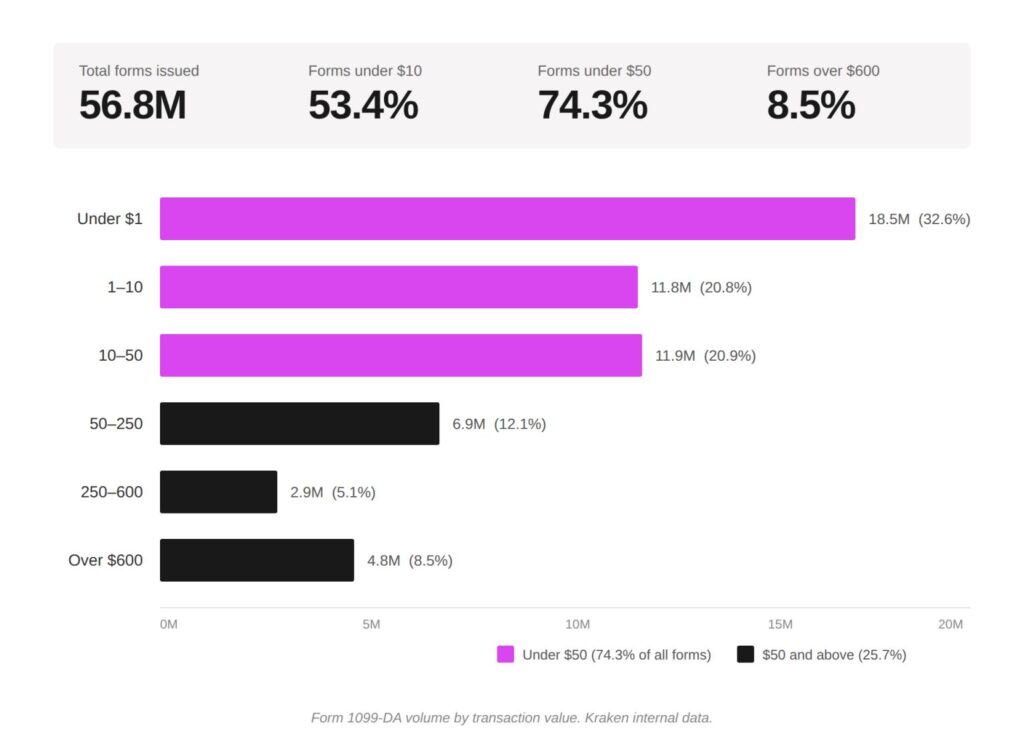
Kraken says it submitted more than 56 million Form 1099-DA filings tied to customers’ 2025 activity, giving the market one of the clearest early looks at how the new U.S. digital asset reporting rules are working in practice. The scale is the headline, but the deeper story is what the filings reveal about the burden the new U.S. digital asset tax reporting rules load onto both exchanges and everyday users.

The exchange said nearly a third of the forms, or about 18.5 million, covered transactions worth less than $1. More than half were for $10 or less, and nearly three-quarters were for under $50. Kraken argues that many of these records relate to routine account activity, small purchases, and tiny staking rewards rather than large speculative trades.

A first real test of Form 1099-DA

The IRS finalized digital asset broker reporting rules in 2024, with gross proceeds reporting starting for transactions effected on or after January 1, 2025. IRS instructions for Form 1099-DA say brokers are not required to report basis information for 2025 transactions, with broader basis reporting generally beginning in 2026.

That makes the 2025 tax year a transition period. Users may receive forms showing proceeds without the full cost-basis context needed to calculate taxable gains or losses. This can create confusion for people who hold assets across multiple exchanges and wallets. Kraken said that disconnect drove thousands of customer questions during the filing season.

Why the Kraken’s crypto tax reports matter

The filing volume matters because it shows how crypto reporting differs from many traditional financial tax workflows. According to Kraken’s own figures, only 8.5% of the forms exceeded $600. That threshold commonly applies to reporting in other parts of the tax code but does not apply to crypto transactions. Therefore, a huge number of very small transactions flow into a system that was not built with micro-rewards and high-frequency blockchain activity in mind.

For readers outside crypto, the significance is practical. A person may now receive tax reporting connected to very small digital asset disposals or staking-related activity, even when the dollar amount appears trivial. While the tax owed may not be large, but the record-keeping burden can grow quickly.

Source: Kraken

Paper delivery adds to the reporting burden

Beyond filing with the IRS, exchanges are also required to provide copies of tax forms directly to users. Under long-standing rules for information returns, this has typically meant paper delivery by default unless a user explicitly consents to electronic tax form delivery.

At the scale seen in Kraken’s tax reporting, that requirement creates a significant operational layer. Platforms that operate entirely online would distribute tens of millions of physical documents, introducing printing costs, mailing logistics, and delays.

Recent proposals from the IRS aim to address this issue by allowing exchanges to default to electronic tax form delivery. The shift would not change reporting obligations, but it would reduce the need for large-scale paper distribution. Such rules would align the system more closely with how digital platforms operate.

Kraken turns compliance into a policy argument

Kraken is using the disclosure to push for two policy changes. First, it wants a meaningful de minimis exemption that would remove small, routine digital asset payments from capital gains reporting. Second, it wants Congress to let taxpayers choose whether staking rewards tax treatment applies when rewards are received or when they are sold, rather than forcing tax treatment at the moment of receipt.

The exchange argues that current treatment can create a mismatch between taxable income and real economic gain, especially when staking rewards are worth only fractions of a cent at the transaction level. That position is likely to resonate with industry groups. Lawmakers, however, would still need to balance simplification against tax enforcement and revenue concerns.

What comes next

The first year under these new tax reporting rules was always likely to expose friction points. Kraken’s numbers now offer a concrete example of where those frictions sit. The immediate takeaway is that the current rules may capture a large volume of low-value activity, adding compliance work without clearly improving tax clarity for users.

The debate around crypto tax reporting is likely to move beyond one exchange’s filing count, though Kraken highlights the scale of the issue. As basis reporting expands, more platforms will work through the same requirements. Pressure on Washington might grow quickly to refine rules around micro-transactions and staking rewards.

Lazarus Expands Attack Strategy With Mach-O Man macOS Malware

TL;DR

  • Lazarus is deploying a new macOS malware kit called Mach-O Man to target crypto and fintech businesses
  • The campaign relies on fake meeting invites and social engineering to trick victims into running malicious Terminal commands
  • The malware focuses on credential theft and system access, increasing risk for executives and high-privilege users

A new campaign linked to the Lazarus Group is putting fresh pressure on crypto and fintech firms. It uses fake meetings and macOS malware to steal credentials and sensitive business data. Researchers say Lazarus Mach-O Man is the latest toolkit in that playbook, targeting high-value users who are more likely to hold wallet access, internal credentials, or privileged corporate information.

The campaign stands out because it does not depend on a software vulnerability. Instead, it relies on social engineering that gets the victim to do the attacker’s work. In reported cases, targets are contacted over Telegram, often through compromised or trusted-looking accounts. Once contact is established, they are pushed into fake meeting invites or support flows that end with them copying a malicious command into Terminal.

How the attack starts

According to security researchers, the lures mimic Zoom, Microsoft Teams, or Google Meet pages and claim there is a connection or verification issue that requires a quick fix. That “fix” is actually a command sequence that downloads and runs macOS malware on the Mac. The campaign has focused on financial organizations, including cryptocurrency, venture capital, and blockchain entities, with particular emphasis on crypto executives.

This approach matters because it lowers the technical barrier for the attackers while raising the risk for companies. A single employee or executive can expose browser sessions, credentials, system secrets, and internal access. They simply follow the instructions and the attacker does not need to break through traditional defenses first.

What the malware does

Researchers describe the toolkit as a collection of Mach-O binaries that perform different tasks after execution. SOC Prime said the malware chain includes components used to profile the infected host, create persistence through launch agents or daemons, and harvest browser extensions, cookies, Keychain data, and other credentials. In some reporting, the stolen data is then exfiltrated through Telegram-linked infrastructure.

That is what makes Lazarus Mach-O Man more than a simple infostealer headline. The toolkit appears modular, business-focused, and designed to support deeper compromise inside organizations. One successful infection can unlock access to trading systems, wallets, cloud services, and internal communications.

Part of a broader 2026 pattern

The new campaign also fits a wider shift already documented this year by major cybersecurity firms. Google Cloud’s Mandiant described a February intrusion in which a compromised Telegram account, a fake Zoom meeting, ClickFix attack technique, and AI-assisted deception were used against a crypto-sector target. Microsoft separately detailed a Sapphire Sleet operation that used fake recruiter outreach and malicious macOS files disguised as Zoom or SDK updates to steal passwords, financial data, and cryptocurrency-related information.

That continuity is important because it suggests these attacks are not isolated experiments. They are part of a maturing North Korea-linked tradecraft pattern that combines trusted communication channels, believable business lures, and macOS-native malware. This approach is difficult to detect, especially once a victim decides to cooperate.

Why crypto firms should pay attention

Some crypto-focused coverage has tied the malware wave to recent large DeFi thefts. However, the clearest evidence in the reporting is about the intrusion method itself rather than direct proof that Mach-O Man drove each exploit. Even so, the risk to the sector is obvious. Crypto companies remain attractive targets. Executives, developers, and operations staff often hold the exact mix of wallet access, privileged credentials, and fast-moving authority that attackers want.

For that reason, Lazarus Mach-O Man is best viewed as a warning about operational security, not just malware naming. The campaign shows how a routine meeting invite can become the entry point for a much broader compromise. This risk is especially high in firms where one MacBook may connect personal messaging, production systems, and valuable digital assets.

Bitget Wallet Brings Prediction Markets In-App With Polymarket

TL;DR

  • Polymarket is integrating with Bitget Wallet, bringing prediction market access directly into the wallet interface.
  • The move expands distribution to a reported 90 million users while signaling a shift in wallet functionality toward embedded trading experiences.
  • The rollout includes AI-driven tools and event-based markets, with further expansion planned around major global sports events.

Polymarket is expanding its distribution through a new integration with Bitget Wallet. The move marks the wallet provider’s entry into prediction markets and a broader product shift.

Bitget Wallet outlined the integration in a blog post dated April 17. It positioned the feature as a step beyond traditional wallet functions and into more interactive, event-driven financial activity. The update enables users to access prediction markets directly within the wallet interface.

This integration reflects how crypto wallets are evolving from mere storage tools into gateways for on-chain trading and applications. There is a growing focus on user engagement and in-app activity.

A direct integration inside the wallet

The integration allows users to trade on outcomes tied to elections, macroeconomic indicators, and sports events, without leaving the Bitget Wallet environment. That reduces on-boarding friction, which has historically limited participation in decentralized applications.

Rather than redirecting users to an external platform, the feature is embedded directly into the wallet interface. This structure keeps trading activity within the app. It also simplifies access for users who may be new to prediction markets.

Bitget Wallet says the product supports payment methods such as Apple Pay. It also includes gas abstraction to streamline transactions across multiple blockchains, including EVM networks and Solana.

Expanding wallet functionality

The move highlights a broader shift in wallet strategy. Crypto wallet integration is becoming more important as platforms evolve. Wallets are now being positioned as full-service environments.

By adding prediction markets, Bitget Wallet introduces a new category of activity. Increasing user engagement beyond basic transactions aligns with a wider industry trend toward “all-in-one” crypto platforms.

For Polymarket, the integration provides access to a significantly larger user base, without requiring separate on-boarding. This type of distribution strategy has become a key growth lever for on-chain applications.

Features designed for accessibility

The rollout includes tools aimed at making prediction market trading more accessible. These include AI sports analysis tools that aggregate real-time and historical data. The system is designed to help users interpret event outcomes.

The rollout also adds a smart money tracking feature, highlighting activity from high-performing wallet addresses. Further, leader boards and alerts are expected to be part of the experience, too.

Integrating Polymarket into the Bitget wallet combines these features into a single interface and lowers barriers to entry and encourages more frequent interaction.

Growth narrative and open questions

Prediction markets are often presented as a way to quantify collective expectations related to real-world events. Supporters argue that these markets can act as real-time indicators of sentiment.

Critics, however, take a different view. They see prediction markets as highly speculative. Some coverage has pointed to risks, especially as access expands to a broader retail audience.

These risks include potential user losses and increased regulatory attention. The Polymarket Bitget rollout sits within this broader context. It combines ease of access with a product segment that remains under scrutiny in some jurisdictions.

What comes next

Bitget Wallet and Polymarket have indicated that the integration is part of a longer-term strategy. The companies are planning campaigns tied to major global sports events through 2026.

This includes tournaments that typically drive high user engagement. The focus appears to be on event-driven participation. Prediction markets are being used to capture attention during widely followed moments.

For now, the Polymarket Bitget integration signals a shift in both distribution and product design. It expands access to prediction markets. It also reinforces the role of wallets as central hubs for on-chain activity.

- Advertisement -

FEATURED