Home Blog Page 29

Why Strategy Is No Longer Treating Bitcoin Sales as Impossible

Michael Saylor, Executive Chairman at Strategy

TL;DR

  • The growing possibility of a Bitcoin sale emerged after Strategy reported a $12.54 billion Q1 loss and rising dividend obligations tied to preferred stock financing.
  • Michael Saylor said the company may sell Bitcoin under certain conditions to help meet dividend obligations tied to preferred shares.
  • The comments mark a notable shift from Strategy’s long-standing “never sell” Bitcoin narrative and highlight growing focus on capital structure management.

Strategy, led by Executive Chairman Michael Saylor, posted a net loss of $12.54 billion for Q1 2026. A year earlier, the loss stood at $4.22 billion. The result was driven largely by Bitcoin price weakness and fair-value accounting rules that make Strategy’s earnings highly sensitive to market swings.

The Strategy Bitcoin sale discussion marks a notable shift because Saylor has long been associated with a firm “never sell” position on Bitcoin. However, the latest earnings call showed a more flexible approach as the company manages dividend obligations tied to its preferred stock products.

Strategy Still Holds More Than 818,000 BTC

Strategy remains the largest corporate Bitcoin holder, with 818,334 BTC as of May 3, 2026. The company said its Bitcoin holdings had grown 22% year to date, while total capital raised in 2026 reached $11.68 billion.

The company has continued using equity and preferred stock issuance to expand its Bitcoin position. Its STRC preferred stock product has become a major part of that strategy. It gives the company another funding channel beyond common stock sales.

Preferred shares can help Strategy raise capital without immediately diluting common shareholders in the same way as ordinary equity issuance. But they also create regular dividend obligations, which now sit at the center of investor attention.

Saylor Frames Strategy Bitcoin Sale as Capital Management

Saylor said Strategy may sell some Bitcoin to fund dividends. He also argued such a move would not damage the company, Bitcoin, or the broader market.

His comments were not presented as a warning of forced liquidation. Instead, management framed the option as part of a wider treasury toolkit. Strategy may choose between selling common stock, issuing STRC, using dollar reserves, selling Bitcoin, or reducing debt depending on market conditions.

The potential sale is therefore less about abandoning Bitcoin and more about actively managing Strategy’s balance sheet. A limited sale to meet dividends or optimize taxes is different from a broad retreat from the company’s Bitcoin strategy.

Why the Statement Matters

The comment still carries symbolic weight. Saylor’s public message has helped define Strategy as a corporate Bitcoin proxy, not a traditional software company with a crypto position on the side.

By acknowledging Bitcoin could be sold under certain conditions, Strategy is reshaping how investors view the company. It increasingly resembles a leveraged Bitcoin treasury business rather than a pure buy-and-hold vehicle.

That may make the model more practical, but also more complex. Retail investors who buy MSTR stock for Bitcoin exposure now have to consider preferred stock dividends, market net asset value, debt levels, and capital allocation decisions.

Investor Focus Turns to STRC Dividends

Strategy said it has paid more than $693 million in preferred equity dividends since launching those products in early 2025. The company also said STRC had raised $5.58 billion year to date. Those figures show why dividend funding has become a central issue. As preferred stock grows, Strategy must keep balancing Bitcoin accumulation with recurring cash obligations.

A Strategy Bitcoin sale could become more likely if common equity trades at unattractive levels. Management may also decide selling a small amount of BTC is more efficient than issuing new shares. Saylor argued that the company has enough liquidity and optionality to make those decisions without threatening its core model.

The bigger question is how the market prices that flexibility. Strategy’s Bitcoin holdings remain central to its valuation. But the earnings call showed those reserves are now part of an active capital structure rather than an untouchable asset.

For now, Strategy is still positioning itself as a net Bitcoin accumulator. The shift is that management no longer treats selling Bitcoin as impossible. That alone changes how investors may read the company’s next dividend payment, capital raise, or Bitcoin purchase.

Circle Secures MiCA Approval in France to Expand USDC and EURC Services Across EU

TL;DR

  • Circle secured regulatory approval in France under MiCA, enabling licensed crypto operations.
  • The move allows USDC and EURC services to expand across the EU under a single framework.
  • The development signals growing alignment between crypto firms and formal regulation in Europe.

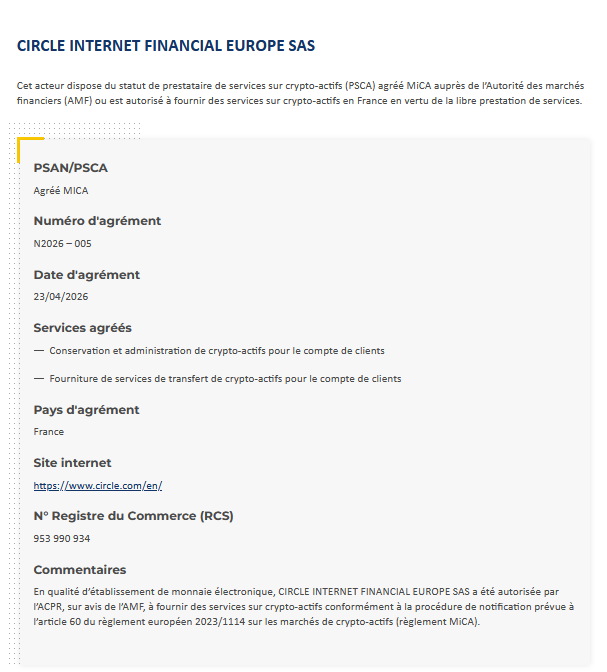
Circle has secured regulatory approval in France under the European Union’s Markets in Crypto-Assets (MiCA) framework, allowing the company to operate as a licensed crypto-asset service provider. The move enables it to offer regulated stablecoin services, including USDC and EURC, across the bloc.

The authorization was granted by France’s financial regulator, enabling Circle’s local entity to operate within one of the first fully active MiCA jurisdictions. The approval comes as the MiCA regulation in the EU begins to standardize crypto oversight across member states.

What the Approval Allows

The license enables Circle to provide a range of crypto-asset services. These include issuance, custody, and the transfer of digital assets. A central component of this approval is the ability to distribute and manage its stablecoins, USDC and the EURC stablecoin, under MiCA compliance standards.

This means Circle can now offer both stablecoins within a regulated environment across EU member states. The framework imposes requirements on transparency, reserves, and operational practices. These rules aim to reduce risk for users and institutions interacting with digital currencies.

By meeting these conditions, Circle positions its products as compliant alternatives in a market that is shifting toward stricter oversight. This move also supports USDC’s Europe expansion under a regulated framework.

Source: Autorité des marchés financiers (AMF)

Passporting Across the European Union

A key feature of MiCA is the ability for licensed firms to passport their services across all EU countries. Companies no longer need separate approvals in each jurisdiction. Instead, a single license can unlock access across the bloc.

With regulatory approval secured in France under MiCA, Circle can extend its services across the EU without additional national licenses. This effectively gives the company a single framework to operate cross-border.

France is emerging as a key hub for crypto regulation under MiCA, with regulators actively engaging global firms seeking early authorization.

Stablecoins Enter a Regulated Phase

The approval highlights the evolving role of stablecoins within regulated financial systems. USDC is pegged to the US dollar, while EURC is tied to the euro. Both are designed to maintain stable value and support digital transactions.

Under MiCA, stablecoin issuers must meet strict requirements related to reserve backing and disclosure. These rules are intended to address concerns around transparency and financial stability.

Circle’s ability to operate within this framework suggests that regulated stablecoins may play a growing role in payments, remittances, and financial infrastructure across Europe.

Strategic Positioning in a Changing Market

The timing of the approval is notable as firms race to secure licenses under the new EU regime. Early entrants may benefit from regulatory clarity. They may also gain an advantage as institutions and users look for compliant partners.

Circle’s approval in France under MiCA reflects a broader shift in the crypto industry toward regulated growth. Companies are increasingly aligning with formal frameworks to expand their reach and build credibility.

At the same time, competition is expected to intensify as more firms pursue similar approvals. The long-term impact will depend on adoption and whether regulated offerings can match the flexibility seen in less restrictive markets.

What Comes Next

As MiCA implementation continues, more approvals are expected across the EU. This will shape a new regulatory landscape for digital assets. Circle’s entry into this framework marks an early step in that transition.

The coming months will likely show how effectively companies can scale under these rules. It will also indicate whether regulated stablecoins gain traction among businesses and consumers.

Equiniti Deal Moves Bullish Beyond Crypto Trading Into Market Infrastructure

TL;DR

  • Bullish agreed to acquire Equiniti for $4.2 billion to expand into shareholder infrastructure.
  • The deal combines a crypto platform with a major transfer agent serving public companies.
  • It reflects a broader push to support tokenized securities within regulated capital markets.

Bullish has agreed to acquire Equiniti in a $4.2 billion deal that would move the crypto exchange operator deeper into traditional capital markets infrastructure. This acquisition combines a digital asset platform with one of the largest transfer agents serving public companies and shareholders.

The transaction includes $1.85 billion of assumed Equiniti debt and approximately $2.35 billion in Bullish stock consideration. Bullish said the deal is expected to close in January 2027, subject to regulatory approvals and customary closing conditions.

A Move Beyond Crypto Trading

Bullish is best known as an institutional digital asset platform, but the Equiniti deal points to a broader strategy. Rather than focusing only on crypto trading, Bullish is trying to position itself inside the systems that manage ownership records, shareholder payments, and issuer services.

Equiniti brings scale in a part of finance that is often invisible to retail investors. The company serves nearly 3,000 issuer clients, supports more than 20 million shareholders, and processes about $500 billion in annual payments.

Why Equiniti Matters

A transfer agent keeps official records of who owns a company’s shares and helps manage shareholder-related processes. That role becomes important if stocks, bonds, or other securities are represented on blockchain networks.

The Bullish Equiniti acquisition is therefore less about buying a crypto brand and more about buying regulated market plumbing. Tokenized securities still need reliable ownership records, compliance processes, corporate actions, and links to existing financial institutions.

Bullish said the combined platform is intended to support the full tokenized asset lifecycle. That will include token design, issuance, compliance, liquidity, and investor services. It also said it will build the platform to work with existing market infrastructure, including DTCC, Euroclear, Clearstream, custodians, and broker-dealers.

Tokenization Push Faces Execution Risk

The deal reflects growing interest in tokenized securities, a model where traditional financial assets are represented digitally on blockchain rails. Supporters argue that tokenization could make settlement faster, improve transparency, and allow assets to move more easily between platforms.

Still, adoption depends on more than technology. Public-market issuers, regulators, brokers, custodians, and investors need systems they can trust. Bullish will also need to integrate Equiniti’s established shareholder services business without disrupting its existing clients.

The company’s own announcement includes forward-looking assumptions around revenue growth, tokenization services, regulatory approvals, and integration benefits. Those projections remain dependent on market adoption and the successful closing of the deal.

A Bigger Bet on Market Infrastructure

If completed, the Equiniti acquisition would give Bullish a direct role in both digital asset markets and traditional shareholder infrastructure. That combination could help the company compete in the emerging market for tokenized public securities.

For now, the deal signals that crypto firms are increasingly targeting the back-end systems of finance, not just trading apps and exchanges. The next test is whether Bullish can turn Equiniti’s established issuer network into a practical bridge between blockchain settlement and public-market ownership records.

Israel Opens Stablecoin Market With Regulated Shekel Token

TL;DR

  • Israel approved a regulated Shekel stablecoin called BILS after a two-year pilot under supervision.
  • The token must be fully backed by reserves and meet strict redemption and reporting requirements.
  • The Shekel stablecoin launch is separate from Israel’s ongoing central bank digital currency plans.

Israel has approved its first regulated Shekel stablecoin, marking a controlled step into fiat-backed digital assets after two years of testing under a regulatory sandbox.

The approval allows crypto firm Bits of Gold to issue BILS, a token pegged 1:1 to the Israeli Shekel and backed by reserves held in local bank accounts. The move signals a shift from policy experimentation toward real-world deployment, while maintaining tight oversight of issuance and redemption.

From sandbox testing to limited rollout

The stablecoin was developed and tested as part of a two-year pilot supervised by Israel’s Capital Market Authority. During this period, the authority evaluated the system for operational resilience, compliance, and market behavior.

Part of the testing included blockchain infrastructure trials, with several reports pointing to integration on Solana. This suggests the project explored scalability and transaction efficiency before receiving approval.

The transition from sandbox to live issuance remains cautious. The regulator has authorized a limited rollout, meaning BILS will not immediately operate at full scale. Instead, the launch will expand gradually as compliance and operational benchmarks are met.

Strict reserve and compliance requirements

Under the approval terms, the BILS stablecoin must be fully backed by fiat reserves held in segregated accounts within Israel. The company cannot mix these funds with others of its assets, reducing counterparty risk and improving transparency.

Bits of Gold must also ensure continuous liquidity and redemption capabilities. Users must be able to convert the token back into Shekels under defined conditions, a key safeguard that aligns with global stablecoin standards.

Additional obligations include ongoing reporting to regulators, disclosure of material changes, and adherence to cybersecurity and custody requirements. These controls position the project closer to regulated financial infrastructure than to typical crypto token launches.

Not a central bank digital currency

The approval has drawn attention partly because of confusion with Israel’s broader digital currency plans. However, the Shekel stablecoin approved here is not a central bank digital currency.

The Bank of Israel continues to explore a digital Shekel as a potential future payment system, but it has not confirmed an official launch yet. In contrast, BILS is a privately issued asset operating under regulatory supervision, not a direct liability of the central bank.

This distinction matters for users and institutions. A private stablecoin carries different risk assumptions and governance structures than a CBDC, even when both are denominated in the same national currency.

Bringing a local currency on-chain

The introduction of a regulated Shekel stablecoin places Israel among a growing number of jurisdictions experimenting with tokenized versions of fiat currencies.

While U.S. dollar-backed stablecoins dominate global markets, local currency stablecoins can address specific regional needs, including domestic payments, settlement efficiency, and integration with local financial systems.

In Israel’s case, the controlled rollout suggests regulators are prioritizing stability over rapid expansion. By limiting issuance and enforcing strict reserve management, authorities appear focused on minimizing systemic risk while still enabling innovation.

What comes next

The long-term impact of the Shekel stablecoin will depend on adoption, integration, and regulatory evolution. If BILS proves reliable in real-world use, it could pave the way for broader stablecoin frameworks in Israel.

At the same time, its development runs parallel to the central bank’s exploration of a digital Shekel, creating a dual-track approach to digital currency innovation.

For now, Israel’s decision reflects a measured strategy. It allows private-sector experimentation with fiat-backed tokens, while keeping tight regulatory control over how those assets enter the financial system.

Senate Deadlock Deepens Over CLARITY Act Amid Ethics and Stablecoin Disputes

TL;DR

  • Ethics concerns have emerged as a key obstacle to the CLARITY Act, adding to the ongoing dispute over stablecoin yield in the Senate.
  • Senator Thom Tillis is pushing for restrictions on White House officials’ involvement in digital assets before supporting the bill.
  • The added ethics demands complicate timing, reducing confidence in a near-term passage despite ongoing negotiations.

The CLARITY Act is facing renewed delays in the US Senate as lawmakers confront a widening set of disagreements. A fresh push for ethics rules targeting White House officials now adds complexity to an already fragile negotiation process.

The Senate’s crypto bill would aim to establish a clearer regulatory framework for crypto in the US, but has missed earlier April timelines. It is now tied to a narrowing window for progress in May. While some policymakers continue to point to a possible June outcome, recent developments suggest that consensus remains elusive.

Stablecoin yield dispute continues to block progress

One of the central obstacles remains a disagreement over stablecoin yield. Officials aligned with the White House have advocated for tighter limits on whether stablecoin issuers can offer interest-like returns to users.

Supporters of restrictions argue that yield-bearing stablecoins could introduce risks similar to traditional banking products without equivalent oversight. Others within the crypto industry and among lawmakers warn that limiting such features could hinder innovation and reduce the competitiveness of US-based firms.

The CLARITY Act was expected to help resolve broader questions around regulatory authority. Dividing oversight between agencies such as the Securities and Exchange Commission and the Commodity Futures Trading Commission is a particularly contentious point. However, the yield issue remains unresolved, preventing the bill from advancing.

Ethics demands shift dynamics in Senate negotiations

A newer point of tension centers on ethics rules tied to crypto activity by public officials. Senator Thom Tillis has indicated he may not support the CLARITY Act unless it includes ethics language restricting how White House officials can sponsor, endorse, or issue crypto assets.

This position introduces additional pressure into negotiations, as the legislatoin requires bipartisan support to move forward. While ethics considerations have been part of earlier discussions, they have now become more directly tied to the bill’s prospects.

The debate has also highlighted a structural complication. Ethics rules governing executive branch officials are not typically handled within financial regulation legislation. This raises questions about how lawmakers could incorporate such provisions without delaying the process further.

Political scrutiny intensifies around crypto involvement

The renewed focus on ethics comes amid heightened scrutiny of crypto-related financial interests in US politics. Activity linked to President Donald Trump and his family’s crypto interests has drawn attention to the broader issue of whether policymakers and public officials should have direct exposure to digital assets while shaping regulation.

This environment has made it more difficult for lawmakers to sidestep ethics concerns, even as they work to finalize technical aspects of the bill. At the same time, competing lobbying efforts from banks and crypto firms continue to shape the debate around key provisions.

As a result, the legislation is now navigating both regulatory design challenges and political considerations. It becomes increasingly difficult to reach an agreement under these circumstances.

Timeline uncertainty grows despite industry optimism

Despite the delays, some industry figures remain cautiously optimistic about the crypto bill’s prospects. Mike Novogratz, Galaxy Digital CEO, has suggested that the legislation could still pass by June, reflecting a belief that negotiations are nearing a final stage.

Senator Cynthia Lummis has also indicated that a markup could take place in May. However, there has been no official announcement from Tim Scott, who chairs the Senate Banking Committee, leaving the timeline uncertain.

The accumulation of unresolved issues has certainly made the timeline less predictable. The shift from earlier deadline-driven momentum to ongoing negotiation suggests that further delays remain possible if lawmakers cannot reconcile key differences.

The CLARITY Act now depends on resolving both the stablecoin yield debate and the newly elevated ethics demands. Without agreement on these fronts, the Senate bill risks slipping beyond its current window for passage.

What comes next for crypto regulation

Lawmakers are expected to continue negotiations in the coming weeks as they work toward a potential markup and Senate vote. The outcome will determine whether the United States can move forward with a comprehensive framework for digital asset regulation in the near term.

For now, the CLARITY Act remains in a holding pattern. Its fate is tied to a complex mix of policy disputes and political pressures that are still unfolding.

- Advertisement -

FEATURED