Home Blog Page 28

Senate Sets May 14 CLARITY Act Vote After Months of Delays
TL;DR

  • The Senate Banking Committee has scheduled a May 14 markup hearing for the CLARITY Act after months of stalled negotiations.
  • Lawmakers revived discussions following a compromise on stablecoin yield rules and renewed bipartisan talks in March.
  • The bill already passed the House in 2025, but political disputes and banking-sector opposition could still affect its Senate path.

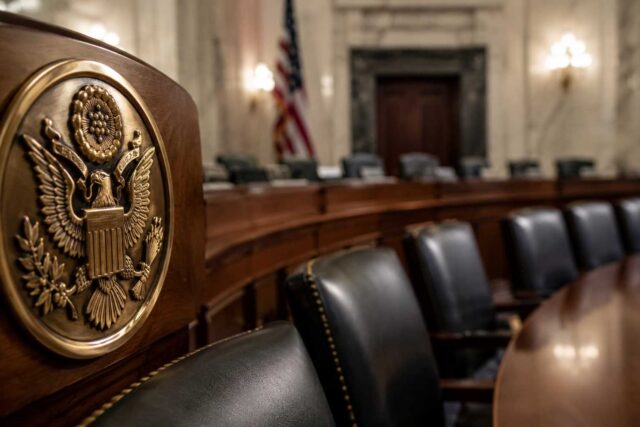
The Senate Banking Committee is preparing once more to take up one of the crypto industry’s most closely watched bills! The CLARITY Act markup hearing is now scheduled for May 14. The session could mark a key procedural step for U.S. digital asset market structure legislation after months of delays and negotiations.

The CLARITY Act is designed to clarify how digital assets should be regulated in the United States. For crypto companies, the bill matters because it could help define whether certain tokens fall under securities or commodities rules, and which federal agencies would oversee different parts of the market.

Senate Banking Sets May 14 Session

The committee’s markup is expected to focus on H.R. 3633, the Digital Asset Market Clarity Act of 2025. The legislation already passed the House of Representatives in July 2025. That makes the Senate process one of the final major hurdles before the framework could become law. A markup allows senators to debate, amend and vote on whether to advance the legislation out of committee.

That does not mean the bill is close to becoming law. It still needs broader Senate support, possible reconciliation with House language and final approval before reaching the president’s desk.

The legislation has already cleared an important hurdle in the Senate Agriculture Committee, where lawmakers voted in April to advance their version of the market structure framework. That committee’s involvement is significant because oversight of digital assets in the United States is split between multiple regulators and congressional committees.

Earlier Delays Shaped the New Push

Still, scheduling the markup hearing is meaningful progress because the CLARITY Act has been stalled for months. Crypto firms and industry advocates have argued that the lack of clear rules has left companies uncertain about compliance, token listings and product development.

The legislation had previously appeared close to a Senate markup earlier this year. However, momentum slowed in January after Coinbase CEO Brian Armstrong withdrew support for parts of the negotiations. The dispute exposed deeper disagreements between crypto firms and banking interests over stablecoin yield rules and market structure oversight. The episode became a major symbol of the broader tug of war between the crypto industry and traditional financial institutions.

Efforts to revive negotiations later gained bipartisan backing from Senators Angela Alsobrooks and Thom Tillis. The lawmakers reportedly began discussions in March aimed at finding compromise language acceptable to both crypto firms and banking interests. Their involvement helped restart talks after months of deadlock surrounding stablecoin oversight and market structure provisions.

Stablecoin Yield Deal Helped Clear Path

One reason the bill appears to be moving again is a reported compromise over stablecoin yield. The dispute centered on whether crypto platforms should be allowed to offer users rewards linked to stablecoin balances.

According to multiple reports, the Tillis-Alsobrooks compromise would restrict bank-like interest payments on idle stablecoin holdings while leaving room for rewards tied to transactions or user activity. That distinction is important because banks have warned that yield-bearing stablecoins could pull deposits away from traditional financial institutions.

For crypto firms, the compromise may preserve some customer incentive programs without allowing platforms to look too much like deposit-taking banks. For lawmakers, it offers a way to address financial stability concerns while keeping the broader market structure bill alive.

Political Risks Remain

Despite the compromise, the CLARITY Act still faces political risks. Banking lobby groups continue to press for tighter stablecoin restrictions. At the same time, some Democrats are reportedly focused on ethics and conflict-of-interest concerns related to political figures and crypto ventures.

Those disputes could affect the amendment process. Even if the bill advances from committee, it may need bipartisan backing to survive the full Senate. The markup is a procedural, but it also tests whether lawmakers can keep crypto regulation separate from broader partisan fights.

The White House has reportedly targeted July 4 for progress on crypto legislation. That timeline adds pressure, but it does not guarantee passage. Market structure rules remain technically complex, and stablecoin provisions have already shown how quickly narrow issues can slow the process.

Why It Matters for Crypto Markets

For ordinary crypto users, the bill’s impact may not be immediate. A committee markup does not change how exchanges, wallets or token projects operate overnight.

The importance is more practical over time. Clearer rules could shape which tokens are listed on U.S. platforms, how companies register with regulators and what protections apply to retail users. It could also reduce the risk that major policy decisions are made mainly through enforcement actions instead of written legislation.

Supporters argue the legislation could become one of the most significant crypto regulation frameworks introduced in the United States.

The next step is whether senators can move the bill through committee without reopening disputes that have delayed it before. If the CLARITY Act markup hearing advances the measure, the crypto industry will gain momentum in Washington, but the hardest votes may still lie ahead.


Arbitrum DAO Approves $71M ETH Release Despite Active U.S. Seizure Fight

TL;DR

  • North Korea’s Lazarus Group exploited Kelp DAO’s cross-chain bridge on April 18, stealing 116,500 rsETH worth $292 million, the largest DeFi hack of 2026.
  • Arbitrum’s Security Council froze 30,766 ETH ($71M) from the attacker two days later; a cross-protocol coalition called DeFi United has since raised over $300 million toward making rsETH holders whole.
  • Law firm Gerstein Harrow LLP obtained a U.S. court restraining order on May 1 seeking to seize the frozen ETH on behalf of terrorism victims holding unpaid judgments against North Korea, not Kelp DAO victims.
  • Arbitrum DAO voted to release the funds anyway with 90%+ approval, setting a precedent that raises unresolved questions about DAO legal liability and the risks of governance-controlled asset recovery.

Arbitrum DAO has voted to release roughly 30,766 ETH linked to the recent Kelp DAO exploit, even as a U.S. legal battle attempts to block redistribution of the recovered assets.

The vote passed with over 90.5% approval, representing 173.9 million ARB tokens in favor. It authorizes the transfer of approximately $71 million in frozen ETH into a 3-of-4 Gnosis Safe multi-signature wallet, co-signed by Aave Labs, Kelp DAO, EtherFi, and onchain security firm Certora, as part of a broader victim compensation effort. The decision comes after nearly three weeks of governance debate following Arbitrum’s Security Council freeze of the assets on April 20, and amid an active legal challenge connected to historical North Korean terrorism claims.

What initially appeared to be a standard DeFi exploit recovery has now evolved into a broader test of DAO governance, legal jurisdiction, and the risks that emerge when decentralized protocols take operational custody of stolen funds.

How the Kelp DAO exploit unfolded

The controversy began after attackers, later linked by to North Korea’s Lazarus Group, exploited Kelp DAO’s LayerZero-powered cross-chain bridge on April 18, 2026. This was not a smart contract vulnerability. Instead, the attackers compromised internal RPC nodes used by LayerZero’s Decentralized Verifier Network (DVN). They then launched a DDoS attack against uncompromised nodes, forcing traffic to the poisoned ones. This gave them control over what the DVN saw and verified. The DVN confirmed transactions that had never actually occurred. That false confirmation tricked the Ethereum-side contract into releasing 116,500 rsETH (worth approximately $292 million) to an attacker-controlled address.

The exploit, now the largest DeFi hack of 2026, represented about 18% of rsETH’s total circulating supply.

With the stolen rsETH in hand, the attacker deposited approximately 89,500 rsETH into Aave v3 on Ethereum and Arbitrum and used it as collateral to borrow tens of thousands of WETH and other assets. This left Aave facing between $123 million and $230 million in potential bad debt. As the attacker leveraged the stolen assets across lending protocols, positions tied to the exploit eventually faced liquidation pressure on Aave. The situation escalated rapidly as ecosystem participants attempted to prevent the funds from dispersing across multiple chains and protocols.

Part of the recovered ETH ultimately became immobilized on Arbitrum-related infrastructure. That set the stage for one of the most unusual governance interventions seen in DeFi to date.

Importantly, the ETH was not originally sitting inside the Arbitrum DAO treasury. The assets first moved through attacker-controlled wallets before governance actors intervened.

Arbitrum’s extraordinary intervention

Just two days after the exploit, on April 20, Arbitrum’s Security Council used emergency powers to help recover the funds. The Council identified wallets tied to the attacker and moved 30,766 ETH into a governance-controlled recovery address, coordinating with law enforcement throughout the process.

The move effectively shifted the assets from attacker custody into a DAO-supervised holding structure.

Supporters viewed the intervention as a necessary emergency response to preserve victim funds before the assets disappeared permanently through laundering or cross-chain transfers.

Critics, however, argued that the operation demonstrated the extent to which major Layer-2 governance structures can exercise centralized control during emergencies. The debate quickly expanded beyond the exploit itself and into broader questions about decentralization, governance authority, and protocol liability.

The DeFi United coalition

The Arbitrum governance vote did not take place in isolation. It formed the centerpiece of a wider, cross-protocol recovery initiative called “DeFi United,” co-authored by Aave Labs, Kelp DAO, LayerZero, EtherFi, and Compound.

DeFi United has drawn pledges from a broad coalition of DeFi protocols, including Mantle, EtherFi Foundation, Golem Foundation, Lido DAO, Ethena, LayerZero, Ink Foundation, and Tydro . The coalition already accumulated more than 43,000 ETH (approximately $101 million) to reduce the contagion effect of the exploit. Larger pledges from the likes of Consensys (30,000 ETH) and Aave founder Stani Kulechov (5,000 ETH personally) have pushed total commitments past $300 million.

The goal of DeFi United is to restore rsETH’s ETH backing in full and make all rsETH holders whole. However, even with the release of the 30,766 frozen ETH, a shortfall of approximately 76,127 rsETH (worth roughly $174 million) remains.

The legal dispute intensified after law firm Gerstein Harrow LLP appeared on Arbitrum governance forums on May 1 seeking to block the redistribution of the frozen ETH. The U.S. District Court for the Southern District of New York had authorized a restraining notice that was served on the DAO through the forum. The order barred the movement of the 30,766 ETH. The court also signed three writs of execution targeting the Arbitrum DAO.

The plaintiffs are not Kelp DAO hack victims. They are families holding three unsatisfied default judgments against North Korea, awarded in 2010, 2015, and 2016. The judgements total over $877 million in damages that have gone unpaid for years.

The legal theory behind the filing does not necessarily claim that the hacker lawfully owned the funds. Instead, the argument focuses on whether assets stolen by a North Korean state-sponsored actor (Lazarus Group) can be treated as DPRK property and therefore attachable under U.S. enforcement and anti-terrorism frameworks.

That distinction has become central to the dispute.

Recovery advocates argue the ETH remains directly traceable stolen property belonging to exploit victims. Because the assets were frozen before being widely dispersed or mixed, supporters of the recovery process maintain that the original victims retain the strongest ownership claims.

The legal maneuver alarmed many DeFi governance participants. It raised the possibility that DAO-controlled recovery wallets could become targets for unrelated third-party claims once governance intervenes operationally.

The dispute has also drawn attention to a deeper structural issue: whether a DAO exercising operational control over recovered assets can be treated as a legally recognizable entity under U.S. law. Arbitrum DAO is not a traditional incorporated entity. Instead, it operates as a decentralized governance system coordinated through token-holder voting. Yet the broader ecosystem includes identifiable participants, among them the Arbitrum Foundation and Security Council members who carried out the emergency freeze.

That creates a legally uncomfortable question: if a DAO can freeze assets, move funds, and approve redistribution through coordinated action, can courts begin treating it as a functional legal association rather than purely decentralized software? Gerstein Harrow has argued in prior litigation that DAOs constitute unincorporated associations whose individual members can be held personally liable. At least one federal judge has allowed claims to proceed on that theory.

In Arbitrum’s case, the scrutiny is sharpened by the fact that governance actors moved beyond passive protocol management into active operational control. This is exactly the kind of conduct that invites that legal framing. For critics, that reinforces concerns about centralization inside major Layer-2 ecosystems. For supporters, it demonstrated that coordinated governance can protect users when it matters most.

The outcome of the legal battle may ultimately influence how future DAOs approach exploit recovery operations, especially if courts begin treating governance-controlled recovery wallets as attachable entities.

Why the DAO voted to release the ETH anyway

Despite the ongoing legal fight, including an emergency motion filed by Aave Labs seeking to vacate the restraining order, Arbitrum DAO voters ultimately approved the transfer of the ETH into a new recovery wallet associated with compensation efforts. Over 90% of voting tokens voted in favor.

The decision suggests governance participants were unwilling to leave the assets indefinitely frozen while external legal claims continued to develop.

Supporters of the proposal argued that delaying redistribution could expose the recovery wallet to escalating jurisdictional risks and prolonged litigation. Others warned that governance paralysis could undermine confidence in future ecosystem-led recovery efforts.

The vote therefore became more than a simple question of whether to release frozen funds. It effectively became a decision about whether decentralized governance should complete the recovery process before courts establish stronger control over the assets.

Every transfer changes the legal posture of the ETH. While the assets remained in governance-controlled custody, they represented a visible and potentially attachable pool for outside legal claims.

A defining moment for DAO governance

The Arbitrum case may become one of the clearest examples yet of how DeFi governance structures enter legally ambiguous territory once they move beyond passive protocol operation and begin actively controlling recovered assets.

The incident raises unresolved questions for the broader industry:

  • Is a DAO acting as a neutral coordinator during exploit recovery?
  • Does governance become a custodian once it controls frozen funds?
  • Can courts treat DAO-controlled wallets as attachable financial entities?
  • And will future protocols hesitate to intervene if emergency recoveries increase legal exposure?

For the crypto industry, the outcome could influence how future exploit recoveries are handled across DeFi ecosystems.

The case also exposes a growing tension at the center of decentralized governance. The moment a DAO successfully recovers stolen funds, it may simultaneously create a legally identifiable target for regulators, courts, and outside creditors.

CoinDesk’s April Report Reveals Where Crypto Capital Is Moving Next

TL;DR

  • CoinDesk’s April 2026 report data shows the stablecoin sector continuing to expand despite relatively muted conditions across broader crypto markets.
  • Tether strengthened its market leadership while synthetic stablecoin models faced renewed pressure following DeFi-related stress events.
  • Tokenized Treasuries and tokenized equities continued attracting institutional adoption, signaling deeper integration between blockchain infrastructure and traditional finance.

The latest CoinDesk stablecoin market report may look, at first glance, like another routine month of rising market caps and expanding tokenized assets. But the April 2026 data reveals something more important happening beneath the surface.

Crypto’s center of gravity is shifting.

The strongest growth in the industry is no longer coming from speculative DeFi experiments or retail trading mania. Instead, capital is increasingly flowing into products designed to resemble traditional financial infrastructure: tokenized Treasuries, yield-bearing money market funds, institutional collateral systems, and stablecoins deeply integrated into payment and settlement rails.

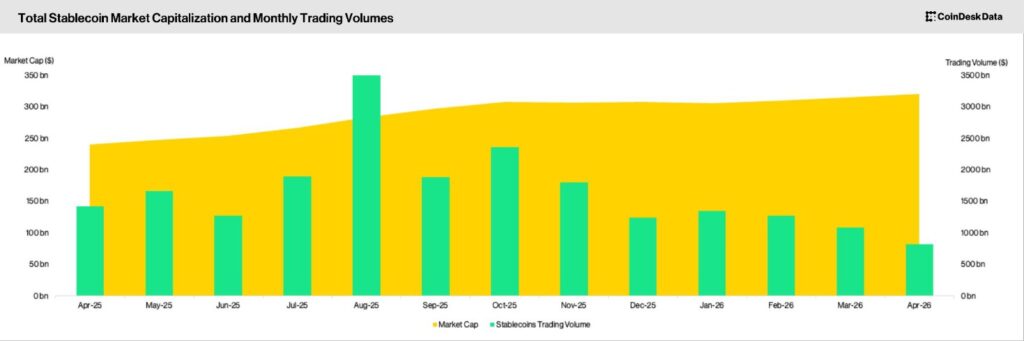
According to CoinDesk’s April 2026 figures, the total stablecoin market cap climbed to a record $321 billion, while tokenized real-world assets reached $26.7 billion. At the same time, some of the market’s more complex synthetic structures continued to unwind under pressure. The contrast may be one of the clearest signs yet that the digital asset sector is entering a more mature and institutional phase.

The Market Rewarded Stability, Not Complexity

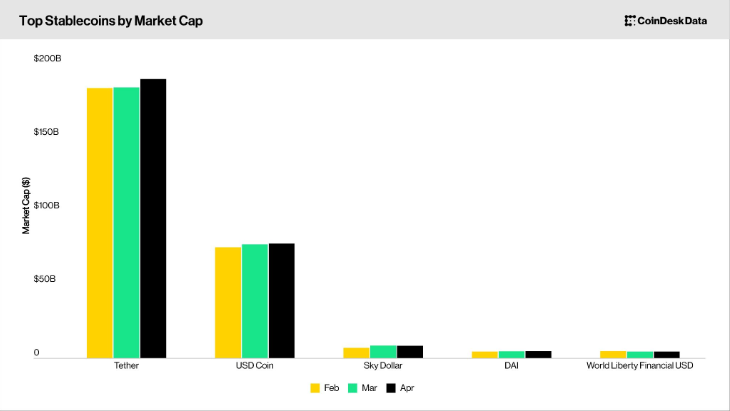
One of the most revealing developments in the report was the widening gap between Tether’s performance and the continued decline of Ethena’s USDe.

USDT expanded its market cap to $190 billion in April, accounting for most of the growth in the broader stablecoin market during the month. Its market share rose back to 59.2%, while its dominance in centralized exchange trading volumes remained overwhelming at 73.6%.

That growth did not happen in isolation.

Tether increasingly behaved less like a stablecoin issuer and more like a liquidity provider for the broader market. Following Drift Protocol’s $285 million exploit, Tether committed up to $127.5 million to support recovery efforts. Drift later switched its settlement infrastructure from USDC to USDT, effectively strengthening Tether’s position inside Solana-based trading activity.

At the same time, USDe experienced the opposite trajectory.

Ethena’s synthetic dollar lost 36.1% of its market capitalization during April, falling to its lowest level since October 2024. The decline followed the broader fallout from the KelpDAO exploit, which exposed vulnerabilities tied to leveraged DeFi positions and recursive borrowing strategies.

The market reaction was telling.

Investors appeared increasingly uncomfortable with stablecoin structures dependent on perpetual futures exposure and complex yield engineering. Ethena itself responded by drastically reducing its perpetual futures exposure and shifting reserves toward overcollateralized institutional lending and traditional fixed-income instruments.

In practice, one of crypto’s most aggressive synthetic stablecoin projects moved closer to traditional finance after market stress exposed the fragility of its earlier model.

Tokenized Treasuries Are Becoming Crypto’s Institutional Core

While speculative DeFi structures struggled, tokenized Treasuries continued to expand rapidly.

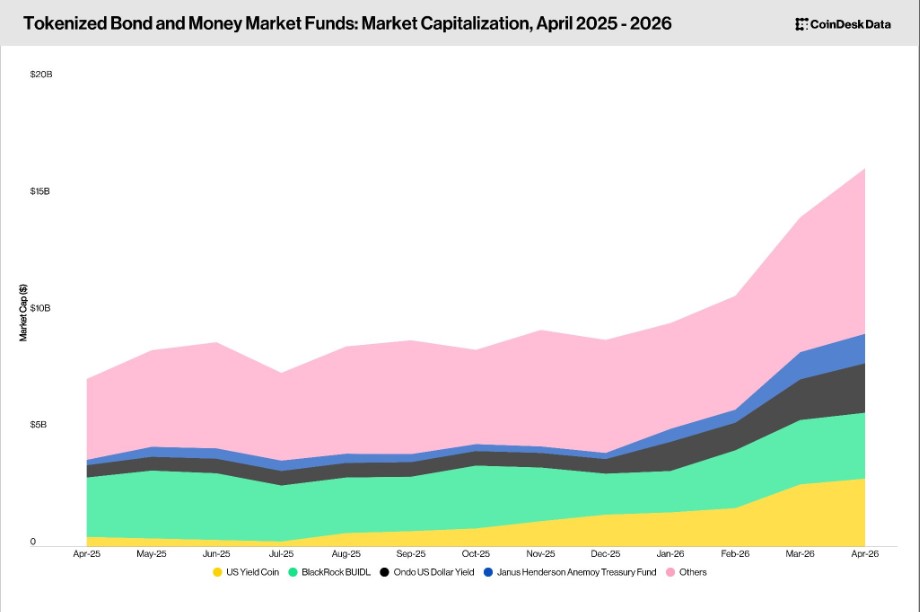
CoinDesk’s report showed tokenized bond and money market fund products growing to $16.2 billion in market capitalization during April. The sector now represents more than 60% of the entire tokenized asset market.

This matters because tokenized Treasuries solve a real institutional problem.

Large pools of capital want blockchain-based settlement efficiency without abandoning regulated yield-generating products. Tokenized money market funds allow institutions to hold Treasury-backed assets on-chain while preserving liquidity and collateral flexibility.

That explains why products like Circle’s USYC and BlackRock’s BUIDL are growing aggressively.
USYC overtook BUIDL in April to become the largest tokenized fund product, while BlackRock continued expanding BUIDL’s integration into institutional trading infrastructure. On April 28th, OKX enabled BUIDL as yield-bearing collateral through a partnership involving Standard Chartered.

This is no longer a niche crypto experiment. Traditional financial instruments are gradually becoming interoperable with blockchain-based trading systems.

Tokenized Real-World Assets Are Gaining Momentum Beyond DeFi

Another underappreciated trend in the report was the acceleration of tokenized equities.

The sector expanded 22% during April to reach a record $1.59 billion. While that figure remains small compared to stablecoins, the speed of growth is notable because tokenized equities increasingly move the conversation beyond crypto-native trading.

The key development was not simply higher market capitalization.

Ondo Finance announced a partnership with Broadridge Financial Solutions allowing holders of more than 250 tokenized stocks and ETFs to review company filings and submit shareholder voting preferences directly through crypto wallets.

That may sound procedural, but it represents something larger. The industry is slowly rebuilding pieces of traditional capital markets infrastructure on-chain. For years, tokenization narratives focused mainly on fractional ownership and 24/7 trading. The newer focus is operational integration: governance, collateral mobility, settlement efficiency, and institutional accessibility.

That transition is significantly more important for long-term adoption.

Stablecoins Are Becoming Financial Infrastructure

Perhaps the most important conclusion from CoinDesk’s April market report is that stablecoins are no longer behaving primarily as crypto trading tools.

Major developments during the month included:

  • Meta launching USDC creator payouts through Stripe
  • Robinhood expanding access to USDG
  • Morgan Stanley introducing a stablecoin reserve portfolio
  • Banking Circle launching stablecoin settlement services

These are infrastructure developments.

The companies involved are not positioning stablecoins as speculative assets. They are positioning them as payment rails, settlement layers, collateral systems, and treasury-management tools.

That distinction matters because infrastructure markets tend to consolidate around scale, liquidity, regulatory clarity, and trust.

April’s data suggests that consolidation is already happening.

The Industry Is Starting to Look More Like Finance

The April stablecoin market report ultimately revealed a crypto industry moving closer to traditional financial architecture rather than further away from it.

The strongest growth came from:

  • tokenized Treasuries,
  • institutional collateral products,
  • regulated yield-bearing assets,
  • and dominant liquidity providers.

Meanwhile, some of the market’s most complex DeFi structures faced renewed pressure under real-world stress.

Speculative innovation is not disappearing from crypto markets. But April’s data suggests the industry is entering a different stage of growth, where adoption and integration are accelerating faster than purely experimental narratives.

The strongest momentum is now concentrated around products and infrastructure that connect blockchain systems with real financial activity: payments, settlement, collateral management, Treasury products, and tokenized capital markets.

Rather than slowing down, the industry increasingly appears to be moving deeper into the global financial system.

Proof of Talk 2026

Proof of Talk 2026 is a high-level Web3 conference that brings together founders, investors, policymakers, and senior executives to discuss the future of digital assets, tokenized finance, Bitcoin, privacy, and decentralized AI. The two-day event combines keynote presentations, panel discussions, and curated networking sessions designed to connect decision-makers across the digital asset ecosystem.

The conference positions itself as a premium gathering for a more executive-level and institutional audience compared to many community-driven crypto conferences, with programming centered on leadership discussions, investment trends, compliance, and the evolving role of blockchain technologies in global finance and digital infrastructure.

Event Name: Proof of Talk 2026
Dates: June 02-03, 2026
Location: Louvre Palace, Paris, France
Format: In-person conference
Organizer: Proof of Talk
Expected Attendance: 2,500 attendees
Speakers: 120 speakers
Decision-Maker Ratio: 95% CEOs/founders
Official Website: https://proofoftalk.io/

What the Event Covers

The conference agenda focuses on institutional priorities across digital assets and blockchain. Themes include:

  • Tokenisation of finance.
  • Bitcoin and institutional strategy.
  • Decentralised AI.
  • Investing in digital assets.
  • Privacy and zero-knowledge systems.

Sessions are delivered through keynotes, panels, and investor discussions.

Speakers and Participants

Proof of Talk emphasizes speaker seniority as a core differentiator, stating that 95% of speakers are CEOs, institutional leaders, or founders. Stage spots are earned, not sold.

Notable speakers on the official 2026 lineup include:

  • Carlos Domingo — CEO, Securitize.
  • Tom Zschach — CIO, SWIFT.
  • Jenny Johnson — CEO, Franklin Templeton.
  • Tom Lee — Strategist, Fundstrat.
  • Caroline Pham — CLO & CAO, MoonPay, former Commissioner, CFTC.
  • Diogo Mónica — Co-Founder & Executive Chairman, Anchorage Digital.
  • Rob Hadick — General Partner, Dragonfly.
  • Stani Kulechov — Founder & CEO, Aave Labs.
  • Arnaud Caudoux — Deputy CEO, Bpifrance.
  • Marco Santori — CEO, Solmate.
  • Santiago Roel Santos — Founder & CEO, Inversion.
  • Stephan Lutz — CEO, BitMEX.
  • Staci Warden — CEO, Algorand.

The event’s dedicated content council includes media and editorial figures such as Christine Lee, Pete Rizzo, Eleanor Terrett, Michael Del Castillo, Ben Schiller, Frank Chaparro, and Raphaël Bloch.

Program Format

Proof of Talk is not a conventional large-scale trade show. It follows a curated summit-style format built around senior networking and tightly structured business interactions. You can expect:

  • Keynote talks and panel discussions.
  • Curated 1-on-1 networking.
  • Matchmaking lunches.
  • Cocktail networking sessions.
  • Themed networking sessions.
  • Expert roundtables.
  • VIP investor dinners.
  • Proof of Pitch startup competition.

Who Should Attend

Proof of Talk is the place for established decision-makers rather than a broad retail-facing audience. It targets the participation of a senior audience. Therefore, it is most relevant to:

  • Founders and C-suite executives in Web3 and digital assets.
  • Venture capital firms, allocators, and family offices.
  • Institutional finance leaders exploring tokenization and digital asset infrastructure.
  • Policymakers and regulatory stakeholders.
  • Senior operators from custody, trading, infrastructure, and blockchain protocol firms.
  • Journalists and media professionals covering digital assets.

Networking and Side Events

Networking is a major component of Proof of Talk. Side events and private gathering, such as pre-matched meetings, lunches, and private dinners, are organized around the main conference schedule. The event’s format emphasizes relationship building between institutional participants and blockchain companies.

Location Context

Paris has continued to strengthen its position as a European hub for blockchain startups, fintech companies, and digital asset regulation. France has emerged as one of the more active jurisdictions in Europe for regulated crypto businesses under the European Union’s MiCA framework.

Hosting the conference in Paris places the event within one of Europe’s larger financial and technology centers. The Louvre Palace venue reinforces the event’s prestige.

How to Attend

The event is capped at 2,500 attendees and sold out in prior years, so tickets are limited. Passes are available via the official site, with options for general access, networking upgrades, and VIP packages.

Additional entry paths include:

  • Becoming a partner or sponsor.
  • Applying to speak (curated by content council, no pay-to-speak).
  • Participating in Proof of Pitch for startups.
  • Investor or media invitations.

Check proofoftalk.io for availability and waitlist.

TL;DR

  • Proof of Talk 2026 takes place June 2–3, 2026 in Paris at the Louvre Palace.
  • The event is capped at 2,500 attendees and features 120 speakers.
  • The agenda focuses on tokenization, Bitcoin, decentralized AI, investing, and privacy.
  • Confirmed speakers include Carlos Domingo, Tom Zschach, Jenny Johnson, Tom Lee, Caroline Pham, Diogo Mónica, Rob Hadick, and Stani Kulechov.
  • The format emphasizes curated networking, investor access, and senior-level discussions over mass-attendance expo activity.

Morgan Stanley Launches Crypto Trading on E*Trade With Lower Fees Than Rivals

TL;DR

  • Morgan Stanley has begun rolling out crypto trading through E*Trade, initially supporting Bitcoin, Ether, and Solana.
  • The platform reportedly charges a 50 basis point transaction fee, undercutting several brokerage and crypto trading competitors.
  • The launch follows years of development after Morgan Stanley acquired E*Trade in 2020 and later partnered with Zerohash for crypto infrastructure.

Morgan Stanley has started rolling out crypto trading through E*Trade, marking one of the largest moves yet by a major Wall Street bank into direct retail digital asset access.

The launch initially supports Bitcoin, Ether, and Solana trading through E*Trade accounts, according to reports from Bloomberg, Reuters, and CoinDesk. Bloomberg reported that the platform is charging a 50 basis point transaction fee, positioning the service below some competing brokerage and crypto trading platforms on pricing.

Analysts say Morgan Stanley E*Trade crypto trading could accelerate broader retail adoption of digital assets through traditional brokerage platforms.

A Long-Building Expansion Into Crypto

The launch follows years of development after Morgan Stanley acquired E*Trade in a $13 billion deal that closed in October 2020. At the time, the acquisition was widely viewed as a push to expand the bank’s retail investing and self-directed trading business.

Public reports about direct crypto integration first surfaced in May 2025. Back then, Bloomberg reported that Morgan Stanley was preparing to add cryptocurrency trading to E*Trade. Several months later, reports revealed that the bank had selected Zerohash as its infrastructure partner and was targeting a 2026 rollout timeline.

The Zerohash partnership was first disclosed in September 2025. The current launch suggests the bank spent several years integrating E*Trade into its broader wealth management strategy before expanding into digital assets.

Morgan Stanley Targets Mainstream Investors with Crypto Trading on E*Trade

Unlike crypto-native exchanges, the new service is designed around a familiar brokerage experience for mainstream retail investors.

According to E*Trade disclosures, digital assets are held through separate Zerohash accounts rather than directly through Morgan Stanley brokerage accounts. The company also notes that crypto assets are not protected by FDIC insurance or SIPC coverage.

That structure reflects a broader trend among large financial institutions. They enter crypto markets through third-party infrastructure providers instead of directly handling custody and settlement operations internally.

The launch also arrives as traditional brokerages face increasing pressure to offer digital asset access alongside stocks, ETFs, and options trading. The move strengthens competition in the retail crypto brokerage market.

Pricing May Become a Competitive Factor

One of the most notable details in the rollout is pricing.

Bloomberg reported that Morgan Stanley plans to charge 50 basis points per crypto transaction. Such fees would potentially undercut pricing offered by some established crypto platforms and brokerage competitors. Lower trading costs could become an important selling point for investors who already use E*Trade for traditional investing activity.

The timing may also increase competitive pressure on both crypto exchanges and traditional brokerages that are still developing digital asset offerings.

While firms including Coinbase and Robinhood already offer retail crypto trading, Morgan Stanley’s E*Trade enters the market with a large existing wealth management and brokerage customer base. the platform reportedly serves around 8.6 million client accounts, giving the bank a significant distribution advantage if adoption expands.

Regulatory Conditions Continue to Shape Expansion

The rollout also highlights how large banks continue to approach crypto cautiously despite growing institutional acceptance.

Rather than fully integrating crypto custody into its banking structure, Morgan Stanley is relying on external infrastructure. It is also limiting the initial asset selection to a small number of established cryptocurrencies. The service initially focuses on Bitcoin and Ether trading alongside Solana support. That approach may help reduce regulatory and operational risks while still allowing the firm to compete in the growing digital asset market.

Crypto trading on Morgan Stanley‘s E*Trade could become an important test case for how traditional financial institutions introduce digital assets to mainstream retail investors. If adoption grows, other major brokerages may face pressure to accelerate their own crypto trading plans over the coming years.

- Advertisement -

FEATURED