Home Blog Page 47

next block expo 2026

Next Block Expo (NBX) is a European Web3 conference that brings together founders, developers, investors, and policy stakeholders to discuss developments across blockchain, digital assets, and decentralized technologies. The two-day event combines keynote presentations, panel discussions, startup showcases, and networking sessions designed to connect participants across the Web3 ecosystem.

The conference has become one of the larger blockchain gatherings in Central and Eastern Europe, attracting a mix of startups, venture capital firms, infrastructure providers, and crypto-focused entrepreneurs.

What the Event Covers

The conference agenda focuses on a broad range of topics across the blockchain and digital asset ecosystem. Expected themes include:

  • Decentralized finance (DeFi)
  • Real-world asset tokenization (RWA)
  • Blockchain infrastructure and tooling
  • Web3 startups and early-stage innovation
  • Crypto trading and investment strategies
  • AI integration with blockchain
  • Legal and regulatory developments
  • Cybersecurity in Web3

Sessions are typically delivered through keynotes, panel discussions, and technical workshops.

Speakers and Participants

Next Block Expo brings together founders, investors, and infrastructure leaders from across the global Web3 ecosystem. The 2026 edition is expected to feature more than 200 speakers participating in keynotes, panels, and workshops across multiple stages.

Several notable speakers associated with the event lineup include:

  • Miko Matsumura — General Partner at Gumi Cryptos Capital
  • Robby Yung — CEO of Investments at Animoca Brands
  • Marouane “Kounga” Essaidi — Ecosystem contributor at Solana Foundation
  • Piotr Szopa — CEO of zondacrypto
  • Tom Kopera — Head of Growth at Next Block Expo, opening keynote speaker

Previous editions of the conference have also featured executives and builders from major blockchain projects, venture capital firms, and infrastructure providers, reflecting the event’s focus on both startup innovation and industry investment.

Program Format

NBX follows a multi-track conference format combining several types of programming:

  • keynote presentations and panel discussions
  • technical workshops and educational sessions
  • startup pitch competitions and investor meetings
  • exhibition floor featuring Web3 companies
  • networking sessions and community meetups

The event also includes a dedicated Pitch Arena, where startups present their projects to investors and industry experts.

Who Should Attend

The conference targets a broad audience across the blockchain industry, including:

  • Web3 startup founders and entrepreneurs
  • blockchain developers and technical builders
  • venture capital firms and crypto investors
  • digital asset traders and analysts
  • fintech companies and enterprise technology teams
  • regulators and policy specialists

NBX positions itself as a meeting point between the technical, financial, and entrepreneurial sides of the Web3 ecosystem.

Networking and Side Events

Networking is a central component of the event. Attendees can schedule meetings through a dedicated event mobile app designed for matchmaking and one-to-one meetings.

Additional networking opportunities often include:

  • side events hosted across the city
  • themed meetups such as Women in Web3 sessions
  • official after-parties and informal gatherings
  • startup–investor networking sessions.

Location Context

The 2026 edition will take place in Warsaw, which has become an active hub for blockchain developers and Web3 startups in Central and Eastern Europe. The event also serves as a flagship gathering during Polish Blockchain Week, a broader series of industry meetups and activities held across the city.

How to Attend

Tickets for Next Block Expo are available through the official event website and are offered across multiple categories, including general attendee passes, startup passes, investor passes, and VIP tickets.

Registration details and ticket availability are managed directly by the event organizers.

TL;DR

  • Next Block Expo (NBX) takes place March 24–25, 2026 in Warsaw
  • The event expects 5,000+ attendees and 200+ speakers
  • Topics include DeFi, AI, Web3 infrastructure, startups, and regulation
  • Programming includes keynotes, panels, workshops, and startup pitches
  • The conference is part of Polish Blockchain Week
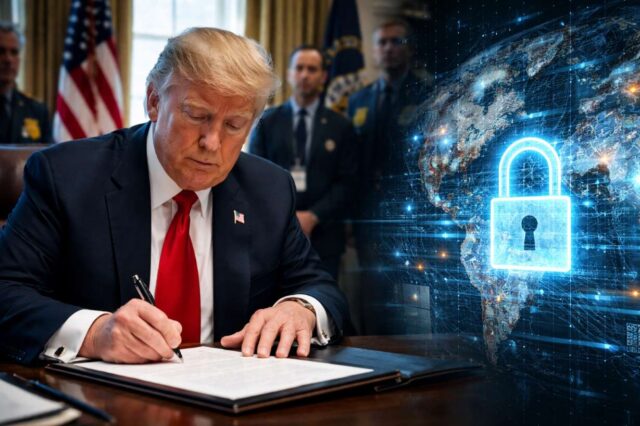
Trump Cybercrime Executive Order Targets Global Scam Networks

President Trump signed an executive order to dismantle global cybercrime networks responsible for online fraud targeting Americans.

TL;DR

  • President Donald Trump signed an executive order to dismantle transnational cybercrime networks responsible for large-scale online fraud targeting Americans.
  • The directive expands coordination between U.S. agencies to prosecute cybercriminal groups, impose sanctions, and disrupt global scam infrastructure.
  • Many fraud schemes today involve digital payment methods, which means investigations into international scam networks may involve crypto platforms.

U.S. President Donald Trump signed an executive order on March 5, 2026, directing federal agencies to intensify efforts against transnational criminal organizations involved in cybercrime and online fraud targeting American citizens. The directive focuses on large-scale scam operations that rely on digital infrastructure. They reach victims through social media, messaging platforms, and fraudulent websites.

Trump’s cybercrime executive order instructs agencies, including the Department of Justice, the Treasury Department, the Department of Homeland Security, and the State Department, to coordinate investigations. They must strengthen intelligence sharing and develop a comprehensive strategy to disrupt international fraud networks. The White House says these operations have evolved into sophisticated criminal enterprises operating primarily from overseas locations.

The executive order itself does not reference cryptocurrency or blockchain technology. However, many online scams investigated by law enforcement in recent years have incorporated digital asset payments. For audiences following developments in digital finance, the policy highlights the broader enforcement environment surrounding financial fraud that can intersect with cryptocurrency markets.

A Federal Strategy Against Global Fraud Networks

The executive order directs federal agencies to develop a coordinated action plan targeting transnational criminal organizations responsible for cyber-enabled fraud schemes like phishing, investment fraud, ransomware attacks, and sextortion. Authorities say these scams frequently rely on digital platforms to build trust with victims before requesting financial transfers.

Under the directive, the Justice Department will prioritize prosecutions against individuals and organizations linked to these fraud operations. The Treasury Department may also use financial sanctions to disrupt networks that facilitate criminal activity. At the same time, intelligence agencies are tasked with expanding information sharing to identify infrastructure used by cybercrime groups.

The policy also calls for expanded diplomatic tools. The State Department may apply visa restrictions and could limit foreign assistance for jurisdictions that fail to cooperate with U.S. investigations targeting cybercrime networks.

Scam Operations Are Increasingly Sophisticated

Government officials describe many fraud networks as highly organized enterprises operating from overseas hubs. These groups often use social engineering tactics, including fake investment platforms, impersonation schemes, and long-running confidence scams, to persuade victims to transfer funds.

According to law enforcement reports and industry research, some fraud schemes increasingly reference cryptocurrencies to create the appearance of legitimacy. Victims may be directed to fraudulent trading platforms or asked to send payments to addresses controlled by scammers as part of schemes that falsely promise high returns.

These tactics have become particularly visible in so-called “pig-butchering” scams. Criminals build relationships with victims online before persuading them to deposit funds into fraudulent investment platforms.

The Role of Blockchain Investigations in Financial Crime Cases

While the executive order itself does not address cryptocurrency investigations, blockchain analysis has become a common investigative tool in fraud and cybercrime cases. Public blockchain records are immutable and pseudonymous. While wallet addresses conceal real identities, their transactions remain fully transparent. This transparency allows investigators to track funds moving between addresses and identify clusters of activity linked to criminal operations.

Law enforcement agencies increasingly work with firms specializing in blockchain analytics to trace digital asset flows across wallets and exchanges as part of broader financial crime investigations. These techniques have been used in multiple high-profile cases involving ransomware groups, online fraud rings, and darknet marketplaces.

For investigators, blockchain transparency can provide an evidentiary trail that complements traditional financial intelligence methods used to track illicit funds.

Possible Implications for Digital Asset Platforms

Although Trump’s cybercrime executive order does not specifically address cryptocurrencies, its focus on dismantling large-scale fraud networks could indirectly affect digital asset service providers. Cryptocurrency exchanges and other platforms already operate under anti-money laundering and know-your-customer requirements designed to detect suspicious financial activity.

As enforcement agencies prioritize fraud investigations linked to transnational criminal organizations, compliance expectations for financial platforms, including crypto platforms, may continue to evolve. Regulators and investigators often seek cooperation from exchanges when tracing illicit funds linked to scams or cybercrime cases.

For the broader digital asset industry, the executive order reinforces the wider policy trend of integrating cybercrime enforcement with financial intelligence tools to disrupt criminal financial flows.

A Global Challenge for Law Enforcement

Cybercrime networks frequently operate across multiple jurisdictions, making international cooperation critical for effective enforcement. Many scam operations targeting Americans are believed to originate from organized centers located outside the United States.

The executive order emphasizes diplomatic coordination and intelligence sharing with foreign governments to disrupt these networks and bring perpetrators to justice.

As governments strengthen their response to cyber-enabled financial crime, Trump’s cybercrime executive order highlights growing enforcement attention on global fraud networks. The intersection between online fraud investigations and digital financial systems, including cryptocurrency, will likely remain an area of ongoing scrutiny for policymakers and industry participants.

BitGo Secures PSD2 License for EMT Payments to Expand Regulated EU Crypto Services

TL;DR

  • BitGo secured PSD2 authorization in Germany alongside its existing MiCA license, enabling regulated payment services tied to Electronic Money Tokens.
  • The dual framework allows the company to combine crypto infrastructure with EMT payment capabilities across the European Economic Area.
  • BitGo aims to support banks and fintechs integrating crypto services through its institutional Crypto-as-a-Service platform.

Crypto infrastructure provider BitGo has secured regulatory approval under the European Union’s Payment Services Directive 2 (PSD2). The move adds payment capabilities tied to digital assets to the firm’s regulated presence in the region.

The newly announced PSD2 authorization allows BitGo to provide regulated payment services for Electronic Money Tokens alongside its crypto infrastructure platform across the European Economic Area. The development builds on the firm’s existing regulatory framework in Europe. BitGo Europe GmbH obtained a license under the EU’s Markets in Crypto-Assets regulation in 2025.

Together, the two approvals position the company to offer integrated crypto and payment services to banks, fintech firms, and other institutional clients operating across EU markets.

Combining Crypto Infrastructure With Payment Services

BitGo operates primarily as a backend infrastructure provider, not as a consumer-facing crypto exchange. Its platform supplies institutional services such as custody, trading infrastructure, wallet technology, and digital asset settlement systems.

With the addition of PSD2 authorization, the company can now integrate these crypto services with regulated payment rails. This combination enables financial institutions to incorporate digital assets into existing financial products without needing to build internal blockchain infrastructure.

BitGo recently announced the expansion of its Crypto-as-a-Service platform across the European Economic Area. It targets banks and fintech companies that want to offer crypto features to customers while relying on an external infrastructure provider. Under the model, partner institutions can provide services such as custody, trading access, or tokenization tools while BitGo handles the underlying security systems and regulatory compliance.

https://twitter.com/BitGo/status/2030901403842236897

What PSD2 Means for Crypto Firms

The Payment Services Directive 2 is a European regulatory framework that governs electronic payments and digital financial services. BitGo’s license is issued under Germany’s ZAG framework, implementing PSD2. It specifically covers payment services related to Electronic Money Tokens (EMTs).

Under the EU’s Markets in Crypto-Assets regulation, EMTs function similarly to regulated electronic money because they are stablecoins referencing a single fiat currency. As a result, firms that interact with these tokens often require payment or e-money authorization to process transactions in the traditional financial system.

For crypto companies, PSD2 authorization enables interaction with established payment infrastructure while meeting the regulatory standards applied to financial institutions operating in Europe.

Building on BitGo’s MiCA license

The latest approval follows BitGo’s successful application for a license under the EU’s Markets in Crypto-Assets regulation in 2025. MiCA created a unified regulatory regime for crypto-asset service providers across the EU. It covers activities such as custody, trading platforms, and token issuance.

A MiCA license allows approved firms to “passport” services across the European Union. In practice, authorization in one member state can enable operations throughout the bloc.

By pairing its MiCA license with the newly secured PSD2 authorization, BitGo now operates under two complementary regulatory frameworks that cover both digital assets and EMT-related payment services.

This dual structure may simplify the integration of crypto services into traditional financial products, particularly for banks and fintech platforms that must operate under strict compliance requirements.

Institutional Crypto Adoption in Europe

Europe has emerged as one of the most structured regulatory environments for digital assets following the rollout of MiCA. The framework aims to provide legal clarity for crypto businesses while strengthening consumer protections and market oversight.

That clarity has attracted infrastructure providers seeking to build institutional crypto services in the region.

BitGo’s platform focuses heavily on institutional security architecture. It includes multi-signature wallets and hardware security modules designed to protect digital assets held in custody.

The company’s infrastructure serves financial institutions, trading platforms, and asset managers that need enterprise-grade security and compliance controls when working with digital assets.

Looking Ahead

The combination of MiCA and PSD2 regulatory approvals signals a broader shift toward deeper integration between the crypto sector and traditional financial systems in Europe.

With the regulatory groundwork now in place, BitGo’s PSD2 authorization could help accelerate partnerships with banks and fintech firms exploring digital asset services under the EU’s evolving regulatory framework.

As the MiCA regime continues to roll out across Europe, infrastructure providers like BitGo are positioning themselves to supply the backend systems that could support the next phase of institutional crypto adoption.

US Crypto Bill Hits New Deadlock as Banks Reject Stablecoin Yield Compromise

TL;DR

  • Negotiations around the US crypto bill have stalled after major banks rejected a White House compromise on stablecoin yield rules.
  • President Donald Trump urged Congress to pass the legislation, escalating tensions between banks and the crypto industry.
  • The deadlock raises uncertainty about whether the crypto market structure bill known as the CLARITY Act can pass in 2026.

Efforts to pass sweeping cryptocurrency legislation in the United States have hit another obstacle as negotiations over a key digital asset framework stall in Washington.

The US crypto bill, widely associated with the Digital Asset Market Clarity Act framework, is facing renewed uncertainty. After weeks of consultations, major banking groups rejected a compromise proposal backed by the White House. The dispute centers on whether crypto platforms should be allowed to offer yield-like rewards to users holding stablecoins.

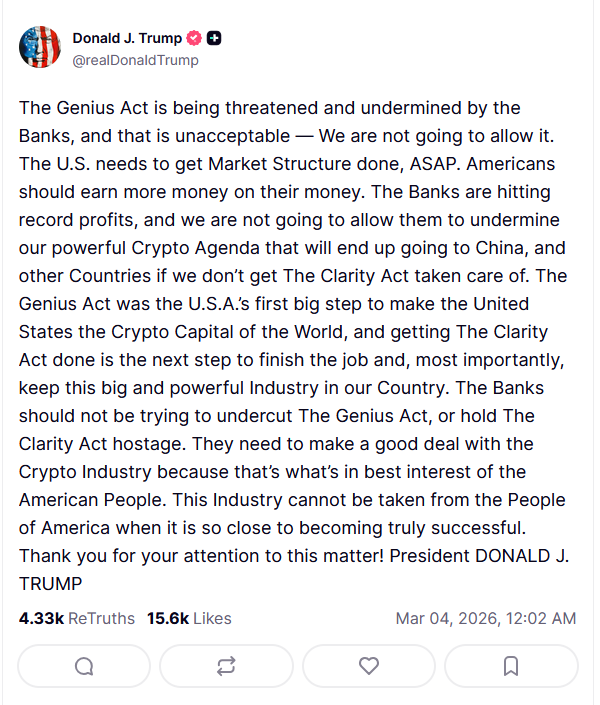
Now, President Donald Trump has stepped into the debate, criticizing banks for obstructing the legislation. He urged Congress to move forward quickly. The intervention has intensified an already complex political fight between traditional financial institutions and the crypto industry over how digital assets should be regulated.

Stablecoin rewards at the center of the dispute

The latest impasse stems from failed White House consultations over stablecoin rewards. Banks rejected compromise proposals ahead of a March 1 deadline.

Stablecoins are digital tokens pegged to fiat currencies, such as the U.S. dollar, widely used for trading and payments in crypto markets. Under the GENIUS Act passed in 2025, issuers must back stablecoins 1:1 with high‑quality reserves and provide regular disclosures. However, the debate now centers on whether exchanges and platforms can offer yield‑ or reward‑like incentives on stablecoin holdings or transactions.

Banking groups strongly oppose such provisions. They argue that they would let uninsured stablecoin balances compete with FDIC‑protected bank deposits for customer funds. Industry representatives warn that yields comparable to savings rates could redirect trillions in liquidity from banks over time, threatening lending capacity. Crypto firms counter that activity‑based rewards expand payment use cases and promote competition with traditional finance.

Trump intensifies pressure on banks

The political dimension of the debate escalated after President Trump publicly criticized banks for blocking the legislation.

Reports indicate the president met privately with Coinbase CEO Brian Armstrong before posting comments accusing banks of attempting to undermine his administration’s crypto agenda. Trump called on lawmakers to pass the legislation quickly, framing the issue as part of a broader effort to modernize the U.S. financial system.

His remarks helped fuel renewed attention around the US crypto bill. The legislation has been under negotiation for months as lawmakers attempt to balance innovation with financial stability concerns. Despite Trump’s support, analysts note that presidential pressure alone may not be enough to break the current stalemate, particularly given the competing interests involved.

Market reaction boosts crypto assets

Financial markets responded positively to the political developments.

Bitcoin climbed following Trump’s comments supporting the legislation, briefly moving toward new highs for the year. Crypto-related equities also rallied, with companies tied to digital asset infrastructure and mining posting gains.

Investors often view progress toward clear regulation as a positive catalyst for the industry. Supporters of the legislation argue that a comprehensive regulatory framework could reduce legal uncertainty and encourage greater participation from traditional financial institutions.

At the same time, market analysts caution that the legislative process remains unpredictable and could take months to resolve.

Legislative timeline remains uncertain

The US crypto bill, formally the Digital Asset Market Clarity (CLARITY) Act, cleared the House with bipartisan support in 2025. Nevertheless, the Senate remains stalled on key provisions. Lawmakers must resolve disputes over stablecoin rewards, market oversight, financial crime compliance, and jurisdictional lines between the SEC and CFTC. With the 2026 midterm elections looming, the window to advance this financial legislation is narrowing.

Industry observers remain cautiously optimistic that talks between representatives of the banking and crypto industries could resume soon to find a compromise, potentially unlocking Senate progress. Still, the recent breakdown underscores persistent tensions blocking comprehensive digital asset regulation.

Kraken Secures Federal Reserve Master Account in Crypto Banking First

TL;DR

  • Kraken Financial has secured a Federal Reserve master account, allowing the crypto bank direct access to the U.S. central bank’s payment infrastructure.
  • The approval makes Kraken the first crypto-focused banking entity able to settle transactions directly through Federal Reserve payment systems.
  • The move could reshape crypto banking by reducing reliance on intermediary banks and testing how digital asset institutions integrate with U.S. financial rails.

Kraken Financial has secured approval for a Federal Reserve master account, albeit as a limited-purpose account, giving the crypto firm’s banking entity direct access to the U.S. central bank’s payment infrastructure. The development marks a significant step in the integration of cryptocurrency firms with traditional financial systems.

Reports indicate that the approval allows Kraken’s banking division to connect directly to the Federal Reserve’s core payment rails. For the crypto industry, the move represents a rare case of a crypto-native financial institution obtaining the same operational privileges typically reserved for traditional banks.

The Federal Reserve master account effectively enables the Kraken to settle payments with the central bank without relying on intermediary commercial banks.

What a Federal Reserve master account allows

Master accounts are a fundamental part of the U.S. banking system. They allow financial institutions to hold reserves directly with the Federal Reserve and access payment systems such as Fedwire.

These accounts provide a secure way for banks to move funds between institutions and settle transactions in central bank money. For traditional banks, master accounts form the backbone of daily payment and settlement activity.

Direct access can significantly reduce reliance on correspondent banking relationships. In practical terms, this could enable Kraken’s banking entity to process U.S. dollar payments more efficiently and with lower counterparty risk.

The role of Kraken Financial and the Wyoming SPDI framework

Kraken Financial operates under Wyoming’s Special Purpose Depository Institution framework, commonly known as SPDI. This regulatory model was introduced to allow digital asset companies to function as banks while maintaining strict reserve requirements.

SPDI institutions offer digital asset custody and payment processing without traditional lending. This full-reserve structure bridges crypto and regulated banking. Unlike FDIC-insured banks, SPDIs like Kraken Financial aren’t required to obtain federal deposit insurance, though they may opt in, leaving customer deposits without the standard $250,000 FDIC protection if uninsured.

Kraken’s Federal Reserve master account is one of the first practical tests of whether this regulatory structure can integrate crypto banking entities into the existing U.S. financial system.

Wyoming lawmakers originally developed the SPDI framework to attract digital asset businesses seeking clearer regulatory treatment. Several crypto companies have pursued similar charters, though access to Federal Reserve services has historically been difficult to obtain.

Regulatory tension around crypto access to central bank infrastructure

Crypto firms have long sought direct access to the Federal Reserve’s payment systems. However, regulators have often approached these requests cautiously, citing concerns related to compliance oversight, financial stability, and operational risk.

In previous cases, applications from crypto-focused banks faced extended delays or legal disputes over eligibility for master accounts. The debate has reflected broader uncertainty about how crypto-native financial institutions should fit within the U.S. regulatory framework.

Some reports suggest Kraken’s access may initially operate in a limited or pilot-style configuration. This approach could allow regulators to monitor how a crypto banking entity interacts with central bank payment rails before broader expansion.

What this could mean for crypto and banking

The approval may signal a gradual shift in how regulators view digital asset institutions within the banking system. Direct connectivity to central bank infrastructure could make it easier for crypto firms to offer fiat payment services. They would also manage liquidity without relying heavily on traditional banking partners.

The Kraken Federal Reserve master account could also influence how other crypto banking initiatives approach regulatory integration in the United States. If the model proves workable, it may encourage additional digital asset institutions to pursue similar structures.

For now, the development represents an important milestone in the evolving relationship between cryptocurrency companies and the traditional financial system. While the long-term implications remain uncertain, the decision places Kraken at the center of an ongoing experiment in crypto banking integration.

- Advertisement -

FEATURED