
Home Blog Page 49

Can the Gaza Stablecoin Proposal Function Under Current Infrastructure Conditions?
TL;DR

  • The Board of Peace is discussing a potential stablecoin for Gaza as part of reconstruction planning, but the structure behind that proposal remains undefined.
  • A dollar-pegged token requires reserves, redemption rails, compliance controls, electricity, and telecom stability. Code alone does not create a payment system.
  • Without reliable power, communications resilience, banking access, and regulatory clarity, large-scale rollout would be premature.

U.S. President Donald Trump’s newly launched Board of Peace is discussing whether a U.S. dollar‑pegged stablecoin could be used in the Gaza Strip as part of reconstruction efforts.

The Gaza stablecoin proposal has surfaced in media reports citing people familiar with the discussions. The board did not release any formal policy document, and neither has it issued a detailed framework explaining how such a system would operate.

Most coverage has focused on political implications. However, the more immediate question is operational: Can a fully digital payments system function reliably under current conditions in Gaza?

Stablecoins rely on electricity, telecommunications, access to banking services, liquidity conversion, and regulatory oversight. Without those foundations, the technology alone does not create a functioning payment system.

Who Is Involved in the Discussions?

Reporting has consistently identified technology entrepreneur Liran Tancman as a participant in the discussions. He is described as advising on the technical feasibility of a dollar‑pegged token within the broader reconstruction framework.

The Board of Peace formally launched in January 2026 with President Trump as its Chair. The board’s reported executive and Gaza‑focused committees include figures such as Jared Kushner, Marco Rubio, Steve Witkoff, Tony Blair, and Nikolay Mladenov.

There has been no official announcement confirming a rollout structure. At this stage, the Gaza stablecoin proposal remains exploratory.

How Stablecoins Normally Operate
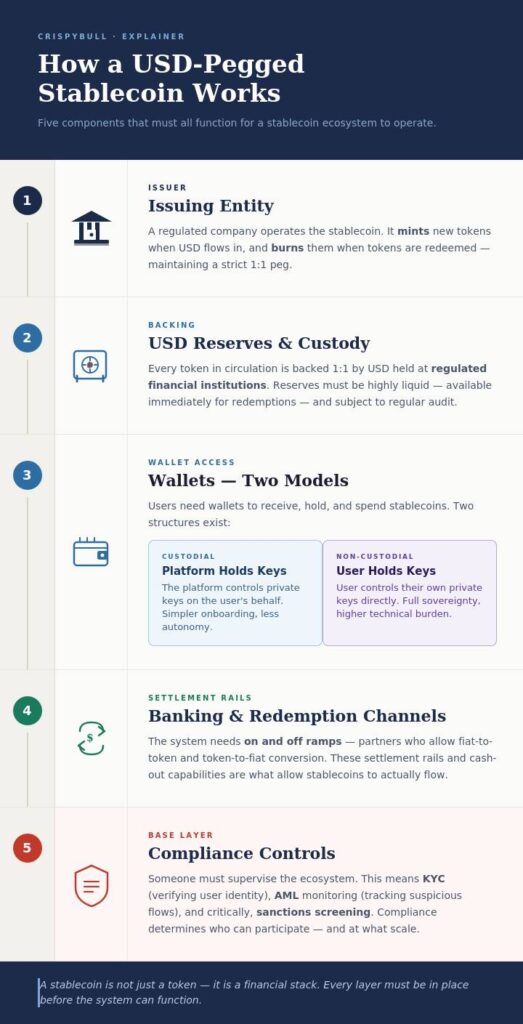
Infographic titled "How a USD-Pegged Stablecoin Works." 
A vertical five-step flow diagram explaining the components of a stablecoin ecosystem. 
Step 1, Issuing Entity: a regulated company mints new tokens when USD flows in and burns them when tokens are redeemed, maintaining a 1:1 peg. 
Step 2, USD Reserves and Custody: every token is backed 1:1 by USD held at regulated financial institutions, subject to audit and available immediately for redemptions. 
Step 3, Wallets — Two Models: users need wallets to receive, hold, and spend stablecoins. Custodial wallets have the platform hold private keys on the user's behalf; non-custodial wallets give the user full control of their own keys. 
Step 4, Banking and Redemption Channels: the system requires on and off ramps, partners enabling fiat-to-token and token-to-fiat conversion, along with settlement rails and cash-out capabilities. 
Step 5, Compliance Controls: the base layer covering KYC to verify user identity, AML monitoring to track suspicious flows, and sanctions screening. 
Footer reads: "A stablecoin is not just a token, it is a financial stack. Every layer must be in place before the system can function."

In practice, a U.S. dollar‑pegged stablecoin is not just software. It is a financial structure built around reserves, banking access, and compliance.

An issuing company creates tokens against dollar reserves. Those reserves sit in regulated financial institutions and are subject to oversight. Without verified reserves, the peg does not hold.

Users access the token through wallets. In a custodial model, a platform controls private keys and manages compliance. In a non‑custodial model, users hold their own keys and assume that responsibility themselves.

Crucially, the token must be redeemable. Banking partners convert tokens back into fiat currency. If redemption channels fail or narrow, confidence erodes, and parity breaks down.

Compliance is not peripheral. Sanctions screening, anti‑money laundering controls, transaction monitoring, and customer identification determine whether financial institutions can participate at all.

Issuance is the visible layer. Redemption, settlement certainty, and regulatory acceptance are what make a stablecoin function as money rather than as a tradable digital asset.

So far, the proposal has not publicly identified an issuing authority, reserve custodian, governing jurisdiction, or banking partner for the system it envisions.

Gaza’s Monetary Environment

Gaza does not issue its own currency. The Israeli New Shekel remains the primary legal tender, and the U.S. dollar is also widely used in commercial activity.

The Palestinian Monetary Authority conducts banking oversight. However, the banking system depends on cross‑border clearing arrangements and has experienced periodic cash shortages during border restrictions.

Any digital dollar layer would therefore enter an existing multi‑currency environment rather than replace it. External clearing access and physical cash constraints are already shaping liquidity flows.

Electricity and Payment Reliability

Digital payments require consistent access to charged devices and functioning networks.

Gaza experiences rolling blackouts due to damaged infrastructure, affecting grid stability. When electricity is unavailable, users cannot access digital wallets, even if balances are recorded on a blockchain.

Retail commerce depends on predictability. If payment access becomes intermittent, merchants may hesitate to rely on it. In environments where electricity supply is unreliable, physical cash typically reasserts itself as the primary medium of exchange.

The Gaza stablecoin proposal assumes sufficient power stability to support daily transactions. Yet no public timeline has been presented for restoring durable grid reliability, raising sequencing concerns about deploying an electronic settlement layer before core infrastructure resilience has been reestablished.
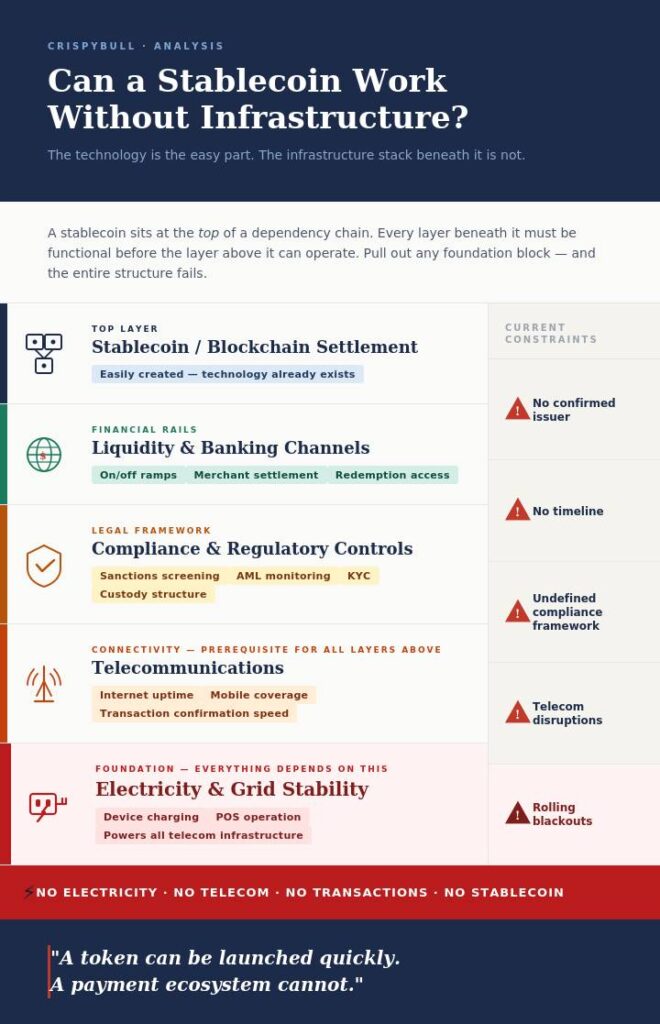
Infographic titled "Can a Stablecoin Work Without Infrastructure?" 
A layered dependency stack showing five infrastructure layers a stablecoin relies on, arranged top to bottom from easiest to most foundational. 
An introductory line reads: "A stablecoin sits at the top of a dependency chain. Every layer beneath it must be functional before the layer above it can operate." 
The five layers, left to right with a current constraints column on the right: 
Layer 1, Stablecoin and Blockchain Settlement — the top layer, described as easily created since the technology already exists; constraint: no confirmed issuer. 
Layer 2, Liquidity and Banking Channels — on/off ramps, merchant settlement, redemption access; constraint: no timeline. 
Layer 3, Compliance and Regulatory Controls — sanctions screening, AML monitoring, KYC, custody structure; constraint: undefined compliance framework. 
Layer 4, Telecommunications — internet uptime, mobile coverage, transaction confirmation speed; constraint: telecom disruptions. 
Layer 5, Electricity and Grid Stability — the foundation layer on which everything depends, covering device charging, POS operation, and powering all telecom infrastructure; constraint: rolling blackouts. 
A red warning bar reads: "No electricity · No telecom · No transactions · No stablecoin." 

Footer quote: "A token can be launched quickly. A payment ecosystem cannot."

Telecommunications and Transaction Confirmation

Stablecoin transactions require internet connectivity for broadcasting and confirmation.

Telecom disruptions can delay confirmation windows and increase settlement uncertainty. Merchants may be reluctant to accept payments that cannot be confirmed within predictable timeframes.

Even custodial wallet systems depend on backend servers that must remain online. Connectivity, therefore, affects both decentralized and centralized models. As with electricity, policymakers have not presented a clear public timeline for restoring telecom resilience at scale, which reinforces concerns about introducing a digital settlement system before communications stability is in place.

Compliance and Sanctions Considerations

Hamas still governs Gaza and remains a designated terrorist organization by several jurisdictions.

Any U.S. dollar‑pegged instrument operating in Gaza would require robust sanctions screening and transaction monitoring systems. Financial institutions participating in a potential rollout would face compliance obligations under U.S. law.

Issuers would need defined customer identification standards, wallet verification procedures, transaction monitoring systems, and redemption controls. No public compliance framework has been released.

Liquidity and Conversion Mechanics

A digital token must integrate with the real economy.

Users would need reliable mechanisms to convert shekels into tokens and tokens back into usable funds. Merchants would require clarity on settlement currency, exchange rate handling, and access to working capital.

Without stable banking partners and predictable redemption channels, liquidity conversion becomes the primary bottleneck.

These operational mechanics are central to evaluating the Gaza stablecoin proposal.

Timeline and Sequencing

This Gaza stablecoin plan remains an informal proposal with no publicly confirmed launch timeline. As outlined in the previous sections, multiple technical, regulatory, and infrastructure prerequisites would need to be addressed before a rollout could become operationally feasible.

Reconstruction governance under the Board of Peace is still evolving. Energy, telecom, and banking systems remain under strain. While issuing a token is technically straightforward, building a resilient payment ecosystem requires coordinated regulatory approval, financial partnerships, infrastructure stabilization, and merchant integration.

Policymakers must therefore evaluate the Gaza stablecoin proposal within the broader reconstruction sequence rather than treat it as a standalone technology initiative.

Conclusion

The Gaza stablecoin proposal is being discussed as a reconstruction tool. On paper, a digital dollar layer promises efficiency, transparency, and faster payments. In practice, it would sit on top of systems that are still unstable. Power supply remains inconsistent. Telecom resilience has not been publicly benchmarked. Banking channels and compliance architecture are not yet defined.

A blockchain token can be launched quickly. A functioning payments ecosystem cannot.

Before an electronic settlement layer can operate at scale, electricity, connectivity, liquidity conversion, and regulatory clarity must be demonstrably in place. Until then, the Gaza stablecoin proposal remains a concept under discussion rather than an executable payments system.


Bitdeer’s Zero Bitcoin Treasury: Strategy or Capitulation?

TL;DR

  • Bitdeer holding zero Bitcoin in its treasury became a reality in Q1 2026 after the company sold roughly 2,000 BTC within 8 weeks.
  • The move comes amid tighter post-halving miner economics and coincides with plans to raise approximately $325 million through convertible notes to support infrastructure expansion.
  • Based on available disclosures, the decision reflects capital reallocation tied to Bitdeer’s AI and data center strategy rather than clear evidence of miner capitulation.

When a public mining company eliminates its Bitcoin holdings entirely, the move carries weight beyond routine treasury management.

Bitdeer’s zero Bitcoin treasury is now a statement of fact. Bitdeer Technologies Group has sold its remaining BTC holdings, reducing its balance sheet exposure to zero. In an industry where a miner’s treasury often signals long-term alignment with the asset, that decision invites a direct question: Does this qualify as miner capitulation, or is it a calculated shift in capital allocation?

Understanding the answer requires examining the numbers, the timing, and the broader context of post-halving miner economics.

What Actually Happened

Bitdeer completed its liquidation and reduced its corporate Bitcoin holdings to zero. In total, the company sold roughly 2,000 BTC over the past 8 weeks. The final tranche amounted to 943 BTC, sold in late February 2026. Based on prevailing market prices at the time of the transactions, the aggregate value of the sales was estimated in the range of approximately $60 million to $70 million.

The liquidation occurred during a period of tightening margins across the mining sector. Hashrate competition remains elevated. Energy costs continue to pressure profitability. At the same time, the company disclosed capital market activity, including plans to issue convertible notes targeting approximately $325 million.

The immediate outcome is clear. Bitdeer’s balance sheet no longer reflects direct Bitcoin exposure.

Why a Bitcoin Miner Treasury Matters

A Bitcoin miner treasury historically serves multiple functions.

First, it acts as a balance sheet hedge. Miners generate revenue in BTC. Holding part of that production provides price upside participation.

Second, it signals conviction. Market participants often interpret retained Bitcoin as a long-term commitment to the asset.

Third, it offers optionality. Treasury BTC can be pledged, sold, or deployed during expansion cycles.

Gradually reducing holdings differs from eliminating them entirely. A zero position removes balance sheet exposure. That is why Bitdeer’s decision to reduce its treasury to zero Bitcoin carries symbolic importance beyond its nominal size.

Does This Qualify as Miner Capitulation?

The term miner capitulation has a specific meaning in market structure analysis.

Miner capitulation typically refers to forced selling due to financial stress. It often coincides with insolvency risk, operational shutdowns, or emergency liquidity events. To assess whether this case meets that definition, the surrounding conditions matter.

There is no public indication that Bitdeer halted operations. There is no disclosure of covenant breaches. The company continues to operate and expand infrastructure capacity.

At the same time, sector-wide selling pressure has increased. Post-halving miner economics have compressed margins across the industry. Lower block rewards combined with persistent energy costs reduce free cash flow.

In that environment, treasury liquidation can serve two purposes. It can relieve balance-sheet stress but also reallocate capital toward higher-return projects.

Whether this constitutes miner capitulation depends on intent and financial necessity. Available disclosures point to structured capital management rather than an emergency response.

The Bitdeer AI Pivot and Capital Reallocation

A key factor in evaluating Bitdeer’s Bitcoin liquidation is the company’s strategic repositioning.

Bitdeer is actively pivoting into high-performance computing by repurposing mining infrastructure for AI workloads and building new data centers. This strategic shift elevates compute capacity as the core priority. Capital once held in Bitcoin now fuels those infrastructure investments.

In parallel with the treasury reduction, Bitdeer outlined plans to raise approximately $325 million through convertible notes. This financing initiative, alongside the liquidation, supports broader infrastructure objectives.

Data center expansion requires upfront capital expenditure. Redeploying treasury assets can support that build-out. From a corporate finance perspective, this represents a reallocation decision. Capital tied to Bitcoin appreciation is redirected toward operating assets with projected cash flow.


The Bitdeer AI pivot, therefore, provides context. The treasury reduction aligns with a model that prioritizes compute infrastructure over passive asset exposure.


Post-Halving Miner Economics and Selling Pressure

Post-halving miner economics have tightened industry-wide. Block rewards have declined. Hashrate competition remains intense. Energy and hosting costs continue to shape operating margins. These factors increase sensitivity to Bitcoin price fluctuations.

Under such conditions, Bitcoin miners’ treasury strategies vary. Some miners retain production to maintain exposure. Others monetize production to fund operations and expansion.

Selling pressure from miners does not automatically indicate distress. It can reflect liquidity strategy, debt management, or capital rotation.

The broader mining industry stress environment frames the Bitdeer decision. However, it does not in itself determine whether the move represents capitulation.

What a Zero-Bitcoin Treasury Signals

A zero balance sheet position sends a clear signal.

It indicates that the company has separated operating activity from direct asset exposure. Revenue remains denominated in Bitcoin, but treasury policy no longer assumes holding as a default strategy.

Three interpretations emerge.

First, defensive liquidity preservation. Companies under margin pressure may prioritize cash reserves.

Second, structural capital reallocation. Firms pursuing expansion may liquidate non-core assets.

Third, a shift in corporate Bitcoin treasury philosophy. Bitcoin may be treated strictly as inventory rather than a long-term balance sheet asset.

The available information supports the second interpretation more strongly than the first. Bitdeer’s AI pivot and infrastructure expansion align with a structured capital redeployment.

Conclusion: Strategy, Capitulation, or Repricing?

Bitdeer’s zero Bitcoin treasury outcome stands clear-cut. The real question lies in its meaning.

Current evidence shows no signs of miner capitulation: operations run smoothly, expansions push forward, and fresh capital market moves support the shift. Even so, the choice mirrors post-halving miner economics, where clinging to Bitcoin miner treasury holdings no longer suits every firm.​

Bitdeer’s zero-Bitcoin treasury looks more like smart repricing than forced surrender. That difference shapes how investors view the company and Bitcoin miners’ changing strategies overall.

Tether Offshore Yuan Stablecoin Winds Down as Dollar Dominance Persists in Crypto Markets

TL;DR

  • Tether stopped minting CNHT immediately and will allow redemptions for one year before fully shutting down its offshore yuan stablecoin, citing low demand and limited adoption.
  • The wind-down reinforces dollar dominance in crypto, where USD stablecoins anchor most trading pairs, liquidity pools, and settlement flows.
  • Tightening oversight, regulatory ambiguity, and capital-control constraints in China limit space for private RMB-linked tokens, while the state advances its e-CNY strategy.

Tether has begun discontinuing its offshore yuan stablecoin, CNHT, marking the end of a product that struggled to gain meaningful traction. Tether’s yuan stablecoin was designed to track the value of the offshore yuan CNH. New issuance has stopped immediately, while redemption will continue for one year before full shutdown. Tether cited low demand and limited adoption as the primary reasons for the token’s phase out. Circulation remained limited compared to dollar-pegged tokens. As a result, the discontinuation should have minimal impact on overall crypto liquidity. Its wind-down highlights structural realities of the stablecoin market rather than triggering any broader market disruption.

What the CNHT Stablecoin Represented

The CNHT stablecoin was a yuan-pegged stablecoin linked specifically to offshore yuan CNH rather than onshore CNY. The distinction matters because CNY trades within mainland China under capital controls, while CNH trades in offshore markets such as Hong Kong.

Tether launched CNH₮ in 2019 to provide easier yuan exposure for crypto traders, with support on Tron added in 2022. Demand never took off relative to expectations, and market depth remained limited.

Understanding CNY vs CNH is central to assessing the product. CNH exists to facilitate international use of the renminbi without fully liberalizing China’s domestic capital account. The offshore yuan stablecoin structure allowed blockchain-based exposure to CNH without accessing China’s domestic banking system.

Despite that design, adoption remained limited. Exchange trading pairs were concentrated, and there was little integration into major DeFi protocols. Compared with USD stablecoin dominance across trading venues, CNHT’s footprint was small.

Dollar Dominance in Crypto Markets

The discontinuation of CNHT reinforces the broader pattern of dollar dominance in crypto. Most trading pairs on centralized exchanges are settled against dollar-pegged assets. Liquidity pools in decentralized finance are also largely denominated in U.S. dollar equivalents.

USD stablecoin dominance is not only a function of market preference. It is embedded in exchange infrastructure, derivatives markets, and collateral frameworks. Across major venues, USD stablecoins account for the vast majority of stablecoin trading volume, consistent with the prevailing stablecoin market structure. As a result, non-USD stablecoins face structural barriers to scaling.

Non-USD stablecoins must overcome network effects that favor dollar liquidity. Market makers, arbitrage desks, and institutional desks typically operate within dollar settlement systems. That environment limits the natural demand for alternatives such as yuan-pegged instruments.

In this context, the Tether offshore yuan stablecoin operated within a market architecture built around dollar-based rails.

China’s Stablecoin Regulation and Monetary Control

Recent developments in China’s stablecoin regulation have shaped the operating environment for renminbi-linked digital assets. Authorities have tightened oversight, while regulatory ambiguity and capital-control constraints continue to limit the scope for RMB-pegged stablecoins, including activity connected to offshore markets.

This regulatory backdrop intersects with broader objectives of internationalizing the yuan. China seeks greater global use of its currency while maintaining capital controls. That balance creates structural constraints for privately issued digital tokens linked to the renminbi. It pushes issuers toward dollar-linked rails where market infrastructure is deeper and regulatory clarity is stronger.

The e-CNY strategy represents a separate policy track. The digital yuan is a central bank digital currency. The People’s Bank of China issues and operates the digital currency within its state-controlled monetary framework. Unlike private stablecoins, it constitutes sovereign digital fiat rather than a privately collateralized token.

RMB stablecoin policy, therefore, emphasizes oversight and boundary-setting, while the e-CNY strategy advances state-managed digital currency infrastructure. Together, these approaches limit the operating space for privately issued offshore yuan instruments.

Implications for Non-USD Stablecoins

The CNHT stablecoin wind-down is not a market shock. However, it illustrates how stablecoin market structure reinforces existing currency hierarchies.

Non-USD stablecoins continue to face liquidity constraints. Even where technical issuance is possible, sustained demand requires integration across exchanges, derivatives venues, and settlement corridors. Dollar dominance in crypto remains the defining feature of the sector’s monetary layer. Until alternative currencies achieve comparable network depth, dollar-linked tokens are likely to remain central to trading and settlement.

The discontinuation of Tether’s offshore yuan stablecoin, therefore, reflects structural conditions rather than a short-term event. It underscores how currency architecture, regulation, and liquidity dynamics shape the evolution of digital assets.


Robinhood Chain Enters the Layer-2 Race With 4M Testnet Transactions

TL;DR

  • Robinhood Chain processed roughly 4 million transactions in its first week of public testing, marking early activity on the company’s new Arbitrum-based Layer 2 network.
  • The launch reflects a strategic shift as the fintech brokerage expands into blockchain infrastructure through its Robinhood Layer 2, built within the Ethereum Layer 2 ecosystem.
  • The 4 million transactions figure signals testnet engagement, but it does not yet confirm sustained economic adoption.

Robinhood Chain processed roughly 4 million transactions in its first week of public testing. The milestone was highlighted following the launch of the company’s new Robinhood Layer 2, built as an Arbitrum-based Layer 2 network on Ethereum.

The figure drew attention across industry coverage. However, the larger development is structural. With Robinhood Chain, the fintech brokerage is moving beyond offering crypto access and into operating blockchain infrastructure.

From Neobroker to Blockchain Builder

Robinhood began as a commission-free brokerage app, with crypto trading added later as an additional asset class. The launch of its own blockchain network marks a deeper shift.

By building an Ethereum Layer 2, the company is no longer relying solely on external networks. It is establishing direct control over transaction rails, fee design, and execution logic. This move reflects vertical integration within fintech.

Operating a fintech blockchain allows Robinhood to customize how digital assets are issued, transferred, and settled. It also reduces dependence on third-party chains for core functionality. Infrastructure ownership can create a long-term competitive moat.

Why Build a Chain at All?

The decision to launch Robinhood Chain aligns with a broader trend. Financial platforms are increasingly seeking to control blockchain infrastructure rather than operating only at the application layer.

Owning a Layer-2 scaling network enables flexibility in performance tuning and cost structure. It also creates space for purpose-built financial products. In this context, blockchain infrastructure becomes part of the business model rather than an external dependency.

For Robinhood, the strategy appears tied to tokenized finance. A dedicated network provides an environment tailored to regulated assets and brokerage-style workflows.

Why Robinhood Chose Arbitrum

Robinhood Chain was developed using the Arbitrum Orbit framework. The choice positions the network within the broader Ethereum Layer 2 ecosystem.

Ethereum’s rollup roadmap has encouraged Layer-2 specialization. Arbitrum offers established tooling, developer familiarity, and scalability benefits. The Orbit framework enables faster deployment while remaining aligned with Ethereum’s security model.

Building on Arbitrum also allows compatibility with existing smart contract standards. This reduces friction for developers who may experiment on the Robinhood Chain testnet.

The selection suggests a pragmatic approach rather than an attempt to build a new base-layer blockchain from scratch.

What Robinhood Chain Is Designed For

Coverage of Robinhood Chain consistently points to tokenized stocks and tokenized ETFs as core use cases, positioning the network to support real-world assets issued in digital form.

Tokenized stocks represent a bridge between traditional equities and on-chain infrastructure. Real-world assets can be structured for settlement and transfer within a blockchain environment. In this context, on-chain securities become technically feasible within a brokerage framework.

The design of Robinhood Layer 2 appears aligned with financial asset issuance rather than general-purpose decentralized finance. While decentralized finance remains part of the broader ecosystem, the focus here is institutional-grade infrastructure.

By developing a dedicated Ethereum Layer 2, Robinhood can tailor compliance logic and asset controls to brokerage requirements. This specialization differentiates the network from purely experimental chains.

The 4 Million Transactions Question

Robinhood stated that the chain’s testnet processed approximately 4 million transactions in its first week. The number signals activity during early testing.

However, testnet metrics require careful interpretation. Developer experimentation, smart contract deployment, and automated interactions often contribute to transaction counts. Testnet transactions do not necessarily reflect economic volume.

The 4 million transactions figure, therefore, indicates engagement rather than adoption. It suggests that developers and partners interacted with the Robinhood L2 during initial rollout. It does not confirm sustained usage at scale.

Positioning the milestone within this context preserves analytical clarity.

Fintech Platforms and Blockchain Infrastructure

Robinhood Chain reflects a broader structural shift. Fintech platforms are increasingly moving toward infrastructure ownership. Operating an Arbitrum-based Layer 2 allows integration of brokerage services directly with blockchain rails.

As Ethereum’s rollup roadmap matures, specialized networks can emerge for distinct financial purposes. A fintech blockchain built for tokenized stocks and real-world assets represents one such specialization.

This approach extends the company’s evolution. Robinhood began as a mobile brokerage interface. It later incorporated crypto trading and now enters the blockchain infrastructure layer.

Conclusion

Robinhood Chain processed roughly 4 million transactions during its first week of testing. The figure highlights early activity on the testnet, though it should be viewed as a development milestone rather than proof of adoption.

More significantly, the launch of Robinhood Layer 2 signals an expansion into blockchain infrastructure. Built within the Ethereum Layer 2 ecosystem, the network is designed to support tokenized stocks, real-world assets, and on-chain securities.

The mainnet launch expected later in 2026 will determine how the strategy translates into sustained usage. For now, Robinhood Chain marks a structural step in the evolution of a fintech brokerage into a blockchain infrastructure operator.

Readers’ frequently asked questions

What is a Layer 2 network?

A Layer 2 network is a blockchain built on top of another blockchain, such as Ethereum, to increase transaction speed and reduce costs while still relying on the base layer for security.

When will Robinhood Chain launch the mainnet?

Robinhood has indicated that a mainnet launch is expected later in 2026. The company did not confirm a specific launch date yet.

Can users trade tokenized stocks on Robinhood Chain today?

No. Robinhood Chain is currently operating as a public testnet. Tokenized stocks and other on-chain assets are not yet available for live trading on the network.

What Is In It For You? Action items you might want to consider

Monitor the Robinhood Chain mainnet timeline

Follow official Robinhood announcements to track when the mainnet launches and whether new on-chain products become available to retail or institutional users.

Assess implications for tokenized stocks

If you are active in equities or digital assets, evaluate how tokenized stocks on an Ethereum Layer 2 could affect settlement speed, access, and cross-border trading models.

Watch fintech infrastructure trends

Monitor how other fintech platforms approach blockchain infrastructure, as vertical integration into Layer-2 networks may signal a broader structural shift in digital finance.

Dutch Regulator Moves Against Polymarket, Rejecting “Prediction Market” Defense

TL;DR

  • A January 2026 order by the Kansspelautoriteit classified the platform’s services as illegal gambling and unlicensed betting, resulting in a ban for Polymarket in the Netherlands.
  • Polymarket faces €420K weekly fines, capped at €840K total, and Dutch access is now restricted via geo-blocking.
  • The case highlights the broader debate over the regulation of prediction markets and event contracts, as European authorities tighten regulation across Europe.

The Polymarket ban in the Netherlands marks a new phase in Europe’s regulatory scrutiny of blockchain-based prediction markets. In January 2026, the Kansspelautoriteit, the Dutch gambling authority, ordered the platform to halt operations in the Netherlands, concluding that it was offering illegal gambling without a local license.

Under the enforcement order, Polymarket faces a €420K weekly fine if it fails to comply. Those penalties are capped at €840K in total, meaning the maximum exposure would be reached after two weeks of continued non-compliance. The regulator stated that the platform’s services amount to unlicensed betting under Dutch law and, therefore, the company cannot offer such services to residents.

Dutch access is now restricted via geo-blocking, following the post-order compliance period. Users connecting from the Netherlands can no longer participate in markets, reflecting the enforcement of the order.

KSA’s Prediction Markets Ruling

At the center of the Dutch Polymarket crackdown is a legal classification issue. The Kansspelautoriteit rejected the company’s framing of its products as financial-style prediction markets and instead treated them as illegal gambling under national statutes.

This determination reflects the broader tension between gambling vs event contracts regulation. Platforms such as Polymarket argue that their offerings function as information markets built around those principles. However, the Dutch gambling authority concluded that users were effectively placing wagers on uncertain outcomes for potential financial gain.

In addressing the question of whether Polymarket is gambling, the regulator relied on this gambling-event divide rather than the platform’s branding. Because participants stake value on future events and receive payouts based on results, the activity met the legal definition of gambling under Dutch law.

That approach places the platform within domestic gambling oversight rather than financial supervision. The ruling adds to the ongoing debate over prediction market regulation in Europe, as similar platforms expand across jurisdictions.

Election Betting and Regulatory Concerns

The enforcement action targeted political markets, including those on Dutch parliamentary elections from October 2025, where users wagered millions. Under Dutch law, even licensed operators cannot offer election betting, amplifying KSA’s concerns over election integrity and public confidence.

While licensing violations drove the order, these prohibited political markets heightened urgency, as Director Ella Seijsener warned of their potential to influence democratic processes.

Enforcement Impact and Compliance Measures

The Dutch gambling authority backed the Polymarket ban with a coercive order to compel immediate compliance. The capped €840K penalties function as a financial deterrent rather than a retroactive sanction.

Following the order, access from the Netherlands was restricted through geo-blocking. Reports indicate that Dutch users can no longer actively trade or participate in markets, confirming the decision’s implementation.

The Kansspelautoriteit emphasized that combating illegal gambling remains a priority, particularly where offshore platforms target domestic users without authorization. Enforcement tools such as escalating weekly fines are common to pressure operators into compliance.

What This Means for Prediction Markets in Europe

The Dutch action does not stand alone. Hungary recently restricted Polymarket, and Portugal also moved against the platform over similar gambling concerns. Those developments suggest that national regulators are increasingly applying domestic gambling laws to cross-border prediction markets.

As authorities refine their stance, prediction market regulation in Europe faces a clearer dividing line. In the Netherlands, that line now places certain event-based contracts squarely within gambling supervision rather than financial oversight.

The Polymarket ban in the Netherlands illustrates how regulators are drawing a firm line between innovative prediction markets and traditional betting. More bans are likely as EU regulators align approaches. The Dutch position may well serve as a blueprint for jurisdictions targeting unlicensed offshore platforms.

- Advertisement -

FEATURED