Home Blog Page 50

White House Crypto Talks Continue as End-of-Month Deadline Nears

TL;DR

  • White House talks are ongoing as officials push banks and crypto firms to reach a compromise before an end-of-month deadline, with March 1 cited as a target date.
  • The central dispute remains the stablecoin yield debate, particularly whether non-bank issuers can offer deposit-style returns under the CLARITY Act.
  • Policymakers appear open to transaction-based stablecoin rewards, but broader yield provisions remain unresolved.

Crypto talks at the White House continued this week as administration officials pressed banking representatives and digital asset firms to narrow their differences before an end-of-month deadline. Despite multiple rounds of negotiations, the parties did not reach final agreements on key elements of stablecoin legislation. While participants describe the discussions as constructive, disagreements over stablecoin yield rules and issuer parity remain unresolved.

The ongoing discussions are tied to the CLARITY Act (H.R. 3633) and its stablecoin framework, which passed the House and now awaits Senate action. The bill aims to define how payment stablecoins would be supervised in the United States. At the center of the debate is whether non-bank issuers should be allowed to offer certain reward mechanisms to token holders. That question has shaped much of the recent progress and tension inside those meetings.

Progress in the Negotiations

Officials involved in the talks at White House have signaled movement on limited incentive structures. According to policy documents and meeting summaries, policymakers appear open to allowing transaction-based stablecoin rewards if they tie to payment activity rather than passive holding. This distinction has become central to the evolving stablecoin reward proposal.

The shift suggests that regulators are attempting to draw a line between cashback-style incentives and deposit-style returns. By narrowing the scope of acceptable benefits, negotiators have moved away from an all-or-nothing debate. That approach reflects an effort to preserve innovation while addressing financial stability concerns.

There has also been progress on enforcement language. Reports indicate that draft provisions include potential civil penalties of up to $500,000 per violation per day for attempts to circumvent any final restrictions. The inclusion of enforcement mechanisms suggests that discussions have advanced beyond principle and into legislative drafting.

Participants have described the recent sessions as structured and substantive. The continuation of stablecoin talks into a third round indicates that the process remains active, even if it has not resulted in an agreement yet.

Where Talks Still Stall

Despite incremental movement, the stablecoin yield debate remains the primary sticking point. Banks argue that deposit-style yield stablecoins resemble interest-bearing accounts and should therefore be subject to banking regulation. Crypto firms contend that they can design certain yield models without replicating traditional deposits.

This disagreement has produced a deadlock for now. While transaction-based incentives may be acceptable, the broader question of whether stablecoin issuers can offer yield at all remains unsettled. That issue continues to divide participants in the White House crypto discussions.

Another unresolved area concerns regulatory parity. Banking representatives voiced concerns about a competitive imbalance if non-bank entities can distribute returns without complying with bank capital and supervisory standards. Industry groups respond that overly restrictive rules could limit market development and slow digital dollar innovation.

Definitions also remain under discussion. Policymakers must determine how to classify different forms of incentives under the CLARITY Act’s stablecoin framework. The boundary between rewards and interest has not yet been formally codified, which complicates efforts to finalize statutory language.

Deadline Pressure Builds

An end-of-month deadline has added urgency to the crypto talks at the White House. Administration officials have encouraged both sides to reach a consensus before legislative momentum slows. While no formal cutoff has been announced, the timeline has become a reference point in recent discussions.

The broader CLARITY Act framework aims to reduce regulatory fragmentation. Lawmakers and regulators have emphasized the need for clearer supervision of payment stablecoins. However, progress in stablecoin yield negotiations remains uneven.

If the current stablecoin yield debate cannot be resolved, the legislation could face delay or require further revision. Participants have not indicated that talks are collapsing, but the absence of a final compromise underscores the complexity of the issues under review.

While the latest White House policy negotiations demonstrate that engagement between banks and crypto firms is ongoing, the central divide over yield and issuer authority persists. As the end-of-month deadline approaches, negotiators must determine whether a limited stablecoin reward proposal can bridge the gap or whether the impasse will extend into the next phase of legislative deliberation.

For now, the discussions continue without a definitive outcome. The Administration’s mediation efforts remain active, but the path to agreement on stablecoin legislation is still being negotiated.


Poland’s President Vetoes Revised MiCA Bill for Second Time

TL;DR

  • Poland’s President vetoes MiCA bill for a second time, rejecting a revised draft of the Crypto-Assets Market Act on February 12, 2026.
  • The veto delays Poland’s MiCA implementation, leaving the country without a finalized national competent authority or operational CASP licensing framework.
  • The approaching July 2026 deadline for CASP and stablecoin rules increases pressure on lawmakers to resolve the legislative impasse.
  • Under MiCA passporting rules, Poland-based crypto firms may seek licenses in other EU jurisdictions and operate cross-border, while domestic implementation remains incomplete.

Poland’s President Karol Nawrocki vetoes the MiCA bill for a second time, delaying the country’s domestic framework for supervising crypto markets under European Union rules. The decision adds to the uncertainty around Poland’s MiCA implementation as the EU’s July 2026 deadline for CASP and stablecoin rules approaches.

The veto does not suspend the Markets in Crypto-Assets (MiCA) regulation at the EU level. MiCA applies directly across member states. However, it blocks the adoption of Poland’s national oversight and licensing structure. As a result, the country still lacks a finalized domestic framework aligned with EU standards.

What Happened After Poland’s President Karol Nawrocki Vetoes MiCA Bill

The latest veto, issued on February 12, 2026, concerns a revised version of the Crypto-Assets Market Act (Druk 2064). President Nawrocki determined that the new draft did not sufficiently address concerns raised during the earlier legislative process.

The first veto occurred on December 1, 2025, when he rejected the original Crypto-Assets Market Act (Druk 1424). Following that decision, the Sejm attempted to override the veto but fell short by approximately 18 votes. The revised bill was then introduced, yet the President concluded that the amendments were insufficient.

Under Poland’s constitutional framework, the Sejm may override a presidential veto with a three-fifths majority. That requires 276 of 460 votes. The governing coalition currently holds 248 seats, meaning cross-party support would be necessary to reach the required threshold.

Absent an override or a new compromise draft, MiCA implementation in Poland cannot proceed under the proposed legislation.

Supervisory Powers and Structural Objections

The rejected bills sought to define the competent authority required by MiCA for national supervision and to formalize Poland’s crypto licensing framework for crypto asset service providers.

Objections included excessive supervisory powers, such as the ability to block websites, high licensing fees that critics argued could harm startups, and provisions exceeding EU MiCA minimum standards. According to the President’s assessment, certain elements extended beyond what is required under harmonized EU rules.

These concerns formed the basis for both vetoes. As a result, the legislative process tied to Poland’s MiCA implementation remains unresolved.

The State of MiCA Implementation in Poland

With the legislation blocked, Poland’s MiCA implementation lacks a finalized supervisory and licensing architecture. No national competent authority has been formally designated. There is also no operational licensing regime for crypto asset service providers (CASP) under domestic law aligned with MiCA.

Although MiCA applies directly at the EU level, member states must establish supervisory structures and administrative procedures. In Poland, that national layer is still pending.

This gap affects domestic CASPs, and Poland-based crypto firms do not yet have a confirmed national pathway under a Polish crypto licensing framework.

Meanwhile, the EU’s July 2026 deadline for MiCA alignment remains fixed. Member states are expected to have supervisory mechanisms and licensing processes in place before that milestone.

The delay, therefore, places administrative and legislative pressure on the timeline for MiCA implementation in Poland.

Competitive Dynamics Under MiCA Passporting Rules

MiCA passporting rules allow authorized CASPs in one EU member state to operate across the bloc. Once licensed in a jurisdiction with an operational framework, firms may provide services in other member states without separate national approval.

This creates strategic alternatives while MiCA implementation in Poland is not completed. Polish crypto firms seeking licenses abroad become a viable response if domestic authorization continues to be delayed.

Jurisdictions such as Lithuania or Estonia already operate MiCA-aligned frameworks. A firm licensed there could passport its services into Poland under EU rules.

This dynamic may influence business structuring decisions as companies evaluate regulatory certainty within the EU single market.

Override Prospects and Legislative Outlook

Given the failed override attempt in December and the current seat distribution in the Sejm, securing the required three-fifths majority would require cross-party support.

If that threshold cannot be reached, lawmakers must introduce a further revised draft. Any new proposal will need to address concerns over supervisory powers while still establishing a competent authority in Poland as MiCA requires, and finalizing Poland’s crypto licensing framework.

Until legislative consensus is achieved, MiCA implementation remains pending.

Institutional Outlook Ahead of July 2026

The veto does not remove Poland from the scope of EU crypto regulation. MiCA applies directly across all member states.

However, the absence of a finalized national framework affects how Poland administers crypto regulation domestically. Supervisory designation and licensing procedures are not yet operational.

As the EU’s July 2026 MiCA deadline approaches, attention will shift from legislative debate to practical readiness. Whether through a successful override or a revised legislative compromise, MiCA implementation in Poland will require resolution before the transition period concludes.

Deutsche Bank Expands Blockchain Strategy With Ripple Partnership, Alongside SWIFT

TL;DR

  • The reported partnership between Deutsche Bank and Ripple, according to Der Aktionär and crypto industry outlets, would see Ripple’s blockchain infrastructure used in the bank’s global payments modernization efforts.
  • There is no indication that Deutsche Bank is abandoning SWIFT; public reporting points to a hybrid model combining Ripple-powered solutions with ongoing SWIFT initiatives.
  • No public source confirms that Deutsche Bank will hold or use XRP in live settlement flows as part of the reported agreement.

Germany’s largest lender, Deutsche Bank, is expanding its digital payments infrastructure through a reported partnership with Ripple, according to reporting from Der Aktionär and crypto industry outlets. The reported agreement would see Ripple’s blockchain infrastructure used as part of Deutsche Bank’s global payments modernization efforts, alongside the bank’s ongoing work with SWIFT’s blockchain and payment initiatives.

The development reflects a hybrid approach. Rather than replacing legacy rails, Deutsche Bank appears to be layering blockchain capabilities alongside established correspondent banking systems.

What the Deutsche Bank – Ripple Partnership Involves

According to multiple reports, the partnership involves using Ripple’s enterprise payment technology to enhance Deutsche Bank’s cross-border processing efficiency. The focus aims at operational improvements such as faster settlement, improved liquidity visibility, and greater transparency in transaction flows.

Ripple’s cross-border payments infrastructure is designed to streamline international transfers between financial institutions. These systems use distributed ledger technology to reduce reconciliation friction and shorten processing cycles.

The reports do not specify financial terms or a detailed implementation timeline. Public reporting so far frames the move as a payments technology upgrade, without detailing whether it will replace or overhaul existing systems.

Ripple and SWIFT: A Hybrid Modernization Model

The Ripple partnership does not indicate a departure from SWIFT as Deutsche Bank continues to contribute to SWIFT’s blockchain ledger while adopting Ripple-powered solutions.

Ripple integration narratives often frame the relationship as competitive. However, current reporting suggests coexistence with SWIFT rather than replacement. This points to a dual-track strategy in which blockchain-based settlement layers operate alongside the global messaging network.

This hybrid architecture aligns with broader trends in experimenting with blockchain-based cross-border payments. Major financial institutions are testing distributed ledger overlays without dismantling legacy infrastructure.

Deutsche Bank’s Blockchain Strategy in Context

The reported agreement fits within Deutsche Bank’s blockchain strategy initiatives that have gradually expanded over recent years. The bank has explored blockchain and digital assets in areas such as real-time treasury, cross-border payments, and digital asset custody.

Banks have accelerated the institutional adoption of blockchain technology, seeking to improve operational efficiency. Cross-border payments remain a primary focus due to their complexity and cost structure.

By incorporating Ripple technology into its payments stack, Deutsche Bank appears to be strengthening its position in global payments infrastructure modernization. The emphasis, at least in public reporting, is on operational efficiency rather than consumer-oriented crypto speculation.

Does This Mean Deutsche Bank Is Using XRP?

The partnership between Deutsche Bank and Ripple centers on enterprise payment software. It does not automatically confirm the use of XRP in settlement processes.

Ripple’s enterprise solutions can function without direct XRP deployment. Many institutions utilize Ripple infrastructure without holding or transacting in the digital asset.

As of now, no public source from Deutsche Bank or Ripple confirms that Deutsche Bank will hold or use XRP in live settlement flows. As a result, XRP implications remain limited to structural context rather than confirmed operational adoption. The distinction between Ripple technology and XRP usage remains important when evaluating the development.

A Broader Signal for Institutional Blockchain Adoption

Deutsche Bank partnering with Ripple illustrates how traditional financial institutions are integrating blockchain tools into existing frameworks. Public reporting suggests incremental modernization rather than abrupt disruption.

As institutional blockchain adoption continues, hybrid payment models combining established networks and distributed ledger systems are becoming more common. For large banks, modernization appears to be driven by efficiency, transparency, and settlement speed.

In that context, the Deutsche Bank Ripple partnership represents another step in the ongoing evolution of global payments infrastructure.

Kraken acquires Magna: Move Into Token Capital Formation Infrastructure

Kraken Crypto exchange eyes IPO with funding round of $100M pre-IPO

TL;DR

  • Kraken acquires Magna through its parent company Payward, adding token lifecycle management capabilities to its platform.
  • The deal strengthens Kraken’s token issuance infrastructure and expands its role within digital capital formation.
  • By integrating token management platform tools, Kraken moves beyond trading into issuer-facing crypto exchange infrastructure.

When Payward, Kraken’s parent company, announced it acquired Magna, much of the market reaction focused on potential IPO timing. However, the acquisition of the token management platform adds a new operational layer to Kraken’s business model. By integrating token lifecycle management capabilities, the exchange is extending beyond secondary market trading into the infrastructure that governs token issuance, allocation, and administration.

Kraken describes Magna as tooling for token vesting, claims, distributions, and related operational workflows, spanning on-chain and offchain operations. With this move, Kraken strengthens its token issuance infrastructure as part of its broader crypto exchange strategy.

What Token Lifecycle Management Actually Means

Token lifecycle management refers to the operational processes that surround a token from issuance through long-term administration. These processes include cap table tracking, investor allocations, vesting schedules, and compliance reporting.

In traditional equity markets, this function is handled by specialized back-office software providers. In digital asset markets, the same operational layer is increasingly relevant as projects raise capital through token offerings. By acquiring a token management platform, Kraken moves closer to the internal operating system used by token issuers.

This layer matters because token issuance does not end at launch. Ongoing governance, reporting, and allocation tracking remain critical for both issuers and investors.

From Trading Venue to Token Issuance Infrastructure

Historically, crypto exchanges focused on liquidity and trading fees. Over time, many expanded into custody and institutional services. With this acquisition, Kraken deepens its token issuance infrastructure capabilities.

The addition of token lifecycle management tools allows Kraken to participate earlier in the token capital formation process. Rather than solely listing assets after launch, the exchange can support issuers during distribution and administration phases.

This vertical integration shifts Kraken’s positioning within digital capital formation. It places the company closer to the mechanisms that structure how tokens are created and managed.

Why Infrastructure Revenue Matters More Than Trading Cycles

Trading activity in crypto markets is cyclical. Volatility periods tend to increase transaction volumes, while quieter markets reduce fee income. Infrastructure-based services follow a different pattern.

Token lifecycle management resembles enterprise software more than exchange trading. Cap table management and compliance workflows are ongoing operational requirements. These functions can generate steadier revenue streams than volume-dependent trading fees.

By incorporating token management platform capabilities, Kraken adds a layer of crypto exchange infrastructure that is less sensitive to short-term market fluctuations.

Control Over Digital Capital Formation

Digital capital formation involves the creation and structured distribution of tokenized assets. It includes allocation tracking, compliance checks, and ongoing stakeholder management.

The Magna acquisition extends Kraken’s reach into this segment. The company is no longer limited to providing liquidity after issuance. It now participates in elements of digital capital formation itself.

This development aligns with a broader trend in which exchanges seek greater control over token capital formation processes. By integrating token issuance infrastructure and lifecycle tools, Kraken strengthens its position within that framework.

Industry Context: Exchanges Expanding Beyond Trading

Kraken is not alone in expanding beyond traditional exchange functions. In 2025, Coinbase acquired Liquifi, a provider of token management tooling that Coinbase said would help teams manage token cap tables, automate vesting and distribution, and streamline compliance.

That transaction, like Kraken’s acquiring Magna, signals exchanges are increasingly pushing into issuer-facing token operations and the infrastructure around fundraising, distribution, and lifecycle administration.

By integrating token management platform capabilities, exchanges are embedding themselves more deeply into digital capital formation. The emphasis is shifting from serving only secondary-market trading to supporting builders earlier. This includes administrative and compliance workflows tied to token launches and ongoing management.

As Kraken integrates Magna through Payward’s acquisition, the move signals a structural expansion into the mechanisms that govern token capital formation. In doing so, the company adds an infrastructure layer that extends beyond trading and into the operational core of digital asset markets.

Long-Term Bitcoin Holders Are Under Pressure — But This Isn’t a Collapse

TL;DR

  • Bitcoin is showing signs of stress: more long-term holders are selling at a loss, and more coins are moving onto exchanges; but this still doesn’t look like a full market breakdown yet.
  • Most of the pressure appears to be coming from people who bought in the last year, while longer-term holders are (on average) still above their cost basis.
  • The key thing to watch next is whether BTC can stay above the long-term holders’ “cost basis” level. If it holds, this may be redistribution; if it breaks, the risk of deeper selling increases.

Selling at a loss is rising, and Bitcoin exchange inflows are increasing, yet the structural cost basis of long-term Bitcoin holders remains intact. Recent on-chain data shows visible stress inside the cohort. However, stress alone does not confirm capitulation.
(Note: On-chain metrics define “long-term holders” (LTHs) as coins unmoved for 155+ days (~5 months), though many investors intuitively think 1–3+ years of true HODLing.)

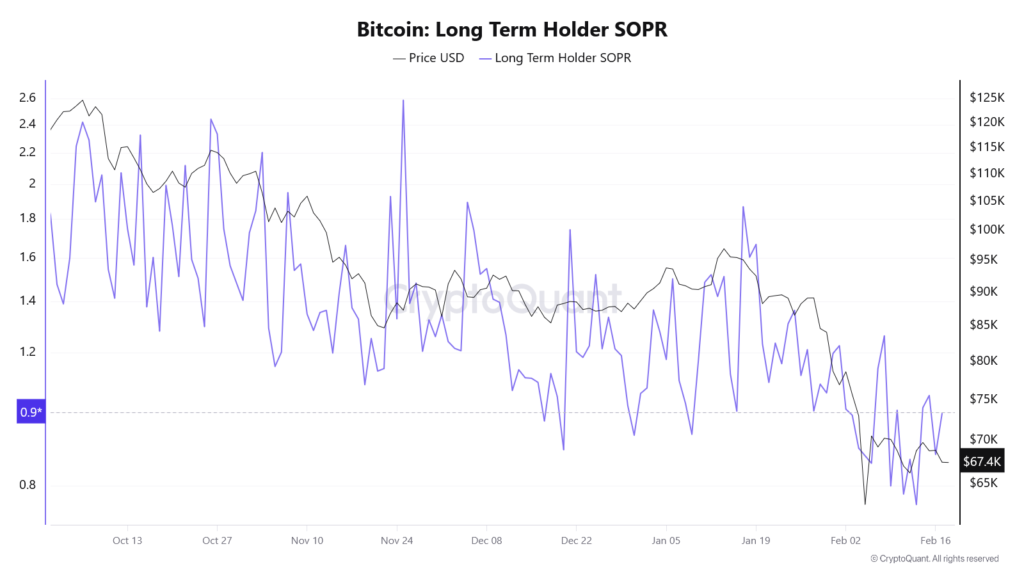
Long-term Bitcoin holders are selling at a loss, according to LTH SOPR (Spent Output Profit Ratio) readings that have slipped below 1. At the same time, exchange inflows from older coins have accelerated. These signals suggest distribution pressure. Still, price continues to trade above the LTH realized price, which historically separates strain from structural failure.

The current environment presents tension. Some long-term holders are reducing exposure. Others remain above cost basis and inactive. The distinction matters.

What the Bitcoin On-Chain Data Is Actually Showing

Recent on-chain data highlights two developments. First, some long-term Bitcoin holders are selling coins at a loss. Second, Bitcoin exchange inflows are rising from older supply bands. These metrics reflect behavior under pressure. However, they do not automatically confirm capitulation.

Long-Term Bitcoin Holders Are Selling at a Loss

The LTH SOPR metric measures whether long-term holders are realizing profits or losses when spending coins. When LTH SOPR drops below 1, it indicates that coins older than 155 days are being sold at a loss.

Current readings show LTH SOPR below that threshold. This confirms that some long-term bitcoin holders are selling at a loss. Historically, this condition appears during drawdowns and late-stage corrections.

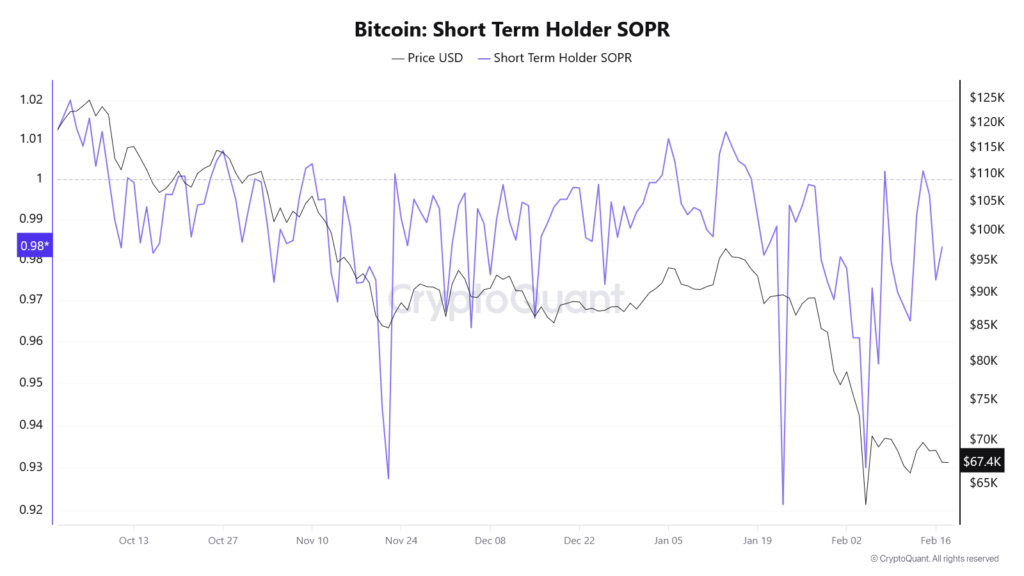
Meanwhile, STH-SOPR has remained below 1 since October 2025, indicating prolonged pressure on recent buyers, which suggests the stress is more persistent among short-term cohorts than among long-term holders.

However, LTH SOPR reflects behavior. It does not measure Bitcoin’s structural support. Short-term stress can coexist with long-term stability.

Periods of weak LTH SOPR have occurred without immediate capitulation. The context around structural levels is therefore essential.

Source: CryptoQuant

CryptoQuant data shows LTH-SOPR dipping below 1 in early February, briefly recovering February 7–8, then stabilizing around 0.98 as of February 18, 2026

CryptoQuant LTH SOPR chart, Oct 2025–Feb 18

STH-SOPR has remained below 1 since October 2025.

CryptoQuant STH SOPR chart, Oct 2025–Feb 18

Bitcoin Exchange Inflows Are Rising

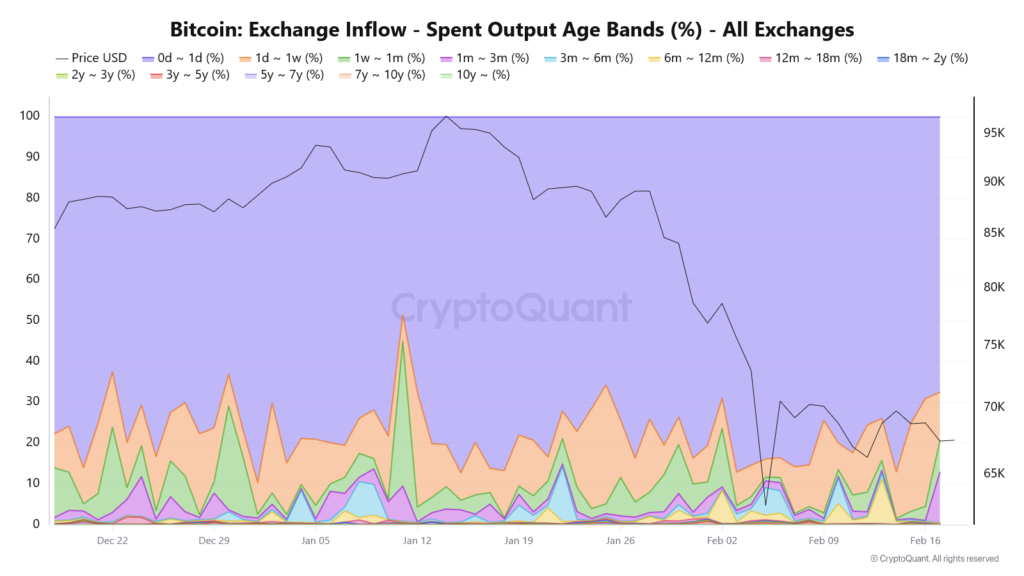
Bitcoin exchange inflows from mid-term holders have increased in recent sessions. Inflows have accelerated specifically from the 3–6-month (light blue) and 6–12-month (yellow) age bands in January through mid-February.

Rising exchange inflows often signal intent to sell or rebalance positions. However, this activity is currently concentrated in recent cycle buyers rather than older multi-cycle supply. Even so, exchange transfers represent positioning. They do not guarantee sustained distribution.

In prior cycles, spikes in Bitcoin exchange inflows preceded volatility, but they did not always coincide with structural breakdowns.

Source: CryptoQuant

The Line That Separates Stress From Capitulation

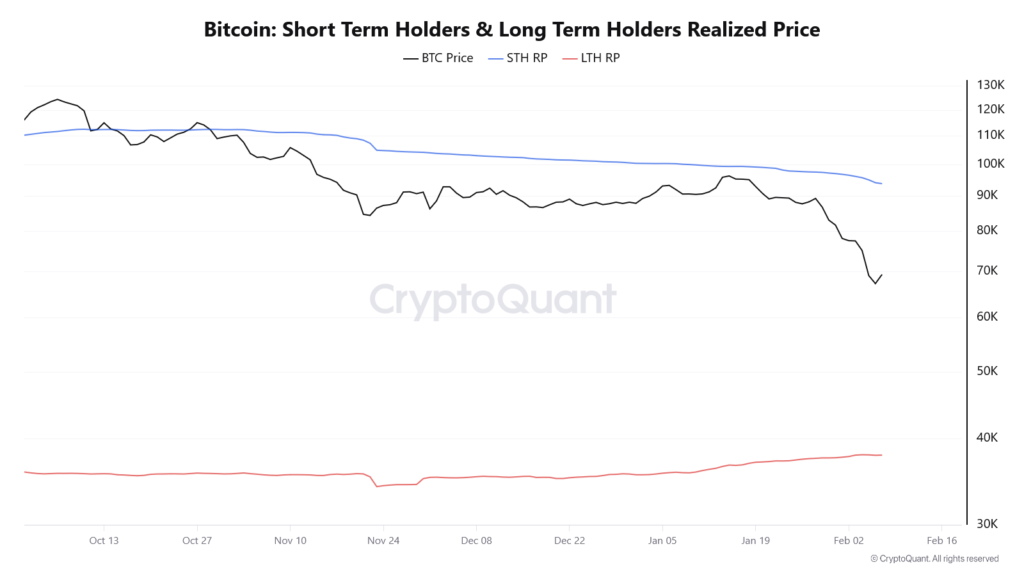
The LTH realized price represents the average acquisition cost of coins held by long-term Bitcoin holders. This level has historically acted as Bitcoin’s structural support during major drawdowns.

Bitcoin trades at approximately $68,000, well above the LTH realized price of roughly $42,000, according to CryptoQuant data. This keeps the cohort in aggregate profit despite recent volatility.

When the market price trades above the LTH realized price, the cohort remains in aggregate profit. When price breaks and holds below that level, broader Bitcoin capitulation risk increases.

In 2018 and 2022, decisive breaks below the LTH realized price marked structural breakdown. Sustained trading under that threshold coincided with prolonged bear markets.

Current on-chain data shows Bitcoin’s price above the LTH realized price. This suggests that long-term holders, as a group, are not underwater on average.

Stress is visible. Structural failure is not yet confirmed. The distinction between temporary weakness and Bitcoin capitulation often rests on this level.

Source: CryptoQuant

Why One On-Chain Level Decides the Next Bitcoin Move

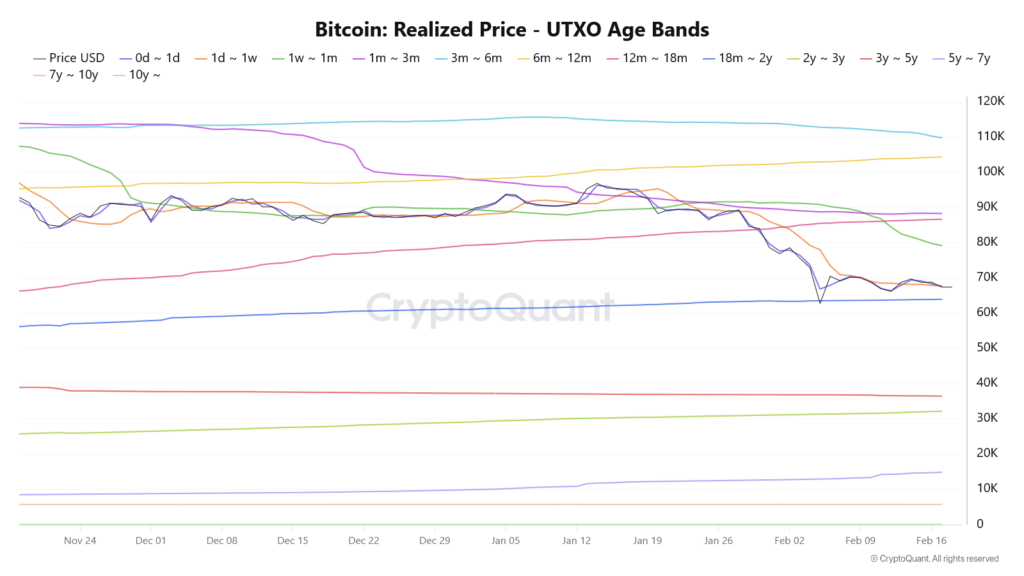
Markets tend to break when the aggregate cost basis fails. The LTH realized price functions as a reference point for structural support.

Source: CryptoQuant

Realized Price by UTXO Age Bands shows that the 3–6-month cohort sits near ~$75,000 and the 6–12-month cohort near ~$85,000, both currently underwater relative to spot. The 18–24-month cohort around ~$55–60,000 would face pressure if BTC declines further. This clarifies which segments are experiencing strain.

If the price remains above the LTH realized price, selling pressure from long-term holders may represent a redistribution rather than a systemic exit. Volatility can persist without a regime shift.

If price decisively loses that level, the probability of Bitcoin capitulation increases. A sustained break would place a large share of long-term Bitcoin holders into unrealized losses.

On-chain data, therefore, centers on a single threshold. The reaction around the LTH realized price can determine whether the market stabilizes or weakens further.

Short-term indicators such as LTH SOPR provide context. Structural levels provide confirmation.

Redistribution or Capitulation?

Long-term holders selling at a loss does not automatically equate to Bitcoin capitulation. Within the cohort, behavior can diverge.

Some long-term holders are under pressure. Others remain inactive and above cost basis. At the same time, parts of the market appear to be increasing exposure during weakness.

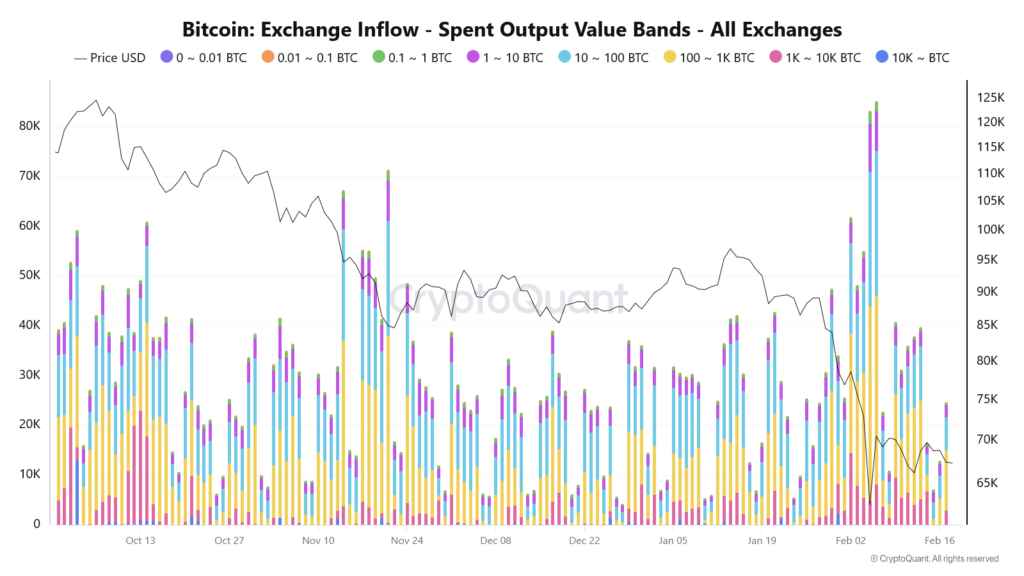
Recent bitcoin on-chain data shows that while mid-term age bands are moving coins to exchanges, balance growth has appeared in other cohorts, implying that supply entering the market is being absorbed rather than cascading lower without bids.

Source: CryptoQuant

Exchange Inflow by Spent Output Value Bands further shows increased activity from mid-tier holders (10–100 BTC and 100–1k BTC) and whales (1k–10k BTC) as prices fell, alongside retail (<10 BTC), suggesting calculated positioning across size cohorts rather than uniform liquidation.

Exchange inflows reflect positioning adjustments. They do not confirm forced liquidation across the entire cohort.

When evaluating on-chain data, the interaction between LTH SOPR and the LTH realized price is critical. Weak LTH SOPR with price above realized cost basis indicates stress. Weak LTH SOPR with price below realized cost basis signals deeper risk.

In the current phase, selling pressure from long-term holders is visible. However, the presence of growing balances in selected cohorts implies that some participants view the drawdown as an opportunity rather than an exit.

At present, the data shows pressure but not confirmed Bitcoin capitulation.

Why This Doesn’t Look Like 2022 — Yet

During 2022, capitulation followed a sustained break below structural cost basis levels. Price remained under the LTH realized price for an extended period. Loss realization intensified across cohorts.

Yes, today, some long-term Bitcoin holders are selling at a loss, and exchange inflows have increased. However, Bitcoin’s structural support at the LTH realized price remains intact.

The absence of a decisive structural breakdown differentiates the current phase from prior capitulation events. This does not eliminate downside risk, but it clarifies the threshold that defines regime change.

Conclusion: Stress Is Visible — Collapse Is Not Confirmed

Long-term Bitcoin holders are under pressure. LTH SOPR shows that some are selling at a loss. Bitcoin exchange inflows indicate heightened positioning activity.

At the same time, on-chain data points to selective balance expansion within other cohorts. This suggests that part of the market is absorbing supply during weakness.

Yet the LTH realized price continues to act as Bitcoin’s structural support. As long as the price remains above that level, the evidence points to stress rather than confirmed capitulation.

Bitcoin on-chain data provides mixed signals. Behavioral metrics show strain. Structural metrics remain intact.

The distinction between stress and collapse rests on one level. For long-term Bitcoin holders, that level is the LTH realized price.

- Advertisement -

FEATURED