Danske Bank ends crypto ban after eight years, allowing clients to access Bitcoin and Ethereum exchange-traded products through its brokerage platform.
The move follows growth in Denmark crypto adoption and reflects clearer EU-aligned regulation, with access limited to listed ETPs issued by BlackRock and WisdomTree.
Danske Bank has lifted its crypto ban, in place since 2018, and will now allow clients to access exchange-traded products linked to Bitcoin and Ethereum through its brokerage platform.
Danske Bank reports more than 2.2 million personal customers, giving the policy change meaningful domestic reach. Crypto-linked ETP exposure is now available inside a mainstream Danish retail banking channel.
Which ETPs Are Being Offered
Danske Bank will make three crypto-linked ETPs available to self-directed clients. The products are issued by BlackRock and WisdomTree and provide exposure to Bitcoin and Ethereum through listed securities.
Investors can access a BitcoinETP through DanskeBank’s brokerage platform, with Ethereum-linked ETPs offered under the same framework, subject to product availability and investor checks.
The rollout is execution-only, and clients must complete appropriateness assessments before trading the instruments.
Denmark Crypto Adoption Has Expanded Since 2018
The policy change comes amid steadily growing crypto adoption in Denmark. A 2024 survey by K33 Research and EY estimated that roughly 300,000 Danish adults (about 7% of the population) hold digital assets.
That level of crypto ownership contrasts with the environment in 2018, when retail participation in Denmark was more limited and institutional risk concerns were more pronounced.
Why the 2018 Restriction Was Introduced
When the restriction was first implemented, the regulatory and market landscape differed significantly from today. Price volatility was extreme, and product governance standards for crypto-linked instruments were still developing.
Denmark’s crypto regulation in 2018 lacked the clarity that now governs listed exchange-traded securities tied to digital assets. In that context, limiting access through internal brokerage systems reflected a conservative compliance approach.
Danske Bank’s crypto ban restricted clients from purchasing certain crypto-related instruments through the bank’s trading platforms, even as independent exchanges operated outside traditional banking infrastructure.
What Has Changed
Since 2018, the regulatory environment has evolved at the European level, with the introduction of the EU’s Markets in Crypto-Assets framework. As EU rules developed, Denmark’s supervisory landscape adapted within that structure.
For Danish banks, this has meant clearer product governance standards and defined investor protection requirements for listed instruments. Crypto-linked ETPs tracking Bitcoin and Ethereum now operate within established securities regulation, rather than in a regulatory grey zone.
In that context, Danske Bank reassessed the market conditions under a more defined rulebook. It concluded with the end of its crypto ban, albeit its approach remains cautious. Access is limited to exchange-traded products, rather than direct cryptocurrency trading.
Danish retail investors can now explore crypto within a familiar banking environment rather than requiring transfers to external platforms.
The products remain structured as regulated exchange-traded securities. The policy update integrates digital asset exposure into Denmark’s largest retail bank while maintaining the existing regulatory model.
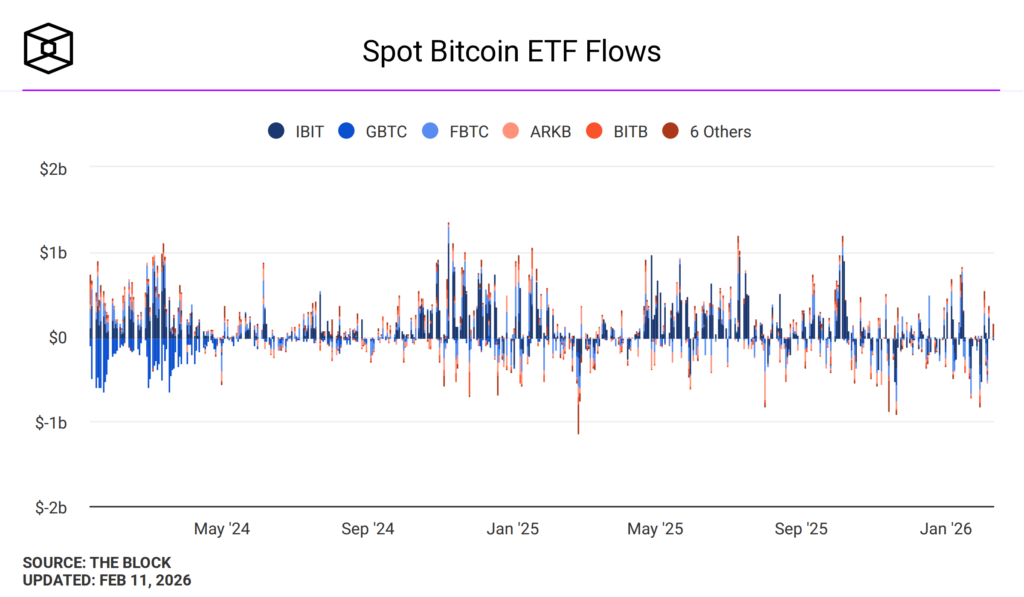
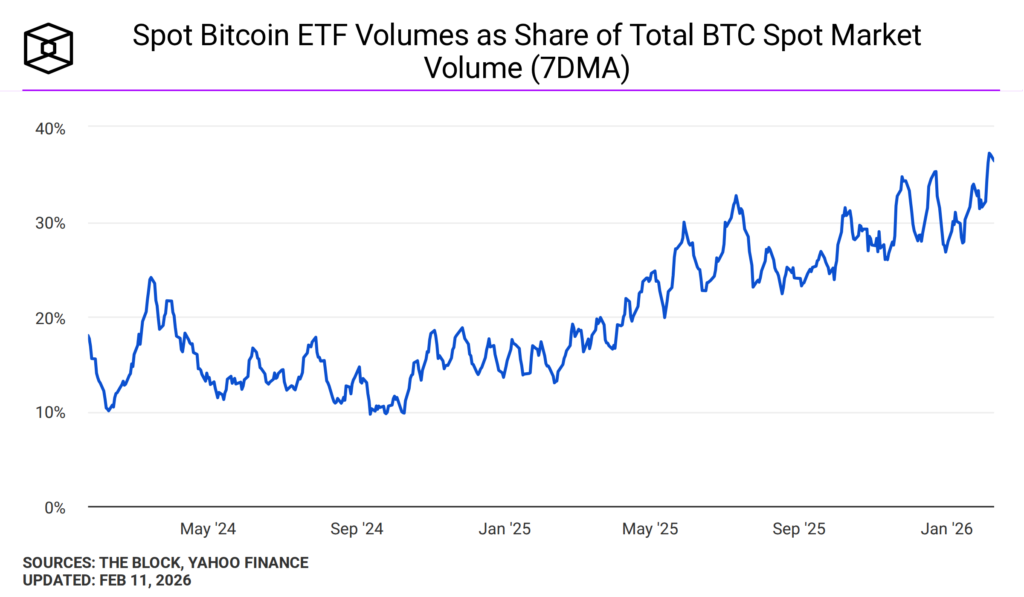
Bitcoin ETF flows remain closely linked to price momentum, suggesting that much of the activity in spot ETFs is still tactical rather than driven by long-term strategic allocation.
The institutional wrapper is real, but allocation sizes, governance constraints, and short-horizon positioning mean the “institutional era” still behaves more like Retail 2.0 than a stable pension-driven market.
The market’s expectation followed naturally. If ETFs could remove operational friction, meaning custody, key management, and counterparty risk, then the marginal buyer should begin to resemble traditional ETF allocators. That would mean slower rebalancing, longer holding periods, and more resilience during volatility. In that world, Bitcoin ETF flows would function more like a portfolio base, and less like a short-term sentiment gauge.
Recent months have tested that assumption. Weakness in price has coincided with sharp outflows. Inflows have tended to accelerate during rallies, while redemptions intensified as momentum faded. The pattern of these Bitcoin ETF inflows and outflows increasingly mirrors price momentum rather than long-horizon allocation behavior. That raises a clear question: what if the ETF era represents real infrastructure progress, but investor behavior remains early-cycle and highly tactical?
Understanding the ETF Promise
The ETF story was always about friction.
For years, many professional investors had views on Bitcoin, but no clean implementation path within standard policy constraints. Operational complexity mattered. So did exchange exposure, custody frameworks, and approval processes that can take quarters, not days.
Spot ETFs changed that. A portfolio manager can buy exposure through a standard broker. An adviser can allocate without building a bespoke custody stack. Committees can approve a familiar instrument and measure it within established reporting systems.
That shift made the “institutional access” narrative powerful. The institutional ETF wrapper made Bitcoin easier to own within traditional portfolios. The implied next step was that ownership behavior would begin to resemble long-term portfolio allocation rather than reflexive risk-on/risk-off positioning.
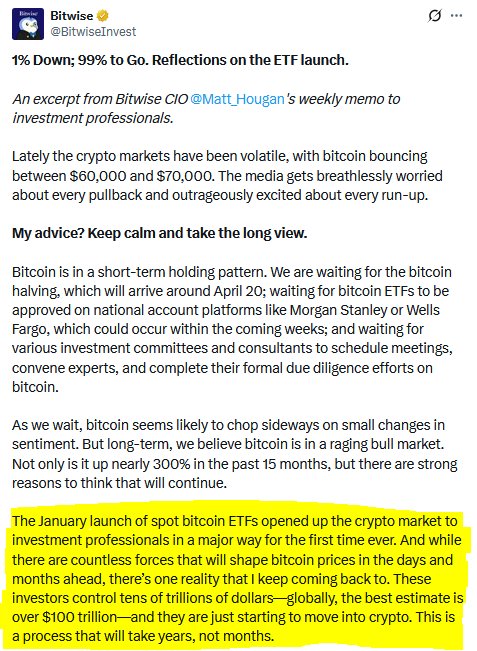
Implicit in that narrative was the now-familiar $100 trillion figure, the approximate size of global institutional assets. No one expected all of it to flow into crypto. The point was addressable capital. Even a low single-digit allocation across pensions, endowments, sovereign wealth funds, and insurers would imply trillions of dollars gradually rotating into digital assets over time.
The assumption was not a flood, but a slow, sticky seep. Something closer to SPY or GLD than a high-beta tech stock.
@BitwiseInvest
What Flows Are Actually Showing
If ETFs were dominated by strategic allocators, the correlation between Bitcoin ETF flows and price would gradually weaken rather than remain statistically significant. There would still be profit-taking and rebalancing, but not repeated “in on strength, out on weakness” patterns.
Empirically, research points to a consistent link between ETF demand and Bitcoin price, though the interpretation depends on horizon and regime. FalconX‘s October 2024 analysis found a statistically significant yet modest relationship between changes in spot ETF flows and Bitcoin price moves. In one specification, the correlation was around 0.30, with a rolling 60-day range spanning roughly 0.10 to just above 0.50 over a ten-month window, an explicit reminder that the relationship is variable rather than stable.
A separate 2025 Ledger study analyzed daily data from January 2024 through May 2025 and identified a strong positive long-run association between Bitcoin spot ETF net assets and Bitcoin price, with cointegration confirmed at the 10% level.
Taken together, these findings do not suggest that flows determine price. However, they show that Bitcoin ETF flows are embedded in price formation, particularly when marginal positioning is short-horizon and reflexive.
Outflow episodes reinforce the point. On January 21, 2026, U.S. spot Bitcoin ETFs recorded about $708 million of net outflows in a single day, and a three-day streak totaled roughly $1.59 billion. Amberdata’s market note for the Jan 20–26 window similarly described heavy weekly outflows.
These are not the slow reallocations typical of a predominantly strategic allocator base. They resemble rapid risk resizing. Exactly the type of dynamic that helps explain why bitcoin ETF outflows can intensify during a market crash, amplifying volatility through redemptions and forced selling pressure.
A large part of the confusion stems from one word: “institutional.”
An ETF is an institutional-grade wrapper. That does not mean the typical holder is a pension fund. ETFs are also the easiest vehicle for self-directed investors and advisers managing retail wealth. Anyone with access to a brokerage account, trading app, or neo-broker platform can now buy or sell Bitcoin exposure in seconds.
Before spot ETFs, participation required navigating exchanges, custody solutions, and private keys. Those frictions acted as a filter. Investors who were curious but uncomfortable with operational complexity often stayed on the sidelines. The ETF structure removed that barrier.
That shift matters. In mature markets, many retail investors treat broad equity or bond ETFs as long-term holdings. Crypto is different. For a large segment of market participants, it remains an opportunistic or high-beta trade rather than a strategic allocation. The same investor who passively holds an S&P 500 ETF for years may actively trade Bitcoin exposure when it is available in the same account.
In other words, the institutional wrapper widened access faster than it reshaped behavior. Some investors who previously avoided direct custody now express their crypto view through ETFs, not because their time horizon changed, but because the implementation became easier.
The more useful distinction, then, is not simply retail versus institutional. It is strategic allocator versus tactical participant. If a large share of the buyer base is tactical, whether individual traders, wealth-platform clients, or hedge funds, ETF activity will amplify prevailing trends. If the base shifts toward allocators with explicit policy mandates, flows will look more stable and rebalancing-driven.
Early in a new product cycle, it is common for tactical capital to dominate marginal activity.
ETFs rely on creation and redemption mechanisms that link share flows to underlying exposure.
In calm markets, authorized participants create and redeem shares efficiently, helping the ETF trade near net asset value. In volatile markets, the same mechanism can transmit urgency into underlying buying or selling. Heavy redemptions can translate into net selling pressure; heavy creations can accelerate buying.
This dynamic is not unique to crypto. But Bitcoin’s volatility profile and reflexive narrative cycles can make these feedback loops more visible.
One indirect proxy for this dynamic is the implied ETF turnover rate: when turnover is high, short-horizon positioning tends to dominate price discovery.
The wrapper is not a lockbox. It is a highly liquid doorway that reflects the behavior of whoever is walking through it.
Myth vs. Fact: The Institutional ETF Era
Myth 1: ETFs mean institutions are finally all-in on crypto. Fact: Early volume has been driven heavily by retail investors, wealth platforms, tactical hedge funds, and systematic desks, not giant pension mandates making strategic allocations.
Myth 2: ETF capital is sticky and long-term. Fact: The structure of Bitcoin ETF flows still reflects pro-cyclical positioning more than disciplined rebalancing.
Myth 3: A regulated wrapper lowers overall risk. Fact: Product risk may be lower (custody, compliance, operational friction), but market and behavioral risks remain unchanged. Easier trading can amplify volatility.
Myth 4: Price crashes prove institutional adoption has failed. Fact: Infrastructure adoption is real. But the persistent myth around institutional adoption in the Bitcoin ETF market shows how easily structure can be mistaken for behavioral maturity.
Why Institutions Still Behave Like Tourists
Even among professional investors, crypto allocations are often measured in basis points rather than percentages. A 50-basis-point sleeve is easy to add and as easy to cut.
Governance structures matter. New asset classes face tighter scrutiny and lower tolerance for drawdowns. A pension fund can justify equity volatility. It is far harder to justify a 40% drawdown in a recently approved digital asset allocation.
Political and reputational constraints also play a role, particularly for public pensions and insurers. Crypto is still frequently categorized as opportunistic or speculative exposure, instead of a core strategic allocation alongside equities, bonds, or real assets.
When allocations are small, oversight is intense, and conviction is developing, behavior tends to resemble tourism.
What Real Institutionalization Would Look Like
The shift from tactical ETF trading to strategic allocation will be observable.
First, the correlation between Bitcoin ETF flows and BTC price should weaken over time as a larger share of assets sits in long-horizon portfolios.
Second, markets should show more evidence of rebalancing into weakness rather than exiting during volatility.
Third, ETF ownership should broaden toward long-term mandates, transforming how Bitcoin ETF investors behave across cycles.
Finally, the broader institutional crypto stack should deepen: tokenized cash instruments, tokenized treasuries, and regulated stablecoin infrastructure.
The clearest signal of maturation will not be ETF approval headlines. It will be durable allocation policy, observable rebalancing behavior, and a measurable decline in flow-price sensitivity.
Closing Thoughts
The original ETF optimism was not wrong, but it may have been early. The infrastructure thesis proved correct because access scaled rapidly. However, the narrative was too optimistic in assuming that product design alone would reshape institutional behavior.
Hougan’s framework, a $100 trillion investor base moving over years, remains directionally intact. But the current phase shows that structure evolves faster than psychology.
We have built the on-ramp. The next phase will determine whether Bitcoin ETF flows begin to resemble strategic capital or remain a tactical trade.
Bithumb mistakenly credited roughly 620K in Bitcoin to user balances on its internal ledger due to an accounting error.
South Korean regulators are investigating the incident.
Although the balances existed only within Bithumb’s systems, some users briefly withdrew real Bitcoin before controls intervened, leading the exchange to seek the return of the funds.
South Korea’s regulators have launched an investigation into Bithumb after a configuration error led to the erroneous crediting of Bitcoin balances worth more than $40 billion. While the incident did not involve a hack or permanent loss of customer funds, authorities say it exposes serious weaknesses in exchange-level risk controls and internal accounting systems.
How an internal system failure created false Bitcoin balances
The problem originated from what Bithumb described as a configuration failure within its accounting infrastructure. In effect, an internal system error caused Bitcoin balances to be recorded inaccurately on the exchange’s internal ledger.
In market terms, the erroneous balances were valued at more than $40 billion. Measured in Bitcoin, Bithumb’s error amounted to roughly 620,000 BTC, which would represent just over 3% of the circulating supply.
Now, those Bitcoins did not exist as real holdings. Neither the exchange nor any of its users ever held them. The amounts existed only as internal ledger entries that appeared valid inside Bithumb’s systems before reconciliation checks flagged the anomaly.
When the accounting issue became a withdrawal risk
The situation worsened when the internal accounting issue translated into a withdrawal problem. For a short period, some of the incorrect balances were treated as eligible for withdrawal.
During that window, a limited number of users were able to withdraw real Bitcoin from Bithumb-controlled wallets. Once broadcast to the blockchain, those transfers became final and irreversible.
Bithumb halted withdrawals and froze affected accounts shortly after identifying the issue.
Why Bithumb asked users to return mistakenly transferred Bitcoin
Because real Bitcoin had already left the exchange, Bithumb contacted affected users and asked them to return the assets. The exchange told users the transfers occurred due to a system failure and without legal entitlement.
Regulators later confirmed that most of the Bitcoin was recovered after users returned the funds. The recovery relied on cooperation, as blockchain transactions cannot be undone.
This recovery process became a central element of the Bithumb investigation, even though the exchange did not report any permanent customer losses.
South Korea launches investigation into Bithumb
South Korea’s financial authorities opened a formal investigation into the incident, treating it as an operational breakdown, given that there were no signs of market abuse. Officials said the review forms part of a broader investigation into whether South Korea’s crypto exchanges maintain sufficient internal safeguards.
The inquiry is examining accounting controls, withdrawal authorization systems, and escalation procedures to understand how an internal error progressed to an actual external settlement. Regulators said the absence of permanent customer losses did not reduce the seriousness of the case, warning that similar control failures under different conditions could result in far more significant losses.
What comes next for Bithumb and crypto regulation in South Korea
The investigation remains ongoing, with regulators assessing whether additional safeguards or compliance measures are required. Bithumb has said it is reviewing internal processes and strengthening controls following the incident.
While no permanent customer losses were reported, regulators have pointed to the case as an example of how internal system failures at centralized exchanges can result in real asset movements. As exchanges grow larger and more complex, the episode will surely influence future discussions around crypto regulation in South Korea, particularly standards for operational resilience at systemically important platforms.
A single Bitcoin transaction sent roughly 2.5 BTC, worth about $180,000, to the Bitcoin genesis address. And, once again, it was enough to ignite widespread speculation. Because the wallet address is historically attributed to Satoshi Nakamoto, the transfer quickly circulated as a possible signal of renewed Satoshi activity, even though it provides no evidence of any action or involvement by him.
A familiar trigger for outsized reaction
The transaction itself was simple: somebody sent Bitcoin to the genesis address linked to the network’s first block. The reaction was not. Within hours, screenshots of the transfer spread across crypto forums, social platforms, and market commentary, reviving long-standing narratives about Satoshi’s return. As with similar past transfers, attention focused on the symbolic destination rather than any accompanying on-chain signal.
The Bitcoin genesis address originates from the network’s Bitcoin genesis block, mined in January 2009. Unlike standard coinbase outputs, the genesis block’s reward was never added to Bitcoin’s spendable UTXO set. No private key can authorize a spend from that output under Bitcoin’s consensus rules. Hence, any Bitcoin sent to the genesis address becomes permanently locked. It cannot be recovered or moved, regardless of the sender’s intent. In practical terms, the address functions as a Bitcoin unspendable address.
When symbolism outweighs signal
Despite the reaction it generated, the transaction does not indicate that Satoshi Nakamoto was moving Bitcoin to this wallet. It did not involve early mined coins, and there was no message signing, private key use, or wallet activity beyond the inbound transfer. Under current consensus rules, Bitcoin genesis coins cannot be spent, and the transaction does not alter that limitation. Technically, the outcome is indistinguishable from a voluntary burn.
Transfers involving the genesis address repeatedly draw attention because they intersect with Bitcoin’s origin story. A Bitcoin symbolic transaction tied to that address reliably produces speculation, even when the mechanics are well understood. The episode does not affect supply, markets, or governance. It does illustrate, however, how narratives around a possible Satoshi Nakamoto return continue to amplify otherwise routine on-chain events.
China crypto crackdown headlines do not reflect a new policy shift. Regulators are tightening and clarifying how long-standing crypto restrictions apply to stablecoins, offshore issuance, and RWA tokenization.
The latest guidance removes gray areas rather than introducing fresh bans, enforcing the existing framework that China has steadily refined since 2021.
Headlines warning of a renewed crypto crackdown in China have resurfaced once again, prompting questions about whether Beijing is escalating its long-standing opposition to digital assets. Mentions of stablecoins, real-world asset tokenization, and offshore issuance have been widely interpreted as signs of a fresh policy offensive.
That reading misses important nuance. China has not adopted a new posture on crypto. Instead, regulators are extending and formalizing how long-standing restrictions apply to newer structures such as stablecoins, offshore issuance, and real-world asset tokenization. The direction of policy remains unchanged. What has changed is the level of precision and explicit scope.
The illusion of a new crackdown
The idea that China is suddenly tightening the screws on crypto is misleading. The core of China’s crypto ban has been in place since 2021, when authorities prohibited trading, exchange services, and mining as illegal financial activity. Additional enforcement measures reinforced that ban in 2025.
What keeps reviving the crackdown narrative is timing. Each time regulators restate or clarify existing restrictions, headlines frame the move as a new escalation. In reality, the policy perimeter has been stable for years. The latest announcements do not change the direction of that perimeter, but extend it to explicitly cover structures that some market participants had treated as gray areas.
What actually changed in China’s crypto policy
The February guidance simply represents an evolution in China’s cryptocurrency regulation. It tightens and clarifies existing rules without changing the policy direction. Regulators now explicitly name activities that they previously addressed only indirectly through broader language on virtual currencies and illegal financial conduct.
This matters because enforcement follows clarity. By spelling out how existing prohibitions apply to stablecoins, tokenized assets, and offshore issuance linked to onshore interests, China’s crypto regulation becomes easier to apply consistently across institutions, intermediaries, and cross-border structures.
Why China finally named stablecoins
One of the most prominent clarifications concerns stablecoins. The updated guidance makes clear that certain stablecoin activities fall under prohibited financial conduct, reinforcing the view that stablecoins are virtual currencies and, therefore, subject to China’s broad ban on digital currencies.
In practice, this formalizes a broad ban on unapproved RMB-linked stablecoins and issuance connected to Chinese entities, rather than every conceivable stablecoin use outside China’s jurisdiction. Understanding why China bans stablecoins requires looking beyond crypto markets. Stablecoins can function as settlement instruments and stores of value. When issued offshore but tied to the renminbi or used in RMB-denominated activity, they blur the line between private tokens and sovereign money, raising concerns about monetary sovereignty and capital controls that regulators have long sought to avoid.
Why RWA tokenization was brought clearly inside the red line
The same logic applies to RWA tokenization. Tokenizing claims on real-world assets creates transferable economic rights that can circulate outside China’s regulated ownership, disclosure, and approval frameworks.
Regulators have now explicitly brought RWA tokenization within the scope of prohibited activities when conducted without authorization. Even when promoters frame tokenization as neutral infrastructure, the effect is often the same: offshore investors gain exposure to onshore assets, price discovery occurs beyond domestic oversight, and dispute resolution shifts outside Chinese jurisdiction. Under existing rules, this resembles unlicensed issuance of financial claims rather than a fundamentally new category of activity.
Not anti-blockchain, just anti-unapproved tokenization
It is important to separate technology from authorization. China has repeatedly supported blockchain development within licensed, state-supervised systems, including permissioned networks and projects linked to the digital yuan.
This distinction sits at the heart of China’s crypto regulation. Blockchain infrastructure deployed inside approved financial or administrative frameworks is acceptable. By contrast, unapproved issuance of tradable tokens that function as financial claims remains illegal financial activity. The recent guidance reinforces this distinction rather than creating it, clarifying where blockchain experimentation ends and prohibited crypto activity begins.
What China’s crypto crackdown actually means going forward
Understanding what this current crypto crackdown means requires looking at what remains. There is little left to restrict in economic terms because China already prohibited trading, exchanges, mining, and most forms of financial intermediation.
Going forward, regulatory action is focused on tightening enforcement and clarifying how existing crypto rules apply in practice. This most recent guidance makes explicit that areas such as stablecoins, offshore issuance, and tokenization fall within the scope of long-standing restrictions. It closes gaps that had persisted as market structures evolved.
China’s latest policy signals are not about escalation for its own sake. They are about finality. By formally extending existing bans to cover stablecoins and tokenization more explicitly, regulators have pushed crypto policy to a point of saturation, where ambiguity no longer serves a regulatory purpose. The framework is now fully defined. What remains is enforcement, not expansion — and silence should no longer be mistaken for tolerance.
Readers’ frequently asked questions
Is China cracking down on crypto again?
Not in the sense of a new policy turn. The recent guidance tightened and clarified how long-standing restrictions apply to newer structures such as stablecoins, offshore issuance, and tokenization of real-world assets. It reduced ambiguity around enforcement.
Does China’s crypto policy apply to Chinese citizens holding crypto assets overseas?
Mainland rules primarily target crypto-related activities and services connected to China, rather than simple ownership. In practice, enforcement often intersects with foreign-exchange and capital-control rules if funds are moved offshore through non-compliant channels to purchase or trade crypto.
Do China’s latest rules affect crypto trading and asset tokenization activity in Hong Kong?
Hong Kong has a separate regulatory system, and regulators there govern crypto activity and licensing rules. Mainland policy does not automatically apply in Hong Kong. However, it can influence cross-border business models that involve mainland entities or onshore-linked assets.
What is the difference between the renminbi and the yuan?
The renminbi (RMB) is the official name of China’s currency, while the yuan is the unit of account. Prices and exchange rates are typically quoted in yuan, while policy and regulatory language often uses “renminbi” when referring to the currency system and monetary policy.
What Is In It For You? Action items you might want to consider
Audit exposure to China-linked stablecoins and tokenized assets
If you hold or service crypto products, review whether any stablecoin, tokenized asset, or structured product relies on mainland-linked entities, RMB-linked settlement narratives, or onshore Chinese asset exposure that regulators now explicitly treat as prohibited without authorization.
Treat offshore issuance tied to onshore assets as a compliance risk
If a tokenized product is issued offshore but references onshore Chinese assets or counterparties, treat it as higher-risk in due diligence. Do not assume “offshore” removes China policy exposure when the underlying economic link remains connected to the mainland.
Separate China policy tightening from global crypto market assumptions
When assessing market impact, separate China-specific enforcement and scope clarification from global crypto fundamentals. For non-Chinese investors and builders, the practical takeaway is policy risk around China-linked structures, not a change in worldwide adoption or infrastructure.