A crypto supply chain attack used malicious software packages linked to the dYdX protocol to drain user wallets without exploiting the protocol or its smart contracts.
Attackers targeted off-chain tooling and dependencies, showing how wallet losses increasingly stem from compromised software rather than on-chain flaws.
Malicious software packages posing as tools linked to dYdX, a decentralized platform for crypto perpetual trading, were recently used to drain user wallets, without exploiting any vulnerability in the protocol itself. The incident reflects a broader pattern. Supply chain attacks are increasingly responsible for user losses across the crypto industry.
Rather than targeting smart contracts, attackers compromised the tools used to access them. This shift has made off-chain crypto attacks a primary risk vector, even as on-chain security improves.
What actually happened
Attackers published malicious npm packages and malicious PyPI packages, presenting them as legitimate tools connected to dYdX. They hosted the packages on public repositories that developers routinely use to download prebuilt software components, much like marketplaces for reusable code.
Once installed, the software acted as wallet draining malware. It quietly collected wallet credentials and enabled unauthorized transfers, often without triggering any visible errors or alerts. Any wallet that interacted with the compromised code had to be considered exposed.
The packages were eventually removed, but anyone who installed them before the removal was already at risk.
This wasn’t a protocol failure
The incident illustrates the difference between on-chain and off-chain crypto attacks. The dYdX protocol continued to operate normally, and the attack did not involve any smart contract vulnerability.
Instead, the compromise occurred entirely in the surrounding software layer. Off-chain crypto attacks exploit trust in developer tools and dependencies, areas that protocol audits do not cover. Hence, protocol security alone is no longer sufficient to prevent losses.
The shift from on-chain exploits to off-chain attacks
As smart contract security has improved, direct on-chain exploits have become more expensive and less reliable. So, attackers now focus on softer targets outside the protocol boundary and move the crypto attacks off-chain.
Dependency poisoning and fake tooling allow attackers to bypass hardened contracts and reach private keys directly, without engaging with blockchain defenses at all.
Why crypto is especially vulnerable to supply-chain attacks
Crypto’s software supply chain depends heavily on open-source packages and rapid iteration. Dependencies are often pulled from public repositories with limited verification.
These conditions make developer dependency attacks particularly effective because a single compromised package can expose private keys and trigger immediate losses.
To understand how these crypto supply chain attacks work, one must first recognize that the most fragile components often sit outside the blockchain itself.
What this means for users and developers
The incident underscores how wallet security in crypto now extends beyond phishing scams or flawed smart contracts. Increasingly, what puts funds at risk comes down to whether a user can actually trust the third-party software relied on.
For developers, developer dependency attacks turn routine choices into real risk decisions. Pulling a package, trusting an update, or skipping verification can now carry direct financial consequences.
The dYdX-related package incident helps explain why wallets get drained without smart contract hacks, even when protocols operate as intended. The losses did not stem from a failure of blockchain design, but from assumptions made outside it.
Seen in that light, a supply chain attack is less an anomaly than a byproduct of how crypto software is built and distributed today. Protocol security matures, so attackers increasingly exploit the trust placed in tooling, dependencies, and update paths sitting off-chain.
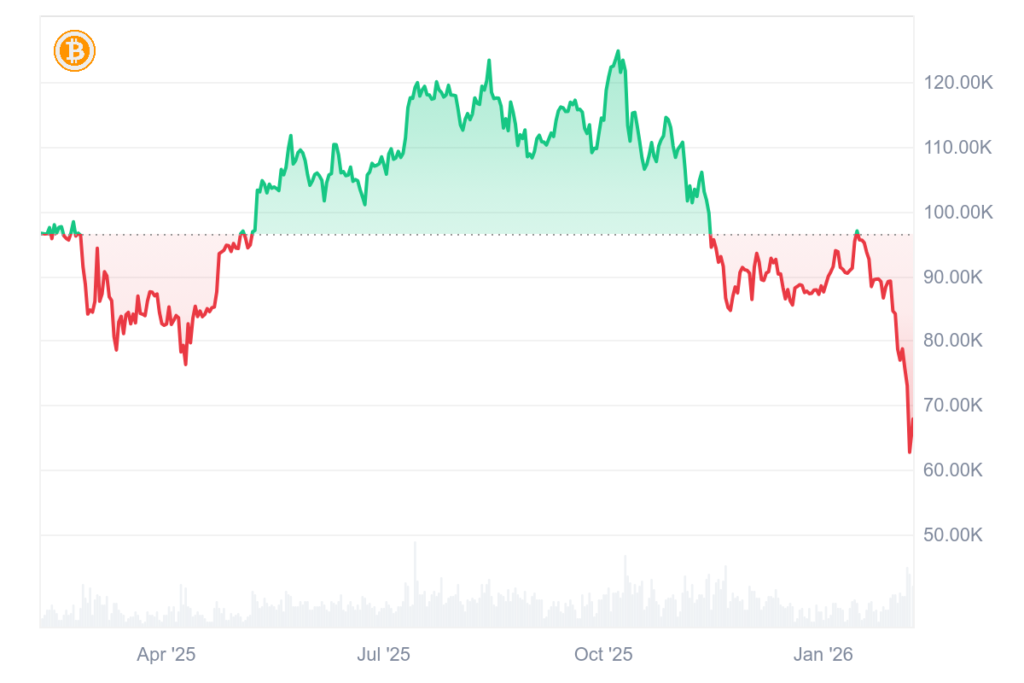
The sharp decline that began with the October 2025 market shock unsettled Bitcoin investors. At the time, many analysts projected a rapid recovery and a return to new highs before year-end. Those expectations did not materialize.
Instead, the downturn extended. By early February, Bitcoin had failed to stabilize, and prices continued to weaken. What initially appeared to be a sharp but temporary correction has turned into a prolonged period of uncertainty. Confidence has eroded not because of a single event, but because recovery narratives repeatedly failed to hold.
This shift matters because Bitcoin adoption is not only about access or awareness. It is also shaped by expectations. When widely promoted timelines break down, and weakness persists across months, uncertainty grows around Bitcoin’s future and its role in portfolios. The result is not panic, but sustained hesitation.
That hesitation explains why broader questions are resurfacing. Investors are no longer focused solely on near-term price targets. They are reassessing what Bitcoin represents after the crash and whether its current role remains sustainable under prolonged pressure.
Why collapse narratives resonate now
Extended drawdowns change how markets process risk. When optimism fades, narratives that once felt extreme gain attention. Questions about Bitcoin survival tend to emerge in these moments, even without new technical failures.
This dynamic is not unique to digital assets. Markets often reassess fundamentals when price action contradicts expectations. In Bitcoin’s case, the reassessment is sharper because speculation has played an outsized role in prior cycles.
As leverage unwinds and activity slows, the question shifts from short-term recovery to continuity. Can Bitcoin survive prolonged disappointment without relying on renewed speculative momentum?
Source: CoinMarketCap
Jacob King’s theory as a stress test, not a forecast
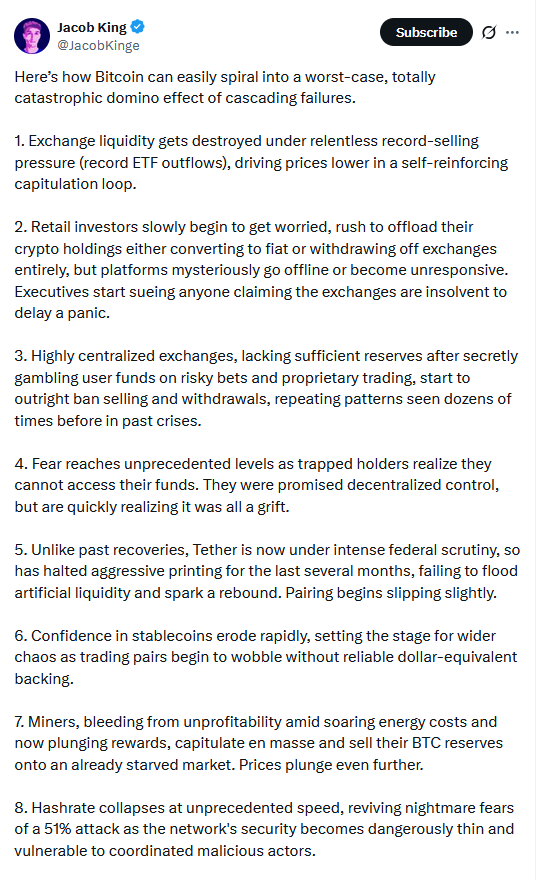
One framework that has gained attention comes from Jacob King, CEO of SwanDesk and self-proclaimed crypto contrarion. He outlines a gradual failure scenario rooted in declining conviction rather than a single shock. His argument does not depend on protocol failure or external bans. It depends on participation.
In this view, Bitcoin’s future is shaped by behavior. If fewer participants are willing to hold, secure, and integrate the asset, pressure compounds over time. The value of this framework is not its predictive certainty. It functions as a stress test for Bitcoin survival under unfavorable conditions.
Importantly, the scenario highlights dependency rather than inevitability. It describes how erosion could occur, not that it must occur.
Bitcoin was introduced as a peer-to-peer system for electronic cash. In that vision, adoption implied everyday economic use without intermediaries. In practice, that outcome did not take hold.
The constraint was not only technical. Bitcoin peer-to-peer payments remained possible, but they never became the dominant way value was exchanged in daily life. One reason is that Bitcoin did not become a unit of account.
Prices continued to be expressed in fiat terms. Even when transactions settled in BTC, negotiation and comparison still happened in national currencies. A private sale, such as a car transaction between individuals, is typically priced in dollars or euros and converted at the moment of settlement. Hence, Bitcoin functions as a payment rail rather than a pricing standard.
Because we never measured value directly in BTC, Bitcoin struggled to displace existing monetary habits. This helps explain why Bitcoin is not used as money in everyday commerce despite global awareness and accessible infrastructure. Over time, Bitcoin became layered on top of existing pricing systems rather than replacing them.
Bitcoin didn’t need to be money to survive
Despite this limitation, Bitcoin continued to exist and grow. That outcome suggests that Bitcoin survival did not depend on fulfilling every traditional function of money.
Bitcoin did not become a primary unit of account, nor did it replace fiat in routine transactions. Instead, it increasingly functioned as a store of value. Participants treated it as an asset to hold rather than a currency to spend, and supporting infrastructure developed around custody, security, and settlement.
Bitcoin speculation reinforced this shift. Rising prices encouraged holding behavior and reduced transactional use. Over time, persistence became tied to asset credibility rather than payment utility.
This evolution does not imply failure. Some systems remain relevant without serving everyday retail functions. In Bitcoin’s case, survival depended less on becoming money and more on remaining meaningful as an asset within a broader financial system.
The real dependency: belief expressed through action
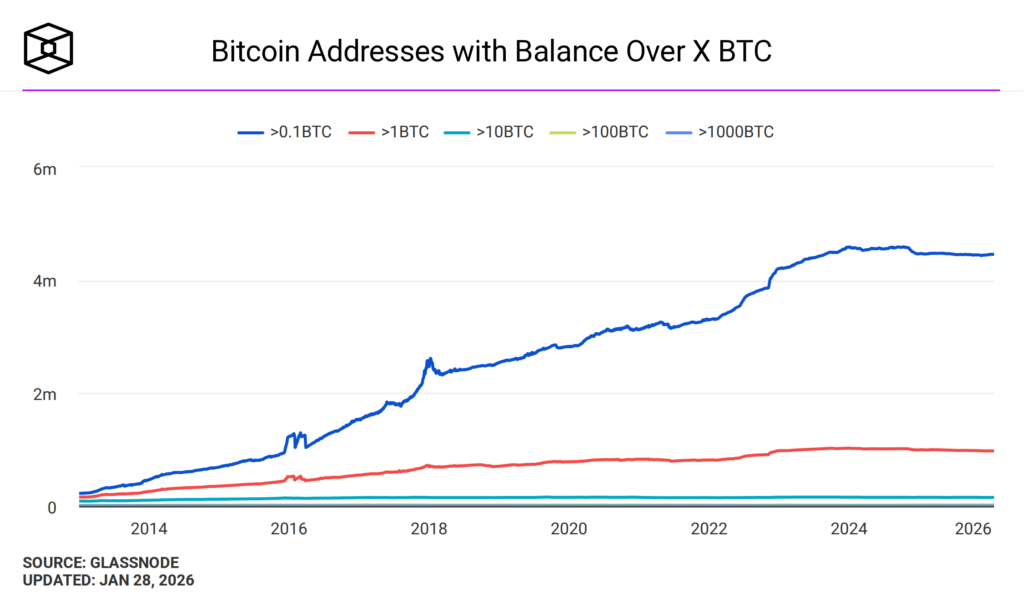
Today, Bitcoin belief is expressed through concrete actions. These include holding through volatility, maintaining mining operations, providing liquidity, and integrating Bitcoin into financial systems.
In this context, Bitcoin adoption reflects coordination rather than usage. The question of what is Bitcoin adoption becomes a question of participation thresholds. How many actors are willing to continue engaging with the system under less favorable conditions?
Belief does not require universal enthusiasm. It requires sufficient alignment to sustain security, liquidity, and relevance.
Can Bitcoin survive without reclaiming its 2025 ATH?
This leads to a difficult but necessary question: Can Bitcoin survive without 2025 ATHs returning? The answer depends on expectations.
Expectations of renewed ATHs shaped prior Bitcoin cycles, but they are not a structural requirement for persistence. An asset can lose speculative dominance and still remain relevant if participation stabilizes at lower levels.
In such a scenario, Bitcoin speculation would play a smaller role. Volatility could decline, and narratives would adjust. This would represent a reset rather than a collapse.
Where King’s theory may overreach
The assumption underlying many failure scenarios is that reduced upside eliminates belief. That outcome is possible, but it is not automatic.
Bitcoin’s future may involve lower growth expectations alongside continued relevance. Bitcoin survival depends less on price milestones than on whether the asset remains meaningful to enough participants.
The distinction between erosion and reset matters. One implies disappearance. The other implies adjustment.
Bitcoin’s test is no longer technical
Bitcoin’s current challenge is not a protocol issue or an adoption bottleneck. It is a coordination problem shaped by expectations, behavior, and belief.
Bitcoin adoption no longer hinges on becoming everyday money. It hinges on whether enough participants accept a future without constant upside and continue to act accordingly. The future of Bitcoin without ATH scenarios is difficult to accept, but it is not incompatible with persistence.
The outcome remains uncertain. What is clear is that Bitcoin’s survival now depends on conviction expressed through action, not on recovering past highs.
Readers’ frequently asked questions
How can I transfer BTC peer-to-peer?
Bitcoin can be transferred directly between two parties by sending BTC from one self-custody wallet to another using a Bitcoin address. The sender signs the transaction with their private key, and the transaction must be broadcast to the Bitcoin network to be validated and recorded on-chain. This requires network connectivity at some point so the transaction can reach Bitcoin nodes. No exchange, bank, or custodian is involved as long as both parties control their private keys.
Does Bitcoin require intermediaries to function at the network level?
No. Bitcoin transactions are validated by a decentralized network of nodes and miners rather than by financial intermediaries. While many users choose to rely on exchanges or custodial services, the Bitcoin protocol itself allows transactions to occur without third-party approval or account-based control.
Why are most Bitcoin transactions still referenced to fiat prices?
Most goods and services are priced in fiat currencies because fiat remains the dominant unit of account in modern economies. Even when Bitcoin is used for settlement, its value is typically calculated by converting from a fiat price at the time of the transaction. This reflects economic convention rather than a technical limitation of Bitcoin.
What’s in it for you? Action items you might want to consider
Clarify why you hold Bitcoin
Review whether your Bitcoin exposure is based on expectations of speculative upside, long-term diversification, or non-sovereign value storage. Each rationale implies a different risk tolerance and time horizon.
Understand your custody and control model
Confirm whether your Bitcoin is held through custodial platforms or self-custody wallets, and what that means for counterparty risk, direct peer-to-peer transfers, and control over assets.
Monitor participation signals beyond price
Pay attention to indicators such as network security participation, liquidity depth, and infrastructure activity. Don’t rely solely on price movements when assessing Bitcoin’s continued relevance.
Gemini exits Europe post-IPO, winding down operations in the UK, EU, and Australia as it prioritizes cost discipline and regulatory efficiency over geographic expansion.
The move underscores a broader consolidation trend among public crypto companies, where margin stability and execution predictability now matter more than market reach.
Less than a year after going public, Gemini is scaling back its international operations, exiting several overseas markets, including Europe. Customer accounts will move to withdrawal-only status in due course. The exchange is also reducing headcount as it refocuses on a narrower geographic and regulatory footprint. The decision marks a clear shift in Gemini’s post-IPO positioning and reflects growing pressure on listed crypto firms to prioritize cost discipline over expansion.
Post-IPO reality sets in for Gemini
For newly listed companies, the transition from private growth narratives to public-market scrutiny is often abrupt. In Gemini’s case, the months following its IPO have brought a reassessment of which markets justify continued investment.
This context helps explain why Gemini is shrinking after its IPO rather than continuing a broad international rollout. Public markets reward predictable execution and margin control more than geographic reach alone.
Gemini exits Europe and cuts back its international footprint
The most visible step in this reset is that Gemini exits Europe as part of a wider international pullback. Operations in the UK, the EU, and Australia are being wound down, with customer accounts transitioning to withdrawal-only mode ahead of full market exits.
This Gemini market exit is proceeding through an orderly process. Users are given advance notice and withdrawal access. There has been no indication of liquidity stress or operational disruption.
Gemini UK exit and Gemini EU withdrawal timelines
Gemini’s UK exit is scheduled to take effect first, restricting user accounts to withdrawals only from early March. Similar timelines apply to the EU withdrawal, affecting Gemini customers across multiple European jurisdictions previously served under EU regulatory permissions.
By setting clear deadlines and maintaining withdrawal functionality, the company has framed these moves as controlled exits rather than emergency measures.
Why Europe became harder to justify after the IPO
Europe remains one of the world’s largest regulated crypto markets. MiCA harmonizes authorization across the EU, enabling firms to passport services once licensed. Regulatory clarity, however, does not necessarily translate into lower operating costs.
For public companies, crypto exchange regulation costs in Europe have increased under MiCA’s higher baseline requirements. Capital, governance, reporting, and compliance obligations now reflect a more institutional standard. But supervision remains national, requiring ongoing engagement with multiple regulators despite a single authorization regime.
This helps explain why crypto exchanges exit these regulated markets even after harmonization. MiCA raised certainty, but it also raised the economic threshold required to operate profitably at scale.
Layoffs signal consolidation, not crisis
Alongside its geographic pullback, Gemini announced workforce reductions affecting roughly a quarter of its staff. These layoffs align with the Gemini’s narrower operational focus rather than signaling distress.
Such moves are increasingly consistent with crypto exchange consolidation strategies, as listed firms recalibrate cost structures to match more conservative growth assumptions.
Crypto’s public companies are entering consolidation mode
Gemini’s retrenchment fits a broader pattern emerging among listed crypto firms. As public-market scrutiny increases, many exchanges are reassessing where scale still translates into acceptable returns. This dynamic has pushed parts of the crypto industry’s consolidation trend, driven by cost structure and capital discipline rather than competitive pressure.
For investors asking whether crypto exchanges are consolidating, the answer increasingly lies in how companies adjust their footprints. Instead of pursuing mergers, firms are narrowing geographic exposure, trimming product scope, and concentrating resources in jurisdictions where regulatory and operating costs align more closely with revenue potential.
In that context, consolidation reflects a shift in priorities after listing. Public crypto companies are moving away from expansion as a default strategy and toward tighter execution, even when that means giving up market reach.
Investors should read Gemini’s decision to withdraw from Europe as a capital allocation choice rather than a sign of operational stress. By stepping back from overseas markets, the company is narrowing its addressable market in exchange for lower fixed costs, simpler regulatory exposure, and more predictable execution.
The move suggests that management no longer views global retail expansion as the primary driver of post-IPO value creation. Instead, Gemini appears to be concentrating on jurisdictions and activities where regulatory requirements, operating costs, and revenue potential align more closely. That trade-off favors margin stability and cost control over top-line growth driven by geographic reach.
From a public-market perspective, this approach reduces strategic optionality but improves visibility. Investors are left with a clearer framework for evaluating performance, even if it implies slower expansion. The decision reflects a broader post-IPO strategy for crypto exchanges as they recalibrate growth expectations under higher compliance standards and sustained market pressure.
Gemini’s retreat illustrates how public crypto companies are adjusting to life after listing. Expansion is no longer assumed. In the current environment, consolidation has become a rational response to higher regulatory standards and sustained market pressure.
Bitcoin miner capitulation risk has increased as a sharp Bitcoin price drop collides with high fixed mining costs and weather-related disruptions.
While mining shutdowns and Bitcoin miners selling can add short-term pressure, the network is designed to adjust, meaning stress reshapes the mining sector more than it threatens Bitcoin itself.
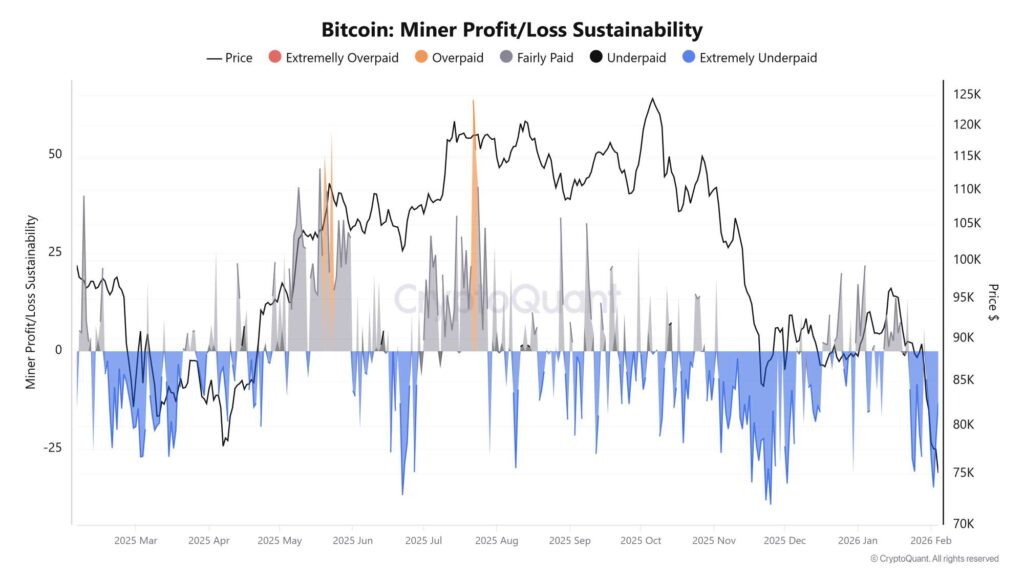
Bitcoin miner capitulation has moved back into focus as the market absorbs a sharp Bitcoin price drop. Over the past two weeks, Bitcoin has fallen quickly enough to strain the economics of mining, pushing revenue below levels many operators need to cover routine expenses. As margins tighten, pressure is building across the mining sector.
Bitcoin mining profitability has weakened because revenue moves with price, while Bitcoin mining costs do not. Electricity, hosting contracts, and financing obligations remain largely fixed in the short term. That mismatch matters when prices fall quickly. The added concern for the network is not panic, but resilience: how stress among miners interacts with Bitcoin network security if conditions remain tight.
Bitcoin price drop and the new stress point
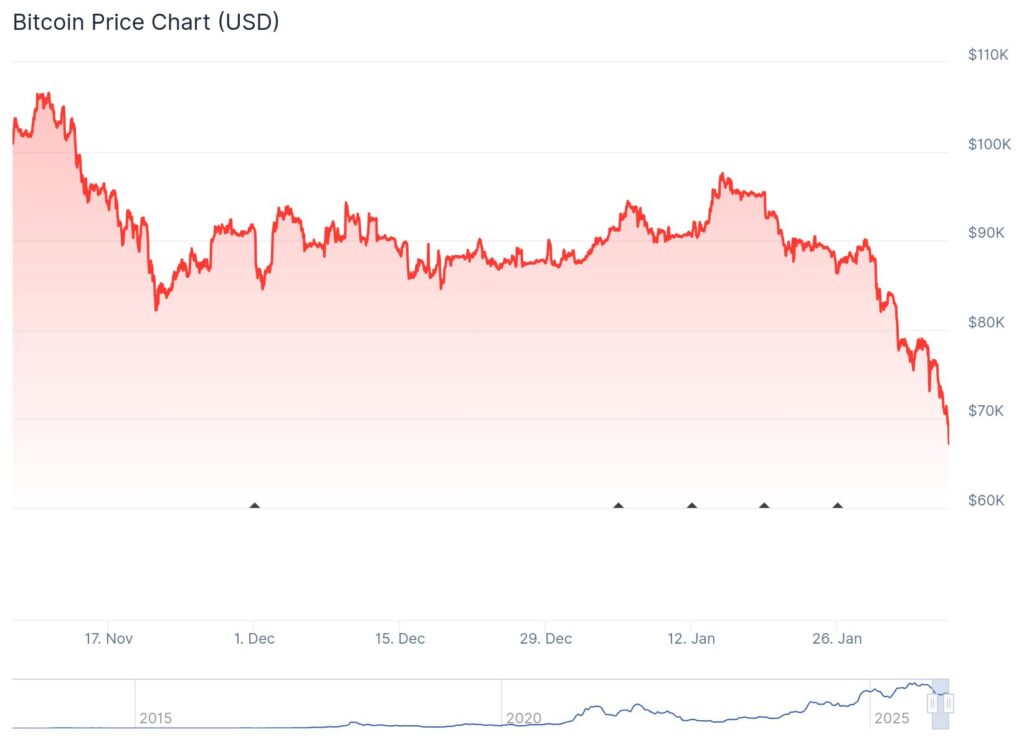
The Bitcoin price drop has been steep enough to force miners to reassess short-term operations. On February 5, 2026, Bitcoin traded around $70,000, down from roughly $84,000 a few days earlier and well below mid-January levels. For industrial miners that plan around relatively stable cash flow, this kind of move compresses margins quickly.
The Bitcoin price drop impact on miners is magnified because revenue is earned in Bitcoin while most costs are paid in fiat. Power contracts and hosting fees do not adjust downward when price falls. That imbalance can turn marginal operations unprofitable almost overnight, especially for miners running older equipment or higher-cost power.
Source: CoinGecko
Bitcoin mining profitability and cost pressure
Why Bitcoin mining profitability is falling comes down to timing and structure. When price declines, revenue per unit of hashpower drops immediately. Costs, by contrast, remain fixed. A miner that was near breakeven at one price level can slip into losses after a sudden move lower.
This is where Bitcoin mining costs become decisive. Operators with cheap power and efficient fleets can withstand pressure longer. Those without that buffer face difficult choices. The current environment does not affect all miners equally, but it does expose structural weaknesses across the sector.
Source: CryptoQuant
Winter storm impact on Bitcoin mining
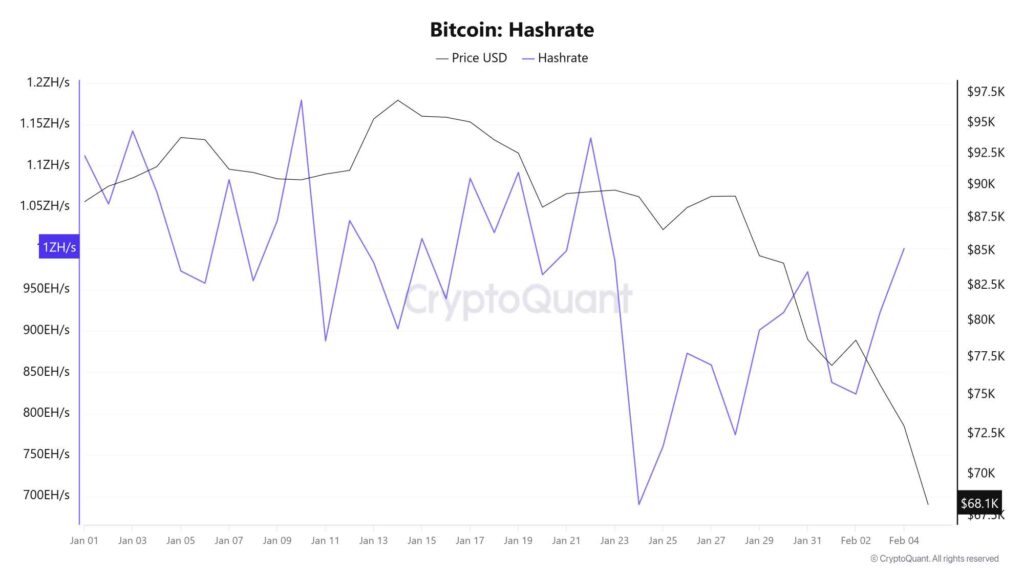
Winter storm impact on Bitcoin mining added a second shock at a fragile moment. Severe U.S. winter weather in late January and early February forced some miners to curtail activity or shut down temporarily. Network data shows a notable drop in hashrate during this period, reflecting outages and voluntary reductions tied to grid conditions.
The storm did not create the underlying stress, but it intensified it. For miners already dealing with falling revenue, even short disruptions reduce cash flow and delay recovery. In some regions, miners also participate in grid programs that pay large power users to cut consumption during emergencies, which can help offset losses but does not solve longer-term profitability issues.
Mining shutdowns are the most visible sign of miner stress. Are miners shutting down Bitcoin mining? In this phase, some shutdowns were weather-related, while others reflected economic decisions. Both matter, because they reduce overall network activity and signal that a portion of the industry is operating below sustainable levels.
When enough miners reduce activity at once, the market begins to talk about Bitcoin miner capitulation. In practical terms, it means weaker operators stop mining, sell equipment, or liquidate Bitcoin holdings to stay solvent. That process is uneven, but it tends to concentrate activity among miners with lower costs and stronger balance sheets.
What happens to Bitcoin if miners capitulate
What happens to Bitcoin if miners capitulate is usually less dramatic than the phrase suggests. In the short term, reduced hashpower can slow block production slightly until the network adjusts. Transaction processing continues, but confirmation times can lengthen temporarily during peak stress.
The economic effect can be more visible. Bitcoin miners selling reserves to fund operations can add near-term supply to the market. At the same time, capitulation can reduce ongoing selling later, because surviving miners tend to be more efficient and financially stable. This is why some analysts view capitulation as a painful but stabilizing phase rather than a systemic threat.
What miner capitulation means for Bitcoin’s mining sector
What miner capitulation means for Bitcoin depends on scale and duration. A brief squeeze tied to weather disruptions and a short-lived price decline may pass with limited long-term impact. A prolonged period of low profitability, by contrast, can accelerate consolidation across the mining sector.
Smaller or higher-cost operators may exit, while larger firms gain share. The industry shifts focus from expansion to efficiency, liquidity management, and power optimization. For the broader market, this process reshapes who produces new Bitcoin rather than whether Bitcoin continues to function.
Bitcoin network security under stress
Bitcoin network security is designed to withstand periods of disruption. When mining activity declines, the protocol adjusts difficulty over time to keep block production near its target rate. That mechanism does not eliminate stress, but it prevents temporary shocks from breaking the system.
For readers assessing the current moment, the key point is context. The Bitcoin price drop and winter storm impact hit mining economics simultaneously, increasing pressure on weaker operators. Bitcoin miner capitulation, if it deepens, would reflect a rebalancing of the mining sector rather than a failure of the network itself.
The next signals to watch are straightforward: price stability, the pace of mining shutdowns, and how quickly operations recover after weather disruptions. Together, those factors will determine whether current stress fades or reshapes the industry more permanently.
Canada’s latest move shifts regulatory focus away from trading activity toward custody, with crypto custody rules now structured around how and where platforms hold client assets rather than what they list or trade.
CIRO’s interim framework introduces tiered limits for custodians and caps platform self-custody, reshaping market structure by favoring stronger governance, diversification, and institutional-grade custody arrangements.
Canada’s latest move on digital assets does not target trading activity or token listings. Instead, the focus is on custody. With new crypto custody rules now in effect, Canada’s regulators are tightening standards around where regulated platforms hold client crypto assets and how they manage custody risks.
The framework was issued by the Canadian Investment Regulatory Organization (CIRO) and applies to its dealer members that operate crypto asset trading platforms. The rules take effect immediately and introduce a tiered approach to crypto custody that links allowable exposure to the quality and risk profile of custodians.
The shift reflects a regulatory judgment shaped by past failures. In Canada, those failures are inseparable from the collapse of QuadrigaCX, which exposed how custody breakdowns can erase client assets even when trading activity itself appears orderly.
Why custody, not trading, is where regulators now intervene
Regulators have learned that trading rules offer limited protection if custody fails. Market conduct requirements do not prevent losses when private keys are lost, assets are commingled, or insolvency law is unclear.
For Canadian crypto regulation, custody has emerged as the critical control point. Weak custody arrangements concentrate operational and legal risk in a way that trading oversight cannot offset. When assets are poorly segregated or controlled by a single entity, failures can propagate quickly.
CIRO’s approach reflects a broader push toward clearer crypto custody standards. The goal is to reduce single-point-of-failure risk while maintaining continuity for platforms that already operate within the regulated perimeter.
How CIRO’s tiered custody framework actually works
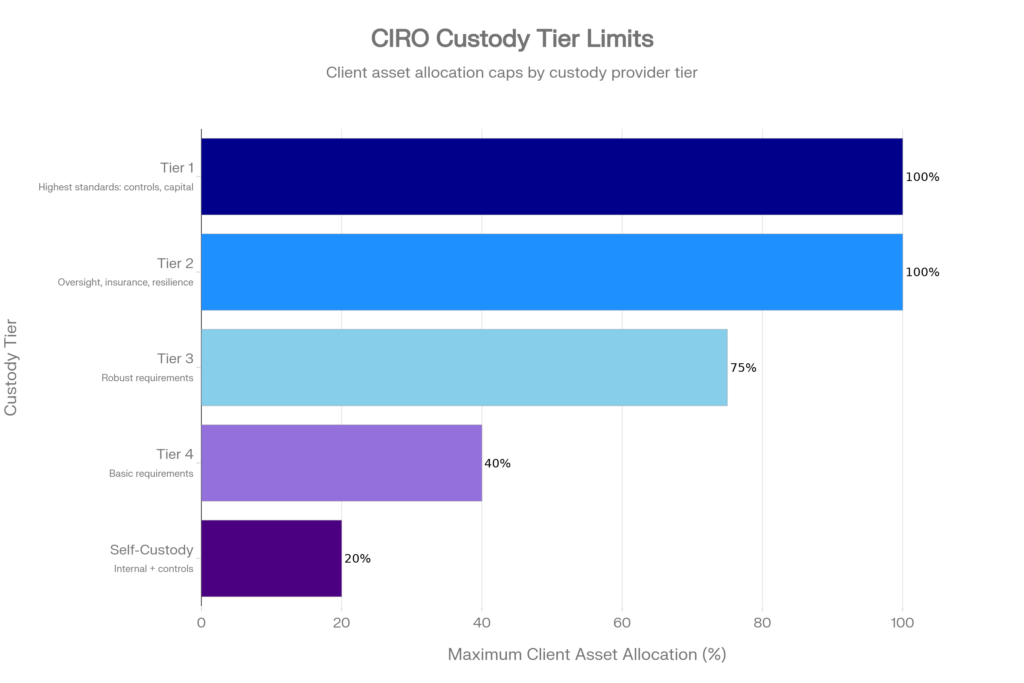
CIRO’s interim Digital Asset Custody Framework introduces a risk-based structure built around four custodian tiers. Each tier carries a specific cap on how much client crypto a dealer member may place with custodians in that category.
Under the framework, Tier 1 and Tier 2 custodians may hold up to 100% of client assets, Tier 3 custodians are capped at up to 75%, and Tier 4 custodians are limited to up to 40%.
Higher-tier custodians are subject to stronger requirements around governance, audits, and financial resilience. These include capital or insurance expectations, with Tier 1 Canadian custodians required to maintain at least CAD $100 million. Lower-tier custodians face tighter percentage caps and reduced allowable exposure. The framework also addresses crypto custody rules Canada has previously applied on an interim basis, formalizing them into a single supervisory model.
The structure does not prohibit custody arrangements outright. Instead, it constrains exposure based on assessed risk. CIRO positions the framework as flexible, but enforceable, with custody decisions tied directly to measurable controls rather than broad policy judgments.
Market structure impact: who benefits, who feels pressure
While neutral in design, regulated crypto custody requirements tend to favor platforms with access to large, well-capitalized custodians. Firms that already rely on institutional custodians with established audit and governance practices can adapt more easily.
Smaller platforms may face higher costs or reduced flexibility. For some, meeting crypto custody standards will require restructuring existing arrangements or limiting client asset exposure. The framework therefore introduces indirect consolidation pressure without explicitly excluding participants.
This effect is structural rather than punitive. CIRO’s rules do not dictate business models, but they do reward scale, compliance infrastructure, and access to high-quality custody providers.
Why self-custody caps apply — even for regulated firms
One of the most notable features of the framework is the introduction of crypto self-custody limits for dealer members. Under the framework, CIRO permits dealer members to self-custody client crypto assets, but limits self-custody to 20% of total client and proprietary crypto assets under management, subject to internal control requirements.
The rationale is historical rather than ideological. Past failures showed that internal custody without strong governance can amplify risk. Concentrating key control inside a single operating entity exposes clients to operational errors and insolvency complications.
By capping self-custody, CIRO aims to balance operational flexibility with crypto investor protection that Canada’s regulators have emphasized since earlier enforcement actions. The focus is not on banning internal custody, but on preventing unchecked concentration.
CIRO has described the framework as interim, signaling that supervisory expectations may evolve. That designation matters because it allows the regulator to refine limits and requirements as data from supervision and audits accumulates.
For Canadian crypto regulation, custody has become a durable enforcement lever. Future adjustments are likely to focus on assurance standards, cross-border custodians, and the treatment of client assets during insolvency.
The framework does not eliminate failure risk. It reshapes how that risk is distributed and managed. In doing so, it marks a decisive step in formalizing custody as the cornerstone of Canada’s approach to regulated crypto markets.