
Home Blog Page 54

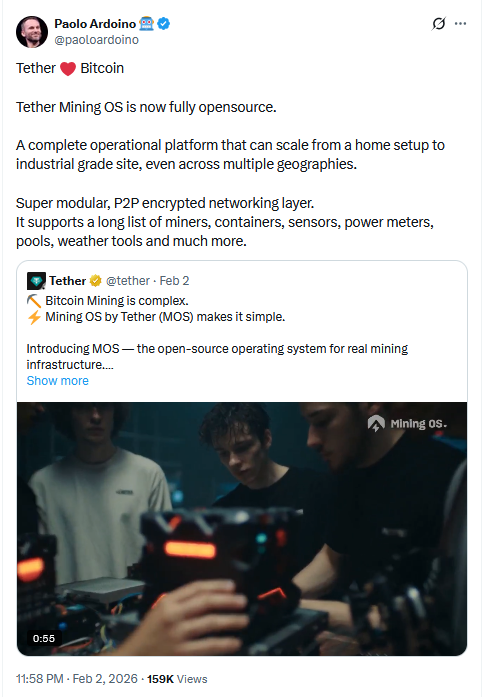
Tether Pushes Deeper Into Bitcoin Mining With Open-Source MiningOS

TL;DR

  • MiningOS expands Tether’s role in Bitcoin mining by introducing open-source software that reduces reliance on proprietary mining systems.
  • The release reflects a broader infrastructure strategy, with Tether focusing on control, auditability, and long-term resilience in mining operations.

Tether has released an open-source operating system for Bitcoin mining, extending its involvement beyond capital deployment and into the software layer that runs mining operations. The move reinforces Tether’s growing role in Bitcoin mining and reflects a focus on operational resilience rather than short-term market disruption.

Branded as MiningOS, the system aims to reduce reliance on closed, third-party tools that dominate Bitcoin mining software today. Tether positions the release as a way to give miners greater visibility and control over their infrastructure while scaling its own mining activities.

Tether’s MiningOS: What Was Released

Tether’s MiningOS is an open-source operating system built to manage and monitor Bitcoin mining operations. It targets core functions such as device coordination, performance oversight, and system-level management, rather than mining pools or hardware manufacturing.

Tether describes the platform as open source mining software that operators can deploy across existing setups without forcing them into proprietary ecosystems. The company has emphasized compatibility with current mining environments, allowing miners to adopt the system without reworking their entire stack.

Why Mining Software Matters More Than It Appears

Mining hardware receives most of the attention in Bitcoin, but control often sits elsewhere. Bitcoin mining software determines how machines communicate, how performance is measured, and how issues are diagnosed in real time.

Much of the industry relies on proprietary mining software that limits transparency and restricts customization. These systems can create operational blind spots, especially at scale, where software failures or inefficiencies are costly and hard to audit.

By addressing this layer directly, MiningOS targets a part of the mining stack that shapes efficiency and risk, even though it remains largely invisible to outsiders.

How MiningOS Fits Tether’s Existing Bitcoin Strategy

Tether’s release of MiningOS aligns with its broader expansion in Bitcoin mining activities. The company has invested directly in mining operations and energy infrastructure, positioning Bitcoin as a long-term strategic asset rather than a peripheral holding.

As those operations grow, dependence on external vendors becomes a structural risk. Developing internal tooling, then releasing it publicly, allows Tether to standardize its own systems while contributing to the wider Bitcoin mining infrastructure ecosystem.

This approach frames MiningOS as part of a long-term operating strategy, not a standalone product launch.

Open Source as a Risk-Reduction Tool

Open-sourcing MiningOS changes the distribution of risk. With open source mining software, code can be inspected, audited, and improved without relying on a single vendor’s roadmap or priorities.

This also reduces exposure to vendor lock-in, where licensing terms or opaque firmware updates constrain mining operators. For large-scale miners, the ability to review and adapt software internally can lower operational friction. For smaller operators, it can reduce entry barriers tied to proprietary systems.

In both cases, open source functions as a practical control mechanism rather than a philosophical statement.
Broader Market Impact: Incremental, Not Disruptive

Tether’s MiningOS is unlikely to displace existing proprietary mining software in the near term. Switching costs remain high, and many operators value long-standing support relationships with established vendors.

Hence, adoption is more likely to be gradual. Early use may concentrate among operators that already prioritize customization and internal development. Over time, broader adoption will depend on stability, community contributions, and proven performance in live environments.

The Analytical Tension: Open Software, Expanding Influence

The release of MiningOS supports decentralized Bitcoin mining by lowering software barriers and improving transparency. At the same time, it places Tether deeper into the technical fabric of mining operations.

Open source does not confer control, but it does create influence through standards and adoption. Bitcoin’s history shows that such tools can coexist with decentralization, provided no single entity controls access or direction.

MiningOS sits within that balance. Its impact will depend less on who released it and more on how widely and independently it is used.

What This Signals About Tether’s Direction

MiningOS signals a continued shift toward infrastructure-level participation. By contributing directly to Bitcoin mining infrastructure, Tether is reinforcing its role as an operational actor rather than a purely financial one.

This release does not change mining economics overnight. It does, however, underline how major firms are increasingly focused on the control layers that support Bitcoin’s network. In that context, MiningOS is less about disruption and more about durability.

White House Crypto Meeting Ends Without Resolution on Stablecoin Yield

TL;DR

  • Fact: The White House crypto meeting ended without agreement on stablecoin yield.
  • Context: Disagreement over stablecoin rewards has stalled the crypto market structure bill.
  • Outlook: Negotiations continue, with yield treatment likely to determine the bill’s fate.

White House officials met with representatives from major U.S. banks and crypto firms this week to address unresolved issues in pending digital asset legislation. The White House crypto meeting focused on disagreements that have stalled progress on a broader policy package, including whether stablecoin holders should be allowed to receive yield through intermediaries. Participants described the talks as constructive. No agreement was reached, and discussions are expected to continue.

Who was at the table and why the meeting mattered

The meeting brought together administration officials, banking representatives, and leaders from the crypto industry. Banking trade groups and major financial institutions attended alongside large crypto platforms and stablecoin stakeholders. The session took place as lawmakers seek to move forward with legislation that would define regulatory boundaries across the digital asset sector.

The White House stepped in after weeks of stalled negotiations. Momentum around the Senate Banking Committee’s approach slowed after Coinbase publicly withdrew support, citing unresolved concerns tied to stablecoin yield. By contrast, the Senate Agriculture Committee advanced its own markup last week, a procedural step viewed as constructive but one that does not directly address banking-related questions around stablecoin rewards.

Lawmakers have narrowed the dispute to a small set of issues. Among them, stablecoin yield has emerged as the primary obstacle. The administration’s goal was to clarify positions and test whether a compromise was possible.

Why the Crypto Market Structure Bill Is Stalled

The current impasse centers on the Crypto Market Structure Bill under discussion in the Senate. The proposal aims to clarify oversight of digital assets, define regulatory roles, and establish guardrails for stablecoins. Progress slowed as banking and crypto groups diverged on how the bill should treat the yield associated with stablecoins.

Banking groups argue that allowing yield could blur lines between deposits and private payment instruments. Crypto firms counter that strict limits would undermine stablecoin use cases and competitiveness. These differences have delayed committee action and prompted White House involvement.

The Stablecoin Yield Dispute at the Center of the Talks

At the heart of the discussion is stablecoin yield and how it should be treated under federal law. The issue is not issuer-paid interest. The debate focuses on whether exchanges or other intermediaries may offer rewards or yield linked to stablecoin balances.

Banking representatives warned that yield could function like interest on deposits. They raised concerns about consumer confusion and deposit competition. Crypto firms said that yield offered by intermediaries is distinct from bank interest and reflects market activity rather than balance sheet risk.

The meeting did not resolve this disagreement. Both sides restated positions that have been consistent in prior weeks.

Why Stablecoin Rewards Divide Banks and Crypto Firms

The dispute over stablecoin rewards reflects different views of risk and consumer protection. Banks frame rewards as deposit-like features without the protections that accompany insured accounts. From that perspective, rewards could shift funds out of traditional banking channels.

Crypto firms frame rewards as optional features offered by platforms. They argue that users accept market risk in exchange for yield. In their view, prohibiting rewards would limit stablecoin adoption and reduce their utility as financial tools.

These positions remained unchanged after the meeting. Participants acknowledged the gap but did not signal movement toward a shared framework.

What the Debate Signals for US Crypto Regulation

The unresolved discussion points to broader questions in US crypto regulation. Lawmakers are attempting to draw boundaries between payments, investments, and banking activities. Stablecoins sit at the intersection of those categories.

Allowing yield through intermediaries raises questions about oversight and disclosure. Banning yield raises questions about competition and innovation. The White House meeting highlighted the difficulty of addressing both concerns in a single statute.

The outcome suggests that lawmakers may face pressure to narrow the bill or defer some decisions to regulators.

What This Means for Stablecoin Regulation Going Forward

The lack of agreement leaves stablecoin regulation in a holding pattern. Negotiators may pursue narrower language that addresses issuer conduct while leaving intermediary practices to future rulemaking. Another option is to impose stricter disclosure requirements without an outright ban.

For now, the bill’s progress depends on whether a limited compromise can satisfy both banking and crypto interests. Without such a compromise, the yield issue could continue to delay action.

Outlook: Process Moves Forward, Substance Remains Unresolved

The White House crypto meeting clarified positions but did not close the gap on stablecoin yield. Talks are expected to continue as legislative timelines tighten. According to multiple reports, further discussions will happen against an informal timeline, with the White House urging banking and crypto representatives to narrow their differences by February, as the legislative process must keep moving.

The immediate path forward appears to involve incremental adjustments rather than a comprehensive resolution. Whether the Crypto Market Structure Bill advances will depend on how lawmakers address stablecoin rewards without creating new risks. Until then, the debate over yield remains the central roadblock.

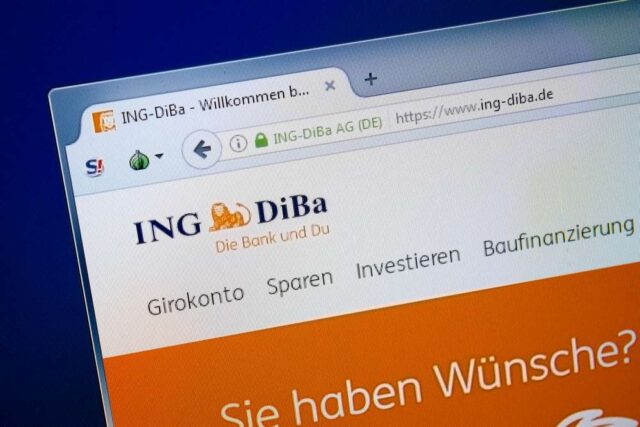
ING Germany Brings Crypto ETPs Into Everyday Retail Banking

TL;DR

  • Retail clients in Germany can access crypto ETPs through ING, gaining regulated exposure to Bitcoin, Ethereum, and Solana via standard bank investment accounts.
  • The rollout delivers bank-led crypto exposure via exchange-traded products, without direct crypto trading or custody.

Retail clients at ING Germany can now gain crypto exposure through regulated exchange-traded instruments held inside their existing bank accounts. The bank has enabled access to crypto-linked ETPs and ETNs that track major digital assets, positioning the rollout as a routine extension of its retail investment offering rather than a new trading service.

The change places crypto ETPs alongside other securities already available to ING customers in Germany. It also reflects a broader shift toward bank-led crypto exposure delivered within established compliance and risk frameworks.

ING integrates crypto ETPs into its retail investment platform

The new offering allows customers in Germany to purchase crypto ETPs via the same interfaces used for stocks, funds, and bonds. Access is provided through listed products rather than direct interaction with crypto markets. As a result, ING clients gain market exposure without opening exchange accounts or managing private keys.

This structure keeps crypto investments inside the bank’s standard securities infrastructure. It also aligns with a growing focus on regulated crypto investment in Europe, where banks emphasize product familiarity and operational continuity.

What products are offered

ING’s rollout centers on exchange-traded products and notes that track leading cryptocurrencies. The lineup includes instruments linked to Bitcoin, Ethereum, and Solana, offered as crypto-linked ETPs and ETNs.

Crucially, the bank does not provide direct crypto trading or custody. Investors receive crypto exposure without custody, and positions settle like other securities on regulated venues. This distinction matters for risk, reporting, and consumer protections, and it underpins ING’s conservative approach.

Crypto ETPs follow ING’s standard third-party product model

ING’s crypto-linked ETPs and ETNs follow the same third-party distribution model the bank uses for other exchange-traded investment products. Rather than issuing instruments itself, ING makes securities created by specialist asset managers available through its retail platform.

The issuers behind the crypto ETP lineup include Bitwise, VanEck, and 21Shares, all of which focus on regulated crypto-linked exchange-traded products. Product structuring, index methodology, and asset exposure remain the responsibility of the issuers, while ING acts solely as a distributor.

This approach allows ING to offer crypto investment products without altering its operating model or balance-sheet exposure. From the bank’s perspective, crypto ETPs are handled in the same way as other externally issued securities, reinforcing the view that digital-asset exposure is being integrated as a conventional investment category rather than treated as a standalone service.

Germany’s framework enables bank-led crypto exposure

Germany has emerged as a natural entry point for regulated crypto investment in Europe. Existing rules already support exchange-traded crypto instruments within the securities regime, giving banks a clear path to distribution.

By operating within this framework, ING can offer bank-led crypto exposure that meets domestic compliance standards. The result is a tightly scoped product expansion rather than a broader shift into digital-asset services.

Crypto normalization moves from exchanges to traditional banks

The availability of crypto exposure via traditional bank products reflects a wider normalization trend. Crypto is increasingly accessed through familiar investment vehicles instead of standalone platforms. For banks, this means treating digital assets as another market exposure rather than a parallel financial system.

This evolution supports crypto normalization in banking by embedding exposure within established investor workflows. It also reframes crypto as a portfolio component that sits alongside equities and funds.

What changes for retail investors

For customers, the main change is convenience. Retail crypto exposure via banks reduces friction by keeping investments within a single account and a single regulatory perimeter. It also simplifies reporting and account oversight.

At the same time, core market risks remain. Volatility, tracking differences, and product complexity still apply. The rollout does not alter price behavior or market dynamics, and it does not equate to owning crypto directly.

A cautious step toward normalization

ING’s move illustrates how large banks are approaching digital assets today. By offering securities-based crypto access through ETPs and ETNs, the bank expands choice while maintaining conservative boundaries.

The significance lies less in scale than in structure. As crypto ETPs become part of standard retail investing at ING Germany, crypto continues its shift from a niche market to a normalized asset exposure within European banking.

Coinbase Insider Trading Lawsuit Moves Forward After Years of Procedural Limbo

TL;DR

  • A Delaware court declined to terminate an insider trading lawsuit, keeping alive shareholder claims tied to stock sales around Coinbase’s 2021 direct listing.
  • The ruling does not decide liability or insider trading; it determines that the board’s Special Litigation Committee cannot end the case at this stage.
  • By clearing this procedural hurdle, the decision allows the case to move toward discovery and factual examination for the first time.

Coinbase’s insider trading lawsuit, a shareholder derivative case tied to its 2021 direct listing, resurfaced in headlines in early 2026. The suit was filed in Delaware Chancery Court in 2023 (Adam Grabski ex rel. Coinbase Global, Inc. v. Marc Andreessen et al., C.A. No. 2023-0464-KSJM).

The renewed attention follows a ruling that kept the case alive after the company’s board sought dismissal through a Special Litigation Committee process, rather than any new allegation or factual development. The recent ruling does not resolve liability. It addresses whether the case can move beyond preliminary governance barriers that have constrained it since filing.

Why the lawsuit still matters in 2026

The renewed focus reflects a procedural shift rather than new allegations. Until now, the Coinbase lawsuit remained limited to threshold questions about corporate control and process. Courts examined who had authority to decide the fate of the claims, not whether the claims were correct.

That distinction matters. An insider trading lawsuit can persist for years without discovery when it is brought as a derivative action. This case followed that path. The latest decision signals that the court is no longer prepared to end the matter solely on governance grounds.

The original allegation behind the case

The dispute traces back to Coinbase’s April 2021 direct listing. Unlike a traditional IPO, the Coinbase direct listing imposed no lockup restrictions. Executives and directors were free to sell shares immediately.

Shareholders later alleged that insiders sold approximately $2.9 billion in stock while possessing material non-public information. According to the complaint, these stock sales allowed Coinbase insiders to avoid more than $1 billion in losses as the share price fell following later disclosures.

These figures remain allegations. No court has made findings on whether the sales breached fiduciary duties or violated securities laws.

Why this was never a normal shareholder lawsuit

The case is structured as a shareholder derivative lawsuit. That means investors sue on behalf of the company rather than for individual damages. Delaware law treats such actions differently from standard securities litigation.

When a derivative suit is filed, boards typically receive the first opportunity to respond. Courts often pause the case to allow internal governance mechanisms to operate. As a result, a lawsuit of this type does not move directly into discovery or merits litigation.

This framework prioritizes corporate decision-making. It also means early proceedings focus on process instead of evidence.

The Special Litigation Committee and its conclusion

After the case was filed in 2023, Coinbase’s board formed a Special Litigation Committee (SLC) and tasked the SLC with reviewing the allegations to determin whether continuing the litigation served the company’s interests.

The SLC investigation concluded that the lawsuit should be dismissed. Defendants relied on that recommendation in seeking termination.

Shareholders challenged the committee’s independence and methodology. That dispute, rather than the substance of insider-trading claims, became central. It placed the Coinbase directors lawsuit squarely within Delaware’s corporate-governance framework.

What the Delaware judge ruled — and why it matters

On January 30, 2026, Chancellor Kathaleen St. J. McCormick issued a decision addressing the board’s attempt to end the case. The court reviewed certain allegations and materials relied upon by the parties but ultimately declined to terminate the litigation at this stage.

The ruling does not resolve the Coinbase insider trading lawsuit on the merits. Neither does it determine whether insider trading occurred, whether disclosures were misleading, or whether fiduciary duties were breached. Instead, the court concluded that the Coinbase SLC’s recommendation was not sufficient to shut down the case before further proceedings.

By denying termination, the court cleared a procedural hurdle. The decision clears the way for the case to move toward discovery, document production, and depositions, subject to future rulings and scheduling. This shift changes the litigation dynamic. Risk exposure increases for all parties, and the dispute can begin moving from abstract governance questions toward factual development.

At the same time, the ruling remains limited in scope. It does not assess intent, damages, or liability. It determines only that the lawsuit should not end solely through board-level review.

The broader takeaway for public crypto companies

The Coinbase insider trading lawsuit highlights how governance structures shape litigation timelines. Direct listings without lockups can create distinctive exposure. Delaware law emphasizes process over speed, even in high-profile cases.

For public crypto companies, the lesson is structural rather than sensational. Legal consequences may surface years after market events, and procedure often determines whether those claims are ever examined.

Nevada court order Puts Polymarket on a Collision Course With state gaming law

TL;DR

  • A Nevada judge issued a temporary restraining order that blocks Polymarket activity by barring sports-related event contracts for Nevada residents while a preliminary injunction is considered.
  • The dispute centers on whether Polymarket’s sports event contracts fall under state gaming law or remain governed by CFTC regulation, with the court rejecting claims of exclusive federal control at this stage.
  • The case highlights a broader conflict between prediction markets vs. betting, testing how far states can apply gaming statutes to federally structured event contracts without a final ruling on legality.

A Nevada judge has issued a temporary restraining order that affirmatively bars Polymarket from offering event-based contracts to Nevada residents for roughly two weeks, pending a preliminary injunction hearing expected around February 11. The court order does not resolve the case on the merits but temporarily halts Polymarket’s Nevada-facing activity based on findings that the state showed a likelihood of unlicensed gaming violations and irreparable harm to its regulatory regime.

The action follows a civil enforcement filing by the Nevada Gaming Control Board. The agency alleges that specific sports event contracts constitute wagering under Nevada law and therefore require state licensure. Polymarket disputes that characterization. The dispute turns on regulatory authority and statutory definitions, not allegations of fraud.

What the Polymarket Nevada court order actually does — and what it doesn’t

The court issued a temporary restraining order that Polymarket must comply with for a short, defined period. The order blocks Polymarket from offering sports-related event contracts to Nevada residents while the court considers whether to grant a preliminary injunction. It is more than a neutral pause. The judge found that Nevada demonstrated a likelihood of success on claims of unlicensed gaming and irreparable harm to the state’s regulatory framework if the activity continued.

The TRO is narrow and time-bound, and it does not impose penalties. Neither does it make a final determination on legality. The court will revisit the dispute after further briefing and argument. But when issuing the TRO, the judge rejected the argument that federal commodities law gives exclusive control over these contracts at this stage. The court concluded that Nevada had shown sufficient grounds to enforce its gaming statutes temporarily. The filing was brought by the regulator, not private parties. In the lawsuit, the Nevada Gaming Control Board frames the conduct as unlicensed wagering rather than misconduct.

Why Nevada filed the Polymarket lawsuit now

The lawsuit cites specific provisions of Nevada law governing gaming and wagering, including NRS 463.160, 463.350, 465.086, and 465.092. These provisions prohibit unlicensed gaming operations and wagering offered to state residents. The complaint focuses on sports event contracts tied to professional and collegiate competitions, including NBA, NHL, and college basketball games.

Timing is part of the context. Nevada moved as major sports events approached, when exposure to sports-linked contracts is highest. While not quoted directly in filings, it is reasonable to view the proximity to marquee sporting events as a factor that heightened regulatory urgency.

The Nevada vs. Polymarket lawsuit does not allege fraud or deception. It centers on classification and licensing. If Polymarket’s activity fits Nevada’s statutory definitions of wagering, the state argues, gaming laws apply regardless of how the products are described.

The CFTC context most coverage skipped

Polymarket has publicly emphasized a federal regulatory pathway for its U.S. activities. That position is informed by prior interaction with the Commodity Futures Trading Commission, including a 2022 CFTC enforcement action that resulted in a civil penalty and an order to wind down non-compliant markets. Since then, the company restructured its U.S. approach.

By late 2025, the CFTC approved an Amended Order of Designation enabling Polymarket to offer event contracts through CFTC-licensed entities it acquired, namely QCX LLC (a Designated Contract Market) and QC Clearing LLC, allowing intermediated trading via futures commission merchants (FCMs), traditional custody, and enhanced surveillance and reporting. That compliant structure differentiates its current U.S. offering from its earlier, crypto-native iteration.

That history shapes the CFTC regulation argument, but does not resolve it. Event contracts can fall within federal commodities frameworks when properly structured, a point contested in ongoing litigation involving other platforms.

Against that backdrop, the Polymarket Nevada court order is not about blockchain rails. It is about whether Nevada can apply its gaming statutes to event contracts offered to residents, notwithstanding federal oversight claims.

Prediction markets vs betting: why labels won’t decide this case

Much of the debate is framed as prediction markets vs betting. The distinction explains the parties’ positions but does not decide the outcome.

Nevada focuses on statutory effect. When users stake funds on sports outcomes and receive payouts based on results, the regulator treats the activity as wagering. Polymarket, for its part, has publicly emphasized market structure and pricing mechanisms typical of event contracts.

Courts, however, look beyond labels. The prediction markets vs betting question matters insofar as it informs statutory coverage and jurisdiction. The sharpest conflict arises with sports prediction markets, where state gaming laws are most developed and strictly enforced.

The dispute is not limited to federal preemption. It also turns on whether the challenged activity fits Nevada’s statutory definitions of wagering under state gaming law.

Polymarket is expected to argue that federal commodities oversight limits, or preempts, state licensing requirements when contracts are offered through a federally regulated structure. Nevada counters that its gaming statutes apply when residents are offered sports event contracts without a state license.

At the TRO stage, the court sided with Nevada on a preliminary basis. It rejected claims of exclusive federal control under the Commodity Exchange Act for purposes of temporary relief. The Nevada Gaming Control Board vs. Polymarket lawsuit will test these issues more fully at the preliminary injunction phase.

Why sports contracts are the pressure point

The complaint targets sports event contracts tied to NBA, NHL, and college basketball games. Sports wagering sits at the core of Nevada’s gaming regime, and the TRO reflects that focus.

The order cites traditional regulatory concerns, including integrity safeguards, suitability, and protections related to underage participation. Those considerations help explain why sports-linked contracts drew immediate enforcement attention.

The Nevada court order thus isolates sports as the test case for how far state gaming authority extends over event-based markets like Polymarket.

Why the Nevada court order matters beyond the Polymarket case

The implications extend beyond a single platform. Nevada has already targeted similar operators: a 2025 cease-and-desist forced Crypto.com to suspend Nevada sports contracts after a federal loss (appeal pending), while Kalshi won a temporary injunction but lost it in November when the judge ruled its sports event contracts subject to state gaming rules (Ninth Circuit stay).

A ruling for Nevada here would reinforce regulators’ ability to apply gaming statutes to sports-linked event contracts, building on those precedents. A ruling for Polymarket would strengthen federal-primacy arguments and disrupt the pattern.

The outcome will shape U.S. prediction-markets regulation and influence how platforms structure offerings to residents. The order illustrates courts’ use of temporary relief to manage regulatory harm without final judgments.

What happens next

The TRO will expire unless extended after further proceedings. The court will consider whether to grant a preliminary injunction, focusing on statutory coverage, likelihood of success, and the balance of harms.

Whatever the outcome, appeals are likely. The Nevada vs. Polymarket lawsuit raises recurring questions about the boundary between state gaming authority and federally regulated markets. The current order is best understood as a procedural step signaling agreement with Nevada’s likelihood-of-success arguments, not a final resolution on legality.

- Advertisement -

FEATURED