Home Blog Page 55

Warsh Fed Pick: A Credibility Play, Not Confrontation
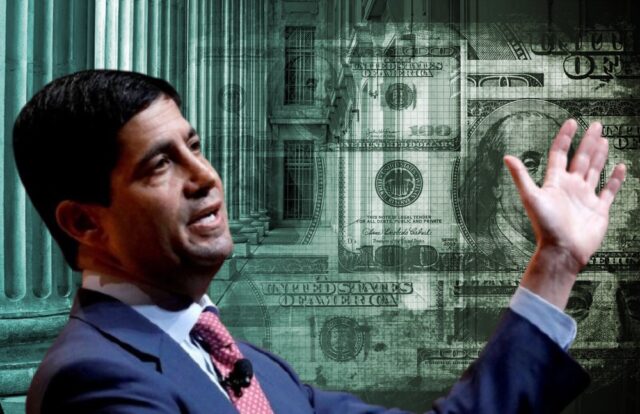
President Trump picked Kevin Warsh as his nominee to succeed Jerome Powell as the Chair of the Federal Reserve.

TL;DR

  • Donald Trump has nominated Kevin Warsh, a former Federal Reserve governor, to succeed Jerome Powell as Fed chair, bringing an experienced crisis-era policymaker into a closely watched confirmation process.
  • Warsh’s public record includes skepticism toward prolonged quantitative easing and large balance sheets, alongside a narrower interpretation of the Federal Reserve’s mandate; for crypto markets, the development does not signal stimulus or policy support.

President Donald Trump’s decision to nominate Kevin Warsh as Federal Reserve chair has drawn attention because he combines establishment credentials with long-standing ties to Trump’s economic circle. Supporters of the Warsh nomination framed it as a move to bolster the central bank’s credibility rather than a confrontation with the institution. For investors, the implication is caution rather than urgency. For crypto markets, it points to stability rather than stimulus.

Warsh is a former Federal Reserve governor with direct experience during the 2008 financial crisis. He is widely viewed as a familiar figure in monetary policy debates. As a Trump Fed chair nominee, he does not fit the profile of a disruptive or openly political pick. Instead, the choice appears to be an attempt to satisfy markets and the Senate while accommodating Trump’s repeated pressure for lower rates. The nomination reflects a balancing act in Federal Reserve leadership, with continuity taking precedence over disruption.

Why Trump Picked Kevin Warsh for Fed Chair

The selection of Kevin Warsh can be read as an effort to balance credibility with alignment on rates while avoiding ideological loyalty. Trump has consistently argued that interest rates should be lower. Warsh approaches that question differently. He has historically opposed aggressive quantitative easing. In more recent commentary, however, he has signaled openness to lower rates alongside a smaller and more disciplined balance sheet.

Supporters of Warsh’s nomination for chair have cast him as reassuring to markets even as Trump continues to publicly criticize the Fed. That framing matters in a narrowly divided Senate, where confirmation debates often focus as much on institutional trust as on policy direction.

Warsh also brings procedural familiarity as he previously served on the Federal Reserve Board of Governors. That reduces uncertainty about how he would operate inside the institution. As the nominated Jerome Powell successor, subject to Senate confirmation, he is widely seen as an incremental choice rather than a rupture with recent leadership.

What a Warsh-Led Fed Signals for Monetary Policy

A Warsh-led Federal Reserve does not guarantee immediate rate moves. His record suggests that inflation data and broader financial conditions would guide any policy shift. Political pressure alone would not be decisive. That reality shapes the near-term FOMC policy outlook, even amid heightened attention to leadership changes.

Warsh has frequently argued that central banks risk damaging credibility when they rely too heavily on forward guidance or react too quickly to market volatility. As a result, the signal embedded in this nomination is one of restraint within existing frameworks of Federal Reserve leadership. Interest rate decisions would likely remain cautious, with limited appetite for pre-commitment.

On balance sheet policy, Warsh’s skepticism is well documented. He has criticized prolonged quantitative easing and the normalization of a permanently large balance sheet. While that stance does not imply abrupt tightening, it reinforces the view that accommodation would not be expanded simply to support asset prices.

Kevin Warsh, the Fed, and Innovation

Warsh’s approach to innovation has consistently emphasized institutional boundaries. He has argued that the Federal Reserve should stay within the limits of its mandate. Consequently, he criticized efforts to expand the central bank’s role into areas such as climate policy and other non-core objectives.

As a former governor and nominee to succeed Jerome Powell, Warsh has framed technological change as something markets and regulators adapt to. He does not see it as a domain the Fed should actively shape. That perspective reflects a narrower view of central banking. It centers on price stability and financial functioning rather than broader social or industrial goals.

Stability Over Stimulus — Where Crypto Actually Fits

The nomination of Warsh does not represent a pro-crypto pivot. It does, however, suggest a more restrained posture. Under Kevin Warsh as the Fed chair, crypto issues would likely be filtered through concerns about fraud, financial stability, and the role of a potential central bank digital currency. They would not be framed as an existential monetary threat. That distinction matters for crypto regulation.

Warsh has described crypto, and Bitcoin in particular, as software innovation rather than money, while also warning about scams and speculative excess. Those comments point to a critical but nuanced view. He has not endorsed crypto markets, nor has he argued that they sit fully outside public policy scrutiny. For digital assets, his record suggests skepticism without hostility.

From an institutional standpoint, this implies that the Fed under Warsh may view most crypto-specific issues as falling primarily under the remit of other regulators. For investors assessing what Kevin Warsh means for crypto, the implication is constraint. The central bank would neither champion nor suppress the sector through monetary policy tools.

Why Markets Reacted Anyway

Despite the absence of stimulus signals, markets reacted sharply to the announcement. U.S. Treasury yields moved higher following the nomination, while Bitcoin and crypto prices in general dropped. The market seems concerned about Warsh’s hawkish reputation on inflation credibility and uncertainty about the timing of future rate cuts.

For digital assets, the response underscored how sensitive prices remain to perceptions of Fed leadership. Rather than pricing reduced tail risk, markets appeared to focus on the possibility that a Warsh-led Fed would resist easing. That reaction highlights the gap between expectations of stability and expectations of accommodation.

What This Nomination Really Says About Trump’s Strategy

Taken together, Kevin Warsh’s nomination to chair the Fed can be interpreted as an attempt to thread the needle between aligned policy preferences and the need for Senate and market viability. Rather than escalating tensions with the central bank, Trump appears to have opted for a candidate who can withstand confirmation scrutiny while still sharing concerns about prolonged tight policy.

This approach fits if we interpret Trump’s broader Fed policy direction as built on sequencing. Monetary policy remains institutionally insulated, while pressure for lower rates continues through rhetoric and appointments. For crypto markets, the outcome is neither endorsement nor attack. Stability replaces stimulus, and confrontation gives way to constraint.

Binance SAFU fund shift moves user protection risk into Bitcoin volatility

TL;DR

  • Binance will convert its SAFU fund into Bitcoin within 30 days of the announcement and will top it up if its value falls below $800 million.
  • The shift replaces stable liquidity with Bitcoin volatility, changing how user protection behaves during periods of market stress.

As crypto markets move through renewed market stress, Binance has announced a structural change to how it will hold its user protection reserves. The exchange plans to convert the assets backing the Binance SAFU fund from stablecoins into Bitcoin, with a target size of roughly $1 billion.

The decision reframes how Binance finances user protection during periods of heightened volatility. Rather than reducing risk, the shift changes its character, replacing stability and immediate liquidity with exposure to Bitcoin price movements.

Why Binance created the SAFU fund

Binance created the SAFU emergency fund (short for Secure Asset Fund for Users) as a dedicated user protection fund to cover losses arising from extraordinary events. These include security breaches, hacks, or severe operational failures that directly affect users.

The design logic was straightforward. In moments of disruption, funds needed to be readily available and predictable in value. SAFU was not structured as regulated insurance. It is a self-funded reserve intended to restore user balances quickly when standard safeguards fail.

What Binance is changing

Under the new approach, Binance will convert assets held the SAFU fund from stablecoins into Bitcoin within 30 days of the announcement. The exchange has stated that it will actively monitor the fund’s value and replenish it if market movements cause it to fall below $800 million.

From a structural standpoint, this is an asset-allocation decision. The purpose of SAFU remains unchanged, but the nature of the assets backing it is materially different.

Risk is not removed — it is transformed

Stablecoin-backed reserves primarily carry liquidity risk tied to issuers and settlement mechanisms. Bitcoin-backed reserves, by contrast, are exposed to Bitcoin volatility that can amplify value swings during turbulent markets.

This shift does not eliminate uncertainty. It substitutes one risk profile for another, altering how the fund behaves under stress rather than insulating it from stress altogether.

SAFU’s paradox: protection is needed most when Bitcoin is weakest

Emergency reserves are most likely to be required during acute market stress. These periods often coincide with sharp price declines across risk assets, including Bitcoin.

That creates a tension around emergency liquidity. A fund designed for rapid deployment may experience its largest valuation swings at the exact moment it is expected to provide stability.

From user backstop to balance-sheet signal

Holding SAFU entirely in Bitcoin also changes how users perceive the fund. As part of Binance’s user protection, SAFU has traditionally been viewed as operational infrastructure rather than a strategic statement.

The reallocation introduces an element of crypto exchange risk signaling. The fund now reflects a balance-sheet posture aligned with long-term Bitcoin exposure, even though its functional role remains user-focused.

What this means for users in a real crisis

In a scenario involving a rapid market drawdown, a user protection fund backed by Bitcoin would fluctuate in value alongside broader market conditions. Coverage levels could vary depending on timing, even if the fund maintains its nominal size.

This does not imply that SAFU cannot function as intended. But this also means the fund delivers less predictable outcomes during stress events than reserves held in assets designed to remain stable during downturns.

The unresolved trade-off

The shift places the Binance SAFU fund at the intersection of emergency preparedness and strategic asset allocation. Bitcoin offers long-term resilience and independence, while stable assets offer short-term certainty during disruptions.

How that trade-off performs will only be tested during future stress events. What is clear is that the structure of user protection has changed, even if its stated purpose has not.

Senate crypto market structure vote advances bill, exposes fault lines ahead of Banking talks

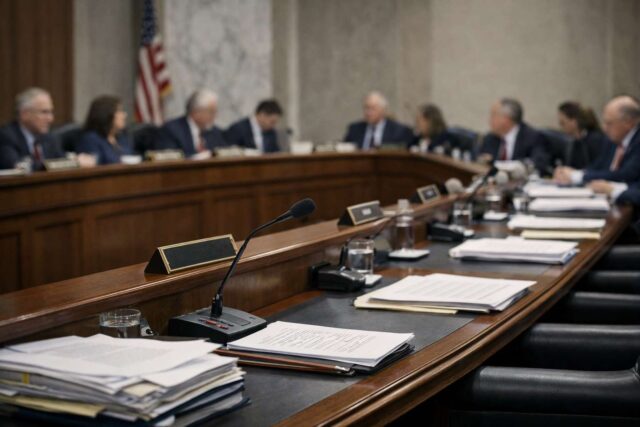
Editorial illustration, Senate committee room during the Senate crypto market structure vote on digital asset regulation

TL;DR

  • The Senate Agriculture Committee advanced its version of the crypto market structure bill in a narrow, party-line markup vote, establishing a baseline Senate text.
  • Republicans and Democrats share broad goals on regulatory clarity but remain divided over DeFi coverage, consumer protections, and governance concerns.

The Senate crypto market structure vote marked a procedural milestone for digital asset regulation in the United States. The markup advanced out of the Senate Agriculture Committee on a narrow, 12-11 party-line vote. Democratic members voted no, though they reiterated their support for clearer federal rules for crypto markets. While the vote did not resolve outstanding disputes, it did establish a baseline framework for further work and potential alignment with the Senate Banking Committee as the Senate process continues.

The outcome underscores a shift from abstract debate toward legislative sequencing. Lawmakers now have a concrete text to refine, align, or amend as discussions move forward.

The markup outcome and why it still matters

The Senate Agriculture Committee crypto markup succeeded despite unified Democratic opposition. That result matters because it moved the crypto market structure from discussion into a formal legislative procedure. The committee’s approval of the “Digital Commodity Intermediaries Act“ produced a working draft that can now serve as a reference point for negotiations, even if it lacks bipartisan backing at this stage.

The Senate crypto markup vote also clarified the limits of the current agreement. Yes, the bill advanced. But it did so without Democratic buy-in, underscoring that significant issues remain unresolved before any Senate floor consideration.

Where lawmakers agree on crypto market structure

Despite the split vote, there are emerging areas of overlap in how lawmakers view the problem. Many members of both parties generally recognize the need for clearer federal oversight of crypto markets. They also acknowledge that the current regulatory framework leaves gaps.

There is general recognition that the bill’s approach centers on digital asset intermediaries, such as exchanges and brokers, rather than attempting to regulate open-source software directly. In addition, the text reflects an effort to define a stronger role for the CFTC in crypto markets, paired with some degree of SEC-CFTC coordination. Democrats, however, have raised concerns about consumer protection and DeFi risks. They also question whether the CFTC has sufficient capacity and governance tools to take on an expanded mandate.

Why Democrats voted no despite shared objectives

Democratic members cited a range of unresolved issues as reasons for opposing the bill in its current form. One set of concerns raised by Democrats relates to the DeFi oversight debate. They argue that the legislation does not adequately address decentralized finance activity and could leave significant on-chain activity outside effective supervision.

Other objections focused on ethics, conflicts of interest, and consumer protection. Democrats said the text does not go far enough in addressing perceived political exposure or in setting clear enforcement standards. Taken together, these concerns explain why Democrats oppose the crypto bill at this stage, even as they continue to express support for establishing clearer market structure rules.

What happens next in the Senate process

Attention now turns to the Senate Banking crypto bill and related committee work. Banking Committee members are expected to continue developing their own framework, including on custody and stablecoin issues. That will shape the contours of any eventual compromise.

Observers anticipate that staff-level discussions will focus on reconciling differences between the Agriculture Committee text, the Banking Committee’s approach, and the House-passed CLARITY Act. Whether yesterday’s vote in the Senate Agriculture committee becomes a stepping stone towards broader legislative alignment will depend on how negotiations around the crypto market structure bill unfold.

For now, the markup reflects progress without closure. The bill has advanced procedurally, but the next phase will determine whether that momentum can translate into a path forward in the Senate.

Ethereum Turns Security Into Infrastructure, Not Just Talk

Visual representation of Ethereum’s infrastructure with visible internal layers, symbolizing the network’s shift toward treating security as core infrastructure.

Estimated reading time: 7 minutes

TL;DR

  • Ethereum security initiatives have moved from planning to execution, as the Ethereum Foundation announced funding for post-quantum research, while TheDAO Security Fund commits significant capital to ecosystem security work.
  • Quantum risk acts as a catalyst, but the response targets broader Ethereum protocol security, infrastructure hardening, and long-term resilience rather than an imminent threat.
  • By separating research leadership from capital deployment, Ethereum distributes security responsibility across institutions instead of centralizing it.

Ethereum’s recent security initiatives show an ecosystem that is no longer just discussing future risks, but actively funding and institutionalizing long-term security across multiple layers. Within days, two separate but aligned actions underscored that shift. The Ethereum Foundation launched a dedicated post-quantum security effort, while TheDAO Security Fund (rebooting 2016 edge-case ETH) announced a renewed mandate to deploy significant capital toward Ethereum security. Together, the moves signal a practical commitment to security that goes beyond statements or roadmaps.

Rather than framing security as an abstract concern, Ethereum is backing it with organizational focus and measurable resources. This approach reflects a broader effort to treat security as core infrastructure, not as a reactive response to isolated threats.

Ethereum institutionalizes security beyond short-term threats

For years, Ethereum security discussions often followed incidents, audits, or isolated research breakthroughs. The current phase looks different. Ethereum security initiatives are now being structured as long-term programs with dedicated teams, budgets, and governance boundaries.

The significance lies in the shift from ad hoc responses to institutionalized planning. By formalizing security work, Ethereum reduces its dependence on informal coordination and volunteer research. This signals an expectation that the network will need to manage evolving risks over decades, not months.

How the Ethereum Foundation is approaching post-quantum security

The Ethereum Foundation’s new initiative focuses on post-quantum security as a defined research and coordination domain. The effort includes a dedicated team and $2M in prizes ($1M new Poseidon Prize for hash/ZK hardening + $1M ongoing Proximity Prize). The stated goal is preparation, not emergency intervention.

The Ethereum Foundation’s security-related efforts emphasize research, ecosystem alignment, and long-term planning. There is no immediate proposal to change Ethereum’s core cryptography. Instead, the work centers on understanding migration paths, testing assumptions, and coordinating across clients, wallets, and tooling.

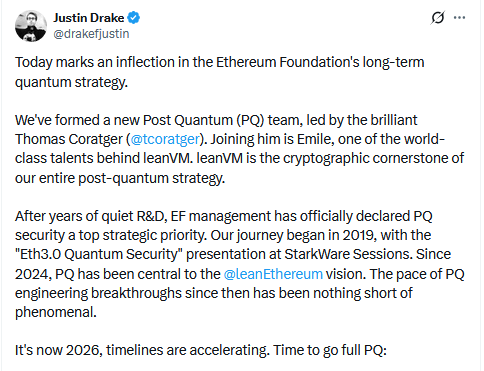
This framing is deliberate. Quantum security is treated as a future-facing risk that requires early groundwork rather than last-minute fixes. By investing now, the Foundation aims to avoid rushed decisions later. As Justin Drake noted, “Today marks an inflection… Time to go full PQ.”

X.com

Why post-quantum security forces broader protocol hardening

Post-quantum security research does not exist in isolation. Preparing Ethereum for post-quantum cryptography requires reviewing key management, validator assumptions, recovery mechanisms, and upgrade coordination.

As a result, the work naturally extends into long-term security planning. Even if quantum timelines remain uncertain, the research improves today’s security posture. Protocol hardening driven by post-quantum considerations also strengthens defenses against non-quantum failures.

This makes quantum risk a catalyst rather than a narrow objective. The outcome is a more resilient protocol, regardless of when quantum capabilities mature.

The DAO Fund’s new role in Ethereum security funding

Alongside the Foundation’s initiative, TheDAO Security Fund announced a renewed mission focused on Ethereum security funding. The fund plans to activate up to 75,000 ETH to support security-related work across the ecosystem.

This marks a clear shift in purpose. Historically associated with early DAO experimentation, the fund is now positioned as a capital allocator for security and infrastructure. Its mandate does not limit support to quantum research alone. Instead, it targets Ethereum protocol security and ecosystem resilience more broadly. As the fund explained, “69,420 ETH staked for yield, creating an endowment” for audits and wallets.

Importantly, the fund operates independently from the Ethereum Foundation. That separation allows it to deploy capital flexibly, without centralizing control or decision-making.

Security capital outside the Ethereum Foundation

Ethereum’s infrastructure security often depends on teams and researchers that sit outside formal institutions. TheDAO Security Fund’s structure enables it to support those efforts directly.

By keeping security capital outside the Ethereum Foundation, security governance becomes more distributed. Research coordination can remain institutional, while funding execution can adapt to evolving priorities. This reduces concentration risk and aligns with Ethereum’s broader governance culture.

The presence of both initiatives highlights complementary roles rather than overlap. The Foundation focuses on research and standards, while the fund emphasizes deployment and execution.

How the two initiatives reinforce Ethereum security

Viewed together, these actions reinforce Ethereum security initiatives across multiple layers. One provides organizational clarity and research direction. The other supplies capital and flexibility.

In practice, the split is functional. The Ethereum Foundation leads foundational research such as Poseidon and coordinates with client teams like Lighthouse and Prysm. TheDAO Security Fund focuses on execution, funding audits through firms such as Trail of Bits and supporting wallet security tooling via RFPs and platforms like Giveth. The combination creates broader coverage than either approach could achieve alone.

This division mirrors how mature infrastructure systems manage risk. Responsibilities are shared, not centralized. Funding is diversified, not dependent on a single budget. Oversight emerges through transparency and outcomes rather than hierarchy.

The ecosystem support, including Vitalik (as per reports), adds continuity without implying control. Public communication has emphasized alignment of purpose, not consolidation of authority.

Why this is about more than quantum risk

It would be inaccurate to describe these developments as solely about quantum threats. Quantum considerations provided a clear entry point, but the scope is wider.

Ethereum protocol security faces ongoing challenges unrelated to cryptography alone. These include client diversity, validator safety, tooling reliability, and upgrade coordination. Funding and organizing security work in these areas improves Ethereum ecosystem resilience regardless of quantum timelines.

Ethereum security initiatives framed around long-term planning also avoid alarmist messaging. There is no claim of imminent failure. Instead, the approach treats security as an evolving discipline that requires sustained investment.

Addressing skepticism without speculation

Some observers question whether these moves represent coordination or coincidence. The available information supports neither speculation nor grand narratives. What can be observed is behavior.

Resources are being allocated. Teams are being formed. Mandates are being clarified. These are concrete steps, not symbolic gestures. The absence of urgent language or dramatic claims further supports a measured interpretation.

Ethereum Foundation security planning and independent Ethereum security funding can coexist without formal linkage. In practice, that separation strengthens credibility by reducing centralization concerns.

What to watch as execution unfolds

The credibility of these initiatives will ultimately depend on follow-through. Observable signals will include public calls for proposals, named security projects, and transparent reporting on deployed funds. Developers can apply directly through thedao.fund for audits and tooling support, while investors will watch expected yields of roughly 4–6% and a potential 5–10% premium tied to post-quantum security positioning.

If those signals appear, Ethereum security initiatives will have moved firmly from intent to execution. If not, skepticism will be warranted. For now, the structure suggests preparation rather than performance.

Security treated as long-term infrastructure

Ethereum’s recent actions show a network that expects to endure. By funding research, organizing teams, and allocating independent capital, Ethereum is embedding security into its institutional fabric.

Ethereum security initiatives now extend beyond discussion. They reflect a deliberate effort to plan for future risks while improving present resilience. In infrastructure systems, that distinction matters.

Readers’ frequently asked questions

What does the Ethereum Foundation’s new post-quantum security team actually do day to day?

The team focuses on research, testing, and coordination around post-quantum cryptography, including evaluating cryptographic assumptions and aligning work across Ethereum clients and tooling. The Ethereum Foundation has not published a roadmap, deliverables, or an upgrade schedule.

How does the TheDAO Security Fund distribute its funds in practice?

The TheDAO Security Fund allocates ETH to security-related work such as audits, tooling, and infrastructure through application-based or proposal-driven processes. Funds are deployed independently of the Ethereum Foundation and are not tied to protocol governance decisions.

Who is eligible to receive funding from the TheDAO Security Fund?

Security auditors, wallet developers, infrastructure teams, and tooling projects that contribute to Ethereum security can apply. Funding is intended for practical security work rather than speculative development or token-based incentives.

What is in it for you? Action items you might want to consider

Developers and security teams: apply for security funding

If you are working on Ethereum-related audits, wallet security, client tooling, or infrastructure hardening, monitor application and RFP processes published by the TheDAO Security Fund. Funding is designed to support concrete security work rather than speculative development.

Track post-quantum research progress

Developers and infrastructure providers may want to follow research outputs from the Ethereum Foundation’s post-quantum initiative, particularly findings related to cryptographic assumptions, key management, and client coordination.

Investors: evaluate security-driven yield and positioning

Long-term investors can assess how security-focused capital allocation, including ETH staking yields in the 4–6% range and a potential post-quantum security premium, may influence Ethereum’s risk profile and infrastructure resilience over time.

Dubai Insurance Launches UAE’s First Crypto Wallet for Insurance Premiums and Claims

TL;DR

  • Dubai Insurance has launched a crypto-enabled insurance wallet, allowing policyholders to use crypto for premium payments and claims settlement within a regulated framework.
  • Zodia Custody supports the wallet with its institutional custody infrastructure, signaling a controlled approach rather than a retail crypto experiment.
  • The rollout positions the UAE insurance sector among regulated financial services testing crypto rails for core operational use cases.

Dubai Insurance has launched a crypto-enabled digital wallet that allows policyholders to pay premiums and receive claims payouts using digital assets. The initiative marks the first deployment of a crypto wallet within the UAE insurance sector and is positioned as an operational upgrade rather than a retail crypto play.

Dubai Insurance developed the wallet in partnership with Zodia Custody, which provides the custody and security infrastructure. According to public disclosures, the project focuses on integrating digital asset rails into existing insurance workflows while maintaining institutional governance and control standards. Coverage across the region has described the launch as a UAE-first, without framing it as a global precedent.

What the wallet enables in practice

The new wallet supports two core insurance functions: premium collection and claims settlement. For policyholders, this means they can use crypto payments to meet insurance policy obligations. At the same time, successful claims may be settled through the same digital channel. Dubai Insurance has described the tool as part of its broader digital transformation strategy, not as a standalone crypto product.

Public information indicates the wallet is focused on insurance flows (premiums and claims). There is no indication that features will extend to trading or broader retail and consumer functions. The focus is on settlement efficiency and secure custody, not on expanding crypto usage beyond defined insurance processes. This distinction matters for understanding how this insurance solution differs from common retail applications of digital asset wallets.

Why claims settlement matters more than payments

Surely, the option to pay insurance premiums with crypto will attract attention. However, the claims handling carries greater operational weight. Claims payouts sit at the center of trust between insurers and policyholders. They involve verification, reconciliation, and regulatory oversight, all under tighter scrutiny than inbound payments.

Therefore, supporting the settlement of insurance claims via crypto represents a deeper integration step. It shows that insurers are testing digital assets not only at the point of collection, but also at the point where they must deliver value to customers. Dubai Insurance’s wallet addresses both sides of the insurance ledger rather than treating crypto as a one-way payment option.

Custody as the core infrastructure choice

A central feature of the launch is the reliance on institutional custody. Zodia Custody provides the secure storage and operational controls that underpin the wallet. This framing places institutional crypto custody ahead of user-facing features, which aligns with the risk profile of insurance operations.

For insurers, custody arrangements define how assets are safeguarded, audited, and governed. Outsourcing this layer to a regulated custody provider enables crypto-based transactions without the need to manage private keys internally. At the same time, Dubai Insurance involving Zodia Custody reinforces the message that the wallet must meet institutional standards rather than consumer experimentation thresholds.

Positioning within the UAE insurance market

All available reporting frames the initiative as a first for the local market. It is consistently described as a milestone for UAE’s insurance sector. Similar crypto-enabled insurance products exist in other jurisdictions, for example, in Switzerland, but the structure and regulatory context differ.

Within the UAE, the wallet aligns with ongoing efforts to integrate digital assets into regulated financial services. UAE banks and payment firms have already explored crypto-based payments within the regulator’s framework. Insurances adopting crypto extends this pattern into a sector known for conservative risk management, hence this launch reflects a controlled step within domestic regulatory expectations.

What remains undisclosed

Despite broad coverage, several operational details have not been publicly specified. Dubai Insurance has not disclosed which digital assets the wallet will support, whether conversion to fiat occurs automatically, or how it will structure transaction limits. Eligibility criteria and rollout scope have also not been detailed.

These omissions suggest a phased or controlled deployment. In regulated financial environments, insurers often introduce new settlement rails gradually, with limits and internal controls refined over time. The absence of granular disclosure does not weaken the announcement, but it does define its current scope.

Why this matters beyond crypto headlines

Dubai Insurance’s launch of its own crypto wallet highlights how digital assets are being tested inside core financial operations, not just at the margins. The emphasis is not on novelty, but on whether crypto rails can function reliably within established insurance processes.

As insurers, banks, and asset managers explore regulated digital infrastructure, this development shows how crypto adoption is progressing in the insurance sector. The focus on premiums, claims, and custody highlights a shift from experimentation toward operational integration, within clearly defined regulatory boundaries.

- Advertisement -

FEATURED