Home Blog Page 56

Two Senate Committees, One Question: How US crypto regulation market structure Is Taking Shape
Estimated reading time: 7 minutes

TL;DR

  • The Senate is advancing crypto market structure legislation on two tracks, with the Agriculture Committee moving toward a January 29 markup while the Banking Committee’s timeline remains fluid after cancelling its own markup.
  • The Agriculture proposal focuses on commodities-style oversight and market infrastructure, while the Banking approach emphasizes investor protection, disclosure, and securities-style regulation.
  • Despite different committee mandates, both proposals overlap on regulating intermediaries, tightening custody standards, and reducing risks from platform failures.
  • The near-term path for crypto regulation and market structure now depends on whether the Agriculture markup succeeds and whether the two committee approaches can be reconciled amid broader legislative constraints.

Since mid-2025, the U.S. Senate has been advancing crypto market structure legislation along two parallel tracks. The Senate Agriculture Committee and the Senate Banking Committee’s work is based on different statutory mandates. But ultimately, both are grappling with the same question: how US crypto regulation should shape market structure as digital asset intermediaries mature.

This dual-track approach is not accidental. Senate committees are organized by jurisdiction, and digital assets now sit at the intersection of commodities markets, securities law, and consumer finance. As a result, lawmakers have produced two legislative frameworks that differ in emphasis but overlap in scope.

Recent procedural developments clarify the current state of play. The Agriculture Committee has concrete text and a scheduled markup. The Banking Committee has released draft language but faces more open political questions following the cancellation of its markup. Together, these tracks illustrate a process that is active, but uneven.

What the Senate Agriculture Committee’s Crypto Proposal Covers

The Senate Agriculture Committee proposal approaches crypto primarily through the lens of commodities markets. Chairman Boozman released an updated ‘Digital Commodity Intermediaries Act‘ draft on January 20, 2026, building on the bipartisan November 2025 discussion draft. The committee has scheduled a markup for January 29, 2026, rescheduled from January 27 due to severe weather.

The framework treats many digital assets as digital commodities and places primary oversight responsibility with the Commodity Futures Trading Commission. It focuses on market infrastructure rather than consumer finance. Core coverage extends to exchanges, brokers, dealers, and custodians that facilitate trading or hold customer assets.

Key provisions emphasize registration, operational standards, and supervision of intermediaries. Custody and segregation requirements are central, reflecting lessons from past intermediary failures rather than concerns about price volatility.

The Agriculture proposal also draws explicit boundaries between software development and financial intermediation. Regulatory obligations attach when an entity exercises control over transactions or customer assets, not when it merely publishes code or operates network infrastructure.

Overall, the Agriculture draft functions as a market infrastructure framework. Its objective is to bring crypto trading activity within a defined regulatory perimeter while preserving distinctions between code, protocols, and custodial services.

How the Senate Banking Committee Approaches Crypto Regulation Differently

The Senate Banking Committee proposal reflects a different regulatory tradition. On January 12, 2026, Chairman Tim Scott released an amendment titled the Digital Asset Market Clarity Act, building on a July 2025 RFIA-style draft that closely parallels the House-passed Digital Asset Market Clarity Act.

The Banking Committee had scheduled a markup for January 15, 2026, but cancelled it following industry opposition. Notably, Coinbase publicly withdrew its support. Since then, the timeline has remained fluid, with consideration potentially slipping to late February as other legislative priorities, including housing and fiscal matters, take precedence.

Substantively, the Banking approach leans more heavily on investor protection and consumer finance concepts. It relies on securities law principles and assigns a larger role to the Securities and Exchange Commission, particularly for securities-like tokens, yield-bearing products, and stablecoin incentives subject to disclosure requirements, as reflected in Clarity Act provisions on stablecoin rewards.

At the same time, the Banking draft does not cede market structure entirely to Agriculture. It carves out a role for the CFTC in supervising digital commodities and addresses token classification directly, recognizing that not all crypto assets function as securities.

The Banking framework assumes that many crypto platforms resemble traditional financial services from a user perspective. As a result, consumer expectations, disclosure, and balance-sheet risk receive greater emphasis than trading mechanics alone.

Where Senate Crypto Regulation Overlaps Across Both Committees

Despite different starting points, the two proposals share substantial common ground. Both assume that large-scale crypto intermediaries cannot operate indefinitely outside regulatory oversight.

Registration is a shared baseline. Exchanges, brokers, and custodians are expected to operate within defined supervisory frameworks rather than relying on voluntary standards.

Custody and segregation requirements also overlap. Both proposals restrict how intermediaries may use customer assets and emphasize clear treatment of customer property during insolvency or enforcement actions.

Consumer harm is another area of convergence. While the committees prioritize different tools, both recognize that losses at scale can become a public policy issue as adoption expands.

These overlaps exist because both committees regulate the same market actors, even as they approach the task from different statutory angles.

SEC vs CFTC crypto: The Regulatory Divide Shaping Crypto Market Structure

The most visible distinction between the two approaches is the allocation of regulatory authority. The ongoing debate over SEC vs CFTC crypto oversight runs through both proposals.

The Agriculture Committee places the CFTC at the center of oversight for digital commodity markets, particularly spot trading in non-security tokens. The Banking Committee assigns greater responsibility to the SEC where assets or products resemble securities or investment contracts.

Taken together, the drafts trend toward a hybrid jurisdictional model. The CFTC would serve as the primary regulator for specified digital commodities, while the SEC would oversee securities, ancillary services, and consumer-facing products tied to disclosure and investor protection.

This split reflects institutional mandates rather than disagreement over the need for regulation.

Crypto Market Intermediaries, Custody Rules, and Consumer Protections

Both proposals converge most clearly on the regulation of crypto market intermediaries. Entities that custody assets or execute trades on behalf of users are central to both frameworks.

Crypto custody regulation focuses on asset segregation, record-keeping, and operational controls. These measures are designed to reduce uncertainty when an intermediary fails, not to eliminate market risk.

Consumer protections emerge indirectly through these rules. By constraining how intermediaries handle customer assets, lawmakers aim to reduce the severity of losses without offering guarantees.

As adoption grows, this focus reflects a shift toward users who may not distinguish between custodial platforms and traditional financial services.

Can the Two Committees Reconcile Their Crypto Asset Market Structure Bills?

Reconciliation would require aligning statutory authority rather than replacing either framework. Several paths remain possible.

One approach would involve sequential movement, with one bill advancing first and elements of the other incorporated through amendments. Another would rely on activity-based thresholds to determine when SEC or CFTC oversight applies.

A hybrid outcome is plausible. For example, centralized exchange spot trading in BTC or other non-security tokens would likely fall under CFTC oversight consistent with the Agriculture approach, while a yield-bearing stablecoin resembling a deposit would fall under SEC jurisdiction with disclosure requirements under the Banking framework.

Any reconciliation would clarify boundaries rather than remove trade-offs.

What Happens After Committee Approval

Committee passage is only an early step. Even if the Agriculture Committee advances its bill on January 29, 2026, several hurdles remain.

Senate floor time is constrained, particularly with shutdown risks looming. Bipartisan support will be necessary for passage, and coordination with the House adds another layer of complexity.

Early-2026 Senate votes now hinge on the Agriculture markup succeeding, while Banking delays increase the urgency to reconcile between the two approaches. Implementation would also require extensive rule-making and agency coordination.

As a result, US crypto regulation is likely to shape market structure gradually rather than through a single legislative act.

Where the Process Stands Now

At present, the Agriculture Committee has concrete text and a scheduled January 29 markup, while the Banking Committee has released draft language but faces a fluid timeline following its cancelled markup.

The two approaches are closer than surface narratives suggest. Both accept regulation of intermediaries as a baseline and emphasize custody and accountability, building on concepts first advanced in the House Digital Asset Market Clarity Act.

The process remains active. With the Agriculture markup occurring tomorrow and Banking negotiations unresolved, the direction of US crypto regulation and market structure will depend on whether the two committees’ approaches can be aligned within a crowded legislative calendar.


UK Bans Coinbase’s ‘Everything Is Fine’ Ads Over Crypto Risk Messaging

TL;DR

  • UK regulators banned Coinbase ads from the “Everything Is Fine” campaign after ruling that the messaging trivialized cryptocurrency investment risks by linking crypto to cost-of-living pressures.
  • The Advertising Standards Authority acted following complaints from members of the public and found the campaign breached social responsibility standards, even though it contained no explicit call to invest.
  • The ruling follows an earlier broadcast rejection and reinforces tighter UK scrutiny of how crypto platforms market high-risk products to mass audiences.

UK regulators banned Coinbase ads tied to its “Everything Is Fine” campaign after concluding the messaging trivialised crypto investment risk. The decision by the Advertising Standards Authority follows an earlier rejection of the same campaign for television broadcast and revisits longstanding concerns over how crypto platforms market high-risk products to the general public in the UK.

Why Coinbase Ads Were Banned in the UK

The ASA Coinbase ruling concluded that the campaign breached social responsibility standards after receiving 35 complaints from members of the public. The regulator said the ads risked presenting complex, volatile investments as an obvious response to financial pressure. The ruling applies to video and outdoor formats and requires that the materials must not appear again in the form complained of.

The Advertising Standards Authority Coinbase assessment said the ads linked real economic hardship to a call for change while placing the Coinbase brand at the centre of that message. In its view, that positioning could lead consumers to infer that crypto offered a solution to widespread financial stress.

Coinbase’s “Everything Is Fine” Advertising Campaign

The Coinbase “Everything Is Fine” campaign launched in mid-2025 across multiple channels. It included a musical-style video and a series of posters displayed in London Underground and major rail stations.

The creative concept relied on dark satire. Characters sang cheerfully while facing rising living costs, job insecurity, and declining purchasing power. The tagline, “If everything’s fine, don’t change anything,” appeared alongside Coinbase branding at the end of the video and on the posters.

Coinbase said the campaign aimed to provoke reflection rather than promote a specific product. The company argued that there was no explicit call to action and that the tone was clearly exaggerated.

Clearcast’s Rejection and the Limits of UK Crypto Advertising Rules

Before the ASA issued its ruling, the campaign faced resistance from Clearcast. Clearcast rejected the advertisement for television broadcast during pre-clearance in summer 2025.

Clearcast’s decision did not constitute a formal ban. It applied only to broadcast advertising and did not prevent the campaign from running online or in outdoor locations. The rejection reflected concerns about compliance with UK crypto advertising rules for television, particularly where ads might imply investment solutions to economic problems.

The campaign continued to run in non-broadcast formats until complaints triggered a full ASA investigation. The later Coinbase advertising ban represents a separate enforcement step with broader effect.

Coinbase’s Response to the ASA Ruling

Coinbase defended the campaign during the investigation. It said consumer awareness of cryptocurrency had increased significantly and that the satirical tone was obvious to viewers. The company also cited internal safeguards, including onboarding checks and cooling-off periods.

The ASA rejected these arguments. It said awareness did not equate to understanding and that safeguards applied only after a consumer engaged with the platform. According to the regulator, the responsibility lay with the advertising itself.

How the ASA Applies Social Responsibility Standards to Crypto Advertising

The ASA assessed the ads under CAP Code rules on social responsibility. It focused on how crypto advertising UK reaches broad audiences in public spaces and on mainstream platforms.

The regulator acknowledged the use of humour. It concluded, however, that humour did not remove the underlying message. By juxtaposing financial hardship with a call to change, the ads risked minimising the dangers of a high-risk investment.

The assessment also highlighted audience vulnerability. The campaign appeared in locations where it would be unavoidable. That exposure increased the likelihood that people facing financial difficulty would encounter the messaging.

Coinbase’s Previous Advertising Ban in the UK

The latest ruling was not Coinbase’s first encounter with the regulator. In 2021, a Coinbase Facebook ad was banned after complaints about misleading claims and insufficient risk disclosure were upheld, creating a precedent for crypto advertising rules in the UK.

The 2021 case focused on product-specific issues. These included performance claims, implications about regulation, and the absence of clear warnings. The 2026 ruling differs in emphasis. It centres on social responsibility rather than technical disclosure.

Both cases reflect a consistent regulatory view that crypto investments carry high risk and require careful marketing.

What UK Crypto Advertising Rules Require Today

Since late 2023, the UK has operated a tighter financial promotions regime for cryptoassets. These UK crypto advertising rules require clear warnings and prohibit misleading impressions about risk or suitability.

The ASA operates alongside the Financial Conduct Authority (FCA) within this framework. The FCA oversees authorisation and compliance, while the ASA enforces advertising standards.

Recent enforcement shows that regulators are scrutinising not only what ads say, but how messages are framed and where they appear.

What the Ruling Means for Coinbase and UK Crypto Marketing

For Coinbase UK marketing teams, the ruling narrows the margin for creative experimentation. Campaigns that link crypto to everyday financial challenges now face higher regulatory risk.

More broadly, the decision signals that regulators will continue to apply social responsibility standards to mass-market crypto advertising. Firms operating in the UK will need to ensure that tone, context, and placement do not imply that high-risk assets offer easy answers to economic pressure.

The ruling does not impose a financial penalty. It does, however, reinforce the boundaries within which crypto firms must operate when addressing the general public.

Readers’ frequently asked questions

Why did the Advertising Standards Authority ban the Coinbase ads?

The Advertising Standards Authority concluded that the “Everything Is Fine” campaign breached social responsibility rules by trivialising the risks of cryptocurrency investment. The regulator found that linking crypto messaging to cost-of-living pressures could imply that a high-risk, volatile asset class offered an answer to financial hardship, even without an explicit call to invest.

Who filed the complaints that triggered the ASA investigation?

The investigation was triggered by 35 complaints from members of the public. The ASA did not identify competitors, advocacy groups, or public authorities as complainants in its ruling.

Does the ruling mean cryptocurrency advertising is banned in the UK?

No. Cryptocurrency advertising remains legal in the UK, but it is subject to strict rules. Ads must clearly communicate risk, avoid misleading impressions, and comply with social responsibility standards, particularly when targeting broad or vulnerable audiences.

What Is In It For You? Action items you might want to consider

Review creative context, not just risk disclaimers

If you operate or market a crypto platform in the UK, assess tone, implied meaning, and placement alongside standard warnings. Messaging that links crypto to economic stress or personal financial pressure may attract regulatory scrutiny even if disclosures are present.

Treat lifestyle-led crypto campaigns with caution

If you encounter broad, mainstream crypto advertising, separate brand storytelling from investment reality. UK regulators continue to stress that cryptocurrency investments are high risk and may not be suitable for all investors, regardless of how campaigns frame the message.

Align marketing and compliance early

If you work in marketing or compliance, involve legal and risk teams at concept stage. UK enforcement increasingly focuses on implied meaning, audience vulnerability, and where ads appear, not only on explicit claims.

Alleged $40M Seized Crypto Case Exposes Weak Links in Government Custody

TL;DR

  • Reporting and on-chain analysis have put custody arrangements for seized crypto under scrutiny after roughly $40 million in transfers exposed weaknesses in access controls.
  • An on-chain investigation relied on blockchain transparency to surface the activity, underscoring ongoing risks in crypto custody for governments and institutional custodians.

Allegations that tens of millions of dollars in seized cryptocurrency were illegally accessed from government crypto wallets have placed renewed scrutiny on how seized digital assets are controlled after law enforcement actions. The case centers on the custody of seized crypto assets, not a failure of blockchain networks. Reporting and on-chain evidence have instead focused on access permissions and oversight within government-linked custody arrangements.

U.S. authorities have confirmed they are reviewing the claims. Public reporting has emphasized internal access controls rather than external hacking activity.

How the Alleged Movements From Government Crypto Wallets Were Detected

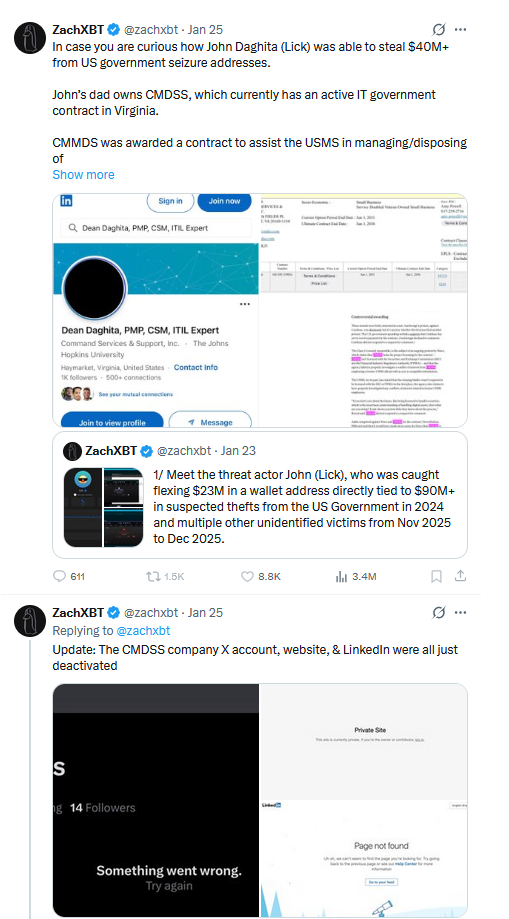
The allegations first surfaced through an on-chain investigation published by blockchain investigator ZachXBT. The analysis linked wallet activity to John “Lick” Daghita. He identified transfers traceable to addresses associated with seized assets managed under U.S. government authority.

According to the disclosures, a recorded Telegram dispute triggered the investigation. In that dispute, Daghita allegedly screen-shared wallet balances, showing more than $23 million in assets. Those wallets were later traced to addresses connected to long-standing U.S. seizure cases. This included funds seized from the 2016 Bitfinex hack. Because the transactions occurred on public blockchains, these movements from government crypto wallets were immediately visible once flagged.

@ZachXBT

Blockchain Transparency Versus Institutional Oversight

The episode illustrates the contrast between blockchain transparency and institutional monitoring. Public blockchains provide immutable transaction records that enable independent review. Custody oversight, however, operates off-chain through private keys, access permissions, and internal procedures.

In this case, blockchain records did not prevent the transfers. However, they did enable rapid external scrutiny. The incident has therefore raised questions about institutional crypto custody models that rely on trusted access rather than continuous external verification.

How Seized Crypto Assets Are Held and Controlled

After confiscation, authorities typically transfer seized crypto assets into wallets controlled by the U.S. government. Specialized custody contractors often provide operational support for the transactions. One such contractor, CMDSS, holds a 2024 contract with the U.S. Marshals Service. The contract covers management of certain categories of seized digital assets, including non-mainstream tokens.

These arrangements depend on defined access roles, internal audits, and key management policies. Reporting around this case has focused on crypto custody risk tied to how access privileges are assigned and monitored. The issue has not been framed as a technical exploit. Instead, the allegations point to insider access risk in the structure of seized crypto custody, as authorized users moved assets without immediate detection.

Scale of the Allegations and Asset Movements

ZachXBT’s analysis estimates that more than $40 million in seized cryptocurrency may be linked to the wallets in question. Some reporting references exposure to significantly higher transaction flows. One wallet identified in the disclosures reportedly held 12,540 ETH. That amount was valued at approximately $36 million at the time of analysis.

The investigation also highlighted activity in October 2024. During that period, roughly $20 million was moved. Most of those funds were later returned. Approximately $700,000 remains unaccounted for based on publicly available tracing. ZachXBT further disclosed that he received a small ETH transfer directly from one of the flagged wallets. This detail reinforced claims that the funds originated from seized sources.

Precise totals remain unconfirmed. Authorities have not released independent figures.

What Authorities Have Confirmed So Far

U.S. officials have stated that they are investigating claims of unauthorized access involving seized digital assets. The U.S. Marshals Service has confirmed that it is reviewing the allegations. It has not characterized the activity as a confirmed theft or protocol breach.

Public statements have remained limited. This reflects the sensitivity of digital asset seizure processes and the ongoing nature of the review. Authorities have emphasized that no conclusions have yet been reached.

Why Seized Crypto Custody Matters for Institutions

The implications extend beyond this case. The U.S. government controls substantial government-held bitcoin. Estimates place total holdings between roughly 198,000 and more than 300,000 BTC. Governments increasingly retain seized cryptocurrency rather than liquidating it immediately. As a result, custody controls become more critical.

Financial institutions relying on institutional crypto custody face similar challenges. Weaknesses in seized crypto custody can undermine confidence in broader custody models. This is particularly true where access controls and audit mechanisms lag behind the transparency of blockchain records.

Secondary Developments and Public Optics

Following the public exposure of the allegations, John Daghita launched a meme token known as $LICK on pump.fun. He retained a significant share of the supply. He also promoted the token through Telegram streams. These developments have drawn attention. They remain secondary to the core custody and oversight questions raised by the case.

Conclusion

The allegations surrounding the $40 million seized crypto case have shifted focus toward custody of seized crypto and the internal controls governing access to government-managed digital assets. Blockchain transparency enabled early detection of the activity. Off-chain permission structures emerged as the point of concern. As investigations continue, the case highlights ongoing crypto custody risk in environments where asset visibility exceeds the robustness of institutional oversight.

Ripple and Riyad Bank’s Jeel Sign MoU to Explore Blockchain Applications for Financial Services Under Vision 2030

TL;DR

  • Ripple‘s latest partnership in Saudi Arabia with Riyad Bank and its innovation arm Jeel explores blockchain applications for financial services.
  • The collaboration focuses on cross-border payments, digital asset custody, and tokenization with work conducted through regulated pilots and sandbox programs.

Ripple has signed a memorandum of understanding (MoU) with Riyad Bank through its innovation arm Jeel. The MoU establishes a partnership to explore blockchain applications for financial services in Saudi Arabia. Multiple reports link the collaboration to Saudi Arabia’s Vision 2030 agenda to modernize financial infrastructure and expand the Kingdom’s fintech ecosystem.

The partnership is framed as an MoU to explore use cases through controlled trials and sandbox environments. Any broader deployment would be subject to regulatory approval. Public disclosures emphasize collaboration and experimentation, but do not announce a confirmed commercial rollout.

Scope of the Ripple Riyad Bank MoU

Under the Ripple Riyad Bank MoU, the two parties will work together to assess blockchain use cases relevant to institutional finance. Public statements highlight cross-border payments, digital asset custody, and asset tokenization as key areas of focus.

The MoU sets out a collaborative framework to explore these applications, which includes proofs of concept and technology trials within Jeel’s regulatory sandbox. Public materials do not outline production timelines or specific live customer-facing services. Any wider deployment will depend on regulatory and performance outcomes.

Blockchain payments in a Saudi institutional context

A central theme of the collaboration is assessing how blockchain technology could support cross-border and institutional payments within Saudi Arabia. Saudi banks continue to evaluate whether blockchain-based systems can improve efficiency and transparency. These assessments are being conducted while maintaining compliance with domestic regulatory requirements.

So far, public disclosures focus on sandbox trials and proofs of concept. They do not confirm production-scale transaction processing or customer-facing launches. Some trials may involve realistic transaction scenarios within controlled environments.

Vision 2030 alignment and fintech development

The Ripple partnership is explicitly positioned within Vision 2030, Saudi Arabia’s long-term economic transformation program. Vision 2030 prioritizes digital transformation and the development of advanced financial services. The program typically assesses new technologies through regulated pilots before considering broader adoption.

Within this context, the Jeel–Ripple collaboration follows an established approach rather than signaling a blanket policy endorsement. Saudi authorities frequently rely on regulatory sandboxes and pilot programs to evaluate fintech innovations in a supervised environment.

Ripple Middle East expansion through institutional partnerships

From Ripple’s perspective, the agreement supports its broader Middle East expansion strategy. Coverage of the deal frequently places it alongside Ripple’s efforts to deepen relationships with banks and financial institutions. This approach is most visible in regulated markets across the region.

The Saudi partnership revolves around enterprise and institutional use cases. It does not focus on retail crypto offerings. Within this context, this blockchain partnership with Saudi Arabia strengthens Ripple’s presence in a key regional market. It also aligns the company with local regulatory structures.

Regulatory posture and sandbox framework

Saudi authorities commonly use sandbox programs and pilot frameworks to supervise fintech experimentation. The Jeel–Ripple collaboration will operate within such a sandbox, allowing controlled testing under regulatory oversight.

Saudi policymakers use such blockchain pilots to balance innovation with financial stability. It enables institutions to assess new technologies without committing to full-scale deployment. Regulatory and operational requirements must be met first.

What the partnership does not signal

Public materials related to the MoU do not mention XRP usage, revenue impacts, or specific deployment schedules. They also do not describe the agreement as an endorsement of particular digital assets. Neither do they name any public blockchain networks in this context. Hence, market commentary linking the announcement to token price movements reflects interpretation. It does not reflect confirmed elements of the partnership itself.

Directional signal rather than confirmed rollout

Overall, the agreement highlights how Saudi financial institutions are exploring blockchain technology. This work takes place as part of a structured fintech development strategy. For Ripple, it represents another step in building institutional partnerships within regulated environments.

Saudi Arabia’s blockchain partnership with Ripple signals intent and strategic alignment under Vision 2030. Concrete outcomes remain dependent on the results of sandbox trials. Regulatory review will also play a decisive role.

Bitcoin Hashrate Drop as US Winter Storm Forces Texas Miners Offline

TL;DR

  • A severe US winter storm triggered a Bitcoin hashrate drop after Texas-based miners temporarily shut down operations.
  • The disruption was short-lived, with protocol mechanisms and coordinated demand response allowing Bitcoin mining operations to resume without affecting long-term network stability.

The severe winter storm in the US led to a pronounced drop in Bitcoin’s hashrate, disrupting mining activity across the country. The most significant impact was concentrated in Texas. As temperatures fell and electricity consumption surged, Texas Bitcoin miners curtailed operations during peak demand to reduce stress on the power grid.

The disruption pushed the Bitcoin network hashrate to its lowest level in roughly seven months. The decline was driven by weather and energy constraints, not by changes in market conditions or mining economics.

Winter storm leads to Bitcoin mining shutdowns

The storm brought extreme cold, ice accumulation, and record electricity demand across multiple states. In Texas, where a large share of industrial capacity is located, Bitcoin mining shutdowns followed as grid operators moved to preserve stability.

During the storm’s peak, miners powered down operations in coordination with grid operators. These curtailments are temporary and aimed at protecting critical infrastructure during periods of exceptional demand.

Texas power grid and demand response

Mining facilities in Texas participate in energy demand response arrangements that place operators in direct coordination with grid managers during periods of peak stress. These arrangements allow large industrial consumers to reduce electricity usage during emergencies, freeing capacity for residential and essential services.

As a result, Bitcoin facilities now operate as a flexible component of the state’s energy system. During extreme weather, mining activity is among the first loads to be reduced, reflecting its role within broader grid management strategies.

Network effects and protocol response

The coordinated shutdowns caused a measurable slowdown in block production. Fewer machines contributed to computing power during the curtailments. The protocol responds automatically, adjusting the mining difficulty and recalibrating block intervals as available hash power changes. As a result, the drop in Bitcoin’s hashrate reflected an operational pause rather than miner distress, with Bitcoin mining operations resuming once electricity demand eased.

Policy relevance for mining and energy markets

Events like this continue to shape how policymakers view Bitcoin mining and power grids. Mining facilities no longer act as fixed sources of consumption. Instead, they increasingly function as controllable industrial loads during energy emergencies.

As weather volatility increases, demand response participation is likely to remain central to discussions about infrastructure planning and energy market integration.

What the hashrate drop signals

The recent drop in Bitcoin’s hashrate illustrates how environmental and energy factors can influence short-term network metrics. It also shows how mining infrastructure and protocol design absorb disruptions without altering long-term security assumptions.

In this case, the decline reflects a temporary weather-driven interruption, not a structural shift in the Bitcoin network.

- Advertisement -

FEATURED