
Home Blog Page 57

Monday Reset: The Macro Signals That Will Decide Crypto Sentiment This Week

TL;DR

  • Crypto market sentiment starts the week driven by the January 30 U.S. funding deadline, Fed messaging, and bond yields, not crypto-specific headlines.
  • A risk-on flip likely needs shutdown clarity, softer Fed tone, stabilizing yields, and inflation data that reinforces gradual disinflation, with leverage still active across derivatives.

Crypto markets are starting the week under pressure, but the drawdown itself is not the story. The real question for traders and investors on Monday morning is what could flip market sentiment back to risk-on, and what would keep crypto markets pinned in defensive mode.

The latest risk-off move comes as Congress works against a January 30 funding deadline, just weeks after the record-long U.S. government shutdown that only ended in mid-November 2025. That political overhang has coincided with renewed volatility across risk assets, including crypto, where leverage remains elevated despite recent pullbacks.

This sets up a familiar but fragile environment: positioning has lightened since early January, yet conviction remains thin. Direction this week will be dictated almost entirely by macro signals rather than crypto-specific news.

Political risk is the immediate overhang

The fastest sentiment catalyst remains clarity around U.S. government funding.

Most federal agencies are currently operating on stop-gap funding that expires January 30, forcing Congress to either pass the remaining spending bills or approve another continuing resolution. Markets do not require a long-term fiscal solution, but they do need the removal of a near-term deadline that introduces binary risk.

This matters even more because November’s reopening was just another temporary fix. Another short-term extension would reinforce the pattern of political uncertainty, but it would still reduce headline risk enough to calm markets.

Until funding clarity emerges, crypto and other risk assets are likely to trade defensively. When certainty arrives, regardless of quality, volatility typically compresses quickly.

Federal Reserve messaging still defines the medium-term trend

Beyond politics, the key variable is how markets interpret the Fed’s messaging at the start of 2026, after last year’s rate cuts.

Following multiple cuts in 2025, the Federal Reserve has entered a pause stance with inflation still above target. Markets are no longer pricing an aggressive easing cycle. Instead, they are debating whether the Fed merely holds rates steady or delivers a very shallow path of cuts later in the year, with consensus expectations now clustered around mid-2026 at the earliest.

In this environment, language matters more than action. Any acknowledgment that financial conditions have tightened, or any softening away from explicit “higher for longer” framing, would materially improve risk sentiment. Reaffirming the restriction, on the other hand, would cap rallies fast.
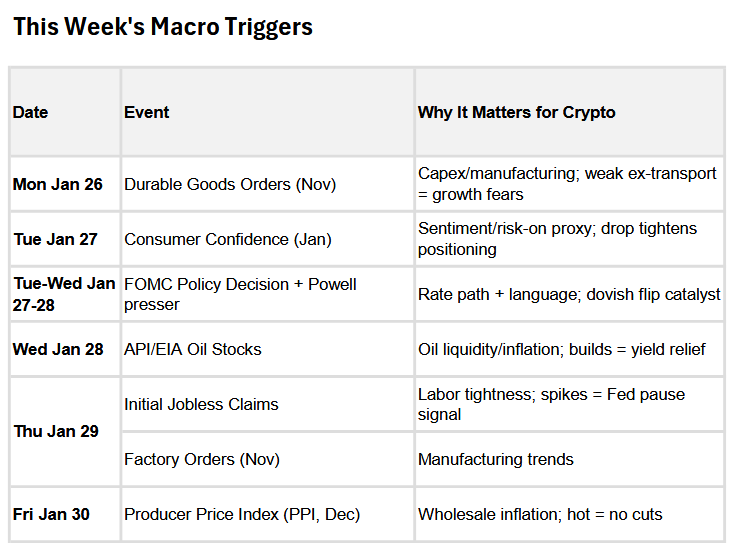
Macro Calendar: Risk Catalysts

Bond yields remain the key liquidity barometer

Equities and crypto continue to take their cues from the bond market.

Heavy Treasury issuance has continued into early 2026, pressuring term premiums higher and keeping yields elevated even as markets mark down the odds of early-year rate cuts. That dynamic has absorbed liquidity and limited risk appetite.

Markets will be watching:

  • Whether 10-year yields fail to make new highs
  • Demand strength at auctions run by the U.S. Treasury
  • Signs that term premiums are stabilizing rather than rising

Stable or lower yields would act as a relief valve for risk assets and help stabilize sentiment in the crypto market. Rising yields would continue to crowd them out.

Inflation data must reinforce gradual disinflation

Inflation remains the main constraint on monetary flexibility. Projections still show core inflation above the Fed’s 2% target for much of 2026, which limits how quickly policymakers can pivot toward meaningful easing.

This week’s data will matter less for headline numbers and more for trend confirmation. Markets are looking for:

  • No upside surprises
  • Continued cooling in services inflation
  • Consistency across releases

A single benign print helps sentiment. Repeated confirmation reinforces positioning. Any upside shock, however, would revive concerns that policy remains tighter for longer than markets can tolerate.

Earnings guidance feeds into crypto indirectly

Corporate earnings are not a direct crypto driver, but guidance continues to shape risk appetite and market sentiment.

Multiple cyclical and rate-sensitive sectors, like industrials, materials, regional banks, and consumer discretionary, have signaled caution entering 2026, citing higher funding costs and slower growth. That combination weighs on capital expenditure plans and reinforces defensive positioning across markets.

When equity confidence weakens, crypto typically follows with a short lag.
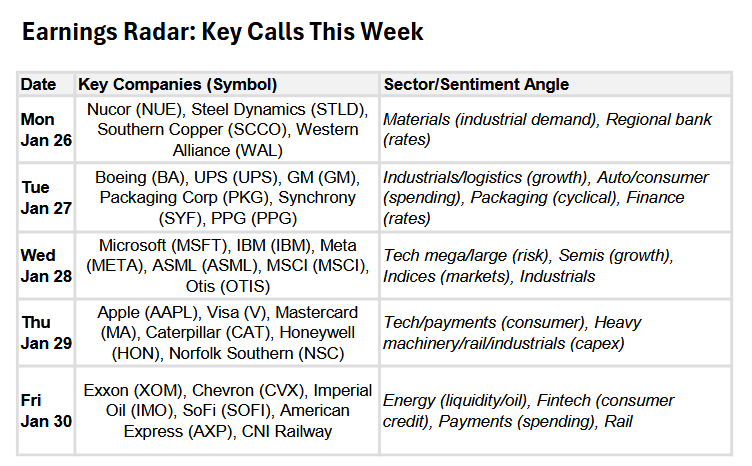
Watch these for macro commentary on growth, capex, and uncertainty.

The dollar remains a quiet tightening channel

The U.S. dollar continues to act as a background constraint on global liquidity.

With the Fed only gradually shifting toward eventual cuts, and other major central banks also remaining cautious, the dollar still has room to function as a quiet tightening mechanism. Sustained dollar strength tends to compress risk appetite across commodities, emerging markets, and crypto simultaneously.

For risk-on momentum to build, the dollar likely needs to at least stop strengthening.

Leverage has been reduced, but not reset

Recent liquidation waves have knocked back some of the froth in futures positioning, but aggregate derivatives open interest remains elevated by historical standards. Bitcoin futures open interest is still meaningfully higher than at the start of the year, while options open interest has overtaken futures in notional terms. That suggests that risk-taking has not disappeared, but is increasingly expressed through more structured or hedged exposures. This shift reduces immediate liquidation pressure, yet indicates that leverage across crypto markets has not fully reset.

In simple terms, futures are leveraged bets on price direction, while options are often used to hedge or structure exposure—meaning leverage can persist even as outright risk-taking cools.

What would flip sentiment this week?

Markets would likely turn decisively risk-on if several of the following align:

  • A funding deal or continuing resolution that pushes the shutdown deadline beyond January 30
  • Fed communication that reinforces a pause rather than renewed tightening
  • Stabilizing or lower Treasury yields
  • Inflation data that reinforces gradual disinflation
  • Earnings guidance that does not deteriorate further

Absent these signals, rallies are more likely to remain tactical than trend-defining. As long as macro uncertainty dominates, crypto will trade in line with market conditions rather than improving sentiment around the asset class itself.

Bottom line

What we are seeing is not a market searching for a bottom. This market is searching for certainty.

With political risk unresolved, monetary easing expected to be gradual at best, and liquidity still constrained, crypto remains firmly macro-driven. As seen during the 2025 shutdown episode, the macro calendar, rather than crypto headlines, will decide the week.


Nasdaq Removes Position Limits on Crypto ETF Options as Crypto Derivatives Scale

TL;DR

  • Nasdaq has implemented rule changes removing position limits on crypto ETF options, enabling uncapped options trading on Bitcoin and Ethereum ETFs.
  • SEC has a limited 60-day window to intervene.
  • The change reflects the normalization of crypto ETF options within existing U.S. derivatives rules.

Nasdaq, through several of its U.S. options exchanges, has submitted parallel rule change filings to the U.S. Securities and Exchange Commission (SEC) to remove Bitcoin ETF option limits. The filings, submitted by Nasdaq ISE, Nasdaq BX, Nasdaq PHLX, and related entities, took effect in mid-January after the SEC waived its standard 30-day review period.

As a result, the existing caps on how many contracts market participants may hold or exercise have already been lifted in practice. The SEC, however, retains authority to suspend, modify, or reverse the changes within 60 days of filing, a window that runs into early March.

The rule changes do not introduce new crypto products. They focus solely on how options tied to already approved crypto exchange-traded funds operate within U.S. derivatives markets.

Why option limits were applied in the first place

Position and exercise caps are a common risk-management tool in options markets. They aim to prevent excessive concentration, reduce manipulation risk, and support orderly trading during early market phases. When crypto ETF options were first listed, regulators applied position limits on ETF options to reflect uncertainty around liquidity and participant behavior.

Those constraints provided safeguards during market formation, not as permanent features. Nasdaq now argues that the conditions that justified those limits no longer apply.

Nasdaq’s case for removing the limits

In its filings, Nasdaq points to sustained growth in trading activity and market depth since spot crypto ETFs began trading. According to the exchange, options linked to these funds now display liquidity and participation profiles comparable to other established ETF options markets.

From Nasdaq’s perspective, Bitcoin ETF option limits have shifted from a risk control to a structural bottleneck. Removing them allows market makers and institutional participants to manage exposure more efficiently without altering the underlying regulatory framework.

The rule changes apply to both Bitcoin-based products and Ethereum ETF options, reflecting the broader scope of crypto ETF derivatives now active on U.S. exchanges.

Normalization through existing regulatory channels

The filings build on earlier SEC approvals, which already permit options trading on spot crypto ETFs. Nasdaq is not seeking to revisit those approvals. Instead, the exchanges are aligning crypto ETF options with the same rules that govern traditional ETF options.

In that context, lifting options limits on Bitcoin ETFs represents procedural normalization rather than deregulation. Crypto-linked options are being treated consistently with comparable derivatives tied to equities or commodity ETFs.

Expansion as a market consequence

Although regulatory in nature, the impact is tangible. Eliminating caps enables larger hedging positions, more flexible market-making strategies, and higher potential open interest. These changes expand how the products can be used, even though the products themselves were already live.

For participants active in Nasdaq crypto ETF options, the shift affects scale rather than access. Retail participation rules remain unchanged, and the underlying ETFs continue to trade under existing oversight.

What the rule changes do not affect

The filings do not alter the approval status of any crypto ETF. They do not change how spot Bitcoin or Ether markets are regulated. They also do not expand retail eligibility or signal a broader shift in crypto policy.

Instead, the changes focus narrowly on whether limits on Bitcoin ETF options remain appropriate given current liquidity and market structure. While the limits are no longer in force, the SEC maintains the ability to intervene during the statutory review window.

Regulatory status going forward

Because the SEC waived its initial review period, the rule changes are already effective. The agency may still suspend or revise them within 60 days of filing if concerns emerge. Absent such action, the rule changes removing Bitcoin ETF option limits are final.

The episode marks a further step in integrating crypto-linked derivatives into mainstream U.S. market infrastructure, without expanding the regulatory perimeter around digital assets themselves.

Readers’ frequently asked questions

Do the rule changes apply to all Bitcoin ETF options listed on Nasdaq?

The rule changes apply to Bitcoin and Ethereum ETF options listed on Nasdaq-operated options exchanges that submitted the filings, including Nasdaq ISE, Nasdaq BX, and Nasdaq PHLX.

Are position limits fully eliminated, or can they be reinstated?

The limits are currently removed, but the SEC retains authority to suspend or modify the rule changes within 60 days of filing if regulatory concerns arise.

Does this change affect margin requirements or options eligibility?

No. The rule changes only address position and exercise limits. Margin rules, eligibility requirements, and options trading permissions remain unchanged.

What’s in it for you? Action items you might want to consider

Review hedging strategies involving crypto ETF options

If you trade or manage exposure to Bitcoin or Ethereum ETFs, reassess existing hedging strategies in light of the removal of position limits, which may allow greater flexibility in options positioning.

Monitor SEC actions during the review window

Although the rule changes are already effective, the SEC retains authority to intervene within 60 days of filing. Market participants should track any regulatory updates that could alter current trading conditions.

Evaluate liquidity and pricing changes in ETF options markets

With position caps removed, options liquidity and pricing dynamics may evolve. Traders and risk managers may want to observe changes in spreads, open interest, and market depth before adjusting exposure.

Coinbase Rolls Out USDC Loans Backed by Staked Ethereum

Illustration showing staked Ethereum held securely in a vault while digital USDC flows outward, representing Coinbase USDC loans that allow users to borrow against cbETH without selling ETH.

TL;DR

  • Coinbase has launched Coinbase USDC loans, allowing eligible users to borrow up to $1 million in USDC using cbETH as collateral.
  • The loans are facilitated via the Morpho protocol on Base, with on-chain collateral management and automatic liquidations.

Coinbase has launched a new lending feature that allows users to borrow up to $1 million in USD Coin using staked Ethereum exposure as collateral. The product, described by the company as Coinbase USDC loans, is backed by cbETH. It enables borrowers to access liquidity without selling ETH or forfeiting staking rewards.

The rollout adds another component to Coinbase’s expanding suite of on-platform financial services. It targets users who hold Ethereum long term and want access to dollar liquidity while maintaining exposure to the underlying asset.

What Coinbase announced

Under the new program, eligible users can pledge cbETH as collateral and receive USDC loans through the Coinbase interface. Loan amounts can reach up to $1 million, depending on collateral value and risk parameters. According to Coinbase, they designed the feature to provide liquidity without requiring users to unwind staked positions.

Coinbase routes the loans through the Morpho lending protocol on Base, its Ethereum Layer 2 network. The protocol manages collateral on-chain, while Coinbase supplies the centralized interface, aggregates liquidity, and handles the user experience. Morpho’s smart contracts enforce loan terms and liquidations, rather than discretionary platform rules.

How cbETH is used as collateral

cbETH is Coinbase’s liquid staking token, representing ETH that has been staked through the platform. When users stake ETH, they receive cbETH, which reflects both the principal and accrued staking rewards. In this lending setup, cbETH-backed loans allow users to borrow while their underlying ETH continues to earn staking yield.

This structure makes it possible to borrow against staked Ethereum without selling the original asset. However, collateral value remains fully exposed to ETH price movements, and borrowing is therefore subject to on-chain risks tied to market volatility.

Loan limits and risk controls

The lending feature operates under predefined loan-to-value thresholds within an overcollateralized model. While Coinbase has not disclosed all parameters publicly, maximum loan-to-value ratios are reported to be in the mid-80% range. Borrowers must maintain sufficient collateral value relative to their outstanding loan balance.

As these USDC loans are backed by ETH, price volatility is the primary risk factor. If cbETH collateral falls below the required thresholds, the smart contracts on the underlying protocol will trigger liquidations automatically. Interest rates are variable, and there is no fixed repayment schedule. Users are responsible for monitoring their positions and managing risk throughout the loan period.

Positioning within Coinbase’s product strategy

The introduction of this Coinbase lending feature reflects a broader shift toward secured borrowing products integrated directly into the platform. Rather than emphasizing yield or experimental structures, the company has focused on conservative collateral requirements and clearly defined risk boundaries.

By enabling borrowing against platform-issued staking tokens, Coinbase extends its role beyond trading and custody. The approach mirrors traditional finance practices, where investors borrow against securities instead of liquidating long-term holdings, while blending centralized access with decentralized infrastructure.

The launch also comes amid renewed attention to crypto-backed lending models. After several high-profile failures in earlier market cycles, platforms have moved toward more restrained designs. Coinbase USDC loans align with that trend, combining on-chain enforcement with a controlled user interface.

Access and availability

The lending feature is rolling out to eligible Coinbase users in the United States, excluding New York, with more limited availability in the United Kingdom. Users must already hold cbETH on Coinbase to qualify for USDC loans. So far, the company has not indicated plans to support external staking tokens or non-custodial collateral at this stage.

As with other Coinbase products, participation requires acceptance of platform terms and ongoing compliance with account requirements. Coinbase has stated that rates, limits, and eligibility conditions may evolve over time.

By allowing users to unlock liquidity from staked Ethereum positions, Coinbase adds another option for managing capital without asset sales. The product combines DeFi-based lending infrastructure with a centralized access layer, offering a controlled approach to borrowing against long-term crypto holdings.

Readers’ frequently asked questions

Who is eligible to use Coinbase USDC loans?

Eligibility depends on jurisdiction and account status. The lending feature is currently available to eligible users in the United States, excluding New York, with more limited access in the United Kingdom. Users must hold cbETH within their Coinbase account to qualify.

Do these loans have a fixed repayment schedule or maturity date?

No. The loans do not have a fixed repayment term. Interest rates are variable, and borrowers can repay at any time, provided collateral requirements remain satisfied.

Can borrowers add or remove collateral while a loan is active?

Yes. Borrowers can manage their position by adding collateral or repaying part of the loan to improve their collateral ratio. Removing collateral is only possible if the remaining collateral continues to meet required thresholds.

What Is In It For You? Action items you might want to consider

Review cbETH exposure before borrowing

Borrowing against cbETH increases exposure to Ethereum price movements. Users should consider how a sharp price decline could affect collateral ratios and liquidation risk before taking a loan.

Monitor loan-to-value thresholds closely

Because liquidations are triggered automatically through smart contracts, borrowers should actively track collateral health and avoid operating near maximum loan-to-value limits.

Check eligibility and regional availability

Access depends on jurisdiction and account status. Users should confirm availability in their region and review current terms, rates, and limits before using the lending feature.

Ledger Engages Top Banks in Evolving IPO Discussions

TL;DR

  • Ledger IPO plans have advanced from a strategic question into an active capital-raising review. The company is now weighing public markets alongside private funding as viable options.
  • Recent reporting points to adviser involvement and valuation discussions, but no SEC filing or firm commitment has been disclosed.

The idea of Ledger IPO plans is not new. As early as November 2025, the crypto hardware wallet firm Ledger publicly acknowledged that a future listing was one of several strategic options under consideration. At the time, comments made by CEO Pascal Gauthier to the Financial Times and Sifted framed the discussion around long-term positioning rather than an active transaction.

What has changed since then is not the underlying logic, but the process now underway to determine how Ledger raises its next round of capital.

Recent reporting, led by the Financial Times and cited across multiple outlets, indicates that this evaluation has progressed from a conceptual discussion to a structured analysis. Seemingly, public markets are now treated as a viable funding route rather than a distant possibility.

November 2025: a strategic question, not a capital process

When the conversation on Ledger’s potential IPO plans surfaced last autumn, it was framed as a strategic consideration. Ledger had reached meaningful scale, with revenue in the hundreds of millions of dollars, according to comments made by Gauthier to the Financial Times. The company had also expanded beyond consumer hardware into enterprise-grade security and custody services.

However, the reporting at the time did not describe an active capital-raising process. It did not include the names of advisers. The valuation range was not discussed. No listing venue was identified. The coverage reflected strategic framing rather than execution planning.

Capital needs come first

Ledger is reviewing how to raise capital for its next stage of growth. This assessment involves weighing private funding against public markets, rather than committing to a single route from the outset.

At this stage, companies often engage external advisers to test multiple scenarios. They model valuations and assess market appetite. They review regulatory and jurisdictional implications. These steps do not require a firm decision to list. However, they do elevate an IPO from a theoretical option to a practical one.

What changed since then

According to Financial Times reporting published in January, Ledger is now working with major investment banks, including Goldman Sachs, Jefferies, and Barclays, as part of this evaluation. The same reporting cites people familiar with the matter as saying that discussions have included valuation scenarios exceeding $4 billion and a potential U.S. listing.

A Ledger US IPO would bring significant regulatory and disclosure requirements. The fact that these elements are now being actively assessed suggests that Ledger’s IPO plans have advanced within a broader decision process to raise capital. Ledger declined to comment publicly on the reporting.

Where the process stands today

Active evaluation, however, does not necessarily equate to commitment. There is no public evidence that Ledger filed an S-1 with the SEC, either public or confidential, despite ongoing IPO discussions. The company has yet to announce any transaction and a corresponding timeline.

While other crypto firms have previously pursued confidential filings ahead of potential listings, no such step has been reported for Ledger. Monitoring SEC filings remains the clearest way to confirm escalation beyond the current stage. A Ledger public listing remains one possible outcome, not a confirmed plan.

Valuation and positioning

The repeated reference to a multi-billion-dollar range introduces the first concrete benchmark. An IPO valuation at that level reflects the Ledger’s scale, revenue base, and relevance within crypto security infrastructure. It also places the firm among the larger potential crypto-related listings currently under evaluation in U.S. markets.

These figures are indicative rather than final. They signal that advisers are testing financial models against public-market comparables as part of a wider capital review.

Why this matters now

The importance of the current reporting lies in its specificity and sourcing. Named advisers, valuation ranges, and venue discussions typically appear only once capital strategy moves from abstract debate to structured assessment.

At the same time, the reliance on anonymous sources and the absence of formal filings underline the provisional nature of the process. Ledger IPO preparation is visible as part of a broader capital decision, not as confirmation of an outcome.

What to watch next

Confirmation of a confidential filing or clearer guidance on timing would indicate that the public route has been selected. Continued silence, or the announcement of a new private funding round, would point in the opposite direction.

For now, the story reflects evolution rather than inevitability. Ledger IPO plans have progressed from a strategic question into one option within an active capital-raising process, with public markets now firmly under consideration.

Circle Grant Powers UN Treasury Hub to Cut Aid Payment Costs

TL;DR

  • Circle is backing a United Nations treasury upgrade that uses stablecoin settlement to deliver humanitarian aid faster, reduce transaction and administrative costs, and improve internal traceability.
  • By implementing stablecoin payment infrastructure, the UN aims to ensure more funding reaches beneficiaries of aid programs with clearer oversight at scale.

Humanitarian impact depends not only on how much funding is pledged, but on how efficiently money moves once it is approved. Delays, fees, and fragmented payment systems reduce the real value of aid before it reaches people in need. A new initiative backed by Circle aims to address that gap by modernizing how the United Nations moves funds across borders.

The focus is practical. The goal of the stablecoin initiative is to support UN aid payments through faster and more efficient settlement mechanisms, lower administrative friction, and strengthen internal visibility across humanitarian operations. It is not intended to change aid programs themselves, but to upgrade the payment rails that support them.

A treasury upgrade, not a pilot

Circle Foundation granted support to the UN’s Digital Hub of Treasury Solutions, a shared infrastructure initiative to streamline value transfers between UN agencies and partners. The hub operates as a common treasury layer rather than a single-use experiment. Its mandate is to reduce complexity in cross-border disbursements while improving coordination and reporting.

While the grant amount has not been disclosed, they did outline the scope. The system will support multiple agencies and corridors, with digital settlement tools integrated into existing treasury workflows. Within this framework, the UN applies stablecoin settlement to aid payments as internal infrastructure, not as a public-facing offering.

Speed: reducing delays in aid delivery

Humanitarian funds often pass through several intermediaries before reaching implementing partners. Each step adds processing time and reconciliation work. In emergency contexts, those delays can slow response efforts.

By shortening settlement cycles, digital rails support faster aid payments without changing how humanitarian aid is distributed on the ground. The improvement is operational. It reduces wait times that arise from traditional cross-border payments, where transfers depend on correspondent banking chains and manual checks. As a result, agencies can focus on speeding up aid delivery when timing matters most.

Cost savings: when lower friction means more aid

Transaction fees, foreign exchange spreads, and administrative overhead accumulate at scale. Even modest inefficiencies become material when applied across billions in annual disbursements. Addressing those leakages is central to the UN’s modernization effort.

By reducing intermediaries and simplifying reconciliation, the system can help to reduce the cost of delivering humanitarian aid across treasury operations. Lower friction also supports lower transaction costs for aid, particularly in multi-currency environments where conversions incur additional expenses. Over time, these efficiencies can translate into cost savings that expand the amount of funding available for aid programs.

The logic is straightforward. Every dollar not absorbed by payment friction remains available for humanitarian use. In this context, cost savings are not about tightening aid budgets, but about increasing effective capacity within existing funding levels.

Transparency: improving traceability without changing aid delivery

Humanitarian organizations manage complex flows across agencies, regions, and partners. Tracking those flows often requires manual reconciliation across disconnected systems, which is a slow and resource-intensive process.

Digital settlement tools can support transparent aid payments by improving internal visibility at the treasury level. Better data alignment enables payment traceability across accounts and aid programs, which simplifies audits and reporting. It also helps teams responsible for tracking humanitarian funds understand where delays or discrepancies arise.

This operational transparency improves oversight without altering how beneficiaries receive assistance or exposing recipient data. The focus remains on institutional accountability.

From pilots to infrastructure

The UN has previously tested blockchain-based tools in limited aid programs, and those efforts demonstrated feasibility. The current approach moves beyond pilots toward shared infrastructure that can support multiple agencies and use cases.

Stablecoin settlement gets embedded into the UN’s aid payment infrastructure, replacing isolated experiments with a common treasury layer. The emphasis is on standardization and scale rather than experimentation.

Why this matters beyond crypto

The broader significance lies in payment modernization, not in the technology itself. Stablecoins provide the infrastructure, while the intended outcome is measurable improvement in speed, cost efficiency, and oversight.

For the UN’s humanitarian operations, how funds move is inseparable from how aid performs. More efficient payment rails can translate directly into faster delivery and greater reach.

- Advertisement -

FEATURED