Home Blog Page 60

Crypto Is Inevitable. Accountability at Scale Is Too.

Before diving into the substance of the Senate market structure debate, it is worth acknowledging that many of the industry’s concerns are not frivolous. Warnings about slowing innovation, experimentation moving offshore, and regulatory uncertainty chilling development deserve serious attention. For that reason, Brian Armstrong is right to flag those risks. The analysis that follows does not ignore these arguments or dismiss them as self-interest. It starts from the premise that those fears are real, then asks a narrower question: how lawmakers are weighing innovation against consumer protection as crypto moves from a niche system for early adopters toward mainstream financial infrastructure.

Even the most crypto-native builders ultimately want systems that can scale without constant trust failures. But that requires clarity about where autonomy ends and responsibility begins.

Why One Tweet Was Enough to Stall a Senate Bill

The Senate Banking Committee’s decision to cancel the scheduled markup of its crypto market structure bill was unusual, but not mysterious. The immediate trigger was a public withdrawal of support by Brian Armstrong, CEO of Coinbase, who argued that the draft was worse than the regulatory status quo and not something the industry could accept.

The public debate framed this moment a clash between innovation and regulation. Some even presented it as proof that lawmakers are hostile to crypto itself. That framing misses what is actually at stake. The bill was not derailed because it outlawed digital assets or shut down decentralized finance. What derailed it were the uncomfortable answers to a simpler question: who bears risk when crypto scales beyond early adopters?

Crypto’s existence is no longer in doubt. What remains unresolved is how crypto fits into a financial system built around consumer protections, institutional responsibility, and political accountability when things go wrong. The market structure bill was an attempt to answer that question. Armstrong’s reaction helps explain why that answer is so contentious.

Taking Armstrong’s Objections Seriously — Not Symbolically

Armstrong’s statement listed four core objections: a supposed ban on tokenized equities, restrictions on DeFi and privacy, erosion of the Commodity Futures Trading Commission’s authority in favor of the Securities and Exchange Commission, and amendments that would eliminate stablecoin rewards.

These complaints are often dismissed as industry self-interest. That would be too easy; and analytically lazy. Each objection maps directly onto how large crypto exchanges operate, how they grow, and how they compete with traditional financial institutions. None of them are random.

What matters is not whether one agrees with Armstrong’s conclusions, but whether the bill genuinely alters the structure of crypto markets in ways that affect consumers, intermediaries, and regulators differently. When stripped of rhetoric, his objections point to a draft that reduces ambiguity, narrows gray zones, and limits the ability to scale financial products without assuming corresponding obligations.

That is precisely why this market structure bill mattered.

Crypto’s Own Framing: “We Compete With Banks”

For years, large crypto firms have argued that they compete directly with banks. They describe stablecoins as money. Exchanges become financial hubs. DeFi is presented as alternative market infrastructure. This framing has been central to crypto’s pitch to policymakers and the public alike.

But competition is not just about features or technology. It is about serving the same customers, performing the same economic functions, and meeting similar expectations. Once crypto positions itself as an alternative to mainstream financial services, it no longer operates solely in a niche of informed risk-takers.

This is where the regulatory conversation shifts. Competing with banks does not merely invite lighter rules in the name of innovation. It invites scrutiny over whether consumers are being offered comparable protections or whether risk is being quietly transferred to crypto users under the banner of choice.

The Senate draft takes that framing seriously. Armstrong’s objections, in turn, reveal how costly that seriousness can be for existing business models.

In that sense, consumer protection is not an external constraint on crypto innovation, but a prerequisite for trust at scale. When that trust is missing competition with incumbent systems never moves beyond niche adoption.

Two User Groups, One Regulatory Reality

Much of the tension in crypto regulation stems from the fact that there are effectively two audiences using the same systems.

The first consists of crypto-native users. They understand volatility, custody risk, smart-contract failure, and the absence of guarantees. They are comfortable trading protection for autonomy and yield. Losses, while painful, are understood as part of participation.

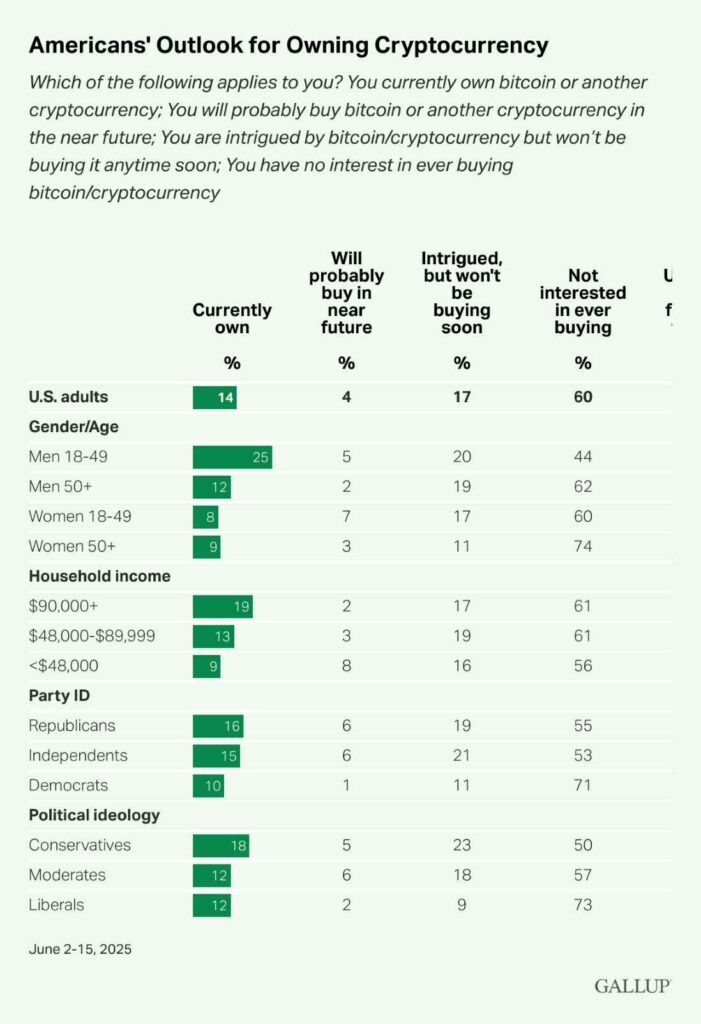
The second group is far larger and less visible in policy debates: mainstream users. These users interact with crypto through apps and interfaces that look and feel like traditional finance. They see balances, rewards, and familiar terminology. They do not audit smart contracts, parse governance structures, or assume that a failed intermediary leaves them without recourse.

Regulation written exclusively for the first group fails the second. And once mass adoption becomes the goal, that failure becomes political.

The Senators drafted the market structure bill with this reality in mind. It assumes that most users will not behave like early crypto adopters and therefore, consumer protections cannot depend on user sophistication.
Source: Gallup

We Don’t Have to Guess What Failure Looks Like

This debate is not happening in a vacuum. Over the past several years, multiple centralized crypto exchanges and lending platforms have failed. In those failures, consumers did not merely suffer price volatility. They lost access to funds, became unsecured creditors, and entered bankruptcy processes that dragged on for years.

These outcomes were not edge cases. They were systemic consequences of operating financial intermediaries without resolution regimes, capital requirements, or fiduciary obligations comparable to those in traditional finance.

Failures occur in every financial system. What distinguishes one system from another is not whether things break, but who absorbs the damage when they do. In banking, losses are buffered through layers of regulation that protect depositors and contain contagion. In crypto, losses have often flowed directly to users.

The Senate draft reflects that history. It is less a reaction to theoretical risk than an attempt to respond to harm that has already occurred. Ultimately, regulators and lawmakers had to answer for that harm.

From this perspective, consumer protection is less about preventing failure and more about ensuring that failure does not destroy confidence in the system as a whole.

DeFi and Developer Liability: What the Bill Actually Says

One of the loudest objections to the Senate draft is the claim that it would make developers legally responsible for how decentralized tools are used. This argument has traveled fast in crypto circles, often framed as an attack on open-source software itself. But when read carefully, the text does not support that interpretation.

The draft does not regulate the act of writing code. It does not impose liability simply for publishing a smart contract, contributing to a protocol, or releasing open-source software. There is no provision that equates authorship with financial intermediation.

What the bill does target is control and economic function. Obligations arise when an actor exercises discretion over transactions, operates an access layer, maintains control over user assets, earns fees from facilitating trades, or otherwise functions as an intermediary between users and markets.

Much of what is described as “DeFi” today is experienced through interfaces, frontends, governance structures, and managed access points that behave like services. The bill focuses on those layers, not on the underlying code.

It is not criminalizing the development. It is the collapse of a long-standing gray zone that allowed economic intermediation without responsibility. This distinction will not eliminate uncertainty for developers, but it narrows it by tying regulatory obligations to control and intermediation rather than to the act of writing or publishing code.

By clarifying where responsibility actually begins, the bill arguably gives builders more room to innovate outside those boundaries, rather than forcing all activity to exist in perpetual legal ambiguity.

Tokenized Equities: Parity, Not Prohibition

Another flashpoint in Armstrong’s critique is the claim that the Senate draft imposes a “de facto ban” on tokenized equities.

The bill does not prohibit tokenized equities. It insists that if an instrument represents equity-like rights, it remains subject to securities law, regardless of the technology used to issue or transfer it. Tokenization may change settlement mechanics, but it does not change the economic nature of ownership.

This is a deliberate market-structure choice. Allowing tokenized equities to trade under a lighter regime would recreate equity markets with fewer safeguards and weaker disclosure. The Senate draft blocks that path.

Calling this a ban only makes sense if one assumes innovation should automatically dilute investor protections. The bill rejects that assumption.

SEC vs. CFTC: Closing the Arbitrage Window

The dispute over regulatory jurisdiction is often framed as innovation versus enforcement. In reality, it is about who sets the compliance baseline for crypto markets.

The Senate draft does not eliminate the role of the CFTC, nor does it subordinate it to the SEC. What it does do is narrow the ability to move assets and activities between regimes based on convenience.

Jurisdiction is determined more tightly by economic substance rather than labeling. For exchanges, this reduces regulatory flexibility. For consumers, it reduces confusion and surprise.

This is a governance decision aimed at clarity, not an attempt to suppress innovation.

Stablecoin Rewards: Where the Bill Draws a Hard Line

Of all the objections raised, this is where the Senate draft is most explicit; and where the conflict becomes unavoidable.

The bill draws a clear line between payment instruments and deposit-like products. Stablecoins may be used for transfers and settlement. What they may not do is pay yield simply for being held.

Yield implies interest. Interest implies safety. And safety implies safeguards.

By prohibiting yield on passive stablecoin balances, the bill prevents stablecoins from quietly functioning as shadow deposits without deposit-level protections. For exchanges, this closes a powerful growth lever. For consumers, it removes a source of silent risk transfer.

This distinction does not remove user choice; it makes the trade-offs legible, separating payment utility from risk-bearing investment in a way that supports informed adoption rather than accidental exposure.

This is the point where business models collide with regulatory logic and where support ultimately collapsed.

Lobbying, Power, and the “Banks Wrote the Bill” Claim

Critics of the Senate’s market structure draft argue that banking interests helped shape the bill in ways that tilt the competitive landscape in favor of incumbent institutions. In this view, the issue is not that banks received explicit carve-outs, but that the bill would force crypto-native firms, fintechs, and other non-bank intermediaries to operate under bank-like constraints. Those constraints raise costs, slow experimentation, and make it harder for alternative models to compete on distinct terms.

That critique is directionally correct. The bill does narrow regulatory gray zones, raise compliance thresholds, and make balance-sheet risk without backstops harder to sustain. These changes do constrain non-bank competitors.

The disagreement lies in why those constraints exist. One interpretation is regulatory capture: banks lobbied to impose rules they already meet. Another is regulatory path dependence: lawmakers applied a consumer-protection baseline to crypto that was shaped by decades of financial crises and voter backlash to any actor performing bank-like economic functions.

The Senate draft reflects the latter logic. It does not grant banks exemptions or new privileges. Instead, it applies a single premise: intermediaries that hold customer balances and facilitate transactions at scale must absorb responsibility when things fail. Banks benefit not because the market structure bill favors them, but because they already operate within that perimeter.

That choice is not neutral in its effects. Regulatory design always produces winners and losers. Lawmakers made a policy judgment about risk and accountability, rather than attempting to insulate incumbents from competition.

From a system-design perspective, the question is not whether competition should exist, but whether competition built on lower accountability can remain stable as participation broadens.

Why the Senate Draft Looks So Different From the House Bill

The contrast with the House approach helps explain Armstrong’s reaction. The House framework emphasizes carve-outs, decentralization exemptions, and faster market expansion. The Senate draft emphasizes parity, clarity, and integration. For crypto-native firms, this shift understandably feels less like neutral integration and more like being forced into a regulatory architecture designed for incumbents.

One vision prioritizes growth. The other prioritizes compatibility with an existing financial system where consumer harm quickly becomes a public problem.

Armstrong’s withdrawal makes sense in this context. The Senate draft does not prohibit crypto, but it forces it to choose between scale with safeguards or autonomy with limits.

The Transition Is the Danger Zone

Even if crypto’s end state proves safer and more efficient, history suggests the greatest risk lies in the transition.

Financial harm concentrates when systems scale faster than protections, when users adopt products they do not fully understand, and when responsibility is diffuse. This is not unique to crypto. It is a recurring feature of financial innovation.

The Senate draft slows that transition deliberately. That friction frustrates firms built around speed and ambiguity. But from a consumer perspective, friction can be a feature, not a bug.

Innovation and accountability are not opposing forces here; together, they determine whether growth is temporary and fragile or durable and widely trusted.

What This Fight Is Really About

Armstrong did not walk away because the Senate draft bans crypto, criminalizes developers, or hands the future to banks. He walked away because the bill forces clarity. Clarity about who intermediates, who bears risk in crypto, and what protections consumers should reasonably expect.

Crypto can remain a high-risk system for informed participants. Or it can become mainstream financial infrastructure with mainstream safeguards. What it cannot easily be is both at once.

Crypto’s future may be inevitable. Ensuring that innovation scales with accountability, rather than at its expense, is the policy choice still being made.


Kazakhstan’s Crypto Enforcement in 2025 Shows How the Crackdown Evolved

Kazakhstan is cracking down on illegal cryptocurrency exchanges.

Kazakhstan’s crypto enforcement efforts did not reset at the start of 2025. Instead, authorities carried forward actions that began earlier, shifting from broad market cleanups to more targeted measures focused on access, payments, and informal intermediaries. As a result, operational follow-through defined the year 2025 more than headline numbers did.

After a wide-ranging enforcement campaign in prior periods, Kazakhstan’s regulators entered 2025 with crypto oversight already in motion. Rather than announcing new prohibitions, officials concentrated on tightening control over how unlicensed activity continued to operate. That distinction matters because 2025 reflects enforcement continuity rather than a new escalation.

Why crypto enforcement in Kazakhstan shifted in 2025

The first enforcement wave reduced the visibility of openly unlicensed exchanges, but informal crypto activity adjusted quickly and continued through other channels.

By early 2025, authorities were increasingly concerned about offshore platforms still accessible to domestic users. Informal brokers kept operating through messaging apps, and card-based fiat on-ramps bypassed licensed channels. In response, regulators adjusted their approach. The focus moved away from taking down platforms en masse and toward the infrastructure that allowed illegal trading to persist.

Hence, later actions appear smaller in scale but sharper in execution. The objective was no longer broad disruption. Sustained pressure on unlicensed crypto operations became the enforcement goal for authorities in Kazakhstan.

Blocking access to unlicensed crypto platforms

One of the most visible tools used in 2025 was website blocking. Regulators restricted access to roughly 1,100 crypto-related websites offering trading services without authorization.

When Kazakhstan blocks crypto websites, it does not target blockchain protocols themselves. Instead, enforcement concentrates on web-based interfaces, mirror sites, and offshore platforms marketed to local users. Instead of chasing every operator individually, they cut off the entry points, complementing the earlier exchange shutdowns.

Website blocking reflects the fact that unlicensed platforms often reappear under new domains, while access restrictions at the network level reduce their reach and shorten their operational lifespan.

Shutting down remaining shadow exchanges

Alongside access restrictions, authorities reported the closure of 22 shadow crypto exchanges during 2025. While the number is small compared with earlier cleanup efforts, the focus was deliberate.

These were active platforms that continued facilitating trades even after previous enforcement actions. Rather than targeting marginal or inactive operators, regulators moved against exchanges that had proven able to persist under pressure.

The narrower scope reflects how enforcement evolved over time. Instead of sweeping broadly, authorities concentrated on shutting down illegal crypto exchanges officials viewed as repeat offenders, signaling diminishing tolerance for unlicensed activity that continued to resurface.

Cutting off fiat on-ramps

Perhaps the most consequential measure in 2025 involved the financial system. Authorities froze more than 20,000 bank cards linked to suspected crypto-related violations.

This step directly affected informal brokers and OTC-style traders who relied on personal or pooled cards to move funds. By targeting payment rails, regulators disrupted the bridge between fiat and crypto rather than crypto activity in isolation.

The scale of card freezes suggests coordination between financial monitoring agencies and commercial banks. It also signals that compliance expectations now extend beyond exchanges to the banking relationships that enable unlicensed trading.

Enforcement beyond platforms

Another notable feature of the 2025 enforcement trajectory was the extension of scrutiny beyond platforms and infrastructure to individual facilitators. While large-scale action against influencers was not a defining feature of the year, authorities signaled that personal liability was not off the table.

One illustrative case emerged in early 2026, when investigators seized approximately 182,700 USDT from a blogger accused of promoting illegal gambling operations using crypto. Although the seizure occurred after the close of 2025, it reflects enforcement patterns that had already taken shape last year and reinforces the deterrence message directed at informal promoters.

Beyond isolated cases, official disclosures indicate that more than 1,135 crypto-related criminal investigations were concluded in 2025. That number suggests that accountability efforts extended well beyond exchanges themselves. Taken together, these actions show enforcement moving gradually from platforms toward the broader networks that enable unlicensed crypto activity in Kazakhstan.

What 2025 reveals about Kazakhstan’s crypto policy

The pattern that emerged in 2025 was one of follow-through. Operating outside the licensed crypto framework became increasingly difficult. Website blocks, targeted exchange closures, payment freezes, and selective individual cases all pointed in the same direction: informal crypto markets were being pushed to the margins. The emphasis shifted away from headline numbers toward persistence. What mattered was not eliminating every platform, but making unlicensed activity harder to run, easier to detect, and less attractive over time.

Visa Taps BVNK to Pilot Stablecoin Payouts via Visa Direct

TL;DR

  • Visa is piloting stablecoin payouts with BVNK via Visa Direct, targeting enterprise and cross-border disbursements.
  • The program focuses on backend settlement and treasury flows, not consumer payments or card transactions.
  • The rollout remains limited in scope, testing infrastructure inside Visa’s $1.7 trillion payments network.

Visa has partnered with BVNK to pilot stablecoin payouts through Visa Direct. The initiative expands the use of blockchain-based settlement inside Visa’s global payments network. The focus is on enterprise disbursements and treasury flows, positioning stablecoins as a backend settlement tool rather than a consumer-facing payment method. While the move adds to Visa’s growing stablecoin activity, the company is framing it as a controlled infrastructure experiment rather than a broad rollout of crypto payments.

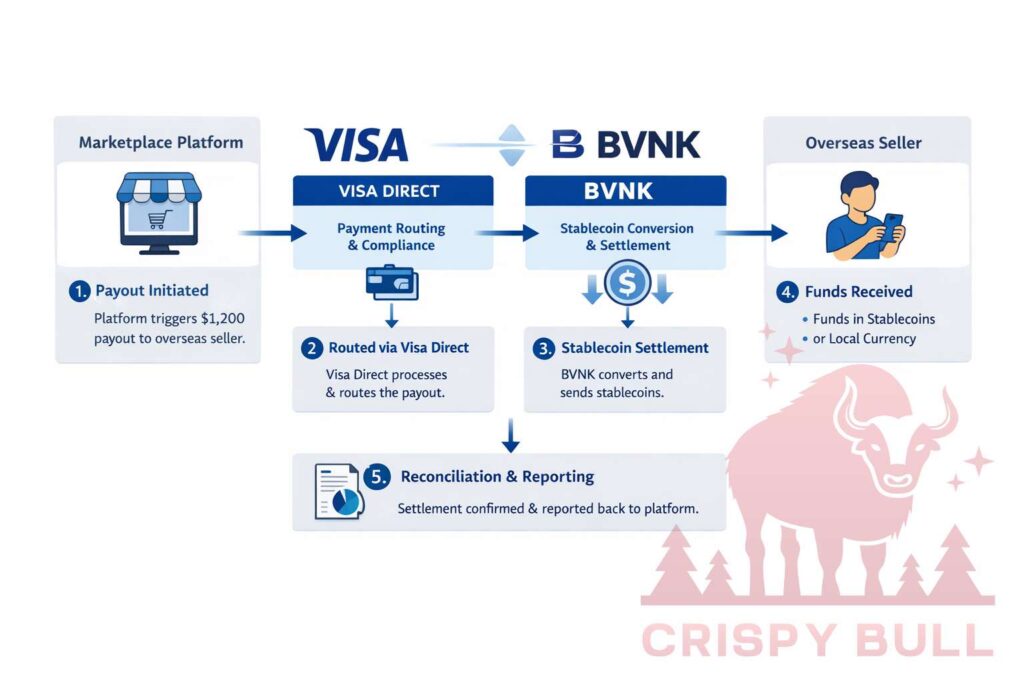
The Visa BVNK partnership enables selected clients to send payouts using stablecoins through Visa’s existing Visa Direct rails. BVNK will provide the underlying stablecoin infrastructure. Visa does not issue stablecoins, hold customer funds, or operate wallets under the arrangement. Instead, it acts as a coordinator. This allows regulated stablecoin flows to plug into its payout network, if permitted by local rules.

What the Visa BVNK partnership actually enables

At a technical level, the Visa–BVNK collaboration allows enterprise clients to route payouts through Visa Direct. Those transfers are settled using Visa Direct stablecoin payouts supported by BVNK. The structure targets use cases such as platform disbursements, cross-border treasury transfers, and corporate settlement flows. In these cases, speed and operational efficiency take precedence over consumer-facing features.

The structure keeps stablecoins firmly in the background. End users may never interact with digital assets directly, while enterprises gain access to faster settlement options that sit alongside traditional fiat rails. This approach reflects Visa’s broader strategy of integrating new settlement technologies without altering how its core payments products function.

Infographic showing how stablecoin payouts work via Visa Direct and BVNK, with a step-by-step flow from an enterprise platform initiating a payout, Visa Direct routing the transaction, BVNK executing stablecoin settlement, and an overseas recipient receiving funds, followed by reconciliation and reporting.

Why payouts, not payments, come first

Visa’s focus on payouts rather than retail payments is deliberate. Enterprise disbursements present fewer consumer protection challenges, involve fewer counterparties, and are easier to scope within existing compliance frameworks. For Visa, stablecoin payout infrastructure offers a way to test efficiency gains without exposing cardholders or merchants to new forms of risk.

By starting with payouts, Visa can evaluate whether stablecoins meaningfully reduce friction in areas such as cross-border settlement and treasury management. The emphasis remains on operational plumbing, not on replacing cards or point-of-sale transactions.

A pilot inside a $1.7 trillion network

Despite the scale of Visa’s global payments network, the initiative represents a narrow stablecoin pilot. It is limited in scope and designed to test infrastructure rather than drive volume.

This framing matters. While some coverage has pointed to Visa’s $1.7 trillion annual volume as evidence of impending scale, the company is not positioning the program as a network-wide shift. Instead, it is being used to validate technical and regulatory assumptions before any expansion is considered.

How this fits Visa’s broader stablecoin strategy

The BVNK partnership builds on earlier experiments rather than marking a new direction. In previous initiatives, Visa tested USDC-based settlement between regulated banks in the United States. Those efforts explored whether stablecoins could improve interbank clearing efficiency.

Taken together, these initiatives suggest a layered approach to Visa’s blockchain settlement strategy. Visa is experimenting with stablecoins across different parts of the money movement stack, from bank settlement to enterprise payouts, while avoiding dependence on any single issuer or use case.

Regulatory posture and risk containment

Regulation remains a central constraint. Stablecoin rules vary widely across jurisdictions, and Visa has consistently structured its initiatives to remain compliant with local requirements. By keeping pilots small and modular, Visa limits regulatory exposure while gathering data on how stablecoin settlement performs in practice.

The partnership with BVNK reflects this posture. BVNK operates regulated infrastructure in multiple markets, allowing Visa to adapt stablecoin usage to different legal environments without standardizing on a single regulatory model.

What this does, and does not, signal

The move signals growing institutional comfort with stablecoin adoption, particularly for enterprise and cross-border use cases. It also reinforces the view that stablecoins are increasingly treated as infrastructure rather than speculative assets.

At the same time, the initiative does not signal a shift toward consumer stablecoin payments, endorsement of a specific stablecoin issuer, or an immediate increase in transaction volumes. Visa’s core card and account-based payment model remains unchanged.

Infrastructure before ideology

Taken together, the BVNK partnership underscores Visa’s cautious approach to blockchain integration. Stablecoins are being tested where they offer clear operational benefits, but always within tightly defined boundaries. For Visa, the priority is future-proofing settlement rails, not reshaping how consumers pay.

In that sense, the pilot reflects incremental normalization rather than disruption. Stablecoins are entering the payments stack quietly, as infrastructure first and ideology last.

BitGo NYSE IPO Tests Public-Market Appetite for Regulated Crypto Custody

Crypto Custodian BitGo eyes IPO in 2025.

TL;DR

  • BitGo’s planned NYSE IPO targets roughly $201 million in proceeds and a valuation just under $2 billion.
  • The offering tests whether public markets favor regulated crypto custody over trading-driven business models.
  • MiCA authorization allows BitGo to passport its licensed EU services, reinforcing regulatory clarity ahead of the listing.

BitGo’s IPO via the New York Stock Exchange (NYSE) is shaping up as an early-2026 test of whether public investors are willing to back crypto infrastructure built around compliance rather than trading volume. BitGo has filed to go public at a valuation of up to $1.96 billion. The company seeks to raise about $201 million through its NYSE listing. The move follows a year of regulatory groundwork that has sharpened the company’s positioning ahead of public-market scrutiny.

Deal structure and offering details

According to the filing, BitGo plans to offer roughly 11.8 million shares in the transaction. The indicated price ranges between $15 to $17 per share. At the top of the range, the offering implies proceeds of about $201 million and a valuation just under $2 billion.

BitGo’s public listing on the NYSE is expected under the BTGO ticker, with Goldman Sachs and Citigroup acting as lead underwriters for the IPO. The share mix includes primary shares issued by the company as well as a smaller portion sold by existing holders, alongside a standard underwriter option. Timing is expected in the early part of 2026, subject to market conditions.

A custody-first business model

BitGo operates as a regulated crypto custody provider. The company offers institutional-grade safekeeping of digital assets alongside wallet infrastructure, trading, staking, and related services. Its core client base consists of exchanges, asset managers, and other enterprises that require secure storage and operational support rather than retail-facing trading tools.

That positioning places BitGo closer to financial-market plumbing than to consumer crypto platforms. As a regulated crypto custody firm, its revenues and risk profile are tied primarily to assets under custody and service usage, not directly to retail trading volumes.

Regulatory positioning in the U.S. and EU

Regulation remains central to BitGo’s public-market positioning. In the United States, the company operates through a trust structure designed to meet institutional custody requirements. That framework has become increasingly important as regulators tighten oversight of crypto intermediaries.

In Europe, BitGo expanded its regulatory footprint in mid-2025 when BaFin granted authorization under the Markets in Crypto-Assets Regulation (MiCA) to BitGo Europe in May. The initial license covered crypto-asset custody and staking services. However, later reporting indicates an extension that permits MiCA-compliant regulated crypto trading from Germany under BaFin oversight.

Under MiCA, licenses issued by one member state are generally passportable across the European Union. In BitGo’s case, this allows the company to passport its MiCA-licensed services across EU member states. Consequently, it does not need to seek separate national authorizations, provided activities remain within the scope of the approved services. While BitGo has emphasized regulatory clarity and risk reduction, the authorization also facilitates EU-wide expansion of its regulated offerings. This, in turn, reinforces its positioning as an institutional crypto infrastructure provider rather than a jurisdiction-specific operator.

Financials and valuation context

The BitGo valuation implied by the filing appears conservative by historical crypto standards. At roughly $1.9–$2.0 billion, it sits well below the peak multiples once attached to trading platforms during prior market cycles. Coverage of the filing highlights revenue growth and references to profitability, signaling an effort to present BitGo as a durable infrastructure business rather than a volatility-driven bet.

For investors, the pricing suggests expectations centered on steady cash flows and regulatory resilience, not explosive expansion. In that sense, the deal aligns more closely with how markets value custody and clearing services in traditional finance.

From IPO plans to filing

BitGo’s move to file marks a clear shift from preparation to execution. When the company outlined its public-listing ambitions in early 2025, the focus was on positioning and readiness. Since then, the BitGo IPO narrative has evolved into a concrete transaction. Underwriters have been appointed, a valuation range has been set, and regulatory milestones have been completed. The filing brings with it the disclosure and accountability that come with public markets.

Why this IPO matters now

As one of the first notable crypto listings of 2026, the BitGo NYSE IPO carries weight beyond the company itself. Success would signal that public markets are open to crypto infrastructure plays that emphasize compliance and custody. A weak reception, by contrast, would underscore lingering skepticism toward the sector, even for firms positioned away from retail trading risk.

Either way, the offering serves as a litmus test for crypto custody IPOs. It’s less about predicting price performance and more about gauging whether regulated digital-asset infrastructure can earn a durable place in public portfolios.

The Senate’s Crypto Market Structure Bill Enters Critical Markup Phase

TL;DR

  • The Senate crypto market structure bill is advancing unevenly, with the Banking Committee moving on January 15 and the Agriculture Committee delaying its markup to January 27.
  • The surge in crypto bill amendments reflects Senate signaling, while only disputes over stablecoin rewards and CFTC crypto authority will materially shape the bill.
  • Crypto executives are not rejecting regulation but are pushing back selectively on stablecoins and DeFi, while backing clearer SEC vs CFTC crypto oversight.

The Senate crypto market structure bill has entered a phase that, from the outside, looks like legislative disorder. Senators filed more than 100 amendments within days of the bill text becoming public. Committee markups are unfolding on different schedules. Stablecoin rewards, DeFi surveillance, and jurisdictional disputes are all being debated at once.

But this is not a bill spinning out of control. What is happening is a collision between Senate process, committee jurisdiction, and strategic signaling. This dynamic produces noise long before it produces outcomes.

Understanding the bill’s trajectory requires separating where the attention is from where the decisions are actually made.

Two committees, two very different roles

The Senate Banking Committee: loud, visible, and politically charged

The Senate Banking Committee is where most public attention has settled, in part because it is the committee that is moving first. The committee is proceeding with its markup of the crypto market structure bill as scheduled on January 15, creating the impression that the legislative process is accelerating despite visible controversy.

Banking oversees the parts of the bill that are easiest to understand and easiest to politicize: stablecoins, investor protection, payments, and the relationship between crypto firms and banks. That combination of timing and jurisdiction explains why the public considers the January 15 markup as a decisive moment.

In practice, however, the Banking markup is about positioning. It is where senators surface amendments, test coalition support, and negotiate language that affects consumer-facing products. It is also where the most emotionally charged issue in the bill, the stablecoin rewards, is being contested.

These debates matter, but they do not determine whether the bill ultimately delivers a functional market structure.

The Senate Agriculture Committee: quieter, but structurally decisive

The real market-structure mechanics sit with the Senate Agriculture Committee. Agriculture has jurisdiction over commodities markets and, by extension, the Commodity Futures Trading Commission. That places it in charge of the bill’s most consequential questions: who regulates spot crypto markets, how exchanges register, and how tokens are classified.

The committee had initially scheduled its own markup for January 21. However, it now postponed that session and rescheduled it for January 27. The delay has attracted far less attention than the Banking markup, even though its implications are more significant.

This is where CFTC crypto authority is either meaningfully established or left ambiguous. It is also where the long-running SEC vs CFTC crypto oversight debate is resolved in practice rather than theory. Without Agriculture advancing its portion of the text, the crypto market structure bill cannot move forward in a coherent form, regardless of what happens in Banking.

The staggered timing has created a situation in which the most visible committee moves first, while the committee with the greatest structural authority moves later, and more cautiously.

https://twitter.com/SenateAgGOP/status/2011206161656389671

The amendment explosion, explained

One of the most misunderstood aspects of the current debate is the sheer number of amendments. Headlines citing 75, 100, or even 130+ crypto bill amendments suggest chaos or unreadiness. In reality, amendment counts at this stage say more about Senate strategy than about opposition to the bill.

Amendments are filed against a base text designated for markup, not against the public PDF readers see online. Senators and staff have been working from discussion drafts and working versions of this crypto bill for weeks. Many amendments were written and queued before the bill was formally released, filed in anticipation of markup rather than in reaction to it.

Most of these amendments are signals, not rewrites. They range from reporting requirements and delayed effective dates to narrow carve-outs designed to create leverage in negotiations. Only a small subset will ever be offered. Fewer still will survive committee.

The real question is not how many amendments exist, but which ones matter.

Which amendments actually matter

A narrow set of issues will determine whether the crypto market structure bill works as intended.

The first is stablecoin rewards. Language that limits interest or rewards paid simply for holding stablecoins has immediate commercial implications. Crypto firms argue that such restrictions tilt the field toward banks and freeze existing payment and settlement models. Banks counter that yield-bearing stablecoins resemble deposit products without equivalent safeguards. Amendments in this area are not symbolic; they define competitive boundaries.

The second is jurisdiction. Amendments affecting CFTC crypto authority over spot markets and the mechanics of token classification are foundational. Small wording changes can shift enforcement risk, invite litigation, or undermine the bill’s promise of regulatory clarity.

The third is DeFi. Proposals that extend compliance or surveillance-style obligations to decentralized protocols have drawn sharp criticism from developers and infrastructure providers, who argue the language is technically unworkable. These amendments are fewer in number, but politically sensitive and closely watched.

Everything else, ethics disclosures, studies, sense-of-Congress language, is secondary.

Who is driving the debate

The loudest voices shape the public perception of the bill. But these voices aren’t necessarily the most powerful ones.

On the Republican side, Tim Scott, as chair of the Banking Committee, controls markup timing and the manager’s package that ultimately determines what language advances out of committee. Cynthia Lummis plays a different role: she is the most visible pro-crypto advocate in the Senate, shaping narrative more than text. Bill Hagerty frequently anchors objections around stablecoins and payments.

On the Democratic side, Elizabeth Warren dominates the enforcement and illicit-finance framing of crypto regulation, particularly on DeFi and AML. In Agriculture, Amy Klobuchar, as ranking member, is the key Democratic counterweight on market structure questions, even if she attracts far less media attention.

The imbalance is central to understanding the bill’s coverage. Narrative power creates headlines. Committee control determines outcomes.

How the crypto industry is reacting

The crypto industry’s response has been more restrained than the headlines suggest. There is no coordinated effort to kill the Senate’s crypto bill. Most firms and trade groups accept that a federal market structure framework is inevitable and preferable to continued regulation by enforcement.

Pushback is concentrated in two areas:

The first is stablecoins. Executives argue that banning or tightly constraining rewards for holding stablecoins is less about consumer protection and more about insulating bank deposits from competition. This is where crypto CEOs have been most willing to go on the record.

The second is DeFi. Developers and infrastructure providers warn that compliance language designed for intermediaries does not map cleanly onto decentralized systems, and that overly broad requirements risk pushing activity offshore without improving oversight.

By contrast, the industry has been cautiously supportive of efforts to clarify SEC vs CFTC jurisdiction. They view even imperfect clarity as an improvement over the current landscape.

The strategy is pressure, not rebellion. Amendments are the battlefield, not the bill itself.

What actually happens next

The Banking Committee markup on January 15 will generate headlines and consolidate negotiating positions. It will not settle the core market structure questions. That depends on the Agriculture Committee’s delayed markup, now scheduled for January 27, and on how CFTC crypto authority and classification mechanics are finalized.

The most important changes will not happen in floor speeches or press releases. They will happen in manager’s amendments and reconciled committee text, negotiated after the loudest moments have passed.

The bottom line

The Senate crypto market structure bill is not unraveling. It is being negotiated in public after months of private drafting. Some mistake the visibility of that process for dysfunction.

The loudest fights are not the most important ones. The most consequential decisions are being made where the spotlight is weakest; in committee sequencing, jurisdiction, and the fine print of authority.

Readers’ frequently asked questions

Why are two different Senate committees handling the crypto market structure bill?

The Senate crypto market structure bill is split by jurisdiction. The Senate Banking Committee oversees stablecoins, investor protection, and banking-related provisions, while the Senate Agriculture Committee controls market structure issues tied to commodities law, including CFTC crypto authority over spot crypto markets.

What role does the Senate Agriculture Committee play in deciding crypto market structure?

The Senate Agriculture Committee controls the bill’s market structure provisions, including how spot crypto markets are regulated and whether the Commodity Futures Trading Commission receives clear supervisory authority. Without Agriculture advancing its portion of the text, the bill cannot establish a functioning regulatory framework.

What does a Senate markup actually do in the legislative process?

A markup is a committee session where senators debate, amend, and vote on the text of a bill within that committee’s jurisdiction. Approved sections may be revised through amendments or consolidated into a manager’s package before advancing to the next legislative stage.

What Is In It For You? Action items you might want to consider

Track committee outcomes separately

Follow the Banking Committee markup and the Agriculture Committee markup as distinct processes, since each committee controls different parts of the crypto market structure framework.

Monitor stablecoin and market structure language changes

Review updated bill text and manager’s amendments after each markup to identify changes affecting stablecoin rewards, exchange oversight, and regulatory authority.

Assess regulatory exposure by activity type

Crypto firms and market participants should evaluate how the bill’s provisions apply differently to stablecoin issuance, trading platforms, and decentralized protocols, depending on final committee outcomes.

- Advertisement -

FEATURED