Home Blog Page 61

Eric Adams’ NYC Token Faces Rug Pull Allegations After Rapid Crash

TL;DR

  • A Solana-based NYC token promoted by Eric Adams surged after launch before crashing more than 60%. Some trackers are showing losses above 80%.
  • On-chain analysts flagged liquidity withdrawals near the peak, fueling rug pull allegations, though no official findings have been made.

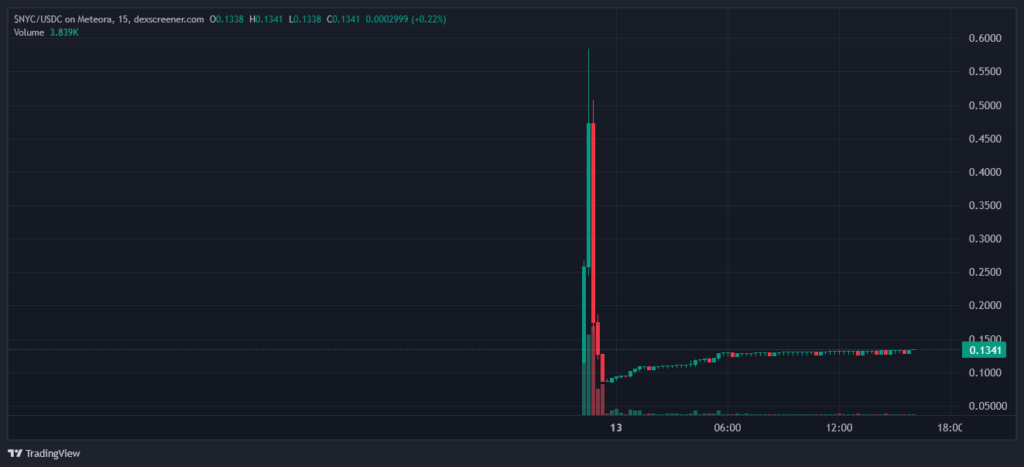
A Solana-based meme coin branded as the NYC token and publicly endorsed by former mayor Eric Adams surged in early trading before reversing sharply as liquidity concerns spread among traders. Prices plunged more than 60% from peak levels within hours, with some trackers showing drawdowns above 80% at the lows. The sudden reversal drew attention to the NYC token crash and triggered allegations that early liquidity movements amplified losses for late buyers.

How Eric Adams presented the NYC Token

Eric Adams promoted the NYC Token publicly, framing it as a civic-minded initiative rather than a conventional meme coin. At launch, Adams described NYC Token as a “commemorative” digital asset whose proceeds would support antisemitism awareness programs, anti-Americanism education initiatives, and crypto and blockchain education for New York City students. Further, it would help finance scholarships for underserved youth, including at HBCUs. Adams did not claim any official affiliation with the City of New York.

NYC Token Launch and Early Market Activity

The crypto token launched on Solana and quickly attracted speculative inflows typical of a Solana meme coin. Early trading was concentrated in a small number of liquidity pools. Such a structure can accelerate price movements in thin markets. Market-cap estimates put NYC Token as high as roughly $580 million to $730 million at its peak. Even by meme-coin standards, that’s an unusual scale for a newly launched asset.

Sell-Off and Liquidity Concerns

Momentum reversed soon after the peak. As liquidity thinned and some large liquidity positions were reduced, slippage surged, making it significantly more expensive for traders to exit positions. The resulting feedback loop accelerated the price collapse. The token‘s crash erased most of its gains within a short time window, intensifying scrutiny of the NYC project’s liquidity structure.
Source: dexscreener.com

Rug Pull Allegations and On-Chain Claims

Attention soon shifted to blockchain data. On-chain analytics firm Bubblemaps and independent analysts flagged a wallet associated with the token’s deployer. It withdrew roughly $2.5 million in USDC liquidity near the peak. According to these accounts, about $1.5 million was later added back after the price had already fallen. Close to $1 million remained unreplaced.

Community members characterized this pattern as a potential rug pull, alleging NYC investors’ losses in the low-to-mid single-digit millions. No regulators have made formal findings, and reporting consistently frames the claims as allegations based on on-chain analysis, not legal determinations.

Adams’ Role in the Project

Adams, who left office on December 31, 2025, promoted the NYC token as his initiative on television and social media just days after his term ended. Though his public-facing role went beyond a typical endorsement, Eric Adams didn’t identify publicly as the issuer. Instead, it appears that unnamed parties control the smart contract and liquidity wallets. This leaves a visible gap between the project’s public-facing branding and its on-chain control.

Open Questions and Market Scrutiny

It remains unclear who ultimately owns and controls the deployer and liquidity wallets, and how much of the proceeds, if any, the named charities will receive. What audit or reporting mechanisms would verify those transfers? As the rug pull allegations circulate, crypto traders are closely monitoring on-chain activity linked to the token.

https://twitter.com/bubblemaps/status/2010890093431832789

Political Meme Coins Under the Spotlight

The NYC Token episode unfolds amid a broader boom in political meme coin launches, from Trump-themed tokens to other politician-branded assets. The trend has raised fresh questions about conflicts of interest, including whether anonymous deployers could expose buyers to undisclosed risks. And most importantly, do retail buyers fully understand how little protection they may have when hype turns into panic and liquidity dries up?


UK Labour MPs Push to Ban Crypto Political Donations Over Foreign Interference Fears

TL;DR

  • Senior Labour MPs serving as parliamentary committee chairs are pressing for a ban on crypto political donations, citing transparency gaps and risks of foreign interference in UK politics.
  • No ban exists yet, and ministers have not committed to one; officials say any restriction may come through follow-on legislation linked to broader electoral reforms rather than the initial Elections Bill.

Senior Labour MPs serving as parliamentary committee chairs are urging the UK government to prohibit political donations made in cryptocurrency. They argue that the practice poses growing risks to transparency and could expose UK politics to foreign interference. The call comes as ministers work on linked electoral reforms, including a forthcoming Elections Bill, alongside the possibility of related follow-on legislation addressing political finance.

The intervention does not reflect official government policy. Instead, it represents pressure from influential committee chairs who argue that existing campaign finance safeguards were designed for cash and bank transfers, not digital assets that can move rapidly across borders and obscure the true origin of funds.

Their focus is on governance and security risks linked to crypto-based political donations, not on broader questions of crypto adoption.

A renewed push as electoral legislation approaches

The latest pressure follows growing concern within Westminster that the UK’s political funding framework has not kept pace with financial innovation. Crypto donations indeed remain rare. However, committee chairs argue that waiting for widespread adoption would leave regulators and parties scrambling to respond.

Several MPs backing a ban have framed it as a preventative step. They warn that crypto-based contributions could create enforcement problems if they scale during election cycles. Calls to ban crypto political donations are therefore positioned as an attempt to close a vulnerability early, rather than react to abuse after the fact.

The timing is strategic. Ministers are preparing an Elections Bill expected to revisit aspects of electoral law and political finance. However, its primary focus lies elsewhere, including voting rules and existing compliance gaps. Officials have indicated that a crypto-specific ban may require separate or follow-on legislation. Technical and enforcement details have yet to be resolved.

Foreign interference at the center of the debate

Concerns about foreign interference in UK politics sit at the heart of the argument for a ban. MPs and watchdog groups say cryptocurrencies introduce additional complexity when verifying whether political donations originate from permissible UK sources.

Political parties must already confirm whether donors are eligible. Critics argue that crypto transactions complicate those checks, especially when funds move through multiple wallets, exchanges, or overseas platforms. Even where blockchain records are public, establishing control and beneficial ownership can exceed the practical enforcement capacity of existing regulators.

This has raised fears that hostile actors could exploit crypto-based donations to funnel money into UK campaigns indirectly. The risk extends beyond large transfers. Coordinated micro-donations can be structured to avoid disclosure thresholds, making foreign political donations in the UK harder to detect in real time.

What UK law currently allows

There is no explicit statutory ban on crypto donations under current UK political finance rules. Instead, general party-funding requirements apply, and regulators treat cryptocurrency as a form of non-cash donation rather than a prohibited asset.

Under existing guidance, political parties must still verify that any crypto donation comes from a permissible UK source. A contribution above £500 must be refused if the party cannot confirm the donor’s eligibility, just as it would be with any other non-cash asset. The Electoral Commission has previously noted that valuation, reporting, and permissibility checks apply regardless of the donation’s form.

Critics argue, however, that these obligations were drafted for traditional financial instruments. They place unrealistic expectations on parties when applied to crypto assets. As a result, crypto donations in UK politics are becoming an increasingly significant stress test for a system built around conventional banking infrastructure.

Pressure on ministers, but no settled policy

The intervention from Labour committee chairs adds pressure on the government as it finalises electoral reform proposals, including the UK Elections Bill. Ministers have acknowledged broader concerns around foreign financial interference. Nevertheless, they have stopped short of committing to an outright ban on crypto donations.

Some officials have questioned whether a targeted prohibition is proportionate, given the limited current use of crypto in political funding. Others have pointed to legislative sequencing. They argue that any ban may need to follow later, once enforcement standards and definitions are fully developed. A second reference to the UK Elections Bill underlines that the issue remains politically live, but unresolved.

A debate that goes beyond crypto

Watchdog groups argue that the controversy surrounding UK crypto political donations reflects wider weaknesses in campaign finance oversight. From their perspective, crypto is not the only route for opaque or foreign-linked money to enter politics, but it is one of the few channels where lawmakers still have room to draw a clear regulatory line.

Supporters of a ban say the issue is less about digital assets themselves and more about enforceability. They argue that political funding must remain traceable, auditable, and compatible with existing oversight capacity, particularly as concerns about foreign interference continue to shape the UK’s electoral reform agenda.

Readers’ frequently asked questions

Yes. There is currently no explicit ban, though campaigners want a clear cryptocurrency political donations ban written into law.

Why are crypto donations considered higher risk?

Critics say they complicate donor verification, valuation, and enforcement, especially when transactions involve overseas platforms or layered wallet structures.

Would banning crypto donations stop foreign interference entirely?

No. But supporters argue it would remove one higher-risk channel for foreign political donations in the UK and strengthen overall safeguards.

What Is In It For You? Action items you might want to consider

Review compliance processes for non-cash political donations

Political parties accepting non-cash donations may want to reassess how donor permissibility and asset valuation are verified outside traditional banking channels.

Monitor developments in UK electoral and political finance legislation

Campaign finance professionals may want to track the Elections Bill and any follow-on legislation, as crypto-specific restrictions could be introduced once technical standards are settled.

Crypto platforms and intermediaries connected to political fundraising may want to evaluate potential exposure if future rules restrict or prohibit the use of digital assets in UK political donations.

South Korea Opens the Door to Limited Corporate Crypto Investment

TL;DR

  • South Korea is reopening corporate crypto access in a tightly controlled form, treating digital assets as balance-sheet risks rather than growth assets.
  • Strict caps and eligibility rules mean the move signals regulatory normalization, not a green light for large-scale corporate crypto adoption.

South Korea is preparing to reopen corporate crypto investment after years of regulatory distance, but the shift is far from an open endorsement of digital assets. Instead, regulators are framing the move as a controlled adjustment within existing crypto regulation. It allows limited exposure while keeping corporate balance sheets insulated from volatility.

At the center of the policy shift is the Financial Services Commission (FSC), which is drafting new guidelines permitting certain companies to gain crypto exposure again under strict conditions. While many headlines describe this as South Korea lifting a long-standing ban, the reality is more nuanced. The country is reopening access selectively. Caps, eligibility rules, and asset restrictions emphasize risk containment rather than market expansion.

What South Korea Is Actually Changing

For nearly a decade, supervisory expectations and compliance uncertainty kept corporate participation in crypto markets effectively off-limits. While not always enforced through explicit prohibitions, the lack of regulatory clarity made corporate crypto exposure impractical for most firms.

Recent guidance does not reverse that stance outright. Instead, it clarifies how limited forms of corporate crypto activity can take place within defined regulatory boundaries. The goal is not to enable speculative trading. They want to establish conditions under which companies can hold or transact digital assets without breaching prudential standards.

This approach sits within the broader crypto policy framework of the Financial Services Commission, which treats digital assets primarily as balance-sheet risks rather than strategic growth assets. That distinction is deliberate. It folds crypto exposure into existing financial governance and risk controls, rather than carving out a special or exceptional category.

The Guardrails: Caps, Scope, and Eligibility

The most visible safeguard is the 5% cap on corporate crypto investment, which limits exposure to a small share of a company’s equity or net assets. This cap applies at the corporate level to ensure that crypto holdings remain non-material in financial reporting terms.

Eligibility is also narrow. The framework prioritizes listed firms and professional entities with established compliance infrastructure, shaping how listed companies can structure and disclose their crypto exposure. On the asset side, the investable universe is restricted to large-capitalization cryptocurrencies, reducing exposure to illiquid or thinly traded tokens.

Together, these constraints define the reopening as conditional access rather than a wholesale policy reversal.

Why the Cap Matters More Than the Headline

From a market perspective, the cap is the most important feature of the reform. Even if every eligible firm were to allocate the maximum allowed amount, aggregate flows would be modest relative to global crypto markets. This is why expectations of immediate institutional inflows are misplaced.

More importantly, the cap reframes South Korea’s corporate crypto investment as a treasury and risk management question, rather than a growth strategy. By limiting size and scope, regulators are signaling that crypto remains a volatile asset class unsuitable for meaningful balance-sheet reliance. In practice, this turns crypto into a monitored allocation rather than a strategic holding. Which reinforces the idea that crypto exposure on corporate balance sheets must be constrained, not optimized.

Korea’s Move in a Regional Regulatory Cycle

The timing of the policy shift is as important as its content. Across Asia, regulators are tightening disclosure standards, custody rules, and investor protections around digital assets. Against that backdrop, South Korea’s approach stands out for its calibration. Instead of maintaining an outright freeze or moving toward liberalization, the country is threading a narrow middle path.

Seen through this lens, South Korea’s crypto regulation is evolving to remain competitive without reopening systemic risk. The policy aligns with broader Asian crypto regulation trends, allowing corporate investment, as long as it remains within clear quantitative limits.

This positioning allows Korea to avoid falling behind regional peers while still projecting supervisory discipline.

What This Signals — and What It Doesn’t

The reopening of corporate crypto investment in South Korea sends a clear signal that digital assets are no longer treated as an exceptional or prohibited category for companies. Legal clarity and explicit caps reduce uncertainty for firms that already interact with crypto-adjacent businesses or infrastructure.

At the same time, the policy does not signal a shift toward aggressive corporate adoption. There is no encouragement to build treasury strategies around Bitcoin or other cryptocurrencies. Caps won’t be relaxed quickly. The framework remains revocable and incremental, with implementation details likely to matter more than the headline change itself.

In that sense, South Korea is normalizing corporate crypto exposure under constraint, allowing regulators to keep crypto on corporate balance sheets only to the extent they can monitor, measure, and control it.

WazirX Completes Recovery Token Allocation After 2024 Hack

TL;DR

  • WazirX has completed the allocation of recovery tokens to eligible users, closing a defined phase of its post-hack restructuring process.
  • Most recoverable liquid assets were already distributed, while recovery tokens formalize remaining user claims tied to future outcomes.

WazirX has completed the allocation of recovery tokens to eligible users, marking another procedural milestone in the exchange’s post-hack restructuring process. The allocation follows an earlier distribution of liquid assets and formally closes one defined phase of the recovery plan introduced after the 2024 security breach.

The recovery token allocation forms part of a court-supervised restructuring framework adopted after the exchange lost platform-held assets. Rather than attempting immediate full restitution, WazirX implemented a staged process designed to distribute available value while preserving claims on any future recoveries.

Two-stage recovery structure

The approved framework divided the user recovery into two stages.

The first involved the distribution of liquid assets held on the platform. According to company disclosures, eligible users received approximately 85% of rebalanced net liquid platform assets within days of the exchange resuming limited operations.

The second stage centers on recovery tokens. The exchange issued these tokens to represent users’ proportional claims on the value that it could not distribute immediately. That also includes assets subject to future realization or outcomes tied to the restructuring process.

Allocation mechanics and eligibility

Recovery tokens were allocated on a pro-rata basis. Each eligible user received tokens corresponding to the size of their approved claim relative to the total claims pool.

Only users whose balances were verified and accepted under the restructuring scheme qualified for the allocation. WazirX has confirmed that it now completed the recovery token allocation across the platform, in line with the timelines set out in the restructuring plan. Users can view their allocated tokens through their account dashboards.

What the recovery tokens represent

The exchange has stated that recovery tokens are not cash equivalents and do not represent immediate reimbursement. Instead, they function as residual claims under the restructuring framework.

For users still wondering what WazirX recovery tokens are, the company describes them as instruments to account for any additional value that it hopes to realize over time, rather than as guaranteed payouts.

Current status

With the recovery token allocation completed, WazirX has closed one of the key procedural steps outlined in its restructuring process. The company did not announce any further distributions. However, the exchange has not provided any guidance on the eventual value of the tokens either.

Any future recoveries will depend on developments that fall outside the completed allocation phase, including asset realization and outcomes tied to the broader restructuring effort.

A procedural milestone

The completion of the recovery token allocation marks progress in the WazirX restructuring process. However, it is not the final resolution of user losses. Most eligible users have already received the majority of recoverable liquid assets. At the same time, remaining claims are now formalized through the token framework.

The issuance closes a defined stage of the recovery plan. But the subsequent outcomes depend on future developments rather than immediate guarantees.

Report Says $1B in IRGC-Linked Transactions Routed Through UK-Registered Platforms

TL;DR

  • Investigators say crypto exchanges linked to Iran and registered in the UK processed $1 billion tied to the IRGC.
  • The firms were UK-registered but unlicensed, exposing gaps between registration, supervision, and enforcement.
  • The case shows Iran uses crypto more systematically, creating reputational and systemic risks for the UK financial system.

Blockchain investigators say two crypto exchanges registered in the UK processed roughly $1 billion in transactions linked to Iran. The report places renewed scrutiny on how lightly supervised platforms can become conduits for sanctioned actors. According to blockchain intelligence firm TRM Labs, the activity involved crypto transactions flowing through the platforms over multiple years.

The analysis focuses on transactions connected to the Islamic Revolutionary Guard Corps (IRGC), a U.S.-designated terrorist organization that plays a central role in Iran’s military, intelligence, and overseas operations. Investigators say the flows were not incidental. They formed a sustained pattern, raising questions about compliance controls at the exchanges and the broader meaning of “registration” in global crypto markets.

What Investigators Say the Data Shows

TRM Labs reported that Iran’s IRGC began moving cryptocurrency through the two platforms as early as 2023. The activity continued into 2025. During peak periods, addresses of IRGC-linked front companies accounted for a substantial share of overall trading volume. The firm stated it identified the activity by tracking transaction clustering, repeat counterparties, and wallet behavior consistent with sanctioned networks rather than retail use.

A significant portion of the flows consisted of stablecoin transactions, reflecting the IRGC’s preference for dollar-pegged assets over more volatile cryptocurrencies. Stablecoins allow sanctioned actors to move value without exposure to price swings, while maintaining liquidity across multiple platforms and jurisdictions. Investigators said the scale and consistency of the transactions suggested operational use rather than experimentation.

Why UK Registration Became a Key Pressure Point

TRM Labs identified the platforms as Zedcex and Zedxion. Both companies are registered in the United Kingdom but not licensed or authorized to operate as crypto exchanges for UK customers. The firms do not appear on the register of approved cryptoasset businesses maintained by the Financial Conduct Authority.

That gap matters for the UK because crypto exchanges tied to Iran can use a British registration as a legitimacy signal even without FCA authorization. While the reported activity did not necessarily involve UK users, the use of UK-registered corporate entities in IRGC-linked transactions raises reputational concerns for the UK as a global financial center.

A key pressure point in the case is the distinction between company registration and regulatory authorization. Registration in the UK does not automatically imply direct supervisory oversight. Nevertheless, it carries reputational weight and creates expectations around anti-money laundering controls. The findings have renewed debate over crypto sanctions compliance. How can UK authorities realistically enforce such sanctions when companies operate globally while maintaining minimal local footprints?

A Broader Crypto Sanctions-Evasion Model Emerges

The case also fits into a wider pattern of sanctions evasion that extends beyond the use of crypto exchanges. Separate reporting by major international outlets has described how Iran-linked defense export channels have begun accepting cryptocurrency as payment for weapons sales, as part of broader efforts to bypass Western oversight. Together, the reports suggest that Iran is no longer using crypto rails as an occasional workaround. Instead, it has incorporated crypto into its sanctions-avoidance toolkit.

In this broader model, exchanges provide liquidity and access. At the same time, stablecoins enable settlement without reliance on traditional banking infrastructure. The approach lets sanctioned entities bypass correspondent banks and capital controls while maintaining functional access to global markets. Investigators say this layered structure makes enforcement more difficult, particularly when activity spans multiple jurisdictions.

Stablecoins and Transaction Rails Used in the Flows

Transaction data reviewed by TRM Labs shows that much of the activity relied on USDT transfers within the Tron network. Tron’s low transaction fees and high throughput have made it a frequent choice for large-scale stablecoin movement, including in jurisdictions facing financial restrictions. The network’s design allows high-frequency transfers at minimal cost, which can obscure oversight when paired with compliant-light platforms.

Enforcement Questions and Regulatory Gaps

The findings raise unresolved enforcement questions. Regulators must determine how long the activity went undetected and whether reporting obligations were met. More importantly, it must establish what consequences are appropriate for platforms that maintain registration in a major financial jurisdiction while facilitating sanctioned flows elsewhere. The case also highlights the limits of jurisdiction-based oversight when crypto businesses operate with globally distributed users and infrastructure.

Why This Case Extends Beyond Two Exchanges

For policymakers, the issue is not confined to the two platforms named in the investigation. The case involving these crypto exchanges linked to Iran highlights how gaps in the UK’s registration, supervision, and enforcement framework can create systemic exposure. There is no doubt that stablecoins will continue to expand as a payment infrastructure. Hence, regulators face mounting pressure to align licensing standards with real-world risk rather than formal corporate presence.

Ultimately, the episode signals a shift in how sanctioned states use digital assets. Cryptocurrency activity linked to Iran’s IRGC appears increasingly structured, repeatable, and embedded in broader economic strategy rather than being a fringe use case. Crypto is becoming part of the financial plumbing that allows sanctioned actors to remain operational despite tightening global controls.

- Advertisement -

FEATURED