Home Blog Page 66

YouTube’s PYUSD Payout Option Shows How Stablecoins Are Entering the Creator Economy

TL;DR

  • YouTube now allows eligible U.S. creators to receive payouts in PayPal’s PYUSD stablecoin, using PayPal as the settlement layer.
  • The rollout does not involve on-chain interaction or crypto custody by YouTube, keeping compliance and control within PayPal’s regulated ecosystem.
  • Unlike Rumble’s earlier USDT payouts, which emphasized self-custody and creator autonomy, YouTube’s approach treats stablecoins as backend payment infrastructure.

YouTube has begun rolling out a new payout option that allows eligible U.S. creators to receive earnings in PayPal’s PYUSD stablecoin. The feature, enabled through PayPal, introduces stablecoins into YouTube creator payouts without requiring any direct interaction with blockchain infrastructure or changes to the platform’s existing monetization model.

Rather than signaling a crypto pivot, the move reflects a cautious approach to payments innovation. YouTube retains its traditional advertising and revenue mechanics, while creators gain an additional settlement option that operates within PayPal’s regulated ecosystem.

What YouTube Is Actually Rolling Out

Under the new setup, YouTube still calculates and denominates creator earnings in U.S. dollars. It’s at the payout stage that eligible creators can choose to receive those funds as PYUSD instead of a standard dollar balance. The process takes place entirely within PayPal, which handles custody, compliance, and conversion.

There is no requirement for creators to manage wallets, interact with blockchains, or hold crypto outside PayPal. PYUSD payments through PayPal can also be converted back into dollars, transferred, or used within PayPal’s existing payment network. At launch, the YouTube stablecoin payout option is limited to U.S.-based creators, underscoring the regulatory constraints shaping the rollout.

Why This Matters More for PayPal Than for YouTube

While YouTube enables the feature, the strategic upside is more significant for PayPal. The company introduced its PYUSD stablecoin in August 2023, but large-scale, recurring use cases have remained limited so far. Creator payouts provide a predictable and high-frequency payment flow, offering PayPal an opportunity to expand real-world usage of its stablecoin.

YouTube PYUSD payouts effectively turn the platform into a distribution channel for PayPal’s stablecoin without exposing Google to regulatory or balance sheet risk. For PayPal, this helps position the PayPal PYUSD stablecoin as a practical settlement tool rather than a speculative crypto asset. It also reinforces PayPal’s broader push to integrate stablecoins into mainstream payments while maintaining full compliance with U.S. regulations.

A Carefully Contained Approach to Stablecoin Adoption

The structure of the rollout highlights how large platforms are experimenting with stablecoins under strict guardrails. YouTube does not custody funds, issue tokens, or interact directly with blockchain networks. All compliance obligations, including KYC and AML checks, remain with PayPal.

This approach allows YouTube to test demand for stablecoin payouts while keeping the feature reversible. If adoption is low or regulatory conditions change, it can adjust or withdraw the option without disrupting the core creator economy. The model reflects a broader trend in which stablecoins are introduced as backend infrastructure rather than user-facing crypto products.

How This Differs From Earlier Stablecoin Creator Models

Not all stablecoin payouts for creators follow this model. One notable exception is Rumble, which previously introduced on-chain USDT payouts that allow creators to receive earnings directly and self-custody their funds. Unlike YouTube’s PYUSD rollout, which keeps settlement within PayPal’s regulated ecosystem, Rumble framed its USDT integration as a way to reduce reliance on traditional payment intermediaries and increase creator autonomy.

What This Signals About Stablecoins’ Next Phase

The YouTube rollout suggests that stablecoins are gaining traction not through crypto-native platforms, but through incumbents with established compliance frameworks. Rather than promoting decentralization narratives, regulated stablecoin payouts focus on reliability, familiarity, and ease of use.

The creator economy offers an attractive testing ground. Payouts are recurring, global in ambition, and sensitive to fees and settlement speed. At the same time, the U.S.-only scope of the launch highlights the limits of this approach. Expanding stablecoins in the creator economy will depend on regulatory clarity across jurisdictions and on whether creators see tangible benefits compared with existing payout options.

YouTube’s PYUSD payout option is not a shift toward crypto-driven monetization. It is a controlled experiment in payments infrastructure that allows PayPal to extend its stablecoin into a high-visibility use case. For YouTube, the move carries little risk and minimal disruption. For PayPal, it represents another step toward normalizing stablecoins as part of everyday digital payments. The significance lies less in the technology itself and more in how quietly it is being integrated.

Readers’ frequently asked questions

Can YouTube creators hold PYUSD outside of PayPal once they receive payouts?

Creators initially receive PYUSD within their PayPal account. From there, they can keep it inside PayPal, convert it back to U.S. dollars, or transfer it according to PayPal’s supported withdrawal and transfer options, which may vary by user and jurisdiction.

Is receiving PYUSD mandatory for YouTube creators?

No. PYUSD is an optional payout method. Eligible creators can continue to receive earnings through existing PayPal payout options without using the stablecoin.

Are PYUSD payouts available to YouTube creators outside the United States?

No. At launch, PYUSD payouts are limited to eligible U.S.-based creators. YouTube and PayPal have not announced a timeline for expanding the feature to other countries.

What Is In It For You? Action items you might want to consider

Review PayPal payout settings if you are a U.S. YouTube creator

Creators based in the United States may want to check their PayPal payout preferences to see whether PYUSD is available as an option and understand how it fits their existing payout workflow.

Evaluate settlement and conversion implications before opting in

Before choosing PYUSD payouts, creators should review PayPal’s conversion options, fees, and tax reporting treatment to determine whether receiving stablecoins offers any operational benefit over standard dollar payouts.

Monitor whether the rollout expands beyond the U.S.

Creators and platforms outside the United States should watch for updates from YouTube and PayPal regarding international availability, as regulatory clearance will likely determine whether PYUSD payouts expand to other regions.

Gemini Celebrates CFTC Approval as a Crypto Breakthrough, but the Impact Falls on U.S. Market Structure

TL;DR

  • Gemini received CFTC approval to operate a U.S. prediction-market venue, but the platform uses traditional centralized infrastructure and USD settlement rather than any Web3 technology.
  • The license is important for U.S. market structure and shows how crypto exchanges are moving into regulated derivatives, not how decentralized prediction markets are evolving.
  • Gemini will compete directly with Kalshi and the regulated arm of Polymarket, marking the institutionalization of event-contract trading rather than a breakthrough for blockchain or DeFi.

Gemini recently announced it received CFTC approval for its U.S. prediction markets. The company’s press release cast its new CFTC license as a pivotal moment for crypto innovation in America and a sign of renewed national support for digital assets. It also presented it as a step toward a more open regulatory environment. The development is important, but the significance lies in market structure rather than in Web3. The approval reflects the growing role of prediction markets inside the CFTC’s derivatives framework. It also demonstrates the applicants’ willingness to build fully compliant platforms that settle in dollars. This shift signals how U.S. prediction markets are becoming more institutional as crypto exchanges begin participation in regulated venues.

What Gemini Announced

Gemini Titan, an affiliate of Gemini Space Station, received a Designated Contract Market license from the Commodity Futures Trading Commission. This makes Gemini the first crypto exchange to operate a CFTC-supervised venue for regulated event contracts in the United States. The approval concludes a CFTC review that began in 2020 and brings Gemini into the same regulatory category as Kalshi.

The approval allows Gemini to list yes or no contracts that pay out in USD. These payouts depend on specific real-world outcomes. Examples from the company include financial indicators, corporate milestones and regulatory decisions. They also include price-based crypto markets such as end-of-year Bitcoin ranges.

These contracts are described in the press release as part of how Gemini prediction markets work. The mechanics follow traditional exchange infrastructure rather than blockchain systems. Settlement occurs within custodial Gemini accounts. Users will initially access the platform through the company’s web interface.

The operator of the venue is Gemini Titan Designated Contract Market. It will manage listings, supervision and reporting under CFTC rules.

What the Approval Actually Means

The company celebrated the license as a breakthrough for crypto. The underlying platform, though, is built entirely on centralized USD-settled prediction contracts. The approval does not introduce blockchain-based settlement, smart-contract execution or permissionless trading. In fact, it does not introduce any Web3 primitive.

Instead, it shows how crypto exchange regulation is expanding to include event contracts. This expansion depends on applicants designing their systems to fit within the Commodity Exchange Act. The decision matters because it confirms that the CFTC, under Acting Chair Caroline Pham, is open to supervising these markets. This applies when applicants use fiat settlement, restrict sensitive categories, and provide the controls required for a national derivatives venue.

It also reflects a broader trend where crypto firms adapt their market structure to existing frameworks. The goal is to reach U.S. users more effectively. What the approval does not do is advance decentralized prediction markets or create new crypto-specific regulatory pathways.

How the CFTC’s Position Has Evolved

The approval highlights a pragmatic approach inside the agency. CFTC oversight of event contracts has focused on maintaining clear boundaries between hedging tools and gambling activity. The regulator continues to treat election contracts and politically sensitive events with caution. It remains open to supervised markets that fit the statutory definition of a financial contract.

On the industry side, companies have shifted to compliance-driven models. Polymarket built a new U.S. presence within a licensed DCM following an earlier enforcement case. Applicants now present controlled product categories, conservative settlement mechanics and operational transparency. Gemini’s approval fits this pattern. It does not reflect an attempt to expand crypto policy.

Competitive Landscape: Kalshi, Polymarket and Gemini

Gemini’s entry puts the exchange in direct competition with Kalshi in the regulated prediction market segment. Kalshi has operated under a DCM license since 2020. Since then, it has built liquidity around economic indicators, inflation events, and other measurable outcomes.

Polymarket’s global platform remains crypto-native. However, its U.S. arm operates through a regulated structure with a narrower scope. Gemini brings a large crypto user base and a public company profile. It also enters a market where liquidity concentration and category breadth matter. Polymarket’s U.S. market and Kalshi provide clear reference points for how a centralized prediction venue can scale. Gemini’s approach aligns with those models rather than with decentralized protocols.

Implications for Crypto and Web3

The approval has minimal impact on decentralized finance. It does not narrow the difference between Web3 prediction markets and regulated venues. The reason is straightforward. The new product does not use blockchain rails.

The core question of whether prediction markets are a crypto use case remains open. This development does not move the industry toward a decentralized answer. What it does offer is a new business line for a crypto exchange. Gemini is increasingly operating within TradFi architecture.

Market Reaction and Investor Significance

GEMI shares rose following the announcement. Investors interpreted the CFTC approval as a validation of Gemini’s derivatives ambitions. The company has struggled to gain momentum since its IPO, which makes a shift away from pure exchange-fee dependence a logical move toward more durable growth. Undoubtedly, the license strengthens Gemini’s derivatives strategy. It also provides a foundation for future CFTC applications related to crypto futures or options. The approval improves Gemini’s position in U.S. derivatives market structure and expands the company’s regulated footprint.

The CFTC’s decision to grant this approval gives Gemini a new regulated business line. It reinforces the institutional shift toward supervised prediction markets, which is a significant development for market structure, compliance, and the evolution of U.S. derivatives oversight. However, it is not a blockchain milestone and does not advance decentralized prediction markets. The approval rather shows how crypto exchanges are integrating into established frameworks, instead of extending Web3 infrastructure.

PNC Private Bank Rolls Out Exclusive Bitcoin Trading for Wealth Clients Through Coinbase Partnership

TL;DR

  • PNC Private Bank has launched direct Bitcoin trading for high-net-worth clients, becoming the first major U.S. bank to integrate digital assets into its wealth platform.
  • The service uses Coinbase’s Crypto-as-a-Service infrastructure, giving clients regulated and consolidated access to Bitcoin inside their existing PNC interface.
  • The move signals a broader shift in private banking as wealth managers begin to incorporate digital assets into standard portfolio and allocation strategies.

PNC Private Bank has introduced direct Bitcoin trading for its high-net-worth clients. This makes it the first major U.S. bank to integrate digital assets into a private-banking platform. The feature is powered by Coinbase’s institutional infrastructure, allowing clients to buy, sell, and hold Bitcoin inside PNC’s existing wealth interface. The launch positions PNC at the forefront of bank-integrated Bitcoin trading. Notably, it also offers privileged access that most traditional institutions have avoided until now. For clients, PNC’s new feature adds straightforward Bitcoin access to the wealth platform they already rely on to manage their financial portfolios.

What PNC Is Offering

The new service allows eligible clients to execute Bitcoin trades within the same platform they use for their investment and wealth accounts. PNC’s Bitcoin trading feature follows the bank’s compliance, reporting, and suitability standards, which were applied from day one. Custody and trade execution are handled through Coinbase, giving clients a pathway to regulated Bitcoin access through a familiar banking relationship rather than an external exchange.

PNC is starting with Bitcoin only and so far has not announced plans to support other digital assets. By limiting the scope to a single asset and launching exclusively for high-net-worth clients, PNC is presenting the service as a measured and risk-aligned product. Clients who have been seeking exposure to the asset class now have the option to do so without moving funds outside traditional banking infrastructure. This structure appeals to clients who prioritise consolidated reporting and oversight, and of course, to those who want secure custody solutions that follow institutional wealth standards.

Why This Matters for Wealth Management

The move reflects a shift in private banking. Wealth-management clients have shown increasing interest in digital assets. Many have asked for services that blend Bitcoin exposure with traditional financial planning. But for years, private banks monitored the market only from a distance. During that period, clients sought exposure through ETFs, external platforms, or specialised brokers instead. By enabling in-platform trading, PNC Bank now gives clients a clear alternative and addresses a long-standing service gap in wealth management.

This rollout aligns with a broader adoption trend in private banking. Instead of treating digital assets as fringe holdings, wealth managers now integrate them into conversations about diversification and long-term allocation. They also use them in discussions about cross-border liquidity. From an operational standpoint, the ability to trade Bitcoin through a regulated interface brings the asset class closer to private-bank standards. This supports the wider movement integrating crypto into wealth management in 2025.

Coinbase’s Institutional Role

Coinbase powers PNC’s service through its Crypto-as-a-Service infrastructure. This partnership between PNC and Coinbase is a significant milestone because it shows how banks can access digital assets without developing complex technology stacks in-house. Coinbase delivers a ready-made pathway to Bitcoin trading for PNC that meets institutional requirements for custody, execution, and regulatory alignment.

For Coinbase this expands the company’s focus on institutional services. Undoubtedly, the deployment gives Coinbase a flagship example of a major U.S. bank using its technology. It demonstrates the practicality of offering digital assets through established wealth platforms. The launch also supports Coinbase’s ambition to supply the underlying rails for U.S. banks’ digital asset services.

How the Market Landscape Is Shifting

PNC Private announced its new Bitcoin trading feature at a time when most large banks are still cautious about handling digital assets directly. Some competitors have offered research or custody pilots, while others have explored blockchain settlement experiments. But few have enabled direct Bitcoin trading. Smaller digital banks have introduced retail crypto features. However, the service built by PNC sits in a different category. It is the first instance of a top-ten U.S. bank providing direct trading for private-bank clients. It also delivers access within the clients’ existing portal. This signals a turning point in how banks may view the role of digital assets in wealth management.

PNC has not shared a timeline for expanding the service beyond private-bank clients. The bank has signaled that client demand and regulatory clarity will guide future updates. The launch may encourage other wealth platforms to evaluate similar services as the sector defines how banks offer Bitcoin trading to private clients. Growing interest from high-net-worth clients may accelerate development across the industry. Institutions are now adjusting their long-term digital asset strategies.

Readers’ frequently asked questions

Who is eligible to use PNC’s Bitcoin trading feature?

The feature is available only to clients of PNC Private Bank. Retail banking customers do not have access to Bitcoin trading through PNC at this time.

Can PNC Private Bank clients transfer Bitcoin to external wallets?

PNC has not enabled transfers to or from external wallets. Bitcoin bought through the platform remains custodially held through Coinbase as part of PNC’s integrated wealth service.

What fees or costs apply to Bitcoin trades on PNC?

PNC applies trading fees that follow its standard investment-account structure. Exact costs depend on the client’s account tier and PNC’s internal pricing schedule. The bank advises clients to check their account documentation or contact their advisor for fee details.

What Is In It For You? Action items you might want to consider

Review how Bitcoin fits into your existing wealth strategy

If you are a PNC Private Bank client or work with a similar institution, discuss with your advisor whether a small, risk-calibrated Bitcoin allocation aligns with your portfolio objectives, time horizon, and overall risk tolerance.

Compare bank-integrated Bitcoin services with external platforms

If you already hold Bitcoin through ETFs, exchanges, or brokers, compare the costs, custody model, and reporting quality with what a bank-integrated service offers. Pay attention to security, consolidated account oversight, and how each option fits into your long-term wealth plan.

Monitor how other major banks respond to PNC’s launch

If you follow institutional adoption trends, track whether other top U.S. banks introduce similar Bitcoin trading features for private clients. Their response will indicate how fast digital assets are becoming a standard component of high-net-worth wealth management.

Why Standard Chartered Slashed Its Bitcoin Forecast

TL;DR

  • Standard Chartered cut its 2025 Bitcoin forecast from 200,000 dollars to 100,000 dollars and pushed its long-term milestones to 2030 after reassessing demand conditions.
  • Corporate treasury buying remained active through 2024 and 2025 but is now treated as a mature cohort rather than a new source of incremental demand.
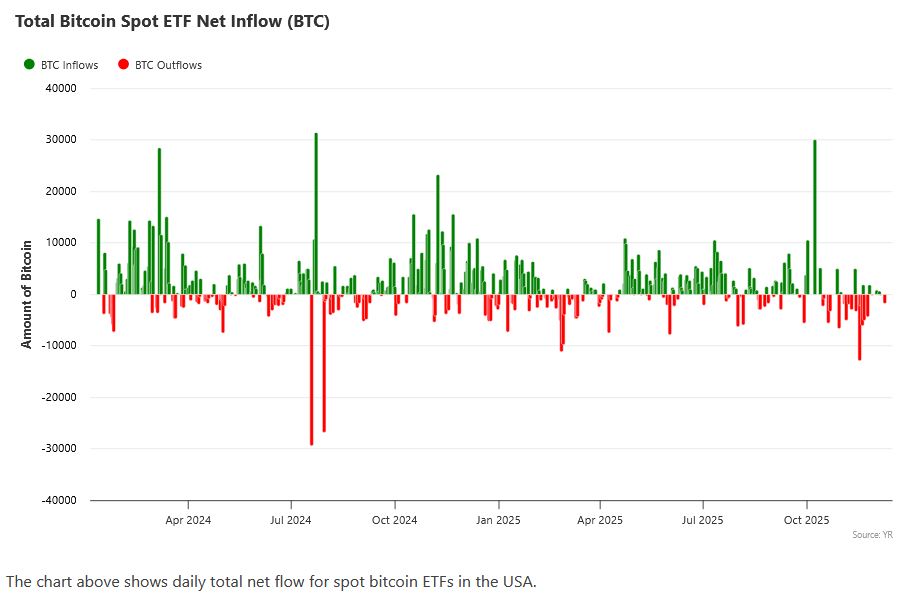
  • ETF inflows slowed to about 50,000 BTC this quarter, which led the bank to base its model on steadier ETF driven adoption and stronger macro influences.

Standard Chartered has not been shy about making bold Bitcoin predictions. The bank raised eyebrows in mid 2025 when it set a 200,000 dollar year end target, a view it repeated as Bitcoin rallied to record highs in October. That call has now been withdrawn. The latest Standard Chartered Bitcoin forecast cuts the 2025 projection to 100,000 dollars and delays the bank’s long term milestones.

The revision lands after one of the most volatile trading years in Bitcoin’s history. Prices surged to new highs, then fell more than thirty percent in the weeks that followed. ETF inflows weakened, corporate treasuries slowed their buying pace, and the macro backdrop grew more unstable. Standard Chartered still believes Bitcoin is headed for six figures and beyond, but the assumptions behind that journey have changed.

The New Forecast: A Longer Road To The Same Destination

In its updated outlook, the bank now expects Bitcoin to close 2025 at 100,000 dollars instead of 200,000 dollars. The multi year roadmap has shifted as well. The new path runs through 150,000 dollars for 2026, 225,000 dollars for 2027, 300,000 dollars for 2028, and 400,000 dollars for 2029. The 500,000 dollar long term target remains in place, but the timeline moves from 2028 to 2030.

Analysts frame the recent pullback as painful but within the normal range of corrections observed since spot ETFs launched. They insist that the long term outlook is intact. What changed is the composition of demand. The bank’s earlier model relied on two forces that worked together across 2024 and 2025. One of those forces is now considered mature.

The Standard Chartered Bitcoin price prediction remains bullish, but the updated Bitcoin price targets 2025 to 2030 reflect a cycle where demand is steadier and less explosive than analysts assumed in mid 2025.

Why Standard Chartered Slashed Its Bitcoin Forecast

The downgrade becomes easier to understand once the bank’s earlier model is unpacked. When Standard Chartered made its 200,000 dollar call, it was counting on two powerful engines. The first was the growing cohort of digital asset treasury companies that held large Bitcoin positions on their balance sheets. The second was the surge of capital that entered US spot Bitcoin ETFs after their launch in 2024.

Both engines were active throughout 2024 and deep into 2025. Corporate treasuries accumulated significant amounts of Bitcoin, and ETF inflows brought large new buyers into the market. The issue now is not that these forces disappeared. It is that one of them no longer adds incremental pressure.

Standard Chartered’s analysts now assume that corporate treasuries will not be a major source of new net demand from here. With that assumption removed, the Bitcoin forecast downgrade reasons center on the idea that the market has shifted into a new phase. The bank now counts only one reliable structural driver of demand.

Corporate Bitcoin Treasuries: From Growth Engine To Mature Cohort

Corporate Bitcoin buying was one of the defining stories of 2024 and 2025. Several companies followed a MicroStrategy style strategy and increased their holdings throughout the year. Some continue to add small amounts. The new view is not that this activity ends completely, but that the cohort is no longer expanding at a pace that justifies including treasury growth as a major demand leg in forward models.

Standard Chartered treats the corporate Bitcoin buying wave as mostly complete in its impact. Treasuries now sit on very large holdings. The marginal effect of each new purchase is smaller than it was when the trend was new and the base was low. For modelling purposes, the bank assumes an end of corporate Bitcoin treasury demand as a structural engine, even if some companies continue to accumulate.

This shifts the Bitcoin demand drivers 2025 in a meaningful way. The next stage of institutional adoption relies less on balance sheet strategies and more on broader market participation through ETFs.

ETF Inflows: From Surge To Stabilisation

This leaves ETF flows as the key structural support for Standard Chartered’s new model. During the strongest periods of the ETF cycle, US spot products saw quarterly inflows of more than 200,000 BTC. At their strongest, spot ETF inflows topped 200,000 BTC in a quarter, and corporate treasuries were actively accumulating at the same time. Even then, total demand did not reach the extreme levels many investors assumed, which helps explain why Standard Chartered now sees that phase as a one off surge rather than a baseline.

Here in late 2025, conditions look different. The bank highlights that net spot Bitcoin ETF inflows are roughly 50,000 BTC this quarter, which is the weakest pace since the products listed. The falling Bitcoin ETF inflows show that the early rush into ETFs has cooled and that future adoption will follow a more gradual pattern.

Standard Chartered still expects ETFs to play a leading role. It assumes that average flows of around 200,000 BTC per quarter are possible over time, but not on a continuous or explosive basis. This supports an ETF driven Bitcoin market, but not the type of vertical rise that earlier models implied. Flows will depend on allocations, rebalancing cycles, and broader investor sentiment.

In this environment, institutional Bitcoin adoption is still underway. It is simply less dramatic and more tied to portfolio construction than traders hoped in the middle of the year.

Source: bitbo.io

Bitcoin Is Now A Macro Asset, Not Just A Halving Story

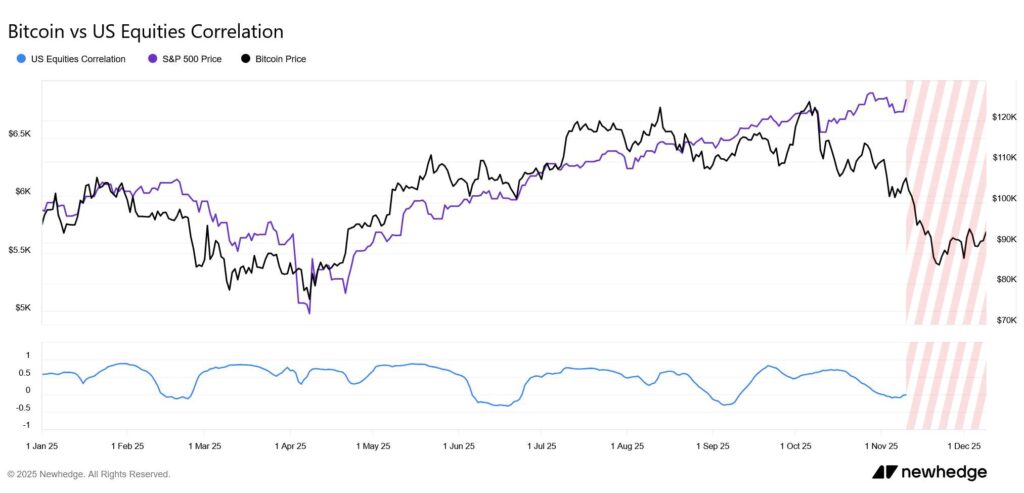
The downgrade also reflects a structural shift in how Bitcoin behaves in the ETF era. Standard Chartered argues that Bitcoin has become more sensitive to macro conditions. Across 2025, Bitcoin showed higher correlation with major equity indices, AI driven tech stocks, and shifts in Federal Reserve expectations. These Bitcoin macro drivers now overshadow the role of the halving cycle in day to day pricing.

Correlation data supports this view. Reuters notes that Bitcoin’s average correlation with the S&P 500 in 2025 has been significantly higher than in 2024. This rising Bitcoin correlation with equities makes the asset more responsive to interest rates, liquidity cycles, and volatility regimes.

For this reason, macro factors affecting Bitcoin price outlook now matter more than supply narratives in Standard Chartered’s model.

Source: newhedge.io

What The Downgrade Means For Investors

For institutions, the interpretation is clear. Bitcoin is still in the process of being integrated into mainstream portfolios, but the timeline is longer than early ETF enthusiasm suggested. Most allocations will flow through ETFs and other regulated channels. Committee approvals will align with risk conditions.

For retail investors, the message is simpler. Watch ETF flows and macro indicators rather than relying solely on halving based expectations. The Bitcoin demand outlook now depends on how quickly institutional money rotates back into risk assets when conditions ease. The revised Bitcoin price forecast 2025 is a baseline for a slower cycle, not a bearish reversal. The updated Bitcoin price targets 2025 to 2030 still show long term upside.

Conclusion: A Bullish View With A Different Engine

Standard Chartered has not abandoned its long term view. The bank still sees Bitcoin reaching 500,000 dollars, but the timeline reflects a changed market. Corporate treasuries expanded aggressively in 2024 and 2025 and now form a mature cohort rather than a growing one. ETF inflows remain the key driver, but they no longer resemble a launch phase surge.

The Standard Chartered Bitcoin forecast now reflects a market shaped by ETF flows, macro forces, and a broader institutional integration period that takes time. The destination remains. The journey is slower and depends on whether ETF demand and global conditions can sustain the next leg higher.

Regulated, But Still Risky? Inside Polymarket’s CFTC-Approved Return to the U.S.

Authorities cracking down on Polymarket, categorizing it as online gambling

TL;DR

  • Polymarket’s U.S. comeback is fully regulated under a CFTC-designated exchange and clearinghouse but abandons the on-chain model that built its reputation.
  • The U.S. app is sports-only, centrally intermediated, and far less transparent, raising new risks around liquidity, execution and internal market-making.
  • Federal approval does not override state restrictions, meaning access, obligations and user protections still vary widely across jurisdictions.

Polymarket is officially back in the United States, nearly four years after the CFTC forced it to geoblock American users and pay a $1.4 million penalty for operating an unregistered derivatives venue. With the CFTC approval now in place, Polymarket is relaunching through a newly acquired exchange and clearinghouse that sit directly under the U.S. futures regime. But this comeback involves a fundamental shift: the U.S. product is not on-chain, abandoning the model that made Polymarket synonymous with transparent, smart-contract-driven prediction markets. The result is a platform that is legally compliant yet structurally closer to a traditional derivatives venue. One where key risks persist, and some become harder to monitor.

From Enforcement to a Federal Green Light

Polymarket’s path back to the U.S. began with its 2022 enforcement case. The CFTC viewed its on-chain markets as real-money event-based derivatives, which must be offered by a registered exchange. After settling the case and blocking U.S. users, Polymarket spent years restructuring the business around a regulated framework.

The turning point was the acquisition of a CFTC-registered exchange and clearinghouse. The amended order granting Designated Contract Market (DCM) status brought Polymarket into the same legal category as CME and ICE, enabling it to list event contracts for U.S. customers. But this regulatory pivot came with a major trade-off: Polymarket could not simply port its on-chain system into a DCM environment. Smart contracts, wallet-based trading, and public settlement flows are incompatible with U.S. derivatives rules.

Under the new model, U.S. users interact with a fully intermediated structure. Brokers and futures commission merchants (FCMs) handle KYC, custody, reporting, and market surveillance. The platform’s liquidity and matching engine operate off-chain. This reshaped Polymarket compliance structure is what unlocked the CFTC approval. However, it also severs the open, verifiable architecture that defined the original platform.

The New Product: Sports-Only, Off-Chain, and Highly Controlled

The Polymarket U.S. app is rolling out gradually, first to waitlisted iOS users. At launch, the offering is limited to sports markets. Political, macro, and entertainment markets, core drivers of Polymarket’s global popularity, will come later, if regulators permit.

Just as important as what the app offers is how it operates. The U.S. version does not live on Polygon, does not settle via smart contracts, and does not expose liquidity on-chain. Instead, it functions like a conventional event-trading platform under U.S. derivatives law. Trades settle in USDC, but that is where the crypto-native experience ends.

For a company known for decentralization, transparent on-chain order books, and verifiable market logic, this shift is significant. The off-chain U.S. model removes the ability to independently audit liquidity flows, market-maker behavior, or settlement outcomes. That may satisfy regulators, but it changes the informational landscape for users accustomed to on-chain visibility.

Prediction Markets Are Growing Up—But Not Without Frictions

Polymarket relaunches at a time when prediction markets are experiencing their strongest momentum yet. Platforms are reporting multi-billion-dollar monthly volumes, institutional investors are entering the space, and competitors like Kalshi are expanding into mainstream distribution channels. The industry is no longer a crypto side experiment; it is becoming a regulated segment of retail derivatives.

This sector evolution explains why the CFTC regulated prediction markets framework is emerging now. Regulators are responding to market growth rather than driving it. But growth also intensifies competition. The Polymarket vs Kalshi dynamic is increasingly defined by distribution, compliance architecture, and access to U.S. flow rather than product design. Truth Social’s planned “Truth Predict” adds another entrant targeting political forecasting, raising the stakes for which platform will control liquidity when election markets return.

Yet while competition is increasing, the U.S. product architectures are converging toward centralized, intermediated systems. If prediction markets are “growing up,” they are also shedding some of the transparency that originally distinguished them.

Where Regulation Ends and Transparency Risks Begin

Federal oversight is a major milestone, but it does not eliminate all risks. In some cases, the shift off-chain introduces new ones.

One of the more significant issues is the emergence of internal liquidity provision. Reports indicate that Polymarket is hiring an in-house trading team to participate in its own markets. In an on-chain environment, such activity would be visible through public addresses and transaction logs. In the new U.S. architecture, this activity happens inside a closed system. That raises the classic trading against customers risk, where a venue operator or its affiliates may have superior information or execution advantages.

Even the perception of this can undermine trust. Prediction markets rely heavily on user confidence that odds reflect aggregated sentiment rather than platform-driven positioning. Centralizing liquidity and removing on-chain transparency makes it harder to distinguish between fair market-making and potential conflicts.

These concerns intersect with broader conflict-of-interest concerns, including the large market speculating on Polymarket’s own success or failure. Self-referential markets are not inherently improper, but on an off-chain venue, users lack visibility into participant composition, liquidity concentration, and execution pathways. The informational asymmetry grows, and so does the potential for misaligned incentives.

Oracle and settlement risk also take on new forms. While DCM rules mandate clear contract specifications and dispute processes, U.S. settlement relies on centralized market adjudication rather than decentralized oracles. For users accustomed to transparent on-chain resolution, this is a meaningful shift.

The commission’s green light addresses federal derivatives requirements, but prediction markets still sit in a gray zone between financial regulation and gambling law. The CFTC approval resolves only the federal component of Polymarket’s regulatory status. There remains a separate layer of state-level restrictions that the platform must still navigate. Several states interpret real-money outcome trading as sports betting. Others view it as a financial activity. This ambiguity means that federal approval does not guarantee universal access.

This complexity feeds a recurring user question: Is Polymarket legal in the U.S. everywhere? The short answer is that federal approval enables national operations, but some states may still impose restrictions, especially as the platform expands beyond sports. Navigating state gambling law vs prediction markets requirements will be a continuing challenge for the industry.

What U.S. Users Should Watch

For retail traders, the U.S. relaunch offers legitimacy but not simplicity. Even with the CFTC approval in place, Polymarket users should not assume that regulatory authorization eliminates operational risks or information gaps. Liquidity depth, market definitions, settlement rules, and regional access still vary. More importantly, the off-chain model reduces transparency around liquidity flows, market-maker identities, and execution quality. Users should also watch how the platform handles disclosures around internal trading activity, conflicts, and market surveillance. The lack of on-chain visibility places more weight on Polymarket’s governance practices.

A Milestone for Prediction Markets, But Not a Replication of the Original Vision

CFTC approval is a meaningful achievement for Polymarket. It shows that a crypto-native company can rebuild itself within the U.S. regulatory perimeter and regain access to the world’s largest derivatives market. But the U.S. app is not a regulated version of the original on-chain platform. It is a different system entirely, trading transparency and decentralization for compliance, intermediated access, and regulatory alignment.

Whether this model can deliver the same trust and informational clarity that made Polymarket successful offshore remains an open question. As prediction markets continue to institutionalize, the challenge will be balancing regulatory requirements with the transparency users expect from crypto-native platforms. Polymarket’s U.S. relaunch is an important step. In addition, it marks the beginning of a new phase where regulation and opacity coexist, and where user trust must be rebuilt under a different set of rules.

Readers’ frequently asked questions

Do I need a crypto wallet to use the Polymarket U.S. app?

No. The Polymarket U.S. app is built on a regulated, intermediated structure, not on-chain wallets. U.S. users access markets through accounts opened with regulated intermediaries that handle KYC, custody, and funding. You don’t connect MetaMask or another wallet to trade. USDC is still used for settlement under the hood, but from the user’s perspective, it behaves more like a balance held with a broker than funds held in a self-custodial wallet.

Can I use the same Polymarket account for the global on-chain site and the new U.S. app?

In practice, you should treat them as separate environments. The global platform still runs on-chain, while the U.S. app runs through a CFTC-regulated exchange and clearinghouse with its own onboarding, counterparties, and controls. Account eligibility, verification requirements, and available markets can differ between the two. If you previously used Polymarket from outside the U.S., that history does not automatically give you access to the U.S. app. U.S. users should expect to go through a fresh onboarding process that complies with local regulation.

What should U.S. users check before trading on the new app?

First, confirm that your state allows access to the Polymarket U.S. app, since some states treat real-money outcome trading as sports betting and may impose restrictions. Second, review the terms of service to understand who actually holds your funds (the intermediary or clearinghouse) and how disputes or outages are handled. Finally, check how fees, limits and reporting obligations work in your jurisdiction. Even with CFTC approval in place, you are still responsible for understanding how tax rules, state-level laws, and platform-specific policies apply to your trading activity on Polymarket.

What Is In It For You? Action items you might want to consider

Check whether your state allows access to Polymarket’s U.S. app

Before creating an account, confirm whether real-money event contracts are permitted in your state. Several jurisdictions still classify outcome trading as sports betting, which may restrict or block access even after federal approval.

Review who actually custodies your funds under the intermediated model

Since the U.S. product is not on-chain, user balances are held by regulated intermediaries rather than in a self-custodial wallet. Traders should understand which entity holds their funds, how settlement is handled and what protections apply in case of outages or disputes.

Monitor how Polymarket handles transparency, disclosures and internal market-making

Because the U.S. app runs off-chain, users cannot independently verify liquidity flows, settlement logic or market-maker activity. Watch for updates on disclosures around internal trading teams, liquidity provision and governance practices that may affect market integrity.

- Advertisement -

FEATURED