Home Blog Page 7

Hyperscale Data Shuts Michigan Bitcoin Mine for AI Customer

TL;DR

  • Hyperscale Data ended Bitcoin mining at its Michigan facility as it prepares the site for a 20 MW AI deployment targeted for Q4 2026.
  • The company has sold about 750 BTC across two August transactions, using proceeds for debt reduction, Michigan development and working capital.
  • Hyperscale continues Bitcoin mining in Montana, while larger expansion plans for both locations remain uncommitted.

Hyperscale Data switched off the final Bitcoin mining machines at its Dowagiac, Michigan, facility on September 1, 2026, after the company and its AI customer agreed to end mining operations following the customer’s inspection of the site. The company intends to sell the mining equipment removed from the property as it prepares the facility for AI computing operations.

The change in Bitcoin mining operations in Michigan follows a master services agreement that Hyperscale signed in June for an initial AI deployment at the site.

The AI contract terms

Hyperscale signed the master services agreement on June 23 through its subsidiary, Alliance Cloud Services. The customer is an unnamed California-based “neocloud” provider, a company that supplies computing infrastructure for AI workloads.

The first phase covers 20 megawatts of capacity, with operations targeted to begin during the fourth quarter of 2026. The agreement has an initial 10-year term and includes two optional five-year extensions.

Hyperscale estimates that the contract could generate about $1.2 billion in revenue if the parties extend it through the full 20-year period. The customer holds a separate option for another 32 megawatts, which would increase total capacity under the arrangement to 52 megawatts.

If the customer exercises that option, Hyperscale estimates potential revenue could rise above $3 billion.

Bitcoin treasury sales are funding the buildout

Hyperscale sold about 685 BTC for roughly $43 million on August 14. The company directed approximately $30 million of those proceeds toward debt reduction and allocated the remaining funds to its Michigan development and working capital.

During the week ending August 30, Hyperscale sold another roughly 65 BTC for about $5.1 million. Its reported Bitcoin holdings stood at approximately 215 BTC after the sale.

Montana mining continues, Michigan’s bigger buildout is unconfirmed

Hyperscale continues to mine Bitcoin in Montana using roughly 10 megawatts of capacity. The company is separately evaluating a potential 125-megawatt expansion at that location, but it has not yet committed to the project.

In Michigan, Hyperscale has identified an eventual site capacity target of about 340 megawatts. The company estimates that a fully expanded 52-megawatt customer contract would use “approximately 20%” of that planned capacity.

Hyperscale has not committed to developing the remainder of the Michigan target. Further expansion would depend on financing, construction, available power, regulatory approvals and additional customers.

Why miners are chasing AI customers

Bitcoin mining sites and AI data centers both need large amounts of electrical capacity. Both also depend on cooling systems and buildings built to house computing equipment. Although the overlap is not complete, some mining operators have used it to repurpose existing facilities for AI customers. AI deployments bring different technical requirements, including networking and reliability standards that bitcoin mining operations did not require. But that added complexity can be worth absorbing: mining revenue tracks bitcoin’s price and swings with it, while a long-term AI contract offers steadier, contracted income instead.

Hyperscale Data shares, which trade under the ticker GPUS, reached an all-time low around the announcement, according to The Block. The stock traded as low as $0.22, extending its 2026 decline to more than 76%.

Hyperscale’s leadership has framed the shift as part of a broader push to close what it sees as a valuation gap. CEO William Horne said the company’s market capitalization trades at a “significant discount to other data center companies” and said he expects it to normalize as the Michigan buildout advances.


Wyoming Puts FRNT Reserve Data Onchain Through Chainlink

TL;DR

  • FRNT reserve data is now published onchain through Chainlink, giving users a more frequent view of the assets backing Wyoming’s stable token.
  • Wyoming law requires reserves equal to at least 102% of circulating FRNT, keeping the reserve pool above parity.
  • Secure Mint would block new issuance once reserves fall below that threshold, but it is not active yet.

Wyoming has added Chainlink Proof of Reserve to its state-issued Frontier Stable Token, known as FRNT. The system publishes verified information about FRNT’s reserves and token supply onchain in near real time.

What FRNT is

Wyoming made FRNT publicly available in January 2026, the first stable token issued directly by a US state. The token targets a value of one US dollar and is backed by dollars and short-term US Treasury securities held in trust. Users can purchase it through Kraken on Solana and through the Rain card platform on Avalanche. FRNT is also available across several other blockchain networks.

The reserve data announced this week is a separate matter from FRNT’s cross-chain infrastructure. In August, the commission moved FRNT’s cross-chain transfer system from LayerZero to Chainlink’s Cross-Chain Interoperability Protocol after a security review. The August move governed how FRNT travels between blockchains. This week’s integration governs the reserves backing every token in circulation.

How the reserve checks work, and what they don’t cover

State law requires the commission to hold reserves equal to at least 102% of FRNT’s circulating supply. The reserve pool must run above parity, not just match it. The Network Firm examines the value of those reserves and compares it with the number of FRNT tokens in circulation, performing that work under standards from the American Institute of Certified Public Accountants.

Chainlink then makes the verified reserve information available through blockchain infrastructure. Users, institutions and regulators can check the published figure without waiting for a monthly disclosure. The blockchain does not inspect the bank accounts or Treasury holdings itself: it relays the figures the outside examiner supplies. Publishing a number onchain makes that number easier to monitor, but it does not verify the underlying accounts on its own.

The upgrade gives users a newer view of the assets supporting the token between formal reporting periods, but it is not the same as a continuous financial audit. Besides, it does not prevent Wyoming from issuing tokens when reserves fall short of that 102% threshold. A separate control for that purpose remains under development.

Secure Mint remains a separate step

The Wyoming Stable Token Commission plans to adopt Chainlink’s Secure Mint feature to close that gap. The system would check whether verified reserves equal or exceed the total FRNT supply before authorizing the commission to create more tokens.

Proof of Reserve publishes information about backing. Secure Mint would use that information to place a technical condition on new issuance, addressing a different risk than the one this week’s announcement covers.

If deployed as described, the feature could help prevent an “infinite mint” incident: an attack in which someone creates unauthorized tokens and increases the supply without matching assets behind them. The commission has reported no such attack involving FRNT.

The project’s scale remains limited

Wyoming’s official website showed reserves with a fair value of about $968,000 in its latest indexed snapshot. That is a small sum next to the broader stablecoin market, and it points to limited use of FRNT since its January launch. The transparency system itself is still notable as a piece of public financial infrastructure, independent of how much FRNT circulates today.

UK Freezes £10M Reportedly Linked to Premier League Deal With Sorare

TL;DR

  • UK authorities froze £10.024 million held in a Premier League account and reportedly linked to its former deal with Sorare.
  • The freezing order preserves the money during an investigation but does not establish wrongdoing by the Premier League or Sorare.
  • The NCA matter is separate from the Gambling Commission case against Sorare over alleged unlicensed gambling.

The UK’s National Crime Agency froze £10.024 million held in a Premier League bank account, citing possible links between the money and alleged third-party criminality. The funds reportedly came from the league’s former partnership with blockchain fantasy-sports company Sorare.

A freezing order does not establish that a crime took place. It keeps the money in place while the investigation continues. Court records show the order was obtained in January 2025. Authorities have not identified the alleged third-party crime. Reports state that the Premier League is not suspected of wrongdoing.

The order was obtained in January 2025 but only became public this week, when The Sun first reported it on August 31.

What the freezing order covers

Court records show the order applies to £10,024,041.33 held in the name of Football Association Premier League Limited. Westminster Magistrates’ Court granted it under the Proceeds of Crime Act (PCA).

According to The Sun, the money was held in the Premier League management company’s Barclays account. The report linked it to Sorare’s first payment under a four-year commercial agreement announced in 2023. The Premier League is seeking to vary the order, which runs until September 14.

An account-freezing order under the PCA is a civil proceeding. It keeps money in place while investigators look into where it came from, without seizing it or transferring ownership to the government. The order alone doesn’t establish guilt or prove the funds are criminal property.

How the Sorare partnership worked

Sorare operates a fantasy-sports game built around digital player cards. Users assemble teams, and their results depend on real-world player performances. The service launched in 2018 on Ethereum, a blockchain network, accepting only its native currency, Ether. It began accepting fiat currency in August 2023 and added Solana, another blockchain network, in late 2025.

Its Premier League agreement allowed Sorare to issue digital cards representing players from all 20 clubs. According to The Sun it was a £120 million deal worth £30 million per year.

The partnership, announced in January 2023, has now ended. Sorare told The Sun that the contract expired after the 2025-2026 season and declined to comment on the freezing order itself. The company gave a more pointed response to other outlets. A Sorare spokesperson told Fortune that Sorare is not the subject of a National Crime Agency investigation and said the frozen account does not belong to Sorare. Sorare’s chief executive Nicolas Julia called initial reports of the freeze inaccurate on social media.

A separate gambling case remains unresolved

The NCA matter is separate from a Gambling Commission prosecution, in which the regulator accuses Sorare of offering gambling facilities without a UK operating licence. Sorare disputes the allegation, arguing that its game depends on skill rather than chance. No court has ruled on Sorare’s liability in the separate case.

Why the disclosure matters beyond football

Crypto companies have used major sports partnerships to reach mainstream users. Those deals can place unfamiliar financial or blockchain products beside brands that fans already trust.

The Financial Conduct Authority warned clubs in June about sponsorships involving unauthorized financial firms. It said such deals may expose supporters to products without normal UK protections. The warning did not accuse Sorare or address the NCA order specifically. Even so, it shows why regulators are scrutinizing the financial relationships behind sports promotions.

Lazarus-Linked Wallets Move $30 Million Through Hyperliquid as US Weighs Bringing It Onshore

TL;DR

  • Arkham linked more than $30 million in Bitcoin sales on Hyperliquid to wallets attributed to North Korea’s Lazarus Group.
  • The Lazarus Hyperliquid activity highlights the limits of public blockchain data when assets move toward centralized exchanges.
  • A proposed US-compliant gateway could screen American users without necessarily governing activity on Hyperliquid’s native platform.

Wallets that blockchain analytics firm Arkham attributes to North Korea’s Lazarus Group sold more than $30 million in Bitcoin on Hyperliquid over three weeks, according to a review CoinDesk commissioned and published on August 31, 2026.

Sanctioned actors continue using Hyperliquid’s native platform at a time when the US government is exploring a compliant route to bring it into the American regulatory system.

What the blockchain review found

Arkham traced the Bitcoin sales through Hyperliquid and found that the Lazarus-linked wallets converted proceeds into Ether and Solana before moving assets toward Kraken, LBank and KuCoin.

Crypto investigator ZachXBT first identified the wallets in 2024. Arkham later attributed the wallets used on Hyperliquid to Lazarus, the North Korean state-backed hacking group that the US Treasury Department’s Office of Foreign Assets Control sanctioned in 2019.

CoinDesk has not established who controls the receiving accounts at the three centralized exchanges. Public blockchain records can trace assets to exchange-linked addresses, but they cannot identify an account holder unless the exchange discloses that information.

On-chain records have another limit. They do not show whether an exchange took private compliance action, such as restricting an account or filing a regulatory report.

How trading works on Hyperliquid

Hyperliquid is a decentralized exchange, meaning no central operator screens who can trade or requires an account before access. Users connect a crypto wallet directly and trade through blockchain-based infrastructure. They skip the know-your-customer identity checks that centralized exchanges usually require. The platform can process trades from a wallet address even when the person or organization controlling it remains unidentified.

Its main market centers on perpetual futures, derivatives that let traders take positions on an asset’s price without an expiration date.

Blockchain analytics companies label addresses by linking transaction histories with previous investigations and other evidence. A wallet label can flag sanctions exposure, but the label does not function like a verified customer identity.

What the exchanges said

CoinDesk sought comment from the platforms named in the transfers. Kraken said its compliance program works with blockchain analytics providers to identify assets tied to sanctioned wallets and block them before they reach the platform.

LBank said it uses industry-standard monitoring tools. The exchange described sanctions screening as a cross-platform, cross-chain and cross-jurisdictional challenge that no single trading venue can fully address on its own.

KuCoin stressed the gap between visible blockchain transfers and private compliance procedures. The company said account restrictions or regulatory reporting can occur after assets reach a platform without appearing in public on-chain data.

Hyperliquid did not respond to CoinDesk’s request for comment before publication.

Washington explores a US pathway

President Donald Trump said at an August White House event that Commodity Futures Trading Commission Chair Mike Selig is working on a pathway to bring Hyperliquid into the United States “in a fully compliant and legal fashion.”

Corporate discussions are moving in parallel. Bloomberg reported that Payward, Kraken’s parent company, is in advanced talks with Hyperliquid Labs about giving US traders access to Hyperliquid perpetuals.

The model under discussion would place a licensed intermediary or US affiliate between American customers and Hyperliquid. Such an arrangement would create a regulated access layer without changing the decentralized exchange model. Regulators have not defined what a compliant structure would need to look like under existing rules. No US entity structure or KYC design has been finalized or publicly announced as of this writing.

Where a US gateway stops

A regulated American gateway would apply only to US persons who choose to access Hyperliquid through it. Regulators can restrict that gateway and require it to screen who enters, since it would run through a licensed intermediary or US affiliate under their jurisdiction. Native Hyperliquid sits outside that reach. Regulators have no comparable mechanism to screen or restrict users interacting directly with the underlying platform, including sanctioned actors, unless the protocol itself imposes those restrictions.

The unresolved regulatory boundary

Hyperliquid has its own approach to regulated access, called HIP-3. It lets licensed third parties build permissioned markets on top of its existing infrastructure instead of routing users through an external intermediary. 

Whether the CFTC’s framework, HIP-3, or neither will ever govern the offshore, native version of Hyperliquid itself remains unresolved. Regulation may end up applying only to the US-facing wrapper built around it.

How a TONIC Price Attack Forced Cronos to Roll Back Its Chain

TL;DR

  • The Tectonic exploit used a sharply inflated TONIC price to support tens of millions of dollars in borrowing.
  • Cronos rolled back the chain, reversing $68.7 million in reported borrowing that had remained on the network.
  • About $6 million reached Ethereum before the halt, while the final loss and any depositor impact remain unresolved.

Cronos rolled back its entire blockchain to undo an exploit on Tectonic, its largest lending protocol, after an attacker used an inflated token price to borrow from the platform. Independent on-chain researcher Weilin Li first estimated the borrowing at $75 million; TRM Labs later cited the same figure. The network resumed block production on August 31, one day after validators halted it during the attack.

The rollback recovered most of the funds that had remained on Cronos, but a portion had already reached Ethereum before the halt, beyond the chain’s reach, according to blockchain intelligence firm TRM Labs.

Tectonic had warned users not to interact with the protocol until it said doing so was safe.

How the TONIC price attack worked

Tectonic allows users to deposit crypto as collateral and borrow other assets against it. The protocol accepted TONIC, its own governance token, as collateral with a 20% collateral factor. In simple terms, every $100 of value recognized by the system could support about $20 of borrowing.

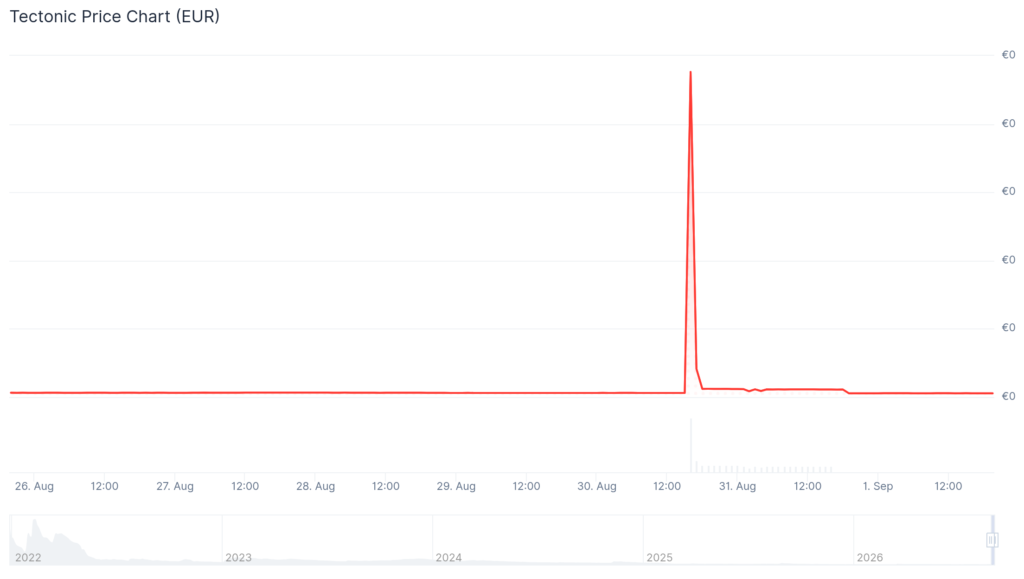
TONIC traded on a thin market, making the collateral arrangement easy to move. TRM said the token recorded about $305,000 in trading volume during the week before the attack.

On August 30, the attacker pushed TONIC’s price up about 100-fold in roughly 20 minutes, then deposited the inflated tokens and borrowed assets with deeper markets from Tectonic’s pools.

TONIC’s price moved cheaply because so little of it traded, and Tectonic’s lending system accepted that price at face value.

Source: CoinGecko.com

Cronos chain rollback

Cronos halted after block 90,907,150 at 14:32:47 UTC on August 30, TRM reported. The network’s software caps its validator set at 100, small enough for the group to coordinate a halt within minutes.

Validators restarted Cronos on August 31 by rolling the chain back to a point before the Tectonic attack, discarding every transaction recorded after that point and returning the network to its earlier state. That reversed the $68.7 million in reported borrowing that had stayed on Cronos. But the rollback did not target the attacker specifically: it erased every transaction recorded after the restored point, whether or not it had anything to do with the exploit.

TRM said about $6 million reached Ethereum before the halt and was exchanged into roughly 2,500 ETH. Those assets survived the rollback because Ethereum keeps its own separate transaction history. Cronos cannot alter those records.

The rollback also accounts for a separate data point: Tectonic’s total value locked, which fell to roughly $3 million during the exploit, had returned to close to its pre-exploit level of about $121 million by September 1. Restoring the chain to a point before the attack undid the transactions that had drained it.

No final loss report

Estimates of the loss have moved as new information emerged. Li initially put the borrowing at $66 million, then revised the figure to $75 million after identifying a second attacker-controlled address. A separate on-chain analysis placed the total higher, at $119.5 million.

The attacker withdrew a mix of assets, including USDC, USDT, wrapped Bitcoin, and wrapped Ether, along with CRO, Cronos’s native token. No confirmed breakdown of the amounts exists. Neither Tectonic nor Cronos has published a final accounting. The gap between the estimates, along with any ultimate depositor losses, remains unresolved.

Tectonic’s total value locked fell from about $121.7 million on August 26 to roughly $3 million by August 31, according to TRM and CoinDesk — the low point before the rollback reversed it.

Source: DefiLlama.com

Price manipulation is becoming more common

TRM recorded 32 price-manipulation exploits in 2026, already the highest annual count in its data. It said this method now accounts for about one in eight crypto attacks, compared with one in 17 in 2022.

The pattern puts pressure on lending protocols to consider how easily a collateral token’s market price can move. A functioning price feed cannot protect a pool when the underlying market is too small to support the borrowing it enables.

Tectonic users are waiting on two things now: when the protocol will confirm it’s safe to interact again, and whether any compensation or new controls will come before lending resumes.

- Advertisement -

FEATURED