
Home Blog Page 76

Western Union Goes On-Chain: Treasury Pilot Points to Cheaper Global Remittances Ahead

Western Union, one of the world’s oldest money-transfer networks, has launched a stablecoin pilot, leveraging blockchain utility to streamline its global settlement infrastructure. The pilot initially focuses on Western Union treasury and internal settlements, allowing the company to test faster, lower-cost transfers across its cross-border network before expanding to consumer-facing use cases.

For a company synonymous with remittances, the move marks a quiet but pivotal modernization. By using digital tokens to settle transactions between subsidiaries and partners, Western Union seeks to reduce its dependence on correspondent banks and the costly delays that come with them.

Inside Western Union’s Stablecoin Pilot for Faster Cross-Border Transfers

Traditionally, Western Union has relied on a web of banking intermediaries to route money across 200 countries. This structure, while trusted, is slow and capital-intensive. Funds often move through several correspondent banks, locking up liquidity for days before final settlement.

The Western Union stablecoin framework replaces this bottleneck with blockchain-based rails, where transactions can finalize in minutes rather than days. Public details of the pilot remain limited for now. However, the company confirmed it’s exploring regulated, USD-backed stablecoins to achieve real-time settlement for its treasury operations.

By adopting stablecoin settlement, Western Union aims to improve transparency, cut reconciliation costs, and eliminate overnight liquidity buffers. For a multinational network handling billions annually, even small improvements in settlement time translate into significant efficiency gains.

Why Now: Regulatory Clarity Enables Institutional Adoption

Western Union’s shift follows a decade of cautious observation. The company’s leadership had long cited regulatory uncertainty as a barrier to using blockchain for money movement. That changed with the passage of the GENIUS Act, which gave U.S. institutions a framework for stablecoin issuance, custody, and reporting.

In contrast, crypto-native firms have long treated stablecoins as speculative tools. Western Union, however, is using them purely for compliance-backed operational efficiency. CEO Devin McGranahan said the pilot reflects “a natural evolution” in payments infrastructure now that the legal parameters are clear. The result is a risk-managed entry point into blockchain settlement. Certainly, other financial incumbents are likely to emulate that.

Consumer Implications: The Future of Cross-Border Payments

Though the pilot is limited to internal flows, its potential impact reaches much further. If successful, on-chain settlement could drastically reduce remittance costs for consumers, especially in high-volume corridors across Latin America, Africa, and Southeast Asia.

Therefore, for millions of migrant workers who depend on cross-border payments, the promise of near-instant transfers and lower fees is not abstract. Using stablecoins as a back-end settlement layer could enable Western Union to deliver faster, cheaper transactions. And it could even do so without altering the user-facing experience.

In countries with volatile local currencies, future consumer models might even offer limited USD exposure through regulated digital wallets. Families would experience more stability without relying on crypto exchanges.

Competing in a New Payments Era

Meanwhile, Western Union’s pivot comes as competitors like MoneyGram and PayPal test their own blockchain integrations. The MoneyGram stablecoin pilot, launched earlier this year, similarly targets faster settlement between partner institutions. For Western Union, however, the advantage lies in its trust infrastructure. After all, it built regulatory relationships over decades, AML compliance systems, and local agent networks that crypto startups lack.

Stablecoin technology could help Western Union close the digital gap without reinventing its entire business. In doing so, the company positions itself as a bridge between traditional remittance networks and on-chain payment ecosystems. Once stablecoins become embedded in mainstream finance, this role may prove strategically vital.

Digital Wallet Expansion and the On-Chain Future

Western Union’s broader transformation already includes a digital wallet expansion now active in seven markets, with over 500,000 active users and more than half of all transactions containing a digital component. Integrating stablecoin settlement with its wallet infrastructure could create a seamless, end-to-end digital payments stack. Consequently, customers could send funds, settle on-chain, and cash out locally within minutes.

The company has not disclosed which blockchain networks or partners it will use for the pilot, though prior collaborations with Ripple and Stellar suggest interoperability testing may be part of its roadmap. Regardless of the platform, the technical logic remains: replacing overnight settlement delays with instant on-chain finality.

What Comes Next

Western Union has not set a public timeline for expanding beyond internal use, but executives hinted at more detailed updates in early 2026. The firm will measure success through metrics like settlement cost reduction, time-to-finality, and liquidity savings.

If the pilot meets expectations, a controlled rollout in select consumer corridors could follow, likely under regulatory sandboxes in high-remittance markets. The results could reshape how traditional money transfer operators view blockchain, not as a rival technology but as the next evolution of their core systems.

For now, the Western Union stablecoin pilot stands as a symbolic turning point: the moment one of finance’s oldest names stepped onto the blockchain; not to speculate, but to modernize the rails of global money movement.

Readers’ frequently asked questions

Are transfers using stablecoins regulated the same way as traditional money transfers?

Yes. Even when stablecoins are used for settlement, transactions remain subject to the same anti–money laundering (AML) and know-your-customer (KYC) rules that apply to any licensed money transfer operator. Western Union must still verify sender and receiver identities, report suspicious activity, and comply with local financial regulations.

How do stablecoin settlements differ from using cryptocurrencies like Bitcoin for payments?

Stablecoins are digital tokens pegged to stable assets, such as the U.S. dollar, which means their value does not fluctuate the way Bitcoin or Ethereum does. This makes them more suitable for settlement and payment use cases. In contrast, using volatile cryptocurrencies would expose both senders and recipients to price swings during the transfer process.

What information does Western Union need to report when using stablecoins for settlements?

Licensed money transfer companies must continue reporting all cross-border transactions to regulators, including transaction value, currency type, sender and recipient data, and settlement details. The use of stablecoins does not change these disclosure obligations, since reporting requirements are based on financial regulations rather than the payment technology used.

What Is In It For You? Action items you might want to consider

Follow institutional blockchain pilots, not hype.

Track official updates from companies like Western Union or MoneyGram when they release pilot data or regulatory filings. These reports show how real payment infrastructure is evolving, beyond token speculation.

Understand how regulation drives adoption.

Read up on the GENIUS Act and similar legislation to see how legal frameworks enable stablecoin use by banks and money-transfer operators. Knowing the rules helps distinguish credible financial integrations from unregulated projects.

Evaluate service options once regulated providers expand access.

If your business or personal transfers rely on cross-border payments, review how licensed operators integrate blockchain settlement once products become available. Choose providers that are transparent about compliance and transaction costs.
Mt. Gox Repayment Delay Extends to 2026, Keeping Billions in Bitcoin Off the Market

Mt. Gox payout of $9.6B in Bitcoin set for October 2024 could bring volatility or stability.

The rehabilitation trustee for the defunct Mt. Gox exchange has pushed the long-anticipated creditor repayment deadline back by another year, to October 31, 2026. The repayment delay keeps an estimated $4 billion in Bitcoin locked inside the Mt. Gox estate for at least twelve more months. While it temporarily eases market fears of a sudden supply shock, it further prolongs the wait for creditors who have already endured almost a decade of uncertainty.

A Decade-Long Winding Road

Once the world’s largest crypto exchange, Mt. Gox collapsed in 2014 after losing 850,000 BTC to hacks and mismanagement. The Tokyo District Court placed the firm into rehabilitation, and years of claims processing followed. A settlement framework approved in 2021 set the stage for gradual repayments, with October 2025 as the original deadline. That schedule has now shifted again. The trustee cited procedural bottlenecks that make it impossible to complete distributions on time.

Why the Mt. Gox Trustee Asked for Another Year

In a court-approved statement, the rehabilitation trustee said the extension was necessary “to make the repayments to the extent reasonably practicable.” Behind that legal phrasing lie two main challenges. First, a significant number of creditors still have not completed required verification steps. That includes KYC checks, bank-account linking, and identity validation on partner exchanges. Second, several partner institutions continue to report processing or compliance issues that slow transfers. Rather than closing the window prematurely, the trustee sought more time to ensure that every verified claimant receives the correct allocation. In essence, the Mt. Gox repayment delay reflects administrative accuracy rather than any new financial dispute.

How Much Has Been Repaid So Far

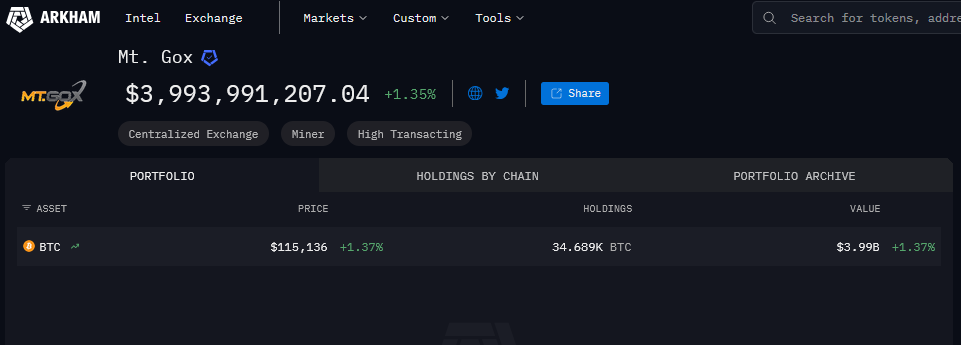
On-chain data and trustee disclosures show that Mt. Gox held 141,686 BTC in total for distribution. As of late October 2025, approximately 106,997 BTC (≈ 75.5%) have already been transferred to end recipients. About 34,689 BTC are still in trustee-controlled wallets. The Base, Early Lump-Sum, and Intermediate Repayment tranches are “largely completed” for creditors who met all procedural conditions. Remaining assets include unallocated Bitcoin Cash (BCH) and Japanese yen cash balances awaiting confirmation. The trustee has not published a unified fiat + crypto total, but blockchain trackers confirm that a majority of BTC disbursements are complete.

https://intel.arkm.com/explorer/entity/mt-gox

Market Impact: Relief Now, Uncertainty Later

For traders, the extension offers a near-term reprieve. The delayed release of billions in Bitcoin means that tens of thousands of coins remain off exchanges, preventing abrupt liquidity shocks that could depress prices. Analysts had warned that repayments scheduled for late 2025 might trigger a surge in sell orders as long-waiting creditors cashed out. By shifting the timeline to 2026, the trustee effectively defers that risk. Though this allows markets to absorb the supply gradually once transfers resume, it simply moves the risk forward in time. Some creditors are long-term believers who are likely to hold. However, others, especially funds that bought claims at discounts, are expected to sell once assets arrive. That blend of holders and sellers means eventual volatility is probable, just not imminent.

The Creditors’ Perspective

For former Mt. Gox users, the news lands with mixed emotions. On one hand, the majority of compliant claimants have finally received partial payouts in BTC, BCH, or fiat. On the other hand, many small creditors feel the rehabilitation has become an endless paperwork loop. Thousands remain stuck in verification limbo due to repetitive KYC requests and exchange-specific technical issues. Each claim must still pass through multiple compliance layers before any transfer is released, and even minor data discrepancies can freeze a case for months. The trustee has warned against unofficial communication channels after several phishing campaigns targeted creditors seeking updates. All status changes are now posted exclusively on the official MtGox.com site and through direct trustee notices.

Why the Delay Matters Beyond Creditors

The Mt. Gox repayment delay doesn’t just impact former customers—it shapes Bitcoin’s supply dynamics. Mt. Gox’s remaining 34,000 BTC equal roughly 0.16% of the circulating supply, a non-trivial amount in thin liquidity conditions. Keeping that stock dormant effectively supports short-term price stability. However, the longer the holdings stay frozen, the more the market begins to price in their eventual return. Traders monitor trustee wallets closely; any large outgoing transaction instantly appears in blockchain analytics dashboards, often sparking temporary price dips. Thus, while the delay offers breathing room, it also extends a period of heightened attention across global crypto markets.

What Happens Next

The trustee has pledged to continue repayments “as soon as practicable” and will issue periodic updates through 2025 and 2026. Remaining payments are expected to occur in staggered batches as each creditor clears final checks. Observers anticipate at least one more progress report in Q2 2026, followed by a completion notice near the new October deadline, if timelines hold. In the meantime, analysts expect Mt. Gox-linked wallets to remain static, signalling that no large market inflows are imminent. Until that changes, both creditors and traders remain in a holding pattern defined by delayed closure and cautious optimism.

Conclusion

More than eleven years after its collapse, Mt. Gox continues to cast a long shadow over Bitcoin’s history. The current extension embodies a paradox: it protects the market from short-term disruption while testing the patience of those still waiting for restitution. If the rehabilitation plan stays on course, 2026 should finally mark the end of this drawn-out saga. A resolution creditors have been chasing since before crypto’s first bull run.

Readers’ frequently asked questions

How do I check my Mt. Gox claim status?

Use only the official Mt. Gox Rehabilitation Claim System and the trustee’s verified emails. Log in with your issued credentials to see approval status and any pending steps. Ignore messages on social media or third-party sites asking for wallet keys or seed phrases.

Will my repayment arrive in BTC, BCH, or cash?

That depends on your linked accounts and the option you selected. Repayments can be delivered in Bitcoin (BTC), Bitcoin Cash (BCH), or Japanese yen (JPY). Crypto transfers are routed via trustee-approved exchanges; cash payments are processed to registered bank accounts.

What if I missed KYC or procedural deadlines?

Your repayment is paused, not forfeited. Complete the required KYC and account details through the official portal; once verified, processing resumes in the next eligible batch. Always rely on the trustee’s notices for exact instructions and timing.

What Is In It For You? Action items you might want to consider

Monitor on-chain movements of Mt. Gox wallets

Large outgoing transactions often appear before official repayment updates. Tracking these movements can provide early insight into when repayments might resume and how much Bitcoin could enter the market.

Prepare for potential short-term volatility in 2026

The eventual release of Mt. Gox Bitcoin may trigger temporary price swings. Traders should plan hedging strategies or adjust portfolio exposure ahead of the revised repayment window.

Stay subscribed to official trustee communications

Use only MtGox.com and verified email addresses for repayment updates. Avoid unofficial Telegram or Discord groups that may circulate false timelines or phishing links.

Operation Catalyst: Interpol’s Landmark Crackdown on Crypto-Linked Terror Financing in Africa

Interpol flag

Interpol and Afripol have completed one of the largest coordinated law-enforcement efforts in Africa’s digital-finance history. The three-month campaign, codenamed Operation Catalyst, resulted in 83 arrests across six African nations. It flagged $260 million in suspect fiat and crypto transactions and led to the seizure of roughly $600,000.
The Interpol investigation into crypto terror financing marks a decisive turn in the global effort to track extremist funding through digital assets. It illustrates how blockchain forensics now shape counter-terrorism strategy across Africa.

The Operation at a Glance

Conducted between July and September 2025, Operation Catalyst united Interpol, Afripol, and national financial-intelligence units across Angola, Cameroon, Kenya, Namibia, Nigeria, and South Sudan. The goal was to dismantle networks suspected of using cryptocurrencies and informal transfer systems to finance terrorism, launder proceeds, or defraud victims under the guise of investment platforms.

Authorities said the joint crypto crackdown flagged nearly $260 million in suspect activity, identifying 160 additional persons of interest whose accounts remain under scrutiny. While the agencies only seized a fraction of the funds, the scale of the flagged flows demonstrates how illicit finance has adapted to Africa’s fast-growing crypto adoption.

How the Crackdown Played Out on the Ground

Angola – Informal Transfers and Bank Freezes

Angola emerged as one of the operation’s focal points. Investigators detained 25 suspects, seized about $588,000, and froze 60 bank accounts. Authorities found that cash from small retail traders was funneled through unlicensed money-transfer networks into wallets later linked to regional extremist activity. These hawala-style crypto conversions exposed how loosely regulated payment apps have become a parallel economy for cross-border cash movement.

Kenya – VASP Laundering and Recruitment Funding

In Kenya, the investigation traced roughly $430,000 in transactions through a registered Virtual Asset Service Provider (VASP). The funds, originating from anonymous wallets, were reportedly used to finance recruitment and logistics in neighboring Tanzania. Consequently, fourteen Kenyans were flagged, with several arrests confirmed.
The case arose just months after Kenya implemented its VASP Act, part of its broader crypto-related anti-money-laundering reforms. The operation was a timely demonstration of how domestic regulation and cross-border policing now intersect.

Nigeria – Crypto Fraud Meets Terrorist Financing

In Nigeria, authorities arrested 11 suspects in connection with crypto-based terror-funding pipelines. Investigators linked stablecoin transactions to unlicensed brokers routing funds to offshore exchanges. According to the Nigerian Economic and Financial Crimes Commission (EFCC), these accounts often disguise flows under legitimate business fronts, showing how easily crypto-based terror financing can exploit informal trade routes.

Beyond direct arrests, Operation Catalyst uncovered a massive $562 million crypto Ponzi scheme spanning 17 countries and 100,000 victims. First the network lured investors with high-yield promises. Then they funneled portions of the proceeds into accounts now under review for potential terrorism ties.
The Interpol investigation revealed overlapping wallet clusters between fraud organizers and addresses already monitored in prior anti-terror operations. While forensic tracing continues, the case underlines how crypto Ponzi schemes in Africa increasingly blur the line between financial crime and extremist financing.

Private-Sector Collaboration: The New Model for Crypto Policing

For the first time, Interpol and Afripol worked closely with private intelligence partners, including Binance, Moody’s, and Uppsala Security. These companies provided transaction-mapping tools and anomaly-detection systems that helped identify high-risk wallet behavior.
This cooperation marks a shift toward crypto compliance across Africa, where regulated exchanges and data providers assist in real-time tracking. They are closing the gap between corporate AML infrastructure and law enforcement operations.

Why So Little Was Seized Compared to Flagged Funds

The headline number, $260 million flagged versus $600,000 seized, reflects the complexity of recovery rather than enforcement failure. Many accounts remain frozen pending legal clearance. Others involve tracing wallets that cross multiple jurisdictions, which can take months.
Interpol noted that Operation Catalyst teams face delays due to privacy-coin obfuscation, peer-to-peer exchange patterns, and inconsistent cooperation agreements among regional regulators. Despite these limits, the data gathered provides the first continent-wide map of suspected crypto-based terror financing flows.

Emerging Patterns: From Local Laundering to Global Pipelines

  • Localized hawala-to-crypto conversions funding small extremist cells.
  • Ponzi-style investment schemes using stablecoins to launder proceeds.
  • Exchange-hopping networks that transfer value across borders via USDT and BUSD pairs.

These patterns reveal how African terror financiers increasingly mimic legitimate fintech behavior. They operate through the same digital channels used for remittances and e-commerce.

The Policy Ripple Effect Across Africa

The crackdown has accelerated policy discussions in several countries. In Kenya, lawmakers are tightening VASP licensing standards under the Africa crypto regulation 2025 agenda. Nigeria is considering mandatory wallet registration, while Angola has initiated talks with the Financial Action Task Force (FATF) on transaction monitoring.
Interpol’s success has also prompted proposals for a continental AML coordination hub. The idea would link national watchdogs through Afripol to share intelligence more efficiently.

What Comes Next

Interpol confirmed plans for Operation Catalyst Phase II, which will emphasize asset recovery and network disruption. The agency will expand its training for local investigators in crypto forensics. It will also launch new partnerships with compliance firms to enhance on-chain analytics.
Regional agencies expect that Interpol arrests in Africa will continue through 2026 as flagged funds are traced and frozen under mutual legal-assistance treaties.

Operation Catalyst demonstrates that Africa’s battle against illicit crypto use has reached a new level of coordination. The Interpol investigation into crypto terror financing not only dismantled active networks. It also created a blueprint for how blockchain data, private partnerships, and regional enforcement can converge.
For Africa’s crypto industry, the message is clear: transparency and compliance are no longer optional. They are becoming the frontline of security.

Readers’ frequently asked questions

Interpol coordinates cross-border investigations by sharing intelligence, training national police forces, and providing access to blockchain analysis capabilities through its innovation centers. While local authorities carry out the arrests, Interpol helps link wallet activity and suspects across multiple jurisdictions so cases can move forward.

How can terrorists use cryptocurrency to finance their activities?

Networks may use crypto to collect donations, move funds between countries, or pay operatives without relying on banks. They often cash out through unregulated brokers or informal exchanges, which makes tracing and freezing funds harder for regulators and law enforcement.

What can crypto users and businesses in Africa do to avoid being linked to illicit activity?

Use licensed Virtual Asset Service Providers (VASPs), complete KYC, and report suspicious activity to your country’s financial intelligence unit. Businesses should deploy blockchain monitoring to screen high-risk wallets and follow emerging AML requirements in their market.

What Is In It For You? Action items you might want to consider

Verify who you trade with

Before sending crypto across borders or using peer-to-peer platforms, confirm the exchange or broker holds a Virtual Asset Service Provider (VASP) license in your country. Unlicensed intermediaries are frequently tied to untraceable or illicit flows.

Monitor your wallet activity

Use blockchain explorers or compliance tools to screen exposure to high-risk addresses. Avoid interacting with wallets that appear on sanction or scam lists to reduce the chance of funds being frozen or flagged.

Strengthen compliance within your business

If you operate a fintech or crypto platform, implement transaction monitoring and regular KYC reviews. Align processes with FATF and local AML standards as oversight tightens across African markets.

Crypto.com Joins 2025 Rush for U.S. National Trust Charters to Court Institutions

Bankers and crypto executives wait in line at a government office labeled “OCC Trust Charter Applications,” symbolizing Crypto.com’s national trust bank charter filing and the 2025 race for federal approval among digital-asset firms.

Crypto.com has filed an application with the US Office of the Comptroller of the Currency (OCC) for a national trust bank charter, marking a decisive step toward federally supervised institutional custody. The move places the exchange alongside Coinbase, Circle, Paxos, Ripple, and Stripe / Bridge, which have all pursued similar trust charters this year as crypto custody inches closer to bank-grade compliance.

A federal move to deepen institutional trust

Until now, Crypto.com has operated its U.S. custody business through a New Hampshire-chartered qualified custodian, Crypto.com Custody Trust Company. That entity remains intact, but the new filing brings part of the business under direct OCC oversight. The company hopes that such a level of supervision will increase its appeal to risk-averse institutional investors.
A federal charter would let Crypto.com serve clients across the United States under a single supervisory framework, removing the need to navigate multiple state trust regimes.

The timing is deliberate. Institutional appetite for digital assets is rising again. However, traditional players, namely asset managers, corporate treasuries, and family offices, demand counterparties with federal oversight and audited controls. For exchanges, an OCC charter has become the ultimate trust signal.

The 2025 national-trust wave

Crypto.com’s filing joins a growing list of digital-asset companies seeking federal charters for crypto firms. Coinbase and Circle were among the first movers, followed by Paxos, Ripple, and Stripe / Bridge. All are chasing the same goal: to operate nationally without the patchwork of state rules that complicate custody and compliance.

The trend reflects a maturing market. In 2020, crypto companies were lobbying to avoid banking rules. By 2025, they are voluntarily embracing them. Analysts compare this phase to the early days of internet banking in the 1990s when digital-only players sought federal trust licenses to prove legitimacy. The OCC national trust bank charter has become the preferred structure because it offers federal recognition without requiring full commercial-bank privileges.

What a national trust bank actually is

Despite the “bank” in the name, an OCC national trust bank cannot take deposits or extend credit unless it holds additional approvals. Instead, it focuses on fiduciary services such as custody, trustee, and safekeeping functions.

That distinction matters. A trust bank provides federal supervision, capital requirements, and regular examinations, yet remains insulated from retail-banking risks. For crypto companies, that balance, oversight without deposit liabilities, is ideal.

This model also fits within evolving U.S. regulation. The SEC’s pending custody-rule changes will require investment advisers to use qualified custodians that meet strict oversight standards. A federally chartered trust bank satisfies those expectations and aligns with institutional compliance frameworks.

Crypto.com’s strategy for institutional expansion

The new charter aligns with Crypto.com’s institutional crypto custody ambitions. Adding this federal layer to its custody stack simplifies the onboarding for asset managers who currently face compliance bottlenecks when dealing with state-regulated entities.
It also positions Crypto.com competitively against Coinbase Custody Trust Company and Paxos Trust Company, which already hold OCC or New York DFS charters.

In practice, the filing shows that Crypto.com isn’t chasing retail expansion. Instead, it’s building infrastructure for qualified custodianship and back-end services that institutional investors expect. Federal oversight, combined with the firm’s global licenses in Singapore, the U.K., and Dubai, could help unify its worldwide compliance profile under one standard.

The competitive landscape: toward federalization

The 2025 charter race marks the federalization of crypto custody. Each approval brings the sector closer to a world where digital-asset service providers operate under the same prudential frameworks as traditional trust banks.
Coinbase, Circle, Paxos, Ripple, and Stripe / Bridge have already set that trajectory. For regulators, this convergence represents progress. After all, it replaces fragmented state oversight with uniform federal rules. For institutions, it reduces counterparty uncertainty.

Foreign exchanges without a U.S. trust presence may find themselves at a disadvantage when competing for custody mandates. Industry observers note that institutional clients increasingly view an OCC trust charter as a baseline requirement for counterparties offering custody services.

The regulatory and political backdrop

The OCC is still recovering from early-2020s controversies around fintech charters. Acting Comptroller Michael Hsu has emphasized that “national trust charters are limited-purpose entities.” That stance signals the agency’s comfort with granting them under tight oversight.

Banking-lobby groups remain wary, arguing that these entities receive some privileges of national banks without the burden of deposit insurance. Still, the regulator’s willingness to process new filings shows that the OCC is treating Crypto.com ’s application for a national trust bank charter as part of a broader institutional trend rather than a novelty.

Approval timelines usually take six to twelve months, depending on capitalization, governance, and risk frameworks. Given the OCC’s backlog and political scrutiny, observers expect a decision on Crypto.com’s application sometime in 2026.

What it means for institutional clients

For large investors, a federal trust charter means simplified compliance and enhanced portability. Institutions operating across several states can rely on one federally supervised custodian instead of multiple state-licensed ones.
The charter also reassures auditors and insurers that digital-asset custody follows bank-level risk management standards. It’s a structural improvement, not a marketing move, and it could drive a new wave of mandates toward federally recognized custodians.

As the SEC and CFTC continue aligning their custody requirements, the institutional crypto custody landscape is expected to narrow around players that meet this benchmark.

A sign of industry maturity

The pursuit of federal trust charters marks a philosophical shift. After years of friction between crypto startups and regulators, leading firms are now seeking to integrate into the U.S. banking framework instead of working around it.
For Crypto.com, success would elevate its credibility with institutional clients and reinforce its U.S. foothold at a time when competition for compliant custody is heating up.

If approved, the Crypto.com national trust bank charter would symbolize a new chapter for the industry. One where digital-asset custodians are not outsiders of finance but recognized participants within it.

Rumble Bitcoin Tipping: Tether’s $775 Million Bet on Creator Payments

A smiling Rumble creator receives a glowing Bitcoin tip on their video screen, symbolizing the new Tether-powered Bitcoin tipping feature that enables global crypto payments for content creators.

Rumble is set to launch Bitcoin tipping for creators, introducing its first crypto-native feature since Tether’s $775 million strategic investment earlier this year. The rollout is scheduled for early to mid-December and will reach more than 51 million monthly users. Viewers will then be able to reward creators directly in Bitcoin through Tether-integrated payment rails. The move positions Rumble as a mainstream platform embracing digital assets, while its biggest rival, YouTube, still relies solely on fiat systems.

Tether’s Stake in Rumble Sets the Stage

The Rumble Tether partnership dates back to early 2025, when Tether announced one of its largest equity investments to date. Both companies described the deal as a long-term effort to fuse crypto infrastructure with creator monetization.

At the Plan ₿ Forum 2025 in Lugano, Tether CEO Paolo Ardoino and Rumble CEO Chris Pavlovski confirmed that the first visible outcome of this partnership would be a Bitcoin tipping platform integrated natively into Rumble. Their joint message was clear: Rumble wants to reduce its dependence on traditional payment processors, while Tether aims to prove that its technology can power real-world use cases far beyond exchanges or remittances.

Why Start with Bitcoin Instead of USDT

Although Tether is best known for issuing the stablecoin USDT, the companies opted to introduce Bitcoin tipping first. The decision carries both symbolic and practical weight. Bitcoin’s brand recognition and decentralized ethos align closely with Rumble’s appeal as a “free-speech” video platform.

Tether provides the liquidity, compliance tools, and technical integration behind the feature, but Bitcoin serves as the entry point for mass adoption. Executives hinted that USDT and other assets could follow once the system proves stable. Choosing Bitcoin also underscores the cultural alignment between Rumble’s audience and crypto’s early-adopter communities.

How Rumble Bitcoin Tipping Works

The tipping feature will let viewers send BTC directly to creators inside the Rumble app or desktop platform. Each creator account will connect to a Rumble Wallet built on Tether’s payment rails, with MoonPay handling fiat on- and off-ramp services.

During the initial beta phase, small transaction limits will apply, but the full rollout is expected by mid-December. Tips will appear instantly in the creator’s balance, with minimal settlement time. Rumble and Tether say the process will remain non-custodial where possible. Creators will have control over their earnings while ensuring compliance with global payment regulations.

Unlike most existing Bitcoin tipping platforms, Rumble’s integration operates at a scale rarely seen in the content economy. Its 51 million active users make it one of the largest social-media experiments for direct crypto payments to date.

A Strategic Win for Tether

For Tether, this Bitcoin tipping initiative extends its reach beyond trading and stablecoin settlement into mainstream consumer platforms. Embedding its infrastructure in Rumble strengthens Tether’s claim that blockchain payments can support high-volume, real-time transactions at a global scale.

It also diversifies Tether’s exposure. The company has been investing in AI data centers, energy projects, and payment start-ups throughout 2025, positioning itself less as a token issuer and more as an infrastructure conglomerate. Rumble’s adoption gives Tether a flagship case study to demonstrate how its technology can move micro-transactions, not just billion-dollar flows between exchanges.

A Differentiator for Rumble in the Creator Economy

The integration equally serves Rumble’s strategic needs. While YouTube dominates global video traffic, it still lacks any native crypto features for creators. All of its monetization tools, like Super Chats, Thanks, and Memberships, operate exclusively through fiat channels such as Google Pay and AdSense.

Rumble’s Bitcoin tipping for creators fills that gap. It allows borderless, peer-to-peer payments without traditional intermediaries, appealing to audiences who value sovereignty and censorship-resistant earnings. For creators working outside the banking mainstream or in countries with volatile currencies, this could open entirely new income streams.

Still, Rumble faces challenges typical of early crypto integrations: explaining volatility risks, simplifying wallet management, and keeping fees transparent. Yet the platform’s messaging suggests that ease of use, not ideology, will drive adoption. That’s something that could attract both crypto enthusiasts and ordinary fans who just want to support their favorite channels.

Compliance and Governance Hurdles Ahead

Integrating payments for millions of users means tackling KYC and AML requirements in every region Rumble serves. Tether’s experience with regulatory frameworks provides an advantage here, but global oversight remains complex.

Both firms are incorporated in relatively flexible jurisdictions. Tether in the British Virgin Islands and Rumble in Canada. But their services span dozens of markets. Analysts expect regulators to pay close attention to the platform’s handling of tipping limits, tax reporting, and cross-border remittances, especially as digital media companies begin embedding financial layers directly into their apps.

Tether’s Broader Fintech Expansion

The Rumble initiative is one piece of Tether’s larger 2025 expansion strategy. Beyond its stablecoin operations, Tether has invested heavily in renewable-energy mining, data infrastructure, and payment solutions.

By entering the creator economy, Tether showcases how its Bitcoin payment rails can underpin digital-content ecosystems as easily as they serve crypto exchanges. It also demonstrates the company’s pivot from being a behind-the-scenes liquidity provider to a visible partner in mainstream fintech.

This Tether ecosystem expansion illustrates a broader industry trend: the migration of crypto technology from trading floors to daily consumer products. Whether it’s remittances, gaming, or video platforms, crypto is becoming a silent backend rather than a niche front-end topic.

Adoption Metrics to Watch

With 51 million monthly users, even a modest uptake could translate into hundreds of thousands of crypto transactions per month. Metrics to watch include the number of active wallets, total BTC tipped, and the introduction of USDT tipping.

Analysts predict that success could push competitors like X (former Twitter) or Kick to follow. Creators actively seek crypto monetization options outside traditional ad revenue models.

Bottom Line

Launching Bitcoin tipping on Rumble marks the first tangible milestone of Tether’s investment strategy in digital media. For Rumble, it represents a leap toward independent, borderless monetization. For Tether, it’s proof that its technology can serve real-world payment flows at consumer scale.

As both companies finalize rollout testing, the project underscores a clear shift in the digital economy. Crypto is no longer confined to exchanges; it’s becoming embedded in the infrastructure of the creator economy itself.

Readers’ frequently asked questions

Do I need a crypto wallet to send Bitcoin tips on Rumble?

No. Viewers can use Rumble’s built-in wallet feature without setting up an external crypto wallet. Transactions are processed through Tether’s infrastructure, and MoonPay can handle currency conversions for users who prefer paying in regular money.

Are Bitcoin tips refundable if I send them to the wrong creator?

No. Bitcoin transactions are irreversible once processed on the blockchain. Always double-check the creator’s profile before confirming a tip, as completed crypto transactions cannot be reversed by support.

Will creators need to pay taxes on Bitcoin tips they receive?

Yes. In most countries, crypto tips are considered taxable income. Creators should keep records of tips for tax filing, and Rumble is expected to provide transaction history to assist with reporting.

What Is In It For You? Action items you might want to consider

Try Rumble’s Bitcoin tipping feature when it launches

If you’re curious about how crypto payments work, test the Bitcoin tipping option once it becomes available. The process will be simple, and you won’t need prior experience with crypto wallets to use it.

Explore the Rumble Wallet for creators

If you’re a content creator, set up your Rumble Wallet early to understand how tips are stored and converted. Familiarizing yourself with the interface will help you manage Bitcoin payouts smoothly once the feature goes live.

Keep track of crypto tax guidance in your country

Bitcoin tips will count as income for creators. Check your local tax authority’s latest guidance on how to declare or convert crypto earnings to stay compliant.

- Advertisement -

FEATURED