Home Blog Page 77

Polymarket Confirms POLY Token Launch After U.S. Relaunch — Utility and Compliance at the Core

A diverse, excited audience watches a glowing holographic display of abstract polygonal shapes at a modern tech event, symbolizing anticipation for the Polymarket POLY token launch. The bright blue and gold light reflects on their faces, capturing the optimism and energy of a digital product reveal.

Polymarket has confirmed it plans to introduce its POLY token, though the airdrop will only follow the platform’s completion of its U.S. relaunch. CMO Matthew Modabber said the team is focusing on utility, longevity, and regulatory clarity over speed. It marks a decisive step in the prediction-market platform’s evolution.

The confirmation gives one of the most prominent crypto prediction markets a clearer identity as it prepares for a major comeback in its largest potential market.

Utility First: Why Polymarket’s POLY Token Matters

While speculation around a Polymarket token has circulated for months, Modabber’s confirmation finally sets the direction. According to him, the project wants POLY to serve a functional purpose within the Polymarket ecosystem. It’s not a short-term airdrop play.
Modabber did not reveal tokenomics, snapshot details, or distribution mechanics yet. However, his message sets expectations: they are designing the POLY token for participation, governance, and sustainability.

In practice, that could mean the token may eventually be used to incentivize liquidity, settle disputes, or vote on market parameters. This utility-first approach would align POLY with a broader move among decentralized applications that treat tokens as long-term coordination tools rather than marketing gimmicks.

A Compliance-Driven Timeline

The company’s choice to launch only after its U.S. rollout reflects lessons learned from past regulatory friction.
In 2022, Polymarket settled with the Commodity Futures Trading Commission (CFTC), agreeing to block U.S. users while aligning its operations with derivatives and event-contract rules. Since then, the company has worked toward a fully licensed framework.

Through the recent acquisition of QCX/QC Clearing, Polymarket has secured a legal pathway for U.S. operations, a prerequisite before introducing the token. This sequencing makes the Polymarket token launch a natural continuation of its compliance-first rebuilding effort.
The POLY token will launch only after that framework is live to prevent any conflict with U.S. securities or derivatives law.

Institutional Tailwinds and ICE Investment

The confirmation comes amid major institutional support. The Intercontinental Exchange (ICE), parent of the New York Stock Exchange, has reportedly committed up to $2 billion toward Polymarket.
This ICE investment adds credibility and shows that prediction markets are maturing into a legitimate asset class. Big investors expect transparency and solid data systems, values that match Modabber’s focus on utility and permanence.

For Polymarket, institutional support provides more than cash. It adds infrastructure experience, risk management expertise, and access to a network of compliant partners that could help scale prediction markets into mainstream financial products. The ICE commitment therefore strengthens the foundation on which POLY will eventually launch.

Prediction Markets Gain Legitimacy

Polymarket has become one of the fastest-growing crypto prediction markets, covering everything from election outcomes to macro-economic indicators. It now stands out as a test case for how decentralized prediction markets can coexist with regulation.
A native token could capture new value layers, tying together governance, liquidity, and user engagement while still operating under clearer and more transparent compliance standards.

This evolution reframes prediction markets as data-rich financial tools, not gambling portals. POLY becomes the mechanism linking speculation to structured market participation.

Bridging Speculation and Structure

By synchronizing its U.S. relaunch with the POLY token launch, the company is bridging two worlds: institutional oversight and decentralized user participation. It’s an approach few blockchain projects have managed, prioritizing regulatory safety before token issuance.

Modabber’s statements suggest that Polymarket aims to become the industry standard for compliant, transparent forecasting markets. If executed as planned, POLY may evolve into a durable governance token supporting prediction liquidity, market resolution, and community input.

What Comes Next

The confirmed roadmap places clear milestones ahead:

  • Completion of the U.S. rollout through QCX Clearing.
  • Official details on the Polymarket airdrop, including eligibility and distribution structure.
  • Disclosure of tokenomics and governance roles once regulatory clearance is achieved.

Until then, Polymarket has not announced a snapshot or whitelist for the airdrop. Users should rely only on official channels to avoid scams and misinformation.

The Bottom Line

Polymarket’s POLY token represents a measured evolution, not a marketing stunt. With ICE’s backing, a compliant U.S. path, and a utility-driven roadmap, Polymarket is positioning itself as a credible bridge between decentralized prediction markets and institutional-grade infrastructure.

Readers’ frequently asked questions

What is a prediction market like Polymarket?

A prediction market lets users trade on the outcomes of real-world events, such as elections or sports results. The price of each outcome reflects how likely traders believe that event is to happen, based on collective opinion rather than a single forecast.

What does it mean when a project launches its own token?

When a project launches a token, it creates a digital asset that can be used within its platform. In Polymarket’s case, the token will likely serve as a way to reward users, support governance decisions, or enable certain on-platform actions once it’s officially released.

Why does Polymarket need regulatory approval before launching its token in the U.S.?

Because prediction markets involve financial contracts tied to real-world events, they must follow U.S. regulations similar to those for derivatives or trading platforms. Gaining approval ensures that Polymarket can operate legally and protect users from unregulated or risky markets.

What Is In It For You? Action items you might want to consider

Follow official updates only.

Polymarket has not yet announced the POLY token snapshot or airdrop eligibility. To avoid scams, monitor announcements directly from official Polymarket channels or verified social accounts instead of third-party sources.

Prepare for account verification.

When Polymarket’s U.S. rollout begins, users may need to complete KYC verification through QCX Clearing. Completing that process early will likely be required before participating in the airdrop or trading once the platform reopens to U.S. users.

Learn the basics of prediction markets.

If you’re new to this type of platform, take some time to understand how prediction markets work—how event contracts are priced, resolved, and settled. That knowledge will help you make informed decisions once POLY becomes active.


Automation, Oversight, and Optics: Paxos’ $300 Trillion Glitch Arrived at the Worst Possible Time

A futuristic blockchain-themed slot machine overflowing with glowing PYUSD coins and digital data streams, symbolizing the Paxos minting error and the risks of automation in stablecoin systems.

A week after the Paxos minting error, in which the company mistakenly created $300 trillion worth of PYUSD stablecoin, the discussion has shifted from shock to scrutiny. The PayPal stablecoin issuer burned the tokens within minutes, confirming that no assets were ever at risk. Yet the episode left a lasting impression on how automation, accountability, and regulation intersect, especially when timing could not have been worse.

The Glitch That Couldn’t Hide

On October 15, blockchain trackers spotted a massive PYUSD mint (briefly exceeding global GDP!) before the tokens disappeared. Paxos later stated that a system malfunction was the cause of the error. Ironically, the same transparency that made the blunder public also prevented panic: every transaction was visible on-chain.

The incident demonstrated both the strengths and weaknesses of automation. Blockchain automation risk lies in how quickly systems execute before humans can intervene. In Paxos’ case, the chain worked exactly as it should. It recorded everything. But the humans didn’t keep up.

For observers revisiting the Paxos minting error, the takeaway was clear: blockchain exposes mistakes instantly, but fixing them still depends on human reflexes.

Automation and Accountability

The Paxos minting error exposes a larger truth about programmable finance: automation reduces friction but also erodes reaction time. A single misconfigured command can cause a stablecoin automation failure long before anyone notices.

Automation promises efficiency, yet it widens the accountability gap. Paxos’ swift fix shows that monitoring tools functioned — but reactively. As issuers rely more on algorithmic minting, stablecoin governance must evolve to include redundancy, independent verification, and human sign-off. Code may be transparent, but transparency is not the same as control.

Timing Couldn’t Be Worse

The glitch struck just as Paxos sought a U.S. national trust charter, a license meant to prove its operational maturity. Even though no damage occurred, the optics were poor. The Paxos trust charter process centers on reliability and compliance. A $300 trillion accident hardly reinforces that message.

This episode became a real-time stress test for crypto regulatory oversight. Blockchain’s openness helps regulators see what happened, but it also magnifies every failure. In an immutable ledger, mistakes don’t vanish. They’re documented forever.

Market and Industry Reaction

Despite the jaw-dropping number, markets stayed calm. PYUSD held its peg, and Paxos’ statement reassured users that all tokens were instantly burned. Some in the crypto community praised stablecoin transparency, noting how quickly the anomaly was exposed. Others questioned whether transparency alone offsets weak procedural safeguards.

For many traditional-finance observers, the Paxos PYUSD story felt less like a success in openness and more like a reminder of how fragile automation can be when billions move at machine speed.

Lessons for Stablecoin Governance

The incident reignited debate over PYUSD governance and compliance. Future regulators may push for stronger automation controls, like dual authorization, continuous auditing, and real-time risk alerts. The blockchain already provides visibility; governance must ensure that what’s visible is also reliable.

Automation doesn’t eliminate human error; it scales it faster. Strong stablecoin governance remains the only counterweight to algorithmic precision.

The Paradox of Trust

The Paxos minting error caused no financial loss, yet it served as a credibility test for a company trying to bridge crypto and traditional finance. Blockchain transparency turned a mistake into a public case study, reminding the industry that trust in code can’t replace trust in judgment.

As stablecoins evolve under tighter supervision, the industry faces a defining question: how to balance transparency vs reliability in stablecoins, when every line of code can both prove integrity and expose vulnerability.

JPMorgan Will Accept Bitcoin and Ether as Loan Collateral by Year-End

JPMorgan crypto collateral concept — Bitcoin and Ether shown as digital assets pledged in a bank loan setting, symbolizing Wall Street crypto adoption.

Even as CEO Jamie Dimon continues to mock Bitcoin as a “pet rock,” his bank is preparing to treat it as a legitimate financial instrument. According to reports, JPMorgan’s crypto collateral program will allow institutional clients to pledge Bitcoin (BTC) and Ether (ETH) as collateral for loans by the end of 2025. The plan represents a global initiative that will rely on third-party custody of the pledged assets. It’s an extension to the bank’s existing practice of accepting crypto-linked ETFs as collateral.

For Wall Street, this is another clear step toward mainstream integration of digital assets within traditional finance.

From Crypto Scepticism to Strategic Adoption

Jamie Dimon’s stance on Bitcoin has been unambiguous for years. He has repeatedly called it “worthless,” a “pet rock,” and, in 2017, even a “fraud.” Yet while Dimon’s personal view remains sceptical, JPMorgan has steadily expanded its blockchain and digital-asset infrastructure.

  • 2019 – JPM Coin: a permissioned stablecoin for interbank settlements.
  • 2023 – Onyx blockchain: JPMorgan’s proprietary network for tokenized deposits and securities.
  • 2024 – ETF collateral pilot: the bank’s first step toward integrating digital exposure into its credit framework.

Now, moving from ETFs to the underlying assets, JPMorgan is formalizing direct crypto collateral as part of its lending operations. Clearly, this is a major normalization milestone for the industry.

How JPMorgan’s Crypto-Collateral Model Works

Under the new program, eligible institutional clients, including hedge funds, corporates, and asset managers, will be able to post Bitcoin or Ether as collateral for loans and credit facilities. The assets will be held by an independent, third-party custodian, segregated from JPMorgan’s balance sheet. This structure mitigates counterparty and operational risk, aligning with the Basel III approach to digital-asset exposure.

Collateral will be marked to market daily, and conservative margin requirements will be applied to account for volatility. The design mirrors traditional collateralized lending; only now, with blockchain assets.

Meanwhile, JPMorgan will initially restrict participation to clients that already meet its highest credit and compliance standards. The framework expands upon JPMorgan’s earlier ETF collateral model. The bank is moving one step closer to full-scale integration of digital assets in regulated credit markets.

A Signal of Crypto’s Normalization

When a bank of JPMorgan’s scale adopts crypto as eligible collateral, it’s more than an internal update. It’s a public signal that digital assets have reached a new level of institutional legitimacy.

Other major banks, including Goldman Sachs, BNY Mellon, and Citi, have advanced digital-asset custody or tokenization projects. But JPMorgan’s plan to recognize Bitcoin and Ether collateral in loan structures goes a step further. It embeds crypto directly into the banking credit system.

It shows that crypto assets are being treated less like speculative instruments and more like financial infrastructure. They are tradable, collateralizable, and risk-weighted within traditional models.

The Sceptic Whose Bank Embraced Crypto

Jamie Dimon’s ongoing criticism of Bitcoin remains part of his public persona. At the World Economic Forum in Davos in early 2024, he called Bitcoin “a pet rock that does nothing.” Earlier in 2017, he called it a fraud and claimed he would fire any employee trading it. Yet under his leadership, JPMorgan has:

  • Launched JPM Coin for institutional settlements.
  • Built the Onyx blockchain to tokenize assets and payments.
  • Announced a crypto collateral program for institutional clients.

The contrast illustrates a broader trend on Wall Street: banks are pragmatically engaging with digital assets even as their leaders remain personally sceptical.

From ETF Collateral to On-Chain Finance

JPMorgan’s 2024 ETF-collateral pilot proved that crypto exposure could coexist within regulated credit frameworks. The next step, allowing Bitcoin and Ether collateral, suggests that custody, valuation, and compliance systems have matured enough to handle direct digital-asset exposure.

The move also complements JPMorgan’s broader blockchain ecosystem. The Onyx platform already supports tokenized repos and payments, while the bank’s Tokenized Collateral Network (TCN) enables real-time collateral transfers over blockchain rails.

This program effectively brings those tools together, creating the technical and regulatory foundation for on-chain collateralization at the world’s largest bank.

Implications for Institutions and Liquidity

In practical terms, this means crypto is entering the same playbook as gold and treasuries.

  • Broader collateral options free up traditional assets like treasuries.
  • Leverage without liquidation becomes possible for crypto positions.
  • Operational efficiency improves through tokenized settlement networks.

For crypto markets, it introduces steady institutional demand, not for trading, but for using BTC and ETH in structured lending. For regulators, it underscores the need to finalize digital-asset capital and liquidity frameworks under global Basel III guidelines.

The move doesn’t make Bitcoin risk-free. But it does make it a bank-recognized and risk-managed asset.

Outlook: The New Baseline for Crypto in Banking

JPMorgan’s crypto collateral program is expected to launch globally by the end of 2025, subject to regulatory and operational milestones. If successful, it could open the door to additional tokenized assets and future integration with stablecoins and deposit tokens.

Competitors are likely to follow, replicating the model across global credit markets. This will further accelerate Wall Street’s crypto adoption, turning blockchain assets into a standard component of institutional finance.

Crypto’s normalization, in the end, isn’t about Jamie Dimon changing his mind. It’s about the financial system changing its architecture. When the most traditional bank on Wall Street treats Bitcoin and Ether as legitimate collateral, the rest of finance takes notice.

Readers’ frequently asked questions

When will JPMorgan launch the crypto collateral program?

According to Bloomberg and CoinDesk, JPMorgan plans to launch its crypto collateral program by the end of 2025. The rollout will initially focus on institutional clients and expand globally once regulatory and operational benchmarks are met.

Who can participate in JPMorgan’s crypto collateral program?

The program is limited to institutional clients such as hedge funds, asset managers, corporates, and other professional investors who already meet JPMorgan’s highest compliance and credit standards.

How will the crypto assets be custodied?

The pledged Bitcoin and Ether will be held by an independent, third-party custodian under a segregated arrangement. This structure ensures that JPMorgan does not take direct custody of client crypto assets, aligning with Basel III regulatory guidelines for digital-asset exposure.

What Is In It For You? Action items you might want to consider

Monitor how banks and financial institutions respond to JPMorgan’s crypto collateral program. Similar initiatives by Goldman Sachs or Citi could accelerate mainstream use of Bitcoin and Ether in credit markets.

Review crypto custody options

As collateralization becomes institutionalized, ensure you understand how third-party custody works. Evaluate regulated custodians and their insurance coverage before using crypto as collateral in any lending arrangement.

Assess long-term impact on crypto liquidity

Crypto used as collateral could reduce circulating supply and impact volatility. Keep track of on-chain liquidity metrics and lending demand for BTC and ETH to anticipate shifts in market behavior.

KuCoin Expands Its Ecosystem With KuPool — Dogecoin and Litecoin Mining Go Live

KuCoin KuPool is now live, marking the exchange’s boldest step yet into crypto infrastructure. The new KuCoin mining pool extends the company’s reach far beyond trading, enabling users and professionals to participate in transparent, verifiable mining for multiple assets. The launch opens with Dogecoin (DOGE) and Litecoin (LTC). Bitcoin (BTC) support is coming soon.

In addition, the move reinforces KuCoin’s brand line — Trust First, Trade Next — and follows September’s debut of KuMining, the exchange’s retail-focused cloud mining platform. Together, KuMining and KuPool position KuCoin as a vertically integrated participant in the global mining economy.

From Exchange to Infrastructure: KuCoin’s Expanding Blueprint

For years, KuCoin has ranked among the world’s top crypto exchanges, offering spot and derivatives trading, staking, and launchpad services. Now, with KuPool, the company takes the next logical step, owning a piece of the network infrastructure itself.

This expansion mirrors a wider industry trend. Major trading venues increasingly invest in crypto mining infrastructure to stabilize revenues and gain operational control. KuCoin’s earlier KuMining rollout served everyday users through cloud-based mining subscriptions. Meanwhile, KuPool anchors the professional backend layer that generates the hashrate powering those products.

By linking trading liquidity with real computational output, the KuCoin ecosystem gains an advantage few competitors can match.

KuPool: A Transparent, Verifiable Mining Pool

At its core, KuPool is a transparent mining pool built around verifiable hashrate. As a result, miners can confirm both the computing power they contribute and the payouts they receive. The mechanism addresses years of mistrust between miners and pool operators, where opaque reward data often left contributors uncertain.

KuPool’s leader is Chris Zhu (Zhu Fa), co-founder of BTC.com and Poolin. Notably, he brings deep operational experience from two of the industry’s largest pools. Under his direction, KuPool emphasizes hashrate verification, auditable performance metrics, and fair, low-latency payouts.

Overall, this focus aligns perfectly with KuCoin’s “Trust First” philosophy and strengthens its claim as a full-stack, credibility-driven crypto brand.

What’s Live Now: DOGE and LTC, Bitcoin on the Way

The initial release of KuPool supports Dogecoin mining and Litecoin mining, both using the Scrypt algorithm. These two communities have remained consistently active even through bear cycles, making them ideal starting points.

According to KuCoin’s official announcement, Bitcoin mining KuPool support will follow shortly. Internal KuCoin materials also reference experimental merged-mining options such as PEPE, Lucky, and BELLS. However, these remain secondary to DOGE and LTC.

Consequently, multi-asset compatibility at launch diversifies entry points for miners and encourages cross-network participation within the KuCoin ecosystem.

KuMining + KuPool: A Two-Layer Mining Ecosystem

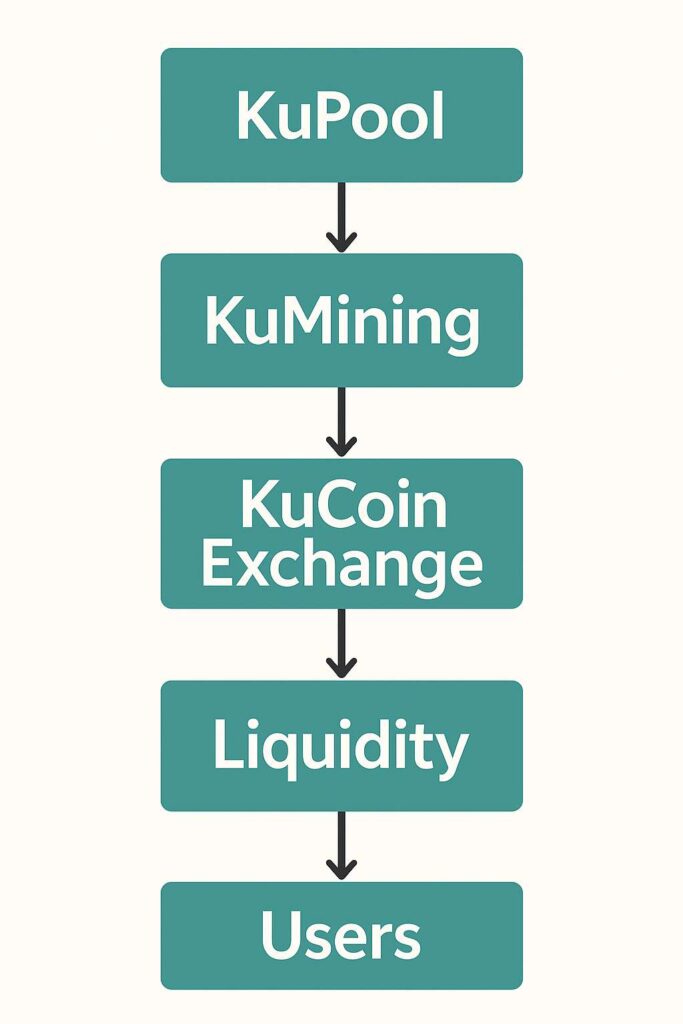
The connection between KuMining and KuPool reveals KuCoin’s long-term architecture. KuPool supplies the raw hashrate, while KuMining packages it into a user-friendly cloud product accessible to retail participants.

Through KuMining integration, KuCoin can funnel verified computational power directly into consumer-level mining contracts. Retail users benefit from real-time performance visibility. At the same time, professionals on KuPool enjoy reliable hashrate demand.

The value chain now runs end-to-end:

This vertical structure captures value at every stage, from block creation to market trade. Therefore, it could redefine how exchanges maintain long-term profitability.

Strategic Significance for KuCoin and the Market

KuCoin’s entry into mining arrives at a moment when exchanges seek resilience against trading-volume fluctuations. Operating a KuCoin mining pool diversifies revenue and anchors the exchange to tangible on-chain activity.

Rivals like Binance Pool and OKX Pool also combine trading and mining services. By contrast, KuCoin’s verifiable-hashrate framework emphasizes measurable trust rather than raw scale. The approach could attract independent miners wary of opaque payout models elsewhere.

Importantly, mining transparency is becoming a competitive differentiator. Regulators and institutional investors now demand proof that crypto operations are both auditable and energy-efficient.

The Road Ahead

Next on KuCoin’s roadmap is full Bitcoin mining KuPool support. Meanwhile, the company plans deeper API integration between KuPool and KuMining dashboards. Future updates may add cross-pool analytics and transparent energy-efficiency reporting. Over time, these features could become standard as verifiable hashrate gains traction.

For KuCoin, expansion into mining infrastructure is more than diversification. It signals a structural shift toward self-sustaining, on-chain services. Overall, KuCoin and KuPool could become the backbone of its proof-of-infrastructure strategy, one that turns “Trust First, Trade Next” into verifiable reality.

Readers’ frequently asked questions

What is the difference between KuPool and KuMining?

KuPool is KuCoin’s professional mining pool that connects miners directly to blockchain networks and provides verifiable hashrate tracking. KuMining is a cloud mining platform for everyday users who want simplified mining contracts without running hardware.

Which cryptocurrencies can be mined through KuPool?

At launch, KuPool supports Dogecoin (DOGE) and Litecoin (LTC) mining using the Scrypt algorithm. KuCoin has announced that Bitcoin (BTC) support will be added soon, with potential merged-mining options for smaller tokens such as PEPE, Lucky, and BELLS.

How does KuPool ensure transparency for miners?

KuPool uses a verifiable-hashrate system that lets miners independently confirm their contributed computing power and corresponding rewards. Auditable performance data and clear payout records provide full visibility into measurement and remuneration.

What Is In It For You? Action items you might want to consider

Explore KuPool if you’re mining DOGE or LTC

If you already mine Litecoin or Dogecoin, try connecting to KuPool to compare its hashrate reporting and payout transparency with your existing pool. Its verifiable-hashrate model helps you check that rewards match your contribution.

Watch for KuMining–KuPool integration updates

KuCoin plans to link KuMining’s retail mining contracts directly to KuPool’s infrastructure. Keeping an eye on this rollout could give small miners or investors earlier access to transparent performance data and steady yields.

Follow KuCoin’s roadmap for Bitcoin mining support

Bitcoin (BTC) pool activation is expected soon. Signing up for KuCoin’s announcements ensures you can join early, test its performance, and assess whether KuPool’s verifiable-hashrate system meets your expectations before the network expands further.

https://twitter.com/CrispyBull/status/1980277482247831880

LNG, Banks, and Crypto: EU’s 19th Sanctions Package Closes Every Escape Route

A cinematic editorial illustration showing a strategic board game map of Europe where miniature ships are stopped by “Access Denied” harbor gates, blocked pipelines, and fenced crypto tokens symbolize the EU 19th sanctions package, A7A5 stablecoin ban, and energy trade restrictions.

On October 23, 2025, the European Union adopted its 19th sanctions package against Russia. This sweeping update targets every remaining channel Moscow uses to fund or bypass restrictions. Consequently, it reshapes how energy, finance, and crypto interact under EU law. Beyond a phased LNG ban, the package adds new limits on third-country banks and penalties on the shadow fleet. For the first time, Brussels has also turned to digital assets. It blacklists the ruble-linked A7A5 stablecoin, restricts crypto-payment services, and bans EU operators from using Russia’s MIR and SBP payment systems. Ultimately, the move cements the EU crypto sanctions framework as a permanent tool of economic defense.

Energy Takes the Lead — LNG and the Shadow Fleet

Energy remains the core target of the EU 19th sanctions package. The measures include a ban on Russian liquefied natural gas (LNG) imports, with separate timelines for long-term and spot contracts. Therefore, the EU can minimize disruption to its supply chains while tightening Russia’s revenue flow.

For shipping, the EU expanded its crackdown on the shadow fleet, vessels that move sanctioned energy under hidden ownership. More than 100 ships are now listed, barred from EU ports, and denied EU-based insurance and reinsurance. In addition, these combined actions aim to cut Moscow’s export income and weaken offshore logistics networks. Together, the LNG ban and shadow fleet sanctions provisions form the bloc’s strongest energy action since the oil-price-cap mechanism of 2023.

Financial Pressure Tightens on Banks and Payment Systems

The EU‘s 19th sanctions package also widens restrictions on Russian and third-country banks. The list now covers intermediaries in the UAE, Hong Kong, and Central Asia accused of helping Russia evade earlier rounds. Moreover, the EU now prohibits engagement with Russia’s domestic payment networks, the MIR payment system, and the SBP fast payments platform. European financial institutions and fintech providers must sever all technical and contractual links to these systems. As a result, the EU closes lingering loopholes in cross-border settlement, where sanctioned actors once converted crypto or fiat through regional intermediaries. The broader financial sanctions block hybrid corridors that previously bridged Moscow’s domestic rails with the global economy.

The Crypto Pivot — A7A5 Stablecoin Blacklisted

For the first time, an EU sanctions package singles out a stablecoin. The A7A5 stablecoin, pegged to the Russian ruble and used to settle offshore trades, has been blacklisted. All A7A5 transactions are prohibited within the European Union, and the individuals behind its issuance are now sanctioned.

Consequently, this step establishes the first Russian stablecoin ban at the European level. It also limits crypto-payment services and custodial providers that may process transfers tied to sanctioned wallets. EU officials describe the move as a direct response to sanctions evasion via crypto. Digital assets, they note, are increasingly used to mask trade settlements, donations, and asset flows linked to sanctioned entities. Therefore, the decision marks a turning point. Digital-asset transfers are now treated as part of the same enforcement perimeter as fiat banking. The EU crypto sanctions framework has evolved from theory into an operational system of control.

Service and Tech Restrictions Broaden Compliance Duties

Beyond energy and finance, the EU’s sanctions package extends to services provided to the Russian government and listed entities. It now restricts AI, high-performance computing (HPC), finance-related software, and certain space-based commercial services. In particular, these changes are intended to prevent dual-use technology from feeding Russia’s industrial base. For fintech and regtech firms, the rule means tighter end-user verification. Consequently, every client and vendor relationship now carries an additional compliance burden.

What EU VASPs Must Do Now

The inclusion of A7A5 stablecoin and crypto-payment bans creates immediate duties for Virtual Asset Service Providers (VASPs) under MiCA rules. VASPs must run geofencing checks, update sanctions-screening software, and ensure travel-rule tools include the new lists. Additionally, they must report any suspicious or failed transaction involving sanctioned wallets promptly to national authorities.

Immediate steps:

  1. Blacklist A7A5 wallet addresses and suspend any related transactions.
  2. Screen all customers and vendors for exposure to newly sanctioned entities.
  3. Disable payment channels linked to MIR/SBP to block indirect settlements.

These procedures align with the EU VASP compliance framework, where sanctions screening and blockchain analytics are mandatory safeguards, not optional measures.

Enforcement and Industry Response

Regulators such as DG FISMA, ESMA, and national financial intelligence units will issue technical guidance soon. Meanwhile, early industry reactions show exchanges and custodians already tightening geofences and disabling ruble-pegged pairs. Compliance vendors are updating databases with A7A5 identifiers, and blockchain-analysis firms are mapping related wallet clusters.

As a result, enforcement will merge with MiCA’s travel-rule architecture, giving regulators a live view of digital-asset sanctions. At the same time, the shadow fleet sanctions and the LNG ban require new oversight for logistics financing and maritime insurance. Energy, finance, and crypto have become inseparable fronts in the EU’s sanctions strategy.

In summary, the EU‘s 19th sanctions package combines energy restrictions, financial closures, and digital-asset controls in one coordinated framework. By banning the A7A5 stablecoin, cutting off MIR and SBP, and enforcing EU crypto sanctions through regulated VASPs, Brussels has closed every gap left in prior rounds. Overall, crypto now stands beside LNG, banks, and high-tech exports as a monitored channel of pressure. For digital-asset businesses, compliance is no longer optional. Operating within the EU means aligning fully with its sanctions architecture, and this time, no escape route remains open.

Readers’ frequently asked questions

Crypto sanctions are enforced under the same legal basis as financial restrictions, Council Regulation (EU) No 833/2014. The 19th package extends its scope to include virtual assets, allowing the EU to list tokens, wallets, and service providers alongside banks or energy firms.

How will these sanctions interact with MiCA once it’s fully enforced?

Under MiCA, EU-licensed exchanges and custodians follow uniform supervision and disclosure standards. The new sanctions will integrate into that system, enabling regulators to monitor compliance and freeze wallets across the EU using shared data infrastructure.

Could the A7A5 ban affect non-EU users trading with European platforms?

Yes. Non-EU users who access EU-based exchanges or custodial services fall under EU jurisdiction when transacting in restricted assets. Even if their country has no similar ban, platforms must block A7A5 activity to remain MiCA-compliant and avoid secondary-sanctions risk.

What Is In It For You? Action items you might want to consider

Check if your exchange or wallet supports A7A5

If you hold or have traded the A7A5 stablecoin, confirm whether your exchange or wallet has restricted it. Many EU platforms have already disabled A7A5 deposits and withdrawals under the new sanctions.

Avoid using MIR or SBP payment apps for transfers

The MIR payment system and SBP fast payments platform are now banned in the EU. Using them for crypto or fiat transfers could result in blocked transactions or frozen accounts on regulated exchanges.

Watch for updated compliance notices from your exchange

Crypto platforms licensed under MiCA must inform users of new sanction-related restrictions. Always read official exchange notices and alerts — ignoring them could cause interrupted access or delayed withdrawals.

- Advertisement -

FEATURED