Home Blog Page 80

France Tightens AML Checks on Crypto Exchanges as It Pushes for EU-Level Oversight; Binance Among Those Reviewed

A digital microscope inspects glowing Bitcoin and Ethereum coins on a circuit board shaped like France, surrounded by red laser scan lines and golden EU stars, symbolizing France’s AML checks on crypto exchanges under MiCA and upcoming EU-wide AMLA oversight.

France’s banking supervisor, the Autorité de Contrôle Prudentiel et de Résolution (ACPR), has launched new anti-money-laundering (AML) probes on registered crypto exchanges, including Binance. The goal is to verify compliance with the Markets in Crypto-Assets Regulation (MiCA).

The inspections, confirmed on October 17, 2025, cover more than 100 firms currently licensed or transitioning under France’s PSAN regime. This framework now operates fully within MiCA’s EU rules. Officials said the reviews ensure consistent enforcement of AML standards as national registrations convert into harmonized EU MiCA authorizations.

ACPR Enforces Stronger Oversight Within the MiCA Framework

The ACPR crypto investigation focuses on AML governance, transaction monitoring, beneficial-owner verification, and travel-rule compliance. These are enforcement reviews, not preparatory audits. They confirm that providers already licensed under MiCA meet EU-level AML expectations.

Paris has positioned itself as a compliance hub. The inspections highlight France’s capability to enforce anti-money-laundering compliance more rigorously than many peers while aligning with EU supervisory reforms.

From PSAN Registration to Full MiCA Authorization

France’s PSAN registration system, established in 2020, provided early structure to crypto oversight. Under MiCA, those PSANs are becoming crypto-asset service provider (CASP) licenses recognized across the EU.

France’s current AML probes on crypto exchanges determine which platforms meet the technical and procedural standards required to continue operating under MiCA. In doing so, this transition effectively bridges the national regime with the new EU authorization. As a result, it allows compliant platforms to passport services across borders once their licenses are formally approved by the national authority.

Binance Under Dual Scrutiny

This latest AML probe continues to draw attention to Binance during France’s regulatory tightening. In early 2025, French prosecutors at JUNALCO opened a judicial investigation into suspected money laundering and tax violations between 2019 and 2024.

By contrast, the ACPR’s current review is prudential and administrative. It focuses on internal controls rather than criminal conduct, a key prudential vs judicial probe distinction. After a prior audit, Bloomberg reported that regulators asked Binance to strengthen compliance systems. The company said it is cooperating fully with French and EU authorities.

France’s Push for Centralized EU Supervision

Beyond national enforcement, France is pushing for EU centralized crypto oversight under the Anti-Money-Laundering Authority (AMLA). The Bank of France and ACPR argue that large cross-border exchanges, such as Binance, Coinbase, and Kraken, should face direct EU supervision. They cite systemic risk and uneven national enforcement capacity.

The Bank of France direct supervision proposal aligns with AMLA’s mandate to oversee high-risk entities in multiple member states. Its supervisory board becomes operational in 2026. France’s inspections, therefore, serve both a national and political purpose. They show that France can lead on compliance until EU control becomes centralized.

AMLA’s Expanding Role in Crypto Oversight

Operational since July 2025, AMLA has made crypto supervision a key priority. Its AMLA work programme 2025 lists crypto assets among the EU’s top money-laundering and terrorism-financing risks.

The agency now coordinates with national regulators such as the ACPR and Germany’s BaFin to harmonize reporting templates and suspicious-activity procedures. France’s current AML inspections align domestic enforcement with the EU’s AMLA crypto supervision model and give Paris early influence in shaping methodology.

What Regulators Are Examining

  • Real-time transaction monitoring and escalation procedures.
  • Beneficial-owner (KYC) verification and re-screening frequency.
  • Sanctions-list management and handling of frozen digital assets.
  • Travel-rule compliance crypto data exchange between counterparties.
  • Internal audit records that prove management accountability for AML controls.

Results will decide whether firms keep their MiCA licenses or must implement remediation. The findings will also feed into AMLA’s cross-country data to detect systemic weaknesses.

Industry Impact and Market Implications

The intensified ACPR crypto investigation is forcing exchanges to upgrade compliance frameworks. Many are consolidating operations to reduce duplication costs. Smaller PSANs and custodians may struggle to meet MiCA’s high AML standards and could merge or exit the French market.

Analysts expect the French reviews to become the benchmark for AMLA crypto supervision across Europe. BNB briefly fell on the news but recovered once it became clear the inspections are regulatory maintenance, not punitive action.

What Comes Next

The ACPR expects to complete its AML inspection cycle by early 2026. It will align findings with AMLA’s centralized database for CASP supervision. Firms that fail to show compliance will receive remediation notices and may face delays in cross-border authorization.

France’s assertive enforcement confirms its goal to remain Europe’s compliance gatekeeper, applying MiCA licensing in France while helping shape future EU centralized crypto oversight.

Bottom Line

France’s latest AML checks marks a turning point in Europe’s regulatory evolution. Rather than preparing for MiCA, France is enforcing it now. The ACPR inspections test how a future EU-wide supervision model could function under AMLA crypto supervision. For major exchanges, the message is clear: MiCA’s single market comes with single-standard accountability; and France intends to define that standard.

Glossary — abbreviations and key terms

ACPR — Autorité de Contrôle Prudentiel et de Résolution

France’s banking and insurance supervisor under the Bank of France. Oversees prudential compliance, including anti–money-laundering checks on financial and crypto institutions.

AMF — Autorité des Marchés Financiers

France’s financial markets authority. Regulates securities and asset managers; coordinates with ACPR on oversight of crypto-asset service providers (PSANs).

AMLA — Anti-Money-Laundering Authority

EU-level agency (operational from 2025) that coordinates AML supervision across member states and will directly oversee high-risk cross-border entities.

CASP — Crypto-Asset Service Provider

The MiCA term for entities providing crypto services (trading, custody, exchange) within the European Union.

ESMA — European Securities and Markets Authority

EU agency that harmonizes financial supervision; works with AMLA and the ECB on crypto oversight.

JUNALCO — Juridiction Nationale de Lutte contre la Criminalité Organisée

France’s national jurisdiction against organized crime. Leads judicial investigations into large-scale financial crimes, including crypto-related money laundering.

MiCA — Markets in Crypto-Assets Regulation

EU regulation that harmonizes licensing and conduct rules for crypto-asset issuance and services across all member states.

PSAN — Prestataire de Services sur Actifs Numériques

France’s term for “digital-asset service provider.” The national regime now transitioning into the EU’s CASP framework under MiCA.

Readers’ frequently asked questions

Will France’s AML probes delay new crypto licenses under MiCA?

Yes. Firms under inspection may experience short delays in their MiCA authorization process if the ACPR identifies weaknesses in AML or governance controls. However, France has committed to complete all prudential reviews before the first quarter of 2026, ensuring MiCA licensing continues on schedule for compliant exchanges.

Are retail users affected by these inspections or their trading activity in France?

No. France’s AML checks target corporate compliance and internal controls, not retail user activity. Customer funds and access to trading platforms remain unaffected unless an exchange loses authorization entirely, in which case users would be notified by the regulator and required to withdraw assets to a licensed provider.

How does France’s position influence how AMLA will supervise crypto across Europe?

France’s ACPR is setting an early benchmark for AMLA by testing how national reviews can align with EU-level supervision. The data and results from France’s audits will feed into AMLA’s comparative assessments, shaping how the new EU authority prioritizes future cross-border inspections and risk categorization for major crypto exchanges.

What Is In It For You? Action items you might want to consider

Exchanges operating in France should audit their AML frameworks now

Crypto-asset service providers licensed under MiCA should immediately review their transaction monitoring, KYC, and travel-rule systems to ensure they align with ACPR and EU-level AMLA standards. Early internal audits reduce the risk of remediation orders or licensing delays.

Investors should verify that their exchange is MiCA-authorized

Retail users can check whether their chosen platform holds a valid MiCA license through the ACPR or ESMA registers. Only MiCA-authorized exchanges will retain cross-border rights once AMLA assumes partial supervision in 2026.

Compliance teams should monitor AMLA’s guidance updates

The EU’s Anti-Money-Laundering Authority will release new supervisory templates and data-reporting requirements in 2025–2026. Following AMLA publications ensures firms stay compliant with the evolving standards France is already enforcing.


Celsius Wins $299.5 Million From Tether, Ending a Two-Year Fight Over Bitcoin Collateral

Illustration of the Celsius Tether lawsuit settlement, showing two men in suits representing Tether and Celsius seated across a courtroom table, exchanging signed settlement documents.

This settlement between Celsius and Tether concluded one of the longest-running disputes in the crypto bankruptcy world. Tether has agreed to pay $299.5 million to the Celsius Network bankruptcy estate. The agreement resolves a two-year collateral dispute that stemmed from margin calls and Bitcoin liquidations before Celsius collapsed in 2022. The deal, brokered by the Blockchain Recovery Investment Consortium (BRIC), marks a significant milestone for creditors who have waited more than three years to recover funds.

Announced on October 14, 2025, the settlement ends all claims between Celsius and Tether. While the payment represents a fraction of Celsius’s original $4–4.5 billion demand, it offers a guaranteed recovery. Both parties avoid further legal uncertainty, and it accelerates final distributions to creditors.

Timeline of the Dispute

The dispute traces back to July 2022, when Celsius filed for Chapter 11 protection following severe liquidity shortfalls and collapsing crypto asset prices. During the crisis, Tether allegedly liquidated large portions of Bitcoin pledged as collateral for loans to Celsius. The Celsius Network bankruptcy filings listed these transactions among the estate’s key adversary proceedings, which are lawsuits filed within a bankruptcy case.

In August 2024, BRIC, a consortium backed by VanEck and GXD Labs, filed a detailed complaint alleging that Tether’s actions cost Celsius billions. Nearly a year later, in July 2025, the bankruptcy court allowed most of those claims to proceed. So, Tether faced a real trial risk. Just months later, the parties settled, bringing an end to the conflict and freeing the estate from one of its most contentious cases.

What the Settlement Means for Creditors

For Celsius creditors’ recovery, the $299.5 million cash infusion significantly improves the estate’s liquidity position. The deal immediately expands the recovery pool. It will provide funds that can be used for faster payouts and reduce the estate’s dependency on future litigation outcomes.

By eliminating a high-cost legal battle, BRIC can redirect administrative and legal budgets toward processing distributions. For individual claimants, this means their Celsius creditor payout may arrive sooner. It may even be at a higher percentage than projected before the deal.

Moreover, this visible success reinforces confidence that professional recovery efforts deliver tangible results. As one of the last unresolved fronts in the bankruptcy, the Tether deal moves Celsius closer to closing its case and returning capital to its users.

Why the Settlement Is a Smart Move for Celsius

By accepting the settlement agreement, the estate has prioritized certainty over speculation. A guaranteed $299.5 million is a pragmatic outcome given the challenges of proving complex on-chain collateral claims and the uncertainties of crypto asset valuation in court.

The Celsius estate also saves millions in legal fees, expert witness costs, and discovery expenses. Each additional month of litigation would have reduced the net recovery available to creditors. Instead, the estate can focus on the creditor distribution process and remaining asset sales without prolonged procedural delays.

The decision also reflects BRIC’s strategy: to deliver quick, measurable recoveries rather than chase multi-year, high-risk verdicts. For creditors fatigued by years of uncertainty, closure itself holds significant value.

Why the Settlement Is a Strategic Exit for Tether

For Tether, the agreement represents prudent legal risk management. After the July 2025 ruling that allowed most Celsius claims to advance, the company faced growing exposure. Settling now for under $300 million prevents unpredictable judgments and avoids potential findings that could redefine stablecoin issuer liability.

The Celsius settlement also protects Tether’s reputation. With regulators worldwide scrutinizing stablecoin practices, closing this chapter without admitting liability allows Tether to demonstrate cooperation and transparency. Resolving this lawsuit saves time and resources, and it offers finality before upcoming stablecoin legislation and licensing frameworks take shape.

By opting for a strategic exit, Tether limits financial uncertainty. It preserves operational stability and avoids precedent-setting rulings that might have broader implications for the industry.

Outstanding Celsius Matters

Although the Celsius Tether settlement is now complete, the wider bankruptcy case continues. Other adversary proceedings are still active as BRIC pursues additional recoveries from counterparties linked to the failed lender’s pre-collapse dealings.

The court must still grant bankruptcy court approval to integrate the new funds into upcoming distribution rounds. Once that occurs, the money will be folded into the estate’s assets for disbursement under the Chapter 11 plan.

Despite this progress, Celsius’s crypto bankruptcy case remains open until all distributions are finalized and residual disputes are resolved.

Market and Regulatory Implications

The Tether case underscores how quickly counterparty risk can ripple across the digital asset ecosystem. For regulators, it underscores the need for clear definitions of stablecoin issuer liability, especially when issuers act as collateral lenders or liquidity providers.

At the same time, the Celsius Tether settlement highlights the effectiveness of an asset recovery consortium like BRIC in handling complex, cross-border crypto bankruptcies. Their success in negotiating substantial recoveries could set a precedent for future insolvency management across DeFi and CeFi platforms alike.

Takeaways for Investors and Lenders

The Celsius Tether settlement offers a clear reminder that contractual precision and documentation are paramount in crypto lending. For creditors, it shows how cooperative settlements can deliver faster, more reliable outcomes than drawn-out trials.

The Celsius creditors recovery process also proves that specialized recovery teams can extract real value even years after a platform’s collapse. For the broader industry, the case adds weight to discussions about crypto market implications of collateral management and stablecoin oversight.

As Celsius moves closer to final closure, the Tether deal stands out not as a defeat for either party but as a pragmatic resolution. One that balances financial logic, reputational risk, and creditor priorities in an evolving regulatory landscape.

Readers’ frequently asked questions

Who will manage the $299.5 million settlement funds from Tether?

The funds will be handled by the Blockchain Recovery Investment Consortium (BRIC) on behalf of the Celsius bankruptcy estate. BRIC is responsible for collecting, managing, and distributing recovered assets to eligible creditors under court supervision.

When will Celsius creditors receive their share of the settlement?

Distributions will occur after the bankruptcy court approves the integration of the Tether settlement into the estate’s plan. The payout timeline depends on remaining administrative steps but is expected to align with upcoming creditor distribution rounds already underway.

Does the Tether settlement mark the end of the Celsius bankruptcy case?

No. The Tether settlement resolves one major adversary proceeding, but other claims, asset recoveries, and administrative processes remain active. Celsius will officially close the bankruptcy only after all distributions and outstanding cases are finalized.

What Is In It For You? Action items you might want to consider

Verify creditor eligibility and claim status

Creditors should confirm that their claim information remains current in the Celsius portal to ensure they are included in the next payout cycle reflecting the Tether settlement funds.

Track official updates on settlement disbursement

Monitor announcements from BRIC or the Celsius bankruptcy administrator regarding court approval, integration of funds, and specific distribution dates for the $299.5 million recovery.

Monitor remaining adversary proceedings

Stakeholders should track Celsius’s other ongoing recovery efforts and court filings to stay informed on additional settlements or asset distributions that may affect overall payout percentages.

France Approves LISE, Europe’s First Tokenized Stock Exchange to Reinvent IPOs

Bright daytime view of Paris La Défense with digital stock ticker and blockchain grid, symbolizing LISE France tokenized stock exchange.

France has officially approved the Lightning Stock Exchange (LISE) to operate as Europe’s first regulated tokenized stock exchange. The decision marks a turning point for blockchain-based capital markets. Licensed under the EU’s DLT Pilot Regime and supervised by the Autorité des Marchés Financiers (AMF France), LISE merges blockchain transparency with the reliability of traditional finance. As a result, France is positioning itself at the forefront of digital finance in Europe.

This approval makes France the first EU member state to bring a DLT-based stock exchange into a fully compliant framework. Consequently, it could redefine how companies issue and trade equity across the region.

What Makes LISE Different

Unlike conventional stock exchanges that depend on intermediaries, LISE operates on blockchain rails. It allows companies to issue tokenized shares directly to investors. Each share is represented as a security token recorded on-chain for immutable verification and near-instant settlement. In addition, the platform eliminates reconciliation delays that often slow traditional trading systems.

The exchange’s architecture also streamlines the IPO process. It reduces issuance costs, shortens settlement time from days to seconds, and delivers real-time transparency. Furthermore, as a tokenized asset trading platform, LISE uses smart contracts to automate issuance, distribution, and compliance checks without the inefficiencies of legacy systems. Together, these features make the process simpler, faster, and more secure.

How LISE Plans to Reinvent IPOs

Traditional IPOs are expensive and complex. They often exclude smaller firms and retail participants. However, LISE’s blockchain IPOs aim to change that by enabling tokenized IPOs where investors subscribe directly through digital wallets. As a result, participation becomes easier for both institutional and individual investors.

This model supports fractional ownership and makes high-value offerings more accessible. Therefore, it could democratize capital markets and open new funding options for startups and SMEs. In turn, it may help bridge the financing gap for innovative businesses that lack access to traditional exchanges.

According to early commentary from French regulators, the DLT Pilot Regime provides a controlled environment. Within this framework, innovations such as on-chain trading and digital custody can operate safely under investor-protection standards. Consequently, the combination of transparency and compliance should make digital securities more appealing to institutions.

The Regulatory Context: Europe’s DLT Pilot Regime

The DLT Pilot Regime, introduced by the European Commission, is a regulatory sandbox for modernizing trading and settlement. It lets licensed entities such as LISE France run market infrastructures based on distributed ledgers under supervision. In practice, this approach allows regulators to test blockchain operations without destabilizing traditional systems.

After gaining authorization from AMF France, LISE France became one of the first European market operators to apply this framework. The regime limits asset classes, enforces investor protection, and demands transparency. These safeguards distinguish LISE from unregulated tokenized finance projects. Moreover, they demonstrate that regulation and innovation can coexist effectively.

The AMF’s decision places France among EU leaders experimenting with blockchain in capital markets. Consequently, it signals a shift toward blockchain-based capital markets as a credible alternative to legacy systems.

France’s Strategic Bet on Tokenized Finance

For France, this step is more than a regulatory milestone, it’s an economic strategy. Paris has invested heavily in fintech innovation France and digital-asset pilots, including CBDC experiments run by the Banque de France. Therefore, the launch of LISE France strengthens this agenda and builds a base for large-scale digital securities trading.

Analysts expect LISE to make France a European tokenization hub. The platform could attract cross-border listings and early-stage firms seeking flexible funding. In addition, by cutting IPO costs and settlement friction, France enhances its appeal as a post-MiCA capital-raising destination.

This integration of tokenized finance within a regulated market shows a pragmatic approach. Ultimately, it fosters innovation without weakening investor protection.

Market Impact and Outlook

Operations are expected to start in early 2026. Lightning Stock Exchange France could trigger a new wave of compliant blockchain IPOs across the EU. Meanwhile, competitors in Germany, Luxembourg, and Switzerland are preparing their own responses.

If the rollout succeeds, other jurisdictions may authorize tokenized stock exchanges. Consequently, Europe’s transition to on-chain trading and near-instant settlement could accelerate. For institutional investors, it provides a proven framework for dealing with security tokens and testing tokenized IPOs under established rules. In the long run, it could reshape how capital markets function in the digital era.

This experiment will show whether blockchain infrastructure can truly cut costs, expand access, and boost liquidity — all while maintaining oversight.

France’s approval of LISE marks a regulatory and technological milestone for Europe. By placing a tokenized stock exchange under full AMF supervision, France bridges the gap between traditional finance and blockchain innovation. Ultimately, the move could influence how other jurisdictions approach digital asset regulation.

As LISE France prepares for the continent’s first blockchain IPOs, the project demonstrates that tokenization and regulation can coexist. Therefore, it may define how Europe’s next generation of public offerings unfolds.

Readers’ frequently asked questions

Do holders of tokenized shares have voting rights?

If the token represents ordinary shares, the same shareholder rights, including voting and dividend entitlements, apply under EU and company law. The DLT Pilot Regime is technology-neutral, meaning tokenized financial instruments remain traditional securities for all regulatory purposes. However, rights depend on the share class and issuer’s prospectus; some non-voting or preference shares may carry limited or no voting power.

How will voting be exercised in practice?

Voting is expected to follow standard corporate procedures such as annual or extraordinary meetings, proxy voting, and electronic participation. While LISE operates on a distributed ledger, governance remains under EU corporate frameworks. DLT primarily modernizes record-keeping and settlement, not corporate decision-making, though e-proxy integrations may simplify shareholder participation.

Are tokenized shares different from utility tokens?

Yes. Security tokens that represent company shares carry shareholder and economic rights, while utility tokens do not. Utility tokens typically grant access to a service or network feature but offer no ownership, dividend, or voting privileges. Under the AMF and EU frameworks, tokenized shares are regulated as securities and fall under full investor-protection standards.

What Is In It For You? Action items you might want to consider

Track LISE’s tokenized IPO developments

If you follow tokenization trends or invest in equity markets, monitor how LISE structures its first blockchain IPOs. Early issuances in 2026 may set standards for compliance, voting rights, and secondary-market liquidity in the EU’s regulated tokenized ecosystem.

Evaluate implications for corporate governance

Tokenized shares under the DLT Pilot Regime retain traditional shareholder rights. However, the integration of e-proxy voting and digital registries could reshape how investors participate in governance. Companies and law firms should assess how these mechanisms align with existing statutes and investor relations practices.

Monitor EU regulatory adoption of the DLT Pilot Regime

France’s leadership through LISE may encourage other EU jurisdictions to accelerate their DLT-based market pilots. Regulators in Germany, Luxembourg, and the Netherlands are already exploring similar frameworks. Keeping track of these developments can help identify new opportunities for cross-border tokenized listings.

ACI Worldwide Taps BitPay to Compete in Next-Gen Payments Race

Futuristic digital control room with glowing data streams linking two network hubs in blue and amber light, representing ACI Worldwide and BitPay collaboration in crypto payments.

ACI Worldwide is stepping into the crypto payments arena through a strategic partnership with BitPay, one of the world’s largest digital-asset processors. The collaboration adds stablecoin payments and major cryptocurrencies to ACI’s enterprise-grade payment orchestration platform. The move is designed to position the company in the fast-growing race for next-generation payments.

Legacy fintech enters the tokenized era

For decades, ACI has powered transaction systems for banks, merchants, and government agencies. Now, however, it’s evolving into an enterprise crypto infrastructure provider by integrating BitPay’s rails for Bitcoin, Ethereum, USDC, and USDT. Through this step, global merchants can offer merchant crypto checkout without holding digital assets or taking on price volatility. Meanwhile, BitPay handles the conversion to fiat currencies, enabling a digital asset acceptance flow that feels identical to conventional card payments. As a result, ACI’s platform bridges traditional finance with blockchain settlement in a fully regulated environment.

In turn, the integration brings tokenized payments to ACI’s global network of payment service providers (PSPs) and enterprise clients, therefore reflecting how legacy fintechs are adapting to market demand for alternative rails.

Strategic rationale: expand and future-proof

ACI’s collaboration with BitPay strengthens its competitive edge against payment giants such as PayPal, Stripe, and Adyen. All three have moved toward blockchain payment rails. According to ACI executives, the goal is to make digital-asset settlement as simple as any other method inside its payment orchestration environment.

BitPay contributes deep expertise in regulatory compliance, anti-fraud monitoring, and multi-asset liquidity management. This allows ACI to maintain enterprise-level reliability while introducing crypto payments at scale. Together, the two companies enable enterprise payment providers to expand their offerings and reduce settlement friction in cross-border commerce.

Competitive landscape: legacy vs. crypto-native

ACI’s entry marks a new phase of legacy fintech transformation. PayPal has its own stablecoin (PYUSD). Stripe is testing blockchain-based remittances. Adyen supports tokenized wallet flows. ACI’s choice to partner rather than build in-house may accelerate time to market. That speed is crucial in the current fintech competition cycle.

Digital-first players like BitPay have dominated crypto payment gateway solutions for years. Legacy infrastructure firms now recognize the need to catch up. For ACI, the integration offers a way to compete head-on in next-generation payments while leveraging existing bank relationships and global compliance coverage.

Market implications: crypto at enterprise scale

Industry analysts see the partnership as another sign that tokenized commerce is moving from concept to execution. As stablecoins gain traction as settlement assets, stablecoin settlement rails could underpin much of tomorrow’s next-gen payment infrastructure.

Enterprises are increasingly evaluating tokenized payments for speed, transparency, and cost savings. ACI’s move suggests that established financial technology providers are ready to operationalize blockchain-based settlement. Crucially, they can do so without exposing clients to the volatility of crypto holdings.

Voices from ACI and BitPay

In the joint announcement, ACI Worldwide said the partnership will “provide merchants with greater flexibility and choice in how they accept and settle payments.” The company added that crypto payments are now part of its innovation roadmap.

BitPay CEO Stephen Pair called the deal “a milestone for global merchants who want to offer customers digital-asset options with the assurance of enterprise-grade compliance.” Both firms described the integration as a natural extension of their focus on secure, transparent, and compliant payment solutions.

Conclusion: positioning for the next fintech decade

Embedding BitPay’s infrastructure makes ACI Worldwide one of the few major payment processors to combine regulated banking rails with blockchain-based settlements. Thus, the move underlines how traditional networks are converging with crypto technology in the battle for next-generation payments. In an industry defined by rapid innovation, ACI’s partnership with BitPay signals a clear intent to remain competitive in the evolving world of tokenized payments. It also points to a broader transformation of legacy fintech into a crypto-enabled future.

Readers’ frequently asked questions

Which cryptocurrencies can merchants accept through ACI’s BitPay integration?

Merchants using ACI’s platform can accept major digital assets, including Bitcoin, Ethereum, and stablecoins such as USDC and USDT. BitPay handles conversion and settlement in fiat currency.

Do merchants need to hold crypto assets themselves to process payments?

No. BitPay instantly converts crypto transactions into fiat currency, so merchants can accept digital payments without holding or managing crypto wallets.

How does this integration affect fees and settlement speed for global merchants?

The partnership aims to reduce cross-border settlement costs and improve transaction speed by using blockchain rails. Exact fees vary by merchant contract and settlement region.

What Is In It For You? Action items you might want to consider

Track enterprise adoption of crypto payment orchestration

Monitor how ACI Worldwide’s integration with BitPay is implemented by major merchants and payment service providers. This rollout may set new standards for enterprise-level crypto payments infrastructure.

Evaluate competitiveness among fintech payment platforms

Compare ACI’s move with other players like PayPal, Stripe, and Adyen. Understanding who captures the next-generation payments segment helps identify investment and partnership opportunities.

Follow the evolution of stablecoin settlement rails

Keep an eye on how stablecoin payments are used in regulated B2B transactions. Their performance could influence how traditional fintechs deploy blockchain rails for faster, cheaper settlements.

LuBian Wallet Awakens: Arkham’s $14.5 B Bitcoin Mystery Moves Again

Editorial image of a dark bitcoin data center where one rack glows with warm amber light, thin particle-like data streams flow outward, and a faint holographic wallet projection hovers above, visualizing the LuBian wallet reactivation and movement of 9,757 BTC after three years of dormancy.

Few in today’s market remember LuBian, the once-active Chinese bitcoin mining pool that vanished after Beijing’s 2021 mining ban. During its short life, LuBian added measurable hash power to the Bitcoin network, then disappeared without explanation. Its wallets went silent, its site went dark, and the name faded into forum history.

Everything changed in August 2025. Arkham Intelligence, a leading crypto analytics firm, published a forensic report claiming that LuBian had lost 127,426 BTC in December 2020. If correct, it was the largest bitcoin theft ever identified. Using detailed on-chain analysis, Arkham traced payouts and deposits from historical LuBian addresses to clusters apparently outside the pool’s control. LuBian never commented. The silence left Arkham’s attribution uncontested and turned an old mining pool hack into a modern-day mystery.

A Dormant Wallet Wakes Up

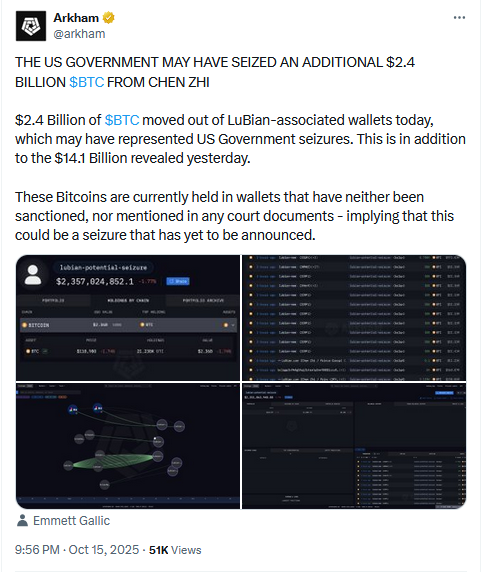
On October 15, 2025, a LuBian-linked wallet suddenly moved 9,757 BTC (about $1.1–$1.3 billion) after nearly three years of inactivity. The coins moved in two waves just hours apart. Several analytics teams confirmed the transfers, matching them to the same address cluster Arkham mapped in August. For on-chain watchers, it was the first visible wallet movement from that group since 2022.

As a result, attention surged. The awakening came less than a day after the U.S. Department of Justice announced a record crypto forfeiture case unrelated to LuBian. That timing sparked rumors. However, no official connection exists between the DOJ action and LuBian’s wallets.

Fact vs Inference: What We Know and What We Don’t

Arkham’s report built a factual baseline. Yet many claims circulating online stretch beyond what evidence supports.

CategoryStatementStatus
AttributionArkham mapped 127,426 BTC loss✅ Public report confirmed
CommunicationsLuBian made no statement✅ Verified silence since 2021
On-chain event9,757 BTC moved on Oct 15, 2025✅ On-chain confirmed
Enforcement linkDOJ seizure includes LuBian coins⚠️ Unverified / speculative
MotiveReason for movement⚠️ Unknown / speculative
ControlWallet owner identity⚠️ Unknown / speculative

In short, the coins moved; the motive did not.

Who Controls the Keys? Competing Theories

Analysts and traders suggest several possibilities. First, the move could reflect a law-enforcement transfer following a quiet seizure. Second, it may show an internal reshuffle by former operators protecting private keys. Third, a thief could be testing small spends before liquidation. Finally, there may be third-party access through compromised or resold keys.

Even now, no public filing confirms any scenario. The bitcoin address cluster Arkham identified shows coins splitting into new outputs, yet there are no exchange deposits or mixing patterns so far. Therefore, the market continues to watch.

Market and Investigative Implications

Overall, the LuBian mining pool story exposes weak governance in early mining operations. It also illustrates how wallet tracking and on-chain analysis now help investigators follow multi-billion-dollar trails years later. Moreover, it reminds compliance teams to review older forfeiture case filings and exchange-screening alerts. Even limited movement from a stash this large can shift short-term BTC liquidity and spreads.

Bottom Line

Two verified anchors now define the case: Arkham Intelligence’s August 2025 report tracing a 2020 theft of 127,426 BTC, and the October 15 awakening of 9,757 BTC from a dormant wallet after years of silence.

Everything between those points (ownership, intent, and outcome) remains under investigation. As a result, LuBian may become a benchmark for how analytic evidence, custody failures, and cross-border enforcement converge at a billion-dollar scale.

Readers’ Frequently Asked Questions

Was LuBian actually hacked in 2020?

Arkham’s August 2025 report attributes a 127,426 BTC loss to theft and maps the addresses involved. However, it remains analytic, not a court finding, and LuBian has issued no statement.

What exactly moved on October 15 2025?

A long-silent LuBian-linked wallet transferred 9,757 BTC in two waves after roughly three years of inactivity, worth about $1.1 – $1.3 billion.

Does this prove the coins were sold or seized?

No. The movement is fact; the motive is not. There is no public document explaining who controls the wallet or why it moved.

What Is In It For You? Action items you might want to consider

Track new outputs from LuBian-linked wallets

Follow on-chain activity for signs of consolidation, mixing, or deposits to exchanges. Any movement could indicate changes in control or liquidation attempts.

Review exchange compliance policies

Exchanges should ensure their wallet-screening systems detect LuBian-linked addresses to avoid accidental acceptance of tainted funds.

Revisit mining-pool governance standards

For mining operators, this case highlights the need to strengthen private-key custody, audit procedures, and internal controls to prevent future losses.

- Advertisement -

FEATURED