
Home Blog Page 82

India expands crypto tax crackdown: 400+ Binance traders under investigation for $42M in unpaid taxes

Indian crypto trader startled as tax officer delivers CBDT notice, symbolic image of India’s Binance tax probe and crypto crackdown

India’s Income Tax Department has intensified its crypto tax crackdown. The tax department is expanding its ongoing Binance tax probe to more than 400 high-income traders suspected of hiding profits from offshore Binance wallets. According to local reporting, the operation targets undeclared income accumulated between FY 2022–23 and FY 2024–25. It marks one of the country’s largest coordinated enforcement actions in the digital-asset sector to date.

The investigation is being led by the Central Board of Direct Taxes (CBDT), which reportedly instructed its regional offices to submit case updates by October 17. This internal directive signals a fast-tracked timeline for preliminary assessments and potential tax notices. Estimates circulating in Indian and international media put the unpaid tax exposure near $42 million (≈ ₹350 crore). However, officials have not yet confirmed the final figure.

A crackdown months in the making

This large-scale expansion builds on a CBDT crypto investigation first revealed in August 2025. Back then, the tax authority began using AI-based analytics to trace discrepancies between declared income and on-chain activity. That initial sweep flagged around 120 wealthy traders whose transactions on foreign exchanges, including Binance, appeared inconsistent with their filings.

Authorities described the August probe as a pilot phase for testing new analytical models designed to uncover crypto tax evasion in India. The results of that phase fed directly into the wider review now unfolding, targeting hundreds of traders across multiple states.

From 120 to 40,000: a nationwide compliance wave

In the weeks following the August pilot, the CBDT’s data systems began issuing automated compliance notices to a much broader segment of the market. By mid-September, more than 40,000 crypto users across India had received intimation letters or discrepancy alerts prompting them to clarify inconsistencies between their filings and blockchain activity.

Most of these notices were informational, part of a large-scale data-driven compliance sweep rather than active enforcement. The 400+ Binance traders now under investigation represent the highest-risk subset of that pool. The analytics flagged significant unreported income or complex offshore wallet structures on these accounts.

As a result, the focus of India’s tax crackdown has narrowed from a broad data-collection effort to a more surgical examination of high-value accounts.

The October escalation

By early October, the Income Tax Department had extended its focus to more than 400 Binance traders nationwide. Media outlets citing internal correspondence said the October 17 CBDT directive required investigation wings to deliver detailed reports on each identified case.

Officials have clarified that the action is aimed at individuals, not the exchange itself. Binance currently operates without a local entity in India. Meanwhile, the department’s analysis relies on AI-driven data matching that links wallet activity, P2P transactions, and offshore holdings with each trader’s PAN-linked records. This approach signals a new stage in India’s crypto enforcement in 2025, emphasizing data-driven accuracy over broad-brush accusations.

Financial exposure and methods

Preliminary assessments suggest an estimated ₹350 crore (about $42 million) in potential unpaid taxes across the identified accounts. These figures represent the calculated shortfall, not yet finalized liabilities. As the cases move forward, additional interest and penalty charges may apply under India’s Income Tax Act.

In parallel, the AI crypto tax system deployed by the CBDT plays a central role in tracking irregularities. It cross-checks blockchain addresses with bank transfers, exchange records, and existing tax filings to detect mismatches. This data analytics infrastructure, first showcased in August, underpins the government’s broader campaign for crypto tax compliance in India.

What it means for Indian crypto traders

For Indian residents trading on foreign exchanges or holding offshore Binance wallets, the message is clear: undisclosed gains remain taxable. The probe demonstrates how AI-powered audits can connect blockchain transactions to real-world identities through KYC trails and exchange data requests.

Tax experts warn that traders who failed to declare profits from overseas wallets could face retroactive scrutiny reaching back multiple fiscal years. Even accounts accessed through VPNs or foreign entities may be reviewed if linked to domestic identifiers such as PAN or Aadhaar.

In previous years, enforcement lagged behind regulation. In contrast, the CBDT crypto investigation now represents a decisive shift from passive monitoring to active enforcement. It turns India’s once declarative virtual digital asset (VDA) tax rules into actionable compliance requirements.

A broader policy trend

This enforcement drive does not exist in isolation; it connects to the longer evolution of India’s crypto tax policy. The current wave of enforcement fits within the crypto-tax framework introduced in 2022. Said framework imposed a 30% flat tax on digital-asset income and a 1% TDS (tax deducted at source) on transactions.

Regulators have since moved toward systemic enforcement rather than new legislation. They are focused on closing loopholes and coordinating with global partners on foreign-exchange reporting. India’s push against crypto tax evasion also aligns with pressure from the Financial Action Task Force (FATF) to tighten oversight of unregistered exchanges and cross-border wallet activity.

At the same time, domestic KYC-compliant exchanges remain the safer choice for local traders. After all, their reporting mechanisms already sync with the tax department’s compliance database.

What happens next

The CBDT’s internal deadline of October 17 could mark the next visible step in India’s crypto enforcement drive. Analysts expect the department to release summary findings or updated guidance later in Q4 2025, potentially accompanied by new notices to non-compliant traders.

If results from the Binance tax probe prove successful, India may expand its investigations to other offshore platforms frequently used by residents. Meanwhile, tax advisors anticipate revisions to disclosure forms for FY 2025–26, requiring clearer reporting of foreign-held VDAs and income derived from them.

The bottom line

India’s Binance tax probe is no longer a limited experiment; it is the clearest signal yet that the government is prepared to enforce crypto tax rules with the same precision as traditional finance. The integration of AI-driven analytics and cross-border data sharing leaves fewer blind spots for non-compliant traders.

As India’s crypto tax compliance regime matures, traders who once relied on anonymity through offshore Binance wallets may find themselves at the center of an increasingly transparent financial map, one where digital footprints have become fiscal evidence.

Readers’ frequently asked questions

Traders who have received a notice should verify whether their disclosed crypto income aligns with their on-chain activity and exchange statements. If discrepancies exist, it’s advisable to respond within the stated timeframe, file revised returns if needed, and retain records of all foreign exchange transactions. Consulting a certified tax professional familiar with virtual digital assets (VDAs) can help prevent penalties.

Does the CBDT’s investigation target Binance as a company or only individual traders?

Current reports indicate that the enforcement action focuses solely on individual Indian traders, not on Binance as a corporate entity. The CBDT’s mandate centers on assessing whether taxpayers have underreported income from offshore accounts rather than investigating the exchange itself.

How can crypto investors in India stay compliant with tax rules in 2025 and beyond?

Investors should report all crypto income, including gains on offshore platforms, under the 30% VDA tax rule and ensure 1% TDS deductions are reflected in filings. Maintaining accurate transaction logs, declaring holdings in foreign wallets, and using KYC-compliant exchanges that issue tax reports will simplify compliance as enforcement becomes more data-driven.

What Is In It For You? — Action Items to Consider

Review and reconcile your crypto filings.

If you’ve traded through offshore exchanges such as Binance, cross-check your reported income with actual on-chain activity. Correct discrepancies before the CBDT’s deadline to minimize penalties.

Use compliant platforms and maintain transaction records.

Switch to Indian exchanges or global platforms with proper KYC and reporting tools. Maintain clear transaction logs and retain documentation for every transfer or conversion, especially across fiscal years.

Stay alert for official tax guidance updates.

Monitor CBDT circulars and press releases in the coming months. India’s enforcement focus is shifting rapidly, and compliance requirements for foreign-held VDAs may tighten again after October 17.

Crypto’s Black Friday: Inside the Oct. 10 Flash Crash, the Binance Depegs, and the Weekend Rebound

Traders panic on a digital crypto trading floor as red charts collapse during the Oct. 10 crypto flash crash; the Binance logo flickers amid falling Bitcoin and Ethereum prices in a chaotic “Crypto’s Black Friday” scene.

It was supposed to be another routine Friday. Then, in the span of a few chaotic hours, the crypto market collapsed into what traders now call Crypto’s Black Friday, a sudden crypto flash crash erasing over $550 billion in market value before staging a dramatic rebound over the weekend.

Bitcoin dropped below $110,000, while Ethereum and altcoins tumbled by double digits. Nearly $19 billion in leveraged positions were wiped out. By Monday morning, the market had clawed back almost half those losses, leaving analysts divided. Was this a coordinated attack, a technical glitch, or simply the price of too much leverage?

How the panic started

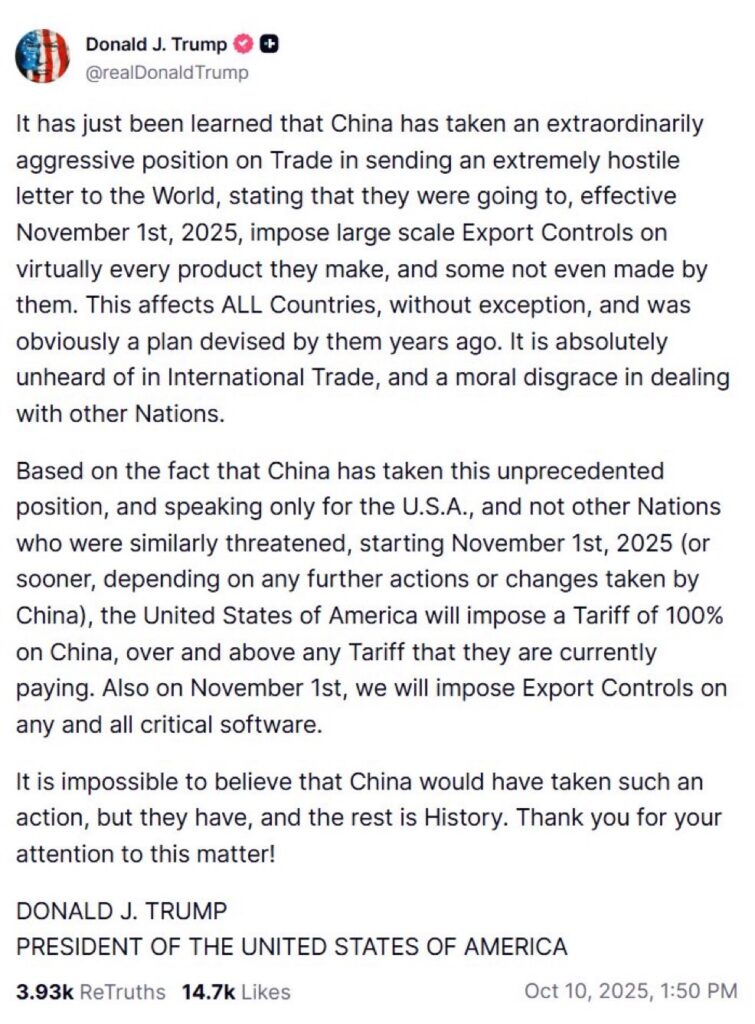
The sell-off began after a sharp Trump tariff announcement on Friday morning, a “100% tariff on Chinese imports” that immediately spooked global traders. As a result, risk assets wobbled, and crypto, already overloaded with leverage, became the first casualty.

Within minutes, large traders started trimming positions. Liquidity evaporated, market-making bots stepped back, and futures spreads widened. Consequently, what started as a macro reaction quickly turned into a structural breakdown as forced liquidations kicked in across major exchanges.

When leverage turns lethal

In highly leveraged markets, even small drops can snowball. Once the first wave of stop-losses hit, automated liquidation engines began selling crypto collateral to cover margin calls. The bitcoin price crash also triggered additional automated liquidations across derivative platforms, which amplified the sell-off. This cascade triggered more forced sales, which intensified the crash.

Data aggregators later counted more than $19 billion in liquidations, with long positions making up the majority. A well-known crypto whale, who reportedly earned $192 million shorting Bitcoin before the crash, even opened a new $163 million short position afterward. This fed speculation that the event was orchestrated.

However, forensic data tells a simpler story. Overcrowded leverage met thin liquidity, and the crypto flash crash was more mechanical than malicious.

When prices stopped making sense: the Binance moment

As the cascade spread, Binance became the epicenter of chaos. Certain tokens, including USDe, bnSOL, and wBETH, appeared to depeg dramatically, losing parity with their underlying assets.

The USDe stablecoin, issued by Ethena, traded far below $1 on Binance but remained stable elsewhere. Ethena’s founder quickly clarified that it was “not a true depeg, only a Binance-specific price slip.”

Binance attributed the issue to thin internal liquidity and auto-liquidation pressure from its cross-margin system. Because these synthetic assets mainly trade on Binance, their order books emptied faster than the broader market.

To contain the fallout, Binance announced $283 million in reimbursements for users affected by the depegs and published compensation terms for USDe, bnSOL, and wBETH pairs. It also denied responsibility for triggering the wider crash, insisting its systems “operated as intended under extreme conditions.”

As a result, many traders now view the episode as a warning about overreliance on a single exchange for liquidity.

From fear to rebound

After the carnage, market sentiment hit rock bottom. The Fear and Greed Index plunged to its lowest level of the year, signaling peak panic among investors.

Nevertheless, by Sunday evening, the market began healing. Spot buyers stepped in, open interest rebuilt, and confidence gradually returned. Bitcoin climbed back near $115,000, and total crypto market capitalization recovered roughly $190 billion.

In hindsight, Crypto’s Black Friday resembled a forced leverage reset. Although it was painful for traders, it ultimately cleared excess risk from the system.

What the data says: crash theories collide

Analysts remain split on what really caused the event.

  • Macro camp: points to tariff shocks and policy uncertainty as the spark.
  • Manipulation camp: argues a few large players timed shorts to profit from the cascade.
  • Microstructure camp: highlights order-book fragility and derivative unwind patterns as the real culprit.

However, blockchain data supports the latter view. There was no exploit, no exchange breach, and no hidden manipulation trail. It was, therefore, a chain reaction of leverage, speed, and shallow liquidity amplified by panic.

In short, the crypto flash crash exposed the fragility of the ecosystem when leverage peaks and liquidity simultaneously thins out.

Why Binance alone saw depegs during the crash


Unlike other exchanges, Binance hosts synthetic versions of assets such as wBETH, bnSOL, and the USDe stablecoin that rely on its internal liquidity pools. When cross-margin liquidations hit, these assets were automatically sold into their own thin markets, draining depth almost instantly.

At the same time, Binance’s internal price feeds lagged external markets by seconds, which caused its interface to display large gaps between reference and live prices.

Other exchanges did not suffer similar distortions because they either do not list those wrapped tokens or use separate collateral pools for margin trading.

Consequently, Binance looked broken while others appeared normal, a venue-specific anomaly rather than a global failure.

Lessons from the crash

  1. Leverage is a double-edged sword. Excessive borrowing amplifies every price move.
  2. Exchange risk is real. Synthetic and wrapped assets can exhibit unpredictable behavior during stress events.
  3. Diversification matters. Holding funds across venues helps reduce single-exchange exposure.
  4. Macro headlines can ignite technical avalanches. What starts as tariff news can end as a 10-figure wipeout.

Therefore, while the weekend rebound does not erase the warning, it highlights the need for better risk management across the industry.

After the flood

By Monday, markets were calmer, yet the lessons were clear. Crypto’s Black Friday revealed a truth many forgot during the bull run: price discovery is only as strong as the liquidity beneath it.

The crypto market rebound shows resilience, but the event left lasting scars on trader psychology. As Binance repairs its image and regulators examine the sequence of events, one takeaway remains: in crypto, speed and leverage can break even the strongest hands.

Readers’ frequently asked questions

Was Binance responsible for the crypto flash crash?

No. Binance was not directly responsible for the market-wide crash. The sell-off started with macro triggers and cascading liquidations across exchanges. However, Binance did experience isolated pricing issues that affected some tokens, which led to user reimbursements totaling $283 million.

Did the USDe stablecoin actually depeg from the dollar?

Not in the true sense. The USDe token from Ethena slipped below $1 only on Binance because of thin liquidity and internal pricing lags. On other venues and on-chain, USDe remained stable, so the event is described as a “Binance-only depeg.”

What allowed the crypto market to stabilize after the flash crash?

Once the wave of forced liquidations ended, spot traders and long-term investors reentered the market, restoring liquidity. At the same time, leverage levels normalized, reducing volatility. This combination of fresh capital inflows and lower systemic risk helped stabilize prices and rebuild confidence within days.

What’s in it for you? Action items you might want to consider

Reevaluate your leverage exposure

If you trade with leverage, review your margin settings and liquidation thresholds. Even modest leverage can magnify small price moves into large losses during volatility spikes.

Diversify across exchanges and assets

Don’t keep all trading capital or collateral on one platform. Using multiple exchanges and limiting exposure to synthetic or wrapped tokens can reduce single-venue risk.

Track liquidity and sentiment indicators

Monitor on-chain liquidity levels and tools like the Fear and Greed Index to gauge when markets may be overheated or oversold. These signals often reveal when risk or opportunity is rising before major moves occur.

Court Ruling Against WazirX Puts Spotlight on Zensui’s Global Legal Exposure

Bombay High Court illustration symbolizing the WazirX CoinSwitch court ruling and Zensui’s global legal exposure across India and Singapore.

WazirX’s rebrand to Zensui hasn’t shielded it from mounting legal exposure. The Bombay High Court this week ordered the exchange’s operator, Zanmai Labs, to post bank guarantees worth more than ₹45 crore (about $5.4 million) in favor of CoinSwitch. It rejected arguments that last year’s $234 million hack absolved the company of responsibility. The WazirX CoinSwitch court ruling marks a clear precedent: crypto exchanges cannot escape custodial liability. Not even through corporate restructuring or rebranding.

The CoinSwitch Ruling: India’s First Clear Custody Precedent

The Bombay High Court verdict stemmed from CoinSwitch’s long-running effort to recover frozen assets trapped on WazirX after the 2024 breach. Judges dismissed WazirX’s claims of force majeure and its attempt to shift blame to Binance under an earlier acquisition agreement. Instead, the court reaffirmed that the platform holding client assets remains the custodian of those assets. It therefore must safeguard them regardless of external events.

CoinSwitch called the outcome a victory for investor protection, noting that the decision could help restore user trust in Indian exchanges. Legal experts view it as the first major Indian case to establish the accountability of crypto exchanges through enforceable guarantees.

How the $234 Million WazirX Hack Sparked Years of Litigation

The WazirX hack in July 2024 drained roughly $234 million from multi-signature wallets holding client and partner funds. Investigators later traced several of the transfers to addresses linked with North Korean–affiliated groups. CoinSwitch was one of the most affected counterparties, with nearly ₹62 crore in frozen assets.

The hack triggered arbitration claims, asset freezes, and parallel criminal probes, eventually culminating in the current court orders. For users and counterparties, it exposed how thin the legal line is between operational loss and custodial breach.

India Turns Up the Heat on Zensui

The CoinSwitch recovery battle is not WazirX’s only legal problem. In August, the Delhi High Court directed WazirX’s Singapore-based parent, Zettai Pte Ltd, to disclose acquisition records tied to Binance. This move could finally clarify who ultimately controls the exchange’s assets. Separately, Delhi prosecutors asked the Central Bureau of Investigation to review a ₹2,000 crore crypto-fraud file that overlaps with the WazirX case.

Together with the Bombay ruling, these steps signal a stronger judicial appetite to test the limits of Indian crypto regulation and exchange transparency.

Singapore’s Parallel Restructuring Battle

While Indian courts hand down rulings, WazirX’s parent is still entangled in Singapore. The Singapore High Court rejected the company’s first restructuring plan in June 2025, citing compliance and creditor-protection gaps. A revised plan later won creditor approval. Another Singapore restructuring hearing is scheduled for October 13, 2025, to decide whether the scheme will be sanctioned.

The company remains under a moratorium, shielding it from new lawsuits. However, each delay deepens creditor frustration and raises questions about Zensui’s solvency.

The Panama Move and the Zensui Rebrand

In June, WazirX announced its migration to Panama under the name Zensui Corporation. The firm described the relocation as a strategic step to serve global users, but many observers see it as an attempt to reset operations outside Singapore’s regulatory reach. This Zensui rebrand creates additional uncertainty for creditors, as enforcement of Indian or Singaporean judgments in Panama remains untested.

Critics warn that the Panama crypto relocation may complicate recovery efforts and weaken user protections.

What the Verdict Means for Exchanges Everywhere

The WazirX CoinSwitch court ruling does more than settle a single dispute. It sets a standard! By defining custodial liability as a legal obligation, Indian courts have effectively raised the bar for crypto custody nationwide. Whether or not Singapore approves Zensui’s new plan, the message is clear: legal responsibility follows the assets, not the brand name.

For investors and regulators alike, this may mark the start of a new enforcement era where exchanges are judged not only by innovation but by accountability.

Closing Line

The CoinSwitch verdict may have begun as a narrow fight over frozen tokens, yet it now resonates across borders. From Mumbai to Singapore to Panama, Zensui’s tangled legal trail proves that in crypto custody, accountability doesn’t vanish with a new logo.

Readers’ frequently asked questions

Does the CoinSwitch court ruling affect regular WazirX or Zensui users?

No. The ruling applies specifically to CoinSwitch’s frozen assets and doesn’t change the current moratorium or user withdrawal restrictions. Ordinary users of Zensui remain subject to the restructuring process overseen by courts in Singapore.

Can WazirX or Zensui users withdraw their funds now?

No. Deposits and withdrawals remain suspended while the Singapore High Court reviews Zensui’s amended restructuring plan. Operations can resume only if the court approves the plan and lifts the moratorium.

What happens next in the Singapore and India court cases?

In India, enforcement of the Bombay High Court’s decision will continue, requiring Zanmai Labs to provide bank guarantees to CoinSwitch. In Singapore, the next restructuring hearing is scheduled for October 13 2025, when judges will decide whether to sanction Zensui’s revised recovery plan.

What Is In It For You? Action items you might want to consider

Monitor the October 13 Singapore court hearing

The upcoming hearing will determine whether Zensui’s restructuring plan gets court approval. The decision will shape when and how user withdrawals could resume.

Track enforcement of the Bombay High Court ruling

The ruling in CoinSwitch’s favor may serve as a template for other claimants. If you hold assets with Indian exchanges, watch whether similar enforcement actions follow.

Reassess exchange custody risks and recovery options

The case shows that legal recourse is possible but slow. Investors should review how their chosen exchanges manage custody, insurance, and jurisdictional protection in case of future incidents.

Shuffle.com Confirms User Data Leak After Partner Breach — Wallets Remain Secure

Shuffle.com data breach alert on laptop screen, showing crypto betting dashboard and red warning, hinting at third-party CRM vulnerability.

A recent Shuffle.com data breach has underscored how even blockchain-based betting platforms remain vulnerable when third-party systems fail. The crypto betting platform confirmed that user data was exposed after its marketing automation partner, Fast Track, suffered a security incident. No crypto wallets or on-chain assets were affected. Still, the event has reignited concerns about user privacy and data handling in Web3 gaming.

A Breach Triggered by a Vendor Vulnerability

Shuffle.com traced the security lapse to Fast Track, a Malta-based CRM and engagement automation provider used by several iGaming operators. According to official statements, the Fast Track security breach allowed unauthorized access to customer data stored on external servers. The compromised information reportedly included email addresses, account engagement logs, and limited marketing metadata, but no private keys, wallet data, or financial balances.

Shuffle.com said an internal audit of suspicious access patterns revealed the data breach. Shuffle.com immediately suspended its integration with Fast Track, launched an independent blockchain security audit, and notified affected users.

What Was and Wasn’t Compromised

Initial findings confirm that the user data leak affected only off-chain records, specifically, data collected for marketing and player engagement. Shuffle.com clarified that crypto balances, deposits, and withdrawals remain fully protected under its decentralized infrastructure. The breach did not involve the platform’s core operations and smart contracts.

Users were advised that while their funds are safe, some contact data may have been exposed. The company has warned customers to remain cautious of phishing attempts imitating Shuffle.com’s official communications.

Fast Track’s Response and Containment Efforts

Fast Track confirmed the security breach on its own platform, acknowledging a “technical vulnerability in a data processing module” that affected a limited number of clients. The firm stated that they patched the flaw immediately and that they had engaged an external cybersecurity team to review their systems.

In its public note, Fast Track emphasized that it is certified under ISO 27001 and follows GDPR compliance best practices. However, it admitted that the breach’s impact extends across several iGaming brands that rely on its CRM automation tools.

Shuffle.com’s Transparency and Audit Measures

Following the incident, Shuffle.com has taken steps to rebuild user confidence. The company has paused all marketing automation campaigns, commissioned a blockchain security audit, and enhanced its GDPR compliance protocols.

A spokesperson for the company said the focus now is on “restoring trust through transparency and prevention.” This includes tightening data-sharing agreements with third-party vendors and requiring stricter encryption standards for all future integrations.

Third-Party Risk in Crypto Betting

Experts say the Shuffle.com incident reflects a broader vulnerability across the iGaming and Web3 sectors, the increasing third-party risk in iGaming. Crypto betting platforms often rely on off-chain service providers for customer analytics, marketing, and engagement automation. These external systems, while convenient, introduce points of failure that blockchain immutability alone cannot protect against.

The event highlights a recurring contradiction in decentralized industries: while user funds may remain secure on-chain, they frequently store personal data in centralized databases. For many analysts, the Fast Track security breach is a reminder that crypto gambling security must extend beyond wallets to include vendor compliance and data privacy audits.

What Users Should Do Now

Shuffle.com users are advised to remain vigilant against phishing and impersonation scams. Any email or message requesting personal credentials should be verified through official channels. Users can also enable two-factor authentication where possible and monitor accounts for abnormal activity.

While the company continues to strengthen its systems, experts encourage all crypto-gaming participants to be aware of the data privacy risks in Web3 and limit the personal information shared with third-party services whenever possible.

The Shuffle.com data breach is a reminder that blockchain infrastructure alone cannot guarantee complete immunity from cyber incidents. As crypto-betting platforms continue to merge decentralized finance with centralized marketing systems, human oversight and vendor accountability will remain crucial.

Ultimately, the incident reinforces a simple truth: in Web3, decentralization secures the money — but transparency secures the trust.

South Korea’s Cold-Wallet Crackdown: How Far Can Tax Authorities Go?

South Korean tax inspector reaching toward a glowing hardware crypto wallet locked in an icy digital safe, symbolizing the South Korea crypto tax crackdown and cold wallet seizure enforcement.

South Korea has entered a new and unprecedented phase in its crackdown on crypto tax evasion. The National Tax Service (NTS) extended its enforcement powers beyond exchange-held assets to include cold wallet seizures. It means that crypto stored on hardware devices and other forms of offline storage may no longer be safe from collection efforts.

Officials say the expansion is part of an ongoing effort to close compliance gaps in a market where digital wealth often escapes conventional oversight. But privacy advocates warn the measure could blur the line between lawful tax collection and invasive state surveillance.

From Exchange Freezes to Home Visits

The latest campaign builds on years of enforcement. Since 2021, the NTS South Korea has confiscated over ₩140 billion (about US $106 million) in digital assets from more than 14,000 taxpayers who failed to settle outstanding bills. Early seizures mostly involved custodial accounts on domestic exchanges, which can be frozen through administrative orders.

Now, with that low-hanging fruit largely collected, tax officials are looking deeper. The next frontier of the crypto confiscation effort is self-custodied crypto wallets, hardware devices, USB keys, and encrypted drives that allow individuals to store assets offline.

In recent guidance from the Ministry of Strategy and Finance, South Korea legally reclassified digital assets as “tangible property.” This move provides a clear statutory basis for seizure warrants and expands the government’s reach under existing asset-forfeiture law.

The change closes a long-standing loophole: until now, crypto existed in a gray zone between intangible data and financial instruments. Under the new definition, the state can physically confiscate devices that store or secure digital wealth. It’s an unprecedented step in the evolution of digital-asset regulation.

Lawmakers describe the measure as a modernization of fiscal policy. Critics, however, caution that reclassification alone cannot guarantee procedural fairness, especially when enforcement reaches into private homes.

Cold Wallet Seizures and Home Raids

Authorities in Cheongju, Gwacheon, Jeju, and Paju have begun deploying blockchain-tracking systems that cross-reference tax records with on-chain data and exchange disclosures. These tools are part of a broader push to integrate blockchain analytics in Korea, allowing investigators to flag wallets suspected of holding undeclared crypto.

If matching evidence surfaces, inspectors may request search warrants to seize physical media during home visits. Local media have reported instances of home raids, though officials insist such crypto operations are used only in extreme cases.

For taxpayers, this signals the end of the assumption that cold wallet seizures are beyond government reach.

Privacy and Due-Process Concerns

The expansion of enforcement powers has sparked privacy concerns in the crypto community. Civil-rights advocates question how authorities can verify wallet ownership or balances without compelling self-incrimination.

Legal experts warn that confiscating storage devices could inadvertently capture unrelated personal data. In turn, this raises constitutional issues under privacy and property rights protections. The government of South Korea maintains that the tax crackdown follows proper judicial oversight and that all crypto seizures must be backed by court-issued warrants.

Still, many observers fear the precedent could normalize intrusive tactics in digital-asset enforcement.

Cross-Border Enforcement Gaps

Despite its growing sophistication, the crackdown remains limited to domestic assets. The Korean tax authority acknowledges that its jurisdiction ends at national borders. Crypto held on foreign exchanges remains largely out of reach.

This weakness may drive more traders to relocate funds offshore or into privacy-oriented tokens. Other markets with aggressive enforcement mirror this trend. That’s why policymakers are exploring cross-border enforcement in crypto through OECD information-sharing frameworks. However, such cooperation remains years away.

Public and Market Reaction

South Korean public sentiment toward the crypto tax crackdown is divided. Supporters praise it as a fair-tax measure that aligns digital assets with traditional property law. Investors and technologists, meanwhile, view it as a heavy-handed move that could stifle innovation and weaken local market confidence.

Analysts at Seoul-based brokerages suggest retail participation could decline if cold wallet seizures become common. Eventually, traders will seek safer jurisdictions or more privacy-resistant tools.

The Policy’s Dual Edge

South Korea now stands at the frontier of crypto-tax enforcement. It’s pioneering new ways to track, classify, and confiscate digital wealth. Yet the same policies that strengthen fiscal compliance also expose the growing friction between state power and financial privacy.

As South Korea deepens its crypto tax crackdown, its success will depend on how much crypto the government can seize, and on whether it can maintain public trust while doing so.

Readers’ frequently asked questions

Can the South Korean government legally seize crypto from cold wallets?

Yes. Under revised Ministry of Finance guidance, digital assets are now classified as tangible property. This gives the National Tax Service the legal authority to confiscate hardware wallets or storage devices if a court issues a seizure warrant for unpaid taxes.

How would tax agents identify private wallets or hidden crypto?

Authorities use blockchain analytics tools that link transaction histories to tax records and exchange data. When on-chain movements suggest undisclosed holdings, investigators can request a judicial warrant to inspect devices believed to store those assets.

Do foreign-held crypto assets fall under this policy?

No. The National Tax Service’s jurisdiction currently extends only to assets held domestically or on exchanges operating under Korean regulation. Crypto stored on foreign platforms remains outside direct enforcement unless covered by future OECD information-sharing agreements.

What Is In It For You? Action items you might want to consider

Check your crypto tax compliance status before the 2025 filing period

The National Tax Service now cross-references blockchain data with tax records. If you hold crypto in Korean exchanges or cold wallets, verify that all gains, transfers, and holdings are reported accurately before annual filing deadlines.

Review how and where your assets are stored

With the NTS expanding seizures to hardware wallets, self-custody no longer guarantees privacy from enforcement. Ensure your storage methods are compliant and your device access keys are secured and documented properly in case of audit.

Monitor developments on cross-border cooperation agreements

Crypto stored on foreign exchanges is currently outside direct reach, but international information-sharing frameworks are being negotiated. Keep track of any new OECD or FATF policies that could extend enforcement to overseas wallets.

- Advertisement -

FEATURED