
Home Blog Page 83

From hype to bailout: Trump meme coin’s $200 million rescue plan
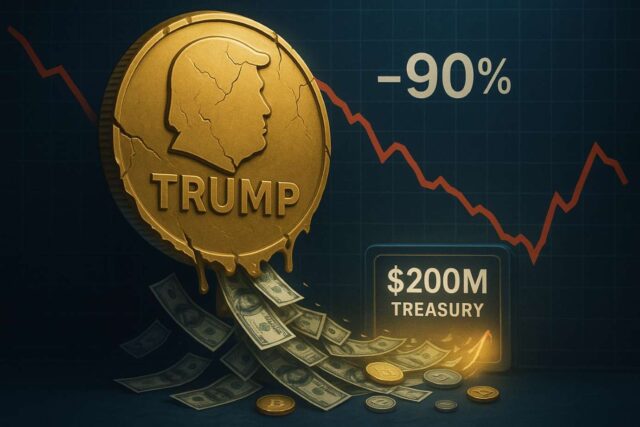
Illustration of a cracked gold coin labeled “TRUMP” tilting downward as dollar bills flow into a glowing digital vault marked “$200M Treasury,” symbolizing the Trump meme coin’s rescue plan after a 90% price drop.

The Official Trump (TRUMP) token, once the hottest political meme asset of early 2025, has lost almost 90 percent of its value since January. Now its issuer, Fight Fight Fight LLC, run by Trump ally and entrepreneur Bill Zanker, is trying to raise at least $200 million. The company wants to form a so-called digital-asset treasury that would buy back tokens and support liquidity. Some reports suggest the goal could stretch to $1 billion, but the plan remains in its early stages and may never materialize.

From hype to collapse

The trump meme coin launched on January 17, 2025, just three days before Donald Trump’s inauguration as the 47th U.S. President. That same evening, Trump publicly promoted the token on social media, helping ignite a retail frenzy. Within days, its market capitalization briefly exceeded $300 million as campaign-season hype and “official” branding sent trading volumes soaring.

However, by late February, momentum faded. Profit-taking, falling volume, and skepticism over the project’s legitimacy triggered a rapid slide. As of this week, the trump meme coin trades about 90 percent below its all-time high. It erased nearly all of its early-year gains.
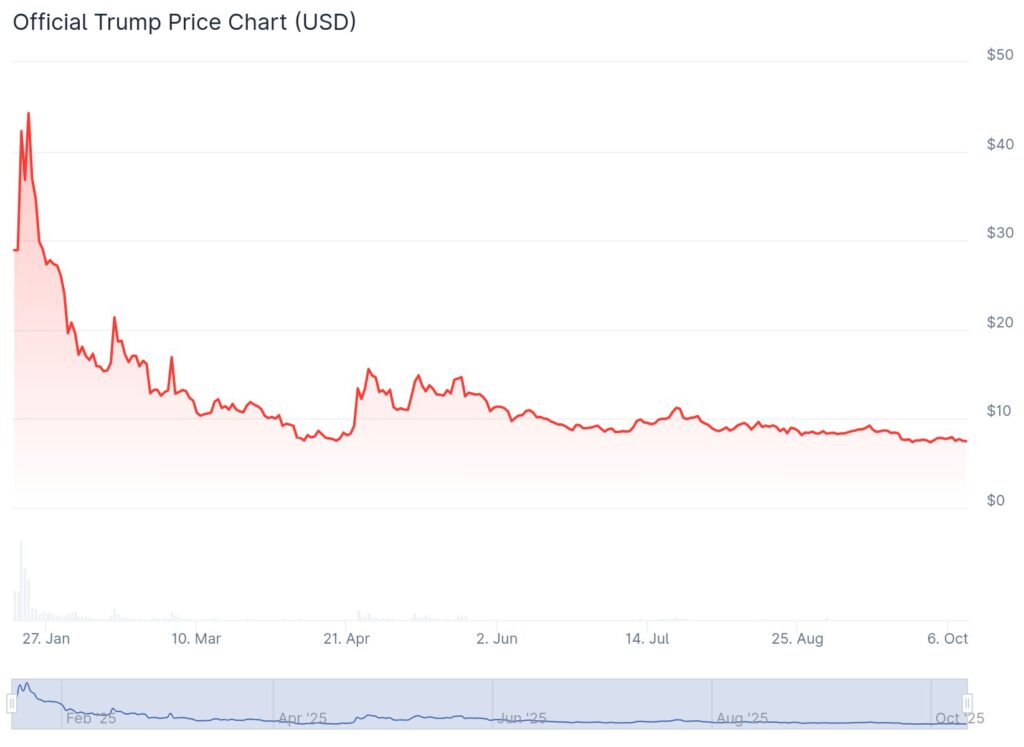
Source: CoinGecko

Who’s behind the project?

Behind the scenes, the issuer is Fight Fight Fight LLC, a Delaware-registered company led by Bill Zanker, best known for co-founding The Learning Annex and previous ventures with Trump. Zanker’s team markets the Official Trump token as part of a broader “Trump community,” hosting events such as the Dinner with Trump for large token holders.

Nevertheless, there is no verified public filing showing direct ownership by Donald Trump or his family. The blurred relationships between Fight Fight Fight LLC, CIC Digital LLC, and the Trump Organization have even prompted Senate inquiries into potential conflicts of interest.

The bailout plan

Zanker’s new proposal would create a digital-asset treasury, a corporate-style fund that accumulates TRUMP tokens to reduce supply and restore confidence. Supporters call it a “long-term stabilization strategy,” while critics describe it as a bailout disguised as a buyback. At this point, the plan still lacks details on governance, custody, or transparency. Even so, reporting indicates that the fundraising target ranges from $200 million to $1 billion, with proceeds intended for token accumulation and market operations.

Locked supply versus treasury holdings

The $TRUMP token has a total supply of 1 billion units, but only approximately 200 million are currently in circulation. The remaining around 800 million tokens (roughly 80 percent) are locked across wallets associated with Fight Fight Fight LLC and CIC Digital LLC.

Those locked tokens follow a three-year vesting schedule. Each allocation has an initial cliff period of three to twelve months. They are followed by partial unlocks of ten to twenty-five percent once each cliff expires. The remainder is released gradually through daily vesting over approximately two years. Therefore, the full release window stretches into 2027 or early 2028.

Locked tokens represent pre-allocated assets that insiders already own. They cannot yet be traded, but they do not require new funding. In contrast, a treasury would use fresh outside capital to buy TRUMP on the open market, collecting tokens that are already in circulation. Consequently, while the locked supply shows founder control, the proposed treasury aims to create the appearance of institutional structure and market confidence, even though both mechanisms ultimately consolidate ownership in the same hands.

Why hold a failing token?

At first glance, the idea of parking hundreds of millions of dollars in a collapsing meme coin seems irrational. Yet the motives mix brand defense, narrative control, and speculative opportunism. Holding a treasury full of TRUMP tokens could signal confidence, slow the decline, or position the issuer to profit from a potential rebound during a political season. More cynically, it could centralize supply control, giving Fight Fight Fight LLC influence over price perception and messaging. This approach resembles market choreography that often appears in meme-asset projects.

Does the Trump meme coin actually do anything?

In practical terms, no. The trump meme coin has no on-chain utility, no staking yield, and no governance rights. It is not used for payments or campaign donations, and there is no formal redemption or burn mechanism. Owning it merely offers exposure to a politically themed digital collectible whose value rests entirely on speculation. Furthermore, even the Dinner with Trump promotion was a marketing perk, not a recurring feature. For investors seeking fundamentals, the token offers none, only branding, hype, and volatility.

ETF listing confusion

Separately, a Canary Capital “TRUMP Coin ETF” appeared on the DTCC’s NSCC list of eligible securities, which prompted online excitement. However, this is not an SEC approval. It simply indicates technical readiness for clearing should a product ever launch. Regulatory filings show no authorized Trump crypto ETF, and the listing itself did nothing to lift prices.

Outlook: Can a treasury save a meme?

Whether a $200 million fund can revive the trump meme coin remains uncertain. Without clear oversight, any buyback could simply concentrate ownership without rebuilding market trust. Moreover, the episode fits a familiar crypto pattern: hype, collapse, and attempted resurrection through financial engineering. If the “digital-asset treasury” goes forward, it will test whether even the most politically charged meme token can be financially reanimated, or whether some manias are simply too far gone to save.

Readers’ frequently asked questions

Can investors legally buy or trade the Trump meme coin in the United States?

Yes. The Official Trump (TRUMP) token trades on major crypto exchanges that serve U.S. customers, but it is not regulated or approved by the SEC. Investors should confirm exchange compliance and note the token is a speculative asset, not a security or campaign contribution.

Where can the token’s official contract and supply data be verified?

The Official Trump (TRUMP) token is an ERC-20 asset on Ethereum. Its contract address and supply metrics are viewable on Etherscan and listed on data aggregators such as CoinMarketCap and CoinGecko.

Does the planned digital-asset treasury change how new tokens are created or released?

No. The treasury plan involves buying existing tokens from the market using raised funds. It does not mint or issue new TRUMP tokens and does not alter the vesting schedule for locked supply.

What Is In It For You? Action items you might want to consider

Verify the project’s legitimacy before trading

Check official contract addresses on Etherscan and confirm listings on reliable exchanges. Avoid buying through social media links or unofficial marketplaces, which often host copycat tokens.

Review token allocation and unlock schedules

The Official Trump (TRUMP) token has roughly 80% of supply locked until 2027–2028. Understanding these future unlocks helps investors anticipate potential dilution and price pressure.

Track regulatory and disclosure updates

Any future filings, fundraising disclosures, or Senate inquiry outcomes involving Fight Fight Fight LLC could influence market confidence. Follow verified financial news channels instead of influencer posts.

Crunch Lab’s $5M Raise Marks Blockchain’s Leap Beyond Crypto — Into Science, Healthcare, and AI

“Editorial image of a transparent glass data panel showing a chain of hexagonal checkpoints lighting up as verified, against a soft-focus research lab background, symbolizing on-chain model verification and reproducible research.

Decentralized research startup Crunch Lab has secured $5 million in new funding led by Galaxy Ventures, Road Capital, and VanEck Digital Assets. This cash injection enables the company to expand its blockchain-powered prediction platform that connects scientists, developers, and enterprises seeking transparent and verifiable collaboration in AI and data modeling.

The raise highlights a broader shift in blockchain adoption. Investors are starting to see that blockchain applications go far beyond cryptocurrency. When paired with AI, blockchain becomes more than a digital ledger; it becomes a trust layer for verifiable intelligence across industries.

Institutional Capital Enters the Decentralized AI Race

For VanEck, the investment in Crunch Lab marks a strategic entry into decentralized AI. This sector is drawing attention from institutional funds that see blockchain as a coordination system rather than a speculative asset.

VanEck’s participation, alongside Galaxy Ventures and Road Capital, shows that institutional adoption of decentralized AI is now moving from concept to execution. These investors have previously focused on infrastructure rather than token speculation, adding weight to Crunch Lab’s credibility.

Just as institutional capital once validated tokenization and stablecoins, the Crunch Lab funding round could become a turning point for AI blockchain projects that serve research and enterprise needs.

https://twitter.com/crunchDAO/status/1976234106074931662

Crunch Lab’s Core: A Decentralized AI Network

At the heart of Crunch Lab’s work is a decentralized AI network built to crowdsource model development through blockchain incentives. The platform connects thousands of data scientists who contribute algorithms and are rewarded based on performance and reproducibility.

Each contribution is verified through on-chain data validation, providing transparency in how models are trained and scored. Thus, the process addresses one of AI’s biggest challenges: accountability. Crunch Lab calls this framework the “intelligence layer” for decentralized AI. Its open infrastructure balances collaboration, ownership, and enterprise control.

The Lab evolved from CrunchDAO, a research collective where contributors compete in predictive modeling challenges. Their work feeds into the AI prediction network that carries Crunch Lab’s commercial platform. Together, these systems translate decentralized collaboration into enterprise-ready intelligence tools.

Blockchain in Healthcare and Science: Real-World Validation

Crunch Lab’s best-known experiments come from research partnerships with Harvard and MIT teams. These projects used the Crunch framework for cancer-detection modeling and showed that blockchain can secure sensitive healthcare research data while preserving transparency.

The results highlight how Decentralized Science (DeSci) is transforming research integrity. Every contribution to a model is recorded immutably, allowing independent verification and reproducibility. In effect, blockchain acts as a peer-review mechanism where every dataset and update is traceable.

Beyond healthcare, Crunch Lab’s contributors also apply similar methods to climate modeling and financial forecasting. These initiatives show that blockchain applications are already improving the reliability of AI across scientific and commercial fields.

From Research to Enterprise Integration

Crunch Lab’s evolution mirrors a larger market trend in which enterprises adopt blockchain as a trust framework for data-driven systems. In practice, its APIs allow companies to integrate decentralized models into business workflows, test them on private datasets, and deploy predictive tools without revealing sensitive information.

Moreover, this dual approach of open collaboration paired with privacy explains why VanEck’s investment strengthens Crunch Lab as a potential leader in blockchain and AI integration. As a result, companies facing regulatory or audit pressure gain a cryptographically verifiable layer that preserves transparency while protecting proprietary data. Ultimately, that combination of traceability and confidentiality is what moves decentralized AI from research labs into production environments.

The Funding Roadmap: Building the Intelligence Layer

Through this funding, Crunch Lab will accelerate development across three key areas: scaling the infrastructure, expanding developer tools, and onboarding new contributors worldwide. The company will allocate parts of the capital to enhance cross-chain interoperability and optimize infrastructure that can handle higher-frequency model updates.

The team also plans to release enterprise APIs and on-chain verification tools to help companies measure and report AI transparency. This will become an increasingly important metric under upcoming global AI governance rules.

Positioning Among AI–Blockchain Projects

Projects such as Fetch.ai, SingularityNET, and Ocean Protocol also explore synergies between blockchain and AI. Crunch Lab differentiates itself through verified research outputs and academic collaborations. Its partnership-driven model blends open science with enterprise software.

This mix of scientific credibility and institutional support positions Crunch Lab among the most credible AI blockchain projects of 2025.

Why It Matters: Blockchain’s Broader Role

The Crunch Lab funding represents more than another startup milestone. It signals blockchain’s evolution into infrastructure for knowledge verification. As blockchain use expands into AI, healthcare, and science, the technology’s defining strength, trust through transparency, finds real utility beyond digital currencies.

Enterprises, researchers, and developers are now adopting these frameworks to ensure data integrity and reproducibility at scale. Crunch Lab’s progress shows how real-world blockchain utility is shifting from finance to the foundation of a decentralized intelligence economy.

What Is In It For You? Action items you might want to consider

Verify the news and avoid scams

Double-check the funding details on Crunch Lab’s official announcement and the PR wire, and confirm investor names (Galaxy Ventures, Road Capital, VanEck Digital Assets). Be wary of fake “airdrop” links or supposed new tokens—this raise did not introduce a tradable token.

Track decentralized-AI adoption signals

Set alerts for “Crunch Lab,” “VanEck Digital Assets,” and “decentralized AI network.” Watch for pilot announcements in healthcare or finance; those will indicate whether on-chain verification and reproducibility are gaining traction beyond crypto.

Explore participation without risk

If you’re curious about the tech, follow CrunchDAO’s public research challenges and read their documentation before engaging. Start by observing or testing with non-sensitive data; you don’t need to connect funds or share private information to learn how the approach works.

Readers’ frequently asked questions

Is there a consumer app I can try, or is Crunch Lab mainly for researchers and businesses?

It’s primarily aimed at researchers and enterprises. Individual contributors can participate via CrunchDAO’s modeling challenges. However, there isn’t a mainstream consumer app tied to this funding announcement.

Can an enterprise test Crunch Lab’s decentralized AI network without exposing private data?

Yes. Crunch Lab says it provides APIs and on-chain verification tools that let teams evaluate models against their own datasets without sharing raw data. Typical next steps: request sandbox/API access, run a pilot on non-production data, review the verification logs, and then proceed under an NDA if you move to production.

Is there a tradable token tied to this funding round, and how do individual contributors participate?

The funding announcement does not introduce a new token. Contributors receive rewards through CrunchDAO’s existing research programs. To participate: create an account, link a wallet, review the submission rules, and enter modeling challenges where rewards are based on performance and reproducibility. Always confirm current rules on Crunch Lab / CrunchDAO’s official documentation before committing resources.

Square pushes Bitcoin payments live — skipping New York and rivaling PayPal’s crypto play

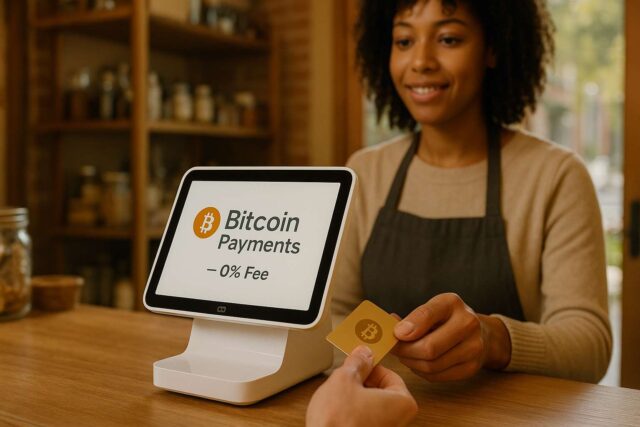
Editorial image of a customer paying with Bitcoin at a small business using a Square terminal displaying “Bitcoin Payments — 0% Fee,” symbolizing Square’s Bitcoin payments rollout across U.S. merchants.

Square has begun rolling out its Bitcoin payments system for U.S. merchants, taking a decisive step from planning to execution. The new service lets sellers accept BTC directly at the point of sale with zero processing fees through 2026. Fees will rise to 1% in 2027. While the feature will soon reach most U.S. states, New York remains excluded because of the state’s strict BitLicense regime.

From pilot to public rollout

The Square Bitcoin rollout follows months of phased testing that began in July 2025. After announcing its roadmap in May, Block Inc. quietly onboarded select small-business merchants to trial Lightning-based transactions. By the third quarter, those pilots had already processed about 142 BTC through the platform’s conversion tools, prompting the company to open access nationwide ahead of the formal Bitcoin Payments launch on November 10.

What merchants get

Merchants can now accept Bitcoin payments via Square’s integrated POS and wallet, which handles receiving, holding, or automatically converting funds. A built-in Square Bitcoin wallet enables sellers to buy, sell, or withdraw BTC, while an auto-conversion feature allows them to direct up to 50% of their daily card sales into Bitcoin. Transactions run over the Lightning Network, enabling faster and cheaper settlement than traditional blockchain transfers.

Strategic timing

By activating Square Bitcoin payments during a period of revived crypto interest, Block is positioning itself to capture merchants before rivals do. Many small businesses still hesitate to test digital-asset tools. The company hopes to lower these adoption barriers with the fee-free window. The rollout arrives alongside Square’s new AI voice-ordering and Square AI Insights suite, combining payments and automation into one merchant ecosystem.

Regulatory friction

The New York exclusion highlights the uneven crypto landscape across the U.S. Block is licensed in most states but continues to sidestep New York’s high-cost compliance rules. Analysts note that the carve-out is pragmatic rather than political: by skipping a jurisdiction with tougher demands, Square can accelerate expansion elsewhere while keeping options open for later approval.

Competitive landscape

The timing also signals a new competitive front in merchant payments. PayPal, which began rolling out crypto payments for merchants earlier this year through its PYUSD stablecoin, has positioned itself as the bridge between digital assets and fiat commerce. Shopify and Coinbase Commerce continue to rely on plug-ins or third-party processors for crypto checkout. Square Bitcoin, by contrast, integrates BTC acceptance directly into its POS and wallet infrastructure, using the Lightning Network for instant settlement. Analysts see the fee-free Bitcoin payments model as a short-term margin play but a long-term bid to build loyalty across Block’s broader merchant network.

Block plans to expand the rollout to all eligible U.S. sellers by mid-2026, followed by international markets. Future updates are expected to include advanced BTC accounting features and deeper AI integrations. For Jack Dorsey, who has long described his Bitcoin mission as making BTC “the currency of the Internet,” this marks a tangible milestone: Square is not just talking about crypto — it’s operationalizing it on Main Street.

Readers’ frequently asked questions

When will Square Bitcoin payments be available to merchants?

According to Block’s October 8 2025 press release, Bitcoin Payments will open to eligible U.S. sellers on November 10 2025. The related Conversions feature, which lets merchants automatically convert a portion of daily sales into BTC, is already live.

Why is New York excluded from the rollout?

New York State requires a special BitLicense for digital-asset services. Square has not yet obtained this license, so the company is launching Bitcoin Payments in other U.S. jurisdictions first and may apply later once the licensing process is finalized.

How do fees work for Square Bitcoin transactions?

Square is offering a 0% processing-fee promotion through 2026 for merchants using Bitcoin Payments. Beginning January 1 2027, standard transactions will carry a 1% processing fee, still below typical credit-card interchange rates.

What’s in it for you? Action items you might want to consider

Prepare your Square account for Bitcoin payments

Eligible U.S. sellers can begin enabling the Conversions feature now and get ready for Bitcoin Payments ahead of the November 10 rollout. Make sure your Square dashboard and KYC details are up to date.

Evaluate how Bitcoin acceptance fits your business

With 0% fees through 2026, merchants can test crypto transactions at no additional cost. Consider whether accepting BTC or converting it to USD aligns better with your cash-flow and tax strategy.

Watch regulatory developments in your state

If you operate in New York or another restricted jurisdiction, follow updates on BitLicense approvals and Square’s expansion timeline. Additional states could be added as compliance frameworks evolve.

VARA Fines Crypto Firms — Dubai Tightens Its License-First, Marketing-Clean Rulebook

Nighttime digital illustration of Dubai skyline under a glowing holographic firewall dome, symbolizing VARA’s regulation protecting the city’s crypto innovation.

Dubai’s Virtual Assets Regulatory Authority (VARA) has taken decisive action against unlicensed operators in the city’s crypto sector. In its latest enforcement round, VARA fined 19 crypto firms for running without the required licenses and for breaching marketing regulations. Penalties range from AED 100,000 to AED 600,000, accompanied by cease-and-desist orders that require firms to halt all unapproved activities. VARA did not disclose the names of the firms under investigation, citing ongoing compliance proceedings. The move reinforces Dubai’s commitment to building a crypto hub based on regulation and accountability rather than unchecked growth.

Compliance as the Entry Ticket to Dubai’s Crypto Hub

Dubai has long positioned itself as a welcoming environment for blockchain innovation, but participation begins with a license. VARA’s latest action, fining crypto firms for unlicensed operations, underscores the regulator’s license-first approach. This central principle of Dubai crypto regulation balances openness with control. Officials describe this system as “permissioned, not permissive,” ensuring that companies meet governance, disclosure, and financial requirements before entering the market. For Dubai, regulatory credibility is the foundation of its ambition to become a trusted global digital assets hub.

The Overlooked Rule: Marketing and Promotion Standards

Beyond licensing, VARA’s enforcement targeted breaches of its marketing regulations, which govern how crypto businesses communicate with the public. Several sanctioned entities had promoted their services without regulatory approval or had distributed materials that failed to meet disclosure standards. Under crypto advertising rules in Dubai, companies must seek advance approval for campaigns. They must provide clear risk warnings and avoid misleading content. VARA treats improper marketing as a consumer-protection issue, giving equal weight to advertising integrity and operational compliance.

Fines, Orders, and the Cost of Non-Compliance

The enforcement package includes fines of up to AED 600,000 and formal cease-and-desist orders, stopping unlicensed activity in its tracks. Penalties vary depending on the scope of violations and level of cooperation during the investigation. By showing that VARA fines crypto firms that disregard its licensing process, the authority sends a clear message: consumer protection and market integrity come first. Companies that continue to operate without approval risk heavier sanctions or permanent exclusion from Dubai’s growing virtual assets ecosystem.

Industry Reaction and Market Implications

Licensed operators and compliance experts have largely welcomed the sanctions. They called them a necessary step toward a fairer, more transparent marketplace. Some marketing agencies have temporarily suspended crypto-related campaigns in Dubai to confirm that they meet VARA’s advertising code. Analysts note that consistent enforcement builds confidence among institutional investors, who view transparent oversight as essential for long-term growth. In this sense, enforcement may be seen not as a setback but as a sign of maturity for Dubai’s crypto market.

Dubai’s Strategic Balancing Act

VARA’s latest move is part of a broader balancing act: promoting innovation while tightening oversight. By combining clear rules with a transparent licensing framework, Dubai positions itself as a crypto hub built on compliance. Observers compare the approach to Singapore and Hong Kong, where stringent regulation coexists with dynamic fintech ecosystems. This balance strengthens Dubai’s reputation as a responsible digital assets center. It aligns crypto compliance in the UAE with international standards on marketing and investor protection.

Market analysts expect more enforcement actions in the months ahead, potentially expanding to cross-border operators and social-media promoters. VARA continues to process new applications through its licensing process, offering legitimate firms a structured path to operate in Dubai. Executives are encouraged to review both operational licenses and marketing approvals to avoid falling afoul of the rules. For Dubai, the message remains consistent: innovation is welcome, but compliance is non-negotiable.

CakePad Goes Live: CAKE Jumps as PancakeSwap Expands Early-Access Launches

Futuristic illustration of the PancakeSwap CakePad launch showing a CAKE token lifting from a golden digital launchpad with pastel pink, turquoise, and gold tones, symbolizing market growth after the X account hack.

PancakeSwap’s CakePad launch has reignited investor interest in one of DeFi’s largest decentralized exchanges. The new early-access platform provides CAKE holders with a gateway to upcoming token listings, while strengthening PancakeSwap’s deflationary token model. The rollout coincided with a double-digit surge in CAKE’s price and increased trading volume across BNB Chain pairs.

The positive momentum came despite an unrelated incident in which PancakeSwap’s Chinese-language X account was compromised. The hackers used it to promote a fake “Sir Pancake” meme coin. The team quickly recovered control and reassured users that the incident did not affect any smart-contract systems or funds.

PancakeSwap doubles down on utility

With DeFi activity rebounding after a slow start to 2025, PancakeSwap is focusing on real token utility rather than promotional campaigns. The PancakeSwap CakePad launch marks the platform’s latest step in a broader strategy to link user participation directly to ecosystem growth.

CakePad acts as an early-access platform for new projects. It lets CAKE holders commit tokens to vetted launches without long lock-ups or custodial risk. By requiring CAKE participation, the platform deepens user engagement and strengthens the token’s underlying demand.

Inside CakePad: How it works

What is PancakeSwap CakePad?

CakePad is the evolution of PancakeSwap’s well-known IFO model. The PancakeSwap IFO rebrand shifts focus from farming toward flexible token-launch access.

Here’s how CakePad works:

Participants allocate CAKE from their non-custodial wallets to join new project sales. A portion of the collected CAKE is burned automatically through the protocol’s CAKE burn mechanism. This contributes to long-term supply reduction and reinforces CAKE’s role as a deflationary token.

The platform supports CakePad early token listings across multiple chains. It aligns with PancakeSwap’s goal to remain the leading multi-chain DEX in the expanding BNB Chain DeFi ecosystem.

What Is an IFO?

IFO stands for Initial Farm Offering, PancakeSwap’s native model for launching new tokens. In an IFO, users commit CAKE tokens (sometimes paired with BNB) to buy a project’s token directly through PancakeSwap. A portion of the CAKE used is automatically burned, which helps reduce the token supply and supports PancakeSwap’s deflationary design. IFOs combine fundraising with farming participation, making them a key part of the DEX’s ecosystem.

Market response: CAKE defies the headlines

News of the PancakeSwap CakePad launch triggered a surge in market activity. CAKE’s price climbed sharply over the past week, supported by growing interest in the new feature and an overall uptick in DeFi trading volume.

Analysts attribute the move to renewed confidence in PancakeSwap’s roadmap and the clear token-burning component. For traders, CakePad’s design suggests sustained CAKE token supply reduction. This could stabilize value while maintaining healthy liquidity for launch participants.

The security incident in context

Amid the product buzz, PancakeSwap confirmed that its Chinese-language X handle had been hijacked to promote a fraudulent “Sir Pancake” coin. The team posted a public advisory, urging followers not to click links from the compromised account and confirming the issue was limited to social-media credentials.

The PancakeSwap Twitter hack was resolved within hours, and no smart-contract or wallet exposure occurred. While the event highlighted the importance of vigilance, it did little to dent user confidence. CAKE’s market performance remained solid throughout the day.

Why CakePad matters beyond the hack

The CakePad token launch process underlines PancakeSwap’s long-term intent: to anchor token value in real usage. Each launch contributes to the PancakeSwap CAKE burn rate, turning platform growth into deflationary pressure.

By integrating these mechanics, PancakeSwap reinforces CAKE’s position as a utility asset rather than a speculative token. The model also supports transparency and aligns with the broader 2025 DeFi shift toward curated launchpads and quality listings.

Industry observers see CakePad as a strategic response to those evolving trends. As the CAKE ecosystem expansion continues, PancakeSwap’s approach signals confidence in sustainable tokenomics and measured growth.

Looking ahead

PancakeSwap plans additional early-access token listings on CakePad in Q4 2025, with cross-chain launches expected on Ethereum and Base. Future updates may refine participation tiers, burn ratios, and community-voting features.

Overall, the PancakeSwap CakePad launch has achieved two objectives: re-energizing CAKE’s market profile and demonstrating that innovation, not hype, remains the most effective defense against volatility.

Readers’ frequently asked questions

How can users verify official PancakeSwap announcements after the X account hack?

Rely only on PancakeSwap’s verified English-language X account, the official website, and the project’s Telegram or Discord announcement channels. Double-check any links from other profiles, including regional handles, before clicking or sharing.

What safety steps should users take before connecting a wallet to PancakeSwap or CakePad?

Confirm the website URL is the official PancakeSwap domain, enable two-factor authentication where possible, and avoid signing unknown contract prompts. Keep browser extensions updated and use a hardware wallet for larger balances.

Does CakePad participation require staking or locking CAKE tokens?

No. Participation does not require staking or lockups. Users commit CAKE from a non-custodial wallet to join verified launches, and a portion of committed CAKE is automatically burned to support the deflationary supply model.

What Is In It For You? Action items you might want to consider

Verify before you click

After any reported social-media compromise, double-check PancakeSwap’s verified X account and official domain before interacting with posts or links. Avoid clicking on offers or tokens promoted by unverified handles.

Review your wallet connections

Open your wallet’s connection list and remove any inactive or suspicious dApps. Keeping your connection history clean reduces exposure to phishing or contract spoofing.

Monitor CakePad launches through official channels

If you plan to explore CakePad, follow updates directly from PancakeSwap’s verified sources. Check token listings on the platform interface instead of third-party links to ensure participation in legitimate launches only.

- Advertisement -

FEATURED