Home Blog Page 9

Standard Chartered Expands Institutional Access to HKDAP Stablecoin

TL;DR

  • The HKDAP stablecoin now has its first bank distributor through Standard Chartered Bank Hong Kong.
  • Standard Chartered gives eligible institutions a conventional banking route to access HKDAP alongside existing distributors HashKey and OSL.
  • HKDAP remains limited to institutions, corporate users and professional investors, while retail access is targeted for late 2026.

On August 24, Standard Chartered Bank Hong Kong became the first bank authorized to distribute HKDAP (HKD At Par), Hong Kong’s regulated stablecoin. Eligible institutions can now rely on a familiar banking channel to access the token, issued by Anchorpoint Financial. HKDAP is still not available to retail customers.

Anchorpoint began a limited rollout on August 12, with HashKey Exchange and OSL already serving as authorized distributors. Standard Chartered’s addition expands that distribution network.

Who issues HKDAP?

Anchorpoint Financial holds the stablecoin issuer licence from the Hong Kong Monetary Authority (HKMA), one of only two granted in April. The other went to HSBC.

While Standard Chartered is Anchorpoint’s largest shareholder, Anchorpoint alone holds the issuer licence and regulatory responsibility for the token. The company’s Hong Kong banking arm joins as a token distributor. The bank can help approved clients obtain and use HKDAP.

What does a distributor do?

An authorized distributor connects qualified users to HKDAP and supports conversion between the token and Hong Kong dollars. Many companies already use banks for onboarding, compliance checks, and treasury services. Folding a regulated stablecoin into an existing banking relationship lowers the friction of adopting it. The arrangement also gives Anchorpoint access to Standard Chartered’s institutional client network.

The distribution model varies by partner. HashKey and OSL serve eligible users through their own platforms. Standard Chartered works through conventional banking relationships. Anchorpoint has not published a full timetable for when access will broaden further.

Who can use it, and when might that change?

In its current phase, HKDAP remains available only to institutions, corporate users, and professional investors. Anchorpoint has described this as a controlled first phase and plans to broaden access through additional distributors and commercial partners. It targets retail availability for late 2026.

Standard Chartered has outlined several intended uses for HKDAP: subscriptions and settlement for tokenized funds, transfers between units of the same company, treasury operations, and cross-border payments. These could reduce the number of separate systems involved in moving Hong Kong dollars, and settlement outside conventional banking hours becomes possible on-chain. But none of this is live yet. The bank has said commercial applications are expected in the coming months.

Whether that timeline holds depends on client uptake once Standard Chartered’s institutional relationships are actually put to work moving HKDAP stablecoin.


MANTRA Chain Restarts, but Exchange Transfers Still Lag

TL;DR

  • The MANTRA Chain resumed block production after deploying the v8.4.0 patch.
  • Some exchange deposit and withdrawal systems remain restricted even though the network is running again.
  • MANTRA has not yet published its full post-mortem, leaving key technical and wallet-impact details unresolved.

MANTRA Chain resumed block production after deploying its patched v8.4.0 software release, restoring the mainnet after the Aug. 20 halt. Some exchange funding gateways remain restricted, however, and MANTRA has not yet published its full incident report.

Restarting the network restored its ability to process transactions, but recovery across connected services remains uneven. MANTRA’s status page was still marked as monitoring on Aug. 24.

What changed with version 8.4.0?

MANTRA Chain resumed block production at approximately 05:30 UTC on Aug. 22, roughly 30 hours after the network halted on Aug. 20, according to MANTRA. Validators restarted the mainnet using v8.4.0, which patches the vulnerability in MANTRA’s EVM module, specifically its Cosmos-EVM component.

The planned restart sequence was carried out in stages. MANTRA’s own validators upgraded first, followed by partner validators. Standard nodes, public endpoints and archive services were then brought back online.

MANTRA reported that its public mainnet infrastructure was operational again after the software upgrade, although some connected services still required additional time to recover.

Were user funds at risk?

MANTRA has said no. The exploit was isolated to two wallets the project itself controls, not user wallets. The project stated it found no indication that user, exchange, or partner funds were affected. “No user funds were exploited,” the team said in its root-cause statement.

That does not mean every question about the incident is closed. MANTRA has not disclosed what happened inside those two wallets, whether any assets moved, or what the incident’s full financial impact was.

Separately, MANTRA reported no rollback and no change to the ledger state between the halt and the restart. A rollback would mean reversing part of the chain’s transaction history, while the ledger state refers to the recorded balances and other data held by the network. According to MANTRA, neither was rewritten during the restart, and user balances were not altered. Token holders do not need to take action.

Why are some exchanges still restricted?

MANTRA can coordinate the recovery of its own network, but it cannot reopen exchange funding gateways itself. A funding gateway is an exchange’s infrastructure for processing deposits and withdrawals, separate from the blockchain. Each exchange must reconnect that infrastructure and complete its own operational checks before transfers resume.

Bitvavo continued to list MANTRA deposits and withdrawals as temporarily suspended when its status page was checked on Aug. 24. Trading remained available on the platform. Kraken’s status page continued to show delays affecting its MANTRA funding gateway.

Users can have different levels of access to the same network. A self-custody wallet, meaning a wallet where the user directly controls the assets instead of holding them through an exchange account, may already be able to interact with MANTRA Chain while an exchange customer remains unable to deposit or withdraw.

MANTRA said its public RPC and EVM endpoints were operational. These endpoints are the connection points that allow wallets and applications to communicate directly with the chain and submit or retrieve network data.

Why are explorers and indexers lagging?

Some explorers, indexers and other downstream services may continue to lag while processing the backlog created during the halt, according to MANTRA. Explorers are user-facing tools that display blockchain transactions and account activity, while indexers organize that network data so applications and interfaces can retrieve it efficiently.

These tools operate separately from the core validation process. The network can already validate a transaction, even if an explorer displays it late or an indexer has not yet processed the relevant data.

What does MANTRA still need to disclose?

MANTRA has not yet published its full incident report or post-mortem explaining the Aug. 20 security event and subsequent halt.

Further detail is still missing on the MANTRA-managed wallets referenced earlier, including what exactly occurred with these wallets and the final financial impact. The project has not named the specific upstream software component that contained the exploited weakness. Also the complete attack path remains undisclosed.

Separately, the DuKong testnet remained offline in MANTRA’s latest update, with restoration expected over the following days.

MANTRA said on X that a full post-mortem will follow in the next few days.

MANTRA Chain Stays Offline Despite Patched Software Release

TL;DR

  • Mantra Chain halted after a software exploit, leaving transactions, transfers and staking unavailable while the network remains offline.
  • A software patch is available, but restoring block production still depends on a coordinated validator upgrade.
  • The company found no evidence that third-party user, exchange or partner funds were affected. The final financial impact remains undisclosed.

MANTRA Chain halted late on August 20 after an attacker exploited a vulnerability in the software used by the network. As of August 22, transactions, transfers and staking remain frozen, leaving users unable to move assets or change staking positions through the blockchain.

MANTRA has prepared patched software release v8.4.0, but installing and testing that fix has not yet brought the chain back online. The network remains unavailable while the project works toward a controlled restart across its validators.

What is MANTRA Chain?

MANTRA is a Layer 1 blockchain: it runs its own independent network for recording and processing transactions, instead of building on top of another blockchain. It focuses on bringing traditional assets, such as funds and bonds, onto that network, where ownership and transfers can be tracked directly.

What caused MANTRA Chain to go offline?

The network stopped producing new blocks at height 17,449,398 at about 23:13 UTC on August 20. MANTRA publicly announced the stoppage roughly 30 minutes later.

Public network endpoints, bridge connections to other blockchains and validators all went offline as part of the outage. Validators are the network’s operators, responsible for processing and confirming transactions.

MANTRA traced the incident to an upstream dependency, software that the project uses but did not develop itself. The vulnerable component was part of MANTRA’s EVM module, which allows applications built for Ethereum-style systems to run on MANTRA.

The project said it identified the root cause and reviewed known attack routes before preparing a software fix. MANTRA has not yet published a full technical post-mortem explaining the incident in detail.

Were user funds affected?

MANTRA’s status updates say the exploit affected two wallets managed by the project. The company says it found no evidence that third-party user, exchange or partner funds were affected.

But the assurance falls short of a complete financial accounting. Wallet balances, the full movement of funds, and the incident’s final financial impact all remain undisclosed so far.

How did the price react?

MANTRA’s token fell 18.5% to a reported record low shortly before the blockchain stopped producing blocks.

The timing places the market decline close to the network incident, but the sequence alone does not show that the exploit caused the price move. MANTRA has not established a direct connection between the two events.

Why hasn’t the patch restarted the chain?

MANTRA prepared version v8.4.0 to address the vulnerable software and add further security controls. The GitHub release is currently marked as a pre-release, meaning it has not yet been designated as a final version fully verified for normal production use.

The project tested the software in an internal environment designed to reproduce the mainnet’s existing condition and on DuKong, MANTRA’s test network. According to MANTRA, the upgrade does not require a state migration. In practical terms, the chain’s stored data does not need to be rebuilt or transferred into a new format. Operators mainly need to replace the affected software.

Upgrading one machine alone is not enough. The chain halted across MANTRA’s distributed network whose operators need to run compatible software and agree on the same transaction history. Restarting only part of that network could leave operators on different software versions or prevent reliable block production.

MANTRA therefore plans to coordinate the upgrade in stages. Its own validators are expected to update first, followed by partner validators. Standard nodes, public endpoints and archive services, which retain historical blockchain data, will follow once MANTRA confirms sufficient validator coverage

The software upgrade itself should take only seconds once operators are ready, according to MANTRA. The larger task is ensuring that enough independent participants have installed the patched version and can restart together safely.

What happens next?

MANTRA has not shared a specific timeframe for when it expects to resume operations. The project says it will give the go-signal after it has sufficient validator coverage and completes its final security review.

Users do not need to take action while the network remains paused. MANTRA has also warned holders to ignore people claiming they can help recover assets or resolve problems related to the outage, since impersonators may use the incident to target users with scams.

BounceBit Is Moving BB to BNB Chain After a $3M Exploit

TL;DR

  • BounceBit chain shutdown follows an authorization flaw that moved 286.5 million BB, worth roughly $3 million at the time.
  • BounceBit plans to recreate legitimate balances on BNB Chain from a snapshot recorded before the unauthorized transfers.
  • Holders are still waiting for the final BEP-20 contract, distribution timing and complete exchange support details.

BounceBit, a crypto platform that runs its own blockchain for staking and yield products, will permanently close that network after an attacker exploited an authorization flaw and moved 286.5 million BB, the project’s native token, without the account owners’ approval. Most of BounceBit’s products already run on BNB Chain, a separate and larger blockchain. The shutdown of BounceBit’s chain turns a roughly $3 million security incident into a full network retirement and token reissue.

The project plans to recreate legitimate BB balances on BNB Chain using a snapshot, a recorded copy of account balances taken at a specific point before the attack. BounceBit has not yet published the final replacement-token contract. Holders should not use unofficial migration or claim links while the project and exchanges prepare the change.

How the attacker moved 286.5 million BB

The attack ran from 21:02 UTC on August 19 to 01:54 UTC on August 20. During that period, the attacker moved 286,543,148 BB in 14 transactions from nine accounts on the network.

The weakness sat in a module built into BounceBit Chain’s software, inherited from Evmos, an underlying blockchain framework other projects can build their own networks on top of. No private key, signature or wallet was compromised. The specific module handled vesting, the process of releasing locked tokens to an account over time according to a set schedule.

That module let a smart contract name another account as the source of funds for a vesting transfer. It should have checked whether that account had authorized the transfer. Because that verification failed, the attacker could move tokens from accounts they did not control.

BounceBit stopped block production, the process by which new transactions get permanently recorded on the chain, at block 20,702,857. That was about 40 minutes after the final unauthorized transfer. The project said the exploit did not affect its other services: CeDeFi Strategy, a yield-generating investment product; Promo Vaults, its promotional staking pools; Prime, its institutional trading product; and its real-world-asset offerings, which let users hold tokenized versions of traditional assets like bonds.

Why BounceBit is abandoning its blockchain

BounceBit considered repairing the network but decided against rebuilding it as a Layer 1, the base blockchain that other applications and tokens run on top of. The project said the Evmos codebase underpinning the chain had been discontinued, which would make a secure rebuild difficult.

Most of BounceBit’s core products and user activity already operate around BNB Chain. Closing the damaged network lets the team concentrate on those products without maintaining an independent set of validators, the network participants who confirm and record transactions, along with the rest of the blockchain’s underlying software.

BB will no longer serve as the native asset of a standalone BounceBit blockchain. The project plans to issue it instead as a BEP-20 token, the standard commonly used for tokens on BNB Chain.

BounceBit’s platform is not closing along with its chain. The company says its yield and real-world-asset services are continuing. Those services will depend more directly on BNB Chain’s infrastructure after the move.

How the BB token reissue will work

BounceBit will calculate replacement balances from block 20,697,260. It recorded that snapshot before the first unauthorized transfer, so it preserves the ledger as it stood before the exploit.

The 286,543,148 BB moved by the attacker, worth about $3.1 million to $3.3 million at the time, will not appear in the new balances. According to Protos, the attacker sent an estimated 254 million BB to one major exchange and about 10 million BB to another. Roughly 18.5 million BB remained in a separate wallet the attacker controls. BounceBit has not confirmed these figures itself. Whatever remains on BounceBit Chain has no live network left to transact through, since the chain’s shutdown is permanent. Tokens already moved to exchanges before those platforms could freeze the relevant accounts may be harder to recover.

Users do not need to submit an application or migrate their wallets. BounceBit plans to distribute the replacement tokens automatically to each holder’s address, the account identifier used to send and receive tokens, as recorded in the pre-attack snapshot.

Staked BB, and BB still in its post-staking waiting period before it becomes fully withdrawable, will also use the pre-attack record. BounceBit is working with exchanges to correct customer balances and exclude the unauthorized tokens. Customers who hold BB on a trading platform remain dependent on that venue’s own timeline for reopening deposits and withdrawals.

What BB holders are waiting for

BounceBit has not announced when the reissued token will reach every holder. The project has not published the final BEP-20 contract address or a complete list of exchanges supporting the change.

Those missing details create an opening for impersonation scams. BounceBit says holders should not follow unofficial migration instructions or connect wallets to sites offering replacement BB. Its stated distribution plan does not require a separate claim.

What BB can still do within BounceBit’s own products, its utility, remains unclear over the longer term. The token can continue to operate there, but it will no longer secure an independent Layer 1, meaning validators will no longer stake BB to help keep that network safe from attacks, or get used to pay transaction fees on it.

Bitcoin’s Best Week Since 2023 Traces Back to a $3 Billion Short Squeeze

TL;DR

  • This Bitcoin short squeeze helped launch a rally that carried BTC near $77,000 and produced two major liquidation waves.
  • Spot Bitcoin ETFs recorded $517 million and $606 million in consecutive daily inflows as forced buying began giving way to a test of broader demand.
  • Treasury buybacks, shifting long-term yields and upcoming U.S. regulatory decisions could influence whether the rally has support beyond short covering.

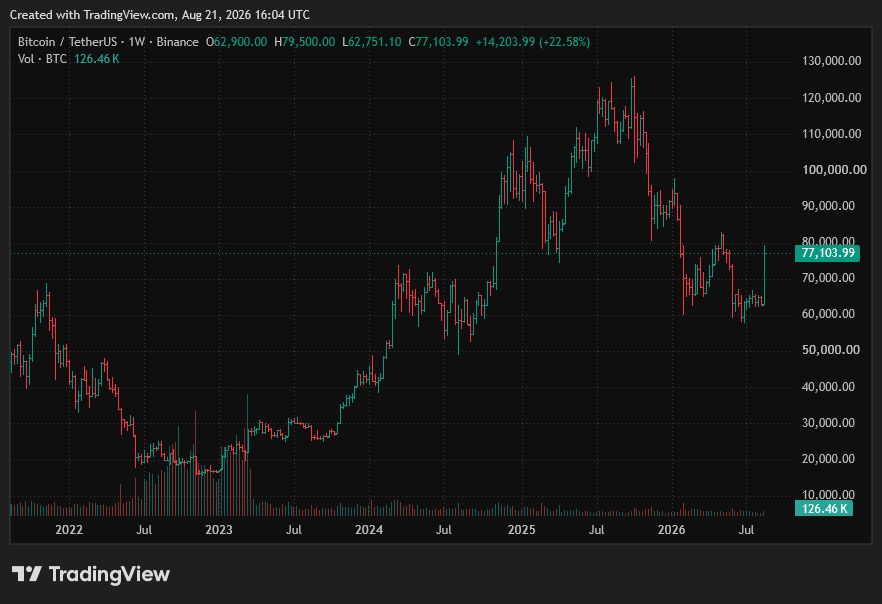
Bitcoin traded near $77,000 on August 21, capping its strongest weekly gain since March 2023. It advanced roughly 24% since Monday. The rally traces back to a short squeeze earlier in the week that forced billions of dollars in bearish bets to close. It has continued through a second wave of liquidations and two consecutive days of large exchange-traded fund inflows. Treasury Secretary Scott Bessent added a fresh signal on top of that.

How a short squeeze started the move

A short position gains when an asset falls in price. Traders can use leverage to increase the size of that bet, and their exchange requires collateral to cover potential losses. When the price rises too far, the collateral no longer supports the position, and the exchange liquidates the trade by closing it automatically. Closing a short requires buying back the asset, so each liquidation can add upward pressure of its own.

Bitcoin spent six weeks trading between roughly $62,000 and $66,900 after July 8. Volatility during that stretch fell to multiyear lows. Traders built up a dense cluster of short positions betting the range would hold. Once Bitcoin broke above the range, a large share of those bets became vulnerable at the same time. Exchanges liquidated the positions automatically, and the resulting wave of forced buying pushed prices higher still.

How the Treasury’s yield relief came and went

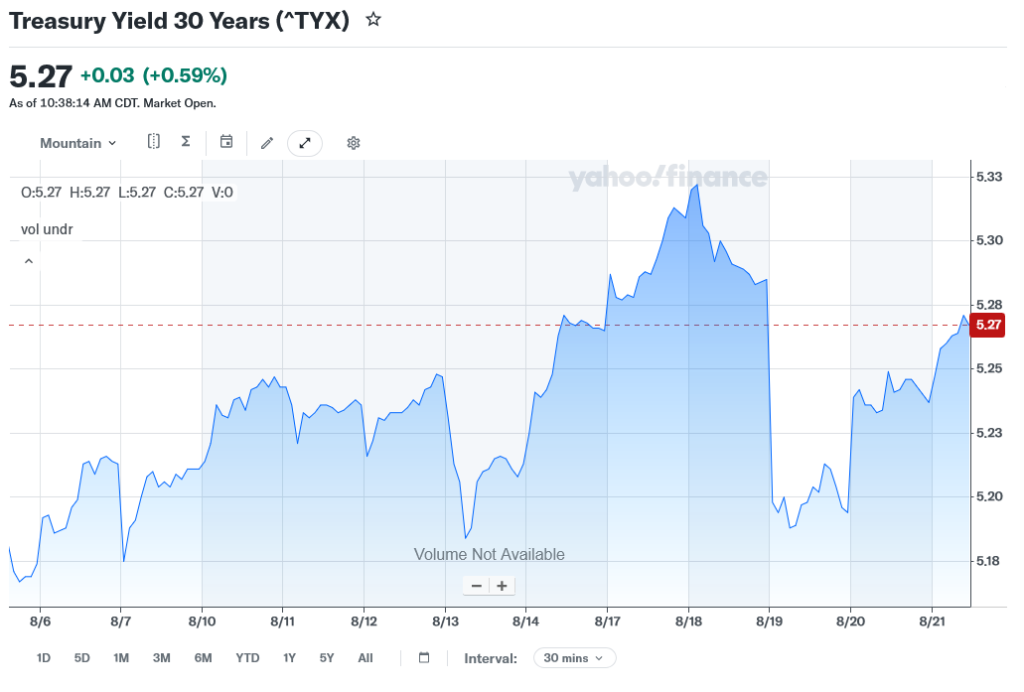
The move began on August 19, when the U.S. Treasury said it would at least double the maximum size of its buyback operations for 10-to-20-year and 20-to-30-year government bonds, from $2 billion to at least $4 billion per operation, running from September 9 through November 4. The announcement pulled the 30-year Treasury yield down from a 19-year high of 5.32% and supported demand for riskier assets, including Bitcoin.

Source: finance.yahoo.com

The relief did not last. The yield rose back above 5.27% the next day, August 20, before Treasury Secretary Scott Bessent eased it slightly with comments on CNBC that afternoon. He said the government expects to conduct these buybacks regularly and could increase their size beyond the $4 billion already announced. “We have a big toolkit,” Bessent said. The comment extended the crypto rally instead of letting it fade once the initial squeeze had run its course.

The yield rose again on August 21, erasing the relief from Bessent’s comments. The long-term borrowing costs remained close to where they stood before the Treasury’s announcement.

Two liquidation waves in 48 hours

The first wave hit on August 19 and 20, when roughly $3 billion in short positions closed within 24 hours, compared with $263.5 million on the long side. Bitcoin positions accounted for about $1.67 billion of that total. Ether contributed another $1.14 billion, with more than $1 billion of shorts closing within a single hour.

A second wave followed as the rally kept extending. Over the 24 hours spanning August 20 and 21, an additional $1.25 billion in positions liquidated, on top of the roughly $3.3 billion recorded the day before. The scale of the follow-through indicates the squeeze was not a single event that burned out shorts and stopped. Leveraged positioning kept getting caught on the wrong side as Bitcoin extended its gains toward $77,000.

Source: TradingView

Is the demand behind the rally real?

Spot demand needs to replace the forced buying once the liquidation cycle slows. Spot Bitcoin ETFs pulled in $517 million on August 19 and $606 million on August 20. Ether funds took in $189 million and $221 million over the same two days. Each figure topped the prior day’s total, marking the largest back-to-back inflows in months.

Open interest tells a less settled story. CoinDesk tracked open interest rising 9.11% to $131.25 billion in the day after the squeeze, with Bitcoin’s share up 7.18% to $23.4 billion, and read the pickup as notional exposure rebuilding quickly. Bloomberg, drawing on the same CoinGlass data, called the rebuild muted and concluded the two-day advance was driven mostly by short covering. It does not see a broad shift into new bullish positions.

What happens if Congress doesn’t pass Clarity?

President Donald Trump renewed his call for Congress to pass the Clarity Act, the crypto market-structure bill that has been the industry’s top legislative priority. Senate Banking Committee Chairman Tim Scott said at the SALT conference that the bill has a reasonable chance of advancing next month. A procedural vote is scheduled for September 15.

The Securities and Exchange Commission is not waiting on Congress. On August 18, the agency proposed a new Regulation Crypto Assets framework that would create tailored registration exemptions for certain crypto-related investment contracts. Under the proposed rules issuers could raise up to $5 million over four years or $75 million annually under lighter disclosure requirements. The proposal moves on its own track regardless of what happens with the Clarity Act.

Congress failing to act at all is also a scenario the Commodity Futures Trading Commission is preparing for. CFTC Chairman Michael Selig said in prepared remarks at the agency’s Innovation Advisory Committee meeting on August 20 that he has directed staff to begin drafting rules for a crypto asset market structure using the agency’s existing authority. Selig said the agency would “utilize its existing authorities to begin establishing a regime” for crypto markets if the Clarity Act continues to stall, giving the market a third regulatory path alongside the SEC’s proposal and the Senate vote.

Whether the rally holds now depends on two dated events. The Senate’s September 15 procedural vote will show whether the Clarity Act has the votes to advance. The Treasury’s expanded buybacks begin September 9, and Bessent’s suggestion that the size could grow beyond $4 billion per operation leaves open how much further that liquidity support might extend.

- Advertisement -

FEATURED