Home Blog Page 107

Polymarket Partners with X to Bring Decentralized Prediction Markets Mainstream — Boosting Polygon in the Process

Billboard in a cityscape at dusk displaying Polymarket and X logos, symbolizing the Polymarket X partnership and its role in mainstreaming blockchain prediction markets.

Polymarket has officially joined forces with Elon Musk’s social media platform X, in what’s being described as a landmark Web3 partnership. X (formerly Twitter) named the blockchain-based prediction market its official prediction partner, bringing decentralized forecasting tools to millions of users globally. This collaboration marks a major step toward mainstream adoption of Web3 services. It also gives a significant boost to the Polygon blockchain, which underpins Polymarket’s infrastructure.

A First-of-Its-Kind Deal

The partnership will allow X users to access Polymarket’s on-chain prediction markets. These markets will be available either through direct integration or via deep-linking mechanisms. Users will be able to view, interact with, and potentially place bets on outcome markets. Topics will range from politics and economics to technology and entertainment.

While specific UI details have not been confirmed, both parties say the collaboration will be rolled out in phases. It will start with event-based market exposure and expand as users engage.

Polymarket, X, and major media outlets confirmed the news. In addition to expanding Polymarket’s social footprint, the deal represents a broader shift. It shows how decentralized prediction markets are moving beyond the typical crypto-native user base.

Mainstreaming Web3 Prediction Markets

This is the first time a major social media platform has officially partnered with a blockchain-based prediction service. The move aligns with X’s broader transformation into a “super app” with embedded financial and crypto-native features.

Integrating prediction markets into the user experience will offer a new way for people to interact with real-world events on X. While boosting platform engagement, it will also introduce decentralized technologies to a wider audience.

More importantly, experts suggest this may normalize blockchain-based forecasting tools. They compare this to how Robinhood helped popularize stock and crypto trading among the masses.

Why Polygon Stands to Benefit

Polymarket runs on the Polygon blockchain. This Layer 2 solution for Ethereum offers fast, low-cost transactions that are ideal for high-volume usage.

As Polymarket’s visibility increases through the X partnership, transaction activity on Polygon should surge. Analysts believe the deal may drive new traffic to the network, especially from users unfamiliar with DeFi platforms.

Polygon has recently positioned itself as the infrastructure of choice for real-world Web3 use cases. This new traffic could reinforce that positioning and accelerate adoption.

Polymarket’s Path to Legitimacy

This high-profile collaboration with X marks a major turnaround for Polymarket. Just a few years ago, it faced regulatory action from the U.S. Commodity Futures Trading Commission (CFTC). The platform paid a $1.4 million fine in 2022 for offering unregistered binary options.

Since then, Polymarket has changed its approach. It now operates under a CFTC no-action letter. This allows it to run markets within specific regulatory limits.

That shift toward compliance likely helped secure the deal with X. Under Musk’s leadership, the platform is careful to manage legal risks and regulatory scrutiny.

Elon Musk’s Bigger Play

Musk has long expressed interest in transforming X into a full-scale financial and engagement platform, and the Polymarket deal fits this vision.

By integrating a blockchain-native tool like Polymarket, X shows its commitment to decentralized technologies. This goes beyond payments and enters the realm of interactive, event-driven content.

Industry-Wide Implications

The Polymarket-X partnership sets a precedent for how decentralized applications can enter mainstream platforms. It opens the door for other Web3 projects to integrate with high-traffic environments and reach general audiences.

Unlike isolated DeFi ecosystems, this model embeds crypto tools where users already spend time: on social media.

More importantly, it may reignite public interest in blockchain-based finance. The line between content, market sentiment, and real-time interaction is getting thinner.

Polymarket’s integration with X is more than a media play. It’s a blueprint for how decentralized platforms can gain mass traction through mainstream distribution.

Polygon is positioned to benefit from the increased traffic, and X is experimenting with new engagement formats. This partnership could well reshape how prediction markets are used and who uses them. If successful, it could be the moment that brings crypto-native utilities into the daily lives of millions.

Readers’ frequently asked questions

What is Polymarket?

Polymarket is a decentralized prediction market platform that allows users to bet on real-world events using blockchain technology. It operates on the Polygon network and is known for offering markets on politics, economics, and current events.

What types of prediction markets does Polymarket offer?

Polymarket covers a wide range of topics, including politics, finance, technology, sports, and global events. Users can bet on outcomes like election results, interest rate decisions, or tech product launches using crypto assets.

Yes. After paying a regulatory fine in 2022, Polymarket now operates under a no-action letter from the U.S. Commodity Futures Trading Commission (CFTC), allowing it to run compliant prediction markets within defined parameters.

What Is In It For You? Action items you might want to consider

Follow the prediction market rollout on X

Keep track of how Polymarket gets integrated into X. Early participation could offer new insights, rewards, or community-driven forecasting opportunities before wider adoption kicks in.

Explore Polygon ecosystem opportunities

As user activity increases due to this partnership, developers and traders should assess how this affects liquidity, token flow, or dApp interoperability across the Polygon chain.

Assess the regulatory signal for other Web3 projects

Polymarket’s compliant partnership with X may encourage other platforms to pursue regulatory clarity. If you’re building or investing in similar tools, this could mark a shift toward safer integrations.


Gemini’s Next Leap: Winklevoss Twins Confidentially File for U.S. IPO

Photo-realistic image showing two suited businessmen resembling the Winklevoss twins walking toward a modern glass office tower in New York City, with reflections of digital financial charts on the building and subtle blockchain symbols etched into the architecture, symbolizing Gemini's IPO and crypto market legitimacy.

Gemini, the cryptocurrency exchange founded by Cameron and Tyler Winklevoss, has filed a confidential S-1 with the US Securities and Exchange Commission (SEC), marking a significant step toward its long-anticipated IPO. The move signals the company’s push to restore its reputation and regain investor confidence after a challenging period.

Gemini’s Path to the IPO

Launched in 2014, Gemini was one of the first crypto exchanges in the U.S. to adopt a compliance-first approach. The Winklevoss twins, already known for their early investment in Bitcoin and their legal battle with Facebook, envisioned a regulated, transparent platform that would appeal to both retail and institutional users.

Over time, Gemini expanded into custody services, launched its own stablecoin (GUSD), and introduced interest-earning products. Although IPO rumors have surfaced in the past, this is the exchange’s first formal step toward a public listing.

Regulatory Setbacks and the Earn Program Fallout

Gemini’s trajectory took a hit with the failure of its Earn program. The product offered users interest on crypto deposits through a partnership with Genesis. When Genesis declared bankruptcy in 2023, Earn users were locked out of their funds.

The situation triggered investigations by the SEC and multiple state regulators. Gemini faced mounting legal challenges and a steep decline in user trust. The fallout from Earn marked one of the most serious reputational crises in the company’s history.

Turning the Page: Strategic Repositioning

In response, Gemini has spent the past year restructuring. The company settled key regulatory disputes and reworked its product offerings. It also expanded internationally, launching an engineering hub in India and pushing into new markets.

These moves are part of a broader effort to reposition Gemini as a trustworthy and resilient crypto platform. The confidential filing signals that the company believes it has stabilized enough to face the scrutiny of public investors.

Confidential Filing: What We Know

A confidential S-1 lets a company begin the IPO process without revealing full financial or operational details. It also allows for private discussions with institutional investors before making public disclosures.

Gemini hasn’t disclosed its intended valuation, share structure, or listing timeline. However, the timing suggests the company aims to take advantage of renewed interest in crypto equities as market conditions improve.

Competitive Landscape

Gemini’s IPO plans follow the successful public debut of Circle Internet Group, the issuer of the USDC stablecoin. Circle’s IPO, which began with a confidential S-1 filing, culminated in a strong market entry, signaling robust investor appetite for crypto-related equities.

Coinbase, another major player in the crypto exchange arena, went public via direct listing in 2021 and has since become a prominent publicly traded crypto exchange. With Circle’s recent IPO, the landscape of publicly listed crypto firms is expanding, offering investors more avenues to participate in the digital asset market.

Compared to its peers, Gemini is smaller and adopts a more conservative growth strategy. While Coinbase emphasizes a broad range of products and high trading volumes, and Circle focuses on stablecoin infrastructure, Gemini positions itself as a compliance-centric platform prioritizing trust, security, and regulatory alignment. This approach may appeal to risk-averse investors seeking exposure to the crypto sector without the complexities associated with more aggressive growth models.

Market and Investor Sentiment

After a long pause in crypto IPO activity, the market appears to be warming up. The broader recovery in tech stocks and growing regulatory clarity have created a more favorable environment for listings.

For institutional investors, Gemini’s move is a signal. It shows that at least some U.S.-based crypto firms believe the public markets are once again open to them. Whether investors share that optimism remains to be seen.

Gemini’s confidential IPO filing represents more than a funding strategy; it’s a statement of intent. After weathering reputational damage and regulatory heat, the company is aiming to re-establish itself as a credible force in the crypto space.

If the listing proceeds, it could mark a new era not just for Gemini, but for other U.S.-regulated crypto firms seeking to rebuild trust and compete in public markets.

Readers’ frequently asked questions

What are the next steps in Gemini’s IPO process after a confidential S-1 filing?

After submitting a confidential S-1, Gemini will engage in SEC correspondence and investor discussions. Once ready, it will file a public version disclosing key details like valuation, offering structure, and financials.

Is there a confirmed date for Gemini’s IPO?

No. Gemini has not disclosed a target listing date, exchange, or valuation. These details will likely emerge once the SEC review process progresses.

Where can investors find updates on Gemini’s IPO progress?

Updates will typically appear in amended SEC filings, official press releases, or financial news coverage. Investors can monitor the SEC’s EDGAR database or Gemini’s media page for announcements.

What Is In It For You? Action items you might want to consider

Track developments around Gemini’s IPO process

Stay informed as the company progresses through the SEC’s review process. Look out for updates on valuation, share allocation, and projected listing timeline.

Evaluate investment sentiment toward U.S.-based crypto exchanges

Gemini’s IPO may serve as a gauge for broader market interest in regulated crypto firms. Analysts, traders, and investors should monitor how institutional capital responds.

Reassess counterparty risk in crypto platforms

The Earn crisis highlights the importance of understanding where platforms deploy customer funds. Investors should perform due diligence on similar yield-generating services offered by other exchanges.

From Resistance to Regulation: How Russia’s Crypto Policy Transformed

Photo-realistic illustration of the Kremlin at dusk with a Bitcoin symbol and legal gavel in the foreground, illustrating Russia’s evolving crypto policy and regulatory shift.

Not long ago, Russia stood firmly against cryptocurrency. The Central Bank of Russia (CBR) saw it as a threat to financial stability. It proposed outlawing mining, trading, and usage altogether. But by 2024, Russia’s crypto policy had undergone a dramatic shift. The government legalized crypto mining and approved digital assets for international trade. What caused this pivot? A mix of geopolitical pressure, economic necessity, and a desire to reduce reliance on Western-controlled financial systems.

2014–2020: Passive Monitoring and Institutional Skepticism

Before the global financial order changed, Russia’s crypto policy was defined by caution. The CBR issued warnings about crypto’s risks and volatility. It emphasized potential use in illicit activities. Crypto lived in a legal gray zone—neither fully legal nor banned. Its use was discouraged, and institutions stayed away.

2021: The Push for Prohibition

In 2021, the CBR called for a complete ban on crypto. It wanted to outlaw mining, trading, and issuance. Officials said crypto threatened monetary policy and consumer safety. The Ministry of Finance disagreed. It supported regulation instead of prohibition. This policy divide slowed government action. But it also proved that crypto had grown too big to ignore.

2022–2023: War, Sanctions, and Strategic Recalibration

In February 2022, Russia invaded Ukraine. This triggered harsh economic sanctions. Banks were cut off from SWIFT. Foreign reserves were frozen. Cross-border payments became difficult. Suddenly, decentralized digital money seemed like a lifeline.

Policymakers began to reassess crypto’s value. Domestic crypto payments stayed illegal. But lawmakers started exploring crypto’s use in foreign trade, especially with countries outside the Western sanctions regime.

2024: A Turning Point in Russia’s Crypto Policy

By 2024, the tone had changed. In August, President Putin signed a law legalizing crypto mining. Registered companies could mine. Individuals could mine without registration if their energy use stayed below limits.

In November, parliament passed a tax law for crypto profits. Mining and sales were exempt from VAT. But income and corporate taxes still applied. These steps marked the start of crypto’s integration into Russia’s economy. Domestic crypto payments, however, remained off-limits.

Strategic Objectives Behind the Policy Shift

Several goals shape Russia’s current crypto policy:

  • Sanctions Evasion: Crypto offers new ways to move money when banks are blocked.
  • De-Dollarization: Russia wants to reduce its reliance on the U.S. dollar.
  • Energy Monetization: Mining puts surplus electricity to use, especially in Siberia.
  • Global Positioning: Russia aims to stay competitive as other countries embrace crypto.

Conclusion

Russia’s crypto journey is not about ideology. It’s about strategy. The country legalized mining, built a tax framework, and enabled crypto use in international trade. Yet crypto use at home remains banned, and the Central Bank still has doubts. This isn’t about being “pro-crypto.” It’s about using a redefined crypto policy to pursue Russia’s national interests in a divided global economy.

Coming Next

In Part 2 of this series, we explore the power struggle within Russia’s financial institutions:
“The Central Bank vs. the Market: Who’s Steering Russia’s Crypto Direction?”

Crypto.com Lawsuit Heats Up Fight Over Who Controls Prediction Markets

Photo-realistic courtroom scene depicting the Crypto.com Nevada lawsuit, with a gavel suspended between a Crypto.com logo and a Nevada Gaming Control emblem, symbolizing the legal clash over prediction markets.

Crypto.com has launched a legal challenge against the Nevada Gaming Control Board, joining a growing list of companies confronting state regulators over bans on sports and event-based contracts. The Crypto.com Nevada lawsuit closely mirrors Kalshi’s earlier legal battle and marks a pivotal escalation in the broader clash between innovation in prediction markets and entrenched gambling oversight.

Crypto.com Nevada Lawsuit: The Latest Flashpoint

On June 5, 2025, Crypto.com filed its lawsuit against the Nevada Gaming Control Board. The filing came just hours before a regulatory ultimatum would have forced the company to halt operations related to event-based contracts. The platform had attempted to offer contracts on the outcomes of sporting events and potentially political and entertainment predictions. Crypto.com argues these markets should fall under federal commodities law, not state gambling rules.

Nevada regulators disagreed. They labeled such products as unlicensed gambling and threatened enforcement. This prompted Crypto.com to seek judicial relief, citing recent federal court rulings and its right to operate under Commodity Futures Trading Commission (CFTC) oversight.

More importantly, the Crypto.com Nevada lawsuit draws heavily on legal precedents set by Kalshi, a federally approved event contracts platform. Kalshi faced similar pushback from regulators in both Nevada and New Jersey. In April 2025, it secured a preliminary injunction from a federal court. The ruling halted Nevada’s attempt to block its markets.

Kalshi maintains that its contracts serve as legitimate hedging tools for real-world risks, akin to financial derivatives. They argue these are not speculative gambling instruments. Kalshi’s legal success has emboldened other platforms, including Crypto.com, to challenge state-level enforcement as inconsistent and unconstitutional.

A Growing Jurisdictional Rift

To make matters worse, the broader U.S. regulatory environment has become increasingly fragmented. States like Maryland, Illinois, Ohio, and Arizona have issued cease-and-desist letters to Kalshi, Crypto.com, and Robinhood over their event market offerings.

At the heart of the issue lies a jurisdictional dispute. Are these contracts commodities under CFTC regulation, or gambling products under state authority? The answer remains unclear. While the CFTC has shown openness to permitting such markets, state regulators remain hostile, especially when sports or political outcomes are involved.

The Crypto.com Nevada lawsuit amplifies this tension. It demands legal clarity on who truly oversees these evolving financial instruments.

Implications for the Prediction Market Industry

The outcome of this legal standoff could determine the future of prediction markets in the United States. States may be forced to back off if federal courts continue to side with companies like Kalshi and Crypto.com. They may also need to redefine how they approach event-based financial products.

A favorable ruling in the Crypto.com Nevada lawsuit could pave the way for wider adoption of prediction markets regulated under federal law. That would allow platforms to bypass state gambling restrictions. On the other hand, if state authorities prevail, it may cement a fragmented regime. Platforms would have to navigate 50 separate interpretations of legality.

As companies continue to test the boundaries of financial innovation, the prediction market sector stands at a legal crossroads.

Readers’ frequently asked questions

Can I trade prediction contracts on Crypto.com now?

No. As of June 6, 2025, Crypto.com is in a legal dispute with Nevada regulators. Until the case is resolved or the court issues further orders, the availability of event-based contracts on the platform remains uncertain.

Does the Commodity Futures Trading Commission (CFTC) regulate prediction markets?

Yes. The CFTC has jurisdiction over certain types of event contracts when they qualify as commodities or derivatives. Kalshi, for example, operates under CFTC approval. However, state regulators may still object depending on how the contracts are categorized.

Kalshi obtained a preliminary injunction from a federal court in April 2025. This halted Nevada’s attempt to block the company from offering event contracts. As a result, Kalshi is currently permitted to operate in Nevada under federal oversight, pending further legal review.

What Is In It For You? Action items you might want to consider

Follow regulatory rulings on prediction markets

Keep an eye on developments in the Crypto.com Nevada lawsuit and similar cases involving Kalshi. These rulings could influence the future legality of event-based trading platforms nationwide.

Reassess market access strategies if operating in the U.S.

If you’re a fintech or crypto company exploring event-based markets, evaluate your exposure to conflicting state and federal regulations. Legal outcomes could shape which states are accessible or off-limits.

Prediction markets are at the center of a regulatory turf war. Traders, developers, and investors should monitor how the courts rule on the CFTC’s authority versus that of state gaming boards.

BitoPro Breaks Silence on $11.5M Hack: Users Reassured, Trust Shaken

Digital illustration of a cryptocurrency exchange cyberattack showing “HACKED” alerts and a $11.5M unauthorized outflow, with Taipei 101 in the background — representing the BitoPro hack.

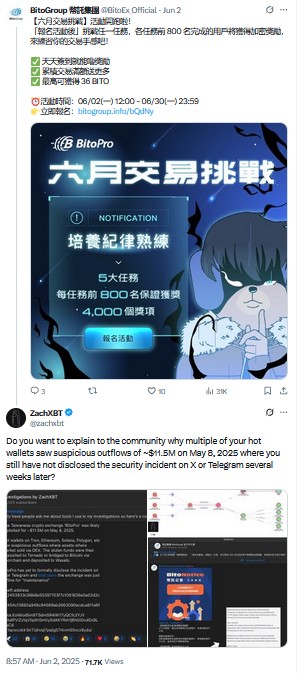
Taiwanese crypto exchange BitoPro has confirmed a security breach that led to unauthorized withdrawals totaling $11.5 million. The BitoPro hack, which took place in early May 2025, remained unacknowledged until early June. The confirmation came only after blockchain investigator ZachXBT raised alarms over suspicious on-chain activity.

BitoPro says it will fully compensate affected users through its internal risk reserve. However, the incident has raised concerns about delayed disclosure, operational transparency, and the overall state of crypto platform security in Asia.

Suspicious Outflows Uncovered by ZachXBT

The incident began unfolding on June 02. That’s when blockchain analyst ZachXBT alerted the public of a series of unusual withdrawals from wallets linked to BitoPro. Someone was moving assets, primarily USDT and other ERC-20 tokens, across multiple addresses. This pattern raised immediate red flags among on-chain investigators.

Despite speculation gaining traction, BitoPro remained silent for more than a week. On June 2, the exchange finally confirmed the breach. It described the event as a “security incident involving unauthorized access.”

What Happened During the Breach

According to BitoPro, the attacker gained access to a portion of its hot wallet infrastructure and exfiltrated several digital assets. However, the exchange emphasized that the breach did not affect its cold wallet storage.

More importantly, the company stated that operational integrity has since been restored. Initial estimates put the loss at $11.5 million. While BitoPro has not shared technical details, it is working with Taiwanese cybercrime investigators and blockchain forensics experts to trace the stolen assets.

BitoPro Assures Users Their Funds Are Safe

To ease concerns, BitoPro reassured the public that users will not bear any losses. The platform said it would cover the damage using its internal crypto exchange risk reserve. This safeguard was established specifically for crisis events.

“All affected users will be fully compensated,” the company said. “We are strengthening our infrastructure to prevent such incidents from recurring.”

At the time of writing, trading and withdrawals remain operational. BitoPro also confirmed that no user account data was compromised.

Delayed Disclosure Raises Red Flags

Even so, the delayed disclosure has drawn significant criticism. While the user fund protection is welcome, many users and analysts view the silence as deeply troubling.

In the crypto space, where trust is fragile and information spreads fast, waiting nearly two weeks to disclose a breach is seen as unacceptable. Critics accused BitoPro of attempting to withhold the information until it was exposed by ZachXBT.

As a result, the incident has reignited broader concerns about transparency standards on centralized platforms. These issues are particularly relevant in developing crypto markets like Taiwan.

Regulatory and Market Implications for Taiwan

Looking forward, this case may prompt changes in crypto regulation in Taiwan. Currently, disclosure rules for exchange hacks are vague. Industry observers expect regulators to introduce stricter incident reporting guidelines. These could include mandatory timeframes and more frequent security audits.

For traders and investors, the BitoPro hack raises important questions about crypto exchange safety. Are these platforms truly prepared for security threats? And can they maintain user trust under pressure?

The BitoPro hack is a clear reminder that even established exchanges are not immune to cyberattacks. While user funds appear secure, the reputational damage from the delayed response may prove harder to repair.

As investigations continue and regulatory scrutiny increases, BitoPro’s next steps will be critical. The outcome will likely shape both its future and public confidence in Taiwan’s broader crypto ecosystem.

Readers’ frequently asked questions

How do I know if my BitoPro account was affected by the hack?

BitoPro has not released a list of affected accounts. The platform states it will notify impacted users directly, who can then apply for compensation from its internal reserve.

Does BitoPro offer a transaction history tool I can check for unusual activity?

Yes. Users can access their complete transaction logs through the account dashboard. If you see unauthorized withdrawals, contact BitoPro’s support immediately.

Where can I get official updates from BitoPro about the hack?

BitoPro posts updates on its official website and verified social media accounts. Users are advised to avoid third-party channels to prevent phishing attempts.

What Is In It For You? Action items you might want to consider

Review your exposure to centralized exchanges

If you store funds on centralized platforms like BitoPro, consider moving high-value holdings to cold wallets or diversifying your custody strategy.

Monitor incident response standards in your region

The BitoPro hack may highlight weaknesses in disclosure policies. Stay informed about how your local authorities expect crypto platforms to handle breaches.

Track on-chain alerts and independent security researchers

Security analysts like ZachXBT often uncover breaches before official disclosures. Following these sources can help you respond faster to emerging threats.

- Advertisement -

FEATURED