Home Blog Page 114

Bitcoin Dominance: What It Is, Why It Matters, and How to Use It

Bitcoin Dominance explained

Imagine the entire cryptocurrency market as a big pie. Bitcoin dominance is essentially the size of Bitcoin’s slice of that pie, compared to all other cryptocurrencies. If you’re new to crypto, terms like “Bitcoin dominance” might sound technical. But the idea is simple: it measures how much of the total crypto market value is made up by Bitcoin. Let’s explore what it is, why it’s important in the crypto market, and how investors can use it to inform their strategies. All in friendly, easy-to-understand language.

What is Bitcoin Dominance?

Bitcoin dominance is basically Bitcoin’s market share in the crypto market. In more technical terms, it’s the ratio of Bitcoin’s market capitalization to the total market capitalization of all cryptocurrencies. (A coin’s market capitalization is its price multiplied by the number of coins in circulation, essentially the total value of that coin.) So when people talk about Bitcoin dominance, they usually express it as a percentage. For example, if all cryptocurrencies combined are worth $1 trillion and Bitcoin accounts for $500 billion, then BTC’s dominance would be 50%.

In plain English, Bitcoin dominance tells us what portion of the crypto market’s value belongs to Bitcoin. In its early days, the dominance was close to 100%. Bitcoin was the crypto market, since hardly any other coins existed. Today, with thousands of altcoins (alternative cryptocurrencies) existing, Bitcoin’s dominance isn’t anywhere near 100%. It fluctuates as the crypto market evolves. Over the past five years, it has typically ranged roughly between 40% and 70%. It can go higher or lower, though, during extreme market events. The key point is that dominance changes over time, depending on how the value of Bitcoin is growing compared to the rest of the crypto market.

Why Does It Matter?

You might wonder why this percentage is such a big deal. Bitcoin dominance matters because it offers insight into market sentiment and the balance of money between Bitcoin and the rest of crypto. Traders and investors watch this metric as a “health check” for the market. It serves as a critical indicator to gauge whether investors favor the relative safety of Bitcoin or chase opportunities in altcoins. In other words, changes in Bitcoin dominance can hint at what phase of the market cycle we’re in and how people feel about risk.

When Bitcoin’s dominance is rising, it means Bitcoin is capturing a larger share of the overall market value. This could happen for a couple of reasons. One common scenario is that Bitcoin’s price is climbing faster than other coins, drawing more investment into Bitcoin itself. Another scenario is during market downturns, when Bitcoin’s price might decline less sharply than riskier altcoins. In that case, Bitcoin’s share of the pie grows simply because the rest of the pie is shrinking faster. A high or growing dominance often suggests investors are playing it safe with the crypto market’s most established asset (Bitcoin). Or, that Bitcoin is in the middle of a strong rally, pulling ahead of the pack.

On the other hand, when Bitcoin’s dominance falls, the rest of the cryptocurrencies (the altcoins) gain value relative to Bitcoin. This often indicates investors are feeling bold, putting money into smaller coins, searching for bigger gains. A significant drop in Bitcoin dominance is usually a sign of an “altcoin season”, which is a period when many altcoins are shooting up in price faster than Bitcoin.

Bitcoin Dominance and Altcoins

To understand Bitcoin dominance, we have to talk about altcoins, the term for any cryptocurrency that isn’t Bitcoin. Today’s crypto market consists of Bitcoin plus a huge array of altcoins – from well-known ones like Ethereum, Binance Coin, and Cardano to countless smaller projects. Bitcoin dominance essentially compares Bitcoin to all these others combined. So whenever the altcoin side of the market gets hotter, Bitcoin’s dominance will go down, and vice versa.

Think back to our pie analogy. If Bitcoin’s slice gets smaller, someone else’s piece (all the altcoins together) gets bigger. One of the biggest challengers in that pie is Ethereum, the second-largest cryptocurrency. Ethereum has grown so much in value and popularity that it now often makes up a significant chunk of the market. In fact, during the bull run of 2021, Ethereum’s rise (fueled by things like DeFi and NFTs) pushed its market share to around 16% by that year’s peak. Naturally, this contributed to a drop in Bitcoin’s dominance at the time, since Ethereum (and other rising altcoins) were claiming a larger portion of the total crypto market.

Bitcoin Dominance Through the Years

Bitcoin’s dominance isn’t just a percentage on a screen — it tells a story. Looking back at how it has changed over time, we can trace the ebb and flow of market sentiment, innovation, hype, and investor caution.

A historical Bitcoin dominance chart shows clear patterns. Bitcoin’s market share was close to 100% when there were few other cryptocurrencies. As altcoins emerged, dominance dropped, especially during major market shifts. For example, dominance declined sharply during the 2017 ICO boom. It rebounded in bear markets and fluctuated during key turning points such as the early 2018 crash and the 2022 market turmoil.
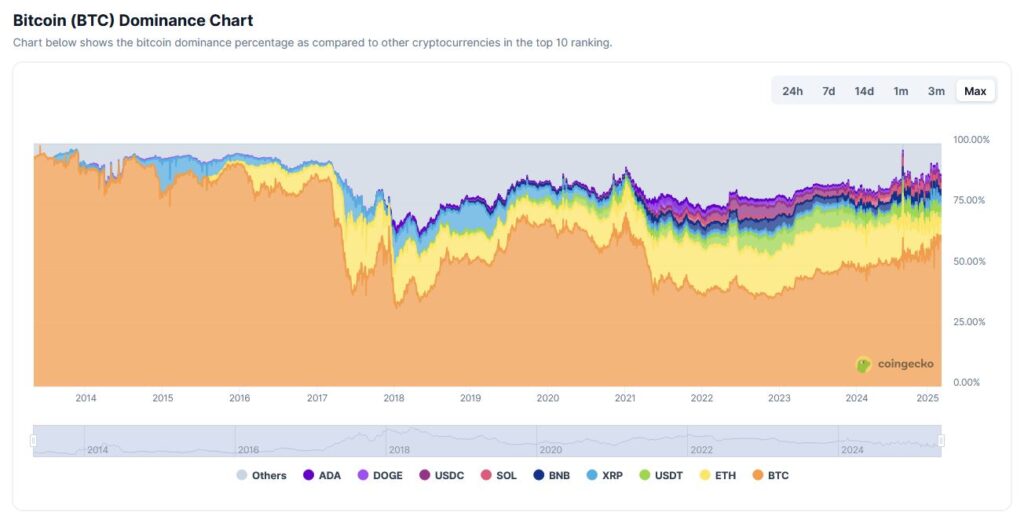
Source: Coingecko

These cycles illustrate several notable shifts in dominance:

  • 2017: A wave of new altcoins, launched through initial coin offerings (ICOs), caused Bitcoin’s dominance to fall from about 86% to around 38% in a matter of months.
  • 2018: When the ICO bubble burst, many altcoins lost value or collapsed entirely. Investors moved capital back into Bitcoin, driving its dominance up to roughly 70% by mid-2019.
  • 2020–2021: Bitcoin rallied from around $8,000 to over $60,000. Meanwhile, altcoins surged on narratives like decentralized finance (DeFi), non-fungible tokens (NFTs), and meme coins. Bitcoin’s dominance hovered around 60% but declined again as other tokens outperformed.
  • 2022: Industry-wide shocks—including the collapse of the Terra/UST stablecoin ecosystem and the FTX exchange—led to renewed caution. Investors rotated funds out of altcoins and back into Bitcoin, driving dominance higher once more.

2023–2024 was a quieter period by comparison. The market consolidated, with fewer speculative bubbles or collapses. Bitcoin’s dominance remained relatively steady, fluctuating between 40% and 50% depending on moderate altcoin cycles and investor sentiment.

By early 2025, Bitcoin dominance climbed to over 64%, its highest level in several years. This surge was driven by renewed interest in Bitcoin following the latest halving, increased institutional participation, and macroeconomic uncertainty. However, as of May 2025, the trend has shown early signs of reversing. Altcoins such as Ethereum, Solana, Cardano, and Dogecoin have recently outperformed Bitcoin, suggesting a possible rotation into higher-risk assets and the beginning of a new altcoin season.

In summary, Bitcoin dominance increases when Bitcoin is seen as the most attractive or safest investment in crypto. It decreases when investors chase growth across the broader altcoin landscape. It remains one of the most widely watched metrics to gauge where money is flowing in the digital asset market.

Note: Bitcoin dominance also accounts for stablecoins like USDT and USDC in the “altcoin” category. When traders move capital into stablecoins, those funds count against Bitcoin’s market share, even though they are not being redirected into other speculative assets. This effect can cause Bitcoin dominance to decline even in periods of broad market caution.

Using BTC Dominance to Inform Your Strategy

Knowing about Bitcoin dominance is useful, but how do people actually use this knowledge? For investors and crypto enthusiasts, Bitcoin dominance can be a guidepost for making portfolio decisions or reading the market’s mood. It’s not a crystal ball, but it can hint at whether it might be a good time to focus on Bitcoin or explore altcoins.

Context is important: Bitcoin dominance is most insightful when considered alongside Bitcoin’s price movements. By looking at both, you get a clearer picture of what’s going on. Let’s break down a few common scenarios:
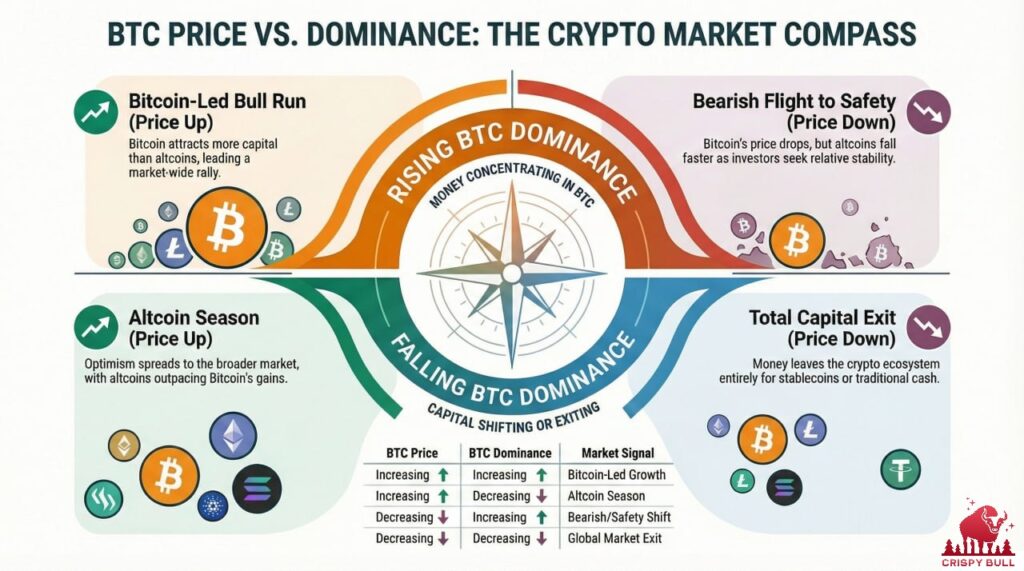
  • BTC Price Up + Dominance Up: Bitcoin is gaining value and outpacing the rest of the market. This often means Bitcoin is leading a rally. In this scenario, Bitcoin is attracting proportionally more money than altcoins. It’s a sign of a Bitcoin-led bull run, where confidence (and capital) is concentrated in BTC. An investor seeing this trend might lean more into Bitcoin, since it’s currently the market leader in growth.
  • BTC Price Down + Dominance Up: Bitcoin’s price is dropping, but altcoins are dropping even faster. Bitcoin’s market share grows because it’s falling less (or recovering faster) than the rest. This pattern suggests a bearish market overall  – investors are pulling back from smaller coins first (a flight to safety). People might be selling altcoins to hold Bitcoin (or even cash) because they view Bitcoin as the safer asset in a crypto downturn. Traders might become cautious about holding too many risky altcoins during this period.
  • BTC Price Up + Dominance Down: Bitcoin’s price is rising, but the rest of the crypto market is rising even more. This is a classic altcoin season signal. It means optimism (and money) is flooding into many crypto projects, not just Bitcoin. You might see Ethereum, for example, outpacing Bitcoin’s gains along with a bunch of other coins rallying. In this scenario, an investor might diversify into strong altcoins to ride the broader wave, since the market’s appetite for risk is high.
  • BTC Price Down + Dominance Down: Bitcoin is losing value, and at the same time, its market share is shrinking. This one is less common, and it usually means money is exiting crypto in general. If Bitcoin and most altcoins are falling (with altcoins perhaps not falling quite as much percentage-wise), investors could be moving funds into something like stablecoins or out of crypto entirely. It’s basically a sign of extreme caution – people aren’t even using Bitcoin as a safe haven; they’re cashing out. In such times, investors might reduce exposure across the board and wait for the storm to pass.

Using Bitcoin dominance as part of your strategy comes down to understanding these trends. For example, if you believe an altcoin season is starting (dominance falling while BTC’s price is holding up or rising), you might increase exposure to select altcoins. If you see dominance rising during a market rally, you might stick with Bitcoin since it’s the frontrunner at that moment.

However, always remember that Bitcoin dominance is just one tool. It’s best used alongside other indicators and a broader analysis of market conditions. Think of Bitcoin dominance as a wide-angle lens for viewing the crypto market. It gives a big-picture overview of where value is flowing. Nevertheless, you’ll still want to zoom in on specific coins and news before making major investment moves.

Conclusion

Bitcoin dominance might sound like jargon at first, but it’s really a straightforward concept. It shows how much of the crypto universe is Bitcoin. This single percentage figure can tell a story about market dynamics. Is Bitcoin taking center stage or sharing the spotlight with a crowd of altcoins? For newcomers to crypto, understanding Bitcoin dominance provides a great foundation for grasping the bigger picture of how the crypto market ebbs and flows.

Even beginners can get a feel for the market’s overall mood by keeping an eye on Bitcoin’s market share. Is Bitcoin pulling ahead of the pack (hinting that investors are cautious or that Bitcoin is driving the rally)? Or are the smaller coins collectively gaining ground (hinting that the market is in a risk-taking, altcoin-friendly phase)? Bitcoin dominance offers a handy lens to view these shifts. In the crypto landscape, knowledge is power. Bitcoin dominance is one piece of the puzzle that can help you make sense of the ups and downs. Armed with this understanding, you’ll be better equipped to navigate the crypto market’s changes. Whether you’re a casual observer or building a crypto portfolio, knowing about Bitcoin dominance will help you see the forest for the trees in the crypto world.

Coinbase and Riot Games Forge Global Esports Alliance – No NFTs, Just Blockchain Education

Coinbase joins Riot Games as exclusive blockchain partner, focusing on education, not NFTs, in a cautious return to esports.

Coinbase is entering the global esports arena through a multi-year partnership with Riot Games. It will become the exclusive cryptocurrency exchange and blockchain partner for League of Legends and VALORANT tournaments. The collaboration steers clear of in-game NFTs or tokens. Instead, it focuses on educational initiatives, economic-themed broadcast segments, and a long-term strategy to introduce blockchain to millions of competitive gaming fans.

The partnership, announced in early May 2025, positions Coinbase as the official blockchain partner for Riot Games’ premier global esports competitions. That includes League of Legends’ Mid-Season Invitational (MSI) and World Championship, as well as VALORANT’s Champions Tour (VCT) events. It is a strategic move that aligns Riot’s vast gaming audience with Coinbase’s ambitions to promote digital asset literacy, without direct financial exposure or speculative tools like NFTs.

A Shift from Speculation to Education

Unlike previous crypto-esports partnerships emphasizing in-game tokenization or exclusive digital collectibles, Coinbase and Riot take a restrained and educational-first approach. Fans tuning in to Riot’s flagship esports broadcasts will notice co-branded segments such as the “Econ Report” in VALORANT and the “Gold Graph” in League of Legends. These features break down team economies and in-game resource dynamics, now with sponsorship from Coinbase.

The partnership also includes digital content and experiences intended to educate viewers on blockchain fundamentals, crypto safety, and the evolving role of Web3 technologies. Riot Games made clear that it will not include blockchain assets, NFTs, or wallet integrations within the games. That is a notable departure from prior attempts by other publishers to weave digital collectibles into gameplay.

Learning from the FTX Fallout

This is not Riot’s first foray into the world of crypto. In 2021, Riot had signed a sponsorship deal with now-defunct exchange FTX, which was abruptly terminated in 2022 following the exchange’s collapse and ensuing legal turmoil. The current Coinbase deal signals a more cautious and reputationally aligned approach, reinforcing Riot Games’ strategic esports focus on fan experience, brand integrity, and trust.

The collaboration comes at a time when crypto companies are seeking new footholds in mainstream culture, following a turbulent market cycle and heightened regulatory scrutiny. Coinbase has increasingly positioned itself as a bridge between the digital asset space and real-world utility. For the exchange, the Riot partnership offers access to a global, digitally native audience already familiar with virtual economies, even if not yet with blockchains.

A Strategic Reentry Point for Blockchain

Riot Games emphasized in its own statement that the Coinbase partnership is not an endorsement of crypto trading or investment. They view it as a means of creating more engaging esports content while supporting broader education around emerging technologies. This aligns with a larger industry trend. Blockchain integrations are increasingly introduced through trusted ecosystems and non-financial touchpoints, such as loyalty programs, identity layers, or analytics.

NFT speculation and crypto pay-to-win mechanics have sparked backlash in other gaming communities. The Coinbase-Riot alliance deliberately avoids these pitfalls. Instead, it aims to build blockchain credibility from the ground up, with transparency and co-branded storytelling. There is no pressure on fans to engage financially.

As the partnership unfolds over multiple years, its success will not be measured by short-term crypto adoption metrics. It will have to prove its ability to rebuild public trust in blockchain applications through esports engagement. Coinbase’s presence in Riot Games’ broadcast ecosystem may ultimately serve as a case study for how the crypto industry can responsibly expand its footprint in pop culture. Not with hype, but with humility.

For the millions of global viewers tuning in to LoL Worlds or VCT Champions, blockchain may now become a familiar backdrop, not a front-line disruption.

Readers’ frequently asked questions

Can I buy crypto through League of Legends or VALORANT now?

No, you can’t buy or use crypto inside League of Legends or VALORANT. The games don’t include any crypto features, tokens, or wallets. The partnership is only for educational content and sponsored broadcast segments.

Do I need a crypto wallet to get any rewards from this partnership?

No wallet is required. Coinbase and Riot will offer content like game economy breakdowns and educational videos, not crypto giveaways or blockchain-based items. There are no crypto rewards or in-game blockchain assets.

Is this the same kind of deal Riot had with FTX before?

No, it’s different. The old FTX deal focused more on branding, and it ended after FTX collapsed. This new partnership with Coinbase is focused on education and viewer experience, with no financial or speculative elements involved.

What Is In It For You? Action Items You Might Want to Consider

Watch how mainstream brands reintroduce blockchain

Keep an eye on Coinbase’s strategy here. It signals that crypto companies are moving away from hype-driven integrations and focusing on user education. Traders should factor this shift into long-term sentiment analysis, especially when evaluating public trust and adoption cycles.

Track Coinbase’s performance in cultural partnerships

This deal positions Coinbase in front of a massive, digitally native audience. Monitor Coinbase’s user growth and engagement metrics over the next two quarters. A successful campaign could influence its brand strength and token inflows.

Reassess NFT market timelines in gaming

Riot’s decision to exclude NFTs, even with Coinbase as a blockchain partner onboard, should prompt traders to temper short-term expectations around NFT adoption in AAA games. Instead, focus on infrastructure plays or education-driven platforms likely to see earlier adoption curves.

US Congress Approves BITCOIN Act, While GENIUS Act Falters in Senate Gridlock

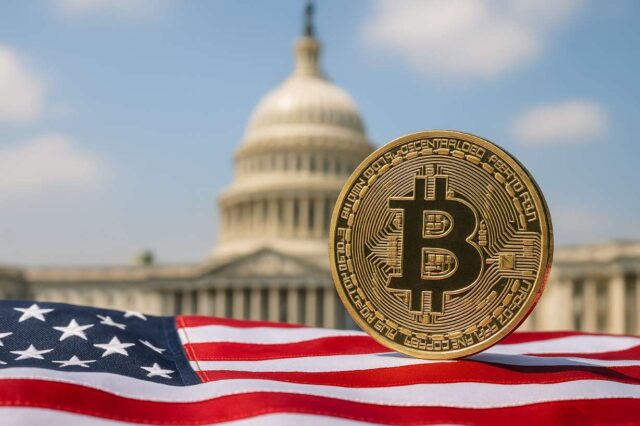
BITCOIN Act passed both houses of US Congress, instructing the Treasury to establish a Bitcoin reserve.

The United States is one step closer to establishing a strategic national Bitcoin reserve. In a historic move, the House and Senate have passed the BITCOIN Act. It marks a watershed moment in the government’s formal embrace of digital assets. Meanwhile, the bipartisan GENIUS Act, designed to regulate stablecoins, has hit a wall. Political tensions over Donald Trump’s crypto dealings derail the Senate’s progress on what was once a consensus-driven initiative.

BITCOIN Act Clears Both Chambers

The BITCOIN Act (S.954 / H.R.2032), introduced in March 2025, calls for creating a national Bitcoin reserve managed by the U.S. Treasury. The legislation aims to integrate Bitcoin into the country’s broader financial strategy, treating it as a hedge against inflation and a digital alternative to gold.

Passed with bipartisan support, proponents hailed the Act as a long-overdue step toward modernizing U.S. monetary policy in a rapidly evolving global financial landscape. The bill also mandates periodic disclosures of reserve holdings and outlines guidelines for purchasing and safeguarding the Bitcoin stockpile.

Overview of the BITCOIN Act of 2025

The BITCOIN Act of 2025, formally titled the “Boosting Innovation, Technology, and Competitiveness through Optimized Investment Nationwide Act,” was introduced by Senator Cynthia Lummis (R-WY) and Representative Nick Begich (R-AK) to establish a Strategic Bitcoin Reserve for the United States. This initiative aims to integrate Bitcoin into the nation’s financial strategy, treating it as a strategic asset akin to gold.

Key Provisions

Establishment of a Strategic Bitcoin Reserve
The Act mandates the creation of a Strategic Bitcoin Reserve managed by the U.S. Department of the Treasury. This reserve’s purpose is to serve as a store of value and a hedge against inflation, enhancing national financial resilience.

Acquisition Strategy
The Act directs the Treasury to acquire 200,000 bitcoins annually over five years, aiming for a total of 1 million bitcoins. Acquisitions must be conducted through budget-neutral means, such as utilizing forfeited assets or surplus funds. It may not inflict additional burden on taxpayers.

Minimum Holding Period
The acquired bitcoins are subject to a minimum holding period of 20 years, during which they cannot be sold or transferred. This provision underscores the long-term strategic intent of the reserve.

Transparency and Oversight
To ensure accountability, the Act requires:

  • Quarterly public reports detailing the reserve’s holdings and activities.
  • Implementation of a Proof of Reserve system with independent audits to verify the existence and security of the assets.

Protection of Individual Rights
A significant provision affirms the right of private individuals and businesses to own, hold, and transact in Bitcoin freely. The federal government is explicitly prohibited from interfering with self-custody rights, reinforcing principles of financial sovereignty.

GENIUS Act Hits a Wall

In stark contrast, the GENIUS Act, which sought to establish regulatory clarity for stablecoin issuance and ensure compliance with anti-money laundering standards, failed to secure the 60 votes required to move forward in the Senate. Despite initial bipartisan enthusiasm, the bill was pulled into partisan controversy after revelations that former President Trump and his associates had deep financial interests in a privately issued stablecoin, reportedly worth billions.

The controversy prompted leading Senate Democrats, including Elizabeth Warren, Mark Kelly, and Jeff Merkley, to introduce the “End Crypto Corruption Act.” The Act seeks to ban elected officials and their families from promoting or profiting from digital asset ventures while in office. The resulting fallout fractured negotiations around the GENIUS Act, delaying stablecoin regulation and potentially jeopardizing industry confidence.

Diverging Paths for Crypto Policy

The divergent outcomes of these two legislative efforts reflect the broader struggle within Washington to craft coherent crypto policy. While Bitcoin’s status as a decentralized and politically neutral asset helped the BITCOIN Act gain traction, stablecoins, often involving corporate issuers and governance models, remain mired in regulatory ambiguity and political baggage.

Industry stakeholders had hoped that 2025 would be the year of regulatory clarity. Now, with one major bill passed and another stalled, the outlook remains murky. As the U.S. moves forward with a national Bitcoin strategy, questions remain about the future of dollar-pegged digital assets that drive much of the crypto economy.

With the BITCOIN Act awaiting presidential signature, attention turns to implementation and potential market impact. Meanwhile, lawmakers behind the GENIUS Act have signaled their intent to revise and reintroduce the bill in the coming months. It remains unclear whether bipartisan alignment can be restored amid rising political tensions.

For now, Bitcoin has gained formal recognition in the halls of Congress. Stablecoins, however, will have to wait their turn.

Readers’ frequently asked questions

Can regular people still buy and hold Bitcoin if the U.S. government is creating a national reserve?

Yes, the creation of a U.S. Bitcoin reserve does not restrict individual ownership in any way. The government acquiring Bitcoin for strategic purposes doesn’t impact your right to buy, hold, or sell Bitcoin through exchanges or wallets. In fact, the BITCOIN Act specifically protects your right to self-custody and use Bitcoin freely within the United States.

Why does the GENIUS Act need 60 votes in the Senate? Isn’t a simple majority enough to pass a bill?

In the U.S. Senate, most legislation requires 60 votes to overcome a filibuster and proceed to a final vote, a process called “cloture.” Even if a bill has majority support, it can be blocked unless 60 senators agree to move it forward. That’s what happened with the GENIUS Act: despite bipartisan talks, it failed to get the 60 votes needed to advance.

Does the BITCOIN Act mean the U.S. will start using Bitcoin for payments or as official currency?

No, the BITCOIN Act does not make Bitcoin legal tender or an official form of payment for taxes or government transactions. The reserve is being created as a store of value, similar to how gold is held. It is not a replacement for the U.S. dollar. The government sees it more as a long-term financial asset than a means of everyday payment.

What Is In It For You? Action Items You Might Want to Consider

Monitor market reactions to the BITCOIN Act’s implementation timeline

With the U.S. poised to begin acquiring Bitcoin for a national reserve, traders should watch for Treasury signals or market activity hinting at purchasing schedules. Accumulation at scale could tighten supply and trigger bullish momentum—getting ahead of that narrative might offer a strategic entry.

Reassess stablecoin exposure in light of regulatory uncertainty

The failure of the GENIUS Act means regulatory clarity for stablecoins remains out of reach for now. Traders should consider diversifying away from stablecoins that may face scrutiny and monitor which issuers remain compliant across jurisdictions. Favor platforms and tokens with transparent audits and strong legal positioning.

Stay alert to political risk as a volatility driver

Partisan divides are clearly influencing crypto policy, and revelations involving high-profile figures like Trump have already disrupted legislation. Traders should factor in U.S. political news as a short-term volatility signal, especially during legislative sessions or campaign periods when crypto becomes a talking point.

Bhutan Sets Global Precedent with World’s First National Crypto Tourism Payment System

Visit Punakha, the ancient capital of Bhutan. The country launched it's tourism crypto payment system for convenient travel in Bhutan.

In a historic leap for blockchain integration at the national level, Bhutan has partnered with Binance Pay and DK Bank to launch the world’s first country-wide crypto tourism payment system. This groundbreaking initiative enables visitors to pay for everything from flights and accommodations to visa fees and souvenirs using over 100 cryptocurrencies. More than just a novel payment option, the system reflects Bhutan’s strategic embrace of digital assets. Crypto is vital in its broader economic modernization and financial inclusion agenda.

A National-Level First in Crypto Payments

Bhutan’s crypto payment initiative marks the first time a sovereign nation has implemented a centralized crypto payment system exclusively for the tourism sector. Binance Pay and DK Bank, Bhutan’s digital-first financial institution, developed this contactless crypto payment platform and fully integrated it into the country’s tourism infrastructure.

Tourists can now use cryptocurrencies, including Bitcoin (BTC), Binance Coin (BNB), Tether (USDT), and USD Coin (USDC) for a wide range of services; airline tickets, hotel stays, visa fees, entry to cultural sights, and even retail shopping, via QR code-based transactions. Payments are instantly converted into local currency through DK Bank’s infrastructure. It shields local businesses from crypto volatility while helping them to access a new global customer base.

A Vision Aligned with Digital Sovereignty

The project aligns with Bhutan’s broader digital policy goals. It promotes financial inclusion, technological self-sufficiency, and national happiness, a unique socio-economic policy metric that guides the country’s development. By adopting crypto payments nationally, Bhutan aims to eliminate high transaction fees, reduce dependency on foreign currency exchanges, and empower micro-entrepreneurs and rural artisans who may lack access to traditional banking services.

Binance Pay integrates seamlessly and is scalable, offering a zero-fee, real-time, cross-border transaction solution. Tourists simply scan a QR code with their crypto wallet, while merchants receive local currency credited to their DK Bank accounts.

Bhutan’s Evolving Crypto Ecosystem

This initiative is not Bhutan’s first foray into digital assets. In recent years, the country has quietly developed a state-run Bitcoin mining operation powered by its abundant hydropower resources. It also explored the establishment of a sovereign crypto reserve. Bhutan’s forward-looking crypto strategy stands in stark contrast to the restrictive stances taken by some of its regional neighbors.

Unlike most other national experiments with CBDCs or private-sector pilots, Bhutan’s model presents a public-private hybrid. It leverages decentralized assets within a regulated, government-approved framework. The tourism-focused deployment may serve as a testing ground for wider national adoption of blockchain-based payment systems.

Setting a Precedent for National Crypto Infrastructure

Bhutan’s system could serve as a blueprint for other nations seeking to integrate crypto into public-facing sectors without compromising regulatory oversight. By choosing tourism, a high-contact, transaction-heavy, and foreign currency-dependent industry, Bhutan has revealed a pragmatic, low-risk use case for digital assets.

The move sends a strong signal: cryptocurrency can function as a bridge between digital innovation and real-world utility, especially when enacted with clear public policy goals and institutional collaboration.

Readers’ frequently asked questions

How do tourists actually pay with crypto in Bhutan? Do they need a specific app or wallet?

Tourists can use any cryptocurrency wallet that supports Binance Pay. This includes the Binance app itself, which allows users to hold and pay with a variety of digital assets. To make a payment, a tourist simply scans a QR code presented by the vendor using the Binance Pay feature, selects the cryptocurrency they want to use, and confirms the transaction. The amount is converted in real time into Bhutanese ngultrum and settled via DK Bank. Merchants never need to handle crypto directly or worry about exchange rate fluctuations. You don’t need a special Bhutan-only app. The system will accept payments with global wallets supporting Binance Pay.

What happens if the value of the cryptocurrency changes while I’m traveling in Bhutan? Will I lose money on the exchange?

The system is designed to minimize the impact of crypto price volatility on both tourists and merchants. When a tourist initiates a payment, the crypto amount is instantly converted into the local currency (the Bhutanese ngultrum) at the current market rate. This real-time conversion locks in the price at the moment of the transaction. Tourists will only experience value fluctuation if they hold volatile cryptocurrencies like Bitcoin in their wallet between payments. So, it’s best to keep that in mind if you plan to spend over several days. Stablecoins like USDC or USDT may offer more predictable value if that’s a concern.

Yes, the system is safe and operates under Bhutan’s national regulatory framework. Unlike peer-to-peer crypto payments in many countries that exist in legal grey zones, Bhutan’s crypto tourism system is officially sanctioned by the government. It works through a partnership with Binance Pay and DK Bank, ensuring compliance with anti-money laundering (AML) and know-your-customer (KYC) standards. For travelers, this means you’re using a regulated, government-backed payment infrastructure. There’s no legal risk involved in using it while visiting Bhutan, assuming you comply with your own country’s standard travel and financial disclosure requirements.

What Is In It For You? Action Items You Might Want to Consider

Monitor the adoption of Binance Pay in emerging markets

Bhutan’s move could signal a broader trend of sovereign crypto payment integrations, especially in sectors like tourism. If more nations follow suit, Binance Pay could see significant growth. Traders might consider keeping an eye on BNB and related infrastructure tokens that benefit from increased transactional utility.

Consider allocating a portion of your portfolio to stablecoins when traveling

Bhutan accepting USDT and USDC for real-time payments reinforces the real-world utility of stablecoins. For traders who travel, holding some of your funds in stablecoins can offer both liquidity and usability in crypto-forward destinations, while sidestepping price volatility.

Reevaluate long-term plays based on sovereign crypto strategies

Bhutan’s crypto integration isn’t a one-off stunt, it aligns with their previous investments in Bitcoin mining and digital reserves. Traders may want to reassess long-term holdings in projects that align with government-level adoption or serve institutional-grade infrastructure. These narratives are gaining traction in quieter corners of the world.

Crypto-Fueled Scam Empire: How Burma’s Militias Built a Global Cybercrime Hub

US sanctions Burma militia group over cyber scams.

A sprawling cyber scam industry, backed by militia power and fueled by cryptocurrency, has taken root in Burma’s lawless borderlands. The U.S. Treasury’s recent sanctions against the Karen National Army (KNA) and its warlord leader Colonel Saw Chit Thu reveal a sophisticated network exploiting blockchain infrastructure to conduct “pig butchering” scams that have siphoned billions from unsuspecting victims worldwide. This dark underworld of digital fraud exposes how cryptocurrencies, once heralded for decentralization and freedom, have become key tools in transnational organized crime.

Pig Butchering Scams and the Role of Crypto

At the heart of the KNA’s illicit operations are “pig butchering” scams. These highly organized schemes groom victims over time via messaging platforms and dupe them into investing in fraudulent crypto platforms. Once they built trust, they encourage targets to deposit increasing amounts of cryptocurrency into fake exchanges or wallets controlled by scammers. These scams have evolved to mirror legitimate trading platforms, making detection more difficult even for seasoned investors.

The use of blockchain-based assets makes cyber scam schemes like the ones in Burma particularly difficult to trace. Scammers often use crypto mixers, decentralized exchanges, and privacy coins to obfuscate the origins of funds. They launder the proceeds through multiple wallets before cashing out. Criminal actors are weaponizing the very features that make crypto attractive to privacy-conscious users. Anonymity, decentralization, and lack of oversight enable these scammers to operate at scale and with impunity.

Sanctioned Militia and Criminal Syndicates

On May 5, 2025, the U.S. Department of the Treasury sanctioned the KNA, Colonel Saw Chit Thu, and his two sons for their involvement in facilitating cyber fraud, illegal gambling, and human trafficking. According to the U.S. government, the KNA leases land and infrastructure to scam operators in territories like Shwe Kokko and Myawaddy. Both are known hubs for digital fraud and criminal activity. The militia also provides protection, utilities, and logistical support to scam compounds.

These operations are closely tied to Chinese and Southeast Asian organized crime syndicates. Many scam compounds are staffed by trafficked labor, individuals lured from countries such as China, Vietnam, and the Philippines. They are promised legitimate employment, only to be forced into executing scams under threat of violence.

A Digital Criminal Economy at Scale

The cyber scam economy in Burma is a lucrative enterprise. A report from The Market Periodical cited estimates of over $5.5 billion in global losses attributed to such frauds. Many are routed through crypto transactions. The infrastructure supporting these crimes includes professional-grade call centers, AI-assisted messaging scripts, fake crypto trading apps, and even fraudulent blockchain explorers.

The Karen National Army’s territory has functioned as a quasi-autonomous criminal haven. Despite their ostensible identity as an ethnic insurgency group, the KNA’s economic model increasingly resembles that of a mafia enterprise. It embraces digital tools to expand its influence across borders.

Global Scrutiny and Sanctions Response

The sanctions imposed by the U.S. are part of a broader international crackdown on cybercrime networks exploiting crypto technologies. These sanctions freeze any U.S.-linked assets and prohibit American individuals or entities from engaging in financial transactions with the designated parties.

However, enforcement faces considerable challenges. Burma’s political turmoil and fractured control over its border regions have created a regulatory void allowing such operations to flourish. Moreover, many of the platforms used in these scams are hosted across jurisdictions with weak enforcement mechanisms. Coordinated international action is essential but complex.

Conclusion: A Test for Blockchain Governance

The rise of crypto-enabled cybercrime in Burma highlights a pressing need for better oversight and cross-border cooperation in blockchain governance. As financial crimes grow more sophisticated, regulatory bodies and the crypto industry alike must contend with the darker consequences of decentralization.

For blockchain to remain viable and trusted, it must evolve with mechanisms to detect and prevent abuse, without compromising its foundational principles. The case of Burma’s scam compounds is a stark warning of what can happen when powerful digital tools fall into the wrong hands.

Readers’ frequently asked questions

How can I recognize a “pig butchering” scam if I come across one?

“Pig butchering” scams usually begin with friendly, seemingly accidental messages on WhatsApp, Telegram, or social media, often along the lines of, “Hi, is this Alex?” or “Sorry, I think I texted the wrong number.” What follows is a slow build of rapport. The scammer eventually pivots the conversation to cryptocurrency or investment, offering insider tips or access to an “exclusive” trading platform. A key red flag is that these platforms often don’t exist on public app stores or exchanges. They may require direct download or crypto wallet connections. Returns seem unrealistically high, withdrawals are delayed or blocked, and there’s a repeated push to deposit more. If someone you didn’t know a month ago is giving you investment advice and asking you to fund a crypto wallet or click on a link, it’s almost certainly a scam.

Why do they use crypto in these scams instead of regular money or bank transfers?

Cryptocurrencies are attractive to scammers because they allow transactions to move across borders almost instantly, often with minimal identity checks. Most blockchains are pseudonymous, ie. wallet addresses don’t require your real name. Moreover, certain tools, like mixers and decentralized exchanges, help launder funds without needing traditional bank infrastructure. Once money is transferred via crypto, especially into platforms the scammer controls, it becomes incredibly difficult to recover. Banks can reverse fraudulent wire transfers or freeze suspicious accounts, but crypto lacks centralized enforcement unless law enforcement gets involved early and knows exactly where to look. That’s why crypto is the go-to tool for cyber scam syndicates like the ones in Burma: fast, global, and hard to trace.

Can authorities actually recover stolen crypto from these scams, or is it gone forever?

It depends on how fast victims report it and whether law enforcement has visibility into the blockchain flows. In high-profile cases, agencies like the FBI or blockchain forensics firms such as Chainalysis or TRM Labs have helped track funds and freeze them if they hit centralized exchanges. But in many pig butchering scams, the crypto moves through decentralized tools or offshore exchanges that don’t comply with international regulations. In such cases, recovery becomes almost impossible. Prevention remains far more effective than recovery. That’s why education, vigilance, and the use of reputable, regulated platforms are so critical for new investors.

What Is In It For You? Action Items You Might Want to Consider

Vet every trading platform – twice!

Before you send funds to any new crypto trading app or platform, take the time to verify its legitimacy. Cross-check domain names, check whether it’s listed on trusted crypto data aggregators like CoinGecko or CoinMarketCap, and read independent reviews. If the platform is only accessible via a private link or mobile APK file, treat it as a red flag. When in doubt, don’t connect your wallet.

Stay alert to unsolicited investment offers

If someone you met on social media or a messaging app starts steering the conversation toward crypto trading or promises high returns, it’s time to walk away. These tactics are central to pig butchering scams. Your best defense is a strict policy: no financial dealings with strangers online, ever!

Use blockchain analytics tools to track activity

Leverage tools like Etherscan, BSCScan, or even more advanced options like Arkham or Breadcrumbs. Analyze wallet addresses and smart contracts before interacting. If a wallet or contract has no history, strange token movement, or ties to known scam addresses, steer clear. A few extra minutes of due diligence can save you thousands.

- Advertisement -

FEATURED