Home Blog Page 119

FDIC Greenlights Crypto for Banks: Regulatory Shift Opens Door to Mainstream Adoption
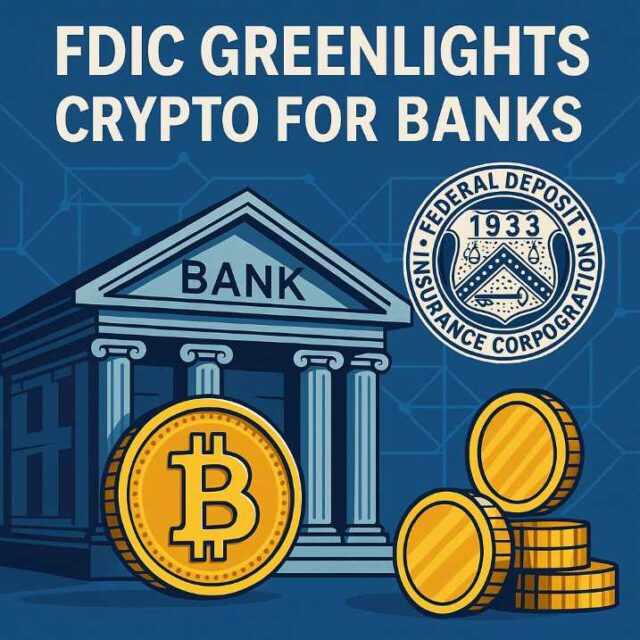
FDIC shifts its crypto policy

In a landmark policy reversal that could accelerate the integration of digital assets into the U.S. financial system, the Federal Deposit Insurance Corporation (FDIC) has lifted its requirement for banks to obtain prior approval before engaging in cryptocurrency-related activities. The March 28, 2025 announcement clarifies that FDIC-supervised institutions may now pursue crypto custody, settlement, and other services without needing written consent. So long as they manage risks appropriately and notify their supervisory contacts.

This change marks a pivotal shift in U.S. regulatory posture. It could enable over 5,000 federally insured banks to tap into blockchain-based financial infrastructure and play a more active role in the growing crypto economy.

FDIC Reverses 2022 Crypto Banking Policy

The move effectively rescinds FIL-16-2022, a policy issued under the Biden administration in April 2022. It required FDIC-supervised banks to notify the agency and await feedback before proceeding with digital asset activities. At the time, regulators cited concerns about systemic risk following the collapse of major crypto-linked firms such as FTX and Silvergate.

Acting FDIC Chairman Travis Hill described the prior approach as “flawed”. He argued that it placed unnecessary obstacles in front of institutions exploring legally permissible digital asset activities. Speaking at the Institute of International Bankers’ annual conference, Hill emphasized that the FDIC remains committed to oversight, but not through pre-emptive vetoes.

“We are not seeking to pre-approve or pre-deny any type of activity,” he stated, clarifying that banks should still engage in “robust supervisory dialogue” and implement appropriate risk controls.

Crypto Innovation Gains Regulatory Clarity

While the FDIC no longer requires prior approval, banks are still expected to adhere to standard risk management principles. That includes ensuring compliance with anti-money laundering (AML) regulations, addressing cybersecurity vulnerabilities, and accounting for market volatility. The FDIC also reaffirmed that institutions must be able to demonstrate that their crypto-related activities do not pose a threat to their safety, soundness, or consumer protections.

The shift does not signal a deregulated free-for-all. Instead, it suggests a transition from restrictive pre-clearance to a more collaborative supervisory model. This new path will allow banks to move faster while remaining accountable.

The approach aligns with recent developments at the Office of the Comptroller of the Currency (OCC), which has also eased its prior approval requirements for crypto activities. Together, these moves reflect a broader shift within the U.S. regulatory landscape toward enabling responsible innovation in digital finance.

How FDIC’s Policy Shift Impacts Crypto Adoption

For the crypto industry, the implications are substantial. By removing regulatory friction, the FDIC’s decision lowers the barrier for traditional financial institutions to enter the digital asset space. Banks can now explore services such as crypto custody, stablecoin settlement, and tokenized asset management without prolonged delays.

This opens the door to deeper institutional adoption of blockchain-based financial infrastructure, something long seen as critical to legitimizing and scaling the crypto ecosystem. It may also encourage the development of crypto-native products by banks, from retail-facing wallets to back-end settlement layers.

“The FDIC’s policy shift is a strong signal that digital assets are becoming an accepted part of the financial system,” said one banking analyst quoted in Coindesk. “It removes uncertainty and allows institutions to build out their crypto strategies with greater confidence.”

Balancing Crypto Market Expansion and Regulatory Risk

Despite the optimism, experts warn that the FDIC’s move should not be seen as an endorsement of crypto writ large. The agency continues to stress that its role is to ensure safety and soundness—not to promote specific asset classes.

Banks entering the space must demonstrate that they understand the operational, legal, and reputational risks inherent in digital assets. “The absence of a pre-approval process does not mean an absence of oversight,” the FDIC clarified in its official letter.

As the line between traditional finance and blockchain technology continues to blur, regulators appear to be recalibrating their approach. They are shifting from gatekeeping to risk-based supervision. If successful, this could lay the foundation for a more integrated, compliant, and resilient digital asset economy.

Readers’ frequently asked questions

Can I now buy Bitcoin directly from my bank?

Not yet. The FDIC’s policy change allows banks to engage in crypto-related activities without first getting approval. However, each bank must still decide whether to offer services like buying, selling, or holding Bitcoin. These services require the bank to develop secure infrastructure, update compliance systems, and manage risks. So, yes. This move makes it easier for banks to enter the crypto space. But most are not yet offering retail crypto products, and there is no guarantee that your bank will.

Are cryptocurrencies now insured by the FDIC like my bank deposits?

No. Cryptocurrencies are not insured by the FDIC. While your bank account is typically insured up to $250,000, that insurance does not apply to Bitcoin, Ethereum, or any other digital asset, even if those assets are held by a bank. The FDIC’s new guidance does not extend deposit insurance to crypto. If a bank offers crypto custody or trading, the crypto itself remains uninsured and subject to market risks.

Cryptocurrencies have been legal to own and trade in the U.S. for years, but the regulatory framework around them has been uncertain and inconsistent. The FDIC’s new policy does not change the legal status of crypto. Nonetheless, it signals a more open and cooperative stance from regulators. It shows that regulators are starting to treat crypto as a permanent part of the financial system, as long as it’s handled responsibly. However, crypto companies and banks are still subject to laws related to securities, taxation, and anti-money laundering.

What Is In It For You? Action Items You Might Want to Consider

Start watching U.S. banks for crypto product rollouts

Now that the FDIC has dropped the prior approval requirement, it’s a good time to keep tabs on traditional banks, especially the larger ones. They could soon offer crypto custody, stablecoin transfers, or even tokenized asset services. Traders might want to position themselves early by monitoring bank announcements and partnerships, as this could impact liquidity flows and new entry points into the market.

Reassess your portfolio for long-term institutional exposure

This policy shift could be the start of deeper crypto integration within the U.S. financial system. That doesn’t mean explosive price action tomorrow—but it does signal a maturing market. Consider reallocating a portion of your holdings to projects focused on compliance, infrastructure, or institutional adoption. These may benefit most from increased bank participation.

Don’t confuse regulatory openness with risk-free exposure

Just because the FDIC is easing the path for banks doesn’t mean crypto is suddenly safe or predictable. Traders should still apply risk management strategies—tighten stop-losses, diversify across sectors, and stay on top of news. The narrative may be shifting, but volatility isn’t going anywhere.

Broken Bets: The Polymarket Bitcoin Reserve Fiasco Reveals Web3’s Gray Areas

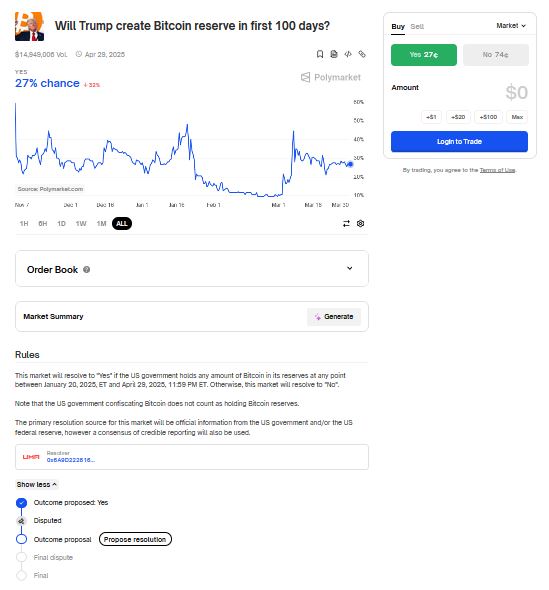
Polymarket sees dispute over Bitcoin Reserve Prediction. Is it a Yes? or is it a No?

The recent fallout from a $15 million prediction market on Polymarket, centered on the U.S. holding Bitcoin in its national reserves, has exposed cracks in the foundation of decentralized truth systems. Conflicting interpretations of government disclosures and reliance on oracles have left bettors divided and questioning the fairness of the outcome. As on-chain betting gains popularity, the incident raises urgent questions about how smart contracts, subjective news interpretation, and blockchain-based governance can—or cannot—coexist in a world still bound by off-chain ambiguity.

When Blockchain Truth Meets Real-World Complexity

The market at the center of the controversy is titled “Will Trump create a national Bitcoin reserve in his first 100 days?” and is hosted on Polymarket, a decentralized prediction platform allowing users to speculate on real-world events using stablecoins. The market was launched in response to political developments in the U.S., including growing crypto-friendly rhetoric from former President Donald Trump.

According to the market’s official resolution criteria, it would resolve to “Yes” only if the U.S. government holds any amount of Bitcoin in its reserves at any point between January 20 and April 29, 2025. Confiscated Bitcoin does not count. Resolution is based primarily on official documentation from the U.S. government or the Federal Reserve, and secondarily on a consensus of credible reporting.

In late March 2025, Polymarket’s data provider proposed a “Yes” outcome based on a public announcement from President Trump regarding the creation of a “Crypto Strategic Reserve.” According to the statement, the proposed reserve would include Bitcoin, Ethereum, and several other cryptocurrencies. This announcement sparked immediate debate. Some interpreted the Executive Order as confirmation that the U.S. government had begun holding Bitcoin. However, others pointed out that no documentation had been produced to confirm that the government actually acquired or added any Bitcoin to national reserves.

As of March 30, 2025, the market remains Disputed on the Polymarket platform. This status reflects the ambiguity surrounding whether the proposed reserve exists in practice or only as a policy intention. There is no final resolution.

The Oracle Challenge in Web3

At the core of this dispute is the reliability of oracles, the systems feeding off-chain data into smart contracts. Oracles are supposed to bring objective truth to decentralized systems. But in practice, objective truth becomes contested when outcomes depend on complex, nuanced developments, like government policy.

In the case of this Bitcoin Reserve prediction, the oracle responsible for resolving the market interpreted the political announcement as sufficient proof. Yet the lack of verifiable government documentation has cast doubt on whether the criteria were truly met. Smart contracts cannot function as impartial referees without clear, authoritative data.

Why It Matters to Prediction Markets

Prediction markets like Polymarket are touted as tools for gathering collective intelligence and pricing in probabilities with accuracy. But their credibility hinges on transparent resolution mechanisms. When millions of dollars are at stake, users expect outcomes to be determined not by interpretation, but by evidence.

The dispute over the Trump Bitcoin reserve prediction market has reignited calls for more decentralized and transparent oracle governance. Some in the community have proposed on-chain arbitration models, while others have pointed to services like Kleros as potential solutions for contested outcomes.

Conclusion: The Need for Better Frameworks

This unresolved and contested prediction market shows that trust and clarity matter, even in a blockchain-based system. Smart contracts are only as good as the data they consume, and the rules interpreting the data. Until oracles can resolve real-world ambiguity with provable certainty, prediction markets will continue to face the same problems they were designed to eliminate.

In Web3, the truth is programmable but still negotiable.

Readers’ frequently asked questions

What exactly is a prediction market like Polymarket, and how does it work in practice?

A prediction market is a platform where users can bet on the outcome of future events. These events could be elections, policy changes, or financial developments. Polymarket operates on the blockchain and uses USDC (a stablecoin pegged to the U.S. dollar) to let users trade shares in potential outcomes. Each market typically has a “Yes” and “No” side. The price of each share reflects the market’s belief in the likelihood of that outcome. If a share in “Yes” is trading at $0.70, the market is pricing a 70% chance of that outcome occurring. At resolution, only the correct outcome pays out at full value ($1), while the other pays nothing. The markets rely on oracles or trusted resolution criteria to determine the final outcome, which smart contracts enforce.

What is the difference between the U.S. government confiscating Bitcoin and holding it in reserves?

Confiscated Bitcoin is typically acquired through legal seizures from criminal investigations, such as taking coins from illicit marketplaces or fraud cases. These assets are not considered part of the government’s official monetary reserves. In contrast, holding Bitcoin in reserves would mean the government, through entities like the U.S. Treasury or Federal Reserve, actively and intentionally allocates part of its balance sheet to Bitcoin. The same way it does with gold or foreign currencies. This would be a formal economic decision, publicly acknowledged and documented as part of national monetary policy or asset management strategy. The key difference is intent and formal recognition.

Why can’t blockchain-based prediction markets just rely on blockchain data or code alone for resolution?

Blockchain is great for automating rules and ensuring transparency, but it can’t natively access or interpret real-world events. For example, a smart contract can’t “see” whether the U.S. government made a press release or passed legislation. A trusted external source, called an oracle, must bring it onto the blockchain. This creates a challenge when outcomes depend on nuanced real-world developments like policy decisions or public statements. While the code is deterministic, interpreting off-chain events is often not. That’s why these markets still rely on human judgment and trusted data providers for resolution. Until reliable, fully decentralized oracle systems can interpret complex real-world events with consensus, some level of subjectivity remains unavoidable.

What Is In It For You? Action Items You Might Want to Consider

Read the fine print before betting on prediction markets

Before placing capital in decentralized prediction markets like Polymarket, take a moment to study the resolution criteria in detail. Outcomes aren’t always about what feels true. They’re about what’s explicitly stated and verifiably documented. If the conditions involve government action, ask yourself: Is this provable within the time window? A trader who ignores the resolution logic risks backing the right narrative but losing the bet.

Don’t mistake hype for evidence

Sentiment can fuel token surges, like the one seen in Strategic Bitcoin Reserve (SBR). But that doesn’t mean the fundamentals have shifted. If you’re trading on market momentum tied to prediction events or political rumors, make sure you separate narrative speculation from facts. Use these moments for short-term plays only if you’re clear-eyed about the underlying risks.

Watch for future oracle upgrades or governance changes

The Polymarket dispute exposes real friction in how decentralized systems resolve off-chain events. Keep an eye on whether platforms like Polymarket adopt new arbitration mechanisms or integrate more transparent oracle frameworks. If you’re active in these markets, staying ahead of governance proposals or dispute resolution upgrades could give you a tactical edge in future trades.

Galaxy Digital Pays $200M in Landmark NYAG Settlement Over Terra Misconduct

Galaxy Digital reaches settlement with New York Attorney General.

Galaxy Digital, the crypto investment firm helmed by billionaire Mike Novogratz, has reached a $200 million settlement with the New York Attorney General’s Office (NYAG) over allegations it misled investors during its involvement with the failed Terra (LUNA) project. The agreement, announced on March 28, is among the largest crypto-related regulatory settlements in U.S. history. It underscores the heightened scrutiny facing digital asset firms.

Discounted Tokens and Undisclosed Sales

The NYAG’s investigation revealed that Galaxy Digital had acquired more than 18.5 million LUNA tokens from Terraform Labs in 2020 at a discounted rate of $0.22 per token, nearly 30% below market value at the time. The firm later publicly promoted LUNA to investors, including Novogratz’s now-infamous tattoo celebrating the token. They continued promoting the token even as the company offloaded significant holdings during LUNA’s price surge. Galaxy reportedly reaped millions in profits while failing to disclose its intention to sell.

Amplifying False Claims Without Due Diligence

Central to the NYAG’s complaint was the accusation that Galaxy amplified misleading claims about Terra’s ecosystem. Notably, it asserted that South Korea’s Chai payments app was using Terra’s blockchain infrastructure. The claim has since been proven false. Galaxy did not conduct independent due diligence on these statements, despite using them to attract investor interest.

Settlement Terms and Compliance Measures

Under the terms of the agreement, Galaxy will pay $200 million over three years. An initial $40 million within 15 days, another $40 million after one year, and two subsequent payments of $60 million in the following two years. The firm neither admitted nor denied the allegations but agreed to enhance its compliance practices. These include conducting legal reviews of token transactions and enforcing stricter internal controls over employee investments.

Regulatory and Ethical Implications

The settlement reflects growing regulatory momentum to rein in deceptive practices in crypto promotion and trading. It also exposes the ethical divide between industry insiders and everyday investors. While Galaxy cashed out at the top, retail holders suffered massive losses during Terra’s $40 billion collapse in May 2022.

Looking Ahead: Galaxy’s Strategic Pivot

Novogratz, who once called LUNA “one of the most exciting projects in crypto,” has since described the experience as “humbling.” Following the settlement, Galaxy emphasized its intent to “move forward” and refocus on institutional infrastructure and AI investments, including a new 15-year agreement with cloud computing firm CoreWeave.

Still, the message from regulators is clear: the era of unchecked hype and undisclosed interests in the crypto markets is ending. The Galaxy case may set a precedent for future enforcement, as authorities push for transparency, accountability, and investor protection in an industry long defined by volatility and opacity.

Readers’ frequently asked questions

What was Terra (LUNA), and why did it collapse so dramatically?

Terra (LUNA) was the native token of the Terra blockchain, which also supported a stablecoin called TerraUSD (UST). The system was designed so that LUNA would help maintain the peg of UST to the U.S. dollar through a mechanism of algorithmic supply and demand. However, in May 2022, UST lost its peg and triggered a death spiral. The system issued massive amounts of LUNA to try to restore the peg, which instead hyperinflated the token and rendered it nearly worthless. The collapse wiped out around $40 billion in market value almost overnight and led to significant investor losses globally. The crash also sparked broader regulatory scrutiny of algorithmic stablecoins and the firms that promoted them.

Why was Galaxy Digital allowed to settle without admitting wrongdoing?

In many U.S. regulatory settlements, particularly those involving financial firms like Galaxy Digital, it’s common for the defendant to resolve a case without admitting or denying the allegations. This is often part of a negotiated deal that enables regulators to secure penalties and policy changes without engaging in prolonged litigation. In Galaxy Digital’s case, the New York Attorney General prioritized stopping the firm from misleading investors in the future and recovering funds, rather than proving fraud in court. However, even without an admission of guilt, the settlement imposes enforceable compliance measures. Hence, it sends a strong signal to other firms operating in the crypto space.

Can investors expect to get any money back from this $200 million settlement?

As of now, there is no public information detailing how the $200 million settlement will be allocated, specifically regarding restitution to affected investors. Typically in such cases, a portion of the payment is allocated to investor restitution while the rest may go to state coffers or regulatory enforcement funds. The exact allocation often depends on the terms set by the Attorney General’s office. If the NYAG establishes a formal claims process for affected investors, it would be publicly announced. However, given the scale of losses during the LUNA collapse and the number of parties involved, individual investors may not recover a substantial amount, if anything. The primary impact of the settlement is regulatory, not compensatory.

What Is In It For You? Action Items You Might Want to Consider

Reevaluate projects with heavy insider promotion

If a token is being aggressively endorsed by high-profile insiders or influencers, especially without clear disclosures, consider it a red flag. Galaxy’s promotion of LUNA while secretly offloading its holdings is a textbook case of how public hype can mask private exits. Always ask: Who stands to gain the most from this narrative?

Dig deeper than surface-level claims

Don’t take ecosystem claims at face value—especially when they come from project teams or their backers. The false narrative that the Chai app used Terra’s blockchain went largely unchallenged in public forums. As a trader, get comfortable verifying tech integrations, partnerships, and on-chain activity yourself—or follow trusted analysts who do.

Price action can mislead when transparency is lacking

LUNA’s meteoric rise was driven by hype, but the collapse revealed just how little investors knew about the risks. Use this case as a reminder to weigh tokenomics, sell pressure, and team incentives—not just momentum or price charts. When in doubt, zoom out: sustainable assets rarely need marketing stunts to justify their value.

Terraform Labs Opens $185M Claims Portal for Terra Collapse Victims

Terraform launches Claims portal for compensations.

Terraform Labs will launch a dedicated claims portal on March 31, 2025, as part of its Chapter 11 restructuring. The portal will allow victims of the 2022 TerraUSD (UST) and LUNA crash to file for compensation. The company has set aside up to $185 million to distribute to eligible creditors affected by the algorithmic stablecoin’s failure. The crash erased tens of billions of dollars from the crypto market and triggered global regulatory fallout.

The portal will remain open until April 30, 2025, at 11:59 p.m. ET, providing a one-month window for affected parties to submit claims. According to the official announcement, both retail and institutional investors who held UST, LUNA, or other assets in the Terra ecosystem at the time of the collapse will be eligible, subject to verification.

Claim Submission Process

To file a claim, users must register on the Terraform claims portal and provide verifiable evidence of their holdings at the time of the depeg event in May 2022. Accepted documentation includes:

  • Wallet addresses
  • Read-only API keys for centralized exchanges
  • Other supporting transaction records

A Wind Down Trust, established during Terraform Labs’ Chapter 11 proceedings in the Delaware Bankruptcy Court, will oversee the process. They will assess claims based on combining on-chain data and exchange platform records.

https://twitter.com/terra_money/status/1905480354150129947

Importantly, the company stated that not all assets are eligible. Claims will exclude Luna 2.0 holdings, as well as assets with less than $100 in on-chain liquidity, according to guidelines published by Terraform Labs.

Rebuilding Trust in the Aftermath of Collapse

The portal launch comes nearly three years after UST lost its 1:1 peg to the U.S. dollar, triggering a death spiral that caused LUNA’s value to collapse. The crash wiped out more than $40 billion in market value. The incident had widespread consequences, contributing to the downfall of multiple crypto institutions and drawing scrutiny from regulators worldwide.

Terraform Labs filed for Chapter 11 bankruptcy protection in January 2024 and has since been navigating legal challenges, including lawsuits from the U.S. Securities and Exchange Commission (SEC) and potential civil claims from investors.

While the $185 million restitution fund is only a fraction of the total losses incurred in 2022, the company says the initiative represents a good-faith effort to address the damage and provide closure for affected users.

Industry Implications for Investor Protection

Terraform’s move signals an increasingly formalized approach to investor compensation in the wake of crypto project failures. Although restitution in decentralized finance (DeFi) has often been ad hoc or nonexistent, the structured claims process and court-supervised distribution represent a notable shift toward accountability and transparency.

However, some legal experts and community members have pointed out that the claims portal launch also coincides with Terraform Labs’ upcoming bankruptcy hearing in April 2025, potentially positioning the initiative as both a restitution mechanism and a strategic legal move.

For now, the claims portal represents a rare opportunity for victims of a high-profile DeFi collapse to seek partial recovery through a formalized, verified process. This might set a reference point for future industry standards in investor redress and post-crisis recovery.

Readers’ frequently asked questions

How do I know if I’m eligible to file a claim on the Terraform Labs portal?

Eligibility depends on whether you held Terra ecosystem assets like UST or LUNA at the time of the collapse in May 2022. Specifically, if you had these tokens in a personal crypto wallet (such as MetaMask or Terra Station) or on a centralized exchange that supported Terra assets (like Binance or KuCoin). If you can prove it, you may qualify. You’ll need to provide documentation such as wallet addresses, exchange account records, or read-only API keys that confirm you owned eligible assets at the time of the depeg. Keep in mind that newer Terra assets like LUNA 2.0, or coins with low liquidity, aren’t eligible.

What happens after I submit my claim? Will I automatically receive compensation?

Submitting a claim does not guarantee compensation. Once submitted through the official portal, an independent Wind Down Trust will review your claim and verify your submission using on-chain data and third-party exchange information. If your claim is validated, you will receive a portion of the $185 million compensation pool. The pool will be distributed proportionally based on all approved claims. The exact timeline for when payouts will occur has not been confirmed yet. However, it will likely follow after the portal closes on April 30, 2025.

What is Chapter 11 and why is Terraform Labs doing this now?

Chapter 11 is a type of bankruptcy protection under U.S. law allowing a company to restructure its operations and finances while continuing to function. Terraform Labs filed for Chapter 11 in January 2024 to deal with outstanding liabilities and legal proceedings. Launching the claims portal is part of that process. It allows the company to formally address creditor claims and potentially reduce future legal exposure. This timing also aligns with a scheduled court hearing in April 2025, making it a critical step in resolving the financial and legal consequences of the Terra collapse.

What Is In It For You? Action Items You Might Want to Consider

Double-check your Terra exposure from 2022 — you might be owed a payout.

If you held UST, LUNA, or other Terra ecosystem tokens around the time of the May 2022 collapse, now’s the time to dig into your old wallets or exchange histories. Even if you think your losses were insignificant, it’s worth checking. The $185 million claims pool is real, and the portal launches on March 31. You’ve got until April 30 to file, but don’t leave it until the last minute.

Prepare your documentation ahead of time — verification will matter.

You’ll need proof of ownership to file a successful claim. That means exporting transaction history, retrieving old wallet addresses, or requesting API access logs from exchanges. Start gathering those now so you’re ready to go the moment the portal opens. The Wind Down Trust will be strict about eligibility, so clean records will save you headaches.

Watch how this unfolds — it could set the tone for future collapses.

This isn’t just about getting compensated. How Terraform handles this may influence how other projects approach investor restitution in the future. If you’re an active DeFi trader, this case could offer key insights into what to expect if another protocol fails — and how to position yourself legally and financially. Keep tabs on the outcomes.

Hyperliquid’s $20M Meltdown: JELLY Token Manipulation Sparks DeFi Trust Crisis

Hyperliquid's liquidity pool drained by JELLY meltdown.

A coordinated manipulation of the thinly traded JELLY token exposed critical vulnerabilities in Hyperliquid, one of DeFi’s fastest-growing perpetuals exchanges. With $20 million drained from its liquidity vaults and the subsequent delisting of JELLY perpetuals, the incident has shaken user confidence. It also reignited the debate around protocol-level risk, governance, and decentralization in crypto derivatives markets.

The Exploit: Leveraged Shorts and Low Liquidity

On March 26, 2025, traders on Hyperliquid opened aggressive short positions on the JELLY token, using up to 50x leverage. According to on-chain data, a key actor opened a $4.08 million short position and subsequently manipulated the token’s price downward. This triggered a cascade of forced liquidations, significantly impacting the Hyperliquid Liquidity Pool (HLP). The result: an estimated $20 million in losses.

The manipulation appears to have exploited the low liquidity and the JELLY token’s relative obscurity, which had recently gained attention following a Binance listing. Thin order books enabled traders to move the price significantly with relatively low capital. This highlights the systemic weaknesses in listing and risk management protocols within DeFi platforms.

Protocol Response: Delisting and Reimbursement

In response to the attack, Hyperliquid’s committee voted to delist JELLY perpetual contracts. It announced that it would reimburse affected users, except for flagged addresses potentially involved in the exploit. The Hyper Foundation promised automatic reimbursements based on on-chain data, attempting to reassure users amid growing concerns over the platform’s resilience.

Centralization Concerns in a Decentralized System

However, the JELLY incident has intensified scrutiny of Hyperliquid’s governance model. Prominent industry figure Arthur Hayes criticized the protocol’s response. He argued that emergency delistings and reimbursements resemble centralized crisis management rather than decentralized decision-making. “Hyperliquid is no longer decentralized,” Hayes remarked, predicting that the platform’s native token, HYPE, could lose significant value as a result.

Market Reaction and Loss of Confidence

Hyperliquid also experienced a reported 20% drop in platform usage and capital deployment following the incident, reflecting shaken user confidence. Critics argue that the protocol failed to implement sufficient safeguards against volatility-induced exploits, especially in cases involving low-liquidity tokens with outsized leverage options.

A Wake-Up Call for DeFi Governance

The exploit has sparked broader concerns across the DeFi ecosystem. As perpetual futures trading becomes a dominant use case in DeFi, the Hyperliquid meltdown is a warning about the risks of allowing synthetic exposure to tokens with fragile liquidity. It also revives the long-standing question: can DeFi platforms truly remain decentralized while ensuring timely responses to emergent threats?

As the dust settles, Hyperliquid faces a critical inflection point. Its future may hinge not only on technical upgrades and governance reform but also on whether it can restore trust among users now wary of decentralized platforms that must act like centralized entities in times of crisis.

Readers’ frequently asked questions

What is a perpetual contract, and how does it work on platforms like Hyperliquid?

A perpetual contract (or “perp”) is a type of derivative in crypto trading that allows users to speculate on the future price of an asset without actually owning it. Unlike traditional futures contracts, perpetuals don’t expire. Traders can go “long” (bet the price will rise) or “short” (bet it will fall), often using leverage to amplify their position. On platforms like Hyperliquid, these trades are settled through smart contracts and supported by a liquidity pool. Prices are typically synced with external market data using price feeds. When traders use high leverage and trade tokens with low liquidity small price movements can lead to large gains or losses. That’s what makes these contracts risky.

Why did the JELLY token’s low liquidity make it easier to manipulate?

Low liquidity means there aren’t many active buy and sell orders in the market. When a token is illiquid, it takes less capital to push its price up or down. In JELLY’s case, a trader opened a large short position and then sold enough JELLY tokens to cause a sharp price drop. This price movement wasn’t due to natural market activity but rather a coordinated strategy to trigger profits from the short position. The lower the liquidity, the easier it is to cause significant price changes. Such types of tokens are more vulnerable to manipulation.

Is Hyperliquid still safe to use after this incident?

Hyperliquid responded quickly by delisting the manipulated token and promising reimbursements to the most affected users. However, the incident revealed gaps in the protocol’s risk management, especially in allowing high-leverage trading on low-liquidity tokens. The platform didn’t fall victim to a hack and nobody stole funds through code vulnerabilities. However, users must realize that similar risks could exist if the exchange doesn’t improve its safeguards. If you consider using Hyperliquid or any DeFi trading platform, trade cautiously. Understand how leverage works, and avoid highly speculative or illiquid tokens unless you’re confident in the risks involved.

What Is In It For You? Action Items You Might Want to Consider

Stick to trading assets with deep liquidity

If you’re trading perpetuals, avoid newly listed or low-volume tokens that can be easily manipulated. Illiquid markets are playgrounds for price attacks. And, you don’t want to be on the wrong side of a sudden 50x leveraged move.

Reconsider using high leverage unless you fully understand the risks

Leverage can boost gains, but in volatile or thinly traded markets, it amplifies losses just as fast. Before opening a leveraged position, assess how easily the price can be moved. If a token’s order book looks suspiciously thin, step back.

Keep an eye on protocol governance and emergency actions.

Even in DeFi, not all decisions are decentralized. Platforms like Hyperliquid may intervene when things go wrong—sometimes at the expense of protocol ideals. If a platform can delist assets or refund users manually, understand how those powers are used and who holds them. It could matter the next time volatility hits.

- Advertisement -

FEATURED