Home Blog Page 120

March Madness or Market Madness? Robinhood Faces Backlash Over ‘Game-Like’ NCAA Bets

Robinhood under investigation for event-based contracts offered during March Madness.

As March Madness captivates college basketball fans, Robinhood’s attempt to capitalize on the hype has caught the attention of regulators. The Massachusetts Securities Division has subpoenaed the trading app over its new Prediction Markets Hub. The regulator expressed concern that gamified financial features could mislead younger users into high-risk behavior. The controversy revives longstanding questions about Robinhood’s appeal to inexperienced investors and its role in reshaping market participation through entertainment-driven tools.

Launched in March 2025, Robinhood’s Prediction Markets Hub allows users to place trades on real-world events, including the outcome of NCAA basketball games. The feature is powered by Kalshi, a Commodity Futures Trading Commission (CFTC)-regulated platform specializing in event-based contracts. Robinhood positions the offering as a novel way to expose users to current events’ outcomes, from sports to economics.

Regulatory Concerns Over Gambling-Like Features

But regulators in Massachusetts aren’t convinced. Secretary of the Commonwealth William Galvin issued a subpoena to Robinhood, citing concerns that the product resembles unlicensed gambling more than regulated investing. Galvin’s office has requested details on user demographics, product design, and marketing strategies, particularly as they relate to NCAA-related markets. “This is just another gimmick from a company that’s very good at gimmicks to lure investors away from sound investing,” Galvin said in a statement.

This isn’t Robinhood’s first brush with regulatory controversy. Earlier this year, the company pulled Super Bowl prediction contracts at the request of the CFTC, which had raised concerns about the legality of the offering. While Robinhood maintains that all event contracts available through its hub follow CFTC regulations, the NCAA-focused feature appears to have reignited the debate over what constitutes a financial instrument versus a wager.

The Ethics of Gamified Finance

The line between investing and gambling has become increasingly blurred. Fintech platforms embrace gamified interfaces, simplified trading products, and cultural hooks like sports events to drive user engagement. Critics argue that such tactics can harm especially younger or inexperienced users, who may misinterpret speculative products as safe or skill-based investments. With the NCAA’s broad appeal among college-aged users, regulators fear Robinhood’s feature could normalize speculative behavior in a demographic already vulnerable to financial misinformation.

Robinhood’s Defense and the Bigger Picture

Robinhood, for its part, defends the Prediction Markets Hub as a legitimate financial tool that offers users a new avenue to express market views. In a statement, the company emphasized that it facilitates all contracts through a CFTC-regulated exchange. Furthermore, the feature aligns with its mission to “democratize finance.”

Still, the regulatory probe highlights the uneasy relationship between financial innovation and consumer protection. While decentralized prediction markets and event-based trading products are gaining traction in the crypto and DeFi sectors they continue to operate in a gray area of regulation. Coupled with its large and often young user base, Robinhood’s stepping into the space makes it a high-profile test case. How far can mainstream platforms go in merging financial speculation with pop culture?

A Pivotal Moment for Prediction Markets

Whether Robinhood’s NCAA markets are ultimately deemed a regulatory overreach or a bold new product remains to be seen. However, as the investigation unfolds, it will likely shape the conversation around fintech gamification, regulatory boundaries, and the future of prediction markets in traditional and decentralized finance.

Readers’ frequently asked questions

Is Robinhood’s prediction market feature built on blockchain technology or does it use cryptocurrencies?

Robinhood’s Prediction Markets Hub is not built on blockchain technology, nor does it use cryptocurrencies. The feature is powered by Kalshi, a U.S.-based event contracts exchange regulated by the Commodity Futures Trading Commission (CFTC). While decentralized prediction markets in the crypto space often operate using blockchain networks and tokens, Robinhood’s offering remains within the framework of traditional finance. It operates with fiat currencies and through a centralized infrastructure, though it mirrors concepts familiar in blockchain-based platforms.

How are prediction markets different from traditional sports betting, and why are regulators treating them cautiously?

Prediction markets differ from traditional sports betting in that they are structured as financial instruments where participants trade contracts based on the outcome of real-world events. These contracts can relate to anything from sports games to interest rate decisions. The idea is to let market forces aggregate public sentiment or knowledge. However, when platforms like Robinhood offer markets based on sporting events like NCAA games, the difference becomes less clear. Regulators are cautious because if these products mimic gambling, but are not explicitly licensed as such, they could bypass consumer protections applicable to betting or investing.

Are there blockchain-based alternatives to Robinhood’s prediction markets, and how are they regulated?

Yes, there are. Blockchain-based alternatives like Polymarket and Augur allow users to trade on real-world outcomes using cryptocurrency. These platforms are decentralized and often accessible globally, operated outside traditional U.S. regulatory frameworks. While some, like Polymarket, have faced enforcement actions from the CFTC for offering unregistered contracts, they remain active and cater to crypto-native users. Regulation for such platforms is evolving and authorities are trying to determine how to oversee decentralized finance (DeFi) systems that lack clear jurisdiction or corporate ownership.

What Is In It For You? Action Items You Might Want to Consider

Watch for Regulatory Signals Before Trading Novel Products

If you’re eyeing event-based trading—especially on platforms like Robinhood—keep an eye on regulatory developments. Massachusetts’ probe could set a precedent. If regulators tighten the rules or redefine these contracts as gambling, access could suddenly vanish. Stay agile and consider risk exposure accordingly.

Don’t Confuse Speculation with Investment

Even if prediction markets look like fun ways to trade on sports or current events, don’t treat them like traditional assets. These contracts carry a high degree of volatility and are binary by nature. Allocate funds accordingly—treat them more like a high-risk trade than part of your core portfolio.

Explore DeFi Alternatives—But Know the Risks

Platforms like Polymarket or Augur offer similar event-driven trading experiences, often with more freedom and fewer geographic restrictions. If you’re comfortable navigating DeFi, it’s worth exploring. But always verify the platform’s regulatory standing, smart contract security, and liquidity depth before diving in.

Gaming Catalyst Program: Arbitrum DAO Debates Future of $225 Million Investment

Arbitrum DAO to decide on the fate of its Gaming Catalyst Program

The Arbitrum decentralized autonomous organization (DAO) is currently engaged in a significant debate over the future of its Gaming Catalyst Program (GCP). The initiative launched in early 2024 aimed to establish Arbitrum as a premier platform for Web3 gaming. The program was allocated 225 million ARB tokens, valued at approximately $468 million at the time, to support game studios and developers building on-chain games.

Concerns Over Sustainability and Transparency

On March 24, 2025, DAO contributor Nathan van der Heyden introduced a proposal to recover unused funds from the GCP. He cited concerns that the program was approved during a period of heightened optimism, which has since proven to be unsustainable. He emphasized the need to “wind down GCP activities and secure all possible funds” to restore confidence in the DAO’s capital allocation abilities. Additionally, van der Heyden criticized the GCP’s lack of transparency, alleging reluctance to document activities and deliver on initial promises.

Divergent Views Within the DAO Community

The proposal has sparked varied reactions within the DAO community. Some members support an immediate clawback of the funds, emphasizing the importance of acting swiftly to prevent further inefficiencies. One supporter echoed the call to preserve remaining funds, stating, “The DAO should step in now and secure what is there and then think about a good and meaningful way of going forward.”

Conversely, other members advocate for a more measured approach. They suggest phased clawbacks and improved oversight rather than abruptly ending the initiative. In their opinion, the desire to protect DAO funds and ensure transparency is valid. However, resorting to a complete clawback seems overly harsh and potentially counterproductive. Implementing flexible reporting standards could allow the GCP to course-correct without dissolving the program entirely.

Financial Implications and Market Conditions

Since the GCP’s launch, the value of ARB tokens has declined significantly. It dropped by 81% from its initial price during the GCP announcement. This decline has reduced the program’s funds to around $215 million by mid-2024. The broader Web3 gaming sector has also faced challenges. Investors adopted a more cautious approach due to market volatility and an oversaturation of low-quality projects.

The ongoing debate within the Arbitrum DAO underscores the complexities of managing large-scale initiatives within decentralized organizations. The decision on whether to continue funding the GCP or to reallocate its resources will have significant implications for Arbitrum’s position in the Web3 gaming industry. As the community continues its discussions, the outcome will likely influence future strategies for fostering innovation and growth within the Arbitrum ecosystem.

Readers’ frequently asked questions

What exactly is a DAO and how can it make decisions about such large amounts of money?

A DAO, or decentralized autonomous organization, is a form of blockchain-based governance structure enabling token holders to vote on decisions collectively. In the case of Arbitrum DAO, anyone who holds ARB tokens can participate in governance. ARB holders can delegate their voting power to representatives or vote directly on proposals. These proposals can cover everything from funding new projects to reallocating existing budgets, like the $225 million Gaming Catalyst Program. The decisions are executed via smart contracts, ensuring transparency and automation. However, the process also relies heavily on community engagement and trust in delegates to act in the ecosystem’s best interests.

Why is Web3 gaming such a big focus for Arbitrum and other blockchain projects?

Web3 gaming is seen as one of the most promising areas for mainstream blockchain adoption. Unlike traditional games, Web3 games allow players to own in-game assets as NFTs. They often reward users with tokens that can be traded or used across platforms. For Arbitrum, investing in this space means attracting developers and users to its blockchain, increasing activity, and expanding its ecosystem. A successful gaming program could lead to more transactions on Arbitrum’s network, generate new use cases for ARB tokens, and give the platform a competitive edge against other chains like Polygon or Avalanche, which are also aggressively courting game developers.

What happens to the unused funds if the DAO decides to shut down the Gaming Catalyst Program?

If the DAO votes to revoke the remaining GCP funds, the unused ARB tokens will be returned to the Arbitrum DAO treasury. From there, those funds could be reallocated through future governance proposals. Community members or delegates could propose new initiatives in other sectors like DeFi, infrastructure, or developer tooling. The important thing is that the funds don’t vanish. They remain in the hands of the DAO and can be redirected based on what the community sees as a higher priority or a better investment at that time.

What Is In It For You? Action Items You Might Want to Consider

Keep a close eye on ARB governance developments.

If you’re holding or trading ARB, now’s the time to monitor Arbitrum DAO votes more closely. The debate over the Gaming Catalyst Program isn’t just about gaming—it reflects broader DAO sentiment on treasury management. Any shift in community trust or funding direction could influence token volatility in the short term.

Watch for signals from Web3 gaming projects on Arbitrum.

Whether the program continues or not, funded or defunded, the outcome will impact game developers building on Arbitrum. Track announcements from projects previously linked to the GCP. Delays, pivots, or new partnerships could trigger momentum shifts or expose opportunities for early positioning.

Assess DAO treasury risks when trading governance tokens.

This case shows how even well-funded DAO programs can face backlash if execution lags. When trading governance tokens like ARB, consider treasury allocations, upcoming proposal votes, and whether there’s clear communication between delegates and the wider community. Governance drama often precedes price action.

Coinbase Eyes $5B Deribit Acquisition in Bid to Conquer Crypto Derivatives Market

Coinbase and Deribit negotiating acquisition.

Coinbase is reportedly in advanced negotiations to acquire Deribit, the world’s largest crypto options exchange. The deal is valued between $4 billion and $5 billion. If finalized, the acquisition would mark a major strategic leap for the U.S.-based exchange. It would thrust Coinbase into a dominant position within the highly lucrative crypto derivatives sector. With rivals like Binance and OKX leading the space, Coinbase’s move signals an aggressive push to diversify revenue. It must meet the growing demand for sophisticated trading products among institutional and retail clients alike.

Closing the Derivatives Gap

According to multiple reports, including Bloomberg and Coindesk, the two firms are in the final stages of negotiation. However, to date, they have not signed a formal agreement. The talks highlight Coinbase’s ambition to expand beyond spot trading, where it currently derives most of its revenue. It wants to establish a stronghold in the global derivatives market, a segment that accounted for over 75% of total crypto trading volume in 2024.

Inside Deribit’s Market Dominance

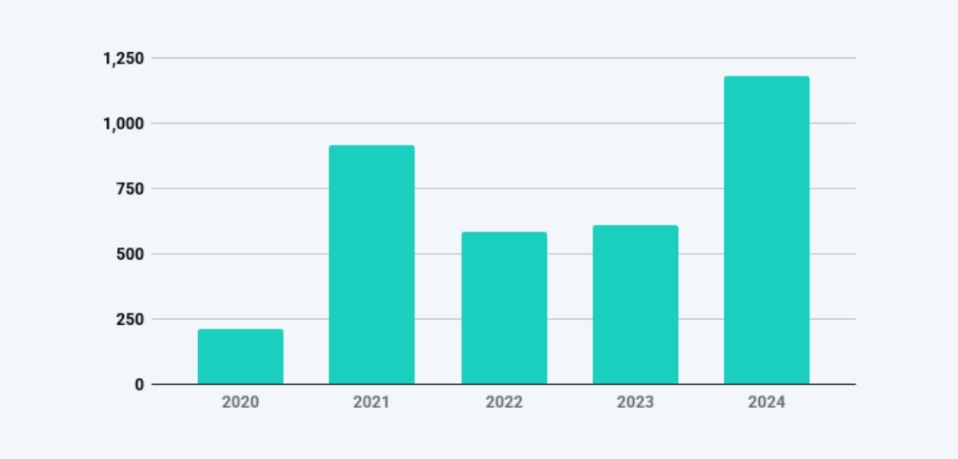
Founded in 2016 and based in Panama, Deribit is a leading platform for crypto options and futures trading. It particularly focuses on Bitcoin and Ethereum derivatives. It commands the lion’s share of the options market, with a reported trading volume of $1.2 trillion in 2024. Its robust infrastructure and deep liquidity have made it the go-to venue for professional and institutional traders seeking leveraged exposure to crypto assets.

Annual Deribit Trading Volume, Source: Deribit.com

A Game-Changing Acquisition for Coinbase

For Coinbase, acquiring Deribit could be a game-changer. While the company already operates a derivatives platform out of Bermuda, its offerings remain limited compared to those of global competitors. Integrating Deribit’s infrastructure and client base could enable Coinbase to instantly scale its derivatives operations. It could quickly close the gap with established leaders like Binance, Bybit, and OKX.

Industry Consolidation and Competitive Pressure

Strategically, this acquisition fits within a broader consolidation trend in the crypto exchange space, particularly around derivatives. Kraken, another U.S.-based exchange, recently acquired futures platform NinjaTrader for a reported $1.5 billion, reinforcing the view that derivatives are the new frontier for growth.

Regulatory Oversight and Jurisdictional Challenges

Regulatory considerations are also central to the deal. Deribit holds a license in Dubai, and both companies have reportedly informed local regulators of the ongoing talks. The handling of this license, including any transfer or reassessment under Coinbase’s ownership, will be a key determinant in the deal’s finalization. Coinbase, which is publicly traded and operates under U.S. regulatory scrutiny, must also weigh the compliance risks of integrating a non-U.S. entity that serves global clients.

A Bet on Market Maturity and Institutional Growth

The move comes amid a resurgence in institutional interest in digital assets, fueled by the approval of U.S. spot Bitcoin ETFs and a general thaw in crypto market sentiment. Derivatives, particularly options and perpetual futures, are increasingly used as essential tools for hedging, speculation, and risk management in a maturing market.

Should the acquisition go through, it would significantly expand Coinbase’s product offering and reshape the competitive landscape of the global crypto market. With Deribit under its wing, Coinbase would position itself to better serve sophisticated traders, boost revenue diversification, and strengthen its footing in a market increasingly defined by advanced financial instruments and regulatory complexity.

Tornado Cash Cleared: U.S. Treasury Lifts Sanctions After Court Rebuke

The U.S. Treasury lifted sanctions on Tornado Cash

The U.S. Treasury’s recent decision to lift sanctions against Tornado Cash, a cryptocurrency mixer, has reignited a complex debate at the intersection of financial privacy and national security. The platform was initially sanctioned in August 2022 for allegedly facilitating the laundering of over $7 billion, including funds linked to North Korea’s Lazarus Group. Its delisting follows a pivotal court ruling and has elicited mixed reactions from various stakeholders.

Background on Tornado Cash and Initial Sanctions

Tornado Cash, launched in 2019, is an Ethereum-based protocol designed to enhance transaction privacy by obfuscating the origins and destinations of cryptocurrency transfers. While this service caters to individuals seeking financial privacy, malicious actors routinely exploit this privacy feature to launder illicit funds. In August 2022, the U.S. Department of the Treasury’s Office of Foreign Assets Control (OFAC) sanctioned Tornado Cash, alleging its involvement in laundering over $7 billion in virtual currency, including $455 million stolen by the Lazarus Group.

The sanctions faced legal opposition from six Tornado Cash users, financially backed by cryptocurrency exchange Coinbase. In November 2024, a U.S. appeals court ruled that the Treasury had overstepped its authority by sanctioning the platform’s immutable smart contracts. The court determined these contracts did not qualify as “property” under federal law. Judge Don Willett emphasized that while bad actors could misuse the technology, it was the role of Congress, not the courts, to amend relevant laws.

Treasury’s Decision to Lift Sanctions

Following the court’s decision, the Treasury reviewed the legal and policy issues surrounding the use of financial sanctions in evolving technological contexts. On March 21, 2025, the Treasury announced the removal of Tornado Cash from its sanctions list. It acknowledged the complex legal landscape and the challenges of applying traditional regulatory frameworks to decentralized technologies. Subsequently, the Treasury also moved to dismiss the pending case in the district court as moot. Its lawyers cited the removal of the sanctions as the basis for concluding the matter.

However, this move has not gone without criticism. Legal and crypto industry observers expressed concern that dismissing the case without a final ruling leaves key legal questions unresolved. They pointed out the matter of whether the government can sanction open-source code or decentralized protocols. Opponents argue that without a binding judgment on these foundational issues, the risk of regulatory overreach remains. Future enforcement actions could once again test the boundaries of constitutional protections and due process.

Reactions and Ongoing Debate

The lifting of sanctions has been met with a spectrum of responses:

  • Privacy Advocates and Developers: Proponents of financial privacy and decentralization view the decision as a victory for individual rights and technological innovation. They argue that tools like Tornado Cash are essential for maintaining anonymity in financial transactions, especially in an era of increasing surveillance.
  • Regulatory and Security Concerns: Conversely, critics express apprehension that removing sanctions may embolden illicit actors to exploit such platforms for money laundering and other nefarious activities. They stress the need for robust regulatory measures to prevent the misuse of privacy-enhancing technologies.

The Tornado Cash case underscores the intricate balance regulators must strike between fostering innovation and safeguarding national security. As decentralized technologies keep evolving, policymakers face the challenge of crafting regulations that protect against illicit activities without stifling legitimate uses of privacy-preserving tools. The ongoing discourse will likely influence future regulatory approaches to similar technologies in the rapidly changing digital finance landscape.

Readers’ frequently asked questions

Can I now legally use Tornado Cash without risking trouble with U.S. authorities?

Yes, following the U.S. Treasury’s decision to remove Tornado Cash from its sanctions list in March 2025, U.S. citizens and residents are no longer prohibited from interacting with the platform’s smart contracts. Technically, using Tornado Cash is not currently a sanctions violation. However, this doesn’t mean the service, or privacy mixers in general, are risk-free. You could still face legal consequences under anti-money laundering or financial crime laws if you use a mixer for illicit purposes. Also, exchanges may block interactions with known mixer addresses, and the reputational risks remain high.

Not necessarily. The legal outcome here is specific to Tornado Cash and its decentralized, open-source structure. The court ruled that the Treasury had overreached by sanctioning immutable smart contracts, which don’t constitute a legal “entity” or “property” under the law. That doesn’t mean all mixers are off the hook. Centralized mixers or platforms that actively operate a business facilitating obfuscation of funds can still face sanctions or prosecution if they’re found to enable illicit finance. Each case depends on the tool’s structure, its usage, and whether the people behind it are identifiable and complicit in illegal activity.

How does this affect the future of crypto privacy tools and DeFi regulation?

This ruling sets a precedent that may make it harder for U.S. regulators to impose broad sanctions on decentralized protocols or smart contracts in the same way they would target individuals or businesses. It also sends a strong message that publishing code is protected under free speech, strengthening the legal defense for developers of privacy tools. However, it also signals to regulators that they may need to craft new legislation tailored to decentralized technologies. Expect increased efforts from both sides: developers pushing for privacy-preserving innovation, and lawmakers seeking more precise tools to control misuse without overreaching. The regulatory landscape for DeFi is still wide open – and this case just reshaped part of the field.

What Is In It For You? Action Items You Might Want to Consider

Reassess your exposure to privacy tools in your portfolio

With Tornado Cash now off the sanctions list, privacy-enhancing protocols could be poised for renewed legitimacy. Or, at least will face less regulatory friction in the near term. If you’ve been steering clear of tokens or projects tied to privacy tech, this might be a good moment to revisit your thesis. Don’t dive in blindly, but start tracking sentiment, development activity, and on-chain trends in the privacy niche. Regulatory clarity – even partial – often breathes life into dormant assets.

Watch for spillover sentiment into decentralized infrastructure tokens

The court ruling wasn’t just about Tornado Cash. It was a broader signal that regulators are hitting the limits of existing legal tools when it comes to decentralized code. That could benefit projects focused on smart contract privacy, anonymity layers, or non-custodial tooling. If you’re trading altcoins, this is your cue to start watching governance developments, GitHub commits, and Layer 1 tokens with built-in privacy features. Momentum could build fast if capital flows back into this narrative.

Stay alert for new regulatory language – especially around mixers

This legal win doesn’t mean regulators are backing off. It likely means they’re regrouping. Expect the next wave of policy proposals or enforcement to be more technical, more targeted, and more nuanced. As a trader, that’s a signal to sharpen your compliance radar. Set up alerts for OFAC updates, Treasury comments, and policy papers on crypto privacy. Staying ahead of these shifts could give you the edge in volatile moments, especially if another crackdown catches others off guard.

Crypto Gets a Seat at the Table: Australia Targets De-Banking and Regulatory Clarity

Australia addresses de-banking of crypto firms in new regulatory framework

Australia is moving decisively to integrate cryptocurrency into its financial system with a landmark regulatory framework that promises oversight and inclusion. Announced by the Treasury on March 21, 2025, the proposed regime aims to impose clear operational rules on digital asset platforms and to tackle a longstanding structural challenge in the sector: de-banking.

For years, Australian crypto firms have been denied access to traditional banking services, citing vague compliance concerns and reputational risk. This practice, known as de-banking, has stifled innovation in Australia and driven some businesses offshore. The new framework, however, explicitly acknowledges this issue and signals a strategic policy shift. The Treasury has pledged to work with major financial institutions to assess and resolve the causes of de-banking. This new initiative offers hope to crypto operators long marginalized by the traditional financial system.

Ending the De-Banking Era

The issue of de-banking has been a significant point of friction between the cryptocurrency sector and Australia’s traditional financial institutions. Crypto businesses have long reported being denied accounts or abruptly offboarded, often without explanation. In its 2025 white paper, the Treasury commits to investigating the scale and drivers of de-banking. It also wants to facilitate discussions between banks, regulators, and crypto firms. The objective is to ensure legitimate crypto businesses have fair access to essential financial services. It’s a prerequisite for building a mature digital asset market.

New Licensing Regime for Crypto Exchanges and Custodians

At the core of the proposed framework is a new licensing system that would apply existing financial services laws to digital asset service providers. Under this system, crypto exchanges, custodians, and certain brokers must obtain an Australian Financial Services Licence (AFSL). This aligns them with the standards already applied to traditional financial entities.

Licensees will be subject to robust compliance requirements. Governance standards, financial resource obligations, and custody arrangements will safeguard client assets. These measures should protect consumers while also establishing the credibility of licensed firms in the eyes of institutional investors and banking partners.

Stablecoins Under Prudential Oversight

The regulatory overhaul will also bring stablecoins under the purview of the Australian Prudential Regulation Authority (APRA). Stablecoin issuers will be classified as providers of stored-value facilities and must meet strict standards. They must maintain high-quality liquid reserves, redemption guarantees, and transparent reporting.

This move hopes to address the systemic risk and user protection, especially in light of high-profile failures of algorithmic or under-collateralized stablecoins in global markets. The framework positions Australia alongside leading jurisdictions such as the EU and Singapore in its treatment of stablecoin regulation.

A Broader Vision: Integration, Not Isolation

Beyond compliance, the Treasury’s white paper outlines a broader vision for integrating digital assets into Australia’s financial system. It identifies tokenization of real-world assets, experimentation with wholesale central bank digital currencies (CBDCs), and blockchain-based market infrastructure as areas of strategic potential.

While the government currently rules out a retail CBDC, it is actively exploring the role of digital currencies in institutional settlement layers. Such a step could reduce friction in capital markets and enhance the efficiency of cross-border transactions.

Industry Applause and Political Support

Industry leaders largely welcomed the proposed framework. BTC Markets CEO Caroline Bowler called it a “watershed moment” that validates the crypto sector’s role in the national economy. Jonathon Miller of Kraken Australia highlighted the government’s commitment to addressing de-banking as a “critical step toward leveling the playing field.”

Importantly, the framework enjoys bipartisan support. While the upcoming federal election may affect the timeline for legislation, both major parties have voiced backing for the regulatory direction. Continuity in crypto policy seems possible regardless of the outcome.

Australia is taking a significant step toward crypto legitimacy, embedding digital assets within its broader financial architecture and addressing access barriers like de-banking. The 2025 framework offers regulatory clarity and institutional engagement that could transform the country into a safer, more mature environment for blockchain innovation.

For the crypto industry — often relegated to the financial periphery — the message is clear: you’re no longer just tolerated. You’re part of the system.

Readers’ frequently asked questions

What is “de-banking,” and why is it a big deal for crypto businesses?

De-banking means traditional banks refuse to provide services, like accounts or payment processing, to crypto companies, often without clear justification. This has made it difficult for Australian crypto businesses to operate transparently and legally. The new regulatory framework aims to fix this by encouraging banks to support licensed crypto firms. It will give the industry fairer access to essential financial infrastructure.

How will these new regulations affect me as a crypto user in Australia?

As a user, you can expect safer and more reliable services. Exchanges will need a financial services license and must meet strict rules on asset custody, transparency, and financial stability. This means better protection for your funds and more secure platforms. Moving money between your bank and crypto accounts may also become easier if de-banking practices are addressed.

What’s the difference between stablecoins and other cryptocurrencies, and why are they being regulated separately?

Stablecoins are cryptocurrencies designed to maintain a stable value, usually tied to a fiat currency like the Australian dollar. Because they’re widely used for payments and seen as less volatile, regulators want to ensure they’re properly backed and redeemable. Under the new framework, stablecoin issuers must hold secure reserves and meet strict reporting standards, just like other financial institutions that manage customer funds.

What Is In It For You? Action Items You Might Want to Consider

Start evaluating platforms for regulatory readiness

Australian exchanges may soon be required to obtain financial services licenses. Now is a good time to review which platforms are positioning themselves to comply. Stick with exchanges transparent about their licensing roadmap and custody practices. Those will likely become the most stable (and bank-friendly) options in 2025.

Watch the stablecoin market — compliance may drive adoption

Regulatory clarity could give compliant stablecoins an edge. Pay close attention to which stablecoins align with the new APRA standards. These are likely to see wider support from banks, payment providers, and trading platforms. Hence, they will be more useful and reliable in your daily trades.

Prepare for smoother fiat on/off ramps — and potential arbitrage windows

As de-banking gets addressed, expect better connectivity between crypto exchanges and Australian banks. That could open up faster fiat deposits and withdrawals — and possibly new arbitrage opportunities when liquidity improves. Keep your KYC up-to-date and banking channels ready so you can act quickly when access improves.

- Advertisement -

FEATURED