Home Blog Page 121

Binance Puts Token Fate in Users’ Hands: Community Voting to Decide Listings and Delistings

Binance introduces Vote to List, Vote to Delist mechanism

Binance has launched its Community Co-Governance Mechanism in a bold step toward decentralization. It empowers users to vote on which tokens should be listed, or delisted, from the platform. The dual-track initiative, “Vote to List” and “Vote to Delist,” reflects the exchange’s move to enhance transparency and community engagement amid growing scrutiny over centralized decision-making in the cryptocurrency industry.

First Vote Targets Four Tokens

The program debuted on March 21, 2025, with a pilot delisting vote featuring four tokens currently in Binance’s Monitoring Zone: Aergo (AERGO), AirSwap (AST), BurgerCities (BURGER), and Linear Finance (LINA). According to Binance’s official announcement, a fifth token, COMBO, will be delisted directly without a vote due to concerns tied to the project’s status.

Users holding at least 0.01 BNB in their master accounts are eligible to participate in the vote. The voting period runs for seven days, with each user’s vote weighted according to the amount of BNB held. The token receiving the most votes for removal will be delisted from Binance on March 28, 2025, at 06:00 UTC.

Binance emphasized that the delisting vote applies only to tokens in the Monitoring Zone. These projects meet one or more risk flags, such as inactivity, poor communication, failure to submit development updates, or potential security and compliance concerns.

Vote to List: A Parallel Track

While “Vote to Delist” focuses on problematic tokens, the “Vote to List” track allows BNB holders to propose and vote for new token listings. Projects that have completed their Token Generation Event (TGE) but are not yet in Binance’s Alpha Observation Zone can apply to enter the voting pool. The project that garners the most votes may be listed if it passes Binance’s due diligence.

This structure marks a shift from Binance’s previously centralized listing process. The exchange now offers multiple listing channels, including Launchpool, Megadrop, HODLer Airdrops, Direct Spot Listings, and now, community voting. According to Binance, this multi-pronged approach aims to improve valuation mechanisms, ensure more equitable token distribution, and align project incentives with community interests.

A Strategic Move Amid Market Pressures

Binance’s move comes amid increasing industry pressure to decentralize decision-making and improve accountability in token management. Over the years, centralized exchanges have faced criticism for opaque listing and delisting criteria. Sometimes they have been accused of favoring well-funded projects or responding to external pressures without user input.

By launching this governance initiative, Binance is signaling a shift toward community involvement. At the same time, it offloads part of the reputational burden of listing decisions onto its users. However, this also introduces new risks and challenges.

Implications for Projects and Investors

The public vote mechanism adds a new layer of reputational risk for token teams. Tokens placed in the Monitoring Zone may suffer loss of investor confidence, especially if the community selects them for delisting. Even if a project survives the vote, its mere presence in the Monitoring Zone could trigger negative price reactions, reputational damage, or capital flight.

On the other hand, projects seeking listing must now consider community engagement as a core strategy. It is no longer enough to meet technical criteria. In the future, garnering grassroots support from BNB holders could determine a project’s ability to access Binance’s vast liquidity.

For investors, the mechanism provides transparency and influence – but also volatility. Community-driven decisions may not always align with objective fundamentals. Popularity contests, social media campaigns, or manipulative tactics could influence vote outcomes, raising questions about governance integrity.

A First Step Toward Exchange Decentralization?

While Binance’s governance system remains a curated and permissioned model, it represents a significant experiment in user engagement. Critics may argue it’s more symbolic than structural as Binance retains final authority over listings, especially in cases involving legal, security, or compliance issues. Still, the initiative marks a notable departure from traditional top-down processes used by centralized exchanges.

Whether this experiment scales or evolves into something more autonomous remains to be seen. For now, Binance has opened the door for its users to shape the trading environment in real time. It’s an innovation that could ripple across the centralized exchange space.

Readers’ frequently asked questions

What is the Binance Monitoring Zone and how does a token end up there?

The Monitoring Zone is a classification Binance uses for tokens that may not meet the platform’s listing standards. A token is placed there if it shows signs of risk, such as low development activity, poor communication from the project team, small or inactive communities, delays in providing regular reports, or issues with token supply and distribution. Placement in the Monitoring Zone doesn’t automatically mean a token will be delisted. However, it does signal that Binance is keeping a close eye on the project. If concerns persist, the token could become a candidate in the “Vote to Delist” process, where users decide whether it should remain on the exchange.

If a token gets voted for delisting, what happens to the user’s funds and their ability to trade it?

When a token is delisted after a vote, Binance usually announces the specific timeline for suspending trading and withdrawals. Users can still access their funds for a short period, but after the withdrawal deadline, the token may no longer be available for trading or transfer on Binance. It’s important for users holding the token to act before the final deadline. Either convert it to another asset or withdraw it to a private wallet or another exchange that still supports it. The asset’s value may also fluctuate heavily once a delisting is announced or confirmed by a community vote.

Can anyone vote in the listing and delisting process, or is it limited to certain users?

Voting is open to users who hold at least 0.01 BNB (Binance Coin) in their master account, a primary account on Binance used for trading and storing assets. It’s not enough to just have a Binance account. You must meet the minimum BNB requirement and ensure the tokens are in the right wallet within your account. This requirement helps prevent spam or manipulation from users with little stake in the ecosystem. Additionally, Binance does not allow bots or third-party services to vote on behalf of users. Any suspected vote manipulation could lead to disqualification of the results or penalties.

What Is In It For You? Action Items You Might Want to Consider

Keep an Eye on the Monitoring Zone Tokens

If you’re holding assets like AERGO, AST, BURGER, or LINA, now’s the time to reassess your position. With the community voting on their potential delisting, consider whether it’s worth holding through the uncertainty, or if it might be wiser to exit while liquidity is still high. Delistings can hit price and accessibility hard.

Hold at Least 0.01 BNB If You Want a Say

Want to help shape which tokens stay or go? Make sure you’ve got at least 0.01 BNB in your Binance master account. That small amount is your ticket to participate in community votes and potentially influence listings that could affect your portfolio down the line.

Watch for Listing Vote Opportunities to Catch Rising Projects Early

The “Vote to List” mechanism could become a signal for breakout tokens. Keep tabs on the projects applying for listing. These may gain traction fast if they win community support and pass Binance’s review. Getting in early on a soon-to-be-listed asset could offer a solid upside if you pay attention.

SEC Drops Ripple Lawsuit; XRP Futures Debut

SEC drops XRP case.

The U.S. Securities and Exchange Commission (SEC) officially dropping its prolonged lawsuit against Ripple Labs underscores an established trend of crypto-friendly regulation under President Donald Trump’s administration. Since Trump’s inauguration in January 2025, the SEC has consistently signaled a softer regulatory approach towards cryptocurrencies. It dismissed several high-profile legal battles against major crypto firms, including Coinbase, Binance, Robinhood, and now Ripple.

Ripple’s Landmark Victory

Ripple’s legal victory marks the culmination of a four-year battle that began in December 2020 when the SEC accused Ripple Labs of conducting a $1.3 billion unregistered securities offering through XRP tokens. Although Ripple secured a significant court ruling in July 2023 stating that XRP’s retail sales did not constitute securities transactions, institutional sales were found to violate securities laws. The SEC’s recent withdrawal signifies a complete closure to this lengthy legal saga. And, it’s a strong signal to other cryptocurrency entities facing similar regulatory challenges.

XRP Futures Launch

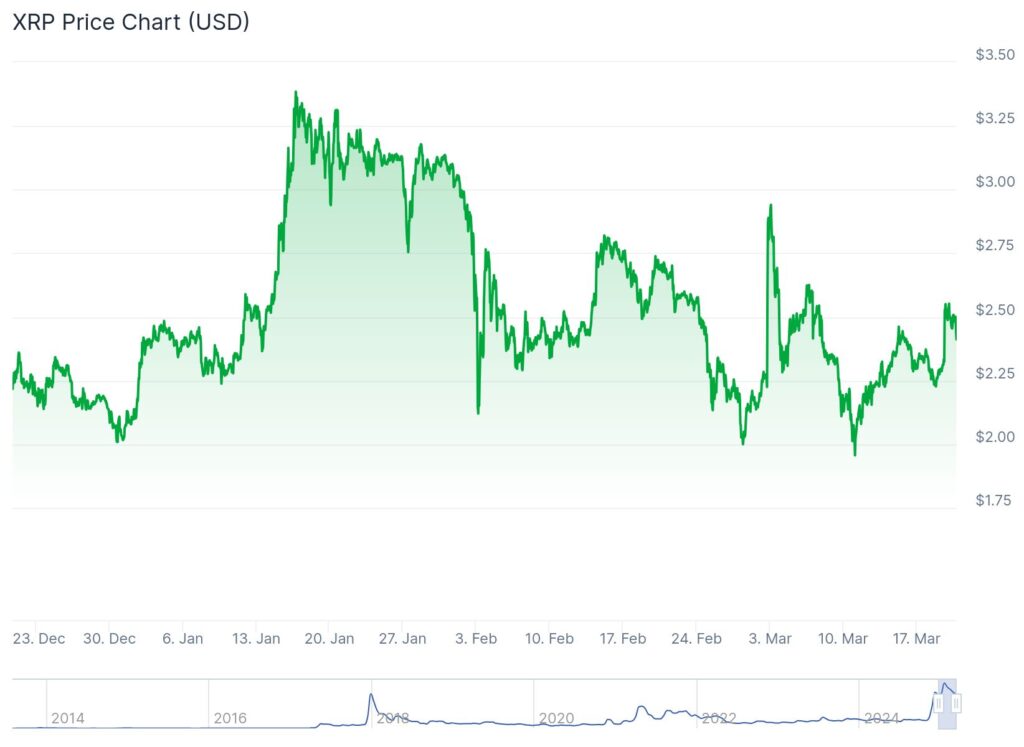
Following the news, XRP’s market value surged by over 10%, briefly surpassing $2.50. This regulatory clarity seems to have restored investor confidence. Capitalizing on this momentum, Chicago-based Bitnomial launched the first Commodity Futures Trading Commission (CFTC)-regulated XRP futures contracts in the U.S. These physically-settled futures, officially trading from March 20, offer traders actual XRP upon contract maturity, marking an essential integration of digital assets into regulated traditional finance.

The launch of XRP futures is expected to enhance market liquidity significantly. It will provide institutional investors and hedge funds with legitimate avenues for exposure to XRP, potentially contributing to broader acceptance and price stabilization in cryptocurrency markets.

Why Institutional Investors May Be Attracted to XRP

Institutional investors may now find XRP particularly attractive due to renewed regulatory clarity and its clearly defined legal status within the U.S. financial market. Unlike Bitcoin, which primarily derives its appeal from scarcity and status as “digital gold,” XRP’s attractiveness stems from its practical utility. As a bridge currency, it enables rapid, cost-efficient cross-border transactions. With SEC-related uncertainty removed, XRP stands uniquely positioned to facilitate financial institutions’ increasing interest in blockchain-based settlement solutions. It offers potentially faster transaction speeds and lower costs than traditional systems like SWIFT. Additionally, regulated XRP futures provide institutions with secure and compliant avenues to engage with XRP, further enhancing its investment appeal.

Source: Coingecko

Implications for XRP and the Crypto Market

Market analysts anticipate XRP could play a more significant role in crypto markets moving forward, potentially attracting substantial institutional investment and paving the way for mainstream financial integration. Optimistic forecasts have suggested XRP’s price could rise significantly, with some predictions reaching as high as $15. The emergence of regulated futures contracts could further stimulate demand, boosting investor confidence, and encouraging greater institutional adoption.

However, XRP’s future also faces potential challenges. Despite the current optimistic climate, skeptics highlight ongoing concerns about XRP’s real-world utility, given that practical applications beyond speculative investment remain limited. Further regulatory clarity will be critical in sustaining XRP’s market position. Uncertainty persists surrounding international regulatory environments and potential market volatility could pose risks to future growth.

A New Era of Regulatory Clarity

As XRP begins trading via regulated futures, the broader cryptocurrency sector is now watching closely, evaluating how this increased clarity and institutional support could shape digital asset markets in the years ahead. The Trump administration’s crypto-friendly policy is seen as fostering innovation, potentially placing the U.S. in a leading position within the global digital economy.

The coming months will prove critical, not only for XRP but for the entire crypto industry. XRP’s trajectory, boosted by newfound regulatory clarity, will serve as an essential benchmark for other cryptocurrencies navigating the complex interplay of innovation, regulation, and market adoption.

Readers’ frequently asked questions

What exactly are futures contracts, and why would investors use XRP futures specifically?

Futures contracts are agreements allowing investors to buy or sell an asset at a predetermined price on a specific date in the future. Investors use futures to hedge against price fluctuations or speculate on market movements without directly owning the underlying asset. In the case of XRP futures, institutional investors might use these contracts to safely participate in the cryptocurrency market through a regulated exchange, reducing the risks associated with directly holding digital currencies.

The SEC’s decision to drop the lawsuit has significantly clarified XRP’s legal status in the United States, making it safer for investors. However, individual investors should still exercise caution. Cryptocurrency markets remain volatile, and legal clarity in the U.S. doesn’t automatically resolve regulatory uncertainties internationally. Investors should stay informed about ongoing developments globally and carefully assess their risk tolerance before investing.

Why is XRP considered useful for cross-border payments, and how does it differ from traditional methods like SWIFT?

XRP facilitates cross-border payments by providing banks and financial institutions a faster, cheaper way to settle international transactions. Unlike traditional systems such as SWIFT, which can take days and incur higher fees, XRP transactions typically complete in seconds and at a fraction of the cost. XRP acts as a bridge currency that allows direct exchanges between different fiat currencies. It can simplify global transactions and reduce reliance on correspondent banking systems.

What Is In It For You? Action Items You Might Want to Consider

Consider Exploring XRP Futures

With regulated XRP futures now available via Bitnomial, you might want to explore this opportunity as a safer way to gain exposure to XRP. Trading regulated futures contracts can help you hedge your risks while benefiting from potential price appreciation.

Stay Updated on Institutional Moves

Keep a close eye on how institutional investors respond to XRP’s new legal clarity. Increased institutional activity could significantly impact XRP’s price movements, presenting valuable trading opportunities.

Watch for International Regulatory Updates

While the U.S. has clarified XRP’s status, international regulations remain uncertain. Regularly monitor global crypto regulatory news, as international developments could affect market sentiment and XRP’s future price stability.

SEC to Host Landmark Crypto Roundtable on March 21

SEC kicks of a roundtable series on crypto regulation.

The U.S. Securities and Exchange Commission (SEC) announced a pivotal roundtable event on March 21, 2025, to address the longstanding regulatory ambiguity surrounding cryptocurrencies. Titled “How We Got Here and How We Get Out – Defining Security Status”, the event will bring together regulators, legal experts, and industry leaders to examine the classification of digital assets under U.S. securities law. The roundtable will be live-streamed. The commission grants the public access to the discussions shaping the future of crypto regulation in the United States.

A Shift in the SEC’s Regulatory Approach

The upcoming roundtable signals a notable shift in the SEC’s stance toward the crypto industry. It moves from relying on enforcement actions to engaging directly with industry stakeholders. This changing approach reflects a broader policy shift within the SEC’s leadership, influenced by evolving views in the current administration.

In recent years, the SEC’s enforcement-driven approach, particularly under former SEC Chair Gary Gensler, was criticized for creating uncertainty within the crypto sector. The agency’s tendency to regulate through litigation left many industry participants without clear guidelines. The new roundtable suggests a potential pivot towards more open dialogue and regulatory clarity.

Part of a Broader Series of Discussions

This roundtable is the first in the SEC’s “Spring Sprint Toward Crypto Clarity” series, an initiative spearheaded by the agency’s Crypto Task Force. The series aims to foster ongoing dialogue between regulators and industry participants, addressing various aspects of cryptocurrency regulation. More sessions are expected to follow, indicating the SEC’s long-term commitment to engage with the crypto industry.

Key Discussion Points and Participants

The classification of digital assets under the Howey Test, the legal standard used to determine whether an asset qualifies as a security, will be at the heart of the discussions. Participants will explore whether current securities laws are sufficient for crypto assets or whether we need a new framework to address the complexities of blockchain-based financial instruments.

The event will feature a diverse panel of legal experts, policymakers, and industry leaders. It will also include representatives from leading blockchain firms and investment funds. Notably, legal experts such as Miles Jennings (General Counsel at a16z Crypto) and Sarah Brennan (General Counsel at Delphi Ventures) will provide insights on regulatory developments and potential pathways for compliance.

Market Reaction and Industry Impact

The crypto market responded positively to news of the SEC’s roundtable announcement. Bitcoin experienced a 3.5% surge, reaching $70,000 shortly after the news broke. Analysts suggest this reaction reflects investor optimism about potential regulatory clarity, paving the way for broader institutional adoption and innovation.

Industry leaders have also welcomed the initiative. They see it as a step toward resolving longstanding regulatory uncertainties that have hindered crypto businesses operating in the U.S. Market participants hope the roundtable will lead to more structured guidelines. Reducing the risk of regulatory crackdowns would foster a more stable growth environment.

Looking Ahead

The SEC’s willingness to engage in open dialogue with industry stakeholders marks a crucial moment for the crypto sector. Whether the discussions will lead to concrete regulatory changes remains to be seen. Nevertheless, the roundtable represents a step toward greater transparency and cooperation between regulators and the industry.

It is the first in a series of roundtables, and more discussions are expected in the coming months. With digital asset adoption continuously growing, the outcome of these events could have significant implications for investors, blockchain companies, and the broader financial market. All eyes will be on Washington, D.C., on March 21 as the SEC launches what could be a defining series in crypto regulation.

Dogecoin’s Price Drop Sparks Unprecedented Network Activity – What’s Next?

Dogecoin price down, network activity up

Despite Dogecoin’s recent price decline, the meme-inspired cryptocurrency is witnessing an unexpected surge in network activity. Blockchain data reveals that active addresses have reached a four-month high, signaling sustained user engagement even as DOGE’s price tumbles. This paradox raises critical questions: Is the increase in network activity an early indicator of a market rebound, or does it simply reflect the dedication of Dogecoin’s community? Meanwhile, financial experts warn that DOGE’s speculative nature, combined with declining prices and growing whale accumulation, could contribute to broader market instability.

Price Decline and Whale Accumulation: A Contradictory Landscape

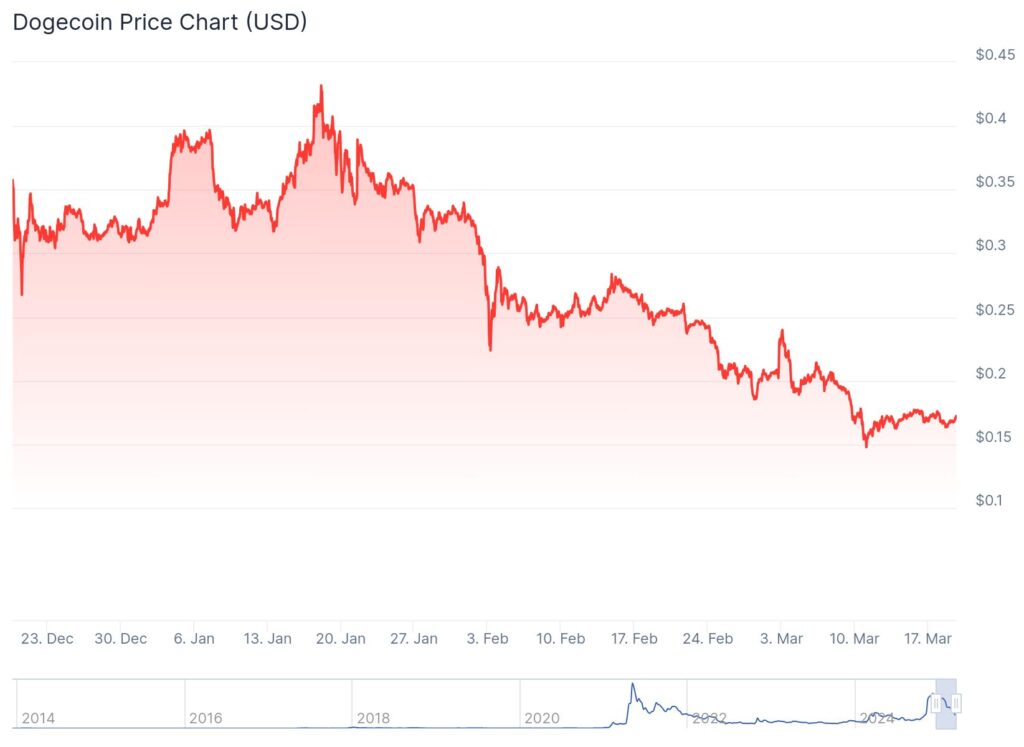
Dogecoin has been on a downward trajectory in recent weeks, aligning with the broader bearish trend in the cryptocurrency market. As of March 18, 2025, DOGE is trading at approximately $0.1683, a sharp decline from its November 2024 peak of $0.47. This drop follows Bitcoin’s 12.71% decrease in Q1 2025, as macroeconomic concerns – such as inflation fears and geopolitical instability – continue to impact risk-on assets.

However, while retail investors have been exiting positions, on-chain data shows that large DOGE whales have aggressively accumulated the token. In the past 72 hours, whales have acquired approximately 1.7 billion DOGE, signaling confidence in the asset’s potential recovery. Historically, increased whale accumulation has preceded significant price swings. It remains uncertain whether this trend points to a rebound or a strategic accumulation before another speculative cycle.

Dogecoin’s Surging Network Activity: A Positive Signal?

Despite its price struggles, Dogecoin’s blockchain metrics tell a different story. The number of active DOGE addresses has reached a four-month high, indicating increased transactional activity on the network. This suggests that more users are interacting with Dogecoin, whether for trading, payments, or transfers.

The increase in active addresses could be attributed to several factors:

  • Retail Participation: Lower prices may attract smaller investors, taking advantage of what they perceive as a discount.
  • On-Chain Transactions: With the rise in whale activity, large-scale transactions might be driving up address activity.
  • Memecoin Popularity: Despite its volatility, Dogecoin remains one of the most recognizable cryptocurrencies. It maintains a strong user base even in bearish conditions.

These network fundamentals present a compelling argument that Dogecoin’s utility and community-driven nature continue to sustain interest, regardless of price action.

Concerns Over Dogecoin’s Speculative Nature

While increased activity suggests resilience, financial analysts caution against interpreting this as a bullish sign. Some experts argue that Dogecoin’s lack of fundamental utility beyond speculation makes it a volatile asset. It’s prone to dramatic price swings.

Additionally, DOGE’s speculative nature has historically contributed to excessive market volatility, drawing comparisons to previous meme coin rallies that ended in sharp corrections. The concern is that while Dogecoin’s blockchain is active, much of this activity might not translate to long-term adoption but rather short-term speculation driven by whale accumulation and market hype.

What’s Next for Dogecoin?

The divergence between Dogecoin’s price drop and its rising network activity leaves the market at a crossroads. If whale accumulation continues and network engagement remains strong, DOGE could be setting the stage for another price surge. However, if broader market conditions remain bearish, this increase in activity could be a fleeting trend rather than a fundamental shift.

For now, traders and investors should monitor Dogecoin’s on-chain activity, whale movements, and macroeconomic trends to gauge whether this surge in engagement is a sign of recovery or just another chapter in Dogecoin’s unpredictable journey.

Readers’ frequently asked questions

What does it mean when active Dogecoin addresses reach a four-month high?

The increasing number of active addresses on the Dogecoin blockchain means more wallets are being used to send or receive DOGE within a specific timeframe. This could indicate that more people are trading or using Dogecoin for transactions. However, an increase in active addresses does not necessarily mean the price will rise. It only shows that more transactions are happening on the network. That could be due to various reasons such as increased trading activity, transfers between exchanges, or automated transactions by bots or large investors.

Why do large investors (whales) buy Dogecoin when the price is dropping?

Large investors, or “whales,” sometimes buy more Dogecoin when the price is falling because they believe it is undervalued and expect it to recover in the future. This strategy is known as accumulation, where investors purchase assets at lower prices to sell later at a profit. Another possible reason is that whales could be preparing for a future price movement, such as a rally driven by market events or social media trends. However, their actions do not guarantee price increases. They can also sell off their holdings later, leading to price drops.

Can Dogecoin’s price drop impact the overall crypto market?

Dogecoin’s price movements generally do not substantially impact the broader cryptocurrency market compared to Bitcoin or Ethereum, which have much larger market capitalizations and influence. However, Dogecoin is one of the most popular meme coins. Its volatility can affect market sentiment, particularly for similar cryptocurrencies like Shiba Inu. If Dogecoin experiences extreme price swings, it may influence short-term trading behavior among retail investors, but it is unlikely to trigger significant market-wide effects on its own.

What Is In It For You? Action Items You Might Want to Consider

Keep an Eye on Whale Activity

Large investors have been accumulating Dogecoin despite its recent price decline, signaling a potential price movement shortly. Monitoring on-chain data for large transactions and whale wallet activity can help you anticipate market trends and make informed trading decisions. If accumulation continues, it may indicate a future price recovery. But, if whales start offloading, be cautious of potential downward pressure.

Watch Key Resistance and Support Levels

Dogecoin’s price is currently facing resistance around the $0.19 level, with a potential downside risk if it breaks below $0.14. If you’re considering an entry or exit position, setting alerts for these price levels can help you react promptly to market shifts. Traders looking for a short-term opportunity might wait for confirmation of a breakout above resistance before entering, while those managing risk should be prepared for possible declines.

Stay Updated on Market Sentiment and External Influences

Dogecoin remains highly reactive to broader market trends, social media movements, and Bitcoin’s price action. Keeping track of macroeconomic news, regulatory updates, and sentiment shifts within the crypto community can provide valuable context for your trades. Since Dogecoin’s network activity is rising despite price drops, it’s worth monitoring whether this trend continues or fades. It could indicate either increasing adoption or short-lived speculative interest.

Strategy’s Bitcoin Obsession: How a Business Intelligence Giant Became a $40B Bitcoin Holding Company

Strategy ($MSTR) obsessed with Bitcoin?

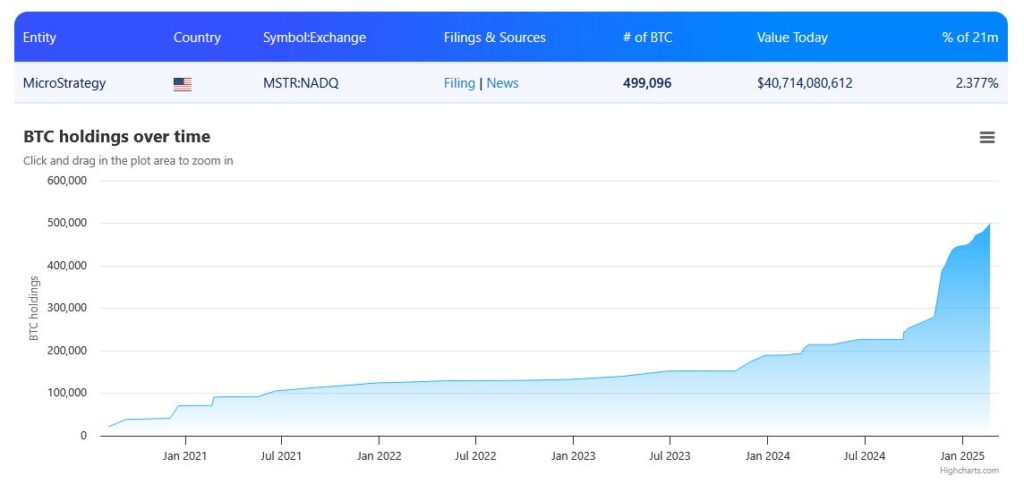
Once a leader in enterprise analytics, Strategy (formerly MicroStrategy) is now better known as the largest publicly traded corporate holder of Bitcoin, with nearly 500,000 BTC in its treasury. With over 20% of its workforce cut, research and development budgets slashed, and a relentless stock dilution strategy to finance Bitcoin purchases, the company has seemingly transformed into a high-stakes Bitcoin ETF in disguise. Is this a visionary long-term bet, or has Strategy sacrificed its core business at the altar of digital gold?

From Enterprise Analytics to Bitcoin Titan

Founded in 1989, Strategy built its reputation as a business intelligence (BI) software provider, helping Fortune 500 companies, government agencies, and financial institutions analyze large datasets. Its flagship product, MicroStrategy ONE, competed with industry leaders like Tableau (Salesforce), Power BI (Microsoft), and Looker (Google).

However, in August 2020, under the leadership of co-founder and chairman Michael Saylor, Strategy took an unprecedented turn. Citing concerns over inflation and currency devaluation, the company adopted Bitcoin as its primary treasury reserve asset and began aggressively purchasing BTC. This decision would reshape the company’s future, turning it into a Bitcoin-centric financial entity rather than a pure-play software firm.

How Strategy Funds Its Bitcoin Empire

Unlike traditional corporate Bitcoin buyers like Tesla or Block (formerly Square), using excess cash for crypto investments, Strategy has relied on debt issuance, stock sales, and convertible securities to fund its Bitcoin purchases.

  • Stock Dilution: The company has repeatedly raised capital through at-the-market (ATM) stock offerings, selling shares to finance further Bitcoin buys. In its most recent move, Strategy announced a $21 billion preferred stock issuance with a 9% yield, further fueling its Bitcoin acquisition strategy.
  • Convertible Debt: Over the past four years, the company has issued multiple rounds of convertible notes, raising billions of dollars.
  • Corporate Bonds: Strategy has leveraged corporate bonds and private placements to increase its Bitcoin holdings without needing to liquidate existing assets.

As of March 2025, Strategy holds approximately 499,226 BTC, purchased at an average price of $66,360 per Bitcoin.

Source: https://treasuries.bitbo.io/microstrategy/

Operational Changes: Is Strategy Abandoning Business Intelligence?

Significant structural changes accompanied Strategy’s pivot to Bitcoin. In 2024, the company cut 20.7% of its workforce, reducing its headcount from 1,934 to 1,534 employees. These layoffs primarily affected research and development, consulting, and sales and marketing. That indicates a reduced focus on its enterprise analytics business.

Although MicroStrategy ONE remains available, the reduced investment in R&D and sales raises concerns about its long-term competitiveness. In a BI market dominated by well-funded rivals like Microsoft, Google, and Salesforce, Strategy’s software business may struggle to keep pace. It could potentially make the company more reliant on Bitcoin-driven financial strategies.

Financial Risks: A Bitcoin Bet with High Stakes

Strategy’s aggressive Bitcoin accumulation strategy has led to extreme stock volatility. Its shares have seen both massive rallies and sharp declines, tracking Bitcoin’s price movements.

Key Risks:

Stock Volatility: Strategy’s stock (MSTR) now became a Bitcoin proxy, often moving in tandem with BTC prices. This exposes investors to crypto market fluctuations, rather than the traditional stability expected from an enterprise software firm.

Leverage and Debt Exposure: The company’s debt-fueled Bitcoin strategy could become a liability if Bitcoin prices drop significantly. Convertible debt and high-yield stock issuances create long-term obligations that could strain financial flexibility.

New Tax Liabilities: Recent U.S. accounting rule changes now allow companies to report real-time Bitcoin market values. While this benefits firms with unrealized gains, it may also subject Strategy to a corporate alternative minimum tax on its $18 billion in unrealized Bitcoin profits, unless IRS exemptions apply.

Regulatory Uncertainty: The evolving U.S. regulatory landscape could impact corporate Bitcoin holdings, and taxation, or even impose new restrictions on how public companies can manage crypto assets.

Conclusion: A Corporate Visionary or a Bitcoin Gambler?

Strategy’s transformation from an enterprise analytics company into a Bitcoin-centric financial entity is one of the most radical shifts in corporate history. While Michael Saylor champions Bitcoin as superior to cash, the company’s reliance on debt, stock dilution, and extreme market volatility presents significant financial risks.

Is Strategy on the cutting edge of financial innovation, or has it sacrificed its core business for a speculative bet on Bitcoin? Only time will tell if this bold strategy secures long-term dominance or exposes the company to catastrophic financial risk.

Readers’ frequently asked questions

What does it mean that Strategy uses Bitcoin as a “treasury reserve asset”? How is this different from how other companies hold cash?

When companies hold a treasury reserve asset, they keep a portion of their financial reserves in a specific store of value rather than traditional cash or bonds. Most corporations hold cash in bank accounts or short-term government securities for stability and liquidity.

Strategy, however, chooses to hold Bitcoin instead of cash. The company believes that BTC will appreciate over time while fiat currencies lose value due to inflation. So, instead of keeping billions of dollars in cash reserves like Apple or Microsoft, Strategy continuously converts its spare cash – and even borrowed money – into Bitcoin. This is an unconventional approach because Bitcoin is far more volatile than cash. Strategy’s financial strength fluctuates based on BTC’s market price.

If Strategy’s stock is tied to Bitcoin, why not just buy Bitcoin directly instead of investing in Strategy’s shares?

Buying Strategy’s stock (MSTR) instead of Bitcoin appeals to investors who want exposure to Bitcoin without directly holding crypto. There are a few reasons for this:

Regulatory and Security Concerns – Some institutional and traditional investors are restricted from buying Bitcoin directly due to regulations or corporate policies. Buying MSTR allows them to gain indirect exposure to BTC without dealing with crypto exchanges, wallets, or custody issues.

Leverage on Bitcoin Price Movements – Strategy’s stock can sometimes amplify Bitcoin’s price movements. If BTC rises, MSTR often outperforms BTC due to investor speculation. However, this works both ways – if Bitcoin drops, MSTR can fall even more sharply.

Tax and Retirement Account Benefits – Some investors prefer stocks over Bitcoin because MSTR can be held in tax-advantaged accounts, such as IRAs and 401(k)s. Direct Bitcoin holdings may not have the same benefits.

That said, Strategy is not an ETF, meaning its stock price can sometimes trade at a premium or discount compared to Bitcoin’s actual value. Investors looking for pure Bitcoin exposure often choose Bitcoin ETFs instead of MSTR.

Why does Strategy keep buying Bitcoin instead of diversifying into other cryptocurrencies or assets?

Strategy’s Bitcoin-focused strategy is driven by Michael Saylor’s firm belief that Bitcoin is the best store of value in the world. Unlike other cryptocurrencies, Bitcoin is widely recognized as digital gold. It has the largest market capitalization, the strongest security, and a well-established regulatory framework compared to alternative crypto assets. Saylor has repeatedly stated that altcoins are too risky due to regulatory concerns and technological uncertainties. To him, Bitcoin is the only asset worthy of the company’s treasury strategy.

Additionally, Bitcoin’s scarcity (capped at 21 million coins) and its growing institutional adoption align with Strategy’s long-term vision. Diversifying into other assets like Ethereum or equities would dilute this vision and expose the company to additional risks, such as regulatory crackdowns on unregistered securities. Unlike hedge funds or trading firms, Strategy is not actively trading Bitcoin. It buys and holds, expecting BTC to appreciate over time.

What Is In It For You? Action Items You Might Want to Consider

Monitor Strategy’s Stock (MSTR) as a Bitcoin Proxy

If you’re trading Bitcoin but looking for alternative ways to gain exposure, keep an eye on Strategy’s stock (MSTR). It often amplifies Bitcoin’s price movements, meaning it can present trading opportunities when BTC is trending. If Bitcoin surges, MSTR may outperform BTC due to investor speculation. However, during corrections, MSTR tends to drop even harder. Use this correlation to your advantage – when Bitcoin enters an accumulation phase, MSTR might be an attractive leveraged play.

Track Strategy’s Capital Raises – They Can Signal Buying Pressure for BTC

Strategy funds its Bitcoin purchases through stock offerings, convertible debt, and corporate bonds. When the company announces a new capital raise, it’s a strong signal that they’re preparing to buy more Bitcoin. That may drive BTC prices up. If you’re trading Bitcoin, watch for these announcements – they often coincide with short-term market momentum shifts. Entering trades before or shortly after a Strategy purchase could allow you to ride a BTC price bump.

Prepare for Volatility – MSTR and BTC Moves Can Be Exaggerated

Whether you trade Bitcoin or stocks, remember that Strategy’s leveraged Bitcoin strategy magnifies volatility. When Bitcoin drops, MSTR can fall even more aggressively, and when BTC rallies, MSTR tends to overshoot gains. If you’re trading MSTR, tight stop-losses and risk management are crucial. If you’re trading Bitcoin, be aware that Strategy’s financial maneuvers – like debt-funded Bitcoin buys – can create market reactions that aren’t purely organic. Stay ahead by watching both the crypto and equity markets for cross-impact opportunities.

- Advertisement -

FEATURED