Home Blog Page 140

UniLend Finance Exploited: $197,000 Lost in Smart Contract Vulnerability

UniLend exploit drains $197,000 in a DeFi breach, exposing vulnerabilities in smart contracts

The decentralized finance (DeFi) ecosystem encountered another challenge on January 12, 2025. UniLend Finance, a prominent Ethereum-based protocol, fell victim to a significant exploit resulting in a loss of nearly $197,000. This breach, rooted in a vulnerability within the protocol’s share price calculation mechanism, once again highlights the persistent security risks associated with DeFi platforms.

Details of the Exploit

According to blockchain security firms like SlowMist and TenArmorAlert, the attacker exploited the share price calculation flaw in UniLend’s smart contract. By artificially inflating the value of their collateral, the attacker deposited assets such as USDC and stETH, manipulated the system to borrow the entire pool of stETH, and redeemed their initial deposits without repaying the borrowed tokens. This strategic manipulation drained the liquidity pool, leaving the platform reeling from the loss.

UniLend’s Response and Security Measures

The UniLend Finance team responded swiftly by collaborating with blockchain security experts to analyze the incident and address the vulnerability. Preliminary assessments confirmed the exploit’s methodology and its impact on the platform’s liquidity. While efforts to mitigate such attacks are underway, the breach has sparked a broader conversation about the inherent risks associated with DeFi protocols and the need for rigorous security measures.

https://twitter.com/SlowMist_Team/status/1878651772375572573

Implications for the DeFi Ecosystem

The incident serves as a stark reminder of the evolving sophistication of DeFi exploits. As the DeFi sector continues to grow, so do the complexities of its smart contracts. That makes them lucrative targets for attackers. This particular exploit underscores the critical importance of comprehensive smart contract audits and proactive monitoring. Platforms must identify and patch vulnerabilities before bad actors can exploit them.

UniLend’s case is not an isolated event. It is part of a troubling trend in the DeFi ecosystem, with smart contract vulnerabilities leading to significant losses for platforms and users. Despite the promise of decentralization and transparency, the sector remains vulnerable to technical flaws, undermining user trust and the industry’s credibility.

The Way Forward

Moving forward, the focus must shift toward fortifying DeFi infrastructure through enhanced security practices. Regular audits, real-time vulnerability assessments, and rapid incident response mechanisms must become the norm. While UniLend Finance works to rebuild its defenses and restore user confidence, the broader DeFi community must take lessons from this exploit to prevent similar incidents from tarnishing the reputation of decentralized finance.

Readers’ frequently asked questions

What is a smart contract?

A smart contract is a self-executing program stored on a blockchain that automatically enforces the terms of an agreement between parties. In DeFi, smart contracts manage key functions like lending, borrowing, and trading without the need for intermediaries. They run exactly as programmed, but an error or vulnerability in the code can be exploited, as seen in the UniLend Finance case.

What does “liquidity pool” mean in DeFi?

A liquidity pool is a collection of cryptocurrency tokens locked in a smart contract to facilitate trading, lending, and borrowing on a DeFi platform. Users contribute assets to these pools and earn rewards, like fees or interest, in return. When a liquidity pool is drained during an exploit, like in the UniLend incident, the funds contributed by users are stolen, disrupting the platform’s operations.

Can stolen funds be recovered in DeFi?

Recovering stolen funds in DeFi is very difficult because transactions on blockchains are immutable (cannot be changed) and often pseudonymous. Once an attacker transfers stolen assets, they may use tools to obscure their identity or move the funds across multiple platforms. Recovery is nearly impossible. Prevention through robust smart contract security is critical to avoid such losses.

What Is In It For You? Action Items You Might Want to Consider

Research Platform Security Before Investing

Before depositing funds into any DeFi platform, take the time to review its security measures. Look for audit reports from reputable firms and check whether the platform has a history of vulnerabilities or exploits. Understanding the platform’s track record can help you minimize risks to your investments.

Diversify Your Assets Across Multiple Protocols

Avoid putting all your funds into a single DeFi platform. Spread your investments across multiple platforms and projects to reduce the impact of a potential exploit. Diversification is a key strategy for safeguarding your crypto portfolio against unforeseen events.

Stay Informed About Platform Updates and Risks

Follow official communication channels of the DeFi platforms you use, including blogs, social media, and community forums. Being aware of updates, audits, or reported vulnerabilities will help you act quickly if a security issue arises, protecting your funds from potential losses.

FTX EU’s Revival: Can Backpack Bring Regulated Crypto Derivatives Back to Europe?

Backpack Exchange has unveiled bold ambitions to revive the European cryptocurrency market following its acquisition of FTX EU, the European subsidiary of the bankrupt FTX platform. By leveraging FTX EU’s MiFID II license, Backpack seeks to reintroduce regulated cryptocurrency derivatives, such as perpetual futures, to traders in Europe. However, the road ahead is far from smooth. However, the transaction has become a focal point of legal and regulatory scrutiny. FTX bankruptcy estate is challenging the legitimacy of the acquisition, raising concerns about the handling of customer funds.

Ambitious Plans for European Expansion

Backpack Exchange, founded by former FTX and Almeda Research employees, acquired FTX EU for $32.7 million. They positioned the purchase as a strategic move to establish a strong foothold in Europe. The acquisition includes the MiFID II license, which enables them to offer regulated financial products. That is a rarity in the largely unregulated crypto trading landscape.

“We believe this acquisition positions us to provide safe, regulated access to cryptocurrency derivatives,” a representative for Backpack stated. It emphasizes the potential to rebuild trust in a market shaken by the collapse of FTX. The exchange also committed to a court-supervised claims process to ensure former FTX EU customers receive restitution.

https://twitter.com/Backpack/status/1876549869055431010

The Conflict Over Legitimacy

Despite Backpack’s optimism, the FTX bankruptcy estate has questioned the transaction. According to the estate, the sale was unauthorized and conducted without prior approval from the U.S. Bankruptcy Court. They argue that any changes in ownership or management require explicit court consent. Further, they have warned that Backpack cannot legally distribute funds to FTX EU’s customers.

In response, Backpack claims the deal adhered to all regulatory requirements. They point to approvals from the Cyprus Securities and Exchange Commission (CySEC) and German court documentation as evidence of its legitimacy. CySEC has acknowledged the transaction but maintains that FTX EU’s license remains suspended. That prevents the entity from onboarding new clients or providing investment services.

Regulatory and Operational Challenges

Backpack’s primary hurdle is the reactivation of FTX EU’s MiFID II license, which has been suspended by CySEC since the collapse of its parent company. Under current conditions, FTX EU is limited to facilitating the return of funds to existing clients. Its operational future hinges on regulatory approval.

Experts in the field note that the reactivation process will likely face significant scrutiny. Regulators will evaluate Backpack’s ability to comply with stringent European financial rules, as well as its capacity to safeguard customer funds and maintain transparency in its operations. The company has indicated it hopes to resume full operations in Q1 2025. However, achieving this timeline depends heavily on regulatory green lights.

Implications for Customers and the Market

One of the central issues in the dispute is the handling of customer restitution. Backpack has pledged to return funds to former FTX EU customers through a structured bankruptcy claims process. However, the FTX bankruptcy estate has expressed concerns over the lack of transparency and legal clarity surrounding this promise.

If successful, Backpack’s revival of FTX EU could mark a significant milestone for the crypto market in Europe. By reintroducing regulated crypto derivatives, the company aims to attract institutional and retail traders seeking a compliant and secure trading environment. This would provide a much-needed boost to the reputation of cryptocurrency exchanges, particularly in light of the scandals that have plagued the industry in recent years.

Broader Implications for the Crypto Industry

The ongoing conflict underscores the complexities involved in acquiring distressed crypto assets, particularly entities under regulatory oversight. It also highlights the challenges of balancing customer protection, regulatory compliance, and business innovation in a volatile and fast-evolving industry.

Backpack’s success – or failure – in overcoming these challenges will set a precedent for how the crypto industry navigates future acquisitions of bankrupt entities. As the European market looks for stability and growth, all eyes are on Backpack to see if it can turn FTX EU into a blueprint for a regulated and trustworthy crypto trading platform.

Backpack’s acquisition of FTX EU is a bold move that promises to reshape Europe’s crypto trading landscape but comes with significant hurdles. As legal disputes and regulatory challenges mount, the future of the deal remains uncertain. Yet, if Backpack manages to fulfill its vision, it could set a new standard for transparency and compliance in the cryptocurrency industry. Can they restore the faith in a market still reeling from the fallout of FTX’s collapse?

Readers’ frequently asked questions

What is MiFID II, and why is it important for FTX EU’s revival?

MiFID II, short for the Markets in Financial Instruments Directive II, is a set of regulations introduced by the European Union to enhance transparency, investor protection, and the overall integrity of financial markets. For cryptocurrency exchanges like FTX EU, possessing a MiFID II license means they can legally offer financial products like derivatives, including perpetual futures, in Europe. This is significant because regulated offerings build trust among institutional and retail investors, particularly after scandals like FTX’s collapse. Without an active MiFID II license, FTX EU cannot operate fully. Hence, its suspended status remains a major hurdle for Backpack’s plans to restore the platform.

What does the suspension of FTX EU’s license mean for customers?

The suspension of FTX EU’s license by the Cyprus Securities and Exchange Commission (CySEC) restricts the entity from onboarding new clients or offering any investment services. However, it does allow the company to facilitate refunds to existing clients who were affected by FTX’s collapse. For customers, this means they cannot yet use the platform for trading or investing. Nevertheless, they can potentially recover funds through the structured claims process Backpack has promised to implement. It’s important to note that reactivating the license is critical for FTX EU’s ability to resume operations and for Backpack’s broader expansion plans for Europe.

How does the dispute between Backpack and the FTX bankruptcy estate affect customers?

The dispute between Backpack and the FTX bankruptcy estate centers on the legality of Backpack’s acquisition of FTX EU and its authority to manage customer funds. If the court rules that the sale was unauthorized, it could delay the restitution process for former FTX EU customers. Likely, additional legal proceedings might be required to resolve the matter. Customers should stay informed about the court’s decisions. These rulings will determine whether Backpack can follow through on its commitments. In the meantime, customers may need to monitor official updates and ensure they participate in any court-sanctioned claims process to recover their funds.

What Is In It For You? Action Items You Might Want to Consider

Stay Updated on FTX EU’s Licensing Status

Keep an eye on announcements from the Cyprus Securities and Exchange Commission (CySEC) and Backpack Exchange regarding the reactivation of FTX EU’s MiFID II license. The timeline for Backpack’s planned operations depends heavily on this regulatory approval. It will determine when and if the platform can offer regulated crypto derivatives in Europe. Knowing when these changes occur could help you plan your trading strategies or explore new opportunities.

Evaluate the Risks of Using FTX EU Under New Ownership

If you’re considering trading on FTX EU once it resumes operations, take time to assess the platform’s compliance with regulatory standards and the security of its offerings. Backpack Exchange promises a compliant and trustworthy environment, but due diligence is crucial. Look for clear communication about fund safety, the claims process for former FTX customers, and how the platform plans to avoid past pitfalls.

Explore Alternative Regulated Platforms While Waiting

Given the suspension of FTX EU’s license, consider exploring other regulated cryptocurrency exchanges for your trading needs. Platforms with active licenses under MiFID II or similar regulatory frameworks can provide a safer and more transparent trading environment in the interim. Staying active in the market while waiting for FTX EU’s reactivation ensures you don’t miss out on opportunities in the fast-moving crypto space.

The Middle East’s Blockchain Revolution: DAMAC’s $1 Billion Deal with MANTRA

DAMAC and MANTRA enter asset tokenization partnership.

The Middle East continues to assert its position as a global blockchain hub, and the recent $1 billion collaboration between Dubai-based DAMAC Group and blockchain platform MANTRA further solidifies this trajectory. This partnership underscores the United Arab Emirates’ commitment to pioneering blockchain innovation while setting the stage for asset tokenization to become a central force in the region’s financial landscape. By combining DAMAC’s extensive real-world asset portfolio with MANTRA’s blockchain expertise, this deal seeks to transform traditional asset management into a transparent, liquid, and accessible digital ecosystem.

DAMAC and MANTRA: Pioneering Asset Tokenization

DAMAC Group is known for its diverse portfolio in real estate, hospitality, and data centers. It has long been a beacon of innovation in the region. The partnership with MANTRA, a blockchain platform specializing in tokenized real-world assets (RWAs), marks a bold step forward in integrating blockchain into traditional finance. With this agreement, DAMAC will tokenize its high-value assets to make them digitally tradeable on the MANTRA Chain by early 2025.

The tokenization process involves converting a tangible asset into digital tokens on a blockchain. That allows fractional ownership, enhances liquidity, and global investors can trade seamlessly. Apart from diversifying its investment base, it also provides DAMAC with unprecedented transparency and security in asset management.

A Strategic Move in the Blockchain Landscape

This partnership aligns with the UAE’s vision of becoming a global leader in digital assets and blockchain technology. The UAE government has consistently promoted favorable regulations to attract blockchain projects, creating a thriving ecosystem for innovation. The DAMAC-MANTRA collaboration reflects the region’s strategic intent to blend traditional industries like real estate with cutting-edge technology.

Experts view this deal as a pivotal moment for blockchain adoption in the Middle East. By integrating blockchain into real-world industries, the partnership showcases the region’s ability to embrace disruptive technologies to enhance economic growth and attract global investment.

Technological Disruption Meets Financial Innovation

For blockchain enthusiasts, this partnership is a testament to the transformative power of asset tokenization. Real-world asset tokenization democratizes access to high-value investments, making them available to a broader range of investors. It also addresses inefficiencies in traditional finance, such as illiquidity and lack of transparency.

DAMAC’s decision to leverage MANTRA’s blockchain infrastructure highlights the increasing convergence of traditional industries and decentralized technology. Blockchain-based tokenization provides the tools to streamline processes, reduce costs, and create a more inclusive investment environment.

Challenges and Future Outlook

While the partnership holds immense promise, experts caution that challenges remain. Regulatory clarity, investor education, and adoption hurdles could slow down the rollout of tokenized assets. However, the UAE’s proactive approach to fostering blockchain innovation is expected to mitigate these risks.

The DAMAC-MANTRA deal is a significant step forward in positioning the Middle East as a global blockchain powerhouse. By blending traditional assets with cutting-edge blockchain solutions, the region is not only redefining its financial landscape but also setting a precedent for other markets to follow.

As the Middle East continues its blockchain revolution, the $1 billion collaboration between DAMAC and MANTRA is a landmark achievement. It reinforces the UAE’s ambition to lead in the digital asset space and highlights blockchain’s potential to disrupt and enhance traditional finance. For investors, innovators, and policymakers, this partnership is a glimpse into the future of a more connected, transparent, and inclusive global financial system.

Readers’ frequently asked questions

What exactly does tokenizing real-world assets mean, and how does it work?

Tokenizing real-world assets involves converting physical or tangible assets, such as real estate, art, or commodities, into digital tokens recorded on a blockchain. These tokens represent a share or ownership in the asset. It allows investors to buy, sell, or trade fractional portions of it, much like shares in a company. For example, in DAMAC’s case, their real estate properties could be divided into tokens that investors can purchase without buying an entire property. This process uses blockchain technology to ensure transparency, security, and the ability to trade these tokens globally. It reduces traditional barriers like high costs and geographical restrictions.

How does this partnership benefit investors compared to traditional real estate investments?

The DAMAC-MANTRA partnership offers several advantages over traditional real estate investments. First, tokenization increases accessibility by allowing fractional ownership. Investors can own a small share of a high-value asset rather than needing to buy the entire property. This lowers the entry barrier for investors who might not have the capital for full-scale property investment. Second, blockchain-based tokens are easily tradeable, providing liquidity that traditional real estate investments lack. Instead of waiting months to sell a property, investors can quickly trade tokens on a digital marketplace. Finally, using blockchain ensures that transactions are transparent and secure, reducing risks like fraud and simplifying the management of assets.

What challenges could arise with tokenizing assets like real estate?

While tokenization offers significant benefits, it is not without challenges. A primary concern is regulatory uncertainty. Different countries have varying rules for blockchain-based investments, and navigating this patchwork of regulations can be complex. Additionally, potential investors need to be educated about tokenized assets. Many are unfamiliar with how blockchain works or how to participate in digital marketplaces. Another challenge is ensuring that tokenized assets remain legally enforceable. Owning a token must equate to owning rights in the physical asset. Lastly, the technology itself needs robust infrastructure to manage large-scale adoption. It must be secure and scalable to prevent issues like fraud or system failures.

What Is In It For You? Action Items You Might Want to Consider

Explore Tokenized Real Estate Opportunities

Consider diversifying your portfolio by investing in tokenized real estate assets. With DAMAC’s partnership with MANTRA, introducing blockchain-based tokens tied to high-value assets offers a way to enter the real estate market without the need for large capital outlays. Keep an eye on updates from MANTRA Chain about token availability in 2025. Assess how these assets align with your investment goals.

Stay Updated on Middle Eastern Blockchain Trends

The UAE is rapidly becoming a global hub for blockchain innovation, and partnerships like DAMAC-MANTRA indicate significant regional growth. As a trader, staying informed about developments in the Middle East can help you identify emerging opportunities in tokenized assets and other blockchain-based financial instruments. Follow updates on regulatory frameworks and market expansions in the region to make informed decisions.

Evaluate the Liquidity Benefits of Tokenization

Liquidity is a key advantage of tokenized assets. Unlike traditional real estate, which can take months to sell, tokenized properties offer faster transactions on blockchain-based marketplaces. As a trader, consider how this enhanced liquidity could fit into your trading strategies, especially if you’re looking for quicker turnaround opportunities. Research platforms that facilitate the trading of tokenized assets and prepare to engage with this evolving market.

Kazakhstan Cracks Down on Crypto Crime: Over 3,500 Illegal Exchanges Blocked in Sweeping Operation

Kazakhstan is cracking down on illegal cryptocurrency exchanges.

Kazakhstan has escalated its efforts against unregulated cryptocurrency activities, blocking over 3,500 unauthorized online exchanges and freezing millions in digital assets. Spearheaded by the Financial Monitoring Agency (FMA) in collaboration with other governmental bodies, this sweeping operation reflects the country’s determination to combat money laundering and illicit transactions. As Kazakhstan tightens its regulatory grip on the rapidly evolving crypto sector, these measures reveal both, the opportunities and the challenges for stakeholders navigating this complex landscape.

A Sweeping Crackdown on Illegal Crypto Activities

In an unprecedented crackdown, the FMA partnered with the National Security Committee and the Ministry of Culture and Information to disrupt thousands of unlicensed cryptocurrency exchanges. The operation also targeted 36 offline exchanges, collectively handling over $112 million in turnover. Authorities froze approximately $4.8 million in digital assets, further emphasizing the operation’s scope and effectiveness.

Beyond shutting down exchanges, the campaign dismantled two significant cryptocurrency-based pyramid schemes that defrauded numerous investors. Authorities recovered 545,000 USDT and froze an additional 120,000 USDT. These efforts underscore the growing misuse of cryptocurrency platforms for fraud and money laundering, highlighting the urgent need for enhanced regulatory measures.

Regulatory Efforts and Their Implications

Kazakhstan’s actions align with a broader initiative to synchronize its cryptocurrency ecosystem with international anti-money laundering (AML) standards. According to the FMA, unregulated platforms often lack robust Know Your Customer (KYC) protocols and fail to monitor suspicious transactions, making them attractive to cybercriminals and drug traffickers. To address these vulnerabilities, the FMA is working with global partners to strengthen regulatory frameworks and promote accountability.

Currently, cryptocurrency exchanges in Kazakhstan are confined to operating within the Astana International Financial Centre (AIFC), a special economic zone designed to provide a regulated environment for digital asset services. The country’s 21 licensed service providers include major platforms such as Binance and Bybit. However, the National Bank of Kazakhstan has signaled plans to broaden cryptocurrency access beyond the AIFC’s jurisdiction, drawing inspiration from regulatory strategies adopted by neighboring nations.

Positive Outcomes: A Safer Crypto Landscape

The crackdown has been widely lauded for its potential to create a safer and more transparent cryptocurrency market in Kazakhstan. By targeting illicit platforms, the government aims to protect investors, deter fraudulent schemes, and reinforce compliance with AML laws. These efforts enhance Kazakhstan’s credibility as a serious player in the global crypto economy, strengthening trust among international stakeholders and positioning the country as a key player in the digital asset ecosystem.

Challenges: Balancing Oversight and Innovation

While these measures address critical security concerns, they also raise questions about their impact on innovation and legitimate cryptocurrency activities. Critics argue that overly restrictive policies and excessive reliance on the AIFC as the sole regulated hub may stifle broader adoption and deter entrepreneurs and investors from entering Kazakhstan’s crypto market. Finding the right balance between rigorous oversight and fostering a thriving innovation ecosystem remains a pressing challenge.

Balancing Regulation and Growth

Kazakhstan’s path forward requires a strategic balance between enforcing regulatory compliance and encouraging growth in the crypto sector. While combating illicit activities is essential, the government must also prioritize policies that support the development of legitimate businesses. Expanding regulated opportunities beyond the AIFC and addressing bottlenecks in accessibility will be critical in positioning Kazakhstan as a global leader in the cryptocurrency space.

Kazakhstan’s aggressive crackdown on illegal cryptocurrency activities marks a significant milestone in its regulatory evolution. The government has taken decisive steps to protect investors and curb financial crimes by prioritizing security and compliance. However, the long-term success of these efforts will hinge on maintaining a balance between strict enforcement and fostering innovation.

As the global crypto landscape continues to evolve, Kazakhstan’s actions serve as a valuable case study in the complexities of regulating this dynamic industry. By addressing challenges strategically and nurturing a supportive environment for legitimate businesses, Kazakhstan has the potential to emerge as a model for effective crypto regulation, blending robust oversight with sustainable growth and innovation.

Readers’ frequently asked questions

What is money laundering, and why is it a concern in the cryptocurrency industry?

Money laundering is the process of disguising the origins of illegally obtained funds to make them appear legitimate. In the cryptocurrency industry, this is a major concern. Digital assets can be transferred across borders quickly and often without sufficient oversight. That makes it easier for criminals to hide illicit gains. Unregulated exchanges are particularly vulnerable to this because they may not enforce identity checks or monitor suspicious transactions. Therefore Kazakhstan focuses on shutting down illegal exchanges that fail to comply with anti-money laundering (AML) regulations.

What is the significance of KYC protocols in cryptocurrency exchanges?

Know Your Customer (KYC) protocols require cryptocurrency exchanges to verify the identity of their users. Typically, they would collect official identification documents. These protocols are essential because they help exchanges identify potential risks, such as fraudulent activity or money laundering. They ensure compliance with regulatory standards. In Kazakhstan, the lack of KYC measures on illegal exchanges was a major factor in the government’s crackdown. Cybercriminals often exploited these platforms. For users, engaging with exchanges that implement KYC ensures a safer trading environment. It reduces the risk of participating in illicit activities unknowingly.

How can someone tell if a cryptocurrency exchange is operating legally in Kazakhstan?

In Kazakhstan, legitimate cryptocurrency exchanges must operate within the Astana International Financial Centre (AIFC), a regulated environment for digital asset services. These exchanges must hold licenses issued by the relevant authorities. Examples of licensed platforms include Binance and Bybit. To verify an exchange’s legitimacy, users can check its licensing status through the AIFC’s official directory. They can also consult the Financial Monitoring Agency (FMA) for updates on compliant service providers.

What Is In It For You? Action Items You Might Want to Consider

Verify the Licensing Status of Your Exchange

Before trading or investing in cryptocurrencies, ensure the platform you use is licensed and operates within a regulated framework. In Kazakhstan, exchanges must be registered under the Astana International Financial Centre (AIFC). Check the exchange’s credentials and confirm its licensing status to safeguard your assets and avoid potential legal or financial issues.

Avoid Platforms Without Strong KYC Measures

When choosing a cryptocurrency exchange, prioritize those that enforce strict Know Your Customer (KYC) protocols. Platforms that require identity verification are less likely to be involved in fraudulent activities or targeted by cybercriminals. Avoiding exchanges that skip KYC processes can protect your funds and keep you on the right side of regulations.

Stay Updated on Regulatory Changes

Regulations in the crypto industry evolve rapidly, and staying informed can help you make smarter trading decisions. Monitor announcements from Kazakhstan’s Financial Monitoring Agency (FMA) or similar bodies in your region to understand new rules, expanded opportunities, or restrictions. Being proactive ensures you can adapt quickly to changes and avoid disruptions in your trading activities.

Bitcoin Turns Sweet 16: A Journey from Experiment to Global Phenomenon

Bitcoin turns 16.

On January 3, 2009, the world witnessed the birth of Bitcoin. Pseudonymous figure Satoshi Nakamoto launched the first decentralized cryptocurrency. By mining the “Genesis Block,” Nakamoto embedded a now-iconic message: “The Times 03/Jan/2009 Chancellor on brink of second bailout for banks.” This subtle reference to the 2008 financial crisis underscored Bitcoin’s mission: to offer an alternative to traditional monetary systems and empower individuals in an era of economic uncertainty.

The Early Years: A Niche Experiment

In its early days, Bitcoin was little more than an experiment discussed among cryptographers and tech enthusiasts in online forums. Its first real-world use came in 2010 when developer Laszlo Hanyecz famously paid 10,000 BTC for two pizzas. Bitcoin held little monetary value back then, but the legendary exchange demonstrated $BTC’s potential as a peer-to-peer digital currency.

Growing Pains and Early Adoption

As Bitcoin gained traction, it encountered numerous challenges. The rise of early exchanges like Mt. Gox provided platforms for trading, but they were plagued by security vulnerabilities. The infamous Mt. Gox hack in 2014, resulting in the loss of 850,000 BTC, highlighted the risks associated with the nascent crypto ecosystem.

Despite these setbacks, the value of Bitcoin continued to climb, driven by its use in remittances, e-commerce, and as an investment. Meanwhile, its underlying blockchain technology began to attract attention across industries, with applications spanning supply chain management, healthcare, and beyond.

The Rise of Institutional Interest

Bitcoin’s mid-2010s transformation marked a turning point. Once dismissed as a tool for illicit activity on dark web platforms like Silk Road, Bitcoin began to shed its negative reputation as regulatory frameworks legitimized its use in various jurisdictions.

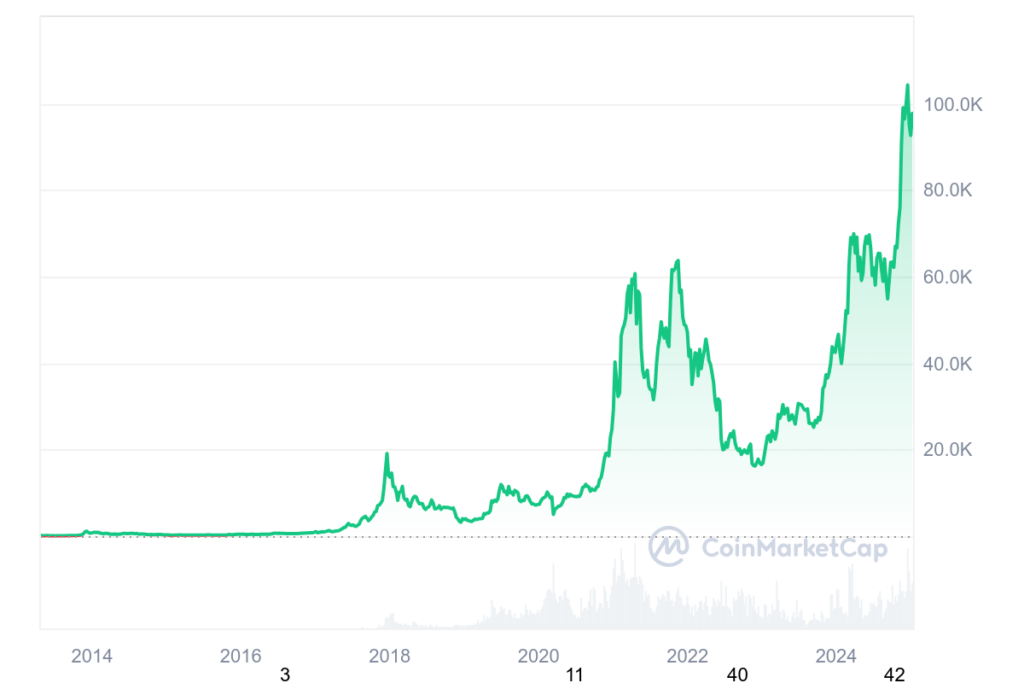
In 2017, Bitcoin experienced its first major bull run, with prices nearing $20,000 per BTC. This surge was driven by increased retail interest and the introduction of Bitcoin futures by financial institutions such as the Chicago Mercantile Exchange (CME). These milestones signaled the entry of institutional players, boosting Bitcoin’s credibility and solidifying its position as a legitimate asset class.

Mainstream Adoption and Challenges

The past five years have cemented Bitcoin’s status as a mainstream financial asset. Companies like Tesla, Square, and MicroStrategy have added Bitcoin to their balance sheets, reflecting growing corporate acceptance. Payment platforms like PayPal and Venmo have further normalized Bitcoin by enabling seamless transactions for everyday users. In 2021, El Salvador made history as the first country to adopt Bitcoin as legal tender. The move sparked global debate and showcased Bitcoin’s potential to transform national economies.

However, Bitcoin’s journey has not been without challenges. Environmental concerns about its energy-intensive proof-of-work (PoW) mining process have spurred heated debates about sustainability. Additionally, Bitcoin’s infamous price volatility remains a double-edged sword – attracting speculators while deterring more conservative investors and institutions.

Bitcoin Today: A Digital Gold Standard?

As of 2025, Bitcoin is often described as “digital gold,” a store of value prized for its capped supply of 21 million coins and decentralized nature. While critics argue that Bitcoin has strayed from its original vision of becoming a peer-to-peer electronic cash system, proponents highlight its role as a hedge against inflation and traditional financial systems.

Technological advancements, such as the Lightning Network, have addressed some of Bitcoin’s scalability issues, enabling faster and more cost-effective transactions. Additionally, progress in renewable energy adoption is helping to mitigate environmental concerns, aligning Bitcoin’s growth with sustainability goals.

The Road Ahead

Sixteen years after its inception, Bitcoin has evolved from a niche experiment into a global financial phenomenon. Its resilience through challenges – from hacks to regulatory scrutiny – demonstrates the power of decentralized systems and the enduring relevance of Satoshi Nakamoto’s vision.

As the world grapples with economic uncertainties, technological advancements, and shifting geopolitical landscapes, Bitcoin’s role as a transformative force is poised to grow. Whether it becomes a universal currency, a global digital gold standard, or takes on an entirely new role, one thing is certain: Bitcoin has already secured its place in history as a catalyst for innovation and financial empowerment.

Readers’ frequently asked questions

What exactly is the Bitcoin Lightning Network, and how does it make Bitcoin transactions faster and cheaper?

The Bitcoin Lightning Network is a secondary layer built on top of the Bitcoin blockchain. Its purpose is to address Bitcoin’s scalability issues by enabling faster and more cost-effective transactions. Instead of recording every transaction on the blockchain, the Lightning Network creates off-chain channels between users. These channels allow multiple transactions to occur without being immediately settled on the main blockchain. Only the final balance is recorded once the channel is closed. This reduces congestion on the Bitcoin network, leading to quicker transaction times and significantly lower fees.

Why is Bitcoin often referred to as “digital gold,” and how is it similar to or different from physical gold?

Bitcoin earns the moniker “digital gold” because, like physical gold, it is considered a store of value. Its supply is finite with only 21 million bitcoins ever to exist. That makes it scarce and resistant to inflation, much like gold. Additionally, Bitcoin is decentralized. No single entity controls it, which aligns with gold’s historical role as a hedge against financial instability. However, Bitcoin differs in several ways. It exists purely in digital form. It is highly divisible (up to 8 decimal places), and it can be transferred globally within minutes. Gold, on the other hand, is a tangible asset that requires physical storage and is cumbersome to transport.

What are some of the challenges preventing Bitcoin from being widely used as a daily currency?

Bitcoin’s price volatility is one of the biggest hurdles to its use as a daily currency. Rapid fluctuations make it difficult for businesses and consumers to set stable prices or trust its value for transactions. Additionally, while improved by the Lightning Network, Bitcoin’s transaction times and fees can still be prohibitive for small, everyday purchases compared to traditional payment methods. Efforts like the Lightning Network aim to solve scalability and cost issues. Additionally, stablecoins pegged to fiat currencies, offer an alternative for daily use. However, Bitcoin’s primary role has shifted toward being a store of value. Some believe it aligns more closely with its strengths and limitations.

What Is In It For You? Action Items You Might Want to Consider

Explore Bitcoin as a Long-Term Store of Value

Consider allocating a portion of your portfolio to Bitcoin as a hedge against inflation and economic uncertainties. Its capped supply and increasing adoption by institutions make it a compelling digital alternative to gold. Keep in mind its long-term potential rather than focusing solely on short-term price movements.

Leverage the Bitcoin Lightning Network for Transactions

If you actively use Bitcoin for payments or transfers, familiarize yourself with the Lightning Network. It offers faster and cheaper transactions, making it practical for smaller, everyday payments. Many wallets and platforms now support Lightning, so explore options that align with your trading and payment needs.

Monitor Regulatory and Market Trends Around Bitcoin

Stay updated on Bitcoin’s evolving regulatory landscape and its adoption by countries and institutions. Developments such as legal tender status or corporate investments can influence market sentiment and price trends, providing valuable opportunities for informed trading decisions.

- Advertisement -

FEATURED