Home Blog Page 141

Regulation, Markets, and Memecoins: Decoding 2025 Crypto Predictions from VanEck and Bitwise

2025 Crypto predictions

With 2024’s crypto market surge setting the stage, 2025 promises to be a pivotal year for the cryptocurrency industry. Two leading investment firms, VanEck and Bitwise, unveiled bold predictions for the year ahead. They outlined a mix of regulatory advancements, market adoption, and speculative trends that could shape the future of digital assets. From Bitcoin ETFs and stablecoin legislation to the rise of tokenized assets and AI-driven innovations, these forecasts provide valuable insights into what lies ahead for blockchain technology and cryptocurrency markets. Let’s dive into the top 2025 crypto predictions and analyze the potential impact on the industry.

Regulatory Breakthroughs: A Turning Point for Crypto?

Both VanEck and Bitwise foresee significant regulatory shifts in 2025. VanEck predicts the U.S. will embrace Bitcoin as a strategic reserve asset, with new SEC leadership paving the way for multiple spot Bitcoin and Ethereum exchange-traded products (ETPs). Bitwise echoes this optimism, emphasizing the potential for crypto’s inclusion in mainstream financial indices like the S&P 500 and Nasdaq-100. Bitwise highlights Coinbase’s likely entry into the S&P 500. Further, they predicted MicroStrategy’s inclusion in the Nasdaq-100 for 2025. This milestone achievement hit earlier when Nasdaq announced its addition in December 2024, bringing indirect crypto exposure to nearly every U.S. investor.

https://twitter.com/CrispyBull/status/1868610849847525599

Stablecoins are another focal point, with both firms expecting transformative growth. Bitwise predicts that supportive U.S. legislation could double stablecoin assets to $400 billion. VanEck projects a similar surge in stablecoin adoption, driven by integration into global commerce and remittance systems. Daily settlement volumes could potentially triple to $300 billion by year-end. Although neither company mentions Tether (USDT) explicitly, its dominance in the stablecoin market suggests it will play a key role in this predicted expansion.

Market Adoption: Institutional and Technological Catalysts

Institutional adoption remains a central theme for both firms. VanEck expects tokenized securities to exceed $50 billion in value, as entities like the Depository Trust & Clearing Corporation (DTCC) explore bridging public and private blockchains. Bitwise similarly predicts the value of tokenized real-world assets (RWAs) will surpass $50 billion, citing Wall Street’s growing embrace of blockchain technology.

Layer-2 solutions also feature prominently in their forecasts. VanEck anticipates Ethereum “blob” space generating $1 billion in fees due to Layer-2 adoption, driven by tokenized assets and enterprise applications. Bitwise expects activity on Ethereum’s Layer-2 networks like Base and StarkNet to accelerate, bolstered by the introduction of spot Ethereum ETFs. Meanwhile, VanEck highlights Solana’s potential. They forecast its price to exceed $500, showcasing its relevance as a leading Layer-1 blockchain alongside Ethereum.

The Memecoin Mania and AI Revolution

Speculative trends like meme coins and the integration of AI into blockchain ecosystems differentiate the predictions. Bitwise envisions a memecoin mania, fueled by AI agents autonomously launching tokens. This phenomenon could surpass the speculative frenzy of 2024, highlighting the intersection of artificial intelligence and decentralized finance.

VanEck takes a broader view of AI’s role. They predict the emergence of one million AI agents as “digital workers” in applications ranging from investment management to online gaming. These agents are expected to drive significant on-chain activity, creating new opportunities and challenges for the crypto market.

Key Differences and Overlaps

While both firms share optimism about regulatory progress and market adoption, their focus diverges in notable ways:

  • Price Projections: Bitwise predicts Bitcoin will exceed $200,000 and Ethereum $7,000. VanEck forecasts slightly lower targets of $180,000 for Bitcoin and $6,000 for Ethereum. VanEck also includes a notable projection for Solana, predicting its price to surpass $500. Bitwise does not provide specific commentary on the blockchain.
  • Layer-2 and Tokenization: Both see exponential growth. VanEck emphasizes the financial benefits of Ethereum’s blob space, while Bitwise highlights Wall Street’s adoption of tokenized RWAs.
  • Stablecoins: Both agree on substantial growth in the stablecoin market. However, they do not explicitly detail Tether’s (USDT) role despite its dominance.
  • AI and Memecoins: VanEck’s focus on AI as a driver of on-chain activity contrasts with Bitwise’s spotlight on AI-powered memecoin launches.

What Lies Ahead?

The year 2025 could solidify blockchain’s role in the global financial system. Regulatory clarity, technological innovation, and market adoption will likely define the trajectory of cryptocurrencies. While VanEck and Bitwise differ on specifics, their shared optimism underscores the transformative potential of blockchain technology in the coming year. However, it is notable that neither firm made predictions about XRP, a leading cryptocurrency by market cap. Is there a potential gap in their focus or is it an intentional omission given XRP’s regulatory challenges?

These 2025 crypto predictions point to a dynamic year ahead, shaped by regulation, market forces, and technological advancements. As policymakers, institutions, and innovators converge on this dynamic industry, the stakes—and opportunities—have never been higher.

Readers’ frequently asked questions

What are stablecoins, and why are they expected to grow so much in 2025?

Stablecoins are cryptocurrency designed to maintain a stable value. Issuers peg them to a reserve asset like the U.S. dollar or other fiat currencies. They are widely used in crypto trading as a way to avoid the volatility of other cryptocurrencies. The crypto predictions for 2025 highlight significant growth in stablecoin usage. Their role as expanding in global commerce, remittances, and integration with major financial and payment networks. With potential regulatory clarity in the U.S. and large traditional financial institutions entering the space, stablecoins are expected to handle transactions worth $300 billion daily by the end of 2025. This growing adoption underscores their practicality as a bridge between the traditional financial system and the crypto ecosystem.

What is tokenization, and how does it benefit real-world assets?

Tokenization is the process of representing ownership of physical or financial assets (such as real estate, stocks, or bonds) as digital tokens on a blockchain. These tokens can be easily traded, transferred, and managed using blockchain technology. They offer benefits like reduced transaction costs, faster settlement times, and increased transparency. In 2025, tokenized real-world assets (RWAs) are expected to exceed $50 billion in value as institutions like Wall Street explore blockchain’s potential for financial instruments. For example, instead of buying an entire piece of real estate, an investor could purchase a fraction of it through tokenized ownership. It would make such investments more accessible and liquid.

What makes Ethereum’s Layer-2 networks important for blockchain technology?

Layer-2 networks are like fast lanes on a busy highway. They are designed to make blockchain transactions quicker and cheaper by reducing congestion on the main Ethereum blockchain. These networks handle many transactions off-chain and then consolidate them into a single batch that gets added to the blockchain. For someone new to crypto, this means applications built on Ethereum, such as gaming platforms or financial tools, can become more user-friendly and cost-effective. Predictions of Ethereum generating $1 billion in fees from these networks highlight their role in making blockchain technology more practical for everyday applications.

What Is In It For You? Action Items You Might Want to Consider

Consider diversifying into tokenized real-world assets (RWAs):

With both VanEck and Bitwise predicting a surge in tokenized assets surpassing $50 billion in 2025, now might be a good time to explore opportunities in this space. Tokenized assets like real estate, private equity, or commodities offer fractional ownership and liquidity, making them accessible and versatile additions to your portfolio.

Stay updated on regulatory developments, particularly stablecoin legislation

The anticipated U.S. legislation on stablecoins could reshape the market dramatically, with daily transaction volumes potentially tripling by year-end. Keeping an eye on policy changes. Identifying stablecoins with strong backing and adoption could provide stable yet growth-oriented trading opportunities.

Monitor Ethereum’s Layer-2 solutions and Solana’s ecosystem

With Ethereum projected to generate $1 billion in Layer-2 fees and Solana expected to exceed $500 in price, these ecosystems are set for significant growth. Traders should track developments in Layer-2 technologies and emerging projects on Solana to capitalize on new dApps, enterprise use cases, or fee-driven opportunities.


Building the Future of Finance: Garanti BBVA’s Crypto Move and the Role of Partnerships

Garanti BBVA has announced the launch of crypto trading services in Europe.

Garanti BBVA’s recent foray into crypto trading in Europe is more than a notable development in the banking world – it’s a strategic step forward in aligning traditional finance with blockchain technology. As a subsidiary of Spain’s BBVA, Garanti BBVA is leveraging its technological and regulatory insights to introduce crypto trading services across Europe. At the core of this initiative are key partnerships, such as the collaboration with Bit2Me and the integration of Visa’s Tokenized Asset Platform. Together they provide the infrastructure for a seamless and secure digital asset trading experience.

Strategic Partnerships Driving Innovation

The partnership with Bit2Me, a leading cryptocurrency platform, is central to Garanti BBVA’s strategy. Bit2Me’s established expertise in crypto trading and asset management equips the bank with the tools to offer trading services in leading cryptocurrencies. That includes Bitcoin, Ethereum, and USD Coin. Garanti BBVA initially launched this service for Turkish clients. It now sets the stage for a broader European expansion of crypto trading services.

In tandem, Garanti BBVA’s adoption of Visa’s Tokenized Asset Platform reflects the bank’s commitment to leveraging cutting-edge technology. This platform enables financial institutions to mint, manage, and transfer tokenized assets, such as stablecoins and tokenized deposits, on blockchain networks safely. By embracing such innovations, Garanti BBVA ensures that its cryptocurrency services are scalable, efficient, and compliant with the highest security standards.

The Role of Regulatory Clarity

A critical factor enabling this initiative is the implementation of the Markets in Crypto-Assets (MiCA) regulation in Europe. MiCA provides a comprehensive legal framework for cryptocurrencies. It offers much-needed clarity for financial institutions entering the crypto trading space in Europe. For Garanti BBVA, this regulatory certainty minimizes risk and lays the groundwork for seamlessly integrating crypto services into traditional banking operations.

However, while MiCA facilitates innovation, it also presents challenges. Compliance with its stringent requirements necessitates significant investment in infrastructure and operational adjustments. Garanti BBVA’s partnerships with Bit2Me and Visa help mitigate these challenges. They provide the technical and strategic support needed to navigate this evolving landscape.

Market Trends and the Future of Crypto Trading in Europe

Garanti BBVA’s move reflects broader market trends. Customer demand for digital assets is reshaping traditional banking. Across Europe, other major banks, such as Santander and CaixaBank, are preparing to launch similar crypto trading services. This competitive landscape underscores the urgency for financial institutions to adapt or risk obsolescence.

At the same time, the integration of blockchain solutions by banks like Garanti BBVA signals a growing acknowledgment of the transformative potential of digital assets. These technologies promise to enhance payment systems, enable faster transactions, and offer clients new avenues for investment diversification.

Garanti BBVA’s entry into the crypto trading market in Europe is a testament to the power of strategic partnerships and technological innovation in redefining financial services. By aligning with Bit2Me and Visa, the bank is expanding its service offerings and also positioning itself as a leader in Europe’s evolving crypto trading landscape. Regulatory and market complexities remain a challenge. However, Garanti BBVA’s proactive approach shows how traditional banks can adopt blockchain effectively to meet modern financial demands and shape the future of finance.

What Is In It For You? Action Items You Might Want to Consider

Explore Trusted Platforms for Crypto Trading

Consider starting your crypto trading journey with platforms affiliated with established financial institutions like Garanti BBVA. Collaborations with trusted partners, such as Bit2Me, ensure a secure and user-friendly experience. That is especially valuable if you’re new to crypto trading in Europe.

Stay Updated on Regulatory Changes

Keep an eye on the Markets in Crypto-Assets (MiCA) regulation and its impact on Europe’s cryptocurrency trading. Understanding these regulations can help you navigate the market confidently and ensure your investments align with the latest legal requirements.

Diversify Your Investments Thoughtfully

Take advantage of the opportunities provided by banks like Garanti BBVA to diversify your portfolio with cryptocurrencies. Start by trading in well-established coins such as Bitcoin and Ethereum. At the same time, stay informed about market trends and innovations in digital assets to optimize your investment strategy.

Readers’ frequently asked questions

How does Garanti BBVA protect its customers from potential risks associated with cryptocurrency trading?

Garanti BBVA uses a combination of advanced blockchain technologies and strict compliance practices to mitigate risks. Its collaboration with Bit2Me ensures that clients access a regulated and secure trading platform. Visa’s Tokenized Asset Platform minimizes vulnerabilities in asset management and transfer. Additionally, the bank provides customers with educational resources to understand the risks of crypto trading. The knowledge empowers them to make informed decisions.

Why is Garanti BBVA focusing on Europe as its primary market for crypto trading?

Europe offers a unique combination of regulatory clarity and a large, tech-savvy customer base increasingly interested in digital assets. The MiCA regulation provides a stable and predictable environment for launching crypto services, reducing operational risks. Additionally, Europe’s established banking infrastructure and widespread blockchain adoption make it an ideal region for Garanti BBVA to scale its crypto offerings effectively.

How will Garanti BBVA’s crypto initiative impact its traditional banking services?

The integration of crypto trading complements, rather than replaces, Garanti BBVA’s traditional banking services. By incorporating digital assets, the bank expands its portfolio, offering customers diversified investment options and innovative payment solutions. This integration also modernizes the bank’s overall service framework, ensuring it remains competitive in a rapidly digitizing financial landscape.

Crypto Hacks 2024: Lessons from a Record-Breaking $2.2 Billion Loss

Crypto hacks in 2024 resulted in $2.2 billion loss

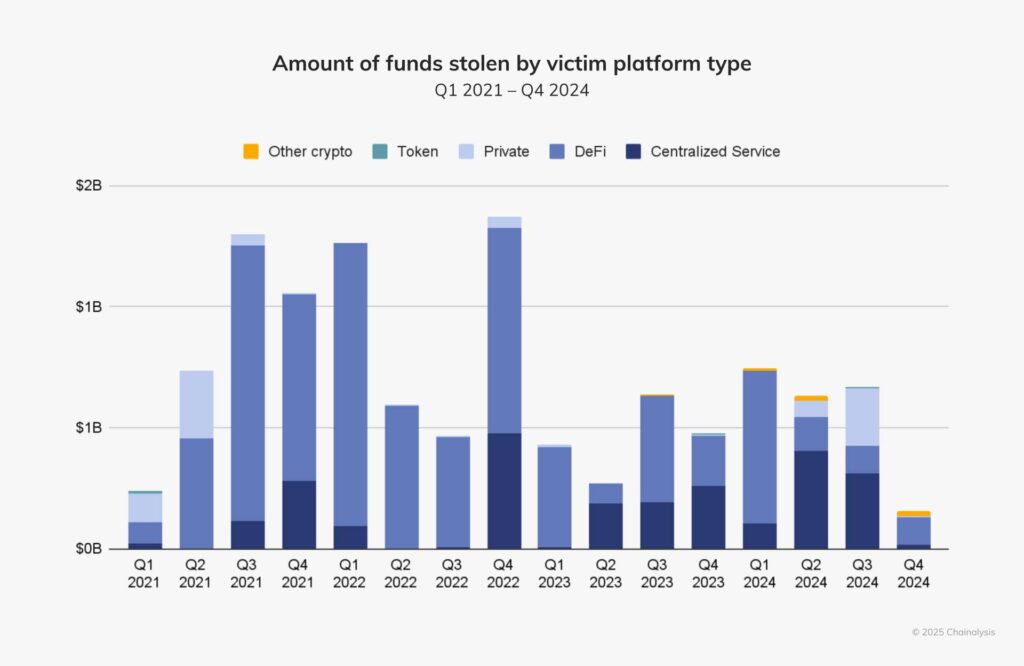
As the cryptocurrency market continues to mature, so do the threats it faces. In 2024, hackers exploited vulnerabilities across the blockchain ecosystem, resulting in a staggering $2.2 billion loss – a 21% increase from the previous year. This sharp rise underscores the increasing sophistication of cybercriminals and the challenges faced by the industry in safeguarding digital assets. While December recorded the lowest monthly losses this year, with $29 million lost, the overall trend paints a grim picture of an industry struggling to keep pace with evolving threats.

The Shift in Targets: Centralized Exchanges Under Fire

Traditionally, decentralized finance (DeFi) platforms bore the brunt of cyberattacks due to their reliance on vulnerable smart contracts. However, 2024 saw a marked shift in hacker focus toward centralized exchanges. These platforms, which hold large concentrations of user funds, became lucrative targets for cybercriminals. Notable incidents include the $305 million breach of DMM Bitcoin in May and the $235 million heist from India’s WazirX in July. These breaches highlight significant security lapses in centralized platforms, particularly around private key management and internal protocols.

Despite their reputation for better security compared to DeFi platforms, centralized exchanges’ weaknesses in safeguarding custodial funds were starkly exposed. This pivot in attack vectors underscores the urgency for centralized platforms to fortify their defenses, adopt advanced monitoring tools, and implement robust security audits.

Additionally, the attacks exposed systemic challenges, including inadequate employee training and a lack of layered security mechanisms. Many of the breaches in 2024 could have been mitigated through stronger access controls, two-factor authentication, and compartmentalized data storage. Centralized platforms now face mounting pressure to restore user trust by demonstrating their commitment to operational security and risk management.

Source: Chainalysis.com/blog

The Geopolitical Dimension: North Korea’s Role in Crypto Hacks 2024

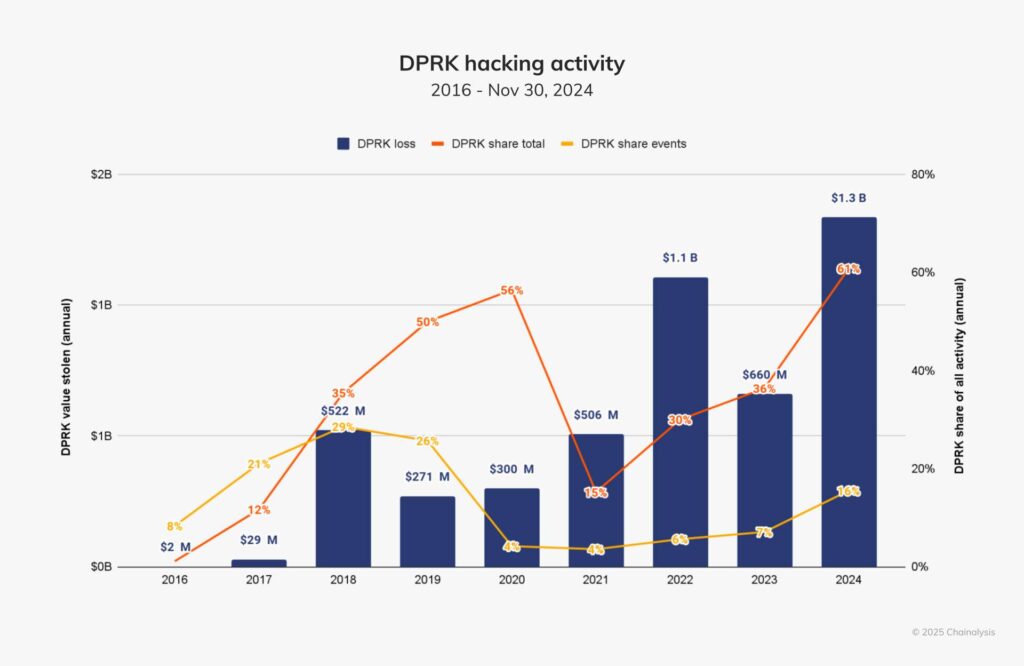
A staggering 61% of all stolen funds in 2024 were linked to North Korean-affiliated groups, including the notorious Lazarus Group. These state-backed actors are believed to have siphoned $1.34 billion across 47 attacks, a record-breaking haul. Analysts assert that these stolen funds are funneled into North Korea’s weapons development programs, circumventing international sanctions and raising significant geopolitical concerns.

The Lazarus Group’s activities included exploiting both DeFi vulnerabilities and centralized exchange weaknesses. Their operations highlight the intersection of cryptocurrency security and international security, with stolen digital assets becoming tools for geopolitical maneuvering. This dynamic underscores the need for global collaboration in addressing the threat posed by state-sponsored cybercrime.

International bodies, such as the United Nations and Interpol, have begun to take notice. In 2024, the UN Security Council’s report on cybersecurity flagged cryptocurrencies as a primary tool for sanction evasion, calling for a unified global response. However, enforcement remains challenging, as the decentralized and borderless nature of cryptocurrencies complicates traditional regulatory mechanisms.

Source: Chainalysis.com/blog

Trends and Lessons from Crypto Hacks 2024

While December’s low losses suggest some progress in security measures, the annual trend reveals a troubling trajectory:

  • Increased Complexity of Attacks: Cybercriminals employed more advanced techniques, including social engineering, sophisticated phishing campaigns, and supply chain attacks.
  • Target Diversification: Beyond centralized exchanges, gaming platforms, and NFT marketplaces also faced heightened risks, with notable breaches like the $290 million PlayDapp hack.
  • First-Half Surge: The first half of 2024 accounted for 84.4% of the year’s stolen funds, suggesting a seasonal or strategic pattern in cybercrime activities.

Moreover, the reliance on cross-chain bridges – critical infrastructure for interoperability between blockchains – emerged as a weak link. Several attacks exploited bridge vulnerabilities, leading to multi-million-dollar losses. This highlights the need for the industry to prioritize security in these critical components, which are essential for blockchain scalability and adoption.

Path Forward: Securing the Crypto Ecosystem Against Crypto Hacks 2024

Experts agree that addressing these challenges requires a multifaceted approach:

  1. Enhanced Security Protocols: Centralized and decentralized platforms must adopt advanced technologies like multi-signature wallets, real-time anomaly detection systems, and regular security audits.
  2. Regulatory Oversight: Governments and international bodies must establish stringent security standards and enforce compliance across the industry.
  3. User Education: Investors must learn to recognize phishing attempts, protect their private keys, and use hardware wallets for added security.
  4. Global Cooperation: Tackling the geopolitical dimension of cybercrime necessitates collaboration between nations, regulatory agencies, and blockchain organizations.

Additionally, cybersecurity experts advocate for proactive measures, such as bug bounty programs, to incentivize ethical hackers to identify vulnerabilities before malicious actors can exploit them. Companies must also invest in incident response plans to minimize damage and ensure a rapid recovery when breaches occur.

Future Prospects: Balancing Innovation and Security

The challenges posed by crypto hacks extend beyond financial losses. They threaten the credibility and trust essential for blockchain technology’s mainstream adoption. Innovations like zero-knowledge proofs and blockchain analytics tools offer promising avenues for enhancing security. These tools can help monitor transactions in real time, detect unusual patterns, and trace stolen assets across chains.

At the same time, the industry must balance innovation with robust security frameworks. Emerging trends, such as decentralized autonomous organizations (DAOs) and Web3 technologies, introduce new attack vectors that require proactive mitigation strategies. As the ecosystem evolves, stakeholders must adopt a holistic approach, integrating technological advancements with robust regulatory and security measures.

Conclusion: Learning from Crypto Hacks 2024

The record-breaking $2.2 billion in losses from crypto hacks in 2024 is a stark reminder of the vulnerabilities within the cryptocurrency ecosystem. The rise in centralized exchange breaches and the geopolitical implications of North Korean involvement underscores the urgent need for industry reform and global collaboration. While significant challenges remain, the industry has the tools and expertise to turn the tide. By prioritizing security, fostering international cooperation, and embracing innovative solutions, the crypto market can safeguard investor trust and ensure its resilience in an increasingly complex threat landscape.

Readers’ frequently asked questions

What makes centralized exchanges more vulnerable to hacks compared to decentralized platforms?

Centralized exchanges are particularly appealing targets for hackers because they act as custodians for large volumes of user funds. Unlike decentralized platforms, which allow users to control their private keys, centralized exchanges manage these keys on behalf of their users. If a hacker breaches the exchange’s security, they can potentially access all the funds stored there. Additionally, centralized exchanges often have complex operational systems and human involvement, which increases the risk of insider threats or social engineering attacks. The concentrated nature of assets and their management in centralized locations make them high-value targets for cybercriminals.

How does North Korea use the stolen cryptocurrency, and why are they so effective at hacking?

North Korean hacking groups, such as the Lazarus Group, use stolen cryptocurrency to fund state-sponsored programs, including weapons development. Cryptocurrencies offer an ideal medium for these activities because they operate outside traditional banking systems, making them difficult to track and confiscate. North Korean hackers are highly effective due to their extensive resources, advanced knowledge of blockchain vulnerabilities, and innovative techniques, such as exploiting cross-chain bridges or conducting spear-phishing campaigns. The stolen assets are often laundered through multiple transactions, mixing services, and exchanges to obfuscate their origin before being converted into fiat currency.

What steps can an individual investor take to protect their cryptocurrency from these kinds of hacks?

Individual investors can significantly reduce their risk by adopting best practices for crypto security. First, they should store their assets in hardware wallets or cold storage, which are not connected to the internet and thus less vulnerable to hacks. Second, investors should enable two-factor authentication (2FA) on all accounts and use strong, unique passwords. Third, it is vital to remain vigilant against phishing attempts, such as emails or messages that attempt to trick users into revealing sensitive information. Lastly, spreading funds across multiple platforms can minimize losses if one account or service is compromised. By taking these precautions, investors can protect their assets even in the face of increasing threats.

What Is In It For You? Action Items You Might Want to Consider

Reassess Where You Store Your Crypto

If you’re using a centralized exchange to store significant amounts of cryptocurrency, it might be time to rethink your strategy. Consider transferring a portion of your holdings to a hardware wallet or other forms of cold storage. By maintaining control over your private keys, you can significantly reduce your exposure to potential exchange breaches.

Stay Alert to New Threats

Cybercriminals are continually evolving their methods, and so should your defenses. Regularly educate yourself about the latest hacking techniques, such as phishing scams or vulnerabilities in cross-chain bridges. This knowledge can help you recognize and avoid potential traps that could jeopardize your assets.

Diversify Platforms for Risk Mitigation

Avoid placing all your assets on a single platform, even if you trust it. Spreading your holdings across multiple exchanges, wallets, or DeFi platforms can act as a safeguard, minimizing potential losses if one platform is targeted. This simple diversification strategy can add an extra layer of security to your crypto investments.

Ahead of the Curve: Kraken’s Ink and the Race to Scale Ethereum

Kraken launches its INK blockchain ahead of schedule.

Kraken’s early debut of its Layer-2 blockchain, Ink, has sparked significant attention in crypto. Initially planned for release in early 2025, Ink’s expedited mainnet launch is a response to strong demand during its testnet phase. It recorded over 8.17 million transactions and a substantial number of connected wallets. This milestone reflects the growing need for Ethereum scalability and Kraken’s strategic commitment to enhancing blockchain efficiency. However, the accelerated timeline raises questions about long-term decentralization and ecosystem stability.

The Vision Behind The Ink Blockchain

Ink is built on Optimism’s OP Stack, a modular technology designed to scale Ethereum while maintaining its core principles of security and decentralization. As part of the Optimism Superchain, Ink integrates seamlessly with other Layer-2 solutions, offering interoperability and shared liquidity across the ecosystem. Kraken’s collaboration with the Optimism Foundation, bolstered by a significant 25 million OP token grant (valued at $58 million), underscores the importance of this partnership in addressing Ethereum’s scalability challenges.

The blockchain’s mainnet launch introduces several key features, including developer toolkits, ETH token bridges, and access to decentralized applications (dApps). These tools aim to empower developers and users with faster transactions and lower fees, creating a more accessible and efficient Ethereum network.

RedStone: Powering the DeFi Ecosystem

A critical component of Ink’s ecosystem is its partnership with RedStone, an Oracle platform providing real-time data feeds to decentralized finance (DeFi) applications. RedStone’s integration enhances the reliability and functionality of DeFi protocols on Ink, enabling innovative financial products and services. This partnership is expected to attract developers seeking robust, data-driven solutions for their projects.

Accelerated Launch: A Double-Edged Sword

The early launch of Kraken’s Ink blockchain demonstrates its agility and responsiveness to market demand. However, it has also raised concerns about the potential risks associated with an expedited timeline. Critics argue that rushing the deployment of such a complex infrastructure could expose the network to unforeseen technical vulnerabilities or governance challenges. Additionally, some observers have pointed out that Kraken’s current level of control over Ink might hinder its path toward full decentralization. After all, this is a key objective for most Layer-2 solutions.

Kraken has sought to address these concerns by outlining a clear roadmap for Ink’s future. Notably, the platform plans to implement permissionless fault proofs by January 2025, a critical step toward decentralization and transparency. This commitment reflects Kraken’s intent to balance rapid innovation with long-term sustainability.

Broader Implications for Ethereum

Ink’s successful deployment on Ethereum’s mainnet represents a significant step forward for Layer-2 scalability. By reducing transaction costs and increasing throughput, Ink contributes to Ethereum’s evolution as a multi-chain ecosystem capable of supporting diverse use cases. Its integration with the Optimism Superchain enhances interoperability, positioning Ethereum as a more competitive platform in the broader blockchain landscape.

Moreover, Kraken’s strategic vision extends beyond immediate scalability gains. The company’s investment in developer tools and DeFi infrastructure suggests a long-term commitment to fostering innovation within the Ethereum ecosystem. This aligns with the broader trend of modular blockchain development. Specialized Layer-2 solutions work in harmony to address the limitations of a single monolithic chain.

Kraken’s launch of Ink ahead of schedule is a bold move that highlights the exchange’s ambition to lead in Ethereum scaling. While the project’s early success is evident in its strong testnet performance and ecosystem partnerships, its accelerated timeline invites scrutiny. As Kraken navigates the challenges of decentralization and long-term sustainability, Ink’s development will serve as a litmus test for the viability of expedited Layer-2 solutions.

In the race to scale Ethereum, Kraken’s Ink exemplifies both the promise and complexity of blockchain innovation. Its impact will undoubtedly shape the future of decentralized finance and beyond, setting a precedent for other Layer-2 projects aiming to transform the Ethereum ecosystem.

Readers’ frequently asked questions

What is a Layer-2 blockchain, and why is it important for Ethereum?

A Layer-2 blockchain is a secondary framework or protocol built on top of a primary blockchain, in this case, Ethereum. Its purpose is to enhance the network’s scalability by processing transactions off the main Ethereum chain while still benefiting from its security and decentralization. This reduces congestion, lowers transaction fees, and increases throughput, making Ethereum more efficient and accessible. Ink, Kraken’s Layer-2 solution, fits into this paradigm. It leverages Optimism’s OP Stack to offer faster, cheaper transactions and seamless integration with Ethereum’s ecosystem.

What does Kraken’s partnership with Optimism and RedStone mean for users and developers?

Kraken’s collaboration with the Optimism Foundation and RedStone has significant implications for both developers and users. By joining the Optimism Superchain, Ink benefits from enhanced interoperability with other Layer-2 solutions. It creates a more connected and liquid ecosystem for decentralized applications. For developers, this partnership provides tools and infrastructure to build scalable applications with lower costs. RedStone’s oracles, meanwhile, ensure reliable data for DeFi applications. That enables users to access innovative and secure financial products within Ink’s ecosystem.

How can users and developers start using Ink after its launch?

After the launch of Ink on Ethereum’s mainnet, users can interact with it by connecting their Ethereum wallets to supported applications built on Ink. Developers, on the other hand, can access developer tools provided by Ink to create decentralized applications (dApps) or integrate existing services into the network. Additionally, ETH token bridges allow users to transfer assets seamlessly between Ethereum and Ink, facilitating easier access to the Layer-2 ecosystem. Those interested should refer to the official Kraken and Ink documentation for detailed instructions and compatibility information.

What Is In It For You? Action Items You Might Want to Consider

Explore Lower-Cost Trading Opportunities on Ink

With Ink’s Layer-2 network live, traders can take advantage of significantly reduced transaction fees and faster processing times. Consider moving some of your trading activity or decentralized finance (DeFi) operations to dApps built on the Ink network to optimize costs and increase transaction efficiency.

Monitor the Development of Ink’s Ecosystem

As Ink integrates RedStone oracles and continues its decentralization roadmap, new DeFi opportunities and tools are likely to emerge. Stay updated on these developments. Assess how they might align with your trading strategies, particularly for accessing reliable data-driven financial products.

Leverage Interoperability Across the Optimism Superchain

Ink’s integration into the Optimism Superchain opens up new opportunities for cross-chain trading and asset transfers. Explore how the shared liquidity and interoperability between Layer-2 solutions can enhance your portfolio diversification or arbitrage strategies.

Play-to-Earn Crypto Games: Economic Models, Challenges, and Future Impact

The rise of Play-to-Earn (P2E) crypto games has redefined how gamers interact with virtual economies. These blockchain-based platforms allow players to earn real-world rewards through gameplay, fundamentally shifting gaming from a purely entertainment-driven activity to a potential income-generating endeavor. However, this burgeoning sector faces significant challenges in sustainability, user experience, regulation, and its impact on traditional gaming industries. Below, we explore the core aspects of P2E games and their implications for the future.

The Economic Model and Sustainability of P2E Games

At the heart of P2E games lies a unique economic model. It incentivizes players through blockchain-based tokens, NFTs (non-fungible tokens), and in-game assets. Players earn rewards by completing tasks, winning battles, or trading assets within the game’s ecosystem. For example, Axie Infinity, one of the most well-known P2E games, allowed players to earn Small Love Potion (SLP) tokens, which could be traded for fiat currency.

However, sustainability remains a critical concern. Many P2E economies suffer from inflationary pressures, as the constant issuance of rewards dilutes their value. In Axie Infinity’s case, an oversupply of SLP tokens led to a sharp decline in value. That impacted the players’ earning potential and undermined the game’s economy. To address this, developers are exploring models that balance reward issuance with token burning, staking mechanisms, and limited asset supplies.

Case in Point: Games like The Sandbox and Gods Unchained incorporate governance tokens and deflationary mechanics to maintain value. However, without a constant influx of new players or external revenue streams, even these models risk becoming unsustainable.

Source: www.godsunchained.com

Game Mechanics and User Experience

While the financial incentives of P2E games attract players, their long-term success hinges on gameplay quality and user engagement. Early P2E titles like Axie Infinity prioritized earnings over immersive experiences, leading to criticism that these games lacked entertainment value compared to traditional titles.

Modern P2E games are addressing this gap. Platforms like The Sandbox provide robust virtual worlds where players can create, own, and monetize experiences. They combine financial rewards with creativity. Similarly, Illuvium offers high-quality graphics and RPG mechanics, rivaling traditional AAA games. The evolution of gameplay mechanics toward richer, more interactive experiences is critical for attracting a broader gaming audience.

Challenges: Despite advancements, high entry costs remain a barrier. For instance, players often need to purchase NFTs or tokens to participate, which limits accessibility for casual gamers.

Source: The Sandbox

Security and Regulatory Concerns

As with any blockchain-based ecosystem, security is a major concern in P2E games. Since players’ in-game assets and rewards hold real-world value, they are prime targets for hacks, fraud, and scams. Notable incidents, such as the $625 million Ronin Network hack that affected Axie Infinity, highlight the vulnerabilities in blockchain gaming infrastructures.

To mitigate these risks, developers are increasingly implementing robust security measures, such as:

  • Multi-signature wallets for asset protection
  • Decentralized identity verification to prevent fraud
  • Regular audits of smart contracts to identify vulnerabilities

Regulatory Hurdles: P2E games also face scrutiny from regulators worldwide. Countries like the Philippines, where P2E games gained widespread adoption, are exploring taxation frameworks for players’ earnings. In regions like South Korea, gaming laws restrict the monetization of in-game assets, posing legal challenges for P2E platforms.

Impact on the Traditional Gaming Industry

P2E games are causing ripples in the traditional gaming industry, prompting developers to rethink monetization models and user engagement strategies. While traditional games often rely on microtransactions or subscription fees, P2E games offer ownership and earning potential. They appeal to gamers seeking more value for their time.

Some traditional gaming studios are exploring hybrid models that integrate blockchain technology without compromising gameplay. For example, Ubisoft’s experimentation with NFTs in Ghost Recon Breakpoint and Epic Games’ openness to blockchain-based titles represent the industry’s cautious yet growing interest.

Collaboration vs. Competition: While some traditional developers view P2E games as competition, others see opportunities for collaboration, particularly in areas like in-game asset ownership and cross-platform economies.

Community and Social Aspects

The success of P2E games heavily relies on their community-driven ecosystems. Players form online communities to collaborate, trade assets, and share strategies, fostering a sense of ownership and engagement. Discord servers, forums, and social media platforms serve as hubs for these interactions.

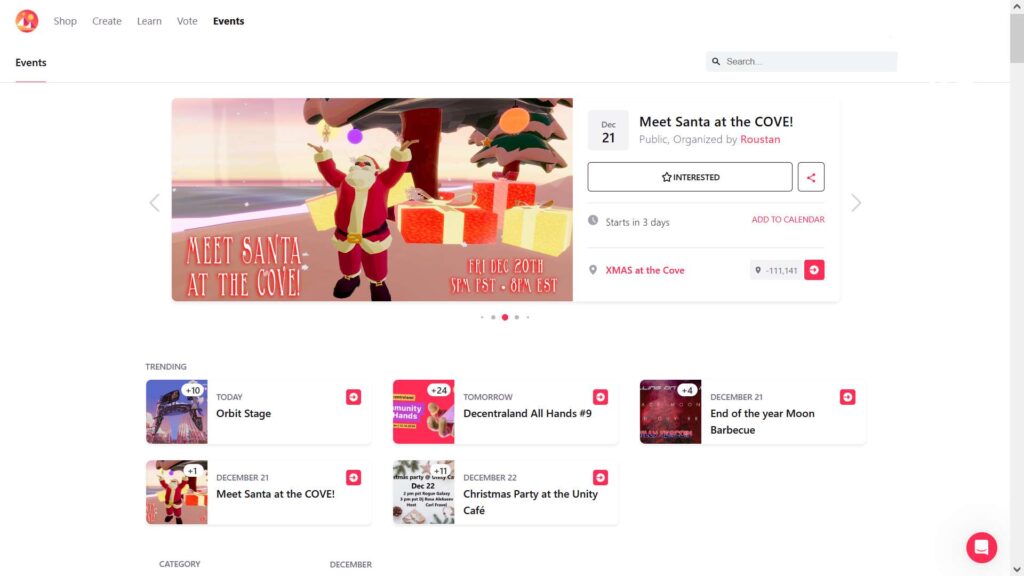
For example, The Sandbox thrives on its creator community, enabling users to build and monetize assets, which strengthens player loyalty. Similarly, games like Decentraland have positioned themselves as virtual social platforms. Their community events, concerts, and gatherings create deeper engagement beyond earning rewards.

Social Dynamics: However, the financialization of gaming can introduce challenges. For example, a focus on profit over enjoyment can lead to exploitative behaviors or dissatisfaction among players who fail to earn meaningful rewards.

Source: Decentraland Events

Final Thoughts: The Future of P2E Games

Play-to-earn crypto games represent a significant shift in gaming, blending entertainment, finance, and technology. While challenges in sustainability, security, and regulation remain, the sector continues to evolve. For P2E games to achieve mainstream adoption, developers must prioritize balanced economies, high-quality gameplay, and robust security measures.

As traditional gaming studios take note and blockchain technology advances, the line between gaming and earning will continue to blur. Whether P2E games will dominate the industry or coexist with traditional models remains to be seen, but their impact is undeniable.

Key Takeaway: Play-to-earn games offer a glimpse into the future of digital economies, where players are no longer mere consumers but active participants and stakeholders. However, for P2E to thrive, it must strike the right balance between entertainment, value creation, and sustainability.

- Advertisement -

FEATURED