Home Blog Page 145

Bull or Bubble? Experts Divided as XRP Reaches New Heights

XRP Ripple Labs surges to a 7-year high

The cryptocurrency world is abuzz as XRP, the digital asset tied to Ripple Labs, achieves a remarkable seven-year high. Once overshadowed by Bitcoin and Ethereum, XRP has surged past Tether to claim the spot as the third-largest cryptocurrency by market capitalization. This unprecedented rally has seen XRP soar over 400% in the past month. Is this rise sustainable?

Some herald this as the dawn of a transformative era for Ripple Labs and XRP, driven by anticipated regulatory clarity and institutional adoption. Others caution against exuberance. Skeptics point to signs of overvaluation, warning that the market may be setting up for a sharp correction. The debate over whether XRP represents a groundbreaking opportunity or an overinflated bubble encapsulates the broader volatility and uncertainty inherent in the cryptocurrency market.

What’s Driving XRP’s Surge?

Regulatory Developments and Optimism

The XRP rally can be partially attributed to growing optimism about Ripple Labs’ legal battle with the U.S. Securities and Exchange Commission (SEC). Ripple’s lawsuit, filed in December 2020, accused the company of conducting an unregistered securities offering. The case has been a pivotal moment for XRP, creating a cloud of uncertainty that has long weighed on its value.

However, the recent announcement of SEC Chair Gary Gensler’s resignation, set for January 2024, has shifted the narrative. Gensler’s tenure was characterized by aggressive enforcement actions against cryptocurrencies, with Ripple being one of its primary targets. Investors now anticipate a more lenient regulatory approach under the incoming Trump administration. Throughout his campaign, Trump expressed support for the cryptocurrency sector and a desire to curtail regulatory overreach.

This anticipated shift has renewed confidence among XRP investors. Many believe that a favorable resolution of Ripple’s legal challenges could pave the way for broader adoption of XRP, particularly among financial institutions that have hesitated to integrate the asset due to regulatory uncertainty. This optimism has significantly contributed to XRP’s recent price surge. It reflects market sentiment that the Trump administration may create a more favorable climate for Ripple and its associated cryptocurrency.

Market Sentiment and Momentum

XRP’s price movements have been bolstered by a wave of positive sentiment and whale activity. Data shows an uptick in large-scale transactions involving XRP, indicating strong confidence among institutional and high-net-worth investors. The combination of regulatory optimism and increased trading volumes has driven XRP’s meteoric rise.

Additionally, the prospect of Ripple launching a stablecoin, RLUSD, has added to the excitement. A stablecoin tied to Ripple’s ecosystem could enhance XRP’s utility within global financial systems, further integrating it into cross-border payments and decentralized finance (DeFi) applications.

Institutional Interest

The filing of XRP-focused exchange-traded products (ETPs) by asset managers like WisdomTree underscores the institutional interest in the asset. As ETPs offer a regulated avenue for traditional investors to gain exposure to cryptocurrencies, these developments could significantly boost XRP’s liquidity and accessibility. Institutional adoption, paired with the legal clarity investors hope for, could further solidify XRP’s position in the market.

The Bullish Case: Why Some Experts Believe XRP Is Just Getting Started

Regulatory Clarity Equals Opportunity

Proponents argue that the potential resolution of Ripple’s legal challenges could usher in a new era for XRP. If the courts ultimately affirm that XRP is not a security, the asset could see a wave of institutional adoption. Banks and financial institutions may leverage Ripple’s technology for cross-border payments, solidifying XRP’s role as a utility-driven cryptocurrency.

Technological Innovation

Ripple’s underlying technology, including its On-Demand Liquidity (ODL) service, positions it as a leader in blockchain-based payment solutions. With the addition of stablecoin capabilities, XRP could become a cornerstone of decentralized finance (DeFi), further expanding its use cases.

Price Predictions

Some bullish analysts have set ambitious targets for XRP. Their projections reach $10 or more if the asset continues to gain momentum. This optimism is fueled by the belief that Ripple’s growing ecosystem and partnerships will drive sustained demand for XRP.

https://twitter.com/RaoulGMI/status/1863358055469002807

The Bearish Case: Why Skeptics See a Bubble

Overbought Market Conditions

Skeptics caution that XRP’s rapid ascent may be unsustainable. Technical indicators, such as the Relative Strength Index (RSI), suggest that XRP is in overbought territory, increasing the likelihood of a price correction. Historical data from previous cryptocurrency bull runs shows that often sharp pullbacks follow such parabolic moves.

Regulatory Risks Remain

Despite recent optimism, the outcome of Ripple’s legal battle with the SEC remains uncertain. A negative ruling could have severe consequences for XRP’s value and adoption. Furthermore, while the Trump administration may take a more favorable stance toward cryptocurrencies, policy shifts take time to materialize. That leaves some room for regulatory uncertainty to persist.

Speculative Fervor

Critics argue that speculative trading rather than fundamental improvements are driving much of XRP’s recent rally. The influx of retail investors chasing quick gains has created a frothy market environment, reminiscent of past cryptocurrency bubbles.

What’s Next for XRP?

The road ahead for XRP is fraught with both opportunities and challenges. Key factors to watch include:

Legal Developments: The resolution of SEC vs. Ripple Labs will have a profound impact on XRP token’s trajectory. A favorable outcome could validate XRP’s status as a legitimate asset, while an unfavorable ruling may trigger a sell-off.

Market Corrections: As with any asset experiencing rapid price appreciation, a correction is always a possibility. Investors should be prepared for volatility as XRP consolidates its gains.

Institutional Adoption: Continued interest from institutional players could provide a stabilizing force for XRP, offsetting the volatility associated with retail speculation.

Broader Market Trends: Macroeconomic factors, including interest rates, inflation, and the overall sentiment in the cryptocurrency market will also influence XRP’s performance.

XRP’s rise to prominence has sparked a polarizing debate within the cryptocurrency community. For its supporters, the asset represents a golden opportunity to capitalize on Ripple’s innovative technology and anticipated regulatory breakthroughs. For its detractors, the rally signals a speculative bubble, fueled by hype and short-term momentum.

As the cryptocurrency landscape continues to evolve, XRP’s story serves as a microcosm of the broader challenges and opportunities facing digital assets. Whether this is the beginning of a new chapter for XRP or a fleeting moment of exuberance remains to be seen. For now, investors and enthusiasts alike will be watching closely as XRP navigates the uncharted waters ahead.

Readers’ frequently asked questions

Why does XRP’s classification as a security or not matter to its value and use?

XRP’s classification as a security determines how it is regulated in the U.S. If XRP is deemed a security, Ripple Labs and investors may face additional compliance requirements, making it harder to use XRP for its intended purposes, such as cross-border payments. This could also discourage institutional adoption. On the other hand, if XRP is not classified as a security, it will be easier for businesses and financial institutions to adopt it without fear of legal consequences, which could drive its value and utility higher.

How do regulatory changes impact the price of cryptocurrencies like XRP?

Regulatory changes influence investor confidence and market stability. For example, the resignation of SEC Chair Gary Gensler and the potential for a more crypto-friendly Trump administration have created optimism that Ripple’s legal issues may be resolved favorably. This optimism has driven demand for XRP, pushing its price higher. Regulatory clarity reduces uncertainty, which is crucial for attracting institutional and retail investors alike, as they feel more secure investing in or using the cryptocurrency.

How does Ripple’s technology make XRP useful for cross-border payments?

Ripple’s On-Demand Liquidity (ODL) technology uses XRP as a bridge currency to facilitate fast, low-cost international transactions. This means that banks or payment providers can convert one currency into XRP, transfer it across borders, and then convert it into the destination currency—all within seconds. This is far more efficient and less expensive than traditional systems like SWIFT, which require pre-funded accounts and can take several days to settle. For readers unfamiliar with blockchain, think of it as a way to send money internationally as quickly and easily as sending a text message.

What Is In It For You? Action Items You Might Want to Consider

Stay Updated on Ripple’s Legal Case and Regulatory Changes

Keep a close watch on developments in Ripple’s ongoing legal battle with the SEC and any shifts in U.S. cryptocurrency regulations, especially with the incoming Trump administration. The outcome of these events could significantly impact XRP’s trajectory. Traders should consider setting alerts for key announcements, as favorable news might present an opportunity to buy, while negative developments could signal the need to adjust positions.

Be Cautious of Overbought Conditions

XRP’s recent meteoric rise has pushed it into overbought territory, according to technical indicators like the Relative Strength Index (RSI). While momentum might continue, traders should exercise caution and consider using stop-loss orders to mitigate potential downside risks. For those considering entering the market, waiting for a price correction or consolidation phase might provide a safer entry point.

Diversify Beyond XRP

While the excitement around XRP is high, it’s essential to diversify your cryptocurrency portfolio to manage risk effectively. Look at other assets that may benefit from broader market trends or regulatory developments. Diversification helps balance the inherent volatility of cryptocurrencies and ensures your portfolio isn’t overly reliant on a single asset’s performance.


Ripple’s RLUSD Stablecoin Set to Disrupt the Market with NYDFS Approval Imminent

Ripple's RLUSD Stablecoin Launch Set for December 4, 2024, Pending NYDFS Approval

Ripple Labs is on the verge of launching its highly anticipated stablecoin, RLUSD, on December 4, 2024. The launch, pending final approval from the New York Department of Financial Services (NYDFS), marks a pivotal moment for Ripple and the cryptocurrency market. RLUSD aims to be a regulated, transparent alternative to Tether (USDT) and USD Coin (USDC). It promises greater compliance and trust in the $200 billion stablecoin market.

Ripple’s move signals not just the introduction of another stablecoin. It is a chapter in a broader strategy to redefine the market landscape and bridge the gap between blockchain-based solutions and traditional finance.

A Stablecoin Built for Regulatory Clarity

RLUSD stands out in a market often criticized for its opacity, particularly regarding the backing of leading stablecoins. Ripple has taken a transparent approach. It pledges to back RLUSD 1:1 with U.S. dollar reserves, short-term government treasuries, and other secure financial instruments. If approved by the NYDFS, RLUSD would be among the first stablecoins to launch under one of the most stringent regulatory regimes in the United States.

The NYDFS has historically set high standards for financial instruments operating within its jurisdiction. That includes anti-money laundering (AML) protocols, reserve audits, and operational transparency. By securing this approval, Ripple is not just meeting regulatory expectations. It also reinforces its commitment to compliance – a move likely to appeal to institutional investors and corporate users wary of the murky waters of the crypto market.

Market Disruption and Ripple’s Strategic Positioning

USDT and USDC currently dominate the stablecoin market. They have maintained a significant market share thanks to their early entry and widespread adoption. However, these stablecoins have faced criticism and scrutiny over their reserve management and transparency practices. By introducing RLUSD, Ripple seeks to position itself as a credible and compliant alternative, disrupting this duopoly.

The timing of RLUSD’s launch could also be fortuitous. The stablecoin sector has been under increased regulatory and public scrutiny, with global agencies calling for greater oversight. RLUSD could capitalize on this sentiment. It offers a product tailored to meet evolving regulatory expectations, particularly in the United States.

Analysts suggest that RLUSD’s initial adoption will likely be driven by its integration into Ripple’s existing financial ecosystem, including cross-border payment solutions and partnerships with financial institutions. Additionally, its dual deployment on the XRP Ledger (XRPL) and Ethereum blockchain enhances its interoperability. That makes it attractive to both centralized and decentralized finance (DeFi) users.

Ripple’s Broader Strategic Goals

The launch of RLUSD represents a strategic shift for Ripple. Known primarily for its cross-border payment solutions leveraging XRP, the company is expanding its scope to encompass a broader range of financial services. Stablecoins like RLUSD are increasingly seen as a cornerstone of blockchain-based finance, particularly in facilitating payments, lending, and DeFi applications.

This diversification comes as Ripple continues to grapple with legal challenges from the U.S. Securities and Exchange Commission (SEC). The SEC’s ongoing case against Ripple over the classification of XRP as an unregistered security has raised questions about the company’s future in the United States. However, Ripple’s pursuit of NYDFS approval for RLUSD signals a renewed focus on compliance and a desire to align with regulatory expectations. This could help mitigate some of the reputational and operational risks associated with the SEC case.

Moreover, RLUSD’s compliance-first approach may influence the broader crypto ecosystem. It could encourage other players to prioritize transparency and regulatory approval as they compete for market share.

Challenges and Opportunities Ahead

While the potential approval of RLUSD is a major milestone, challenges remain. The stablecoin market is not only competitive but also heavily scrutinized by regulators globally. Ripple will need to ensure ongoing compliance with both domestic and international regulations, as well as maintain transparency in its reserve management.

Additionally, adoption will depend on Ripple’s ability to build strategic partnerships. Early reports suggest that Ripple is in talks with platforms like Bitstamp, Uphold, and MoonPay to facilitate RLUSD’s rollout. These partnerships will be critical in driving early liquidity and user adoption.

The success of RLUSD could also hinge on broader market conditions. The cryptocurrency market remains volatile. Economic factors such as interest rate changes and market confidence can significantly impact stablecoin adoption and utility.

What This Means for the Market

The introduction of RLUSD could signal a shift in how stablecoins are perceived and utilized. For users, particularly institutions, RLUSD offers an opportunity to engage with a product that is both compliant and operationally transparent. For Ripple, it represents a chance to expand its market influence beyond cross-border payments and into the broader realm of financial innovation.

As Ripple awaits the NYDFS decision, the market is closely watching. If approved, RLUSD could disrupt the stablecoin market and set a new standard for regulatory compliance in digital finance. For a sector often criticized for its lack of oversight, this could be the beginning of a more transparent and integrated financial future.

Ripple’s RLUSD stablecoin stands at the intersection of innovation, regulation, and competition. With its focus on compliance and transparency, RLUSD is poised to challenge the status quo of the stablecoin market. As the December 4 launch date approaches, the implications of this launch extend beyond Ripple, offering a glimpse into the future of regulated digital assets. Whether it succeeds or faces hurdles, RLUSD is already shaping the conversation about what stablecoins can and should be in a rapidly evolving financial world.

Readers’ frequently asked questions

What exactly is a stablecoin, and how does RLUSD differ from others like Tether or USD Coin?

A stablecoin is a type of cryptocurrency designed to maintain a stable value. It is usually pegged to a fiat currency like the U.S. dollar. The goal is to provide the benefits of blockchain technology – such as fast, low-cost transactions – while avoiding the price volatility typical of cryptocurrencies like Bitcoin or Ethereum.

RLUSD, Ripple’s stablecoin, differentiates itself from existing market leaders like Tether (USDT) and USD Coin (USDC) by placing a strong emphasis on regulatory compliance and transparency. While Tether has faced criticism for a lack of clarity around its reserves, RLUSD will be fully backed by U.S. dollar reserves and short-term government treasuries. Its operations will be overseen by the New York Department of Financial Services (NYDFS), one of the most stringent financial regulators. This makes RLUSD a potentially more secure and trustworthy option for individuals and institutions looking to transact or hold stable digital assets.

How can I use RLUSD once it’s launched, and what platforms will support it?

Upon its release, RLUSD will be available on two major blockchain networks: Ripple’s XRP Ledger (XRPL) and Ethereum. These platforms are widely used and offer different functionalities for users. For instance, the XRP Ledger is known for its efficiency and low transaction costs. Ethereum, on the other hand, provides access to a vast ecosystem of decentralized applications (dApps) and decentralized finance (DeFi) services.

You can use RLUSD to facilitate fast and secure transactions, store value, or engage with various financial services, such as lending, borrowing, or trading in DeFi platforms. Ripple is also collaborating with partners like Bitstamp, Uphold, and MoonPay to enhance RLUSD’s accessibility. That means you’ll likely be able to buy, sell, and trade RLUSD through these platforms and others. This broad integration ensures that users – from individuals to institutional investors – can leverage RLUSD in multiple use cases across the financial spectrum.

Why does Ripple need NYDFS approval, and what happens if they don’t get it?

NYDFS approval is critical because it legitimizes RLUSD as a regulated financial product in one of the most strictly overseen jurisdictions in the United States. This approval signifies that RLUSD complies with rigorous standards for reserve transparency, anti-money laundering protocols, and operational security. Such compliance helps build trust among users, especially institutions, which are cautious about engaging with unregulated crypto assets.

If Ripple does not secure NYDFS approval, the launch of RLUSD would likely face delays, and the stablecoin might be restricted from operating in New York and other jurisdictions that adhere to similar regulatory frameworks. This could limit RLUSD’s adoption and its ability to compete effectively with established stablecoins. However, Ripple’s focus on regulatory compliance suggests that the company is confident about meeting the NYDFS requirements, minimizing the risk of significant setbacks.

What Is In It For You? Action Items You Might Want to Consider

Explore RLUSD’s Potential as a Stable Trading Pair

With Ripple’s RLUSD set to launch on December 4, traders should monitor its introduction into major exchanges and platforms like Bitstamp and Uphold. Stablecoins are often used as trading pairs to hedge against market volatility. Once RLUSD becomes available, it could offer a regulated, transparent alternative to USDT or USDC for executing trades or storing value during turbulent market conditions.

Monitor the NYDFS Approval Process for Ripple’s Stablecoin

Keep a close eye on updates regarding the NYDFS approval for RLUSD. A green light from the regulator would signal the launch of RLUSD but also its compliance with strict U.S. financial standards. This approval might impact market sentiment, creating potential trading opportunities in related assets like XRP or other Ripple-affiliated tokens. Stay informed to capitalize on any price movements or liquidity shifts.

Assess RLUSD for DeFi or Yield Opportunities Post-Launch

Once RLUSD is live, evaluate how it integrates into decentralized finance (DeFi) platforms on Ethereum and the XRP Ledger. If RLUSD is adopted for lending, borrowing, or staking protocols, it could present opportunities for earning yields in a regulated environment. Review these platforms and their liquidity offerings to decide where RLUSD might fit into your broader trading or investment strategy.

DMM Bitcoin Shuts Down After $305M Hack: What Happens to Users’ Assets?

DMM Bitcoin shuts down after a $305M hack

Japanese cryptocurrency exchange DMM Bitcoin is shutting down following a devastating security breach in May 2024, which resulted in the theft of 4,500 Bitcoin, valued at $305 million at the time. The hack, attributed to the North Korean cybercrime group Lazarus, marks one of the largest crypto heists in Japan since the Coincheck hack in 2018. Despite the financial loss, DMM Bitcoin has assured customers that their assets remain safe and will be transferred to SBI VC Trade, a subsidiary of SBI Group, by March 2025.

Steps to Secure Customer Assets

In the wake of the breach, DMM Bitcoin restricted services such as cryptocurrency withdrawals and spot trading to mitigate further risks. After securing financial support from its parent company, DMM.com, to cover the losses, the exchange announced its liquidation. Rather than risk prolonged uncertainty for customers, DMM Bitcoin agreed with SBI VC Trade to oversee the transfer of 14 cryptocurrencies available on the platform. This move aims to provide a seamless transition for users and restore some confidence amid the crisis.

SBI VC Trade, a reputable name in Japan’s crypto ecosystem, has committed to integrating DMM Bitcoin’s operations into its platform. This will ensure continuity for affected users. The timeline for completing the transfer has been set for early 2025, and clear communication is promised throughout the process.

Impact on Investor Confidence

DMM Bitcoin’s decision to transfer assets has been lauded as responsible. Nevertheless, the hack itself has dealt a significant blow to investor confidence. The incident raises concerns about the vulnerabilities of centralized exchanges, even in a highly regulated environment like Japan.

The breach has reignited discussions about the security measures implemented by crypto platforms. DMM Bitcoin’s compromise is a stark reminder that even established exchanges are not immune to sophisticated cyberattacks. For users, the event underscores the importance of diversifying storage solutions, such as using hardware wallets, to mitigate risks.

Broader Implications for the Crypto Industry

The hack and subsequent closure of DMM Bitcoin have drawn comparisons to past high-profile breaches, including the Coincheck and Mt. Gox incidents, significantly influencing Japan’s regulatory framework for cryptocurrencies. However, despite stringent policies introduced by Japan’s Financial Services Agency (FSA), the Lazarus group’s success in this breach highlights evolving threats that continue to outpace defenses.

Experts have noted that the incident may spur additional regulatory scrutiny and drive the adoption of more advanced security technologies within the crypto space. It also highlights the critical need for transparency and swift action when breaches occur.

The closure of DMM Bitcoin following the $305 million hack is a sobering event for the crypto industry. However, the exchange’s decision to prioritize the secure transfer of user assets to SBI VC Trade reflects a commitment to minimizing customer disruption. As the transition progresses, the broader implications for investor trust and industry security standards will remain under scrutiny. This incident serves as a reminder for platforms and users to adopt robust risk management practices in the volatile and increasingly targeted world of digital assets.

Readers’ frequently asked questions

How will the transfer of assets to SBI VC Trade work, and do users need to do anything?

The transfer of assets from DMM Bitcoin to SBI VC Trade is being handled as part of a structured agreement between the two companies. Users of DMM Bitcoin will not need to withdraw or transfer their funds manually. The process will be managed entirely by the exchanges. Customers will receive regular updates regarding the timeline and necessary steps, if any. Before the March 2025 completion date, both companies are expected to provide clear instructions to ensure that all assets are successfully migrated to SBI VC Trade accounts. Users need to verify their contact details with DMM Bitcoin to stay informed about the process and ensure they receive any communications.

What is the Lazarus Group, and why are they targeting cryptocurrency exchanges?

The Lazarus Group is a highly sophisticated cybercrime organization believed to operate under the support of the North Korean government. The group has been involved in various high-profile cyberattacks, including the WannaCry ransomware campaign and numerous breaches of cryptocurrency platforms. Lazarus targets cryptocurrency exchanges primarily to fund its operations, including financing activities for the North Korean regime. Their methods often involve exploiting vulnerabilities in exchange platforms, such as weak security protocols, to gain access to digital wallets. The DMM Bitcoin hack is part of a larger trend of state-backed groups targeting decentralized financial systems. They are globally accessible and oversight is relatively limited compared to traditional banking.

What can users do to protect their cryptocurrency from hacks like this in the future?

To protect their cryptocurrency, users should consider storing their assets in hardware wallets or other forms of cold storage. These are not connected to the internet and therefore are less susceptible to hacking. Using multi-signature wallets, where transactions require approval from multiple parties, is another effective way to enhance security. Additionally, users should regularly update their account credentials and enable two-factor authentication (2FA). They should also avoid leaving large sums of cryptocurrency on exchange platforms for extended periods. While exchanges like SBI VC Trade implement strong security measures, personal vigilance remains crucial in safeguarding digital assets in an increasingly targeted ecosystem.

What Is In It For You? Action Items You Might Want to Consider

Transition Your Assets Early

If you’re a DMM Bitcoin user, prioritize verifying your account information and staying updated on the migration process to SBI VC Trade. Early engagement ensures a smoother transition of your assets without unexpected delays or complications. Keep an eye on official communication channels for instructions and deadlines, and double-check that you receive confirmation of the transfer.

Diversify Your Storage Solutions

Use this event as a reminder to reevaluate how you store your cryptocurrencies. Consider shifting a portion of your holdings to hardware wallets or other forms of cold storage. These offline options are not connected to the internet, making them far more secure against cyberattacks. Centralized exchanges are convenient, but long-term storage on these platforms poses unnecessary risks.

Monitor Exchange Security Standards

Going forward, choose your trading platforms carefully by researching their security protocols and compliance history. Platforms with features like insurance coverage for hacks, multi-signature authentication, and proactive security audits should be prioritized. Being selective about where you trade can protect you from being caught off guard by similar incidents in the future.

DeFi at Risk: $1.5 Billion Lost to Crypto Hacks in 2024 Despite Improved Security

DeFi security remains the Achilles' heel of the crypto industry

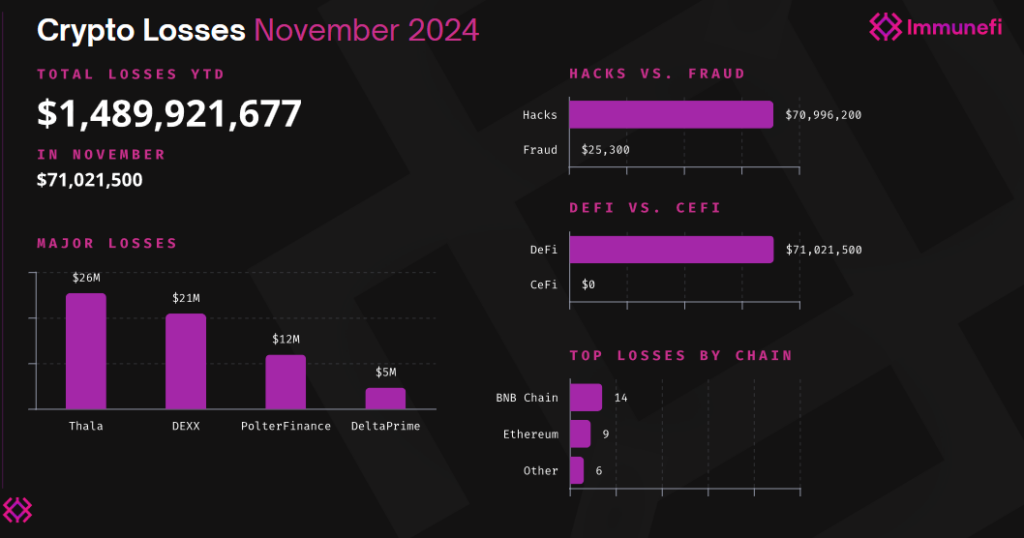
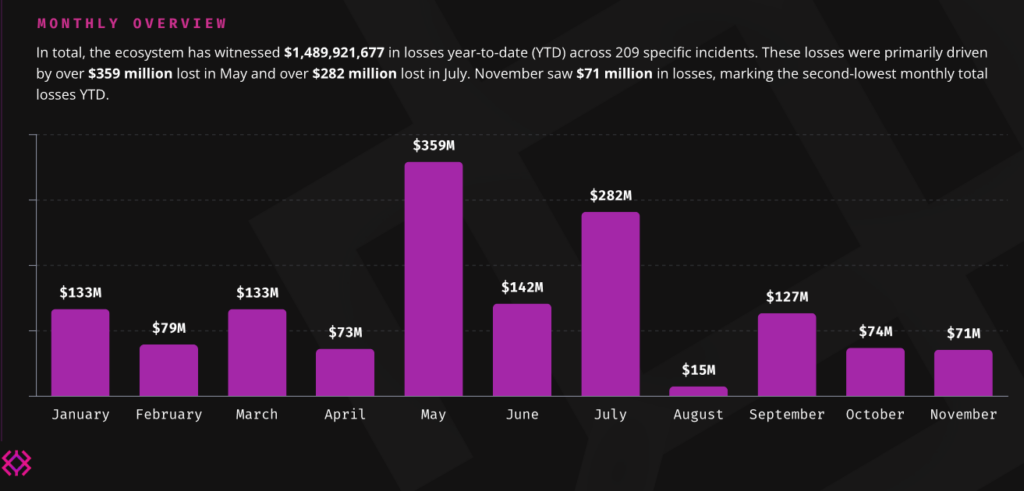
The cryptocurrency industry, celebrated for its innovation and potential to decentralize finance, continues to grapple with a significant Achilles’ heel — security. In 2024, despite advancements in cybersecurity measures, the sector reported losses totaling $1.5 billion across 209 incidents. The staggering figure underscores the relentless threat posed by sophisticated hackers, particularly to decentralized finance (DeFi) platforms, which accounted for most of these breaches.

A Year in Numbers: Trends and Targets

According to data from the Immunefi November 2024 Crypto Losses Report, hacks have overshadowed fraud as the predominant cause of the industry’s financial loss. Out of $1.5 billion in total losses year-to-date, $71 million occurred in November. Though it is one of the lowest monthly figures in 2024, the industry is far from secure. The BNB Chain and Ethereum emerged as the most targeted blockchains, with 46.7% and 30% of total November incidents respectively.

Notably, DeFi platforms faced 100% of November’s attacks, reinforcing their position as the primary focus for cybercriminals. Centralized Finance (CeFi) platforms, in contrast, reported no losses during the same period. This seems to indicate a possible shift in attack vectors favoring decentralized systems.

High-Profile Incidents

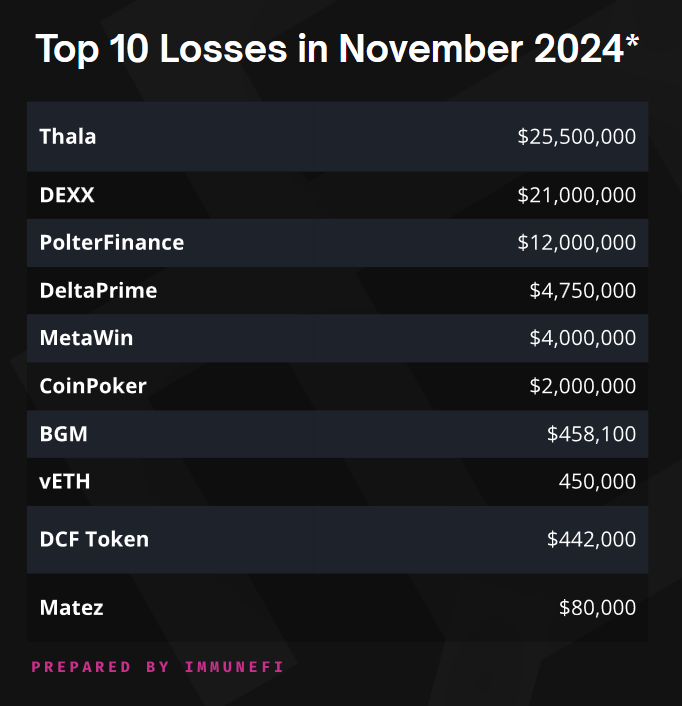
Among the notable breaches in 2024, Thala Labs suffered a $25.5 million loss in November, while the DEXX platform lost $21 million. These incidents reflect the persistent vulnerability of DeFi protocols. They remain lucrative targets for hackers due to their open-source nature and the vast sums of liquidity they handle.

Other significant losses throughout the year included attacks on platforms like PolterFinance and DeltaPrime, demonstrating that no segment of the DeFi ecosystem is immune to exploitation.

Security Improvements and Persistent Challenges

While the $1.5 billion loss represents a 15% reduction from the $1.75 billion reported in 2023, the marginal improvement highlights the enduring challenges in securing DeFi ecosystems. Enhanced security measures, including external audits and bug bounty programs like those offered by Immunefi, have played a critical role in identifying and mitigating vulnerabilities. However, the evolving tactics of hackers – ranging from phishing schemes to smart contract exploits – continue to outpace defensive measures.

Rug pulls, previously a significant source of losses, accounted for a mere 0.04% of November’s financial toll, suggesting progress in combating this particular form of fraud. Yet, the growing complexity of hack strategies, including cross-chain exploits and flash loan attacks, keeps the industry on high alert.

The Path Forward

The persistence of high-value losses underscores an urgent need for the crypto industry to adopt more proactive and collaborative security approaches. Experts advocate for standardized security audits, continuous monitoring of smart contract vulnerabilities, and broader adoption of white-hat hacker programs. Additionally, greater regulatory clarity around cybersecurity standards for DeFi platforms could incentivize stronger safeguards.

As blockchain technology continues to revolutionize finance, its success hinges not only on innovation but also on the ability to secure its foundation. For DeFi to fulfill its promise of a decentralized future, the industry must confront its vulnerabilities head-on, ensuring that recurring breaches do not erode trust in the ecosystem.

Readers’ frequently asked questions

What should I do if the DeFi platform I use gets hacked?

If a DeFi platform you are using gets hacked, the first step is to stop interacting with the platform immediately. Avoid any further transactions to prevent additional losses. Check official announcements from the platform’s developers to understand the scope of the hack and follow their instructions. If the platform has a recovery plan, like tracking the stolen funds or reimbursing users, ensure you register for updates or claims. Additionally, report the incident to blockchain security firms or local authorities specializing in cybercrime. Use this experience to evaluate other platforms for better security practices before investing again.

How can I identify if a DeFi platform is secure before using it?

To evaluate the security of a DeFi platform, check if it has undergone recent audits by reputable blockchain security firms such as CertiK or Immunefi. Look for detailed audit reports that list vulnerabilities and their resolution status. Research whether the platform offers bug bounty programs, as these incentivize ethical hackers to identify flaws proactively. Verify if the platform has been operational for some time without major incidents and consider its reputation within the community. Platforms with transparent development teams and robust documentation are generally more reliable. Always start with small transactions to test the platform’s safety before committing larger funds.

Can stolen funds in a crypto hack be recovered?

Recovering stolen funds in a crypto hack is challenging but not impossible. In some cases, law enforcement and blockchain analytics firms can trace stolen assets using blockchain transparency. Platforms like Thala Labs have successfully recovered funds with the help of legal authorities. However, the chances of recovery depend on the hacker’s methods, the speed of the response, and the cooperation of exchanges where the stolen assets may be moved. To improve the chances of recovery, victims should report the incident immediately to the platform, blockchain security firms, and law enforcement agencies specializing in cybercrime.

What Is In It For You? Action Items You Might Want to Consider

Prioritize Security When Choosing DeFi Platforms

Before engaging with any DeFi platform, ensure it has undergone recent audits by reputable blockchain security firms like CertiK or Immunefi. Look for transparent audit results and active bug bounty programs. Platforms that openly share their security practices and have a track record of resolving vulnerabilities are safer choices for your investments.

Diversify Your Assets Across Multiple Platforms

Avoid concentrating your funds in a single DeFi platform, no matter how reputable it seems. Spreading your assets across multiple platforms reduces the risk of significant loss if one is hacked. Diversification is a practical way to minimize exposure to the vulnerabilities of any single platform or blockchain.

Stay Updated on Emerging Threats and Security Measures

Make it a habit to follow blockchain security news and updates from platforms you use. Cyber threats evolve quickly, and being informed about new exploits or patches can help you react proactively. Subscribing to updates from blockchain security firms or using alert services can keep you one step ahead in safeguarding your investments.

Aftermath of the DEXX Hack: What It Means for Crypto Security and User Trust

The DEXX hack exposed $30M in vulnerabilities

The decentralized exchange platform DEXX, once a growing hub for meme coin trading, is now at the center of a major controversy after suffering a catastrophic $30 million hack. This breach drained funds from over 8,620 Solana wallets. Consequently, it sparked serious discussions about the vulnerabilities of decentralized finance (DeFi). For the affected users, the hack is a devastating reminder of the risks inherent in crypto platforms. For the broader industry, it serves as another wake-up call to strengthen security and user trust.

A Breakdown of the Incident

The breach, which occurred in November 2024, was the result of improper private key management. Investigations by leading blockchain security firms, including CertiK and Beosin, revealed that the hackers exploited DEXX’s official private keys to access user wallets. The attackers executed over 9,000 unauthorized transactions. They strategically targeted wallets based on their balances, with the highest-value accounts suffering the greatest losses.

This systematic and highly efficient operation has raised alarms about the susceptibility of decentralized platforms to targeted attacks. As the stolen assets continue to be laundered through Solana-based protocols, the industry watches closely, seeking lessons to prevent future incidents.

The Human Toll: A Community Reeling

For individual users, the fallout has been devastating. “I woke up to see my wallet balance at zero,” said one victim, who lost nearly $25,000 in the breach. Stories like this are all too common. Affected users report significant financial losses and growing frustration with the platform’s perceived lack of preparedness.

Adding to the chaos, many users deposited funds into DEXX even after the breach was disclosed. They were unaware that the hackers’ script was still active. This resulted in further losses, intensifying the community’s outrage and distrust.

DEXX’s promise of reimbursement offers a glimmer of hope, but the platform’s compensation plan is still under development. Users are required to verify their claims in a rigorous process aimed at preventing fraudulent reimbursement requests. That leaves many uncertain about their financial recovery.

Industry Lessons: Security vs. Usability

The DEXX hack underscores a fundamental tension in decentralized finance: the balance between usability and security. While DeFi platforms strive to provide accessible and efficient trading solutions, incidents like this highlight the dangers of inadequate safeguards.

Experts argue that private key management is one of the most critical, yet often overlooked, aspects of crypto security. “This wasn’t just a breach of DEXX—it was a breach of trust in the DeFi ecosystem,” remarked a blockchain security specialist. For many users, this incident reinforces the importance of self-custody and secure wallet practices.

On the industry side, platforms are being called upon to implement more robust security measures, including multi-signature wallets, cold storage solutions, and regular security audits. Partnerships with leading cybersecurity firms like CertiK and SlowMist are already underway at DEXX, signaling a shift towards stronger defenses.

Broader Implications for DeFi

The DEXX breach is more than an isolated incident; it is a case study in the challenges facing the rapidly evolving world of decentralized finance. As hackers grow increasingly sophisticated, the onus is on platforms to stay ahead of the curve. This includes not only fortifying technical infrastructure but also educating users on security best practices.

Moreover, the industry must address the long-term trust deficit created by high-profile hacks. For many traders, the promise of decentralization is marred by recurring security failures. Rebuilding confidence will require transparency, accountability, and a collective commitment to safeguarding user assets.

A Call to Action

As DEXX works to recover and rebuild, the incident serves as a stark reminder of the risks in the crypto space. For users, it is a lesson in vigilance—ensuring their funds are stored securely and platforms are scrutinized for their security protocols. For DeFi platforms, it is a call to action to prioritize security without compromising on the accessibility that defines the space.

In the aftermath of the DEXX hack, the question is no longer whether DeFi can achieve mass adoption. The questions is whether it can do so without sacrificing the trust and security of its users. This balance will define the future of decentralized finance—and its ability to deliver on its revolutionary promise.

Readers’ frequently asked questions

What exactly is private key management, and why did its failure lead to the DEXX hack?

Private key management refers to the process of securing the cryptographic keys that grant access to a cryptocurrency wallet. In decentralized systems, these keys act as digital signatures to authorize transactions. If a private key is exposed, anyone with access can control the associated wallet, as happened with the DEXX hack. The breach occurred because DEXX’s private key—used to secure user funds on the platform—was improperly managed and ultimately compromised. This allowed hackers to execute unauthorized transactions, systematically draining funds from wallets. Proper private key management typically involves techniques like storing keys offline in “cold wallets,” using multi-signature systems, or employing hardware security modules, none of which were adequately implemented in this case.

Why were users still losing funds even after the hack was disclosed?

The continued losses were due to the lingering presence of the hackers’ automated script, which remained active even after DEXX publicly acknowledged the breach. Some users, unaware of the situation or hopeful that the platform was still operational, continued depositing funds into the exchange. Since the underlying vulnerability had not been patched at that point, these deposits were promptly stolen. This underscores the importance of users acting swiftly to secure their assets and avoid interacting with compromised platforms until the issue is confirmed as resolved by credible sources.

How can users protect themselves from similar hacks on other platforms in the future?

To protect themselves, users should adopt best practices in cryptocurrency security. First, prioritize the use of non-custodial wallets, where users retain full control over their private keys. Hardware wallets are a reliable option, as they store keys offline, away from potential online threats. Second, diversify storage—avoid keeping all assets on a single platform, particularly those with custodial features, where private keys are managed by the platform. Third, stay informed about the platforms you use by following updates from trusted blockchain security firms and community alerts. Finally, if a platform announces a security breach, immediately transfer your funds to a secure wallet and monitor transactions for unusual activity. These steps can significantly reduce the risk of becoming a victim of a similar hack.

What Is In It For You? Action Items You Might Want to Consider

Diversify Your Storage for Enhanced Security

Consider splitting your funds across multiple wallets, including hardware wallets and secure non-custodial options. This reduces your exposure to platform-specific vulnerabilities like those seen in the DEXX hack. Diversifying where you store your assets ensures that even if one wallet is compromised, the majority of your funds remain safe.

Stay Informed and React Quickly to Platform Announcements

Regularly monitor updates from the platforms you use, especially regarding security incidents. In the case of a breach, act immediately—transfer your funds to a secure wallet and avoid interacting with the affected platform until you’ve confirmed the issue is resolved through credible sources. Quick action can prevent unnecessary losses.

Prioritize Platforms with Robust Security Measures

Before using a decentralized exchange or any trading platform, research its security protocols. Look for features like multi-signature wallets, cold storage solutions, and audits by reputable security firms. Opting for platforms that prioritize security over convenience can save you from costly breaches in the long run.

- Advertisement -

FEATURED