Home Blog Page 163

The Missing Piece in CBDC Adoption? IMF’s REDI Framework and the Role of Public Trust

IMF REDI Framework: A Roadmap to Global CBDC Adoption

As central banks across the globe approach the implementation of Central Bank Digital Currencies (CBDCs), a critical challenge looms—public trust. Despite the increasing technological capability to introduce and manage digital currencies, the lack of trust among consumers, merchants, and intermediaries could stifle their widespread adoption. Recognizing this barrier, the International Monetary Fund (IMF) has introduced the REDI Framework, designed to not only address regulatory and technical concerns but also place a strong emphasis on education and communication—key factors in building trust around CBDCs.

The REDI Framework: A Strategic Approach

The REDI Framework, introduced in September 2024, is a comprehensive guide for central banks, aiming to boost CBDC adoption through four core pillars: Regulation, Education, Design, and Incentives. While regulation and design are crucial in ensuring CBDC functionality, the IMF stresses that education and public engagement are indispensable components for success.

As outlined in the REDI Framework, public awareness plays a pivotal role in fostering trust. Without a widespread understanding of what CBDCs are, how they work, and their potential benefits, public skepticism may hinder adoption. The framework encourages central banks to lead educational campaigns that simplify technical concepts and address concerns such as security, privacy, and financial inclusion.
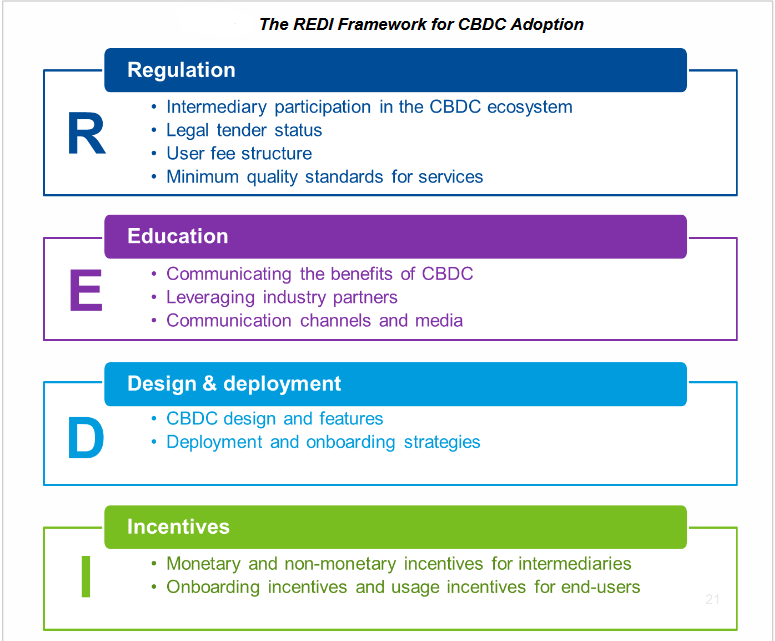
Source: IMF Fintech Notes, Sept 20, 2024

Trust and Education: The Core of CBDC Adoption

One of the core challenges central banks face is that many people do not yet understand the concept of CBDCs or differentiate them from other digital currencies like cryptocurrencies. The lack of a clear distinction has led to confusion, and in some cases, outright mistrust. The IMF’s framework suggests that educational initiatives must target both the general public and financial intermediaries to create a unified understanding of the purpose and potential of CBDCs.

The REDI framework proposes that central banks act as the primary source of information for CBDCs, fostering a centralized and credible communication stream. This could include public workshops, accessible online content, and partnerships with financial intermediaries to explain the safety, privacy features, and benefits of using CBDCs. Without such targeted efforts, the IMF warns that misinformation could spread, potentially sabotaging even the most sophisticated CBDC implementations.

Overcoming Misinformation and Building Confidence

Misinformation poses a substantial risk to CBDC adoption, particularly in regions where digital financial literacy is low or skepticism toward government-managed digital systems is high. Public trust in central banks and digital systems varies significantly between regions. For example, in regions like the European Union, where digital payments and trust in institutions are high, CBDC adoption might face fewer hurdles. Conversely, countries with more skepticism toward governmental control or with less robust digital infrastructure could see significant resistance.

The REDI Framework acknowledges these regional differences and suggests that tailored communication strategies are necessary to address unique concerns. In some cases, central banks may need to emphasize the security and privacy features of CBDCs to combat fears that they could be used for surveillance or control over personal financial behavior.

Incentives: A Boost to Public Engagement

Beyond education, the IMF’s REDI Framework highlights the role of incentives in encouraging CBDC usage. Both monetary and non-monetary incentives could help entice early adopters. For instance, the IMF suggests that subsidizing merchant transaction fees or offering rewards for using CBDCs in daily transactions could make the transition to digital currencies more appealing. These incentives work hand-in-hand with education, helping to demonstrate the tangible benefits of using CBDCs, thus strengthening public trust.

Conclusion: Education as the Foundation of Trust

As central banks continue to develop CBDCs, it’s clear that technology alone is not enough to guarantee success. Public trust, built through targeted education and transparent communication, is the missing piece that will ultimately determine the success or failure of CBDC adoption. The IMF’s REDI Framework provides a roadmap not only for the technical implementation of digital currencies but also for cultivating the public confidence necessary for widespread usage.

By emphasizing the human factors – trust, understanding, and engagement – central banks can ensure that CBDCs are not only accepted but embraced as a transformative tool in the future of global finance. Without these efforts, even the most advanced CBDC systems may struggle to gain traction.


SEC Faces Judicial Scrutiny as Coinbase Demands Rulemaking for Cryptocurrencies

Coinbase challenges SEC over lack of clear crypto rules, with court questioning SEC's actions.

In a landmark legal battle that could reshape the U.S. regulatory landscape for digital assets, Coinbase, the largest cryptocurrency exchange in the U.S., is challenging the Securities and Exchange Commission (SEC) for its refusal to issue formal rules governing cryptocurrencies. The case escalated recently when the U.S. Court of Appeals in Philadelphia questioned the SEC’s approach. One judge criticized the regulator’s rejection of Coinbase’s petition as being “vacuous.” This critique highlights the SEC’s reliance on enforcement actions rather than providing clear regulatory guidelines for the crypto industry.

The Heart of the Dispute

Coinbase’s dispute with the SEC centers around the agency’s refusal to establish a comprehensive rulemaking framework for digital assets. In July 2022, Coinbase filed a petition requesting the SEC to propose rules clarifying which cryptocurrencies should be considered securities. That’s the issue at the heart of the ongoing conflict. However, the SEC denied the petition in late 2023, asserting that its existing securities laws were sufficient.

Coinbase argues that the lack of clear guidance creates an unworkable regulatory environment for crypto firms. It stifles innovation and deters businesses from operating in the U.S. “The SEC refuses to provide a reasonable explanation for its barebones denial,” Coinbase’s chief legal officer, Paul Grewal, commented following the recent court appearance.

Court’s Skepticism of the SEC

During the September 23 hearing, the court’s panel of judges openly questioned the SEC’s decision to deny Coinbase’s request for rulemaking. Judge Thomas Ambro noted that the agency’s explanation for rejecting Coinbase’s petition was “pretty darn close to vacuous,” underscoring the court’s concerns about the SEC’s refusal to clarify its stance on digital assets. The judges further scrutinized the SEC’s enforcement-centric approach. They highlighted how the agency had taken multiple enforcement actions against crypto firms without providing the higher-level guidance needed to regulate the industry fairly.

Judge Stephanos Bibas pointed out that while the SEC has aggressively pursued enforcement actions against various crypto companies, it has failed to provide a regulatory framework. This framework should adequately address the unique characteristics of cryptocurrencies and decentralized finance protocols. This inconsistency between enforcement and rulemaking drew further questions from the court.

A Potential Turning Point for U.S. Crypto Regulation

Coinbase’s legal challenge could have far-reaching consequences. If the court rules in the exchange’s favor, it may compel the SEC to begin a formal rulemaking process. It would force the regulator to engage more directly with the cryptocurrency industry. This could lead to new rules and regulations providing clearer guidelines for crypto firms operating in the U.S., an outcome many in the industry have long awaited.

The stakes are high. A ruling against the SEC would significantly shift the power balance between regulators and the crypto industry. It would impact Coinbase and also set a precedent for how the SEC treats other digital asset firms moving forward.

Regulation by Enforcement vs. Rulemaking

At the core of this conflict is the SEC’s controversial approach of “regulation by enforcement.” Since 2021, the SEC has launched a series of enforcement actions against crypto companies, alleging violations of securities laws. Most notably, the regulator filed a lawsuit against Coinbase in June 2023. They accused the exchange of operating as an unregistered securities exchange and broker. Coinbase has consistently rejected these claims. The company argued that many of the assets listed on its platform are not securities. They should not fall under the SEC’s jurisdiction.

The broader crypto industry has expressed frustration with the SEC’s failure to provide clear guidelines. This refusal resulted in regulatory uncertainty and legal battles. The SEC maintains that digital assets should fit within the existing securities framework. However, many argue that cryptocurrencies represent a new asset class that requires a tailored regulatory approach.

The legal battle between Coinbase and the SEC has become a flashpoint in the wider debate over cryptocurrency regulations in the U.S. As the court continues to scrutinize the SEC’s approach, the outcome of this case could either reinforce the regulator’s enforcement strategy or pave the way for comprehensive rulemaking that offers much-needed clarity for digital asset firms.

This case highlights the urgent need for regulatory clarity in the fast-evolving world of cryptocurrencies. Should Coinbase succeed, it could signal a new era of regulation that balances innovation with investor protection, setting a precedent that would shape the future of crypto in the U.S. for years to come.

Readers’ frequently asked questions

What is the significance of this legal case for the broader cryptocurrency industry?

The Coinbase vs. SEC case is particularly significant because it addresses the growing tension between the cryptocurrency industry and U.S. regulators. If the court sides with Coinbase, it could force the SEC to establish clearer, more transparent rules for the digital asset space. So far it has been governed by existing securities laws that many argue are not suited to cryptocurrencies. A favorable ruling for Coinbase could offer greater legal certainty to the industry. It could encourage innovation and investment by reducing the fear of sudden enforcement actions. This case is a potential turning point for the U.S. regulatory framework. It would likely set a precedent for how digital assets are treated under the law, impacting other crypto firms and the broader ecosystem. Many companies have long called for such clarity. They argue that the SEC’s current enforcement-focused approach hampers business and drives innovation offshore.

Why has the SEC been reluctant to issue specific rules for cryptocurrencies?

The SEC’s reluctance to issue specific cryptocurrency regulations stems from its stance that existing securities laws cover digital assets adequately. Under the leadership of Chair Gary Gensler, the SEC has maintained that many cryptocurrencies function as securities under the Howey Test. That is a legal standard used to determine whether a financial transaction qualifies as an investment contract. The regulator has argued that creating separate rules for cryptocurrencies could undermine investor protection and market integrity upheld by the current securities laws. Moreover, the SEC has cited resource limitations and competing priorities as reasons for not engaging in formal rulemaking for crypto. However, this has led to criticism from the industry and even from within the judiciary. Some courts question whether the SEC is doing enough to provide clarity for businesses that want to operate legally in the U.S.

What could happen if the court ruled in favor of the SEC?

If the court ruled in favor of the SEC, it would affirm the agency’s current approach of regulating digital assets through enforcement actions rather than by issuing new rules. This could lead to continued uncertainty for the crypto industry. Companies would have to navigate an environment where regulatory guidance is delivered primarily through lawsuits and settlements rather than clear regulations. The SEC might be emboldened to intensify its enforcement efforts against other crypto firms, potentially leading to more legal battles. Companies like Coinbase would need to continue adapting to a regulatory landscape where they could be targeted for non-compliance with securities laws that many argue are ill-suited to the unique features of digital assets. Additionally, such a ruling might discourage innovation within the U.S. Companies may seek more favorable regulatory environments in other jurisdictions, thereby impacting the country’s position in the global crypto market.

What Is In It For You? Action Items You Might Want to Consider

Stay Updated on the SEC vs. Coinbase Ruling for Strategic Positioning

As this legal battle unfolds, the potential for new regulations or continued enforcement actions could significantly affect the crypto market’s dynamics. Keep a close eye on the court’s rulings and any developments in regulatory guidelines. If the court favors Coinbase, it may open new opportunities for U.S.-based crypto exchanges and assets that have previously faced regulatory uncertainty. Traders should be prepared to adjust their portfolios. Increased clarity could drive higher institutional interest and a possible surge in certain digital assets.

Consider Diversifying to International Markets

If the SEC continues its enforcement-heavy approach without establishing clear rules, U.S.-based crypto firms, including Coinbase, may face increasing regulatory pressures. This could create an uneven playing field compared to international markets with more favorable crypto regulations. As a trader, consider diversifying your investments. Include international exchanges or assets that may not be as directly affected by U.S. enforcement actions. This strategy can help mitigate risks associated with the uncertain U.S. regulatory environment while still participating in global crypto growth.

Prepare for Increased Volatility in U.S.-Listed Crypto Assets

Should the court rule in favor of the SEC, continued enforcement actions against major crypto firms like Coinbase could trigger market volatility, particularly in assets tied to U.S.-based exchanges. Traders should consider setting up stop-loss orders or using hedging strategies to protect against sudden market movements. At the same time, a clear regulatory outcome – either through court decisions or eventual rulemaking – could drive a rally if investors gain confidence in the legal status of digital assets. Stay agile, and be ready to capitalize on price fluctuations that may arise from this prolonged legal battle.

Bitcoin Set to Hit $200K by 2025: Election Unlikely to Derail Bullish Momentum

Bitcoin set to hit $200K by 2025 as institutional adoption grows, despite U.S. election uncertainty. Bitcoin inflation hedge remains strong.

As Bitcoin continues to gain traction among institutional investors and global markets, experts forecast a meteoric rise in its price. Projections are reaching as high as $200,000 by 2025. Despite the looming U.S. presidential election, which often creates uncertainty across financial markets, analysts argue that Bitcoin’s long-term trajectory remains intact. The cryptocurrency’s growth, they assert, is driven by macroeconomic factors such as rising inflation, increasing institutional adoption, and the gradual clarification of regulatory frameworks. Whether it’s Donald Trump or Kamala Harris who assumes the U.S. presidency in 2024, Bitcoin’s momentum appears unstoppable.

Institutional Adoption Drives Bitcoin’s Rise

A key driver of Bitcoin’s projected surge is its growing appeal to institutional investors. Companies like MicroStrategy, led by Bitcoin bull Michael Saylor, have steadily increased their Bitcoin holdings. MicroStrategy’s Bitcoin stash is now worth over $14.6 billion, and the company shows no signs of slowing down. They recently issued $700 million in convertible notes to buy even more of the cryptocurrency. This large-scale institutional buy-in is one of the most significant factors supporting the predictions of Bitcoin’s price reaching six figures in the coming years.

The influx of institutional capital is also indicative of a broader trend. Bitcoin is increasingly viewed as a hedge against inflation, much like gold. With global inflation rates rising, particularly in the U.S. and Europe, many institutional investors are turning to Bitcoin as a store of value. This shift is bolstered by the idea that Bitcoin’s fixed supply of 21 million coins makes it inherently deflationary. That is a critical selling point in an environment of rising prices and currency devaluation.

Election Won’t Deter Long-Term Growth

While the U.S. presidential election often creates volatility in traditional financial markets, analysts suggest that Bitcoin’s decentralized nature and unique economic properties make it less susceptible to such events. Standard Chartered, one of the leading financial institutions making Bitcoin price forecasts, has been particularly vocal in its predictions. The bank believes Bitcoin will hit $200,000 by the end of 2025, regardless of the election outcome.

This bullish projection stems from Bitcoin’s increasing role as a global asset, largely unaffected by local political developments. Whether Trump, known for his pro-business stance, or Harris, who could introduce more comprehensive regulatory frameworks, takes office, Bitcoin is expected to maintain its upward trend. Analysts argue that the fundamentals of Bitcoin are much more closely tied to macroeconomic factors – such as interest rates, inflation, and institutional demand – than to political administrations.

Macroeconomic Factors Behind the Surge

In addition to institutional adoption, the broader economic environment continues to create ideal conditions for Bitcoin’s growth. Rising global inflation and the threat of recessions have led many investors to seek alternative assets that can preserve value over the long term. Bitcoin’s decentralized, borderless nature and its increasing recognition as “digital gold” make it an attractive choice.

Moreover, regulatory clarity is slowly but surely emerging. Recent regulatory developments in the U.S. and Europe point to a future where the global financial system will fully integrate Bitcoin and other cryptocurrencies. This growing legitimacy is reassuring to retail and institutional investors, who had previously been cautious due to regulatory uncertainties. The introduction of Bitcoin ETFs and the growing possibility of Bitcoin-backed financial products, such as loans and bonds, further cement Bitcoin’s place as a legitimate asset class.

Conclusion: A Bullish Outlook Despite Political Uncertainty

While the 2024 U.S. election may cause temporary market fluctuations, the overall outlook for Bitcoin remains overwhelmingly positive. Institutional adoption continues to grow, and macroeconomic conditions make Bitcoin a more attractive asset for investors seeking a hedge against inflation. With forecasts from Standard Chartered and other financial experts predicting Bitcoin’s price will reach $200,000 by 2025, it’s clear that the cryptocurrency’s long-term growth will be driven by far more than political events.

The market’s focus remains on Bitcoin’s role as a store of value, its limited supply, and its increasing institutional acceptance. As such, short-term political shifts are unlikely to derail its bullish momentum. Whether under Trump or Harris, Bitcoin’s path to $200,000 – and beyond – appears firmly set in motion.

Readers’ frequently asked questions

How does institutional adoption directly affect Bitcoin’s price stability?

Institutional adoption brings a higher level of liquidity and maturity to the Bitcoin market. That has a direct impact on its price stability. As more institutions – such as hedge funds, corporations, and financial institutions – invest in Bitcoin, it leads to greater trading volumes and deeper markets. This increased liquidity allows for smoother price movements, reducing the chances of extreme volatility from large trades or market shocks. Additionally, institutional investors tend to adopt longer-term strategies than retail traders, creating a more stable demand for Bitcoin over time. The capital inflow from institutions boosts market confidence and provides a strong foundation for sustained price growth, mitigating the risk of sudden price crashes.

What role do Bitcoin ETFs play in increasing institutional and retail participation?

Bitcoin ETFs (Exchange-Traded Funds) serve as a bridge for institutional and retail investors to gain exposure to Bitcoin without directly owning or managing the underlying asset. ETFs simplify investing in Bitcoin by allowing participants to buy shares of a fund that tracks Bitcoin’s price. That is similar to how investors buy shares in a stock index fund. This structure provides a familiar investment vehicle regulated and traded on traditional stock exchanges. As ETFs become more widely available and gain regulatory approval in various jurisdictions, they make it easier for institutional investors, such as pension funds and asset managers, to include Bitcoin in their portfolios. This increased accessibility can lead to higher demand for Bitcoin. When more investors feel comfortable participating in the market, it drives prices up.

How does Bitcoin’s fixed supply influence its price in an inflationary environment?

Bitcoin’s fixed supply of 21 million coins creates a scarcity effect, playing a critical role in its price appreciation, particularly in inflationary environments. Unlike fiat currencies, which governments can print in unlimited quantities, Bitcoin’s supply is capped and programmed into its code. As inflation erodes the purchasing power of traditional currencies, investors often seek assets that are scarce and resistant to devaluation. This is why Bitcoin is frequently compared to gold as a store of value. In periods of high inflation, demand for Bitcoin typically increases because its fixed supply makes it an attractive hedge against the decreasing value of fiat money. This rising demand, coupled with Bitcoin’s limited supply, drives its price upward. That reinforces its reputation as a deflationary asset in the context of a volatile economic landscape.

What Is In It For You? Action Items You Might Want to Consider

Consider Gradually Increasing Your Bitcoin Holdings in Anticipation of Long-Term Gains

With forecasts predicting Bitcoin could reach $200,000 by 2025, now may be a good time to start building or expanding your Bitcoin position. Dollar-cost averaging (DCA) could be a smart strategy to mitigate short-term volatility while benefiting from the projected long-term price growth driven by institutional adoption and macroeconomic trends.

Stay Informed on Regulatory Developments and Bitcoin ETFs

Keep a close eye on upcoming regulatory changes and the potential launch of more Bitcoin ETFs. These financial products are expected to boost Bitcoin’s accessibility for both retail and institutional investors, which could drive significant demand. Understanding how these developments unfold can give you an edge in timing market opportunities.

Prepare for Short-Term Volatility Around the U.S. Election

Although long-term predictions remain bullish, the 2024 U.S. presidential election could create short-term market fluctuations. Be ready to adjust your positions accordingly. Consider using limit orders or stop-loss strategies to protect your trades from sudden price swings during this period of political uncertainty.

BlackRock’s Bitcoin ETF Options Approval: A Game-Changer for Institutional Investors

BlackRock’s Bitcoin Options approval enhances liquidity and risk management, offering new opportunities for institutional investors and sophisticated traders.

In a significant breakthrough for the cryptocurrency sector, the U.S. Securities and Exchange Commission (SEC) has approved options trading on BlackRock’s iShares Bitcoin Trust (IBIT). That marks a critical evolution in Bitcoin’s integration into traditional financial markets. Institutional investors will have access to advanced risk management tools, likely enhancing liquidity and hedging capabilities within the digital asset space. This development could signal a new era of mainstream acceptance for Bitcoin derivatives.

What the Approval Means for Institutional Investors

The approval of options trading on BlackRock’s Bitcoin ETF represents a landmark moment for institutional investors. These options are physically settled. That means when exercised the underlying Bitcoin will be delivered, providing investors with greater flexibility and control over their exposure to Bitcoin. By allowing American-style options, investors can exercise contracts at any point before expiration. This is a crucial feature for institutions managing large, dynamic portfolios.

This development gives institutional investors new avenues for hedging risk and speculating on Bitcoin’s price movements without holding the actual asset. For large funds, this reduces the operational complexities of directly managing cryptocurrency assets. They can still maintain significant exposure to its price action.

Why Options Matter for Bitcoin’s Liquidity

Options trading is a crucial tool for any liquid market. It offers new strategies for hedging against price volatility and opens doors for speculators to profit from price movements without the need to own the underlying asset. In BlackRock’s case, options on IBIT will allow investors to fine-tune their exposure to Bitcoin. It could potentially increase market participation and liquidity in the process.

This could attract additional institutional money into the market, further legitimizing Bitcoin as an investment-grade asset. According to industry analysts, this move will likely entice other large financial institutions to follow suit, amplifying liquidity and market depth in Bitcoin.

Institutional Adoption at a Tipping Point?

The approval also signals that the SEC might be warming to the idea of cryptocurrency playing a larger role in mainstream financial markets. Following the introduction of Bitcoin spot ETFs, options add another layer of financial sophistication. This helps Bitcoin gain acceptance among conservative institutional investors who prefer derivatives and hedging mechanisms over outright asset ownership.

Several experts predict that more financial institutions will be inclined to launch similar products, possibly accelerating the institutional adoption of Bitcoin, but also other cryptocurrencies like Ethereum. This growing participation from large asset managers such as BlackRock is a critical step toward integrating cryptocurrencies into traditional financial markets.

Remaining Regulatory Hurdles

While the SEC has approved BlackRock’s Bitcoin ETF options, the products cannot be traded until they receive further clearance from the Commodity Futures Trading Commission (CFTC) and the Office of the Comptroller of the Currency (OCC). These additional approvals are expected to arrive soon, but regulatory caution remains high given the inherent volatility of cryptocurrency markets.

The SEC’s decision comes amid debates about how these financial products could impact market stability. There are concerns about volatility, manipulation, and overall market maturity. However, Nasdaq and BlackRock have introduced several safeguards, such as inter-market surveillance agreements, to reduce these risks.

Conclusion: A New Era for Crypto in Traditional Finance?

The SEC’s approval of Bitcoin ETF options is not just a victory for BlackRock but also a significant advancement for institutional investors looking to engage with Bitcoin in a regulated risk-managed way. As the cryptocurrency market continues to evolve, products like these bring much-needed legitimacy, liquidity, and financial infrastructure to the space.

This approval might mark the beginning of broader institutional adoption, pushing Bitcoin further into the mainstream and strengthening its role as a valuable part of the global financial system. The introduction of Bitcoin options may well be remembered as a turning point in the maturation of the cryptocurrency market.

Readers’ frequently asked questions

What makes BlackRock’s Bitcoin ETF options different from regular Bitcoin trading?

BlackRock’s Bitcoin ETF options offer a more structured and regulated way for investors to engage with Bitcoin without holding the actual cryptocurrency. Unlike buying Bitcoin directly from a crypto exchange, ETF options allow investors to speculate on the price movements of Bitcoin or hedge their positions through a regulated exchange, such as Nasdaq. These options are physically settled, meaning that if exercised, they are backed by actual Bitcoin, which gets delivered upon contract settlement. This contrasts with many other financial products in the crypto market that are settled in cash, providing no exposure to the physical asset. This feature is particularly appealing to institutional investors who need both the security of regulation and the ability to control their exposure to the underlying asset without directly dealing with the technical complexities of holding Bitcoin.

How will the introduction of Bitcoin ETF options affect Bitcoin’s price and volatility?

The introduction of ETF options could have a dual effect on Bitcoin’s price and volatility. On one hand, the availability of options increases the number of sophisticated trading strategies institutional investors can use, such as hedging against price fluctuations. This can reduce the market’s overall volatility because investors are better equipped to manage risk. On the other hand, options trading could also lead to more speculative trading, where traders attempt to capitalize on short-term price movements. Historically, introducing derivatives like futures and options in any asset class has often increased trading volume and liquidity. That in turn tends to stabilize prices over time. However, in the short term, speculative activity can sometimes exacerbate volatility, especially if market participants use high leverage, a trend seen with other crypto derivatives in the past​.

What are the potential risks for institutional investors using these ETF options?

While the introduction of Bitcoin ETF options provides institutional investors with more sophisticated risk management tools, there are still risks. One of the key risks is the volatility inherent in Bitcoin. Even though the options allow for hedging, sudden price swings could lead to significant losses if strategies are not well-timed or executed. Another risk is liquidity, especially in the early stages of the ETF options market. If there isn’t enough liquidity, it could lead to wider spreads between bid and ask prices. That would make it harder for large investors to enter and exit positions at favorable prices. Additionally, there are still regulatory uncertainties surrounding cryptocurrency markets. While BlackRock’s product has been approved by the SEC, other regulatory bodies like the CFTC and OCC need to give final clearance. Further, future changes in regulations could impact the options market or impose additional costs on trading​.

What Is In It For You? Action Items You Might Want to Consider

Leverage Options to Hedge Against Bitcoin’s Volatility

With the SEC’s approval of BlackRock’s Bitcoin ETF options, traders now have a new tool to hedge against Bitcoin’s notorious volatility. If you’re already holding Bitcoin or have exposure through ETFs, consider using options to protect your portfolio during market downturns. Options allow you to limit losses by locking in future prices or to take advantage of market corrections without selling your holdings. Review your current risk exposure and explore using these options to safeguard your long-term positions.

Explore Short-Term Trading Strategies Using Bitcoin Options

For traders interested in short-term opportunities, BlackRock’s ETF options provide an excellent chance to capitalize on Bitcoin’s price swings. Since these are American-style options, they can be exercised at any time before expiration. That gives you flexibility to respond quickly to market movements. Consider strategies such as covered calls or straddles to profit from both rising and falling markets. With the increased liquidity these options will bring, short-term traders can deploy more sophisticated tactics. This allows them to minimize the risk of holding Bitcoin directly.

Monitor Institutional Activity for Market Sentiment Clues

Institutional involvement in Bitcoin has long been seen as a bellwether for price movements. Now that options are on the table, large-scale traders will have more freedom to participate in the Bitcoin market. Keep an eye on trading volumes and positions held by major players. This could provide early indications of major market moves. Tools like open interest and volume data for these new ETF options will give you a clearer picture of how institutional investors are positioning themselves. It will help you adjust your own strategies accordingly.

Crypto’s Latest Scandal: $230 Million Bitcoin Heist Targets Genesis Creditor in Daring Social Engineering Attack

"$230M Bitcoin Heist: Genesis Creditor Hit in Social Engineering Scam

In a case highlighting the vulnerabilities of even the most secure cryptocurrency platforms, two men have been charged with the theft of over 4,100 Bitcoin — worth approximately $230 million — from a creditor of Genesis, the bankrupt cryptocurrency lending firm. The audacious heist, carried out in August 2024, exposes the growing threat of social engineering in the digital currency world, even as blockchain technology itself remains highly secure.

The Heist: How It Happened

The criminals, identified as Malone Lam, 20, and Jeandiel Serrano, 21, allegedly used a blend of technical expertise and psychological manipulation to gain access to the victim’s cryptocurrency holdings. The attackers posed as support staff from Google and Gemini, a prominent cryptocurrency exchange, in a highly sophisticated phishing operation. The thieves convinced the victim to reset their two-factor authentication (2FA) and install screen-sharing software, such as AnyDesk. Consequently, they were able to gain control over the victim’s private keys stored in a Bitcoin Core wallet.

Once they obtained access to the private keys, Lam and Serrano transferred more than 4,100 Bitcoin into accounts they controlled. This heist, targeting a creditor of Genesis, adds to the mounting list of challenges faced by creditors of the bankrupt crypto lender. Genesis has been in financial distress following its exposure to FTX and other collapsed entities.

The Role of Blockchain Forensics

Lam and Serrano made significant efforts to cover their tracks using privacy-focused cryptocurrencies like Monero. However, despite laundering the stolen assets through a network of crypto mixers and exchanges, they were eventually caught. Blockchain investigator ZachXBT played a crucial role in tracking the stolen funds across multiple wallets. His forensic work uncovered a complex web of transactions involving over 15 exchanges. The stolen Bitcoin was repeatedly swapped between various cryptocurrencies in an attempt to evade detection.

The criminals also used “peel chains” and pass-through wallets to launder the funds. That made it more difficult to trace the origin and destination of the assets. However, the attackers made critical operational security (OPSEC) mistakes. For example, they linked their activities to real-world identities via social media posts that flaunted their newfound wealth. Investigators were able to follow the trail of laundered funds to luxury purchases, such as high-end cars, watches, and nightclubs in Miami and Los Angeles, ultimately leading to their arrests.

Implications for Crypto Security

This case underscores the growing risks of social engineering in the cryptocurrency space. While blockchain technology itself remains highly secure, the human element continues to be a significant point of vulnerability. Social engineering attacks — wherein criminals trick victims into revealing sensitive information or credentials — are increasingly becoming the preferred method for accessing high-value cryptocurrency accounts.

The attackers were able to bypass strong security measures like two-factor authentication. However, they did not crack the underlying encryption but exploited the victim’s trust. This highlights the need for enhanced user education and more robust account recovery and support procedures within the cryptocurrency ecosystem.

A Warning for the Crypto Industry

The $230 million heist is not just a warning to individual cryptocurrency holders. It is also a red flag for exchanges and platforms that support them. It points to the need for better internal security measures and training to prevent social engineering attacks from succeeding. In addition, the case demonstrates how, even after the theft has occurred, blockchain forensics can play a vital role in tracking down stolen assets and apprehending cybercriminals.

As the cryptocurrency industry matures, it must continue to address these weaknesses in user authentication processes and improve collaboration between exchanges, law enforcement, and blockchain analysts. The industry can only hope to prevent future attacks of this scale by closing these security gaps.

The arrest of Malone Lam and Jeandiel Serrano after their $230 million Bitcoin theft offers a significant victory for blockchain forensics and law enforcement. However, the underlying issue remains: social engineering attacks are a growing threat in the cryptocurrency world. As this heist shows, even the most secure digital assets are vulnerable to human error and manipulation. The industry must adapt to this new reality and invest in protecting not just the technology, but the users who rely on it.

Readers’ frequently asked questions

How did the attackers bypass two-factor authentication (2FA), a method often considered secure?

In this case, the attackers did not directly crack or break the encryption of the 2FA process itself. Instead, they employed a sophisticated social engineering technique. The perpetrators posed as Google and Gemini support staff, tricking the victim into believing their account had been compromised. They convinced the victim to reset their 2FA and disclose sensitive information while using screen-sharing software like AnyDesk. This allowed the attackers to view and steal the private keys to the victim’s Bitcoin wallet. This method highlights a critical flaw in 2FA. While it strengthens account security, it can be undermined by manipulating the user into voluntarily disabling or resetting the mechanism. The human element, rather than a technical vulnerability, was the weak link exploited in this heist.

Can stolen cryptocurrency be recovered once it has been laundered through mixers and exchanges?

While the attackers used cryptocurrency mixers and multiple exchanges to launder the stolen funds, blockchain forensics can still trace the transactions. Blockchain technology’s transparent nature allows investigators to follow the trail of funds, even when attempts are made to obscure the source and destination through mixers and peel chains. In this case, blockchain analyst ZachXBT played a pivotal role in tracking the movement of the stolen Bitcoin. Although some of the stolen assets were converted into Monero, a privacy-focused coin that is harder to trace, investigators managed to identify key addresses and transactions linked to the suspects. As of the latest reports, portions of the funds were frozen or recovered, though the full amount has not been retrieved. This case illustrates that while laundering adds complexity, skilled forensic teams can often recover or at least trace some of the stolen assets, particularly when attackers make mistakes in hiding their tracks.

What role did Genesis’ bankruptcy play in this heist, and was it a contributing factor to the attack?

Genesis’ bankruptcy, stemming from its exposure to the FTX collapse and the broader crypto market downturn, put creditors in a vulnerable position. The specific creditor targeted in this heist was likely dealing with significant financial uncertainty. That made them an ideal target for a social engineering attack. While Genesis’ bankruptcy did not directly cause the attack, it created an environment where its creditors may have been less vigilant or more susceptible to scams involving claims of compromised accounts. The attackers capitalized on this situation by pretending to be legitimate representatives from major platforms like Gemini. That could have seemed plausible to a creditor seeking to protect their remaining assets. The Genesis bankruptcy, in this sense, was an indirect contributing factor. It left individuals exposed to potential scams and heightened anxiety about their assets.

What Is In It For You? Action Items You Might Want to Consider

Strengthen Your 2FA and Be Wary of Social Engineering Attempts

Even though two-factor authentication (2FA) provides a strong layer of security, this heist reveals how social engineering can easily undermine it. Always be cautious when contacted by someone claiming to be support staff, especially if they ask you to reset your 2FA or install screen-sharing software. Verify communications directly through official channels, and never share sensitive details over the phone or online chats. In high-risk environments, consider using hardware-based 2FA devices like YubiKeys for added protection. They offer more security than app-based 2FA.

Use Multiple Wallets and Limit Exposure

Rather than keeping all your assets in a single wallet, consider spreading your holdings across multiple wallets. Use different levels of security (e.g., cold wallets for long-term storage). This will limit the potential damage if one wallet is compromised. Additionally, use different exchanges for different purposes to prevent a single point of failure. As seen in this case, attackers accessed and laundered the stolen funds through several platforms.

Monitor Transactions and Use Blockchain Analytics Tools

Make it a habit to regularly monitor your wallets and the transactions happening within the blockchain ecosystem. There are numerous blockchain analytics tools available, such as Chainalysis or CipherTrace, that allow you to flag suspicious activity. Many of these tools provide real-time alerts when abnormal movements are detected. Additionally, consider working with services that offer insurance on digital assets or employ advanced tracking in case your funds ever get compromised.

- Advertisement -

FEATURED