Home Blog Page 164

Anonymity Exposed: German Crypto Crackdown Shakes Ransomware Networks

Germany’s crackdown on 47 exchanges exposes crypto anonymity risks, challenging the security of illegal transactions in the crypto world.

German law enforcement has delivered a major blow to cybercriminals. They seized 47 cryptocurrency exchanges accused of facilitating anonymous transactions for money laundering. The platforms, including Xchange.cash, 60cek.org, and Bankcomat.com, have been taken offline and replaced with government warning pages informing users that their transaction and registration data, including IP addresses, has been seized by authorities. While no arrests have been made yet, the operation, dubbed “Final Exchange,” marks a significant shift in the enforcement of anti-money laundering (AML) laws in the cryptocurrency space.

The crackdown was part of a joint effort between Germany’s Federal Criminal Police Office (BKA), the Frankfurt prosecutor’s office, and the cybercrime agency ZIT (Central Office for Combating Cybercrime). These exchanges allowed users to conduct transactions anonymously, circumventing the Know Your Customer (KYC) regulations that should prevent money laundering and illicit financial activities. By operating in this legal gray zone, these platforms became an integral part of the cybercrime ecosystem. They facilitated the laundering of ransom payments, proceeds from darknet markets, and other criminal gains.

The Illusion of Anonymity

For years, users of these crypto exchanges relied on the platforms’ promises of complete anonymity. However, the recent seizure has exposed the vulnerability of that perceived protection. Upon visiting the websites of the confiscated exchanges, users are now greeted with a stark message: all data, including transactions, has been secured by law enforcement. According to the BKA, the operation recovered production servers as well as backup servers and user databases. Authorities can now trace cybercriminals who believed they were protected by the platforms’ anonymity.
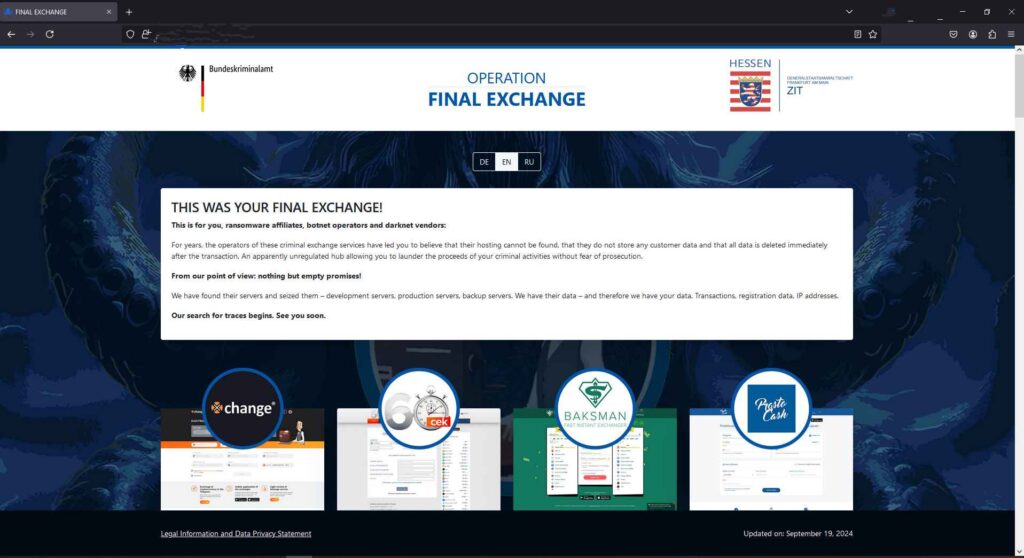
This marks a critical shift in the enforcement landscape of cryptocurrency. Historically, cryptocurrencies such as Bitcoin were often mischaracterized as providing complete anonymity. In fact, the underlying blockchain technology records all transactions on a public ledger. However, the anonymity provided by these specific exchanges allowed cybercriminals to obfuscate their tracks. They could move illicit funds without leaving a traceable identity behind. This is why platforms like Xchange.cash, which processed over 1.3 million transactions for 410,000 users, became a go-to resource for criminal networks.

Impact on Ransomware and Illicit Networks

The operation has far-reaching consequences, particularly for ransomware gangs, who frequently demand payments in cryptocurrency due to its perceived anonymity. Many of the platforms targeted in the crackdown were allegedly used by ransomware operators to launder ransom payments and bring their illicit gains into the legitimate financial system. In this way, exchanges like 60cek.org and Bankcomat.com played a pivotal role in allowing cybercriminals to convert illicit cryptocurrency into fiat money.

The seizure of extensive user data, including registration information, IP addresses, and transaction logs, now poses a direct threat to these networks. With authorities gaining access to this data, many ransomware operators and their accomplices could soon find themselves exposed and vulnerable to prosecution. The BKA has made it clear that their investigations are ongoing. Arrests could follow based on the data they’ve secured.

Erosion of Crypto Anonymity

This operation underscores a broader trend in the crypto space: the erosion of anonymity. As regulatory scrutiny increases and enforcement actions become more sophisticated, the once-perceived invulnerability of cryptocurrencies in illicit activities is being dismantled. Law enforcement agencies globally are collaborating more effectively. They leverage the transparency of blockchain technology to identify and track illicit transactions.

The consequences are profound for users who depend on the anonymity of these platforms. Not only has their data been exposed, but many now face potential legal repercussions. Furthermore, the shutdown of these exchanges sends a powerful message to the broader crypto community: anonymity is no longer a guarantee, especially when it comes to platforms that operate outside the bounds of regulatory oversight.

Germany’s seizure of 47 cryptocurrency exchanges represents a significant step in the global crackdown on crypto-fueled cybercrime. By exposing the vulnerabilities in anonymous transaction platforms and securing valuable data, law enforcement has sent a clear message to ransomware operators and other cybercriminals: the days of hiding behind anonymity are numbered. As the investigation continues, the broader implications for user privacy and the future of cryptocurrency in illicit networks will undoubtedly unfold.

This operation is likely to have a chilling effect on similar platforms that have yet to comply with AML and KYC regulations. Authorities are further tightening the regulatory noose around the darker corners of the crypto world.

Readers’ frequently asked questions

How does this crackdown impact the wider cryptocurrency market, especially for legitimate users?

This crackdown on 47 cryptocurrency exchanges mainly targets platforms that allow anonymous transactions. They are illegal in many jurisdictions because they facilitate money laundering and other criminal activities. Legitimate cryptocurrency exchanges that comply with regulations such as Know Your Customer (KYC) and Anti-Money Laundering (AML) policies are unlikely to be directly affected by this operation. However, it could serve as a wake-up call for platforms operating in a regulatory gray area, prompting them to tighten their compliance measures. For legitimate users, the immediate impact is minimal unless they were unknowingly using one of the seized platforms. The broader effect will likely manifest in the form of stricter regulations and oversight in the cryptocurrency space. That could affect the ease of transactions but also improve security and legitimacy in the long run.

Will users of these platforms face legal consequences?

The seizure of 47 exchanges also involved securing user data. They captured transaction records, registration details, and IP addresses, making it possible for law enforcement to track down those involved in illicit activities. While the initial reports indicate no arrests have been made so far, the BKA has indicated that investigations are ongoing. Future arrests could follow based on this recovered data. Users who engaged in illegal activities, such as laundering ransomware payments, are at significant risk of prosecution. Even users who were not directly involved in cybercrime but used these platforms for anonymous transactions may face scrutiny, especially if they violated financial regulations. However, law enforcement agencies will likely prioritize the prosecution of high-profile cybercriminals and platform operators​.

What does this mean for the future of anonymous cryptocurrency transactions?

This operation highlights a growing trend: the erosion of anonymity in crypto transactions. While cryptocurrencies like Bitcoin are not inherently anonymous, platforms like those seized in Germany facilitated transactions that allowed users to avoid traditional identification requirements. As regulatory frameworks evolve, both regionally and internationally, we are likely to see a continued crackdown on anonymous exchanges. The future of cryptocurrency is leaning toward more transparency. Most governments now require exchanges to implement stringent KYC and AML protocols. For those who used cryptocurrencies for privacy reasons, this shift could push them toward decentralized or privacy-focused cryptocurrencies like Monero. However, even these might not remain fully immune from regulation. Governments worldwide continue to develop tools and strategies to trace blockchain transactions.

What Is In It For You? Action Items You Might Want to Consider

Review your exchange platform’s compliance status

If you’re using cryptocurrency exchanges that operate in jurisdictions with lax or unclear regulations, now is the time to reassess. Germany’s recent crackdown on 47 crypto exchanges highlights the increasing pressure on platforms to follow strict Know Your Customer (KYC) and Anti-Money Laundering (AML) protocols. To safeguard your assets and ensure legal compliance, consider shifting to regulated exchanges. They prioritize security and adhere to global AML/KYC standards.

Prepare for tighter regulations in crypto trading

As governments globally intensify their scrutiny of anonymous crypto transactions, traders should anticipate more regulations, particularly regarding privacy-focused coins and exchanges. Stay updated on new laws or compliance requirements in your country, especially regarding tax reporting and transaction limits. Being proactive about regulatory changes will help you avoid unexpected disruptions or legal complications that may arise as the landscape evolves.

Evaluate your privacy strategy in light of ongoing enforcement trends

It will become harder to maintain anonymity in the crypto world. Traders who value privacy should consider diversifying into decentralized or privacy-centric cryptocurrencies, such as Monero. However, do so with caution. Even these coins may come under scrutiny in the future. To mitigate risks, implement best practices for security, such as using hardware wallets. Regularly monitor regulatory developments to stay ahead of enforcement trends impacting privacy tokens.


Hot vs. Cold Wallets: BingX Hack Reignites Debate Over Crypto Security Strategies

As BingX Recovers from $43M Hack, Industry Rethinks Hot Wallet Risks and Cold Storage Solutions

Singapore-based cryptocurrency exchange BingX recently became the target of a significant security breach. It resulted in the theft of over $43 million from its hot wallet. The attack, which occurred on September 20, 2024, compromised over 360 types of altcoins, including major tokens like Ethereum (ETH), Binance Coin (BNB), and USDT. Although the exchange responded swiftly by suspending withdrawals and launching an investigation with blockchain security firms, the incident has reignited concerns about the security of hot wallets used by centralized exchanges.

BingX Hack Response and Compensation Promise

In the immediate aftermath, BingX pledged to fully compensate all affected users using its reserves, ensuring the losses would not impact customer holdings. According to Vivien Lin, Chief Product Officer at BingX, the exchange views the incident as “manageable” and has committed to restoring user funds. As part of their recovery strategy, BingX resumed withdrawal services for major tokens like Bitcoin, Ethereum, and USDT just days after the attack. Other tokens are expected to follow in the coming weeks.

Despite this positive response, the attack on BingX is yet another reminder of the inherent vulnerabilities of hot wallets. These digital storage tools are always connected to the internet and are thus more susceptible to hacks.

https://twitter.com/blckchaindaily/status/1836926188670886191

The Hot Wallet vs. Cold Wallet Debate

Hot wallets are essential for enabling fast and frequent transactions on exchanges. However, they are particularly vulnerable to cyberattacks due to their constant internet connection. In contrast, cold wallets offer a far more secure alternative. They store your digital assets offline and are, therefore, less accessible to hackers. BingX’s reliance on hot wallets for liquidity purposes mirrors the operational models of many centralized exchanges. That practice makes them attractive targets for increasingly sophisticated attackers.

Several industry experts have suggested that exchanges should move more funds into cold storage to mitigate these risks. Cold wallets are less convenient for day-to-day operations but can protect the bulk of user funds in the event of an attack.

The BingX hack has reignited a debate within the cryptocurrency industry about the balance between operational convenience and security. Advocates for greater reliance on cold wallets point to other recent exchange hacks — such as the breaches at Indodax and WazirX — as examples of the need for stronger security measures in an industry that has already suffered billions of dollars in losses due to cyberattacks.

https://twitter.com/BingXOfficial/status/1836938477570773470

Operational Resilience and Industry Trends

While the risks associated with hot wallets are well understood, many exchanges still prioritize speed and liquidity. That requires a portion of funds to remain accessible for rapid transactions. The need to maintain liquidity, especially in volatile markets, forces many exchanges to keep hot wallets active for user withdrawals and trading activities. However, as hackers become more sophisticated, the reliance on hot wallets has become a growing risk.

BingX has taken steps to reassure its users by freezing $10 million of stolen funds. They work closely with security firms such as SlowMist and Chainalysis to trace and recover the remaining assets. This rapid response, combined with the exchange’s commitment to compensating affected users, has so far helped mitigate the potential reputational damage.

However, the broader question remains: should exchanges shift more of their funds to cold storage to prevent future attacks, even if it means sacrificing some liquidity? This debate is now at the forefront of the industry, especially as centralized exchanges continue to be frequent targets of high-profile hacks.

The BingX hack, while handled effectively in terms of user compensation, is a stark reminder that exchanges must continually evolve their security strategies to stay ahead of increasingly sophisticated attacks. The incident has fueled calls for exchanges to reassess their reliance on hot wallets, prompting a reevaluation of security protocols across the industry.

As the cryptocurrency market matures, the balance between operational efficiency and security will likely continue to drive innovation in asset management strategies. Cold wallets should become the cornerstone of a more secure future for user funds.

Readers’ frequently asked questions

What exactly happened during the BingX hack?

On September 20, 2024, BingX’s hot wallet was breached in a significant cyberattack. The hack occurred around 4 a.m. Singapore time, with hackers exploiting the exchange’s hot wallet, which is always connected to the internet for fast transactions. Initially, the estimated loss was around $26 million, but further investigation revealed that the total amount stolen exceeded $43 million. Some reports suggested it could be even as high as $52 million​.

The hackers drained over 360 types of cryptocurrencies, including major tokens like Ethereum (ETH), Binance Coin (BNB), and Matic. Most of the stolen funds were quickly moved to decentralized exchanges, where they were swapped for ETH and BNB. According to PeckShield, 4,526 ETH and 7,864 BNB were among the assets liquidated​.

BingX promptly suspended all withdrawals and initiated a detailed investigation with the help of blockchain security firms such as SlowMist and Chainalysis. They managed to freeze around $10 million of the stolen funds. The rest had already been traded on decentralized platforms like Uniswap and Kyberswap​.

Despite the attack, BingX reassured users that most of their funds were safe in cold storage. Further, the exchange committed to compensating users for the losses through its reserves. BingX resumed partial withdrawals soon after the hack, focusing on major tokens like Bitcoin, Ethereum, and USDT.

Why are cold wallets considered safer than hot wallets?

Cold wallets are offline storage devices, making them much harder for hackers to access than hot wallets, which are always connected to the internet. While hot wallets are convenient for frequent transactions, they are more vulnerable to cyberattacks. Cold wallets provide a safer option for long-term storage and are less likely to be targeted in a hack.

How can users protect their cryptocurrency from hacks?

Users should store their assets in cold wallets to reduce the risk of losing funds in a hack, especially for long-term holdings. Using strong passwords, enabling two-factor authentication, and avoiding large balances on exchange-provided hot wallets are also essential practices. This can help users avoid being affected when centralized exchanges like BingX are compromised

What Is In It For You? Action Items You Might Want to Consider

Consider moving long-term holdings to cold storage

Given the vulnerabilities highlighted by the BingX hack, limit exposure using cold wallets for large or long-term holdings. Cold storage provides a safer, offline option that’s much harder for hackers to breach. This is particularly important for traders who don’t need frequent access to their funds. It significantly reduces the risk of loss in future exchange attacks.

Be cautious with the amount of funds kept in exchange hot wallets

While exchanges offer convenience for fast transactions, hot wallets are vulnerable to cyberattacks, as demonstrated by the BingX breach. Consider keeping only the amount you need for active trading in hot wallets. Immediately withdraw any profits or unused funds to a personal wallet for better protection.

Implement additional security measures on exchange accounts

If you regularly use centralized exchanges, strengthen your account security by enabling two-factor authentication (2FA), using strong passwords, and keeping your account details private. These simple actions can add an extra layer of protection to your funds in the event of another exchange hack.

Project Agorá: Can Tokenized Deposits and CBDCs Solve the Cross-Border Payment Puzzle?

Project Agorá: Solving Cross-Border Payment Issues with Tokenized Assets
Global money transfer and exchange concept with the businessman

The Bank for International Settlements (BIS) has embarked on a pioneering journey to tackle some of the most persistent issues in global finance through Project Agorá. Announced earlier this year, this experiment brings together 41 of the world’s largest financial institutions. The list includes heavyweights like JPMorgan Chase, HSBC, and BNP Paribas, along with seven G7 central banks, such as the U.S. Federal Reserve, Bank of England, and Bank of Japan. The goal? To modernize cross-border payments by integrating tokenized commercial bank deposits and wholesale central bank digital currencies (CBDCs) on a unified ledger.

The Cross-Border Payment Problem

Cross-border payments have long been plagued by inefficiencies. Those range from high costs and slow transaction times to complex compliance checks, repeated at every step of the process. The legacy correspondent banking system, which involves multiple intermediaries, often leads to funds being stuck “in limbo” while banks verify transactions. Moreover, these payments are subject to varying regulatory frameworks, currency exchange rates, and operational hours, further complicating the process.

The BIS recognizes that these frictions are not just an inconvenience; they have serious implications for global trade and remittance flows. Project Agorá seeks to create a seamless, real-time settlement system that eliminates the fragmentation currently hindering cross-border transactions. It introduces tokenization and blockchain technology into the mix to achieve that.

The Unified Ledger Solution

At the heart of Project Agorá is the concept of a unified ledger. Unlike traditional payment systems that separate the messaging layer (the instructions to move money) from the actual transfer of funds, the unified ledger would merge these processes, ensuring that transactions are completed in real-time. This ledger would hold both tokenized commercial bank deposits and wholesale CBDCs, allowing for near-instant atomic settlements across multiple jurisdictions.

The project will leverage smart contracts, automating and enforcing compliance processes, such as Know Your Customer (KYC) and Anti-Money Laundering (AML) checks, reducing delays. Currently, these checks are conducted independently by every bank involved in the transaction chain. This often leads to duplication and extended waiting times.

Potential Benefits of Project Agorá

By integrating blockchain technology, Project Agorá promises to:

  1. Reduce Costs: Removing intermediaries and automating compliance procedures could slash transaction costs for banks and customers.
  2. Increase Speed: With tokenized assets and real-time settlement, cross-border transactions that once took days could be completed in seconds.
  3. Enhance Security and Transparency: Tokenized money, backed by the trust of central banks, would offer a more secure alternative to existing payment methods. The programmable nature of smart contracts would add transparency, ensuring that transactions are executed as intended.

The Challenges Ahead

However, while the potential benefits are compelling, Project Agorá faces significant challenges. Regulatory alignment across jurisdictions remains one of the most daunting hurdles. Each country has its own rules regarding capital movement, data privacy, and AML compliance. Hence, the unified ledger must accommodate these differences without compromising efficiency.

Moreover, there is the question of interoperability. Can Project Agorá’s unified ledger integrate with existing financial systems, or will it require a complete overhaul? Some critics argue that while tokenization is promising, the transition from traditional systems to blockchain-based infrastructure will be complex, costly, and time-consuming.

A Step Toward the Future

Project Agorá’s success is far from guaranteed, but it represents an ambitious attempt to re-engineer the global payments infrastructure. Supported by major commercial and central banks, the project could offer a blueprint for the future of international finance, particularly in regions where current systems are inefficient or underdeveloped. As the project moves into its design and testing phases, it will provide valuable insights into how tokenized assets and CBDCs might coexist to create a more streamlined, accessible, and secure global financial system.

For now, the financial world watches closely, awaiting results that could shape the next generation of cross-border payments. Will Project Agorá’s bold vision solve the cross-border payment puzzle? Time will tell, but the foundation for transformation is being laid.

Readers’ frequently asked questions

How does the tokenization of deposits differ from traditional banking systems, and why is it important for Project Agorá?

Tokenization transforms a real-world asset, like a bank deposit, into a digital token on a blockchain or distributed ledger. In traditional banking, cross-border payments involve multiple intermediaries, including correspondent banks, when transferring funds between different national systems. These transfers rely heavily on messaging systems such as SWIFT that separate the movement of funds from the messaging process. This often leads to delays, high transaction costs, and operational risks.

In contrast, tokenized deposits, the key to Project Agorá, allow the asset and its corresponding information to move simultaneously on the same platform. With tokenization, ownership can be transferred instantly. Smart contracts can automate the execution of rules and compliance checks such as Know Your Customer (KYC) and Anti-Money Laundering (AML) procedures. The advantage is clear: faster, more secure transactions without the friction associated with traditional banking. This approach is especially relevant to Project Agorá because it aims to streamline cross-border payments. It will reduce the dependency on intermediaries while enhancing security and transparency.

What is the role of central banks in Project Agorá, and how are they using CBDCs to contribute to its success?

Central banks play a crucial role in Project Agorá by bringing wholesale central bank digital currencies (CBDCs) into the fold. Unlike retail CBDCs, aimed at the public, wholesale CBDCs are designed for institutional use, like large-scale interbank transfers. In Project Agorá, central banks are experimenting with integrating these digital currencies with tokenized commercial bank deposits to facilitate seamless cross-border payments.

Involving central banks ensures that state entities back the project’s digital currencies, providing trust and stability to the system. This contrasts with decentralized cryptocurrencies, which often experience volatility and face regulatory scrutiny. By using wholesale CBDCs, central banks hope to establish a more secure and regulated means of transferring funds between nations. In Project Agorá, these CBDCs work alongside commercial bank deposits to form a unified, blockchain-based system that allows for faster and more transparent cross-border transactions

What are the key regulatory challenges that Project Agorá faces, and how might they impact the project’s implementation?

One of the major hurdles for Project Agorá is regulatory compliance across multiple jurisdictions. Each participating country has its own regulatory framework regarding capital movements, data privacy, and financial integrity controls like KYC and AML requirements. Integrating these various legal frameworks into a single unified ledger system presents significant complexity. For example, some countries have strict capital control laws, while others may prioritize privacy regulations. Balancing these differences in a unified cross-border payment system is no small feat.

Moreover, different time zones, operational hours, and national currencies further complicate the matter. The unified ledger promises real-time settlement and atomic transactions. However, the legal and regulatory environments in each participating country must align for smooth operation. Failure to harmonize these frameworks could slow down the project’s implementation, or worse, lead to jurisdictional bottlenecks that undermine the benefits of the system. As Project Agorá progresses, it will need to work closely with regulators worldwide to ensure that its system is compliant, secure, and legally robust.

What Is In It For You? Action Items You Might Want to Consider

Monitor the Development of Tokenized Assets and CBDCs

As Project Agorá progresses, it could lead to a major shift in how cross-border payments are processed. Traders should stay updated on the integration of tokenized commercial bank deposits and wholesale CBDCs within international banking systems. The success of this project could influence the adoption of blockchain technologies by mainstream financial institutions, making it crucial to adjust strategies around digital assets accordingly. Keep an eye on developments from BIS and its central bank partners, as this could impact both traditional markets and the crypto space.

Watch for Regulatory Signals

Given the regulatory challenges highlighted in the project, any progress on regulatory harmonization across jurisdictions could signal a green light for wider adoption of blockchain-based cross-border payment systems. Traders should pay close attention to news on AML/KYC compliance innovations and updates from key regulatory bodies, as favorable regulatory conditions could drive faster adoption of tokenized assets, potentially impacting liquidity and pricing in related markets.

Explore Opportunities in Blockchain Infrastructure and Payment Networks

Project Agorá underscores the growing focus on blockchain infrastructure and payment networks for institutional-level transactions. For traders, this is a signal to explore investments in blockchain infrastructure providers, especially those involved in smart contract technologies and cross-border payment solutions. As financial institutions increasingly adopt blockchain for high-value transactions, companies involved in this technology could experience increased demand, providing new trading and investment opportunities.

Circle Partners with Sony to Push USDC Adoption on Ethereum’s Layer-2: What This Means for Stablecoins

Circle and Sony Revolutionize Web3 with USDC Integration on Soneium Blockchain

Circle, the issuer of the popular USD Coin (USDC) stablecoin, recently announced a strategic partnership with Sony Block Solutions Labs, marking a significant milestone in its bid to expand the utility and market share of USDC. The collaboration aims to integrate Bridged USDC on Sony’s new Soneium blockchain, an Ethereum Layer-2 solution launched in August 2024. By positioning USDC as a key transaction token on Soneium, Circle is reinforcing its efforts to deepen USDC’s role in decentralized finance (DeFi) and the broader Web3 ecosystem.

This move is particularly notable in the context of Circle’s ongoing rivalry with stablecoin market leader Tether (USDT). USDT continues to dominate the space, boasting a market capitalization of $118.8 billion compared to USDC’s $35.7 billion. However, the Soneium integration is expected to enhance USDC’s market presence, especially in the DeFi sector. It can offer cheaper and faster transactions on the Layer-2 blockchain.

What Is Bridged USDC and Why Does It Matter?

Bridged USDC is an iteration of USDC that enables users to transfer the stablecoin across different blockchains. In this case, Bridged USDC will be deployed on Soneium, Sony’s Ethereum-compatible Layer-2 blockchain, while remaining fully backed by reserves on its original chain. This bridging mechanism allows the token to operate efficiently on different networks without compromising its peg to the U.S. dollar.

For developers and users, this means access to scalable and cost-effective digital dollar transactions. Soneium, designed to address some of Ethereum’s scalability issues, will enable developers to create decentralized applications (dApps) with lower transaction fees and enhanced throughput. The Ethereum Layer-2 ecosystem is rapidly becoming a popular solution for congestion and high fees on the Ethereum mainnet. Circle’s decision to bridge USDC to Soneium is a logical extension of its multi-chain strategy.

Expanding USDC’s Reach in a Competitive Stablecoin Market

The stablecoin market has been highly competitive, with Circle facing mounting pressure from other prominent players. Tether’s USDT has long been the market leader, but the entry of PayPal’s PYUSD in 2023 has added a new dynamic. PayPal’s move into the stablecoin arena, coupled with Tether’s dominance, has made it crucial for Circle to innovate. It must expand its ecosystem to remain competitive.

By integrating USDC into Sony’s Soneium blockchain, Circle is aligning itself with a major tech player. Sony is a company known for its influence in entertainment, gaming, and hardware development. Soneium, developed in partnership with Startale Labs, positions itself as a blockchain network emphasizing interoperability and decentralized finance. The network has already formed alliances with leading blockchain projects such as Astar, Chainlink, and Optimism. It clearly wants to position itself as a key player in the Layer-2 space.

A Strategic Move for DeFi and Web3 Adoption

For Circle, integrating USDC into a burgeoning Ethereum Layer-2 blockchain like Soneium strengthens its position in the rapidly evolving DeFi and Web3 sectors. DeFi applications rely heavily on stablecoins like USDC to facilitate lending, borrowing, and trading activities. Hence, Circle’s push into Layer-2 solutions like Soneium enables these processes to occur at a lower cost, with increased speed.

Furthermore, the partnership reflects the broader trend of Layer-2 blockchain adoption. Ethereum’s mainnet is highly secure and decentralized. However, it has faced criticism for its high fees and slower transaction times during periods of network congestion. Layer-2 solutions like Soneium alleviate these issues. They process transactions off the Ethereum main chain, while still benefiting from its security guarantees.

In this context, Circle’s collaboration with Sony also has significant implications for the Web3 creator economy. Soneium aims to attract creators and developers in gaming, media, and other digital content areas. The use of USDC as a stable, widely accepted medium of exchange will play a crucial role in enabling new forms of monetization and innovation.

Circle’s partnership with Sony to integrate USDC on the Soneium blockchain is a bold move in the highly competitive stablecoin landscape. With this collaboration, Circle strengthens its foothold in the DeFi sector and enhances its offering for developers and creators within the Web3 ecosystem. As the stablecoin market becomes more crowded – with players like Tether and PayPal increasing their influence – Circle’s focus on Layer-2 solutions and multi-chain compatibility could be key to maintaining and growing its market share.

While it remains to be seen whether this partnership will shift the balance of power in the stablecoin arena, it certainly underscores Circle’s ambitions to be a leader in the digital finance space.

Readers’ frequently asked questions

How does Soneium’s Layer-2 infrastructure compare to other Layer-2 solutions, and what unique advantages does it bring to USDC transactions?

Soneium, as an Ethereum Layer-2 solution, offers many of the same advantages seen in established Layer-2 protocols like Optimism, Arbitrum, and Polygon. These platforms are all designed to offload transaction processing from Ethereum’s mainnet to improve scalability and reduce costs. However, what differentiates Soneium is its direct association with Sony, a global technology and entertainment giant. It is positioning itself as a blockchain optimized for industries like gaming, entertainment, and the creative economy. This focus could create more tailored applications of Bridged USDC, such as in digital content monetization and gaming rewards, where stable, low-cost transactions are essential.

Soneium also has a broader ecosystem vision that includes partnerships with key blockchain infrastructure players like Chainlink and Astar. This can make it potentially more interoperable across various chains and industries compared to other Layer-2 networks. For Circle, this could mean that USDC on Soneium has more specialized use cases and higher adoption rates among creators and media producers.

What risks does Circle face in relying on a relatively new blockchain like Soneium for expanding USDC?

While integrating USDC on Soneium opens new opportunities for Circle, it also carries risks. Soneium is a relatively new blockchain, launched in August 2024. It has yet to prove itself in terms of network security, scalability under high transaction volumes, and long-term viability. If Soneium were to encounter technical issues or fail to attract enough users and developers, the adoption of USDC on this network could be limited.

Moreover, Tether (USDT) still dominates the stablecoin market with over $118 billion in market capitalization, compared to USDC’s roughly $35 billion​. Although Circle’s collaboration with Sony is strategically significant, Tether has a first-mover advantage, especially in DeFi and crypto trading. Circle’s reliance on Soneium may not be enough to displace USDT without robust demand for decentralized content platforms and Web3 tools. In the competitive stablecoin landscape, Circle must continue expanding to other chains. It must also maintain a high level of liquidity and utility to challenge USDT’s dominance.

Will this partnership with Sony have broader implications for USDC’s regulatory positioning in global markets?

Circle’s collaboration with a globally recognized corporation like Sony could bolster USDC’s standing, particularly in regulatory conversations. Governments and regulators worldwide have been scrutinizing stablecoins. They are concerned about transparency, reserve backing, and potential systemic risks in financial markets. A partnership with Sony, a highly regulated multinational, could offer Circle more legitimacy. It signals that USDC is used in more traditional, highly regulated sectors like entertainment and media rather than just in the more volatile DeFi space.

This might also help Circle in discussions with regulators about the stability and security of Bridged USDC. It would showcase its broad utility beyond speculative trading or cryptocurrency exchanges. Circle has already made strides in aligning with regulatory frameworks. This high-profile partnership may provide more leverage in regions where stablecoins face regulatory hurdles​.

What Is In It For You? Action Items You Might Want to Consider

Position yourself for growth in the Layer-2 ecosystem

With Circle integrating USDC into Sony’s Soneium Layer-2 blockchain, now might be a good time to explore opportunities within Ethereum Layer-2 solutions. Platforms like Optimism, Arbitrum, and Soneium offer lower transaction fees and scalability improvements. This could boost the efficiency of your trades and DeFi operations. Keep an eye on USDC liquidity in these networks and consider positioning some of your assets in Layer-2 protocols to benefit from cheaper, faster trades.

Diversify your stablecoin portfolio

USDC’s new integration with Soneium is a strategic move to challenge Tether’s dominance. While USDT remains the market leader, having exposure to USDC, especially as it expands its use in decentralized finance (DeFi), could provide a more secure alternative for your trading needs. Evaluate whether you want to shift part of your stablecoin holdings into USDC, particularly if you’re involved in dApps or Layer-2 trading, where the token might soon be more widely adopted.

Monitor adoption of Soneium and Layer-2 projects for early opportunities

As Soneium’s ecosystem grows with high-profile partnerships like Circle, consider tracking its developments closely. Early adoption of new Layer-2 technologies often presents lucrative trading and investment opportunities. If Soneium gains traction, the value of assets and tokens in its ecosystem could rise. Look for signs of increased user activity, developer interest, and partnerships to determine the right moment to enter positions in projects built on Soneium or using Bridged USDC.

SIX Group Expands Horizons: Swiss Stock Exchange to Launch Institutional-Only Crypto Trading Platform in Europe

SIX Group Launches Institutional Crypto Trading Platform in Europe

SIX Group, the operator of Switzerland’s premier stock exchange, is making a decisive move into the cryptocurrency market with its plans to launch a European trading platform, specifically tailored for institutional investors. This new platform will offer spot and derivatives trading, leveraging the group’s extensive expertise in traditional finance and digital assets. SIX is building on its established reputation, experience with digital bonds, and strategic partnerships. These include the AsiaNext platform in Singapore, allowing it to bridge the gap between the legacy financial sector and the burgeoning crypto economy.

Bridging Traditional Finance and Crypto

SIX Group’s new platform wants to cater to the growing institutional demand for digital assets. Unlike existing retail-focused crypto exchanges, this initiative will exclusively target institutional investors such as asset managers, banks, and hedge funds. The platform’s offering of both spot crypto trading and crypto derivatives aligns with the increasing sophistication of digital asset markets. It provides institutional players with a safe and regulated environment to diversify their portfolios.

The move is timely, as institutional interest in cryptocurrencies has surged. The growing acceptance of digital assets as a legitimate asset class drives this trend. The recent approval of spot Bitcoin and Ethereum exchange-traded funds (ETFs) in the United States has fueled institutional interest in the space even further. SIX’s platform will capitalize on this momentum, offering institutions access to crypto markets within a familiar and regulated setting.

Leveraging Switzerland’s Crypto-Friendly Regulatory Framework

Switzerland has long been a pioneer in establishing clear and comprehensive regulations for digital assets. It established legal certainty for both crypto traders and institutional investors. The country’s progressive stance on crypto regulations makes it an ideal base for SIX’s expansion into digital assets. Switzerland’s regulatory framework has been instrumental in attracting major financial institutions to explore cryptocurrencies as part of their broader investment strategies. By launching this platform, SIX will open a trusted gateway for institutions to trade digital assets. It will also further solidify Switzerland’s reputation as a global hub for crypto innovation.

Building on Existing Expertise

SIX’s foray into the crypto market builds on its existing digital asset operations. Since 2018, the group has been actively involved in issuing digital bonds and expanding its digital trading capabilities. Its partnership with AsiaNext, a crypto derivatives platform launched in collaboration with Japan’s SBI Group, demonstrates its commitment to expanding into crypto markets.

With AsiaNext already operational, SIX has gained valuable experience in managing crypto assets within a regulated environment. This foundation provides SIX with a competitive edge as it enters the European crypto trading market. It allows them to offer services tailored to institutional needs while maintaining high regulatory standards.

Challenging Established Crypto Exchanges

SIX Group’s institutional-focused platform will directly challenge established players such as Binance, Coinbase, and OKX, which have dominated the European crypto market. However, while these platforms cater predominantly to retail clients, the new SIX Group platform will focus solely on institutional investors. It will be an alternative for large financial entities looking for a secure, regulated environment for digital asset trading.

SIX aims to carve out a niche within the broader crypto ecosystem by targeting institutions. As regulatory scrutiny increases on retail-focused exchanges, a trusted, institutional-grade platform from an established financial player like SIX could attract significant interest. Moreover, SIX’s decision to launch a platform exclusively for institutional clients sets it apart, making it a key player in the evolution of digital asset markets.

SIX Group’s planned entry into the European cryptocurrency market marks a significant milestone for the institutional adoption of digital assets. SIX Group is positioned to bridge the gap between traditional finance and the crypto economy by offering a regulated and secure platform for spot and derivatives crypto trading. It is set to become a formidable player in the institutional trading space thanks to the strong regulatory backing in Switzerland. Relying on its established expertise in digital finance, SIX will be a much-needed alternative for large investors seeking a safe and reliable entry point into digital assets.

Readers’ frequently asked questions

Why is SIX Group only targeting institutional investors and not retail traders?

SIX Group’s decision to focus exclusively on institutional investors stems from its long-standing position in traditional finance and its expertise in servicing large financial entities such as asset managers, banks, and hedge funds. Institutional investors require a highly regulated, secure, and reliable environment for trading, particularly when it comes to volatile assets like cryptocurrencies. Retail-focused exchanges like Binance and Coinbase have dominated the market but face increasing scrutiny, especially concerning regulatory compliance. By catering solely to institutions, SIX Group is positioning itself as a safe and regulated alternative, distinguishing itself from platforms that target retail and institutional traders. Additionally, institutions demand sophisticated tools, such as derivatives and spot trading, within a trusted framework. Based on its experience with digital bonds and partnerships like AsiaNext, SIX is well-equipped to provide that.

How does Switzerland’s regulatory environment support SIX Group’s crypto platform?

Switzerland has established itself as one of the most crypto-friendly countries in the world. Clear and comprehensive regulations provide legal certainty for digital assets and the institutions that trade them. Swiss laws outline a detailed classification of different types of tokens. They also offer robust guidelines on how they can be traded and held. That is crucial for institutional investors. These regulations were pivotal in making Switzerland an attractive hub for blockchain innovation and institutional crypto trading. SIX Group leverages this favorable regulatory framework to offer a highly regulated trading platform. It meets the stringent requirements of institutional investors, thereby reducing concerns around compliance, security, and market manipulation.

How will SIX Group’s platform compete with established crypto exchanges like Binance and Coinbase?

SIX Group’s institutional-only approach sets it apart from Binance, Coinbase, and OKX, which serve a mix of retail and institutional traders. SIX’s focus on regulated, secure, and institutional-grade trading is its key differentiator. While Binance and Coinbase are global leaders in terms of trading volume, they also face ongoing regulatory challenges in various regions. Such disputes could hinder their operations, particularly when dealing with institutional clients that demand the highest security and compliance standards. SIX’s reputation as a trusted financial entity, along with its experience in digital asset trading and regulation, positions it well to attract large financial institutions. These institutions are often hesitant to use platforms that primarily cater to retail traders. Its focus on security, trust, and regulation could help SIX carve out a significant market share within the institutional segment​.

What Is In It For You? Action Items You Might Want to Consider

Explore Institutional Trading Opportunities

If you manage institutional funds or are an institutional trader, the upcoming SIX Group trading platform could be a game-changer. With its focus on spot and derivatives trading in a regulated environment, the platform offers a trusted alternative to retail-heavy exchanges like Binance and Coinbase. This is an excellent opportunity to diversify your portfolio with digital assets while maintaining the compliance and security standards expected by institutional investors. Keep an eye on its launch to capitalize on this new avenue for trading.

Stay Informed About Regulatory Developments

SIX Group’s entry into the crypto market leverages Switzerland’s clear regulatory framework, which sets a precedent for future developments across Europe. Traders should monitor the evolving regulatory landscape in Europe and globally, as it could impact both trading strategies and asset allocation. Understanding the regulatory framework could help you identify safer and more secure platforms for trading digital assets, especially in the wake of increased scrutiny on major exchanges.

Evaluate the Benefits of Crypto Derivatives

If you haven’t already explored crypto derivatives as part of your trading strategy, SIX Group’s focus on these instruments presents an ideal opportunity. Crypto derivatives can help hedge risk or gain leveraged exposure to the market. With a trusted player like SIX entering the derivatives space, this could become a reliable option for institutional-level risk management. Start researching how these instruments work and consider integrating them into your broader trading strategy.

- Advertisement -

FEATURED