Home Blog Page 165

The Bitcoin Reserve Drain Continues: How Long Can the Market Sustain It?

Bitcoin Reserves dwindle on centralized exchanges

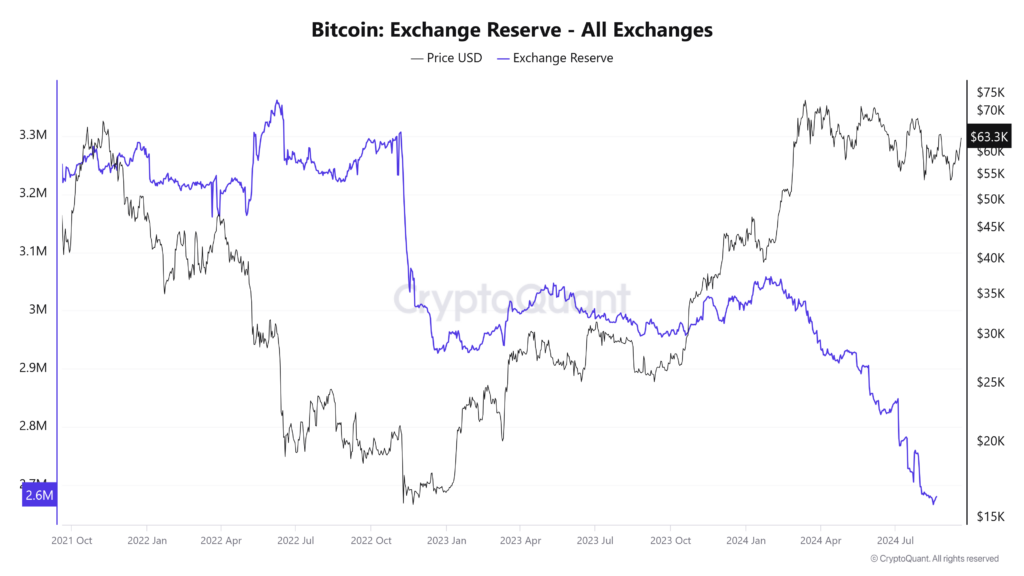
The Bitcoin market has been experiencing a prolonged depletion of its reserves on centralized exchanges, with levels now approaching the lows of 2018. For several months, a steady flow of Bitcoin has been moving off exchanges and into cold storage. What initially appeared to be a reaction to high-profile exchange failures, such as those of FTX and Terra, has evolved into a broader market trend. Investors, both retail and institutional, are increasingly opting for long-term self-custody of their assets. As a result, Bitcoin’s liquid supply has shrunk considerably, raising questions about the potential implications for the market’s liquidity and price dynamics.

A Shift in Investor Behavior

The withdrawal of Bitcoin from exchanges is driven by several factors. After the collapses of major platforms like FTX, trust in centralized exchanges has been shaken. Investors are moving their assets to cold storage to enhance security and take control of their private keys. Additionally, the rising preference for non-custodial solutions aligns with Bitcoin’s decentralized ethos, further reinforcing the shift away from exchanges.

Data from CryptoQuant reveals that Bitcoin reserves on exchanges have declined to just 2.6 million BTC as of mid-September 2024, marking a significant drop from a peak of over 3.3 million BTC in 2021. This ongoing drain has been particularly notable over the past six months, with around $5.96 billion worth of Bitcoin withdrawn from exchanges in just 30 days between mid-July to mid-August. This decline echoes the market dynamics seen in 2018, when reserves fell to similar lows.
Impact on Liquidity and Market Volatility

The diminishing reserves have sparked debate within the market. On one hand, reduced Bitcoin on exchanges typically signals a bullish outlook, as it suggests that holders are preparing for long-term gains rather than looking to sell in the short term. Analysts argue that this trend could limit selling pressure, making Bitcoin less prone to market downturns. Historically, such reserve reductions have preceded major price rallies, reinforcing the idea that scarcity could drive up prices.

On the other hand, the ongoing drain raises concerns about liquidity. Bitcoin’s reduced availability on exchanges means there is less liquidity for immediate trades, particularly for institutional investors looking to execute large transactions. As the pool of liquid Bitcoin shrinks, the market becomes more vulnerable to volatility. Smaller movements could trigger outsized price swings. While this dynamic has not yet caused severe disruptions, the continuous outflow suggests that the market may be heading toward a critical point. Liquidity shortages could become more pronounced.

The Whale Factor

Another important element in this trend is the behavior of so-called “whales” — entities holding large amounts of Bitcoin. The whale ratio, which measures the proportion of Bitcoin held by these large players on exchanges, has risen in 2024. This suggests that while reserves are dwindling overall, whales are still active in the market. This dynamic could further exacerbate liquidity challenges, as large buy or sell orders by whales can have a disproportionate impact on price stability.

At the same time, the number of small and medium-sized wallets holding Bitcoin has continued to grow. That reflects broader adoption among retail investors. This rising demand adds another layer of complexity, as the growing interest from smaller holders could clash with the shrinking supply, amplifying price pressures in both directions.

Can the Market Sustain This Trend?

The central question remains: How long can the market sustain this decline in exchange reserves before the effects on liquidity and price stability become critical? While many analysts believe that the scarcity created by shrinking reserves will bolster Bitcoin’s price in the long term, the short-term impact on liquidity could be problematic. If large players or institutional investors struggle to find sufficient liquidity for trading, it could lead to more volatility or price spikes that are not driven by organic market forces.

Ultimately, the sustainability of this trend will depend on several factors. If the trust in centralized exchanges continues to erode and cold storage remains the preferred option for the majority of investors, reserves may continue to dwindle. On the flip side, if exchange platforms can regain investor confidence through enhanced security and transparency measures, some of this Bitcoin could flow back into exchanges, alleviating some of the liquidity concerns.

For now, Bitcoin’s shrinking reserves represent a fundamental shift in market dynamics, one that signals both growing confidence in Bitcoin’s long-term potential and emerging risks related to liquidity and volatility. How the market adapts to these changes will be critical in determining Bitcoin’s future price trajectory.

Readers’ frequently asked questions

What are the broader implications of shrinking Bitcoin reserves beyond price and liquidity?

The continuous decline in Bitcoin reserves on exchanges doesn’t just affect price and liquidity; it also signals a larger shift in market behavior. Investors moving their assets into cold storage reflect an increasing trend toward self-custody and a preference for decentralized control of assets. This is important for Bitcoin but also for the broader cryptocurrency ecosystem. After all, it aligns with the principles of decentralization and security that many in the industry advocate for. Additionally, as more Bitcoin is removed from circulation on exchanges, the market could see a greater emphasis on long-term value retention rather than short-term speculation. Over time, this could foster a more stable investor base, less prone to the panic selling that has sometimes characterized crypto markets.

What safeguards are in place to prevent major disruptions if liquidity continues to shrink?

To mitigate risks from shrinking liquidity, exchanges and institutional products have introduced new safeguards. For example, Bitcoin futures and exchange-traded funds (ETFs) offer alternative ways for investors to gain exposure to Bitcoin without directly affecting the spot market. These financial instruments provide liquidity without requiring actual Bitcoin to change hands, reducing pressure on reserves. Additionally, larger exchanges are bolstering their internal liquidity pools to ensure that they can handle large orders without causing significant market disruptions. Market makers and algorithmic trading systems also help to maintain order flow, reducing the risk of sharp price movements due to a sudden imbalance in buying or selling pressure.

Could this trend of declining reserves reverse, and what would trigger that?

Yes, the trend of declining reserves could reverse under specific conditions. One key factor would be a resurgence of trust in centralized exchanges. If exchanges improve their security protocols and offer enhanced transparency, more investors might feel comfortable keeping their assets there for trading purposes. Another potential trigger could be a significant bull run, tempting long-term holders to move their Bitcoin back onto exchanges to realize profits. Regulatory clarity around cryptocurrency holdings and the introduction of more institutional investment products could also drive Bitcoin back into exchange reserves. Both retail and institutional investors would need access to liquidity for trading in a more regulated market environment.

What Is In It For You? Action Items You Might Want to Consider

Keep a close eye on liquidity levels across exchanges.

With Bitcoin reserves steadily declining, the market’s ability to handle large buy or sell orders becomes more fragile. As a trader, it’s essential to monitor liquidity metrics on major exchanges. If liquidity becomes too thin, it could amplify price volatility, presenting both risks and opportunities. Ensure you’re trading on exchanges with solid liquidity pools to avoid slippage or sudden price shocks.

Consider adjusting your strategy for long-term holding.

The steady outflow of Bitcoin from exchanges into cold storage suggests many investors are adopting a long-term holding mindset. If your strategy has been more short-term focused, this might be a good time to reconsider and potentially allocate a portion of your portfolio to long-term holds. With supply on exchanges shrinking, scarcity could drive prices upward, offering long-term growth potential.

Diversify your market exposure with alternative financial products.

As Bitcoin reserves on exchanges continue to dwindle, liquidity risks increase. To hedge against these risks, consider using Bitcoin futures, ETFs, or other financial products that offer exposure to Bitcoin without directly requiring on-exchange liquidity. These alternatives can provide smoother trading opportunities during periods of high volatility while still allowing you to capitalize on Bitcoin price movements.


From Coinbase to TrueX: How Industry Veterans Are Pioneering the Future of Stablecoin Trading

TrueX: Ex-Coinbase Execs Launch Low-Volatility Stablecoins Exchange

Vishal Gupta and Patrick McCreary, former executives at Coinbase and Goldman Sachs, are bringing their deep expertise in traditional finance and cryptocurrencies to launch TrueX, a stablecoin-native cryptocurrency exchange. They built TrueX around stablecoins, particularly PayPal’s PYUSD, and aims to offer a secure, low-volatility platform for institutional investors. With an emphasis on transparency, non-custodial trading, and minimal price slippage, TrueX is setting out to address some of the most pressing challenges in the crypto market today.

Stablecoins: A Pathway to Stability

TrueX’s reliance on stablecoins marks a shift in the crypto landscape. Most platforms focus on highly volatile assets like Bitcoin and Ethereum. Stablecoins, which are pegged to stable assets such as the U.S. dollar, offer a more predictable alternative for transactions. It appeals to institutional clients wary of crypto’s notorious price swings. PYUSD, PayPal’s flagship stablecoin, is the exchange’s primary settlement currency at launch, with plans to expand its offerings to other stablecoins in the future.

The founders, Gupta and McCreary, bring years of experience from leading financial institutions. Gupta, former Head of Exchange at Coinbase and the lead for USDC stablecoin at Circle, has been a key figure in the stablecoin ecosystem. McCreary, a former senior engineer at Coinbase, played a pivotal role in developing Coinbase’s International Exchange. Both executives are uniquely suited to lead TrueX. Their extensive background in stablecoin technology and trading infrastructure provides a strong foundation for the new venture.

Non-Custodial Model and Institutional Appeal

One of the core innovations of TrueX is its non-custodial trading model. It gives users control over their assets during transactions, a feature that enhances both security and transparency. This model wants to attract institutional investors who seek protection from risks associated with centralized exchanges, especially in light of recent market failures, such as the collapse of FTX. By segregating execution and custody, TrueX allows clients to reduce their counterparty risks, addressing a major concern for institutional participants.

In addition, the platform features an ultra-low-latency matching engine, ensuring that trades are executed with precision and speed. TrueX also offers a liquidity program to attract market makers. It provides competitive incentives like discounted taker fees and the opportunity to participate in an equity competition for up to $1 million in company equity.

Funding and Strategic Partnerships

Prominent investors in the crypto space backed TrueX’s launch with $9 million in seed funding. Those investors include Paxos, RRE Ventures, and Solana Foundation. This level of investment underscores the confidence in TrueX’s potential and also aligns with the growing institutional interest in stablecoin-based trading platforms. Paxos, the issuer of PYUSD, also serves as TrueX’s third-party custodian, bolstering trust from institutional traders seeking safe, efficient settlements.

Disrupting the Stablecoin Market

Stablecoins are increasingly becoming the bridge between traditional finance and the digital economy. TrueX aims to be at the forefront of this transformation. By offering a secure, transparent platform focused on efficiency and low volatility, TrueX is well-positioned to attract institutional investors seeking alternatives to more volatile assets. The backing of PayPal’s PYUSD, combined with the leadership’s experience, makes TrueX a compelling player in the emerging world of stablecoin trading.

However, the success of this model hinges on its ability to scale and whether it can consistently meet the needs of large-scale institutions. Stablecoins have shown promise in smoothing out volatility, but their widespread adoption in the institutional market is still evolving. TrueX’s leadership believes their platform can push stablecoins into mainstream use, leveraging their deep industry knowledge and innovative platform structure.

TrueX represents a significant evolution in crypto exchanges, focusing on the stability and security that institutional investors are increasingly demanding. With Gupta and McCreary’s deep expertise, strategic partnerships, and a clear focus on stablecoin-based trading, TrueX is positioned to redefine the way stablecoins are traded and settled in the crypto market. As stablecoins grow in importance as a cornerstone of the digital economy, TrueX may well lead the charge in this new era of crypto trading.

Readers’ frequently asked questions

What makes TrueX different from other crypto exchanges?

TrueX stands out from other cryptocurrency exchanges due to its focus on stablecoins. These are digital assets designed to maintain a stable value, often pegged to a currency like the U.S. dollar. While many exchanges primarily deal with highly volatile cryptocurrencies like Bitcoin and Ethereum, TrueX centers around the idea that stablecoins provide more predictability and less market risk, particularly for institutional investors. Additionally, TrueX utilizes PayPal’s PYUSD as its main settlement currency, marking a strong partnership with an established financial entity. Another key differentiator is its non-custodial model. Here, users retain control over their assets during transactions, enhancing security and reducing counterparty risk. This model wants to appeal to institutional investors who seek greater protection from centralized exchange failures, such as the collapse of FTX​.

Why is the focus on stablecoins important, and how does it benefit institutional investors?

Stablecoins offer a way to mitigate the volatility commonly associated with cryptocurrencies. For institutional investors, this is crucial because it provides a more stable and predictable trading environment. They can conduct large transactions without worrying about extreme price fluctuations. TrueX’s focus on stablecoins, particularly PYUSD, means that it can offer lower slippage and faster settlements. These are vital criteria for institutions that require precision in their financial operations. By reducing exposure to the price swings of traditional cryptocurrencies, TrueX enables a smoother experience for investors looking for stability without sacrificing the benefits of blockchain technology. This is especially important in a market where volatility can cause significant disruptions in trading activities. Stablecoins provide a bridge to traditional finance, making crypto more accessible and usable for mainstream financial institutions.

How does TrueX ensure security for its users, especially institutional clients?

TrueX incorporates several features, prioritizing security for its users, particularly institutional clients. First, its non-custodial model means that users maintain control over their assets during transactions. That reduces significantly the risk of theft or loss in the event of an exchange failure. This model contrasts with traditional custodial exchanges, where the exchange holds the users’ assets. That poses potential risks in cases of hacks or mismanagement, as seen with the FTX collapse. Additionally, TrueX partners with Paxos, the issuer of PYUSD, which serves as the third-party custodian for settlements. This partnership adds a layer of security, as Paxos is a regulated entity with a strong track record in providing stablecoin and financial infrastructure services​. Furthermore, TrueX’s segregation of execution and custody enhances transparency and trust. Clients’ assets are handled securely and separately from the exchange’s operations. This approach reassures institutional investors that their assets are protected and they can retrieve them without complications.

What Is In It For You? Action Items You Might Want to Consider

Explore the Stability of Trading with PYUSD on TrueX

If you’re looking for a stable, predictable trading environment, TrueX’s focus on PayPal’s PYUSD could be an excellent opportunity to test. Since stablecoins offer lower volatility than traditional cryptocurrencies, it’s worth experimenting with this platform to minimize risk and slippage in your trades. Especially if you’re dealing with large sums, the predictability of stablecoins like PYUSD can help secure smoother transactions without worrying about market fluctuations.

Leverage TrueX’s Liquidity Program for Cost Efficiency

TrueX is offering a liquidity program for institutional investors, including incentives such as discounted taker fees and equity rewards for top traders. If you’re actively trading or considering expanding your crypto portfolio, take advantage of this program to reduce costs and potentially earn equity in the platform. This could enhance your long-term profitability, especially as TrueX grows and attracts more institutional players.

Diversify Your Trading Strategy with Stablecoins

While many traders focus on high-volatility assets like Bitcoin, consider incorporating more stablecoins into your strategy through platforms like TrueX. Stablecoins, particularly in a non-custodial and secure environment, can serve as a hedge against market downturns. They also provide a safer avenue for short-term liquidity management. Diversifying into stablecoin-focused trading could help you balance risk and maintain more consistent gains in the fluctuating crypto market.

Is World Liberty Financial Ready for Prime Time? Crypto Experts Skeptical of Trump’s New Venture

World Liberty Financial Launch Raises Questions Over Leadership and Details

World Liberty Financial (WLF), the cryptocurrency platform promoted by Donald Trump and run by his sons Donald Trump Jr. and Eric Trump, is positioning itself as a revolutionary decentralized finance (DeFi) project. Marketed as a means of providing financial services like lending, borrowing, and stablecoin use to underserved populations, WLF has gained significant attention. However, the platform’s launch event on September 16 left many industry insiders skeptical. Concerns center on leadership inexperience and vague operational details. It raises questions about whether the project is genuinely ready to disrupt the traditional banking system.

A Flawed Launch Event

The Trump family had teased WLF for months as a transformative DeFi platform. The official launch event, hosted on X (formerly Twitter), however, failed to deliver substantial information. During the two-hour stream, Donald Trump spoke for around 40 minutes. His comments were mostly on unrelated political topics and addressed cryptocurrency only briefly. It wasn’t until later in the event that Zak Folkman and Chase Herro, key figures in the project, finally revealed more details about WLF.

Folkman shared that WLF would introduce a governance token, $WLFI. 63% of the tokens would be available for public sale, 17% set aside for user rewards, and 20% allocated for team compensation. These numbers came in response to earlier rumors that 70% of the token supply would be retained by the founders. That sparked concerns about potential profiteering. The token sale will be limited to accredited investors under Regulation D. Only select individuals will be able to participate.

Leadership Lacks Crypto Expertise

One of the most pressing issues facing WLF is the lack of experienced leadership. While the project is being led by Trump’s sons and includes figures like Steve Witkoff, a real estate developer, none of these individuals has a proven track record in the cryptocurrency space. This has raised doubts about their ability to navigate the complexities of DeFi, especially in a highly competitive market.

Corey Caplan, an adviser to WLF and cofounder of the decentralized lending platform Dolomite, offered more technical insight into the platform. But many in the crypto community remain unconvinced. Dolomite itself was hacked earlier this year, raising questions about the team’s ability to manage security risks in the DeFi space.

Shift in Trump’s Stance on Cryptocurrency

Trump’s involvement in WLF marks a notable shift from his earlier views on cryptocurrency. In 2019, he famously dismissed Bitcoin as a “scam”. However, his perspective has changed since the successful sale of his non-fungible token (NFT) collections. During the event, he credited his children with “opening his eyes” to crypto’s potential. His remarks on the subject, though, were mostly vague and non-technical.

Trump’s political rhetoric also played a role in the event. He used the platform to criticize the SEC’s regulatory stance and called the environment “hostile”. He also suggested embracing crypto could be key to winning voter support in the 2024 presidential election.

Mixed Reactions and Skepticism

The broader crypto community has responded to WLF with mixed feelings. Some view the project as a bold attempt to democratize finance, particularly for those who have been “unbanked” or excluded from traditional financial systems. Donald Trump Jr. and Steve Witkoff framed the platform as a way to help underserved communities gain access to credit and financial services.

However, others remain skeptical. The lack of clarity, combined with the team’s inexperience, is concerning. Earlier reports suggesting the project could be a means for quick financial gain have led many to question whether WLF is truly designed to empower individuals or merely capitalize on the current crypto trend.

While World Liberty Financial has generated significant buzz due to its association with the Trump family, the project’s vague details, lack of experienced leadership, and timing just ahead of the 2024 election have raised doubts about its long-term viability. There is no clear operational roadmap, and many essential questions remain unanswered. As a result, it is uncertain whether WLF is a serious DeFi player or a political maneuver aimed at courting the crypto community. For now, the platform’s future remains in question. The industry will be watching closely to see if WLF can deliver on its ambitious promises.

Readers’ frequently asked questions

Who can invest in the $WLFI tokens, and are there restrictions on participation?

The governance token for World Liberty Financial, known as $WLFI, is not available to the general public in the way some other tokens are. The token sales will be restricted under Regulation D. Only accredited investors who meet specific financial criteria can buy in within the U.S. There are also plans for a Regulation S offering, which allows non-U.S. investors to participate under certain conditions. This restricted approach has raised concerns within the crypto community. Some had hoped the platform would be more broadly accessible to the public. The equity structure is designed so that 63% of the tokens will be available for public sale (within the confines of these regulations), while 20% is set aside for team compensation and 17% for user rewards.

Who are Zak Folkman and Chase Herro, and are they experienced in the crypto space?

Zak Folkman and Chase Herro, mentioned as project leaders during the event, are not widely recognized within the established cryptocurrency community. There is limited public information available on their backgrounds or previous experience in leading decentralized finance (DeFi) or blockchain projects. This lack of visibility in the crypto industry has fueled skepticism about whether WLF has the necessary expertise to succeed in such a competitive and complex space. The Trump family has a strong presence in real estate and traditional business through the Trump Organization. However, their venture into crypto appears to be led by individuals with unclear qualifications in the field. This raises concerns about whether the platform can effectively implement its promises of stablecoin adoption and decentralized financial services.

What are the primary concerns or criticisms surrounding World Liberty Financial?

Several concerns have been raised about WLF, primarily revolving around its leadership, transparency, and timing. First, the lack of experienced leadership in the cryptocurrency space has made many skeptical. Donald Trump Jr., Eric Trump, and Steve Witkoff, the key figures behind WLF, have limited backgrounds in blockchain or DeFi projects. Their involvement sparked questions about their ability to successfully run a crypto platform. Second, the launch event lacked specifics. Trump discussed crypto only briefly and most of the project’s details were left vague. Lastly, there are concerns that the platform may be more of a political maneuver, given its launch just months before the 2024 election. Ethical questions have arisen about potential conflicts of interest. If Trump wins the presidency and implements crypto-friendly policies that could directly benefit WLF.​

What Is In It For You? Action Items You Might Want to Consider

Wait for More Clarity Before Investing in WLFI Tokens

Before diving into World Liberty Financial’s $WLFI tokens, it’s crucial to wait for more operational and technical clarity. The project is still shrouded in uncertainty, with little information on its long-term plans, security protocols, or potential partnerships. If you’re considering adding $WLFI to your portfolio, it’s wise to wait until detailed white papers, platform roadmaps, and clear governance structures are released. Assessing the platform’s viability is key before making any investment decisions, especially considering the leadership’s limited crypto experience.

Monitor the Platform’s Regulatory and Legal Developments

WLF’s token sale is restricted under Regulation D, meaning only accredited investors can participate. If you’re not eligible for the initial token offerings, it’s important to track future regulatory updates closely, particularly around Regulation S, which may open up international opportunities. Regulatory clarity is essential for the project’s success, especially with Donald Trump’s vocal criticism of current SEC policies. If regulatory hurdles are cleared, the platform could gain traction, but if not, you may want to reconsider your options.

Keep an Eye on the Market Reaction and Industry Sentiment

Given the skepticism from the crypto community and concerns about leadership, it’s wise to monitor how the market reacts to World Liberty Financial over the coming weeks. Watch for community feedback, potential partnerships, and any incidents, such as security breaches, that could impact its credibility. Additionally, follow sentiment from key industry players who could influence the platform’s adoption. If market sentiment shifts favorably, it could indicate a safer time to enter, but be prepared to pivot if doubts continue to grow.

Binance Sounds Alarm on Clipper Malware as Crypto Frauds Double in 2024

Concern is rising about increase in Clipper malware attacks targeting crypto users

Cryptocurrency fraud is experiencing a worrying surge, with Binance issuing a stern warning about the rise of Clipper malware. It’s a pernicious threat that targets digital asset holders by manipulating crypto wallet addresses during transactions. According to recent reports, Clipper malware has become increasingly active, leading to substantial financial losses for users globally. This year alone, stolen cryptocurrency funds have nearly doubled, climbing from $857 million to a staggering $1.6 billion, underscoring the heightened risks within the cryptocurrency ecosystem.

A New Wave of Targeted Attacks

Clipper malware operates by hijacking the clipboard on a user’s device. It silently swaps legitimate wallet addresses with those controlled by the attacker. During a cryptocurrency transaction, if a user copies and pastes the recipient’s wallet address, the malware intervenes, substituting the address with one that redirects the funds to the criminal’s wallet. This subtle but highly effective attack is difficult to detect. The altered addresses often resemble the original, leading users to send their assets to the wallets of fraudsters unknowingly.

Binance has confirmed that the malware is predominantly spread through unauthorized apps and plugins, particularly on Android devices, although iOS users are not immune. Once installed, the malware runs in the background, changing wallet addresses during crypto transactions. Most users fall prey to this malicious software by downloading crypto-related apps from unofficial sources, often in their native languages, further complicating their ability to detect threats.

The Broader Crypto Fraud Landscape

Binance’s warning comes at a time when the entire cryptocurrency industry is grappling with a surge in fraud and cybercrime. According to data from blockchain analytics firm Chainalysis, crypto-related illicit activities have seen a significant increase, with stolen funds nearly doubling in 2024. Although overall criminal activity on blockchain networks has slightly declined, specific forms of fraud like address poisoning, pig butchering scams, and targeted malware like Clipper are on the rise.

The U.S. Federal Bureau of Investigation (FBI) also reported a record year for cryptocurrency fraud in 2023, with total losses exceeding $5.6 billion. Investment scams, which often utilize sophisticated fraud techniques, accounted for the majority of these losses. Call center and tech support scams also exploited cryptocurrency vulnerabilities, making them a preferred method for cybercriminals seeking to defraud victims.

Binance’s Response and User Guidance

In response to the growing threat, Binance has taken immediate steps to mitigate the risks posed by Clipper malware. The exchange has begun blacklisting wallet addresses linked to malware activity and has notified affected users. However, Binance stresses that the responsibility also lies with users to take proactive measures to protect their assets. The company advises users to verify wallet addresses multiple times before confirming any transactions. Users should also refrain from downloading apps from unofficial or suspicious sources.

Additionally, Binance is running an aggressive educational campaign, urging users to install and regularly update antivirus software, particularly on mobile devices. The exchange underscores that while technical safeguards are essential, informed user behavior remains the most effective defense against crypto-related fraud.

Systemic Issues in Crypto Security

The rapid increase in Clipper malware attacks highlights broader security challenges within the cryptocurrency ecosystem. Despite the decentralized nature of blockchain technology, which offers robust security at its core, the industry remains vulnerable to targeted attacks that exploit human error, third-party software, and weak security protocols on user devices. The growth of crypto-related fraud endangers individual users but also poses a reputational risk to the whole industry.

As cryptocurrency continues to grow in popularity, especially among retail investors, the stakes for securing the ecosystem have never been higher. Without improved user education, stronger regulation of crypto-related apps, and industry-wide adoption of best security practices, the risks posed by malware and other cyber threats will continue to escalate.

Binance’s warning about Clipper malware is a reminder that while blockchain technology offers revolutionary financial freedom, it also opens the door to sophisticated cybercriminals eager to exploit vulnerabilities. As fraud grows in scope and complexity, the crypto community must remain vigilant, adopting both technical and behavioral defenses to safeguard their assets.

Readers’ frequently asked questions

How can users protect themselves from Clipper malware?

To protect yourself from Clipper malware, it’s essential to avoid downloading cryptocurrency-related apps and plugins from unofficial or unverified sources. This malware often hides in seemingly harmless applications, particularly those downloaded from outside of trusted app stores like Google Play or Apple’s App Store. Binance advises users to verify wallet addresses multiple times before confirming any transaction, as Clipper malware works by altering the copied address without the user’s knowledge. In addition, regular updates to your operating system and the use of antivirus or anti-malware software are key to detecting and removing such threats before they can compromise your wallet. It’s also critical to remain cautious of any software that promises enhanced functionality or shortcuts for crypto trading unless it comes from a highly reputable source. By sticking to known apps and frequently double-checking transaction details, users can significantly reduce the risks posed by this type of malware​.

Why has cryptocurrency fraud, like Clipper malware, increased so much in 2024?

Cryptocurrency fraud, including attacks involving Clipper malware, has risen dramatically due to several factors. First, the widespread adoption of cryptocurrencies has attracted more users, many of whom are not fully aware of the associated risks. This creates more opportunities for cybercriminals to exploit unsuspecting users. Second, malware and fraud techniques have become more sophisticated. They are moving away from broad scams like Ponzi schemes toward more targeted attacks, such as those that hijack transactions. As reported by blockchain analysis firms and the FBI, the increase in mobile usage for crypto trading has also exposed vulnerabilities. Many users download apps from unofficial sources that are more susceptible to malware. The fast-paced growth of the crypto industry, coupled with gaps in user knowledge and security measures, has allowed cybercriminals to exploit weaknesses on individual devices, making fraud prevention a more significant challenge.

What steps is Binance taking to address the issue of Clipper malware and broader crypto fraud?

Binance has taken several steps to address the rising threat of Clipper malware and cryptocurrency fraud. First, they have blacklisted wallet addresses linked to fraudulent activity, aiming to prevent further theft of funds from infected devices. Additionally, Binance has launched a user education campaign, emphasizing the importance of verifying wallet addresses and downloading apps only from trusted sources. The platform advises users to check for signs of suspicious software and plugins on their devices. They also recommend installing security software capable of detecting malware. Binance’s security team is actively tracking new malware variants and working to improve the platform’s defenses against emerging cyber threats. This multi-layered approach, which includes both technical measures and user awareness initiatives, is designed to mitigate risks and ensure a safer trading environment​.

What Is In It For You? Action Items You Might Want to Consider

Triple-Check Wallet Addresses Before Confirming Transactions

Clipper malware operates by altering copied wallet addresses without you noticing, potentially leading to significant financial losses. Before confirming any cryptocurrency transaction, make it a habit to verify the wallet address at least three times. Compare the copied address with the original to ensure no changes have been made. This simple practice can prevent you from accidentally sending funds to a hacker’s wallet.

Only Download Crypto Apps and Plugins from Official Sources

To minimize your exposure to Clipper malware, avoid downloading apps from unofficial or third-party stores. Stick to verified sources like Google Play or the Apple App Store, and always review user feedback to ensure the app’s authenticity. Many traders fall victim to malware by installing apps that offer convenience but come from unreliable sources. Make sure the app or plugin is legitimate before installation.

Install and Regularly Update Security Software

An up-to-date antivirus or anti-malware solution can be your first line of defense against malicious software. Keep your mobile and desktop devices secure by installing reputable security software and running regular scans to detect potential threats. Additionally, ensure that your operating system is updated to the latest version, as this often includes security patches that address vulnerabilities used by malware like Clipper.

Crypto Meets Wall Street: Circle Moves HQ to One World Trade Center Amid IPO Buzz

Circle USDC moves its headquarters to New York, aligning with Wall Street and preparing for its upcoming IPO, signaling stablecoin integration in finance.

Circle Internet Financial, the firm behind USDC, is set to plant its flag in New York City’s iconic One World Trade Center as it gears up for an IPO that could shake the crypto industry. Moving its headquarters from Boston to New York signifies Circle’s strategic alignment with Wall Street powerhouses like Goldman Sachs and BlackRock. It signals a future where blockchain technologies and traditional finance become increasingly intertwined. This relocation marks a pivotal moment in Circle’s journey, positioning the firm to drive the mainstream adoption of stablecoins.

Circle’s Bold Move to New York City

Circle Internet Financial, the company behind the world’s second-largest stablecoin, USDC, has announced the relocation of its headquarters to One World Trade Center in New York City. This decision, expected to materialize by early 2025, is not just a change of scenery but a powerful statement of intent: Circle is positioning itself at the heart of global finance. It aims to strengthen its relationship with traditional financial institutions while pushing forward the adoption of blockchain technology.

https://twitter.com/circle/status/1834643846594220032

By choosing New York – widely regarded as the epicenter of global financial power – Circle is signaling a desire to bridge the gap between decentralized finance (DeFi) and traditional finance (TradFi). The move comes as the company prepares for its much-anticipated Initial Public Offering (IPO). That has been in the works since January 2024, when Circle confidentially filed with the Securities and Exchange Commission (SEC).

CEO Jeremy Allaire framed this relocation as part of a broader vision for Circle’s role in the future financial system. “We are moving our Global HQ to New York City, building out a flagship space on one of the top floors of One World Trade Center,” Allaire announced, underlining the symbolic importance of relocating to a building that stands for resilience and global leadership.

Integration of Blockchain and Traditional Finance

One of the most striking aspects of Circle’s relocation is its strategic alignment with Wall Street powerhouses. The company will be closer to major financial institutions such as Goldman Sachs and BlackRock, which have long been headquartered in New York. This proximity could facilitate deeper partnerships and collaborations, helping Circle integrate its blockchain-based technologies into more established financial frameworks.

The decision to move to New York reflects Circle’s intent to expand the role of stablecoins like USDC in traditional finance. Stablecoins are pegged to the U.S. dollar, making them a bridge between volatile cryptocurrencies and the stability sought by institutions. By embedding itself in New York’s financial ecosystem, Circle positions USDC as a potential cornerstone of future finance systems, blending blockchain innovations with traditional market infrastructure.

Despite regulatory uncertainties surrounding the crypto industry in the United States, Allaire remains optimistic about the country’s potential to lead the global charge in blockchain and digital finance. He expressed his belief that the U.S. is on the cusp of becoming the decisive leader in the cryptocurrency revolution. His view sharply contrasts with fears of regulatory hostility towards digital assets.

https://twitter.com/JasonYanowitz/status/1834712370460995901

IPO Buzz and Its Impact on the Industry

Circle’s relocation comes at a critical time as it prepares for its IPO. The company filed for its public offering in early 2024. While the exact timeline depends on SEC approval, market experts view this IPO as a watershed moment for the cryptocurrency industry. The IPO marks Circle’s entry into public markets and also underscores how blockchain companies are maturing rapidly. They are making serious inroads into mainstream finance.

Observers believe Circle’s IPO could set the stage for other major cryptocurrency firms to follow suit, especially as the lines between traditional finance and digital assets continue to blur. Situating itself in New York is a statement of confidence. Circle is confident in its business model and the future of blockchain technologies in mainstream financial markets.

A Pivotal Year for Stablecoins and Blockchain

Circle’s move is part of a broader narrative within the cryptocurrency world. 2024 is already being touted as a “turning point” year for blockchain and digital assets. Stablecoins, in particular, are gaining traction in traditional finance, and Circle sees 2025 as the year when USDC and stablecoins in general will go mainstream. The company’s New York headquarters will serve as a hub for this push. It will enable closer collaboration with key financial players and regulators to ensure stablecoins are integrated into everyday transactions.

In sum, Circle’s decision to relocate its global headquarters to New York is about more than geography – it’s about positioning itself at the nexus of finance and technology, where blockchain meets Wall Street. As the company gears up for its IPO, its integration into the world’s financial capital marks a significant moment for the future of stablecoins and the broader blockchain ecosystem.

Circle’s move symbolizes a growing confluence between traditional finance and the emerging world of digital assets. USDC is at the forefront of this transformation. As the company prepares for its IPO, it continues to drive the narrative that stablecoins and blockchain technology will play an integral role in the future of finance.

Readers’ frequently asked questions

Why did Circle choose to move its headquarters to New York City?

Circle’s decision to relocate its headquarters from Boston to New York City reflects the company’s ambition to position itself at the heart of global finance. New York is home to leading financial institutions like Goldman Sachs and BlackRock. By moving to One World Trade Center, Circle aims to strengthen its ties with these institutions and integrate more closely with traditional financial markets. The company’s CEO, Jeremy Allaire, believes that being in New York will help accelerate the adoption of blockchain technologies and stablecoins like USDC​.

What impact will Circle’s IPO have on the cryptocurrency industry?

Circle’s upcoming Initial Public Offering (IPO) is expected to be a significant moment for the cryptocurrency sector. As one of the leading companies in the stablecoin space, Circle’s decision to go public could pave the way for other major blockchain firms to follow suit. The IPO will provide Circle with greater access to capital markets. It will enhance its ability to scale its operations and further integrate stablecoins into traditional finance. Market analysts believe that Circle’s IPO could also boost confidence in the broader crypto industry. It would demonstrate that blockchain companies can successfully navigate regulatory frameworks and become key players in mainstream finance​. Furthermore, Circle’s success may encourage regulators to develop clearer policies around cryptocurrencies, benefiting the entire industry.

How does Circle plan to integrate stablecoins into traditional finance?

Circle relocating to New York is part of a broader strategy to make stablecoins, specifically USDC, a fundamental part of the financial system. Stablecoins are designed to provide the benefits of digital assets, such as speed, transparency, and global accessibility. At the same time, they maintain the stability typically associated with traditional currencies. By moving closer to Wall Street, Circle aims to collaborate with major financial institutions. It also seeks to demonstrate how stablecoins can be used for everything from cross-border payments to decentralized finance (DeFi) applications. Jeremy Allaire has expressed confidence that 2025 will be the year stablecoins go mainstream. Circle’s presence in New York will play a pivotal role in advancing this vision. The firm sees USDC as a bridge between the crypto world and traditional banking. It could drive the next wave of innovation in finance.

What Is In It For You? Action Items You Might Want to Consider

Monitor Circle’s IPO Timeline for Strategic Opportunities

Circle’s impending IPO represents a significant milestone for the company and the broader cryptocurrency market. Keep an eye on news about the SEC’s approval and specific IPO dates, as it could trigger increased market activity around USDC and related crypto assets. Early movements in Circle’s stock could present trading opportunities for those ready to act swiftly. Consider positioning yourself in advance by assessing any early pricing trends or market sentiment surrounding the IPO​.

Evaluate USDC’s Role in Your Portfolio as Stablecoins Go Mainstream

With Circle moving to New York and its push to integrate USDC into traditional financial systems, stablecoins are expected to play a larger role in mainstream finance. Assess how USDC fits into your trading strategy, particularly if you’re using it for liquidity management, DeFi applications, or cross-border transfers. As USDC adoption grows, its use cases and value stability could offer both hedging options and opportunities for risk-averse strategies.

Keep an Eye on Potential Partnerships and Collaborations

Circle’s relocation to New York places it close to Wall Street institutions like Goldman Sachs and BlackRock. This geographic shift could lead to strategic partnerships that further legitimize blockchain technologies in traditional finance. Traders should watch for announcements of collaborations or integrations that might drive USDC’s adoption and influence market sentiment. These partnerships could create indirect trading opportunities in other crypto assets or related financial markets​.

- Advertisement -

FEATURED