Home Blog Page 17

UK Sets 12-Month Plan to Tokenise Financial Markets

TL;DR

  • The UK is advancing its strategy to bring tokenised assets into wholesale finance through a 54-member industry taskforce.
  • The programme focuses on testing real transactions while identifying legal and regulatory barriers to adoption.
  • Its success depends on whether working transactions and regulatory clarity can develop together.

The UK has launched a 12-month industry programme to test how tokenised assets could work across wholesale finance. The plan to tokenise UK financial markets brings together 54 companies, including major banks, market operators and crypto firms.

HM Treasury first set out the strategy behind this in its Wholesale Financial Markets Digital Strategy, published in July 2025 as part of that year’s Leeds Reforms. Chris Woolard CBE, former interim chief executive of the FCA, was appointed Wholesale Digital Markets Champion in April 2026 to lead delivery of that strategy. His terms of reference, published in June 2026, committed him to two reports: an initial report and taskforce launch by July 2026, and a fuller report on distributed ledger technology adoption and interoperability standards due to the Chancellor by July 2027. The July 13 report fulfils that first milestone.

This moves it out of the policy stage and into actual work. But there is still no live market, not even a finished pilot. The real question now is whether it can produce a working transaction and not just another round of pilots.

A roadmap built around real transactions

The report convenes 54 UK businesses into the Digital Markets Champion Industry Taskforce, chaired by Chris Woolard, HM Treasury’s Wholesale Digital Markets Champion. The City of London Corporation is supporting the work alongside industry groups and UK authorities.

The taskforce includes financial institutions like BlackRock, Barclays, Deutsche Bank, Goldman Sachs, HSBC and JPMorgan. Market infrastructure providers such as DTCC, Euroclear and Clearstream are also involved, alongside crypto firms including Circle, Coinbase, Kraken and Ripple.

The programme will organize the participants in nine action groups covering areas such as primary issuance, tokenised collateral, funds, payment systems and interoperability between platforms.

Tokenisation could record securities and transaction data on distributed ledger technology, potentially simplifying ownership transfers and settlement. The challenge is ensuring that these systems operate reliably within existing market infrastructure and legal frameworks.

UK financial market tokenisation starts with repo

Their first shared use case will focus on the repo market. In a repo transaction, one party sells securities for cash and agrees to buy them back later. Banks rely on these short-term arrangements to manage liquidity and funding.

The programme targets the first tokenised repo trial for spring 2027. A completed transaction will be the first meaningful test of whether tokenisation can work in UK financial markets.

The tokenisation roadmap also connects with DIGIT, the UK’s planned digital gilt instrument. A gilt is a bond issued by the British government. DIGIT is intended to explore government debt issuance using distributed ledger technology, though no issuance has yet taken place.

The biggest claims remain projections

The report estimates that tokenisation could add up to £33 billion to annual UK economic output by 2035. This would add as much as £14 billion in annual tax revenue to the Treasury.

But these potential outcomes will depend on adoption levels, productivity gains and the eventual scale of tokenised markets.

The report also references projections that tokenised real-world assets could reach $88 trillion globally by 2035. However, as of 2025, tokenised assets represented only a small share of investable markets. The gap between current adoption and long-term forecasts is still huge. 

The FX market in London is massive. It’s one of the largest, most liquid markets in the world. Being able to find efficiencies in that type of environment can really unlock tremendous flows.

Gregg Bell, CIO at Hashgraph

Regulation and interoperability will decide the outcome

Technology is only one component of the programme. One of the taskforce’s nine action groups is dedicated specifically to legal and regulatory certainty. It will be tasked with surfacing where firms need clarity on legal ownership, capital treatment, tax rules and financial-crime controls before tokenised markets can scale.

The taskforce cannot settle these questions on its own, but it can flag barriers and propose fixes to authorities and lawmakers. 

These legal questions carry the most weight when tokenised assets are used as collateral. Financial institutions must be able to enforce their rights in the event of a counterparty failure. At the same time, regulators need visibility into how such transactions affect liquidity and risk system-wide.

At this point, two things have to happen: a transaction needs to work, and the rules need to catch up if tokenisation is going to scale across UK financial markets. The repo trial will test the first. Whether regulators move at the same pace is a separate question.

Industry feedback on the initial report remains open until September 4, 2026. Attention will then shift to whether the planned repo trial can convert a broad institutional coalition into a functioning market process by spring 2027.

Warren Reopens Crypto Ethics Fault Line Ahead of Senate Vote

TL;DR

  • Elizabeth Warren urged Senate leaders to add ethics provision to the crypto market structure bill ahead of a potential vote.
  • The move escalates pressure around conflicts of interest but the language in the legislation has not changed thus far.
  • The outcome may affect support for the CLARITY Act (Digital Asset Market Clarity Act)

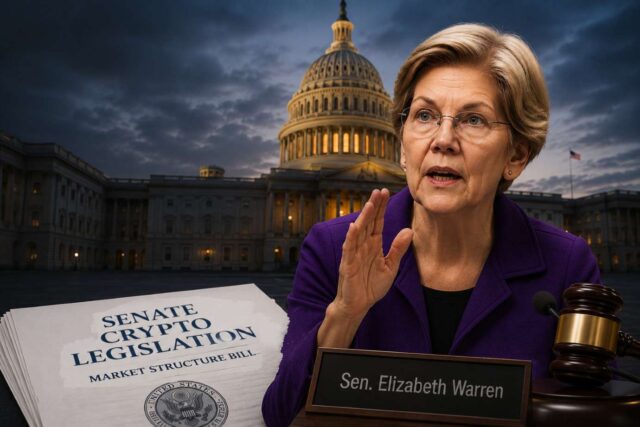
Senator Elizabeth Warren has pushed Senate leaders to add ethics provisions to the CLARITY Act (Digital Asset Market Clarity Act), reopening a political fault line just as Republicans aim to bring the crypto bill to a floor vote.

Though her July 13 letter is sharp, it is not a change in the proposed legislation. But it intensifies an ongoing Senate dispute over whether lawmakers should embed ethics rules directly into crypto legislation. At its core is a question that could influence the bill’s chances of passage: who is allowed to benefit from the crypto industry while writing its rules.

Warren presses for ethics rules in the bill

Warren, the ranking Democrat on the Senate Banking Committee, wrote to Majority Leader John Thune and Minority Leader Chuck Schumer urging them to include restrictions on senior officials’ crypto interests in the bill.

Her proposal would apply to the president, vice president, senior administration officials, and members of Congress. The goal is to prevent them, and their families, from profiting from crypto markets while shaping the regulatory framework.

The letter points directly to President Donald Trump’s family crypto activities. Warren cited his 2025 financial disclosure and argued that those interests create conflicts of interest as lawmakers debate rules that could affect the industry.

That claim reflects Warren’s interpretation of the disclosure. The letter itself does not establish unlawful conduct.

Why this matters for the broader legislation

The Senate’s market structure bill focuses on defining clearer federal rules for crypto markets. It would divide oversight between regulators, define requirements for trading platforms, and address issues such as stablecoin rewards, anti-money-laundering controls, and tokenised securities.

Those areas are already contested. Banks and crypto firms disagree over how stablecoin incentives should work. Some Democrats are pushing for stricter financial-crime safeguards. Others are focused on market structure and regulatory clarity.

Warren’s intervention adds a different pressure point. The inclusion of ethics provisions in crypto legislation could shape how many Democrats are willing to support the bill. Without that support, passage becomes more difficult.

At the same time, there is little visibility on where the votes stand. The letter signals a demand, not a consensus.

A political shift, not a legislative one

What changed is the political cost of moving forward without ethics language. The Senate Banking Committee’s top Democrat has now escalated the pressure by putting the demand in writing to Senate leadership directly.

What has not changed is the bill itself. No amendment has been introduced, no new text has been agreed, and nobody knows when it will reach the floor for a vote. 

Timing remains uncertain. Warren wrote that Thune aims to hold a floor vote this month, and reporting has echoed that intention. But an aim is not a formal schedule. The timeline, and the final wording, can still shift.

It is also important to separate the debate. The current dispute in the Senate focuses on who may benefit from the crypto industry, not on how the regulatory framework itself would function. The core market-structure provisions remain unchanged.

What to watch next in the bill text

The decisive moment will be the release of floor language or an agreed amendment. That will show whether Senate leaders are willing to include ethics rules and how broadly they would apply.

And key details will matter here. Do the restrictions cover only elected officials, or senior appointees as well? Do they extend to family members? And are they strict prohibitions or disclosure-based requirements?

Until those questions are answered, the ethics dispute around the Senate’s crypto legislation remains a live negotiation, with the outcome still uncertain. 

No, Elizabeth Warren did not block the bill. But she has raised the political cost of moving forward without ethics language. Whether that cost is high enough to change the outcome is now up to Senate leaders, not up to her. Is it worth the Democratic support it might buy them, or the Republican votes it might cost?

Block Agrees to $45M Cash App Settlement as States Target Fraud Protections

TL;DR

  • Block Inc. will pay $45 million to settle a multistate investigation into alleged deceptive marketing and fraud protection failures on Cash App.
  • Regulators said Cash App overstated its security protections while failing to adequately support users affected by fraud.
  • The settlement requires stronger customer support and faster complaint handling as scrutiny of fintech platforms continues.

Block Inc., the parent company of Cash App, has agreed to a $45 million settlement with 46 U.S. states following an investigation into the platform’s fraud protection and consumer practices. The settlement resolves allegations that the company deceptively marketed Cash App as offering bank-like security while failing to provide adequate safeguards against fraud and sufficient support for customers affected by unauthorized transactions.

The settlement does not include an admission of wrongdoing by Block. However, the company has agreed to implement a series of operational changes to strengthen customer protections and resolve complaints more quickly. The investigation was led by attorneys general in Oregon and Texas.

States alleged deceptive marketing and weak consumer safeguards

The multi-state investigation alleged that Block misrepresented the level of protection available to Cash App users by promoting the service as offering bank-like safeguards. According to regulators, the company implied that customer funds were protected by FDIC insurance. Though that coverage only applied if one of Cash App’s partner banks failed, not in cases of fraud or unauthorized transactions.

Further, regulators alleged that Cash App allowed users to create accounts without providing a Social Security number or date of birth. It also failed to impose an effective limit on the number of accounts an individual could open. States argued these practices made the platform more vulnerable to fraudulent activity.

Investigators further alleged that, for years, Cash App did not provide an official customer support phone number. As a result, fraud victims were exposed to fake support numbers promoted by scammers online. The complaint also cited a social media campaign encouraging users to publicly share their $cashtag, despite allegations that Block knew scammers were exploiting the promotion to target customers.

Settlement requires specific operational changes

Under the agreement, Block Inc. will pay $45 million and implement several consumer protection measures. The company must provide 24-hour customer support, including at least 13.5 hours of live phone staffing each day. They will also respond to complaints involving unauthorized transactions within three business days.

As part of the resolution, the settlement requires the Block to strengthen Cash App’s complaint handling and compliance procedures. Block has stated that it cooperated with regulators throughout the investigation while continuing to invest in the safety and security of its platform.

Settlement follows earlier enforcement actions

The latest agreement comes after Block reached a separate settlement in January 2025 with 48 states and the Consumer Financial Protection Bureau (CFPB). Back then, it agreed to pay $255 million over seperate allegations involving Cash App. Under a linked CFPB consent order, the company also faces between $75 million and $120 million in consumer refunds.

Block Inc. has also faced other regulatory actions in recent months, including an $80 million multi-state penalty over anti-money laundering compliance and a $40 million penalty imposed by the New York Department of Financial Services for alleged shortcomings in its anti-money laundering program.

What it means for Block’s crypto business

Although the settlement centers on Cash App’s consumer protection and marketing practices, not its cryptocurrency services, it is relevant to Block’s broader digital asset business. The company holds Bitcoin on its balance sheet, while Cash App allows users to buy and sell Bitcoin directly. It has become one of the largest retail on-ramps for cryptocurrency adoption in the United States.

The case also highlights the regulatory expectations facing fintech platforms that combine traditional payment services with crypto features. Regulators increasingly push for bank-like consumer protections on apps that offer payments alongside digital assets. Hence, the settlement may serve as a reference point for how authorities assess similar platforms that blend crypto trading with savings, payments, or banking-style services.

The agreement arrives during a challenging period for Block. The company reported a net loss of $308.7 million in the first quarter of 2026 and announced plans to cut more than 4,000 jobs, even as Cash App’s gross profit increased 38% year over year. Block is also negotiating settlement proposals with the U.S. Department of Justice over compliance and risk management practices, while the U.S. Securities and Exchange Commission has closed a related investigation without taking enforcement action.

Growing scrutiny of fintech firms

This settlement with Cash App highlights increasing regulatory scrutiny of digital payment providers as they continue to attract millions of users. Regulators are placing greater emphasis on accurate marketing, fraud prevention, responsive customer support, and transparent dispute resolution as fintech platforms increasingly compete with traditional financial institutions.

For Block, the financial impact of the settlement is relatively modest given the company’s size. However, the case underscores that fintech firms offering both conventional financial services and digital asset features are expected to provide consumer protections that match the security claims they make while meeting increasingly stringent regulatory expectations.

Kazakhstan Advances Crypto Hub Ambitions With Sweeping Presidential Decree

TL;DR

  • Kazakhstan’s President Tokayev issued a decree to expand its crypto ecosystem and digital asset regulatory framework.
  • The move builds on earlier 2026 steps including nationwide exchange licensing and Alatau City development.
  • Together, these initiatives support Kazakhstan’s crypto hub ambitions and a broader digital asset strategy.

Kazakhstan has taken another major step in its digital asset strategy as President Kassym-Jomart Tokayev signed a sweeping decree to further expand the country’s crypto ecosystem and advance the country’s crypto hub ambitions. The measures introduce new incentives for digital asset businesses, promote stablecoin-enabled cross-border payments, support the tokenization of financial instruments and strengthen the regulatory framework surrounding digital assets.

The presidential digital asset decree builds on a series of reforms introduced throughout 2026, including licensing the first crypto exchange under Kazakhstan’s new national regulatory framework, advancing the development of Alatau City and attracting international blockchain partners.

Kazakhstan’s broad roadmap for digital assets and crypto hub status

The presidential decree outlines an extensive package of digital asset reforms. It was jointly prepared by the Ministry of Artificial Intelligence and Digital Development, the National Bank of Kazakhstan and the Astana International Financial Centre (AIFC). Among its key objectives are expanding the number of licensed digital asset service providers, introducing tax incentives for parts of the crypto sector, encouraging tokenized financial products and supporting the use of blockchain infrastructure across trade and financial markets. The government also plans to expand the use of stablecoins in cross-border settlements, alongside additional measures on digital mining, investor protection and Kazakhstan’s broader capital markets.

While the decree does not create a new law in itself, it sets strategic direction for the sector. Individual agencies are now expected to draft the detailed legislation and implementation timelines needed to put these measures into effect.

Building on months of reform

Earlier this month, Kazakhstan issued the first crypto exchange license under its new nationwide digital asset licensing framework, which took effect on May 1. The license went to Pax Finance.

Crypto exchanges including ATAIX, Binance and Bybit were already operating, but under a separate regime limited to the Astana International Financial Centre (AIFC). The AIFC is a separate legal zone within Kazakhstan that operates under English common law. It has its own regulator, the Astana Financial Services Authority, that allowed licensed crypto exchanges to serve international investors since 2018. So, this began years before crypto was legal anywhere else in the country. Pax Finance’s aproval is significant because it is the first license issued under the National Bank of Kazakhstan’s framework. Regulated crypto trading is now available beyond the AIFC.

Extending licensing beyond the AIFC is part of the government’s effort to unify oversight of the industry under one legal framework for Kazakhstan’s growing digital asset market.

Alatau City takes center stage

Another cornerstone of Kazakhstan’s digital asset strategy is Alatau City. Authorities plan it as an innovation and financial hub which they hope will become a regional center for digital finance. Within the project, the government plans to establish the Alatau Crypto Cluster, a designated pilot zone where digital assets can be used for everyday transactions under a dedicated legal framework. The cluster will serve as a testing ground for blockchain applications and digital payments ahead of broader rollout.

The project has also drawn international partners. During a June roadshow in Shenzhen and Hong Kong, both the Solana Foundation and Solana Company signed separate memoranda of understanding with Alatau City. The Solana Foundation’s agreement focuses on blockchain infrastructure, developer education and startup support. Meanwhile, Nasdaq-listed Solana Company will work on digital asset treasury infrastructure, institutional adoption and platform development.

The project remains at an early stage, however. Independent assessments have flagged open questions. One issue is whether changes to Kazakhstan’s legal or constitutional framework may be required. Another is infrastructure capacity, including electricity, water, gas and internet connectivity.

A regional race for crypto leadership

The latest reforms also reflect a broader regional dynamic. Governments across the Middle East and Asia are racing to attract digital asset businesses through a mix of regulation and incentives.

Within that context, Kazakhstan’s crypto hub strategy stands out for its scope. Instead of focusing mainly on trading activity, it combines regulation, financial infrastructure and technology development into a single national framework.

Many jurisdictions still rely heavily on exchange activity and retail flows. Kazakhstan is attempting to build a more complete digital asset ecosystem from the ground up. If it works, it will strengthen the country’s ambitions over time and attract the long-term blockchain investment it wants to support.

What comes next

Much of the decree’s real-world impact will hinge on implementation. Additional legislation, regulatory guidance and coordination between agencies will still be needed before many of the announced measures become operational. Investors and industry participants will be watching how quickly Kazakhstan converts these policy commitments into practical opportunities.

Viewed individually, each 2026 announcement represents incremental progress. Viewed together, they form one of the region’s most coordinated digital asset reform efforts and further strengthen Kazakhstan’s crypto hub ambitions as competition among global blockchain jurisdictions continues to intensify.

Exclusive Interview: Bitcoin Is Gunpowder. Stephan Livera on Sound Money, Self-Custody, and Why the Next Generation’s Opportunity Is Bitcoin

A conversation with Stephan Livera at BTC Prague — one of the most recognisable voices in Bitcoin education on sound money, self-custody, and why the next generation's opportunity is hiding in plain sight.

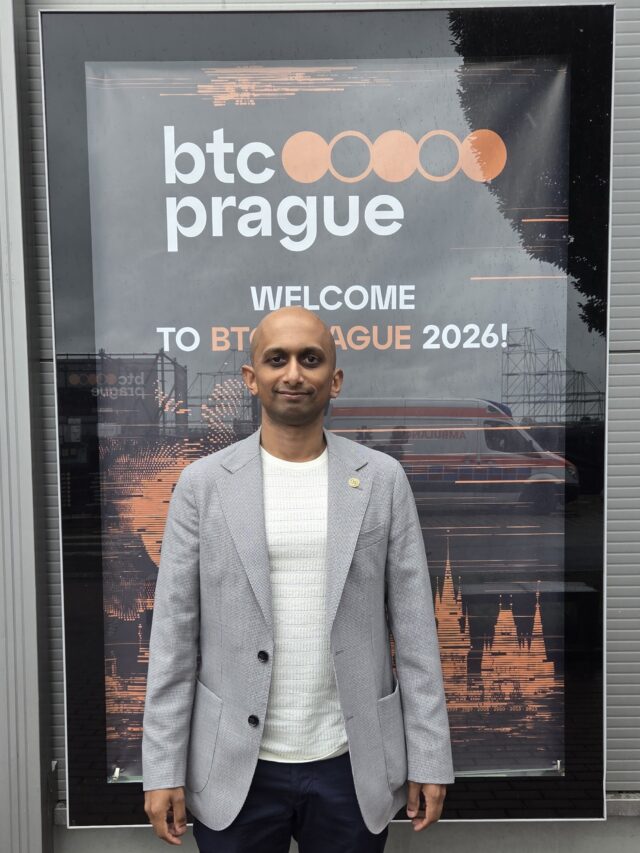
The conference halls of BTC Prague hum with the kind of energy that makes you feel like you’ve stumbled into a gathering of true believers. And perhaps you have. Amid the noise, Stephan Livera cuts a calm, measured figure. He speaks the way he podcasts: clearly, deliberately, without wasted words. He has been doing this long enough to know exactly what he thinks.

Livera didn’t come to Bitcoin through speculation or a lucky early trade. He came through books. Specifically, the works of 19th-century Viennese economists who argued that sound money, money that cannot be inflated away by governments, is the foundation of a free society. When he eventually encountered Bitcoin, it simply made sense.

“For me, it was mainly my interest in libertarian ideas and Austrian economics,” he says. “Being anti-central banking, anti-fiat money. So that was something I was interested in even at a teenage age. And then when I saw Bitcoin and I realised what it was, that’s when I really doubled down.”

He had been working as a Chartered Accountant with stints at Deloitte, the Commonwealth Bank of Australia, Macquarie Group. Good jobs by any measure. But something didn’t sit right. The financial system he was working inside was, in his view, fundamentally broken. Bitcoin offered an exit.

“I was basically shouting from the rooftops about Bitcoin for a while,” he says, with a smile that suggests he is only slightly exaggerating. “And I was frustrated about the quality of the media and the education at the time. So I started my podcast in 2018.”

Seven Hundred Episodes Later

The Stephan Livera Podcast now sits at over 700 episodes and 6 million downloads, ranking in the top 0.5% of podcasts globally. It has featured everyone from core Bitcoin developers to economists, miners, investors and philosophers. But Livera doesn’t talk about the numbers much. What he cares about is the conversation.

“A lot of people still don’t understand the right questions to even ask about Bitcoin,” he says. “What it really does for the world.”

The world he is describing has changed dramatically since 2018. Back then, he remembers having to explain what fiat money even meant. Today, nation states are buying and holding Bitcoin. Sovereign wealth funds are circling. The biggest wealth managers on the planet are offering Bitcoin ETFs. The education battle, at least at the macro level, has been largely won.

“Nowadays, it’s almost like people just kind of understand. Okay, that’s what fiat money is, Bitcoin is a different thing,” he says. “Those are some of the things that have really shifted.”

But a new challenge has emerged in its place. The age of the 90-minute deep-dive podcast is competing with the age of the 15-second scroll. “The attention span has kind of dropped,” Livera observes, with the air of someone who has made peace with an inconvenient reality. “So I just see my job as trying to help people learn about what’s interesting in Bitcoin; whether that is something technical, whether it’s new Layer-2s, whether it’s about treasury companies or lending or protocol or Bitcoin culture. These are all things I see as my remit to cover.”

Who Owns Bitcoin’s Future?

BTC Prague’s debate stage posed a confrontational question this year: Cypherpunks vs. Institutions — Who Owns Bitcoin’s Future? It is a question that carries particular weight when asked of Livera. He built his reputation on grassroots Bitcoin education. But he has also spent years as Managing Director of Swan Bitcoin International, a platform that has actively courted institutional capital and partnered with Tether. He does not see a contradiction.

Bitcoin is the money of enemies. You can’t stop your enemy from adopting it.

“I think it was inevitable,” he says. “If Bitcoin is the better money, everyone is going to adopt it.” He reaches for a quote from his friend, economist Saifedean Ammous. “Bitcoin is not going to be adopted like it’s cool technology like the iPhone. It’s going to be adopted like gunpowder; because if you don’t, other people will beat you with it.”

The point is not that institutions are welcome guests at the Bitcoin table. The point is that they were always going to show up, whether Bitcoiners wanted them to or not. The question of who owns Bitcoin, Livera suggests, may be the wrong question entirely.

“It’s a protocol being advanced, and in certain aspects, it is an anarchist protocol. There is not necessarily a formal governance structure.” He lists the stakeholders: core developers, node operators, miners, exchanges, ETF providers, treasury companies, media. All of them hold a different kind of power. None of them holds all of it. “If you really need to change something at consensus level, you need a super, super majority. But there are other things that can be developed that don’t require a consensus-level change; and that’s where a lot of the action is.”

The Case for Holding Your Own Keys

If there is one theme that runs through nearly everything Livera discusses, it is sovereignty. The ability to hold your own Bitcoin. Without a bank, a custodian, or a government standing between you and your money. In his view, that’s the whole point of Bitcoin.

“Be your own bank,” he says, invoking one of Bitcoin’s oldest slogans. “With Bitcoin, you don’t have to ask permission. And so that’s interesting for people.”

But self-custody has a reputation problem. Horror stories of lost hardware wallets and forgotten seed phrases have created a public anxiety around it. Livera argues, it is mostly misplaced. “I think it’s more like an anxiety that people have — they feel like, if I make a mistake, I’m going to lose it all.” The reality, he says, is that the tools have improved dramatically. Multi-signature setups, cloud backups for smaller amounts, apps that walk users through the process step by step. “It’s just about knowing the right tools.”

He is also pragmatic. Not everyone will self-custody, and he has stopped pretending otherwise. “Sometimes people will come in through a different pathway. The top of the funnel might be an ETF, it might be a treasury company. It’s not all or nothing. You can have a fraction of your coins in self-custody and a fraction not.” What matters, he says, is that people understand the option exists, and why it matters.

You never know when your account could get shut down. You never know when something could get blocked. But if you have self-custody, the ball is in your court.

The AI Wildcard

He also points to a less obvious argument for self-sovereignty: the coming age of agentic AI. Autonomous software agents making micro-payments on behalf of their users will need payment rails that are fast, permissionless, and programmable. Bitcoin’s Lightning Network, he argues, is quietly positioning itself for exactly that role. “There are various people trying to help their product be usable by AIs to quickly set up and take payments, whether that’s PhoenixD or MoneyDevKit or Breeze SDK. These show you the value of self-sovereign payments.”

Lightning: Hub-and-Spoke, But Not Captured

Lightning Network is Bitcoin’s second layer. The network of payment channels allows Bitcoin to move quickly and cheaply without every transaction being recorded on the main blockchain. Critics have raised a concern that it is quietly centralising, with a small number of large nodes routing most of the network’s payments. Livera addresses this honestly.

“It is true to say that the Lightning Network maybe has a bit of a hub-and-spoke model, and in some elements, it is centralising.” But he pushes back on the conclusion that this is dangerous. “At the same time, we have to remember it’s still permissionless. You and I could easily just set up a Lightning node right now, today. There’s no one gatekeeping that.”

The analogy he reaches for is the internet itself. Data doesn’t travel in a straight line from sender to receiver. It hops across a network of nodes, finding the most efficient route. Lightning works the same way. “The coin will find its way,” he says simply.

And the user experience, he adds, is improving fast. Apps like Zeus Wallet are building graduated onboarding, starting users in a custodial mode and walking them toward full self-custody over time, without making the transition feel like a technical exam. “These approaches are being worked on by various entrepreneurs and developers in the system.”

A Message to the Next Generation

Ask Livera what Bitcoin looks like in 2035 and he resists the temptation to paint a perfect picture. “Who knows?” he says, candidly. “Could we have predicted nine years ago that the world would be like it is now? No way.” He suspects that most people in 2035 will use Bitcoin without thinking much about it. It will be built into the apps and services they already use. As invisible as the internet protocols that carry their messages.

But for the generation that is paying attention now, the ones who are noticing the national debt, who feel the housing ladder has been pulled up before they could reach it, who sense that the financial system was not designed with them in mind, he has something more direct to say.

“People fundamentally don’t realise the problem of large government and nation state debt. Maybe that doesn’t resonate for everybody, but for the younger crowd, they may see it as: look, this is an opportunity for me to earn. They can earn online without asking for permission.”

He doesn’t frame Bitcoin as a protest or an ideology. To him, it is a practical answer to a real generational problem. “I think holding and saving with Bitcoin is actually an opportunity for them. It’s a case for optimism, because Bitcoin as a network is still growing quite rapidly.”

Priced in Bitcoin, Everything Is Getting Cheaper

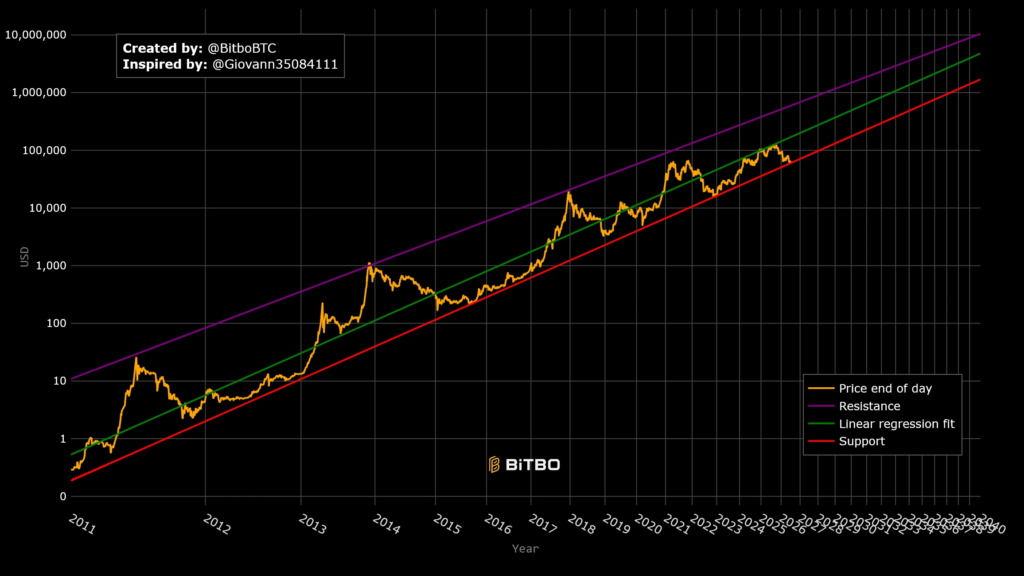
When pressed on whether Bitcoin’s value will always be measured against the fiat currencies it seeks to replace, he offers a reframe. “If you price a house in Bitcoin from ten years ago, it’s down. Whether we call it the fiat USD price or the property house price, Bitcoin fundamentally is growing.” He references the power law model, a mathematical framework some analysts use to project Bitcoin’s long-term price trajectory. He suggests that somewhere around $1 million per Bitcoin by 2033 and $10 million by 2045 sits within the range of plausible outcomes, though he is careful to note the uncertainty in either direction.

Source: charts.bitbo.io/long-term-power-law/

Right now, he acknowledges, sentiment is subdued. On the day of the interview, Bitcoin was trading around the $62,000 mark. The vibe, as he put it, was down. “We’re in the bear market now.” But for someone who has been shouting from the rooftops since 2018, a bear market is less a crisis than a familiar rhythm.

“If you look over the long run,” he says, “it’s going to grow massively.”

- Advertisement -

FEATURED