Home Blog Page 18

Sparkassen and Volksbanken Open a New Chapter for Crypto in Germany

TL;DR

  • Germany’s Sparkassen and cooperative banking networks are bringing regulated crypto trading to millions of existing bank customers.
  • Sparkassen plans to launch Bitcoin and Ethereum trading in summer 2026, while DZ Bank’s meinKrypto platform already supports four major cryptocurrencies.
  • The rollout reflects growing institutional adoption of digital assets under the EU’s MiCA regulatory framework.

Germany’s banking sector is entering a new phase of crypto adoption as its two largest retail banking networks prepare to offer digital asset trading services directly to customers. The country’s Sparkassen savings banks and cooperative Volksbanken institutions are rolling out crypto products through their central banking partners, expanding regulated access to millions of retail clients without requiring a separate exchange account.

This marks a significant change for traditional lenders that were once cautious about cryptocurrencies. Participating banks will integrate digital asset trading into their existing banking services under the European Union’s Markets in Crypto-Assets (MiCA) regulatory framework.

Sparkassen reverses its long-standing crypto stance

The Sparkassen Finance Group, Germany’s nationwide network of public savings banks, plans to introduce crypto trading through DekaBank, its central securities provider. The rollout is targeted for summer 2026 and is expected to initially support Bitcoin and Ethereum.

The decision marks a notable reversal for Sparkassen. In 2023, the organization’s board rejected plans to offer cryptocurrency services, describing digital assets as “highly speculative.” Since then, regulatory developments and growing customer demand have reshaped the landscape, encouraging the banking group to revisit its approach.

Because Sparkassen operates through hundreds of independent regional institutions, each bank will decide whether to make the service available to its customers.

Cooperative banks have already begun their rollout

Germany’s cooperative banking sector is moving even faster. DZ Bank, the central institution serving Volksbanken and Raiffeisenbanken, has already launched its meinKrypto platform, allowing participating member banks to offer cryptocurrency trading to retail clients.

The platform supports Bitcoin, Ethereum, Litecoin, and Cardano, a broader selection than Sparkassen’s initial offering. Custody is provided by Boerse Stuttgart Digital, while trade execution is handled through EUWAX. Individual cooperative banks can choose whether to participate, meaning availability will vary across regions.

Together, the Sparkassen and cooperative banking sectors represent roughly 80 million customer relationships across Germany. This launch will be one of the largest traditional banking expansions into digital assets in Europe.

Regulation helps banks enter the market

The rollout reflects a broader shift in Europe’s regulatory environment. The EU’s MiCA framework establishes common rules for crypto service providers, giving banks greater legal clarity before entering the market.

Offering crypto through existing banking platforms may appeal to customers who prefer dealing with familiar brands instead of specialized exchanges. Established financial institutions stand to benefit from their existing customer relationships. Banks also bring established compliance procedures, identity verification, and customer support that many retail investors already use for traditional financial products. That said, customers shouldn’t expect the full range of tokens or advanced trading features available on dedicated crypto exchanges, at least not at launch.
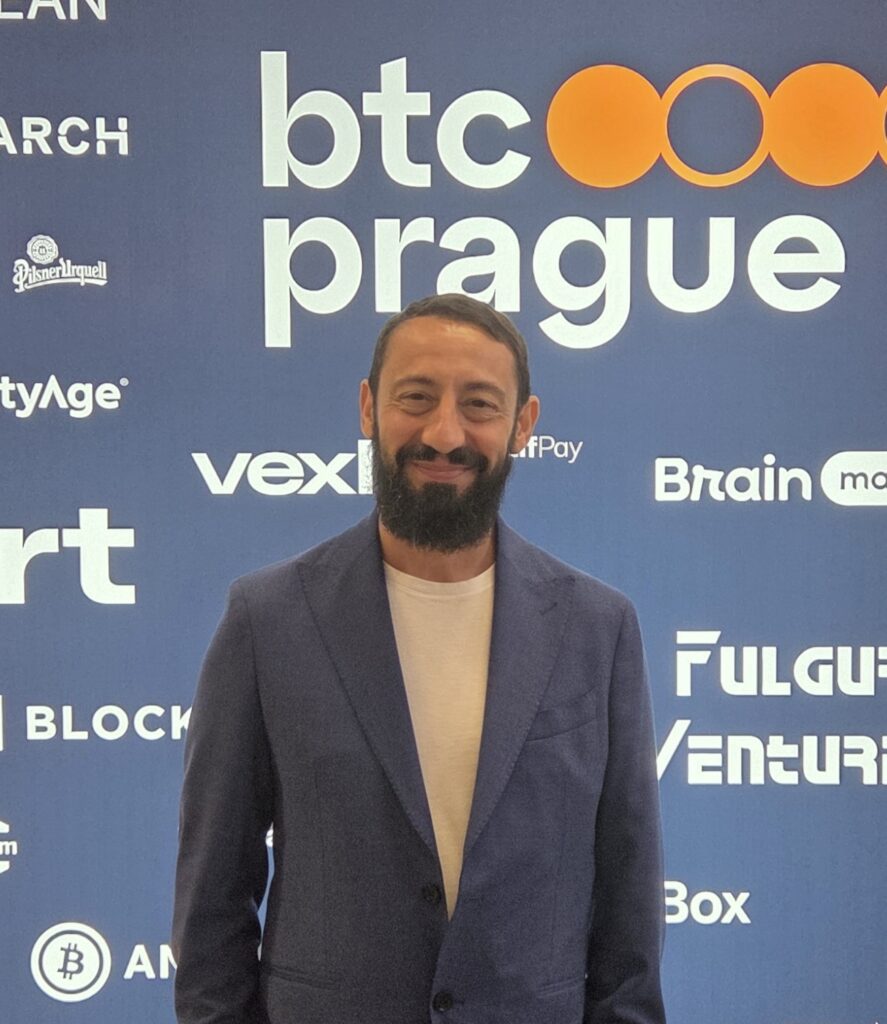

A big shift will also happen when the private banking and retail banking institutions will understand the great opportunity that they have to leverage their own distribution capillary network.

Luca Esposito, Head of Expansion EMEA, Blockstream Capital Partners

Our Exclusive Interview: Luca Esposito on Why Bitcoin Doesn’t Need a Revolution


Traditional finance continues its crypto integration

The rollout illustrates how digital assets are becoming part of mainstream financial services. They are no longer viewed as a niche investment category, which is why established institutions across Europe gradually introduce crypto services under maturing regulatory frameworks. Whether adoption spreads widely will depend on customer demand and how many regional banks ultimately switch the feature on.

Crypto trading is still in its early stages at German banks. However, two of the country’s largest banking groups getting involved suggests cryptocurrencies are becoming an increasingly accepted part of the financial system.

Ill Bloom Vulnerability Exposes Thousands of Crypto Wallets After $5M Theft

TL;DR

  • Security researchers have disclosed the Ill Bloom vulnerability, which exposes cryptocurrency wallets created with weak recovery phrase generation.
  • Coinspect says attackers have stolen at least $5 million since May 27 and warns thousands of wallets may still be vulnerable.
  • The flaw affects certain wallet software rather than blockchain networks, and users can check their wallet using Coinspect’s free tool.

A newly disclosed security flaw known as the Ill Bloom vulnerability could leave thousands of cryptocurrency wallets exposed to theft due to a weakness in how some wallet recovery phrases were generated. Security researchers at Coinspect estimate attackers have already stolen at least $5 million by exploiting wallets created with insufficient randomness.

The issue does not affect blockchain networks themselves. Instead, it targets certain wallet implementations that relied on an insecure pseudorandom number generator when creating seed phrases. Because a wallet’s recovery phrase is used to derive all of its private keys, weak entropy during seed generation can compromise the entire wallet.

Weak randomness can expose wallet recovery phrases

Cryptocurrency wallets rely on randomly generated recovery phrases to secure users’ funds. If the randomness used during seed phrase generation is predictable or insufficient, attackers don’t need to attempt to break modern cryptography. They may just be able to recreate the same recovery phrase.

According to Coinspect, the affected wallets were created using software that failed to generate enough entropy when producing recovery phrases. The vulnerability affects wallets across six blockchain ecosystems: Bitcoin, Ethereum, Polygon, Rootstock, Tron, and Solana.

The Ill Bloom vulnerability demonstrates that even strong cryptographic algorithms can be undermined if the process used to generate wallet recovery phrases is flawed.

Millions already stolen

Researchers say attackers have already exploited the weakness to steal at least $5 million worth of cryptocurrency from affected wallets since May 27. They believe the true figure may be significantly higher.

According to Coinspect, an attack on May 27 targeted 431 of the 2,114 vulnerable wallets identified by the researchers, draining approximately $3.1 million. On the day the company publicly disclosed the vulnerability, an additional $2 million was moved from exposed wallets before more users could secure their funds.

Unlike many software vulnerabilities that can be fixed with an update, wallets created from weak recovery phrases cannot simply be repaired.

Blockchain security remains intact

Coinspect’s findings reinforce that the issue lies in wallet software, not the blockchains themselves. The vulnerability highlights the importance of secure random number generation, which forms the foundation of cryptographic security across digital systems.

Current evidence suggests hardware wallets and most widely used software wallets remain safe. According to Coinspect, the highest risk is concentrated among certain lesser-known mobile wallet implementations, with vulnerable wallets dating back to at least 2018. The incident also echoes the 2023 Trust Wallet browser extension vulnerability. It similarly exposed wallets because of weaknesses in seed phrase generation rather than blockchain security itself.

Users urged to review wallet security

To help users determine whether they may be at risk, Coinspect has released a free public tool that allows users to check their wallet addresses against its database of identified vulnerable wallets. The company said it is intentionally withholding full technical details of the exploit until affected users have more time to move their funds, reducing the risk of copycat attacks. Blockchain security firm SlowMist also said it is monitoring the situation.

Users who believe they may have created a wallet using affected software should migrate their assets to a newly generated wallet from a trusted provider. Security researchers also recommend keeping wallet software up to date and following official guidance as more information becomes available.

Although the vulnerability affects only a subset of wallet implementations, its disclosure underscores how weaknesses in wallet software can create significant risks, even when the underlying blockchain remains secure.

Binance’s Philippines Return Isn’t Official Yet Despite Latest Approval

TL;DR

  • Binance has moved one step closer to re-entering the Philippines after its local partner received approval to begin live SEC sandbox testing.
  • Despite Binance co-founder and co-CEO Yi He’s announcement, regulators say the company is not yet authorized to resume commercial operations.
  • The partnership must complete technical integration, sandbox testing, and additional licensing before any broader public launch.

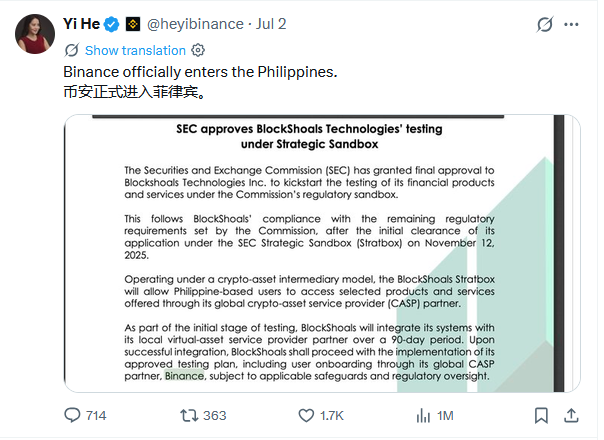
Binance moved a step closer to its return to the Philippines after regulators granted BlockShoals Technologies final approval to begin live testing under the Securities and Exchange Commission’s (SEC) StratBox regulatory sandbox. The announcement coincided with a July 2 post on X in which Binance co-founder and co-CEO Yi He said the exchange had “officially” entered the Philippine market.

However, regulators have made clear that the milestone should not be mistaken for a commercial launch. While BlockShoals can now begin the sandbox phase, Binance has not received a standalone local operating license. Several regulatory steps remain before any public rollout.

Sandbox testing begins, but public launch remains distant

The latest approval does not mark BlockShoals’ admission into the StratBox sandbox. The company previously received in-principle approval on Nov. 21, 2025, followed by a Notice to Proceed on April 14, 2026. The current milestone authorizes the start of live sandbox testing.

Under the framework, BlockShoals is integrating Binance as its global crypto asset service provider within a controlled regulatory environment to evaluate compliance, investor protection, and operational readiness before regulators consider broader market access.

The latest milestone comes more than two years after Philippine regulators ordered internet service providers to block access to Binance. They also requested app stores remove the exchange’s mobile application for operating without the required licenses.

SEC and BSP say Binance is not fully back

Despite Yi He’s announcement, Binance’s return to the Philippines is not yet complete. In the weeks leading up to the sandbox testing approval, both the SEC and the Bangko Sentral ng Pilipinas (BSP) cautioned that significant regulatory and operational hurdles remained.

The SEC has clarified that BlockShoals may not commercially operate or offer crypto services to the public at this stage. According to the regulator, the required 90-day integration period is intended solely to build the technical infrastructure between BlockShoals and its licensed local Virtual Asset Service Provider (VASP) partner. Any system access during this period is limited to technical integration and sandbox testing, not live customer activity.

Only after completing that integration period can BlockShoals begin onboarding users under the sandbox program.

The Bangko Sentral ng Pilipinas (BSP) has separately stated that neither Binance nor BlockShoals currently holds a Virtual Asset Service Provider (VASP) license. The central bank also emphasized that participation in the SEC’s sandbox does not replace existing BSP licensing requirements.

Together, the SEC and BSP statements reinforce that the current phase is a supervised regulatory pilot, not a commercial relaunch.

Partnership reflects Binance’s evolving expansion strategy

Rather than seeking an immediate standalone license, Binance has increasingly pursued expansion through partnerships with regulated local entities. The BlockShoals arrangement reflects a strategy that allows the exchange to work within existing regulatory frameworks while authorities evaluate its services through controlled testing.

The sandbox itself is expected to run for at least two years before regulators consider whether a broader rollout is appropriate. That extended timeline underscores that the current initiative is a pilot program, not a market launch.

The development also comes as competition in the Philippines’ digital asset sector continues to grow. Both, traditional financial institutions and licensed crypto firms are expanding their offerings to retail investors.

What comes next

Binance’s return to the Philippines now hinges on whether BlockShoals can successfully complete its 90-day technical integration, progress through the SEC’s sandbox program, and ultimately secure the regulatory approvals required by both the SEC and the BSP.

The recent approval is an important regulatory milestone, but progress does not yet equal a return. Despite some optimistic headlines, significant licensing and operational hurdles remain before the exchange can fully resume serving the public.

Ripple Secures Key EU License as Crypto Regulation Enters New Phase

TL;DR

  • Ripple has secured a full MiCA CASP license, allowing regulated crypto services across the EEA.
  • The license builds on its EMI approval, strengthening its payments and infrastructure offering in Europe.
  • The move positions Ripple to expand services under a unified EU regulatory framework.

Ripple has officially received a full Crypto-Asset Service Provider (CASP) authorization under the European Union’s Markets in Crypto-Assets (MiCA) regulation, marking a major regulatory milestone for the blockchain payments company. Ripple’s MiCA license was granted by Luxembourg’s financial regulator, the Commission de Surveillance du Secteur Financier (CSSF). It will allow the company to expand regulated crypto services across the European Economic Area (EEA).

The approval comes as the European Union’s Markets in Crypto-Assets (MiCA) framework enters full implementation. While most of the regulation took effect in late 2024, crypto firms could continue operating under national licensing regimes until July 1, 2026. With that transition period now over, companies must obtain a Crypto-Asset Service Provider (CASP) license to offer regulated crypto services across the bloc under a single regulatory framework.

Luxembourg Becomes Ripple’s Gateway to Europe

By obtaining its CASP authorization in Luxembourg, Ripple can leverage MiCA’s passporting framework to provide regulated crypto services throughout the EEA without obtaining separate licenses in each member state.

The company said Luxembourg will serve as its European regulatory hub, reflecting the country’s established financial sector and growing role in digital asset oversight. The authorization follows Ripple’s earlier preliminary approval from the CSSF, completing the licensing process.

The move strengthens Ripple’s ability to serve banks, payment providers, fintech firms, and other institutional clients looking for regulated blockchain-based payment infrastructure.

Expanding Enterprise Payment Services

Ripple said the license supports the expansion of its enterprise offerings, including Ripple Payments, digital asset custody, and stablecoin-related services where permitted under applicable regulations. This includes potential expansion of RLUSD, Ripple’s U.S. dollar-backed stablecoin. While not explicitly named in the announcement, Ripple has previously indicated that RLUSD could benefit from the combination of MiCA authorization and its existing EMI license. Analysts widely view the product as central to its European stablecoin strategy.

Ripple’s MiCA license also complements the company’s existing Electronic Money Institution (EMI) license in Europe.
This gives it a broader regulatory foundation for both fiat and digital asset services. This expanded footing supports Ripple’s long-standing focus on cross-border payment infrastructure, enabling financial institutions to move value more efficiently across international markets.

A Broader Regulatory Strategy

The European authorization adds to Ripple’s growing portfolio of regulatory approvals worldwide. The company already holds licenses and registrations across several jurisdictions, including the United States, Singapore, and Dubai.

As regulators introduce more comprehensive frameworks for digital assets, obtaining formal authorization has become increasingly important for firms serving institutional customers. Many banks and payment providers now prefer working with companies operating under recognized regulatory regimes.

Ripple’s latest approval also arrives as MiCA shifts from a transitional phase to a fully mandatory regulatory regime, making compliance a prerequisite for many crypto service providers operating within the region.

What It Means for XRP and the Crypto Market

While the announcement represents an important business milestone, it does not directly change the role of XRP or guarantee increased demand for the digital asset.

Instead, the MiCA license strengthens the Ripple’s ability to expand its regulated payment infrastructure across Europe. If more financial institutions adopt Ripple’s services under the new regulatory framework, the broader Ripple ecosystem could benefit over time. Nevertheless, any impact on XRP adoption or price remains uncertain.

As MiCA moves into a fully mandatory regime, the approval highlights how regulatory compliance is becoming a competitive advantage for crypto firms seeking long-term growth in one of the world’s largest financial markets.

What Is the European Economic Area (EEA)?

The European Economic Area (EEA) is a single market that allows the free movement of goods, services, capital, and people across participating countries.

It includes all 27 European Union member states, along with three additional countries: Norway, Iceland, and Liechtenstein. Switzerland is not part of the EEA but maintains separate agreements with the EU.

For crypto companies, MiCA authorization in one EEA country allows services to be offered across the entire region under a single regulatory framework.

Wallets Move, Opponents Emerge: The Dormant Bitcoin Wallet Lawsuit Evolves

TL;DR

  • Several developments have reshaped the dormant Bitcoin wallet lawsuit since Noah Doe filed, including wallet activity, a court stay, and the appearance of an opposing claimant.
  • The new developments both challenge and strengthen different parts of the plaintiff’s legal theory, making the case more complex.
  • A July 14 hearing could provide the first indication of how the court views prolonged wallet inactivity under New York property law.

Since filing the complaint with the New York Supreme Court earlier this year, Noah Doe rested his lawsuit on a novel legal theory. The anonymous plaintiff asked the court to declare him the legal owner of 39,069 Bitcoin wallets that he claims were abandoned under state law.

According to widely reported estimates those wallets held roughly 3.7 million BTC, currently worth about $285 billion.

Two months later, several developments have reshaped the case. New questions arose in a dispute that was already testing the boundaries of digital property law.

Dormant Wallets Are Beginning to Move

The first major development since the lawsuit became public has been a series of Bitcoin movements involving wallet addresses included in, or associated with, the complaint.

Early reports highlighted individual Bitcoin wallets becoming active after roughly 15 years of inactivity. Attention later shifted to Wallet No. 137 in the plaintiff’s own list. After remaining dormant since late 2019, it moved 1,878.57 BTC. Additional movements followed throughout June.

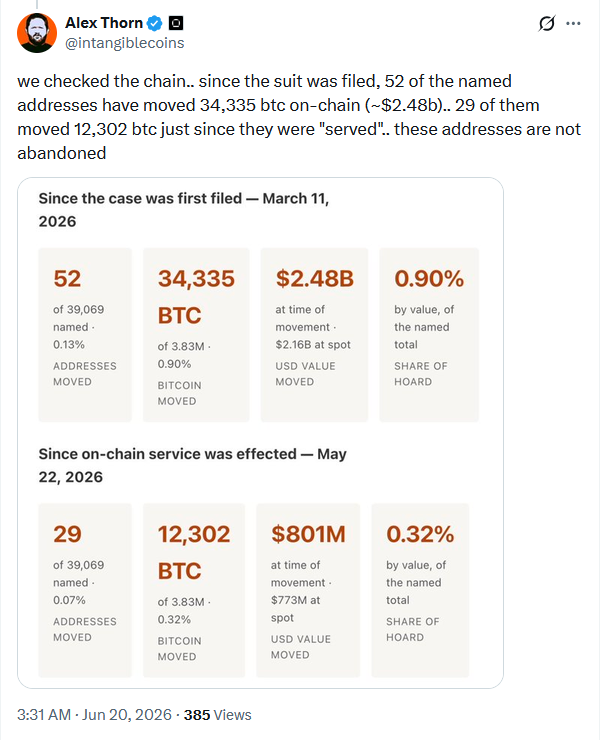
Galaxy Research has since reported that 52 named wallets have moved a combined 34,335 BTC since the lawsuit was filed. More than 12,000 BTC transferred after wallet owners were formally notified through on-chain messages.

The activity complicates one of the lawsuit’s central arguments.

The complaint relies heavily on the idea that prolonged inactivity, through multiple Bitcoin market cycles, supports the conclusion that users abandoned the wallets. If someone holding the private keys can still access an allegedly abandoned wallet, inactivity alone becomes a less reliable indicator of abandonment.

At the same time, the plaintiff could point to the same developments as evidence that the notification process worked as intended. Owners who still controlled their wallets had an opportunity to identify themselves after receiving notice. Yet, thousands of other addresses remain inactive.

Whether that distinction ultimately carries legal weight is one of the questions the court may eventually have to answer.

The Court Pressed Pause

The court pause was separate from the wallet movements.

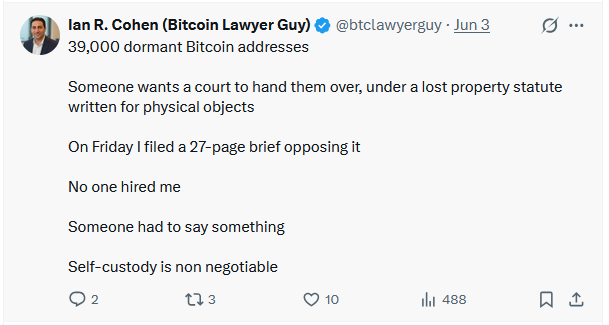
Attorney Ian R. Cohen moved on May 29 for permission to file an amicus curiae, or “friend of the court,” brief opposing the plaintiff’s request for declaratory relief. On June 5, Justice Kathy J. King stayed the proceedings and scheduled a July 14 hearing to consider the amicus motion.

The court has not expressed any view on the merits of the lawsuit. But the stay suggests the judge wants additional legal input before deciding how to proceed with a case that raises several novel questions about blockchain technology and traditional property law.

The hearing could provide the first indication of how the court intends to approach those issues.

The Lawsuit May No Longer Be One-Sided

One unusual aspect of the case was the absence of identifiable defendants.

The plaintiff listed the wallets John Does 1 through 39,069 because their owners were unknown. That raised the possibility that the court would be asked to evaluate the legal theory without anyone directly challenging it.

That may no longer be the case.

Reporting identifies a pseudonymous respondent, John Doe 33, as having filed a notice of appearance on June 30. If the court recognizes the appearance, the proceedings could become substantially more adversarial.

Instead of examining only the plaintiff’s interpretation of New York property law, the court may hear competing arguments over whether users ever abandoned the wallets and whether publicly visible blockchain addresses can legally equal found property.

The Theory Meets Resistance in Bitcoin Wallet Lawsuit

Three weeks ago, Noah Doe’s legal theory rested on a series of absences: no owners coming forward, no opposing legal analysis, and no named defendant contesting the claims.

Each of those absences has since been filled.

Wallets moving on-chain suggest that at least some owners still hold their private keys. Cohen’s proposed amicus brief supplies the adversarial legal analysis the case initially lacked. John Doe 33 supplies an actual respondent.

None of this resolves whether a cryptocurrency wallet can be treated as lost property under New York’s Article 7-B. But the plaintiff’s theory must now survive exactly the kind of scrutiny it spent its first month proceeding without.

That scrutiny will begin in earnest at the July 14 hearing. The proceeding is unlikely to resolve the case, but it could answer a narrower and more immediate question: whether Justice King treats prolonged wallet inactivity as meaningful evidence of abandonment, or whether she finds persuasive Cohen’s argument that dormancy proves little when users can simply hold private keys securely without ever using them.

How the court frames that threshold issue, inactivity as evidence or inactivity as legally insignificant, is likely to shape every filing that follows. It may also influence whether John Doe 33 is permitted to continue pseudonymously and whether additional wallet holders decide to come forward after seeing how the court responds.

- Advertisement -

FEATURED