Home Blog Page 19

Exclusive Interview: Luca Esposito on Why Bitcoin Doesn’t Need a Revolution

Luca Esposito spent 22 years teaching corporations how to adopt new technology. Then he found the technology he actually believed in.

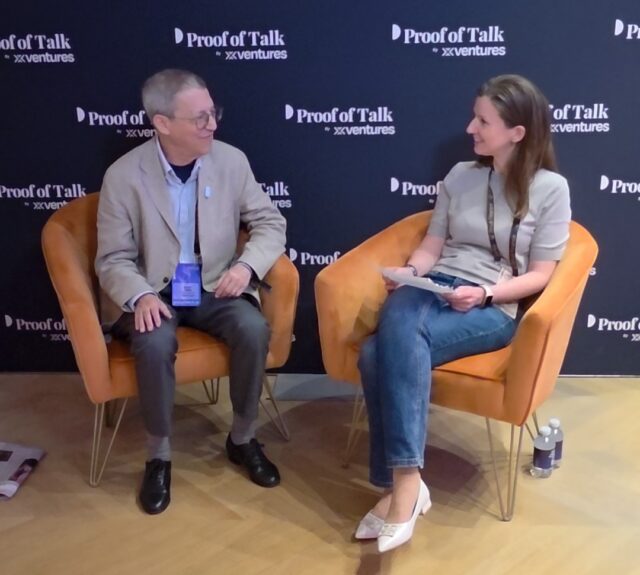
Luca Esposito has become a familiar face on the Bitcoin conference circuit. He is moderating panels, speaking on stages from Dublin to San Marino, present wherever the conversation turns to institutional adoption. Spend thirty minutes with him, and the recurring presence starts to make sense. We caught up with him on the sidelines of BTC Prague 2026  

Luca wears two hats: one at Plan ₿ Network, the global Bitcoin adoption initiative born out of Lugano, Switzerland, and another at Blockstream Capital Partners, the institutional investment arm of one of Bitcoin’s most consequential infrastructure builders. His official title, Head of Expansion for EMEA and APAC, covers more ground than most people cover in a lifetime. But underneath the titles and the geography, Luca Esposito has essentially one job: teaching.

From Oracle to Satoshi

Before Bitcoin, there was a very different kind of career. Twenty-two years of it, in fact, were spent at Oracle, Microsoft, and Nuance, managing European teams tasked with bringing digital transformation to the financial sector. It is, as we pointed out to him directly, not a very Bitcoin-original background.

He laughed at that. Then he explained why it’s exactly the right one.

“The key to bring innovation in the sector is to find ways to interconnect with legacy systems and to bring the added value that these organizations are looking for,” he said. “For any new technology to be successful and being adopted to large institutions, the best way is to find an integration path with existing applications or technologies used by those financial institutions. And this is what I’m trying to do with Bitcoin.”

The pivot began a decade ago, when he started exploring blockchain as an angel investor and startup mentor. But the real turning point came seven years ago, when he read the Satoshi white paper.

“That’s where I kind of understood all my investments and interest in the blockchains, although it has been a very useful experience and very educational, it led me to the point to understand that Bitcoin was the type of chain to be used not only as a monetary alternative but as a global financial infrastructure.”

The blockchain world, in other words, was his education. Bitcoin was the conclusion.

He lives in Lugano. Four and a half years ago, he walked into the Plan ₿ Forum, the annual Bitcoin conference organized in partnership with the municipality, and found his community. He met figures like Giacomo Zucco and his wife Mir, started collaborating, and began building. In November 2024, he left Microsoft. In September 2025, he joined Blockstream Capital Partners as Head of Expansion for EMEA and APAC.

“I decided to dedicate the rest of my career to Bitcoin and the Bitcoin sector,” he said simply.

Two Roles, One Mission

The dual mandate he carries is, on the surface, a study in contrast. Plan ₿ Network operates at the level of cities and communities: merchants, municipal payments, free education courses for ordinary citizens. Blockstream Capital Partners operates at the level of pension funds, institutional allocators, and capital markets infrastructure.

A city treasurer and a pension fund CIO are not the same conversation.

“Those are two completely different sectors, two completely different playing fields,” he acknowledged. “We need both.”

But here’s where the educator in him surfaces. Whether he’s talking to a local government or a global financial institution, the approach is identical: start with knowledge.

“We always start with education. Knowledge is the key to understanding why Bitcoin should become part of, for example, a portfolio diversification. Why a pension fund should maybe look into allocating 1%, 2%, 3%, 5%. And then from there, we kind of guide the institution to understand what are the risks associated with that.”

From someone with his institutional pedigree, it might sound unusual but plainly put: “Yes, it’s an educational mission.”

In Lugano, that education is embedded in the fabric of daily life. Over 400 merchants now accept Bitcoin. Citizens can pay taxes to the municipal system in Bitcoin. There are free courses for residents. There is a physical hub, a PoW Space, where people gather not just to talk about Bitcoin but to build businesses around it. A new hub recently opened in Turin. One is coming to El Salvador. There is already one in Tokyo.

“We are heading towards some sort of a blueprint of how, not necessarily you make a Bitcoin city or a Bitcoin country, but how do you integrate this new network into the fabric of society,” he said.

Is Fiat Failing?

One of his panels at BTC Prague carries a title designed to provoke: How to Profit When the Fiat Experiment Fails. We pushed back a little on the word “fails”, noting that the fiat system as we know it today only began when Nixon ended the gold standard in 1971. So, this experiment hasn’t been running as long as many people might think. It’s been only fifty-five years, to be precise, not centuries.

His response was more nuanced than the panel title suggests. He went straight to the meaning of money itself; not in apocalyptic terms, but in philosophical ones. At its core, money should allow two people to exchange value privately, and it should allow them to retain that value over time.

It has failed society because it has not allowed for people to retain the value in time. This is the most important aspect of money. It has to allow people to retain value in time. Because that’s the only thing we all have in common. We have a very limited time on this planet.

Bitcoin’s fixed supply of 21 million, its mathematical scarcity, is where he plants his flag. And then he admits the obvious: the panel title was always meant to provoke. 

“I’m not all doom and gloom about, oh, it’s going to fail, the big crisis, hyperinflation. I don’t think we’re going to get, I mean, it’s going to happen gradually, but it’s not going to be dramatic.”

What he sees instead is a slow, multipolar transition. Some parts of the world might return to gold standards. Others may embrace tokenized real estate. Others choose Bitcoin. Not a crash. A migration.

“In 50 years time, a point where the general wisdom will understand Bitcoin, because it’s finite and because it’s a complex adaptive system that is following the law of nature; then we’ll gradually and naturally transition and become a standard. So it would be the Internet of Values.”

Bitcoin vs. Everyone Else

His second panel, Building Capital Markets on the Bitcoin Layer, puts him in a more technically contested space. We put the challenge to him directly: TradFi institutions trust infrastructure they’ve used for decades. Besides, Ethereum already hosts over 65% of tokenized real-world assets. BlackRock is building on Ethereum, not on Liquid. So why Bitcoin?

His answer reached back, all the way back to the early internet.

In the early days of the web, he reminded us, there were more than 60 competing internet protocols. Every major company, his former employer Microsoft included, wanted its own. For a while, they competed. Then optimization took over, and the market converged on one: TCP/IP.

“Why did it happen? Because it was the most open, the most resilient, and the most adoptive.”

He sees the same dynamic playing out now, in a different form. The other cryptocurrencies, the smart contract platforms, the layer-2 experiments, they are all, in his view, attempts to prove there is something better than Bitcoin. But they all derive from it, in one way or another. And the market, he believes, is beginning to understand this.

Once you find mathematical perfection, anything that is a copy of it is, per definition, imperfect.

The more pointed argument is about infrastructure trust. You can tokenize real-world assets on Ethereum or on Solana, of course. But you are then dependent on a network that has a CEO, venture capital backing, and centralized points of failure. Bitcoin has none of those.

“The question is, on which protocol and global infrastructure do you want to tokenize your real-world asset, your dividends, your bonds. On the most anti-fragile one, which has more than 100,000 nodes, which cannot be confiscated, cannot be blocked?”

He was careful to distinguish between distributed and decentralized because he clearly considers this distinction critical. Ethereum may present itself as decentralized, he said, but it is, in his view, distributed. Not the same thing.

We left it there.

The Banks Are Coming

Perhaps the most surprising part of the conversation was his view on banks. In a Bitcoin conference, saying something generous about the banking system is a mildly radical act. He said it anyway.

“Banks, they are in the fabric of society for hundreds of years. They are part of the DNA of society. We cannot deny that.”

But his generosity has an edge. The role banks could play in financial literacy, explaining Bitcoin, distributing it, integrating it, is enormous. They are not playing it. Or, in his words, “they are playing it very selectively.”

What has changed, he says, is MiCA, the EU’s Markets in Crypto-Assets regulation. For all the Bitcoin community’s ambivalence about regulatory frameworks, he’s clear-eyed about what it unlocked.

“This sector needs to be regulated, otherwise they can’t do it. Because they don’t want to get in trouble. Now they have MiCA, now they have some bandwidth within which they can operate. And we are having conversations with all these banks because of MiCA. Before it was all about going to an aperitivo or going to an event, chatting, very curious. But that was it. Now, we are really working with them to see how we can integrate Bitcoin data in a compliant way.”

The first team you talk to at any bank, he noted, is the compliance team. That used to be the end of the conversation. Now it’s the beginning.

General Wisdom

We closed by asking him what it would take for him to feel that the world had finally understood Bitcoin. A specific city, a specific institution, a specific deal? What would it take for Bitcoin to stop being seen as a threat and start being seen for what he believes it really is: an evolution of our societal systems. 

He paused. Asked us to repeat the question. Then answered with the same word he’d used throughout the entire conversation – education.

“It needs to become general wisdom. Again, general wisdom happens with a lot of education. I’m sorry to be boring, but unfortunately, “study Bitcoin” is a mantra that is not just a tagline. It really means it.”

Studying Bitcoin, he was careful to add, doesn’t mean learning how to run a node or read a block explorer. Bitcoin is multidisciplinary. You can approach it through economics, through philosophy, through personal finance, through history.

“Study Bitcoin really means to get deep into what this big change is going to bring, not only to society, not only to the economic sector, but to yourself as a person. Because it pushes you to ask very fundamental questions. Why am I working so hard, and then 20 years later I have less than before? Why my grandmother had a pension which had a really good lifestyle 30 years ago, and now I have to give her money to survive?”

Once it arrives, we will see the shift from two directions simultaneously: individuals who study their way to understanding, and institutions that finally align their commercial interests with the opportunity in front of them.

It’s not going to be through a revolution that we’re going to change. It’s going to be through an optimized competition of the assets.

Optimized competition. Coming from a man who spent 22 years inside the corporations that will eventually have to make that choice, the phrase carries a certain weight. 

UK FCA Publishes Final Crypto Rulebook Ahead of 2027 Industry Overhaul

TL;DR

  • UK crypto rulebook sets out full regulatory framework for exchanges, custodians, lenders and stablecoin issuers ahead of a 2027 rollout.
  • Firms must apply for FCA authorization within a defined window or risk losing the ability to operate in the UK market.
  • The rules introduce stricter standards and consumer protections, marking a shift toward full financial oversight of crypto.

The UK’s Financial Conduct Authority (FCA) has published its long-awaited UK crypto rulebook. It finalized its regulatory framework that covers crypto exchanges, brokers, custodians, lenders and stablecoin issuers. The package concludes years of consultation and gives firms a clear path toward authorization before the new regime takes effect on October 25, 2027.

The publication marks one of the most significant milestones for the UK’s digital asset industry since the government committed to bringing crypto under a comprehensive regulatory framework. While the FCA retained the core of its earlier proposals, it also amended several measures following industry consultation. Amongst other measures it eased capital requirements for stablecoin issuers.

New framework brings crypto under FCA oversight

The FCA’s crypto rulebook does not stand alone. It implements a statutory framework established earlier this year under the Financial Services and Markets Act 2000 (Cryptoassets) Regulations 2026. Introduced on February 4, 2026, the legislation brought crypto activities within the FCA’s remit for the first time by defining regulated cryptoasset categories and creating a market abuse regime covering insider dealing and manipulation.

That legislation set the legal foundation. The handbook published this week provides the detailed operational requirements, ahead of the regime’s October 25, 2027 start date.

Under the new regime, firms conducting regulated cryptoasset activities in the UK must obtain FCA authorization before offering services. The framework applies to crypto trading platforms, brokers, dealers, custodians, lenders, staking providers and stablecoin issuers. It also extends to certain decentralized finance (DeFi) operators with an identifiable controlling entity.

Firms will be able to apply for authorization between September 30, 2026 and February 28, 2027. This window applies equally to firms already operating in the UK and to new entrants seeking to launch services.

The UK crypto rulebook requires firms to establish robust governance arrangements, safeguard customer assets, maintain operational resilience and hold adequate financial resources. Businesses must also provide clear information to customers, implement effective complaints procedures and maintain contingency plans to ensure critical services remain available during disruptions.

The FCA has also introduced market abuse requirements for crypto markets. Trading venues will be expected to monitor for insider dealing, market manipulation and suspicious trading activity. This provision aligns digital asset markets more closely with standards applied in traditional finance.

Stablecoin issuers receive lower capital requirement

The FCA finalized a dedicated framework for stablecoin issuers while making one of the most closely watched changes in the package. Following industry feedback, the regulator reduced the proposed minimum capital requirement from 2% of circulating stablecoins to 1%.

The change does not affect reserve requirements. Under the new framework, issuers must still maintain reserve assets equal to the value of every stablecoin in circulation. The tokens must remain fully backed on a 1:1 basis. They must also comply with governance, redemption and risk management requirements to protect consumers and support financial stability.

Beyond the capital reduction, the FCA also softened other elements of the original stablecoin proposal. Issuers may be given additional time in certain cases to return customer funds upon redemption. Further, several disclosure requirements included in earlier drafts have been removed from the final rules.

Industry groups broadly welcomed the revised capital requirement. In their view, the original proposal would have increased compliance costs without delivering proportionate benefits.

The FCA’s final rulebook governs non-systemic stablecoin issuers in full. Separately, stablecoins designated as systemic by HM Treasury will fall under joint oversight by the FCA and the Bank of England. In that arrangement, the Bank of England will oversee prudential and financial stability requirements. The FCA will continue to supervise conduct and consumer protection. Detailed rules for that joint regime remain under consultation.

Industry shifts focus to implementation

With the final rules now in place, attention turns from policymaking to implementation. Firms conducting regulated cryptoasset activities in the UK, whether already operating or planning to enter the market, will need to apply for authorization during the September 2026 to February 2027 window to be ready before the regime takes effect in October 2027.

That process will typically involve reviewing governance structures, strengthening custody arrangements, implementing systems to detect market abuse and ensuring sufficient financial resources. Firms will also need to align internal policies with the FCA’s expectations for consumer protection, operational resilience and ongoing regulatory reporting.

Timing matters here, and not just as a formality. Firms that apply within the window and are still awaiting a decision when the regime takes effect can continue operating under a “saving provision.” This allows them to serve both existing and new customers until the FCA reaches a final decision.

Applying late narrows that protection. Firms that submit after the window closes but before October 25, 2027 fall into a “transitional provision” if their application is not determined in time. Under this arrangement, they can service existing contracts only and cannot take on new UK customers for up to two years.

Firms that do not apply at all have no such protection. They must wind down their UK cryptoasset business entirely. Continuing to operate without authorization could expose them to enforcement action.

Despite the pressure of the deadline, industry participants have broadly welcomed the publication of the final framework. The rulebook removes much of the uncertainty that has surrounded the UK’s crypto regulatory landscape during years of consultation.

What October 2027 means for the market

Crypto firms have operated for years under a patchwork of partial rules: AML registration, separate payment services or e-money authorization for firms handling payments, and approval requirements to market products to UK consumers. None amounted to full financial oversight.

The FCA’s new crypto rulebook changes that. From October 25, 2027, cryptoasset firms serving UK customers will be held to standards similar to those applied across banking, insurance and investment services. Firms will face new obligations. Consumers will gain new protections.

It remains unclear what this will mean for the size of the market. Some firms may choose not to pursue authorization, leaving behind a smaller but more tightly regulated industry. That picture will become clearer once the application window closes and the FCA begins deciding which firms can operate under the new regime.

Exclusive Interview: Why Stefan Smith Says We Live Like Goldfish in Dirty Water

Stefan Smith has spent years helping Europeans act on what they already know about Bitcoin. At BTC Prague 2026, he explains why most people are still missing the point.

There is a particular kind of frustration that comes with knowing something is broken but not being able to name exactly what it is. Stefan Smith knows this feeling well. He has spent the better part of a decade turning it into a career.

Smith is a Bitcoin adviser and one of the founding members of 21Bitfluencers, a network of Bitcoin-only voices dedicated to cutting through the noise of an industry that generates a lot of said noise. We sat down with him this June at BTC Prague 2026, Europe’s largest Bitcoin conference, on a day when the halls were so loud with energy that we eventually gave up looking for a quiet corner inside and stepped outdoors instead. It was raining lightly. We didn’t mind.

Twenty Years in the Corporate World

Before Bitcoin, Stefan Smith spent two decades working in marketing and export sales for some of Europe’s largest consumer companies: a leading cosmetics firm, then a major paper company. By his own account, it was a perfectly respectable career. It was also, eventually, not enough.

“Aged 48, I thought, my job was not stimulating anymore. And the window of opportunity to restart my career is shrinking.”

So he left. With no clear destination, but with one conviction: that everything that can be digitised will be digitised. He started working with startups, leaning on his sales background to explain products he hadn’t built and didn’t fully understand yet. It paid very little. Then COVID arrived, and like millions of others, Smith found himself staring at his finances and wondering if there was a better way.

He started investing on his own; stocks, commodities, crypto. And he made, as he puts it, his “huge mistakes.” He lost money. Then he went through what he describes as the ego test: the moment where you have to decide whether Bitcoin failed you, or whether you failed Bitcoin.

“It’s not Bitcoin’s fault. It’s my fault. Bitcoin is just a protocol. It doesn’t care what you build on it or what you do with it, like the internet back in the 2000s.”

He passed the test. And once he understood Bitcoin, he went all in. He dedicated his time and energy entirely to it. He quotes Jeff Booth: a system that works, instead of a system that works against the people.

The Goldfish

Ask Smith why so many Europeans intellectually understand Bitcoin but still haven’t acted on it, and he reaches for an image that stops you in your tracks.

We are literally like a goldfish in a dirty water bowl — and we think it’s normal.

His point is not about Bitcoin. It is about money itself. People don’t hesitate out of fear or laziness, he says. They have never been given the tools to identify the actual problem. The social issues, the political dysfunction, the economic anxiety that people feel; Smith believes all of it traces back to the same source: the quality of money.

“People don’t realise they cannot pinpoint where our problems come from. And it all literally goes down to the quality of money. We are in a system of broken money, but we don’t realise it. And dirty water will not clean up itself.”

This is the conversation he has, over and over, with clients across Europe. Not a sales pitch. Not a price prediction. A reframing. Once someone understands that the measuring tool itself is broken, that a euro today is not the same as a euro tomorrow, the rest tends to follow.

He illustrates it with the kind of analogy that makes it click: “It’s like saying it’s normal to measure distance with a metre, but next year one metre will equal one metre and ten. The very tool of measurement is not fixed.”

The Price Is the Distraction

One of the more counterintuitive things Smith says is that Bitcoin’s price, the number everyone watches, is actually one of the biggest obstacles to people understanding it.

“People think: oh, it’s too expensive now, I won’t buy it. Or: it dropped 50%, I’ll wait for it to drop another 30%. And in the end, they just miss the train, because they never do the ego test to realise that fiat money is infinite and Bitcoin is only 21 million coins.”

The short-term volatility, he says, is human volatility. Bitcoin itself produces a block every ten minutes, reliably, regardless of what the price is doing. The protocol does not panic. People do.

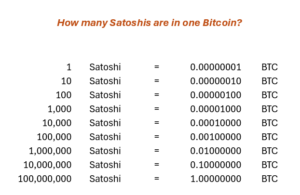
For Smith personally, the mental shift is already complete. He measures one coffee at roughly 2,000 satoshis, the smallest unit of Bitcoin. The euro price of Bitcoin, he says, is “kind of a noise.”

How many Satoshis are in one Bitcoin? Converter table. One Bitcoin contains 100M Satoshis.

Filtering the Signal

Beyond his advisory work, Smith occupies a second role that says something interesting about the Bitcoin ecosystem: he is one of the 21 founding members of 21Bitfluencers, a coordinated network that helps Bitcoin-only companies reach Bitcoin-native audiences.

In a space overrun with projects that dress themselves up in Bitcoin’s language without sharing its values, the filtering question is obvious. How do you tell the real from the fake?

“We scan through candidate clients and make sure it’s Bitcoin-only companies and products. We do due diligence. We test their products. But honestly, in general, just by our conversations, when the word ‘shitcoin’ comes to the surface, we understand very quickly whether we’re talking to a true Bitcoiner or an affinity scammer.”

The red line, for Smith, is simple: any blockchain with its own token anchored to Bitcoin is a shitcoin. Once that line is crossed, the conversation is over. What remains after that filter, he argues, is worth amplifying because growing the Bitcoin ecosystem is a win for everyone inside it.

Is Europe Really Shifting?

At a conference full of conviction, it is worth asking the harder question: is the broader European public actually moving toward Bitcoin, or is this still a gathering of the already-converted?

Smith’s answer is more grounded than you might expect from someone standing inside the cathedral.

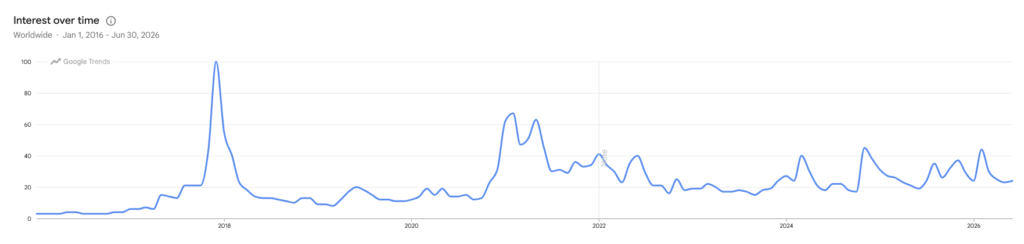
“At the moment, there is absolutely no hype. If you look at Google searches for Bitcoin, it’s at almost an all-time low. People are not interested now, mainly because of the price.”

Source: trends.google.com

And yet, he insists, something real is happening beneath the surface. Bitcoin adoption, he says, is growing organically and constantly, though it is not driven by excitement, but by need. Governments that tax more, control more, and print more are, inadvertently, doing Bitcoin’s marketing for it.

“People feel they need to escape. And this is how they end up discovering crypto in general, and Bitcoin in particular.”

The adoption he tracks is not the kind that shows up in Google Trends. It is the kind that shows up in his clients’ conversations. People who have watched their purchasing power erode quietly for years are finally asking why.

The One Thing

Our final question at the end of our conversation was this: if someone sitting on the fence about Bitcoin listens to this, what is the one thing you want them to walk away thinking? 

Instead of talking about price or the technology, he presents a statistic that stuck with him. 

“Why does only six percent of 30-year-olds own a house today, when it was thirty percent in 1970? This is not normal. And it is exclusively due to the quality of our current money.”

Don’t go straight to buying Bitcoin. Study it, he says, because studying Bitcoin teaches you by contrast how the current system actually works. And once you see that, you cannot unsee it.

“Your time, your energy is being stolen away. Because you work, they print. Even if you think you don’t need Bitcoin, studying it will show you why the system relentlessly works against you, regardless of your merits and the work you produce.”

It is, as the interviewer notes at the end of the conversation, a strong message.

Smith smiles. “Thank you very much.”

In or Out: Europe’s Crypto Market Wakes Up to MiCA

On 1 July 2026 the European Union’s crypto rulebook stops being optional. After an 18-month grace period, only crypto firms holding a full licence may serve EU clients, and most of the old market did not make it through. Here is who is in, who is out, and what it means for the 450 million people who can now only trade crypto inside the lines.


As long as it existed, the European crypto market ran on a patchwork. France registered digital-asset providers one way. Germany licensed crypto custody through its banking regulator. Malta built a bespoke framework years before anyone in Brussels had drafted a paragraph. A firm cleared in one country had no automatic right to serve customers in another. That era ends on 1 July.

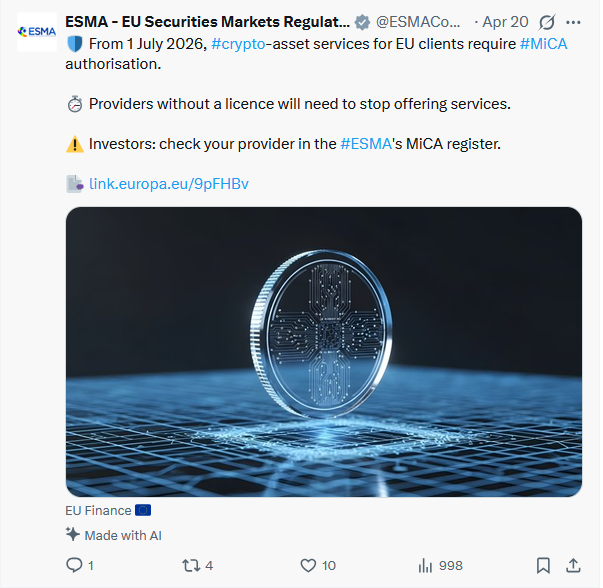
From that date, the Markets in Crypto-Assets Regulation (MiCA) applies in full across all 27 EU member states and the wider European Economic Area. Any business that wants to offer crypto services to EU clients must hold authorisation as a Crypto-Asset Service Provider, a CASP, granted by a national regulator. The reward is a single passport: one licence, valid across the entire bloc. The penalty for operating without one is no longer a grey area. As the European Securities and Markets Authority (ESMA) made clear in an April statement, after 1 July a firm serving EU clients without authorisation is in breach of EU law, with no grandfathering and no national carve-out.

The most striking image of what that means arrived in the last week of June. Binance, the largest crypto exchange in the world by volume, will suspend most services for EU residents on 1 July. It failed to secure a licence in time. Meanwhile Coinbase, Kraken, OKX and Crypto.com, all smaller in global terms, passed through and can now operate across the bloc. The regulation, whatever else one thinks of it, has teeth.

What actually changed

MiCA did not arrive all at once. Its stablecoin rules took effect in mid-2024. The core regime for service providers became applicable on 30 December 2024, and that date started an 18-month clock. Firms already operating legally under national rules were allowed to keep going while they applied for a MiCA licence. The transitional or “grandfathering” arrangement was outlined into Article 143(3) of the regulation. The clock runs out on 1 July 2026.

The crucial point, and one widely misread across the industry, is that 1 July is the date by which a licence must be held! It’s not the application date that matters. A pending application confers no right to keep operating past the deadline. ESMA has told national regulators to scrutinise last-minute filings and not just wave them through. Further, it reminded firms that an unauthorised provider loses its passporting rights entirely which is the very benefit that makes MiCA worth the effort.

There is a further wrinkle that flatters the headline deadline. Member states were allowed to shorten the transitional window, and many did. Germany and Ireland closed theirs at the end of December 2025. The Netherlands, Latvia, Hungary and Slovenia opted for just six months, ending in mid-2025. The Czech Republic set a filing cut-off of July 2025; Bulgaria’s window shut in October. For a large share of European firms, in other words, the deadline that actually mattered passed sometime in 2025. The first of July is only the final wave.

The numbers tell the story

The scale of the cull is best captured in a single ratio. Before MiCA, industry trackers counted close to 2,750 registered virtual-asset providers across the EU, over 1,400 of them in Poland alone. Measured against the 1,200-plus that held active national registrations, only 244 have converted to full CASP authorisation on ESMA’s register. That’s a conversion rate of roughly 17%. The large majority of platforms that were operating in Europe will not be licensed when the deadline lands.

Yet the market is not about to lose four-fifths of its activity. The licensed platforms, though few, already account for an estimated 95 percent of EU crypto transaction volume. The long tail that failed to convert was largely made up of small operators, shell registrations and firms that decided the European market was no longer worth the compliance bill. The centre of gravity had concentrated well before the deadline forced the issue.

This is the paradox at the heart of the story. By count, MiCA has thinned the field dramatically. By volume, it has formalised a market that was already consolidating. Surely it handed a durable competitive advantage to the firms disciplined enough to get through the process early.

Who is in

The licensed roster, drawn from ESMA’s public register, spans global exchanges, bank-grade institutions and a growing band of regional specialists. The household names are present. Coinbase took its EU licence through Luxembourg, becoming the first US exchange to clear MiCA. Kraken authorised through Ireland. OKX, Crypto.com, Gemini, Gate and Blockchain.com all chose Malta. Bitstamp and Clearstream went through Luxembourg; Bitvavo through the Netherlands; Bitpanda through Austria with a second rail in Luxembourg; eToro and Revolut through Cyprus; Robinhood through Lithuania. Circle, issuer of the USDC and EURC stablecoins, is authorised in France.

What CASP status actually buys the customer is more than a logo. A licensed exchange must keep client funds segregated from its own. If it fails, customer holdings won’t simply be swept up with the company’s assets. Any client cash it receives, outside of e-money tokens, must be lodged with an EU credit institution or central bank by the end of the next business day. The firm is also barred from using client assets for its own account. Fee transparency becomes mandatory as well. Providers must show the full cost of a trade before confirming the transaction. None of these protections exist on an unlicensed platform.

A licence is necessary but not sufficient, however, and the register carries a quiet warning on that point. Gemini holds both a MiCA authorisation and the separate MiFID II permission needed for derivatives, and yet it wound down its UK and EEA retail operations in April 2026 as part of a broader restructuring. Being licensed and being open for business are not the same thing.

Who is out, and why

The firms that did not make it fall into three groups: those that chose not to apply, those that applied and were rejected, and those that could not apply in time.

The most consequential absentee is Binance. The exchange filed for a MiCA licence in Greece in January 2026 through a newly created Greek subsidiary. By June, Reuters reported that the Greek regulator was preparing to reject the application. Separate reporting suggested the European Central Bank had weighed in behind the scenes, though no evidence was presented. On June 24, Binance withdrew the application. According to the reporting, the obstacle was the firm’s history. It boasts a record of penalties and regulators grapple with the question of whether co-founder Changpeng Zhao could satisfy MiCA’s “fit and proper” test for owners and managers.

From 1 July, Binance will halt new orders, deposits, sign-ups and staking for EU residents. The exchange frames this as a suspension, not a departure. It says client funds remain safe and withdrawable, as it intends to seek a licence in another member state, reportedly France. Authorisation could be expected “in the coming months.” Any approval, though, is sure to arrive after the deadline and leaves a serious gap during which the world’s largest exchange is locked out of Europe.

The Stablecoin Track

The second giant on the outside sits on the stablecoin track. Tether, whose USDT is the largest stablecoin by market value, has not sought authorisation and has said it will not. Its chief executive, Paolo Ardoino, argued in April that MiCA’s reserve requirements are fundamentally incompatible with the company’s business model. The consequence has rippled across every regulated venue. Coinbase, Kraken, Crypto.com and Binance’s EU entity have all delisted USDT for retail users ahead of the deadline.

What is replacing it is, increasingly, European. ESMA’s separate register of authorised e-money tokens lists around 40 approved stablecoins from roughly 20 issuers. Many are euro-denominated. Alongside Circle’s USDC and EURC and the dollar tokens of Paxos sit a growing rank of bank-backed euro coins. Société Générale’s Forge subsidiary, the AllUnity euro token in Germany standing behind bank and asset-manager backers, Banking Circle’s EURI in Luxembourg, and issuers such as Quantoz, Monerium and Malta’s StablR. The menu is narrower than the unregulated market offered, but a compliant, and notably euro-centric, stablecoin ecosystem is taking shape. The abrupt shift away from USDT reshapes the payment rails that brokers and market-makers across Europe have relied on. And Tether is not the only name outside it: Ethena’s USDe, World Liberty Financial’s USD1, PayPal’s PYUSD and Ripple’s RLUSD all fall outside the authorised set.

The Market Shakeout

The third group is structural, and Estonia is its clearest illustration. Once the undisputed capital of EU crypto licensing, the country counted more than 600 registered virtual-asset providers at its peak. Today its home regulator shows just two authorised CASPs. The old registrations did not convert automatically and the majority of those firms chose not to requalify under MiCA’s stricter substance requirements. France tells a gentler version of the same story: its market regulator confirmed that roughly 40 percent of registered providers never even submitted a MiCA application. Some wound down, some sought buyers, some simply walked away.

The geography of licensing

Where a firm chooses to license says a great deal about how each national regulator approaches crypto, and a clear hierarchy has emerged. The figures below are drawn from ESMA’s register as updated on 25 June 2026.

Europe’s Licensing Hubs

Germany leads by a wide margin, with 57 authorised entities. That’s close to one in four of every licensed CASP in the bloc. But its list is revealing: banks and brokers dominate instead of by crypto-native exchanges. Commerzbank, DZ Bank, DekaBank, Trade Republic, N26, Baader Bank and a long file of regional Volksbanks sit alongside specialist custodians like BitGo and Tangany. BaFin’s review is the most documentation-heavy in Europe and its instinct favours regulated incumbents over startups.

France and the Netherlands are tied for second, each with 26. France’s total surged through the spring as its regulator cleared a backlog of applications. The Dutch list mixes crypto-native firms such as Bitvavo with payments players like MoonPay and Banxa. Several of these firms secured first-day approvals when the regime opened. Malta, with 17, has become the preferred home for established crypto-native exchanges. Its early “Blockchain Island” framework left its regulator and banks comfortable with the sector. The Bitcoin payments app Strike cleared through Malta in the final week before the deadline. Cyprus follows with 14 and Ireland with 12. Ireland set a deliberately high bar, refusing virtual offices and demanding genuine local presence, which filtered out all but the most committed. Luxembourg, with eight, punched above its weight by attracting global brands like Coinbase and Bitstamp.

The Empty Spots on the Map

The more telling number, though, is at the bottom. Five EU member states had issued no home licences at all as of 25 June: Greece, Hungary, Poland, Portugal and Romania. Some, like Portugal and Greece, are not small markets. Their residents will now be served only by firms passporting in from elsewhere. Fees, supervision and tax revenue all flowing abroad.

Poland: the cautionary tale

No country illustrates the cost of falling behind like Poland. It enters July as the only EU member state with no national law implementing MiCA at all.

The regulation, of course, applies directly. But it requires domestic scaffolding: a law designating a competent authority and giving it the power to license and supervise. Poland’s attempt to pass that law became one of the most bitter political fights in Warsaw. President Karol Nawrocki vetoed the government’s Crypto-Asset Market Act in December 2025. He vetoed it again in February 2026. The lower house passed a third version by 241 votes to 200 in May, with the Senate adding no amendments. Nawrocki vetoed a third time on 11 June.

The president says he supports regulation but objects that the bill hands the financial regulator excessive powers to block websites and freeze accounts without adequate judicial oversight, and that its fees would crush small firms. The government says he has chosen chaos. Overriding a presidential veto requires a three-fifths majority the governing coalition does not command; an earlier override attempt fell short by 20 votes.

The Practical Consequences

The practical effect is severe and asymmetric. Without a designated authority, Poland’s regulator cannot process a single CASP application. Polish-registered firms have no domestic route to a licence. They also cannot passport out. Foreign providers licensed elsewhere, meanwhile, can already passport in. Polish crypto businesses remain confined to their home market with a hard stop on the horizon and no way through it except to relocate and relicense in another country; Lithuania, Estonia or Malta among the favourites.

There is one narrow exception that underlines the absurdity. Stablecoin issuance runs through the existing e-money framework, not the stalled crypto law. A Polish issuer, StaBillon, has managed to register an authorised e-money token even as the country cannot license a single exchange. For Polish investors, the upshot is that their domestic industry is being hollowed out by a stalemate that has nothing to do with crypto and everything to do with the country’s wider political war.

What it means for the EU investor

For anyone holding or trading crypto in Europe, the deadline reduces to a short list of practical concerns.

First, check that your platform is actually licensed. ESMA maintains a public register of authorised CASPs, searchable by name and updated weekly. It shows which regulator granted the authorisation and which services it covers. A genuinely licensed firm will usually display its CASP details and the issuing regulator somewhere accessible on its site. If a page mentions only an old national registration, or nothing at all, users should look harder before depositing funds.

Second, deal with USDT if you hold it. Major regulated venues must delist the token for retail users. Anyone holding USDT on a licensed platform should plan to convert to a compliant asset or move it to self-custody. Don’t wait until the last day, when many users will be doing the same thing at once.

Third, watch for withdrawal notices. Firms that are winding down EU operations must tell clients and give them time to withdraw. If such a notice arrives, it warrants prompt attention. Some national regulators may move to block the websites of non-compliant platforms, which could complicate access.

Expect a Smaller Market

Finally, expect a narrower menu, at least for now. The licensed market offers fewer stablecoins, and a shorter list of venues for derivatives, though competition in that space is moving fast. MiCA covers spot services; leveraged products require a separate MiFID II authorisation.

EU rules effectively prohibit true perpetual futures. Any unexpiring leveraged product falls into the contracts-for-difference category that ESMA has capped for retail investors since 2018. The workaround that has emerged: five-year expiry futures that use a funding-rate mechanism to track spot prices. They function like perpetuals in practice but qualify as futures in law. OKX launched exactly this product, branded X-Perps, in April, using a MiFID II licence it acquired through Malta. It has since expanded it to cover equities, commodities and index trackers. Kraken followed with a similar xStocks framework. The derivatives market in Europe is not closed. Select providers that took the time to stack both licences are rebuilding it from scratch, inside the regulatory perimeter.

What is still unsettled

The deadline closes one chapter and opens several. Binance’s pivot to a second member state will test whether MiCA is applied consistently. If one regulator grants what another was about to refuse, it exposes uneven enforcement across the bloc, and any approval landing after 1 July still leaves a gap. Tether’s stance leaves an open question about whether the largest stablecoin ever returns to regulated European venues. In any case, the transition away from it is already pulling Europe toward euro-denominated alternatives. Bank-backed tokens are arriving under MiCA, and a consortium of major lenders is developing a shared euro stablecoin to reduce the region’s reliance on dollar-pegged coins.

The regulation itself is also in motion. The European Commission opened a consultation on a MiCA review in May, with responses due by the end of August. A full report, possibly carrying a legislative proposal, is due by mid-2027. Separately, the Commission has proposed shifting direct supervision of all CASPs from national regulators to ESMA itself. That change would, over time, blunt the very jurisdiction-shopping that shaped where firms chose to license in the first place.

For now, the picture on July 1 is the one that matters. Europe has built a single crypto market, governed by a single rulebook. 244 firms have been judged fit to operate inside it. Most of the old market does not fit. And for the first time, that is a matter of law, not a matter of preference.

Licensing figures are drawn from ESMA’s interim MiCA register as updated 25 June 2026 and from national regulators; totals shift week to week as new authorisations are granted. This article is informational and does not constitute investment or legal advice.

Exclusive Interview: Stuart Haber, The Man Who Invented Blockchain Before Bitcoin Had a Name

Stuart Haber, co-inventor of the blockchain and Chief Cryptographic Officer of SureMark Digital, sat down with CrispyBull at Proof of Talk Paris 2026 to talk deepfake fraud, digital trust, and the cryptographic foundations that made Bitcoin possible.

Stuart Haber walked into the interview carrying a copy of the New York Times. Not as a prop, exactly, more as evidence. Tucked inside that Sunday edition, as it has been every week since 1995, is a small classified ad. Most readers scroll past it. But what it contains is a cryptographic hash, a compact digital fingerprint, that encapsulates every record registered on the world’s oldest continuously running blockchain in the preceding seven days. A blockchain that Haber and his partner W. Scott Stornetta launched before any of us even heard of Satoshi Nakamoto or Bitcoin or Ethereum.

“Still running,” Haber said, setting the paper down. “With a weekly ad in the national edition of the New York Times.”

That detail, this analog anchor for a digital trust system, tells you almost everything about how Stuart Haber thinks. He is the Chief Cryptographic Officer of SureMark Digital, co-inventor of the blockchain, and and one half of the most cited duo in the Bitcoin white paper. He has been solving the same problem for 35 years, and he is still not done.

It Was Never About Money

Fall 1989. Bellcore, the Bell Communications Research lab in New Jersey. Haber had been there two years when Scott Stornetta arrived with what he believed was an urgent and unsolved problem. The world was going online. Every record, financial, legal, creative, medical, was becoming a string of bits. And a string of bits, unlike a physical document, carries no inherent proof of when it was created or whether it has been altered.

“We were worried about all of the world’s records,” Haber said. “We were not trying to invent electronic money.”

There was already a stream of cryptographic research into digital currency. Haber and Stornetta went a different direction. Their solution, now known as the blockchain technique, was designed to register any digital record and prove its existence. Prove the integrity of a contract, a creative work, a financial transaction without relying on any single trusted authority. The duo published its first paper, How to Time-Stamp a Digital Document, in 1991. Experimental code followed the same year. By 1995, their spin-out company Surety had deployed the first commercial blockchain, anchoring it weekly in the New York Times.

Satoshi Nakamoto cited their work three times in the Bitcoin white paper, more than any other source. The data structure at the heart of Bitcoin, the chain of hash-linked blocks with Merkle trees, is theirs. Satoshi adopted it directly. Though he narrowed its application to financial transactions. He added the proof-of-work consensus mechanism, and launched a revolution. Haber describes watching that unfold as “an amazing thing to watch” — gracious, precise, and carefully short of triumphalist.

The Trust Problem Has Not Been Solved

Today, the institutions most aggressively deploying blockchain infrastructure are the same ones Haber and Stornetta built the technology to make unnecessary. BlackRock. JPMorgan. The European Central Bank. Asked whether institutional blockchain represents progress or regression, whether we are simply rebuilding the same trust hierarchy on a new technical stack, Haber does not flinch, but he does not fully commit either.

“Bitcoin is still a pretty large sum of money represented and Bitcoin is not run by a single institution,” he said. On everything else, tokenization, institutional DeFi, central bank digital infrastructure, he offered the same two words twice in the same conversation: “We’ll see.”

That restraint is not evasion. It is the considered position of someone who spent months in 1989 and 1990 trying to prove that a trusted-party-free integrity system was mathematically impossible; before realizing the answer was not mathematical at all.

“It was by stepping back and thinking of the social setting,” he said. “What does it mean, as a human assertion, that this document existed in the world at this time?” Reframing the question from cryptographic puzzle to social question led directly to the concept of decentralization. And the answer was widespread verifiability, not institutional authority. It is still the answer. Whether the industry building on his foundations agrees is, as he says, yet to be seen.

Making Deepfakes Irrelevant

The sharpest and most immediately useful thing Stuart Haber said at Proof of Talk had nothing to do with the 1990s. It had to do with a video call in Hong Kong, in January 2024.

A mid-level employee at a multinational firm received an order to wire approximately $25 million to an overseas account. The employee was appropriately suspicious and requested proper authority. A video call was arranged. Several senior executives from the company joined, all confirming the instruction. Every single one of them was a deepfake! The employee wired the money and the firm lost $25 million.

That attack was the design inspiration for SureMark’s flagship product, SureCircle. SureCircle’s answer to deepfake fraud is not detection, but circumvention.

We make deepfakes irrelevant by sidestepping the problem.

The mechanism is a cryptographic challenge-response system. Each executive, board member, outside counsel, or high-authority contact in a company holds a SureMark credential. In cryptographic terms, the credential is a public key from a public-private key pair. Before authorizing any significant transaction or instruction, a real-time challenge is issued. Only the holder of the corresponding private key can meet the task. A deepfake, however sophisticated, cannot respond to the cryptographic challenge because it was never given the key to answer it.

“If that firm were a SureMark customer,” Haber said of the Hong Kong attack, “the scam would have been avoided.”

SureMark’s second product, Verified Web, extends the same logic to published content. The author of any piece of content, an article, a video, a podcast, can cryptographically sign the work, and participants can co-sign, too. What you get is a publicly verifiable chain of authenticity. Haber offered, on camera, to co-sign this interview. The invitation stood.

On Regulators Who Don’t Know What They Don’t Know

The regulatory frameworks now taking shape around tokenized assets, MiCA in Europe, the emerging digital asset rules in the United States, are beginning to require verifiable audit trails, identity attestation, and provenance records. In theory, that is exactly what cryptographic time-stamping wanted to deliver. In practice, Haber is cautious.

There are people in positions of authority for writing regulations who don’t know what they don’t know.

He is not dismissive. He allows that there is a chance things get done right. But he frames compliance as a game. Institutions will push the envelope, satisfy requirements as minimally as possible, and the difference between cryptographic security and a convincing simulation of it might become visible only when something goes wrong. Institutional finance is moving fast, regulation is moving slower, and the gap is where the risk lives. Haber seems at peace with that, in the way that only someone can afford to be who has been right for 35 years before the world caught up.

Still Running

SureMark Digital is early-stage. Eleven people. First institutional funding round closed in August 2025, co-led by Two Small Fish Ventures. Their first major commercial partnership is with a cybersecurity practice whose insurers are actively recommending SureMark to clients as a mitigation tool against AI-driven fraud. It’s a meaningful signal that the market is beginning to price this risk seriously.

But the company that matters most to understanding Stuart Haber is not SureMark. It is Surety, the blockchain he and Stornetta launched in 1995. Still running, still publishing its weekly hash in the New York Times, still proving, to anyone who knows to look, that a document was real, and that it existed, and that it has not been changed.

He brought the newspaper to Paris to show it off, just in case the conversation went in the right direction.

It did.

- Advertisement -

FEATURED